Optimizing COD reduction in dairy wastewater treatment using magnetic coagulant derived from Moringa oleifera
Abstract
In wastewater treatment scenarios, traditional coagulants are becoming increasingly complex and raising environmental concerns. This has led to the exploration of magnetized plant-derived coagulant as an alternative. In this paper, coagulation parameters such as coagulant dosage and pH were optimized through response surface methodology (RSM) based on a central composite design (CCD) employing a magnetic coagulant derived from Moringa oleifera seeds (M. oleifera-CoFe2O4). The optimized response variable during the treatment of dairy wastewater was the chemical oxygen demand (COD) reduction. The response surface methodology revealed a statistically significant second-order polynomial model (R2 99.24%) for maximizing COD reduction. The maximum COD reduction achieved was 76.13% under optimal conditions with coagulant dosage of 14.24 g/L and pH of 9.38. The results indicated that magnetic coagulant derived from M. oleifera seeds demonstrated significant potential and can be used in an efficient and eco-friendly process for dairy wastewater treatment.
Keywords:
coagulation; dairy wastewater; flocculation; magnetic coagulant; Moringa Oleifera
Resumo
Nos cenários de tratamento de efluentes, os coagulantes tradicionais estão se tornando cada vez mais complexos e levantando preocupações ambientais. Isso levou à exploração de coagulantes alternativos derivados de plantas magnetizadas. Neste artigo, os parâmetros de coagulação, como a dosagem de coagulante e o pH, foram otimizados através da metodologia de superfície de resposta (RSM) baseada em um planejamento composto central (CCD) utilizando um coagulante magnético derivado das sementes de Moringa oleifera (M. oleifera-CoFe2O4). A variável de resposta otimizada durante o tratamento de efluentes de laticínios foi a redução da demanda química de oxigênio (DQO). A metodologia de superfície de resposta revelou modelos quadráticos estatisticamente significativos (R² 99,24%) para maximizar a redução da DQO. A redução máxima da DQO alcançada foi de 76,13% em condições ótimas com dosagem de coagulante de 14,24 g/L e pH 9,38. Os resultados indicaram que o coagulante magnético derivado das sementes de M. oleifera demonstrou um potencial significativo e pode ser utilizado em um processo eficiente e ecologicamente correto para o tratamento de efluentes de laticínios.
Palavras-chave:
coagulante magnético; coagulação; efluentes de laticínios; floculação; Moringa Oleifera
1. INTRODUCTION
Rapid industrial growth has driven global economic progress, albeit at the cost of significant environmental pollution worldwide (Awasthi et al., 2022). The dairy industry generates large volumes of wastewater rich in organic compounds, including carbohydrates, proteins, and fats (Wang and Serventi, 2019). For every liter of milk processed, the dairy sector produces between 2.5 and 10 liters of wastewater (Szabo-Corbacho et al., 2021). Treating this wastewater is challenging due to the high concentrations of proteins and lipids, which cause pH fluctuations and increased levels of Chemical Oxygen Demand (COD) and Biochemical Oxygen Demand (BOD). Disposing of this wastewater poses serious environmental issues due to its high oil content, COD, and color (Silva et al., 2020). Common primary treatments for such waste effluents include coagulation, flocculation, and sedimentation (Parihar et al., 2024).
Coagulation involves adding a positively charged ion of metal salt to the wastewater, leading to particle destabilization and charge neutralization (Blignaut and Van Heerden, 2009). In this process, negatively charged colloids are neutralized by cationic hydrolysis products, causing impurities to combine and form flocs (Duan et al., 2003; Al-Hamadani et al., 2011). This removes total suspended solids and colloid particles from the solution (Kurniawan et al., 2006). Optimizing the coagulation process is complex due to the numerous operational parameters involved, such as pH, mixing rate, settling time, coagulant type and dosage, and effluent chemistry (Maurya and Daverey, 2018). Modernization and increasing industrial activities have worsened water pollution, limiting the effectiveness of traditional coagulation as a physicochemical treatment method (Agoro et al., 2018). Moreover, using metal-based salts (aluminum and iron) as coagulants produces large amounts of complex sludge, which is costly to treat and often disposed of in landfills without treatment (Prosper et al., 2021).
Recently, the use of natural coagulants, such as common beans, mustard, eggshell, chitosan, and starch, has gained popularity for wastewater treatment. The advantages of natural coagulants include environmental sustainability, eco-friendliness, low cost, and process simplicity, making them suitable for developing countries. Plant-based polymeric coagulants are non-toxic, cost-effective, biodegradable, and produce less sludge (Yin, 2010). Natural coagulants have been documented for treating various contaminants, such as inorganic suspensions (Miller et al., 2008), dye wastewaters (Shamsnejati et al., 2015), landfill leachate (Rasool et al., 2016), and paper mill effluent (Boulaadjoul et al., 2018).
Extensive research has been conducted on combining magnetic and natural coagulants to enhance solid-liquid separation using an external magnetic field (Dao et al., 2021). Nguyen et al. (2024) used a magnetic coagulant derived from Cassia fistula seed and achieved 94% color removal in water from the textile industry. Moringa oleifera seeds have been utilized for wastewater treatment due to their safety for human use and lack of significant disadvantages (Desta and Bote, 2021). M. oleifera is an excellent source of nutritional components, energy boosters, and bioactive compounds (Leone et al., 2015). Additionally, significant variations in the polyphenol content of M. oleifera from different regions indicate high genetic diversity, likely due to differences in cultivation conditions, climate, or soil environment, resulting in the accumulation of various polyphenols and enhanced drought resistance (Rani et al., 2018). Optimizing experimental parameters is crucial as it saves time and reduces chemical costs.
Response surface methodology (RSM) is a robust statistical approach for optimizing processes and modeling complex systems. It allows for the simultaneous investigation of multiple factors and their impacts on responses, providing a mathematical model for prediction and determining optimal conditions with fewer experimental trials compared to traditional methods (Zain et al., 2023). Therefore, this study aimed to maximize the reduction of COD in dairy wastewater treatment using magnetic M. oleifera-CoFe2O4 as a natural coagulant. The pH and coagulant dosage were optimized by RSM based on central composite design (CCD).
2. MATERIALS AND METHODS
2.1. wastewater sample
The dairy wastewater samples were obtained from a privately owned dairy industry near Cartagena City, Colombia. Collection was carried out between 6:00 and 7:00 a.m using polyethylene bags, which were subsequently stored in an icebox and transported to the laboratory. To minimize contamination, the wastewater underwent autoclaving at 121°C and 15 psi for 15 minutes.
2.2. Preparation of Moringa oleifera
The seeds of Moringa oleifera were gathered by hand, and any seeds damaged by insects were removed. They were then exposed to sunlight for about 8 days. After drying, they were mechanically ground and the resulting powder was sifted through a 40 mesh sieve.
2.3. Preparation of the magnetic coagulant
Initially, the preparation of CoFe2O4 was carried out according to Nguyen et al. (2024). The M. oleifera (1.0 g) and CoFe2O4 (0.5 g) were incorporated to 125 mL of distilled water and heated at 50℃ during 2 h. Then, the precipitate was filtered and washed with ethanol and distilled water. The solid material was dried under ambient conditions in order to obtain the final magnetic composite. To confirm the magnetic properties of the final composite, X-ray diffraction studies were performed, revealing peaks at 30.3°, 35.6°, 43.2°, 57.0°, and 62.5°, which are indicative of a cubic spinel CoFe₂O₄ structure.
2.4. Characterization of effluent physicochemistry
The physicochemical analyses were carried out according to the Standard Methods protocols for raw water and wastewater (Table 1). Fat and oil content were determined using the Soxhlet method as outlined in the APHA et al. (2012) Standard Methods. Chemical oxygen demand (COD) was measured using dichromate titration (APHA et al., 2012). The efficiency of COD degradation was calculated by comparing the decrease in COD to the initial amount. Phosphorus content was measured via acid digestion, using the ascorbic acid method and reported in mg of P/L. pH was measured potentiometrically with a digital potentiometer (Bench pH-Conductivity meter PC 510). All experiments were conducted in triplicate, and the data are presented as means ± SD.
2.5. Coagulation-flocculation experiments
An experimental study on wastewater treatment using the magnetic M. oleifera-CoFe2O4 was conducted using a test jar apparatus. Each beaker was filled with 500 mL of wastewater and dosed with a specified amount of magnetized M. oleifera according to the experimental design matrix (Table 2). The solution was mixed rapidly for 2 minutes and then stirred at 30 rpm for 15 minutes. After a settling period of 30 minutes, a supernatant sample was extracted from the clarified liquid at a depth of 2 cm using a pipette. This process also was carried out employing non-magnetized M. oleifera with the same coagulant dosages by pH values reported in Table 2.
2.6. Experimental design
Response surface methodology (RSM) using a central composite (α 1.41) design with two independent variables (the magnetic M. oleifera-CoFe2O4 9-16 g/L) and pH (4-12), coded as -1 (low) and +1 (high) as represented in Table 1. The main, quadratic effects and interactions of the variables, defined as a function of the response, are commonly attributed to the second-degree polynomial Equation 1. Subsequently, the regression model via analysis of variance (ANOVA) is used to identify the most significant model terms required to maximize process performance. The coefficient of determination (R²), adjusted R², and predicted R² were used for statistical evaluation, quantifying precision, and confirming the reliability of the polynomial model Equation 1.
Where Y is the response variable, 𝛽0 is the model constant, X1 and X2 are the independent variables. The terms 𝛽1 and 𝛽2 represent the coefficients of the linear regression; 𝛽11 and 𝛽22 are the coefficients for the quadratic terms, and 𝛽12 is the coefficients for the interaction.
3. RESULTS AND DISCUSSION
3.1. Central composite design (CCD) matrix
Assessing COD in decontamination treatments is crucial because it quantifies the amount of organic matter and chemical contaminants in the water that necessitate oxygen for decomposition via chemical and biological processes. Therefore, reducing COD is a primary objective in wastewater treatment and water purification for human consumption, as elevated COD levels can signal the presence of contaminants potentially detrimental to environmental and public health. Table 3 indicates that the COD reduction values range from 52.2% to 75.4%, which are lower than the 90% reduction reported by David et al. (2016); however, it is important to clarify that these authors evaluated the performance of Moringa oleifera seed extract in conjunction with chemical coagulants for the treatment of distillery effluents. That is, they used chemical reagents such as aluminum sulfate and ferric sulfate, which aid in the coagulation process. Additionally, Scholes et al., (2020) observed a 78.6% reduction in COD in the water from Opa Reservoir of Obafemi Awolowo University, Ile-Ife using M. oleifera coagulant protein purified by ion exchange and gel filtration chromatography. It is important to note that the use of a purified protein significantly enhances the coagulation process, improving the COD reduction percentage.
The possible coagulation mechanism of the M. oleifera-CoFe2O4 composite may be similar to that proposed by Nguyen et al. (2024), where the functional groups of the polymeric chains present in M. oleifera undergo partial deprotonation, resulting in a negative charge. On the other hand, the CoFe2O4 particles are likely to exhibit a positive surface charge under synthesis conditions. Consequently, the spherical CoFe2O4 particles can be coated with M. oleifera via electrostatic attraction. The CoFe2O4 particles act as a magnetic component, facilitating recovery, while M. oleifera serves as an active layer leading to coagulation in wastewater treatment.
In this study, RSM based on CCD was used to minimize the number of experimental runs, resulting in an experimental matrix of 13 runs (Table 3). RSM is a crucial, efficient, and cost-effective statistical technique for identifying the interactive effects of parameters on experimental data (Fu et al., 2009). The COD reduction was evaluated as the response, as shown in Table 3. The results underwent a four-step RSM analysis process: (i) the statistical significance of the developed model was assessed using ANOVA; (ii) response plots were employed to determine the optimal region and interactive conditions; (iii) the optimization technique was utilized to maximize the desired goals of COD reduction; and (iv) the model's predictability was validated against experimental runs under optimal conditions. A P-value less than 0.05 indicates statistical significance (Kumar et al., 2007), suggesting that at least one term in the regression equation is significantly related to the response variable.
The second-order equation model (Equation 2) was analyzed with multiple regression to obtain a good fit and its statistical significance was tested with analysis of variance (ANOVA); the results of ANOVA for the reduced second-order model of the response variables for COD reduction are shown in Table 4, which suggests that the model was highly significant (p < 0.05).
ANOVA and regression coefficient δ of the predicted reduced third-order polynomials model for COD of dairy wastewater treatment.
According to Table 4, X1 and X2 had significant influence (p < 0.05) on the COD reduction values in dairy wastewater treatment using the magnetic M. oleifera-CoFe2O4 as a natural coagulant. However, the interaction X1*X2 does not have a significant influence on the COD reduction values. The second-order polynomial is obtained to express the COD reduction values in dairy wastewater treatment as a function of the variables under study (Equation 2):
Where X1 is the coagulant dosage concentrations (g/L) and X2 is the pH.
The model fit was evaluated using the coefficient of determination (R²), adjusted R², and predicted R2. Furthermore, the significance of the model for COD reduction was evaluated using p-values. The R² value obtained for COD was 99.24, indicating a good fit of the model and the experimental data (Körbahti, 2007). This high R² value implies a good fit for the statistical model. The predicted correlation coefficient (predicted R2) (94.61) of the model corresponding to the response variable of dairy wastewater treatment shows reasonable agreement with the adjusted correlation coefficient (adjusted R2), since its difference is <4.09%. With respect to the lack of fit it was not observed significance (p > 0.05), which indicates that the predicted model is adequate to predict the reduction of COD in dairy wastewater employing the magnetic M. oleifera-CoFe2O4 as a natural coagulant. This suggested that the model could also be used to explore the design space. The model effectively represents the relation between the factors and responses (Ravilumar et al., 2006).
3.2. Response surface plots
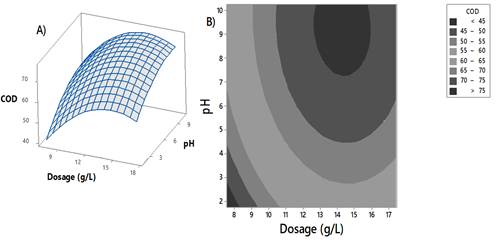
The 3D surface plots provide an accurate visual representation and essential statistical insights, aiding in pinpointing the optimal ranges for the test variables within the experimental framework (Henseler and Sarstedt, 2013). This information is crucial for optimizing the coagulation process, thereby improving treatment efficiency. Figure 1 plots illustrate the relationship between the coagulant dosage and pH and their influence on the reduction of COD in dairy wastewater treatment. The percentage of COD reduction increases by enhancing coagulant dosage up to 12.5 g/ L and then becomes bending down; this could be due to the dosage being more than the impurity in the sample water and a more positive ion was developed (Desta and Bote, 2021). Particle coagulation entails the destabilization and neutralization of suspended particles by introducing positive ions, typically derived from salts or polymers (Verma et al., 2012). This indicates that when the coagulant was introduced to the sample and followed by rapid stirring, the cationic form of the coagulant was dispersed throughout the liquid, interacting with the negatively charged particles responsible for the COD. The incorporation of poly-electrolyte led to greater aggregation of colliding particles, thereby improving flocculation efficiency. However, increasing the coagulant beyond the optimal dose reduced this efficiency. Excess coagulant caused the aggregated particles to redisperse, interfering with particle settling (Mishra and Bajpai, 2005; Teh et al., 2014). With respect to the pH effect, as the pH increases, the percentage of COD reduction increases, indicating an attraction between the charged molecule and the coagulant. The removal of COD using the magnetic M. oleifera-CoFe2O4 was more effective in more basic than acidic characteristics of wastewater (Desta and Bote, 2021) as can be seen in Figures 1a and 1b.
3D plots of curves showing the interaction effect of variables on the COD reduction for dairy wastewater treatment.
The treatment process using magnetic M. oleifera-CoFe2O4 was optimized with RSM in order to minimize operating costs. The optimization is achieved with the highest values of COD reduction during the treatment of dairy wastewater. The critical values of coagulant dosage and pH were determined using the 'response optimizer' function in Minitab® statistical software Version 17.0. These values, according to the surface model, were a coagulant dosage (X1) of 14.24 g/L and a pH (X2) of 9.38, achieving a COD predicted reduction percentage of 76.13%. Non-magnetized M. oleifera was used as a control under the same concentrations and pH values as those applied in the CCD design for M. oleifera-CoFe2O4. The COD reduction values obtained ranged from 48.6% to 67.4%, which are lower than those achieved with M. oleifera-CoFe2O4. This difference may be attributed to a higher number of polymeric chains adhering to the CoFe2O4, which enhances the exposure of charges in contact with the wastewater, thereby improving COD reduction.
4. CONCLUSIONS
The magnetic M. oleifera-CoFe2O4 has been found to be a highly effective natural coagulant for the treatment of dairy wastewater. Response surface methodology based on a central composite design was effectively used to optimize the coagulant dosage and pH. The maximum COD reduction of 76.13% was achieved under optimal conditions with a coagulant dosage of 14.24 g/L and pH 9.38. These results were well matched with the predicted values under optimum conditions. The results indicated that the magnetic coagulant derived from M. oleifera seeds demonstrated significant potential and can be developed into an efficient, magnetically separable, and eco-friendly process for wastewater treatment or pre-treatment.
5. REFERENCES
-
AGORO, M.; OKOH, O.; ADEFISOYE, M.; OKOH, A. Physicochemical properties of wastewater in three typical South African sewage works. Polish Journal of Environmental Studies, v. 27, n. 2, p. 491-499, 2018. https://doi.org/10.15244/pjoes/74156
» https://doi.org/10.15244/pjoes/74156 -
AL-HAMADANI, Y. A.; SUFFIAN YUSOFF, M.; UMAR, M.; BASHIR, M.J.; NORDIN ADLAN, M. Application of psyllium husk as coagulant and coagulant aid in semi-aerobic landfill leachate treatment. Journal of Hazardous Materials, v. 190, p.582-587, 2011. https://doi.org/10.1016/j.jhazmat.2011.03.087
» https://doi.org/10.1016/j.jhazmat.2011.03.087 - APHA; AWWA; WEF. Standard Methods for the examination of water and wastewater. 22nd ed. Washington, 2012. 1496 p.
-
AWASTHI, M. K.; SINDHU, R.; SIROHI, R.; KUMAR, V.; AHLUWALIA, V.; BINOD, P. et al Agricultural waste biorefinery development towards circular bioeconomy. Renewable and Sustainable Energy Reviews, v. 158, n. 112122, 2022. https://doi.org/10.1016/j.rser.2022.112122
» https://doi.org/10.1016/j.rser.2022.112122 -
BLIGNAUT, J.; VAN HEERDEN, J. The impact of water scarcity on economic development initiatives. Water Sa, v. 35, n. 4, p. 415-420, 2009. https://dx.doi.org/10.4314/wsa.v35i4.76800
» https://dx.doi.org/10.4314/wsa.v35i4.76800 -
BOULAADJOUL, S.; ZEMMOURI, H.; BENDJAMA, Z.; DROUICHE, N. A novel use of Moringa oleifera seed powder in enhancing the primary treatment of paper mill effluent. Chemosphere, v. 206, p. 142-149. 2018. https://doi.org/10.1016/j.chemosphere.2018.04.123
» https://doi.org/10.1016/j.chemosphere.2018.04.123 -
DAVID, C.; NARLAWAR, R.; ARIVAZHAGAN, M. Performance evaluation of Moringa oleifera seed extract (MOSE) in conjunction with chemical coagulants for treating distillery spent wash. Indian Chemical Engineer, v. 58, n. 3, p. 189-200, 2016. https://doi.org/10.1080/00194506.2015.1006147
» https://doi.org/10.1080/00194506.2015.1006147 -
DESTA, W.; BOTE, M. Wastewater treatment using a natural coagulant (Moringa oleifera seeds): optimization through response surface methodology. Heliyon, v. 7, n. 11, 2021. https://doi.org/10.1016/j.heliyon.2021.e08451
» https://doi.org/10.1016/j.heliyon.2021.e08451 -
DAO, M.T.; TRAN, T. P.; VO, D. T.; NGUYEN, V. K.; HOANG, L. T. Utilization of macadamia nutshell residue for the synthesis of magnetic activated carbon toward Zinc (II) ion removal. Advances in Materials Science Engineering, 2021. https://doi.org/10.1155/2021/2543197
» https://doi.org/10.1155/2021/2543197 -
DUAN, J.; GREGORY, J. Coagulation by hydrolyzing metal salts. Advances in Colloid and Interface Science, v. 100-102, p. 475-502, 2003. https://doi.org/10.1016/S0001-8686(02)00067-2
» https://doi.org/10.1016/S0001-8686(02)00067-2 -
FU, J. F.; ZHAO, Y. Q.; XUE, X. D.; LI, W. C.; BABATUNDE, A. O. Multivariate-parameter optimization of acid blue-7 wastewater treatment by Ti/TiO2 photoelectrocatalysis via Box-Behnken design. Desalination, v. 243, n. 1-3, p. 42-51, 2009. https://doi.org/10.1016/j.desal.2008.03.038
» https://doi.org/10.1016/j.desal.2008.03.038 -
HENSELER, J.; SARSTEDT, M. Goodness-of-fit indices for partial least squares path modeling. Computational Statistics, v. 28, p. 565-580, 2013. https://doi.org/10.1007/s00180-012-0317-1
» https://doi.org/10.1007/s00180-012-0317-1 -
KÖRBAHTI, B. K. Response surface optimization of electrochemical treatment of textile dye wastewater. Journal of Hazardous Materials, v. 145, p. 277-286, 2007. https://doi.org/10.1016/j.jhazmat.2006.11.031
» https://doi.org/10.1016/j.jhazmat.2006.11.031 -
KUMAR, A.; PRASAD, B.; MISHRA, I. M. Process parametric study for ethene carboxylic acid removal onto powder activated carbon using Box-Behnken design. Chemical Engineering Technology, v. 30, p. 932-937, 2007. https://doi.org/10.1002/ceat.200700084
» https://doi.org/10.1002/ceat.200700084 -
KURNIAWAN, T. A.; LO, W. H.; CHAN, G. Y. Physico-chemical treatments for removal of recalcitrant contaminants from landfill leachate. Journal of Hazardous Materials, v. 129, p. 80-100, 2006. https://doi.org/10.1016/j.jhazmat.2005.08.010
» https://doi.org/10.1016/j.jhazmat.2005.08.010 -
LEONE, A.; SPADA, A.; BATTEZZATI, A.; SCHIRALDI, A.; ARISTIL, J.; BERTOLI, S. Cultivation, genetic, ethnopharmacology, phytochemistry and pharmacology of Moringa oleifera leaves: an overview. International Journal Molecular Sciences, v. 16, n. 6, p. 12791-12835, 2015. https://dx.doi.org/10.3390/ijms160612791
» https://dx.doi.org/10.3390/ijms160612791 -
MAURYA, S.; DAVEREY, A. Evaluation of plant-based natural coagulants for municipal wastewater treatment. 3 Biotech, v. 8, n 1, 2018. https://dx.doi.org/10.1007/s13205-018-1103-8
» https://dx.doi.org/10.1007/s13205-018-1103-8 -
MILLER, S. M.; FUGATE, E. J.; CRAVER, V. O.; SMITH, J. A.; ZIMMERMAN, J. B. Toward understanding the efficacy and mechanism of Opuntia spp. as a natural coagulant for potential application in water treatment. Environmental Science Technology, v. 42, p. 4274-4279, 2008. https://doi.org/10.1021/es7025054
» https://doi.org/10.1021/es7025054 -
MISHRA, A.; BAJPAI, M. Flocculation behavior of model textile wastewater treated with a food grade polysaccharide. Journal of Hazardous Materials, v. 118, n. 1-3, p. 213-217, 2005. https://doi.org/10.1016/j.jhazmat.2004.11.003
» https://doi.org/10.1016/j.jhazmat.2004.11.003 -
NGUYEN, T.; VO, D.; TRAN, T.; DAO, M. Magnetic coagulant derived from Cassia fistula seed for real textile wastewater treatment: A pilot-scale study. Desalination and Water Treatment, v. 319, 100426, 2024. https://dx.doi.org/10.1016/j.dwt.2024.100426
» https://dx.doi.org/10.1016/j.dwt.2024.100426 -
PARIHAR, R. K.; BHANDARI, K.; BURNWAL, P.; GHOSH, S.; CHAURASIA, P.; MIDDA, O. Advancing dairy wastewater treatment: Exploring two-stage fluidized bed anaerobic membrane bioreactor for enhanced performance, fouling, and microbial community analysis. Journal of Water Process Engineering, v. 58, n. 104917. 2024. https://doi.org/10.1016/j.jwpe.2024.104917
» https://doi.org/10.1016/j.jwpe.2024.104917 -
PROSPER, O. E.; UGONABO, V. I.; OKPALA, L. C.; NWOKOCHA, G. F. Clarification efficacy of eggshell and aluminum base coagulant for the removal of total suspended solids (TSS) from cosmetics wastewater by coag-flocculation. Chemical Papers, v. 75, p. 4759-4777, 2021. https://doi.org/10.1007/s11696-021-01703-x
» https://doi.org/10.1007/s11696-021-01703-x -
RASOOL, M. A.; TAVAKOLI, B.; CHAIBAKHSH, N.; PENDASHTEH, A. R.; MIRROSHANDEL, A. S. Use of a plant-based coagulant in coagulation-ozonation combined treatment of leachate from a waste dumping site. Ecological Engineering, v. 90, p. 431-437, 2016. https://doi.org/10.1016/j.ecoleng.2016.01.057
» https://doi.org/10.1016/j.ecoleng.2016.01.057 -
RANI, N. Z.; HUSAIN, K.; KUMOLOSASI, E. Moringa genus: a review of phytochemistry and pharmacology. Frontiers in Pharmacology, v. 9, p. 1-26, 2018. https://dx.doi.org/10.3389/fphar.2018.00108
» https://dx.doi.org/10.3389/fphar.2018.00108 -
RAVILUMAR, K.; RAMALINGAM, S.; KRISHNAN, S.; BALU, K. Application of response surface methodology to optimize the process variables for Reactive Red and Acid Brown dye removal using a novel adsorbent. Dyes Pigments, v. 70, p. 18-26, 2006. https://doi.org/10.1016/j.dyepig.2005.02.004
» https://doi.org/10.1016/j.dyepig.2005.02.004 -
SCHOLES, A.; ADENIKE, K.; ADERONKE, O. Efficacy of a natural coagulant protein from Moringa oleifera (Lam) seeds in treatment of Opa reservoir water, Ile-Ife, Nigeria. Heliyon, v. 6, n. 1, e03335. 2020. https://doi.org/10.1016/j.heliyon.2020.e03335
» https://doi.org/10.1016/j.heliyon.2020.e03335 -
SHAMSNEJATI, S.; CHAIBAKHSH, N.; PENDASHTEH, A.R.; HAYERIPOURD, S. Mucilaginous seed of Ocimum basilicum as a natural coagulant for textile wastewater treatment. Industrial Crops and Products, v. 69, p. 40-47, 2015. https://doi.org/10.1016/j.indcrop.2015.01.045
» https://doi.org/10.1016/j.indcrop.2015.01.045 -
SILVA, D. V.; QUEIROZ, L. G.; MARASSI, R. J.; ARAÚJO, C. V.; BAZZAN, T.; CARDOSO-SILVA, S. Predicting zebrafish spatial avoidance triggered by discharges of dairy wastewater: an experimental approach based on self-purification in a model river. Environmental Pollution, v. 66, n. 115325, 2020. https://doi.org/10.1016/j. envpol.2020.115325
» https://doi.org/10.1016/j. envpol.2020.115325 -
SZABO-CORBACHO, M. A.; PACHECO-RUIZS.; MÍGUEZ, D.; HOOIJMANS, C. M.; GARCÍA, H. A. Impact of solids retention time on the biological performance of an AnMBR treating lipid-rich synthetic dairy wastewater. Environmental Technolology, v. 42, p. 597-608, 2021. https://doi.org/10.1080/09593330.2019.1639829
» https://doi.org/10.1080/09593330.2019.1639829 -
TEH, C. Y.; WU, T. Y.; JUAN, J. C. Potential use of rice starch in coagulation-flocculation process of agro-industrial wastewater: treatment performance and flocs characterization. Ecological Engineering, v. 71, p. 509-519. 2014. https://doi.org/10.1016/j.ecoleng.2014.07.005
» https://doi.org/10.1016/j.ecoleng.2014.07.005 -
VERMA, A. K.; DASH, R. R.; BHUNIA, P. A review on chemical coagulation/flocculation technologies for removal of color from textile wastewaters. Journal of Environmental Management, v. 93, p. 154-168, 2012. https://doi.org/10.1016/j.jenvman.2011.09.012
» https://doi.org/10.1016/j.jenvman.2011.09.012 -
WANG, Y.; SERVENTI, L. Sustainability of dairy and soy processing: a review on wastewater recycling. Journal of Cleaner Production, v. 237, n. 117821, 2019. https://doi.org/10.1016/j.jclepro.2019.117821
» https://doi.org/10.1016/j.jclepro.2019.117821 -
YIN, C. Y. Emerging usage of plant-based coagulants for water and wastewater treatment. Process Biochemistry, v. 45, n. 9, p. 1437-1444, 2010. https://doi.org/10.1016/j.procbio.2010.05.030
» https://doi.org/10.1016/j.procbio.2010.05.030 -
ZAIN, Z. M.; ABDULHAMEED, A. S.; JAWAD, A. H.; ALOTHMAN, Z. A.; YASEEN, Z. M. A pH-sensitive surface of chitosan/sepiolite clay/algae biocomposite for the removal of malachite green and remazol brilliant blue R dyes: optimization and adsorption mechanism study. Journal of Polymers and the Environment, v. 31, p. 501-518, 2023. https://doi.org/10.1007/s10924-022-02614-y
» https://doi.org/10.1007/s10924-022-02614-y