Oxidation, coagulation and filtration processes for the removal of sulfides and organic matter from the effluents of a tannery
Abstract
Currently, the tanneries in the Río Seco Industrial Park discharge their liquid effluents into the sewer system, which then flows into the Añashuayco Stream, passing through nearby settlements, the Sillar tourist route, and agricultural areas. Finally, it enters the Chili River via the San Jacinto Stream, impacting agriculture in the lower Chili River Basin. In response to this problem, an alternative study is underway to achieve effluent treatment through oxidation, coagulation, and filtration processes. Two wastewater treatments were carried out. The first involved varying pH values and doses of H₂O₂ and FeCl₃, with a 24-hour sedimentation period followed by filtration. The treatment resulted in filtration, achieving 97% and 99% removal of COD and sulfides, respectively. The pH was not significant, but the H₂O₂ dose did influence the removal of sulfides and COD. In a second treatment, a combination of peroxone and H₂O₂/O₃ was applied, varying the sample concentration and H₂O₂ dosage while maintaining a constant pH of 8.5, flow rate, and O₃ concentration of 1000 mg/L. Oxidation was carried out for one hour, achieving COD removals of 81.7% and sulfide removals of 93.8%. Both treatments proved efficient for sulfide removal, but the peroxone treatment did not efficiently remove COD. It was concluded that both treatments remove sulfides below permissible levels, but the peroxone treatment uses less H₂O₂. The results obtained warrant further studies using oxygen for the simultaneous removal of sulfides and COD.
Keywords:
chemical treatment; environmental; tanneries
Resumo
Atualmente, os curtumes do Parque Industrial Río Seco vertem seus efluentes líquidos na rede de esgoto, que, por sua vez, deságua no córrego Añashuayco, atravessando assentamentos próximos, a rota turística de Sillar e áreas agrícolas. Finalmente, chega ao Rio Chili pelo córrego San Jacinto, impactando a agricultura na bacia do baixo Rio Chili. Em resposta a esse problema, está em andamento um estudo alternativo para o tratamento de efluentes por meio de processos de oxidação, coagulação e filtração. Dois tratamentos de águas residuais foram realizados. O primeiro envolveu a variação dos valores de pH e das doses de H₂O₂ e FeCl₃, com um período de sedimentação de 24 horas seguido de filtração. O tratamento por filtração resultou em remoção de 97% e 99% de DQO e sulfetos, respectivamente. O pH não foi significativo, mas a dose de H₂O₂ influenciou a remoção de sulfetos e DQO. Em um segundo tratamento, aplicou-se uma combinação de peroxona e H₂O₂/O₃, variando-se a concentração da amostra e a dosagem de H₂O₂, mantendo-se constantes o pH em 8,5, a vazão e a concentração de O₃ em 1000 mg/L. A oxidação foi realizada durante uma hora, atingindo remoções de DQO de 81,7% e de sulfeto de 93,8%. Ambos os tratamentos se mostraram eficientes na remoção de sulfeto, mas o tratamento com peroxona não removeu a DQO de forma eficiente. Concluiu-se que ambos os tratamentos removem os sulfetos abaixo dos níveis permitidos, mas o tratamento com peroxona utiliza menos H₂O₂. Os resultados obtidos justificam a realização dos estudos adicionais utilizando oxigênio para a remoção simultânea de sulfetos e DQO.
Palavras-chave:
ambiental; curtumes; tratamento químico
1. INTRODUCTION
In Europe, leather exports are on the rise, with Italy accounting for 23.9% of tanned products (Fernández et al., 2022). In Latin America, the production of tanned hides and skins for export has increased, particularly in Brazil and Argentina. Demand for tanned hides is increasing the use of chemicals such as sulfides, chromium, and anilines to obtain a pickling and fine texture in the leather (Almirón et al., 2023).
In Peru, the cities of Trujillo, Lima, and Arequipa are the most developed in the tanning industry (Monge et al., 2023). Currently, the Río Seco Industrial Park (PIRS), Arequipa, Peru, has a large number of tanneries that generate effluents with toxic waste that contain sulfides that give rise to unpleasant odors, ammonium salts, formaldehyde, among other chemicals (De Vettori Dorador et al., 2022). It also has a high organic load composed of hair, epidermis, non-collagenous proteins, and fat extracted from hides and raw hides, generated mainly at the riverside stage (Andriamanohiarisoamanana et al., 2024).
PIRS effluents carry sludge, suspended solids, putrescible organic matter and organic polymers that exceed the maximum contaminant level (MCL) (Peru, 2023). They move forming a stream that flows into the Añashuayco Stream, passing through the surrounding human settlements, the sillar tourist route and agricultural areas, finally entering the Chili River through the San Jacinto ravine, affecting humanity's cultural heritage, the working environment of ashlar quarry workers, and agriculture in the lower Chili River Basin (Almirón et al., 2023).
Based on the above, this research aimed to evaluate the oxidation, coagulation and filtration processes for the removal of sulfides and organic matter and the peroxone technique and to propose an alternative treatment after evaluating which is the most efficient from a quantitative point of view of removal, analyzing the economic viability of the process for its application in tanneries, seeking to reduce the emission of pollutants into the environment.
The wastewater from the riverbank stage contains 60-70% of the pollutants generated in leather tanning, containing COD, BOD, soluble sulfide and total suspended solids. In a typical liming process, for every 1000 kg of raw leather, between 5000 and 7000 cubic meters of total effluents are produced (Anik Hasan et al., 2022).
In the quantitative analysis of research and trends in tannery wastewater treatment technologies, they presented information from the studies with the greatest trend in tannery wastewater treatment, highlighting the biological treatment processes: Phytoremediation, artificial wetlands (Karam et al., 2021), anaerobic treatment, chemical treatment, coagulation, flocculation, and advanced oxidation processes, using powerful oxidizing agents to treat wastewater, especially recalcitrant organic pollutants, including methods such as ozone and Fenton (Li et al., 2022), UV radiation, and nanofiltration (Cao et al., 2021). Conventional biological processes do not remove refractory organic substances (Pasciucco et al., 2025).
For the oxidation of sulfides in wastewater with hydrogen peroxide, they used hydrated ferric oxide as a catalyst, and high sulfide oxidation efficiency was demonstrated by increasing the peroxide concentration, catalyst, and temperature (Ahmad et al., 2009). Hashem et al. (2016) treated liming wastewater with oxidation, coagulation, and filtration techniques using hydrogen peroxide to remove hydrogen sulfide and aluminum sulfate as coagulant. They started from untreated effluents with sulfide concentrations of 7285.2 mgL-1, pH 12.5, and EC 40.5 mS. After treatment, the sulfide content was reduced to 81.9 mgL-1, pH 6.9, and EC 5.8 mS. The sulfide and EC removal percentages were 99% and 87%, respectively. In the Fenton reaction, the hydroxyl radical is a non-selective chemical oxidant capable of almost completely oxidizing non-biodegradable organic compounds (Cruz et al., 2021). In the sulfide removal process, the redox reaction (Pudi et al., 2022) let Fe3+ ion reduce to Fe2+ by the action of the hydroxyl anion (Wang et al., 2019; Tian et al., 2025).
In reactions in alkaline media, oxidation occurs according to the following Equation 1.
In an acidic medium, Fe2+ acts as catalysts, breaking the H2O2 bonds, as occurs in the following reactions (Arka et al., 2022).
FeCl3 and H2O2 are effective components to remove organic matter, turbidity, heavy metals and odors in an efficient and functional manner (Pastrana-Pacho et al., 2023), they act in a wide pH range and do not generate hazardous residues found in homogeneous processes (Cruz et al., 2021; Zeng et al., 2017).
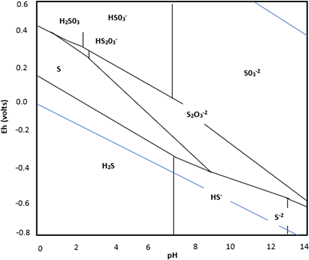
The Pourbaix diagram presents the sulfur species in an aqueous medium at 25 C° considering the electrochemical balance and stability with respect to pH (Patel et al., 2019). Eh-pH diagram of the S-H2O system at 25°C according to Figure 1.
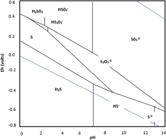
Applied research in mineral processing and hydrometallurgy (Carrillo Pedroza et al., 2017).
2. MATERIAL AND METHODS
2.1. Methodology
Wastewater was sampled from the riverbank process of a tannery located in the PIRS in the city of Arequipa. The sampling and analysis of COD and sulfides was carried out according to the standard methodology (APHA et al., 2017). The analyses were carried out in the Certificaciones del Perú laboratory. Sulfides were analyzed using a titration based on the reaction of iodine with sulfide in acid solution (El Brahmi and Abderafi, 2021). COD is defined as the amount of a specific oxidant that reacts with a sample under controlled conditions.
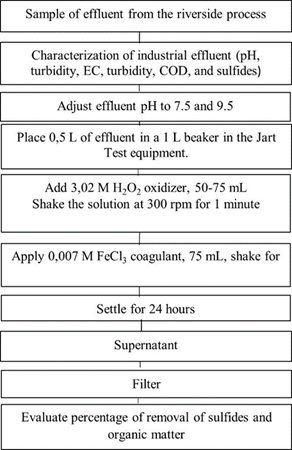
The amount of oxidant consumed was expressed in terms of its oxygen equivalence, mg O₂ L-1 (Mahmoud et al., 2020). The colorimetric method was based on the oxidation of organic matter by a strong oxidant such as dichromate. The orange Cr+6 present in the analysis solution is reduced to green Cr+3, and the absorbance was measured at 600 nm (Naguib et al., 2024). For sulfide and COD analysis, pH, EC, and turbidity were determined in the field. The procedure was carried out according to Figure 2 COD, pH, EC, and turbidity were determined in the field.
To determine the effect of pH and oxidant dose, experimental design 22 was used, in which there are 2 factors and 2 levels for each factor.
2.2. Characterization and treatment
The effluent was characterized by measuring pH, turbidity, COD and sulfides (García Juárez et al., 2022), then the pH value was regulated to 7.5 and 9.5 with HCl 6 M and 0.5 L of effluent from the riverbank stage was deposited in the six jars of the Jar Test equipment, doses of 50-75 mL of H2O2 3.0 M were applied (Song et al., 2022) and stirred for one minute at 300 revolutions per minute (rpm) then FeCl3 0.007 M was applied in doses of 75 mL, then stirred for five minutes at 230 rpm, then allowed to settle for 24 hours. The supernatant obtained from 0.5 L of effluent was filtered with 0.2 g of sheep or camelid wool, 5 g of sand with a size of 1-3 mm and 1 g of activated carbon with a size of 0.5-4.0 mm. Finally, the pH, conductivity, turbidity, and sulfide parameters were characterized and COD. The results obtained are evaluated based on the MCL values of the Peruvian standards (Table 1).
For the treatment with a combination of H2O2/O3 oxidants (Peroxone), 1 L of residual water from unhairing was used, pH 8.5, H2O2 concentration 3.02 M, doses of 0.005L, 0.01L and 0.02L, O3 concentration 1000mgL-1 and flow 467Lmin-1 and the concentrations of COD and sulfides were determined.
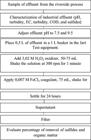
Diagram of the effluent treatment processes from the riverside stage of the tanning process. EC= Electrical conductivity.
3. RESULTS AND DISCUSSIONS
3.1. Results of wastewater characterization
The pH, EC and turbidity results carried out at the final of the liming process of the “La Unión” tannery, the pH value is due to the fact that sodium hydroxide and calcium oxide are used in the riverbank process to facilitate the splitting of the skin and hair fibers (Zhao et al., 2024; Nur-E-Alam et al., 2020) to accelerate the liming of the skins. The pH, EC and turbidity results were carried out at the final of the liming process of the “La Unión” tannery, according to Table 2.
Sulfur pollution (Rana et al., 2020) is caused by Na2S, it acts as a hair remover that removes and dissolves hair, and sulfur is often part of several redox reactions (Liu et al., 2025; Chen et al., 2022) in water it is found in its dissolved form (Yuan et al., 2022). Turbidity and EC have high values due to the use of NaCl to prevent putrefaction. The added chemicals increase the inorganic load and organic matter formed by skin fibers, hair, keratin and unstructured proteins and micro proteins found in blood and hydrolyzed lymphatic fluid (Fernández et al., 2022), which is why COD has high concentrations (Agudelo Valencia et al., 2020).
3.2. Characterization of treated wastewater
The results of turbidity, pH, EC, sulfides and COD obtained at pH 7.5, 9.5 after performing the oxidation, coagulation and filtration treatments according to Table 3.
The results of turbidity, pH, EC, COD and sulfides obtained at pH 8.5 after performing the oxidation treatment with H2O2/O3 in the Table 4.
3.3. Effect of pH and dosage on the removal of sulfides and COD
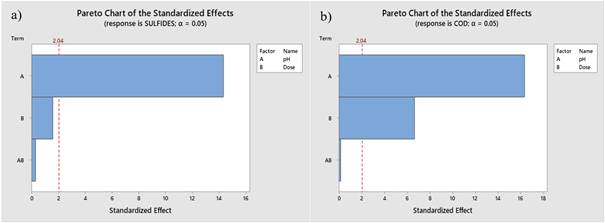
The test was carried out at pH 7.5, because at values lower than pH 7 toxic gases such as H2S gas are released (Liu et al., 2022; Zhao et al., 2022), from the aqueous state it passes to the gaseous phase causing strong and unpleasant odors (Agudelo Valencia et al., 2019) and they are also extremely toxic and very harmful to human health (Paul et al., 2021; Zhang et al., 2022), at pH values 7-9 the effluent has in its composition sulfides and bisulfides (Edathil et al., 2017). At pH 9.5 level the reaction is faster than in acidic medium (Wang et al., 2022; Marais et al., 2020), when the pH of the solution is greater than 10, the sulfur species present in the solution are the reduced sulfur species, S2- ions according to Figure 1 (Edathil et al., 2020). It is shown that the pH has statistically positive influence, greater than dose in the removal of sulfides and COD, in alkaline medium the oxidizing property of H2O2 is favored (Hashem et al., 2016). according to Figure 3.

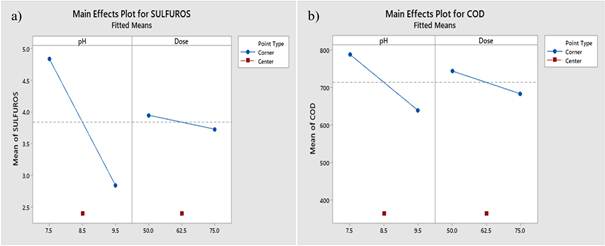
We perceive that, at a higher volume of oxidant 75 mL and slightly basic pH 9.5, greater removal of sulfides 2.71 mg L-1, at a lower volume of oxidant 50 mL and pH 7.5, lower removal of sulfides 4.73 mg L-1, in the case of COD we perceive that when the dose of H2O2 decreases the elimination percentage decreases (Boczkaj and Fernandes, 2017; Barndõk et al., 2016) due to the competitive consumption of hydroxyl radicals (Arka et al., 2022), the results obtained with 50 mL of oxidant and pH 7.5 give COD 800 mg L-1 and with 75 mL of oxidant and pH 9.5 the COD result is 591 mg L-1 and it is shown in the Figure 4.
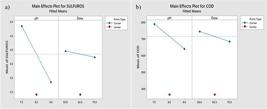
COD removal is higher as the oxidant dose increases (Barndõk et al., 2016; Sawalha et al., 2020). Its efficiency is due to the highly reactive hydroxyl radicals (Lee et al., 2022) that are capable of oxidizing organic compounds, benefiting from the presence of humic acids in the effluent (Del M. Chaile et al., 2024). At pH greater than 10, the production of the Fe2+ catalyst from Fe3+ decreases, therefore, the production of the hydroxyl radical to oxidize organic matter decreases (Gomes Júnior et al., 2020). The influence of the H2O2 oxidant dose factor is positive on the COD results.
3.4. Statement and estimation of the mathematical model using the factorial design of experiments
To determine the effect of pH and oxidant dose, experimental design 22 was used, in which there are 2 factors and 2 levels for each factor according to Table 5.
Experimental design 22 presents the respective notation for each of the levels considered in the experimental design. The notation with the signs indicates the low and high values of each factor according to Table 6.
The mathematical models obtained after developing the factorial method that will allow us to evaluate the behavior of sulfides and COD in the study system are:
There will be no significant difference, because the values produced by the pH and dose factor levels are produced by independent reactions; there is no interaction between the two factors, so the mathematical model obtained is valid in the vicinity of the experimental region.
3.5. Percentage of removal of sulfides and organic matter
The removal percentage for the combined processes was 99.5% for sulfides and 96.5% for COD, as shown in Tables 7 and 8. The removal percentages for sulfides and COD were calculated using the following formulas (Valderrama et al., 2017):
The removal results at pH 9.5 are acceptable, but we observed a slight variation, because at values greater than pH 9 the oxidative power of H2O2 is affected, leading to the formation of hydroxides, which is not favorable for the removal process.
3.6. Treatment cost per cubic meter of effluent
The cost is expressed in terms of reagents and supplies needed for the treatment. Table 9 shows the cost per cubic meter of effluent for treatment with hydrogen peroxide and ferric chloride, and Table 10 shows the cost per cubic meter of effluent for treatment with peroxone.
Evaluation of the cost of peroxone treatment per cubic meter of effluent from the hair-dressing stage.
4. CONCLUSION
The amount of organic and inorganic matter in the effluent, expressed as COD, was determined, yielding 17 g L-1 in the untreated effluent, while after treatment, it was 457 mg L-1. The COD determined complies with the maximum contaminant level 1.5 g L-1 MCL for tannery wastewater, demonstrating the efficiency of the oxidant H2O2 and the coagulant FeCl3.
The sulfide concentration in the initial effluent was 961 mg L-1. It was reduced through oxidation, flocculation, and filtration processes, yielding 0.03 g L-1 of sulfides that comply with the maximum contaminant level 0.03 g L-1 for tannery wastewater. The unhairing stage is one of the problems faced by tanneries due to sulfide emissions. pH and dosage correction are highly relevant for process development; The highest removal was obtained at pH 8.5 with 75 mL of H2O2 3 M and FeCl3 0.007 M.
In the peroxone treatment, a removal of 81.7% and 93.8% for COD and sulfides respectively was obtained with a dose of 0.02 L of H2O2 with a concentration of 3.02 M and 1000 mg L-1 of O3, and it presents an increase in the cost of the treatment of one cubic meter of river effluent, from 115.7 USD to 176.2USD.
The oxidation, flocculation, and filtration processes were efficient at 99% sulfide removal and 97% COD removal.
5. DATA AVAILABILITY STATEMENT
Data availability not informed.
6. REFERENCES
-
AGUDELO VALENCIA, R. N.; OVALLE GONZÁLEZ, D. P.; RODRIGUEZ RODRIGUEZ, L. F. Applicability of photo-fenton process (visible-light) in the degradation of sulfur and cod from tannery wastewater. Luna Azul Magazine, v. 50, p. 215-228, 2020. https://doi.org/10.17151/luaz.2020.50.11
» https://doi.org/10.17151/luaz.2020.50.11 -
AGUDELO VALENCIA, R. N.; OVALLE GONZÁLEZ, D. P.; RODRÍGUEZ RODRIGUEZ, L. F.; CAMARGO VARGAS, G. D. J.; ALMONACID JIMENEZ, L. Y. Removal of sulfides from tanning wastewater using hydrodynamic cavitation. ION Journal, v. 32, n. 1, p. 21-33, 2019. https://doi.org/10.18273/revion.v32n1-2019002
» https://doi.org/10.18273/revion.v32n1-2019002 -
ALMIRÓN, J.; AROSQUIPA-PACHARI, K. R.; HUILLCAÑAHUI, C.; HUARSAYA-HUILLCA, J. A. Evaluation of the bioaccumulation capacity of Buddleja species in soils contaminated with total chromium in tannery effluents in Arequipa (Peru). Sustainability, v. 15, n. 8, 2023. https://doi.org/10.3390/su15086641
» https://doi.org/10.3390/su15086641 -
ANDRIAMANOHIARISOAMANANA, F. J.; FARGHALI, M.; MOHAMED, I. M. A.; YOSHIDA, G.; SHIOTA, K.; IHARA, I. Impact of tannery wastes on anaerobic co-digestion: enhancing biogas production and proDQOss efficiency. Collagen and Leather, v. 6, n. 1, 2024. https://doi.org/10.1186/s42825-024-00162-w
» https://doi.org/10.1186/s42825-024-00162-w -
AHMAD, N.; MAITRA, S.; DUTTA, B. K.; AHMAD, F. Remediation of sulfidic wastewater by catalytic oxidation with hydrogen peroxide. Journal of Environmental Sciences, v. 21, n. 12, p. 1735-1740, 2009. https://doi.org/10.1016/S1001-0742(08)62481-X
» https://doi.org/10.1016/S1001-0742(08)62481-X -
ANIK HASAN, M.; ABUL HASHEM, M.; PAYEL, S. Stabilization of liming sludge in brick production: A way to reduce pollution in tannery. Construction and Building Materials, v. 314, 125702, 2022. https://doi.org/10.1016/J.CONBUILDMAT.2021.125702
» https://doi.org/10.1016/J.CONBUILDMAT.2021.125702 - APHA; AWWA; WEF. Standard Methods for the examination of water and wastewater. 23nd ed. Washington, 2017. 1504 p.
-
ARKA, A.; ASAITHAMBI, P.; KEBEDE DEBELA, S. Development of Solar Photo-Fenton Process for the Removal of Color, COD, and Turbidity from Institutional Wastewater. Journal of Energy, Environmental & Chemical Engineering, v. 7, n. 2, p. 26, 2022. https://doi.org/10.11648/j.jeece.20220702.12
» https://doi.org/10.11648/j.jeece.20220702.12 -
BARNDÕK, H.; BLANCO, L.; HERMOSILLA, D.; BLANCO, Á. Heterogeneous photo-Fenton processes using zero valent iron microspheres for the treatment of wastewaters contaminated with 1,4-dioxane. Chemical Engineering Journal, v. 284, p. 112-121, 2016. https://doi.org/10.1016/J.CEJ.2015.08.097
» https://doi.org/10.1016/J.CEJ.2015.08.097 -
BOCZKAJ, G.; FERNANDES, A. Wastewater treatment by means of advanced oxidation processes at basic pH conditions: A review. Chemical Engineering Journal, v. 320, p. 608-633, 2017. https://doi.org/10.1016/J.CEJ.2017.03.084
» https://doi.org/10.1016/J.CEJ.2017.03.084 -
CAO, Y.; QIU, W.; LI, J.; JIANG, J.; PANG, S. Review on UV/sulfite process for water and wastewater treatments in the presence or absence of O2. Science of The Total Environment, 765, 142762, 2021. https://doi.org/10.1016/J.SCITOTENV.2020.142762
» https://doi.org/10.1016/J.SCITOTENV.2020.142762 -
CARRILLO PEDROZA, F. R.; SORIA AGUILAR, Ma. de J.; MARTINEZ LUÉVAMOS, A. Investigación aplicada al procesamiento de minerales e hidrometalurgia. Universidad Autónoma de Coahuila, 2017. https://www.researchgate.net/publication/313209279
» https://www.researchgate.net/publication/313209279 -
CHEN, B.; QAISAR, M.; WANG, K.; LI, W.; CAI, J. Response of simultaneous sulfide and nitrate removal process on acute toxicity of substrate concentration and salinity: Single toxicity and combined toxicity. Science of The Total Environment, v. 836, 155639, 2022. https://doi.org/10.1016/J.SCITOTENV.2022.155639
» https://doi.org/10.1016/J.SCITOTENV.2022.155639 -
CRUZ, D. R. S.; DE JESUS, G. K.; SANTOS, C. A.; SILVA, W. R.; WISNIEWSKI, A.; CUNHA, G. C. et al Magnetic nanostructured material as heterogeneous catalyst for degradation of AB210 dye in tannery wastewater by electro-Fenton process. Chemosphere, v. 280, 130675, 2021. https://doi.org/10.1016/J.CHEMOSPHERE.2021.130675
» https://doi.org/10.1016/J.CHEMOSPHERE.2021.130675 -
DE VETTORI DORADOR, D.; HUARAG GUERRERO, E.; CARBAJAL PINEDA, C. X.; RIVEROS ENCISO, N. V. The environmental and legal impacts of the textile industry on fashion law. Lumem, v. 18, n. 2, 2022. https://doi.org/10.33539/lumen.2022.v18n2.2678
» https://doi.org/10.33539/lumen.2022.v18n2.2678 -
DEL M.CHAILE, A. P.; UBOLDI, M. E.; ELSA FERREYRA, M. M. Chemical treatment of sugarcane vinasse with hydrogen peroxide. Ciencias Ambientales, v. 59, n. 1, p. 1-19, 2024. https://doi.org/10.15359/rca.59-1.5
» https://doi.org/10.15359/rca.59-1.5 -
EDATHIL, A. A.; KANNAN, P.; BANAT, F. Adsorptive oxidation of sulfides catalysed by δ-MnO2 decorated porous graphitic carbon composite. Environmental Pollution, v. 266, 115218, 2020. https://doi.org/10.1016/J.ENVPOL.2020.115218
» https://doi.org/10.1016/J.ENVPOL.2020.115218 -
EDATHIL, A. A.; PAL, P.; BANAT, F. Alginate derived porous graphitic carbon for highly efficient remediation of sulfide from wastewater. Journal of Environmental Chemical Engineering, v. 5, n. 2, p. 1998-2009, 2017. https://doi.org/10.1016/J.JECE.2017.04.009
» https://doi.org/10.1016/J.JECE.2017.04.009 -
EL BRAHMI, A.; ABDERAFI, S. Hydrogen sulfide removal from wastewater using hydrogen peroxide in-situ treatment: Case study of Moroccan urban sewers. Materials Today: Proceedings, v. 45, p. 7424-7427, 2021. https://doi.org/10.1016/J.MATPR.2021.01.641
» https://doi.org/10.1016/J.MATPR.2021.01.641 -
FERNÁNDEZ, M.; GONZÁLEZ, P. S.; BOARINI, M.; MANDILLE, J.; BARBERÓN, I.; PEROTTI, R. et al Characterization Of Effluents From A Tannery Industry: A Case Study Of Córdoba Province, Argentina. International Journal of Environmental Pollution, v. 38, p. 465-482, 2022. https://doi.org/10.20937/RICA.54212
» https://doi.org/10.20937/RICA.54212 -
GARCÍA JUÁREZ, H. D.; MENDOZA ZUTA, J. C.; ARMAS JUÁREZ, R. A.; CRUZ SALINAS, L. E. Tratamiento de aguas residuales provenientes del proceso de curtido de pieles. Revista Alfa, v. 6, n. 18, p. 423-435, 2022. https://doi.org/10.33996/revistaalfa.v6i18.179
» https://doi.org/10.33996/revistaalfa.v6i18.179 -
GOMES JÚNIOR, O.; BATISTA, L. L.; UEIRA-VIEIRA, C.; SOUSA, R. M. F.; STARLING, M. C. V. M.; TROVÓ, A. G. Degradation mechanism of fipronil and its transformation products, matrix effects and toxicity during the solar/photo-Fenton process using ferric citrate complex. Journal of Environmental Management, v. 269, 2020. https://doi.org/10.1016/j.jenvman.2020.110756
» https://doi.org/10.1016/j.jenvman.2020.110756 -
HASHEM, M. A.; NUR-A-TOMAL, M. S.; BUSHRA, S. A. Oxidation-coagulation-filtration processes for the reduction of sulfide from the hair burning liming wastewater in tannery. Journal of Cleaner Production, v. 127, p. 339-342, 2016. https://doi.org/10.1016/j.jclepro.2016.03.159
» https://doi.org/10.1016/j.jclepro.2016.03.159 -
KARAM, A.; BAKHOUM, E. S.; ZAHER, K. Coagulation/flocculation process for textile mill effluent treatment: experimental and numerical perspectives. International Journal of Sustainable Engineering, v. 14, n. 5, p. 983-995, 2021. https://doi.org/10.1080/19397038.2020.1842547
» https://doi.org/10.1080/19397038.2020.1842547 -
LEE, W.; MARCOTULLIO, S.; YEOM, H.; SON, H.; KIM, T. H.; LEE, Y. Reaction kinetics and degradation efficiency of halogenated methylparabens during ozonation and UV/H2O2 treatment of drinking water and wastewater effluent. Journal of Hazardous Materials, v. 427, 127878, 2022. https://doi.org/10.1016/J.JHAZMAT.2021.127878
» https://doi.org/10.1016/J.JHAZMAT.2021.127878 -
LI, M.; JIA, X.; WANG, J.; WANG, Y.; CHEN, Y.; WU, J. et al Quantitative Analysis of the Research Development Status and Trends of Tannery Wastewater Treatment Technology. Catalysts, v. 12, n. 11, 2022. https://doi.org/10.3390/catal12111317
» https://doi.org/10.3390/catal12111317 -
LIU, H.; ZHA, S.; YANG, Z.; ZHANG, W.; LIN, Z.; WANG, S. et al Acute sulfide exposure induces hemocyte toxicity and microbiota dysbiosis in blood clam Tegillarca granosa. Aquatic Toxicology, v. 249, 106224, 2022. https://doi.org/10.1016/J.AQUATOX.2022.106224
» https://doi.org/10.1016/J.AQUATOX.2022.106224 -
LIU, H.; XIE, X.; SU, Y.; YAN, X.; SUN, M.; LV, Y. Investigation on special reactivity of sulfite as an electron acceptor for the attenuated Fenton reaction and the abatement mechanism. Separation and Purification Technology, v. 354, 129061, 2025. https://doi.org/10.1016/J.SEPPUR.2024.129061
» https://doi.org/10.1016/J.SEPPUR.2024.129061 -
MAHMOUD, A. S.; FARAG, R. S.; ELSHFAI, M. M. Reduction of organic matter from municipal wastewater at low cost using green synthesis nano iron extracted from black tea: Artificial intelligence with regression analysis. Egyptian Journal of Petroleum, v. 29, n. 1, p. 9-20, 2020. https://doi.org/10.1016/J.EJPE.2019.09.001
» https://doi.org/10.1016/J.EJPE.2019.09.001 -
MARAIS, T. S.; HUDDY, R. J.; HARRISON, S. T. L.; VAN HILLE, R. P. Demonstration of simultaneous biological sulphate reduction and partial sulfide oxidation in a hybrid linear flow channel reactor. Journal of Water Process Engineering, v. 34, 101143, 2020. https://doi.org/10.1016/J.JWPE.2020.101143
» https://doi.org/10.1016/J.JWPE.2020.101143 -
MONGE ALCALDE, B. J.; DÁVILA BERNAL, D. A.; MIÑAN OLIVOS, G. S. Seguridad y Salud Ocupacional para disminuir los riesgos laborales en la curtiembre Piel Trujillo S.A.C. Trujillo - Perú. In: LACCEI INTERNATIONAL MULTICONFERENCE ON ENTREPRENEURSHIP, INNOVATION AND REGIONAL DEVELOPMENT, 3., Dec. 4-6, 2023. Proceedings[…] Boca Raton: LACCEI, 2023. https://doi.org/10.18687/LEIRD2023.1.1.407
» https://doi.org/10.18687/LEIRD2023.1.1.407 -
NAGUIB, A. M.; ABDEL-GAWAD, S. A.; MAHMOUD, A. S. Reduction of organic contaminants from industrial effluent using the advanced oxidation process, chemical coagulation, and green nanotechnology. Scientific Reports, v. 14, n. 1, 2024. https://doi.org/10.1038/s41598-024-65162-6
» https://doi.org/10.1038/s41598-024-65162-6 -
NUR-E-ALAM, M.; MIA, M. A. S.; AHMAD, F.; RAHMAN, M. M. An overview of chromium removal techniques from tannery effluent. Applied Water Science, v. 10, n. 9, 2020. https://doi.org/10.1007/s13201-020-01286-0
» https://doi.org/10.1007/s13201-020-01286-0 -
PASCIUCCO, E.; PASCIUCCO, F.; PANICO, A.; IANNELLI, R.; PECORINI, I. Optimization of a Fenton-based process as a tertiary treatment of tannery wastewater through response surface methodology. Journal of Water Process Engineering, v. 69, 106588, 2025. https://doi.org/10.1016/J.JWPE.2024.106588
» https://doi.org/10.1016/J.JWPE.2024.106588 -
PASTRANA-PACHO, A.; SOLIS-SILVAN, R.; ÁVILA-LÁZARO, I.; LAINES-CANEPA, J. R.; SÁNCHEZ-DÍAZ, B. Wastewater coagulation using a mixture of Crotalaria longirostrata powder and aluminum sulfate. Journal of Technology in Motion, p. 135-142, 2023. https://doi.org/10.18845/tm.v36i2.6000
» https://doi.org/10.18845/tm.v36i2.6000 -
PAUL, B. D.; SNYDER, S. H.; KASHFI, K. Effects of hydrogen sulfide on mitochondrial function and cellular bioenergetics. Redox Biology, v. 38, 101772, 2021. https://doi.org/10.1016/J.REDOX.2020.101772
» https://doi.org/10.1016/J.REDOX.2020.101772 -
PATEL, A.; NØRSKOV, J. K.; PERSSON, K. A.; MONTOYA, J. H. Efficient Pourbaix diagrams of many-element compounds. Physical Chemistry Chemical Physics, v. 21, p. 25353-25327, 2019. https://doi.org/10.1039/C9CP04799A
» https://doi.org/10.1039/C9CP04799A - PERU. Ministerio del Ambiente. Decreto Supremo N.° 010-2023 22. Aprueban los Límites Máximos Permisibles para efluentes de las actividades de curtido y adobo de cuero, así como adobo y teñido de pieles. El Peruano, 23 de agosto de 2023.
-
PUDI, A.; REZAEI, M.; SIGNORINI, V.; ANDERSSON, M. P.; BASCHETTI, M. G.; MANSOURI, S. S. Hydrogen sulfide capture and removal technologies: A comprehensive review of recent developments and emerging trends. Separation and Purification Technology, v. 298, 2022. https://doi.org/10.1016/j.seppur.2022.121448
» https://doi.org/10.1016/j.seppur.2022.121448 -
RANA, K.; RANA, N.; SINGH, B. Applications of sulfur oxidizing bacteria. Physiological and Biotechnological Aspects of Extremophiles, p. 131-136, 2020. https://doi.org/10.1016/B978-0-12-818322-9.00010-1
» https://doi.org/10.1016/B978-0-12-818322-9.00010-1 -
SAWALHA, H.; AL-JABARI, M.; ELHAMOUZ, A.; ABDELRAHIM, A. Tannery wastewater treatment options and resource recovery. In: BHASKAR, T. et al (eds.). Waste Biorefinery. Elsevier, 2020. p. 679-705. https://doi.org/10.1016/B978-0-12-818228-4.00025-3
» https://doi.org/10.1016/B978-0-12-818228-4.00025-3 -
SONG, Q.; NI, L.; JIANG, J.; CHEN, Z.; FU, G.; YAO, H. et al Process optimization and thermal hazard analysis of the preparation of diphenyl sulfoxide using hydrogen peroxide as oxidant. Process Safety and Environmental Protection, v. 168, p. 698-711, 2022. https://doi.org/10.1016/J.PSEP.2022.10.042
» https://doi.org/10.1016/J.PSEP.2022.10.042 -
TIAN, Q.; JIANG, Y.; DUAN, X.; LI, Q.; GAO, Y.; XU, X. Low-peroxide-consumption fenton-like systems: The future of advanced oxidation processes. Water Research, v. 268, 122621, 2025. https://doi.org/10.1016/J.WATRES.2024.122621
» https://doi.org/10.1016/J.WATRES.2024.122621 -
VALDERRAMA, M.; JAVIER, C.; DEL ÁGUILA, M.; MICHEL, E.; PIO, C.; ERIKA, L. et al Fenton Process Optimization in the Treatment of Landfill Leachate. Revista de la Sociedad Química del Perú, v. 82, n. 4, 2017. http://revistas.sqperu.org.pe/index.php/revistasqperu/article/view/135
» http://revistas.sqperu.org.pe/index.php/revistasqperu/article/view/135 -
WANG, Y.; WANG, Z.; PAN, J.; LIU, Y. Removal of gaseous hydrogen sulfide using Fenton reagent in a spraying reactor. Fuel, v. 239, p. 70-75, 2019. https://doi.org/10.1016/J.FUEL.2018.10.143
» https://doi.org/10.1016/J.FUEL.2018.10.143 -
WANG, Z.; CUI, H.; XU, H.; SHENG, Y. Decorated reduced graphene oxide transfers sulfides into sulfur and sulfone in wastewater. RSC Advances, v. 12, n. 44, p. 28586-28598, 2022. https://doi.org/10.1039/d2ra04323h
» https://doi.org/10.1039/d2ra04323h -
YUAN, T.; HASHIMOTO, K.; TAZAKI, A.; HASEGAWA, M.; KURNIASARI, F.; OHTA, C. et al Potential application of a hydrotalcite-like compound for reduction of toxicity to aquatic organisms via rapid and efficient removal of hydrogen sulfide. Journal of Environmental Management, v. 321, 115861, 2022. https://doi.org/10.1016/J.JENVMAN.2022.115861
» https://doi.org/10.1016/J.JENVMAN.2022.115861 -
ZENG, T.; YU, M.; ZHANG, H.; HE, Z.; ZHANG, X.; CHEN, J. et al In situ synthesis of cobalt ferrites-embedded hollow N-doped carbon as an outstanding catalyst for elimination of organic pollutants. Science of The Total Environment, v. 593-594, p. 286-296, 2017. https://doi.org/10.1016/J.SCITOTENV.2017.03.180
» https://doi.org/10.1016/J.SCITOTENV.2017.03.180 -
ZHANG, Z.; HU, Y.; WANG, F.; ZHENG, X.; LIU, J.; TANG, K. Pyrolysis of chrome-tanned leather wastes: kinetics, mechanism and evolved gas analyses. Waste Management, v. 143, 2022. https://doi.org/10.1016/j.wasman.2022.02.030
» https://doi.org/10.1016/j.wasman.2022.02.030 -
ZHAO, G.; DING, J.; REN, J.; ZHAO, Q.; FAN, H.; WANG, K. et al Treasuring industrial sulfur by-products: A review on add-value to reductive sulfide and sulfite for contaminant removal and hydrogen production. Journal of Hazardous Materials, v. 438, 129462, 2022. https://doi.org/10.1016/J.JHAZMAT.2022.129462
» https://doi.org/10.1016/J.JHAZMAT.2022.129462 -
ZHAO, G.; DAI, M.; DU, Q.; YANG, H. Application of immobilized biological fillers for the hydrolytic acidification and denitrification of sulfide-containing tannery wastewater. Biochemical Engineering Journal, v. 208, 109342, 2024. https://doi.org/10.1016/J.BEJ.2024.109342
» https://doi.org/10.1016/J.BEJ.2024.109342
Edited by
-
Editor-in-Chief:
Editor-in-Chief: Nelson Wellausen Dias https://orcid.org/0000-0002-9507-9211