Sensitivity analysis of incoming sediment load to the reservoirs of the Paranaíba River basin: effects of climate change
Abstract
Climate change poses significant challenges to reservoir sustainability by altering streamflow regimes and intensifying sediment dynamics. This study provides an integrated assessment of the sensitivity of reservoirs in the Paranaíba River basin to increases in incoming sediment load under climate change scenarios that project higher mean annual streamflow. The system‑level assessment covered 64 dams and 47 hydrosedimentometric monitoring stations in operation in the basin at the end of 2024. For each reservoir, stylized climate-change scenarios applied +1%, +5%, and +10% to the annual mean discharge, with increments redistributed across the daily series. Total sediment loads were computed from station-specific power-law rating curves using Colby’s 1957 simplified method; reservoir trap efficiency followed Churchill and Brune. Impacts are heterogeneous across reservoirs; anthropogenic pressure, particularly urbanization, modulates the sensitivity to discharge increases: sub-basins with higher urbanization show larger responses: the total incoming sediment load increased by up to 32.8% at Lago Paranoá, the most affected site owing to the intense urbanization of its drainage area, which includes Brasília and surrounding cities, in contrast to five reservoirs under lower anthropogenic pressure, such as Santa Maria, near the springs of the Ribeirão do Torto. It explicitly accounts for interactions among multiple projects and addresses the lack of system‑scale analyses for cascade reservoirs.
Keywords:
cascade reservoirs; climate change; incoming sediment load; Paranaíba river
Resumo
As mudanças climáticas representam desafios significativos para a sustentabilidade dos reservatórios, alterando os regimes de vazão e intensificando a dinâmica dos sedimentos. Este estudo fornece uma avaliação integrada da sensibilidade dos reservatórios na bacia do rio Paranaíba ao aumento da carga de sedimentos afluentes sob cenários de mudanças climáticas que projetam vazões médias anuais mais elevadas. A avaliação em nível de sistema abrangeu 64 barragens e 47 estações de monitoramento hidrossedimentométrico em operação na bacia no final de 2024. Para cada reservatório, cenários estilizados de mudanças climáticas aplicaram incrementos de +1%, +5% e +10% à vazão média anual, com os incrementos redistribuídos ao longo das séries diárias. As cargas totais de sedimentos foram calculadas a partir de curvas de lei de potência específicas para cada estação, utilizando o método simplificado de Colby 1957; a eficiência de retenção dos reservatórios seguiu Churchill e Brune. Os impactos são heterogêneos entre os reservatórios; A pressão antropogênica, particularmente a urbanização, modula a sensibilidade ao aumento da vazão: sub-bacias com maior urbanização apresentam respostas mais expressivas: a carga total de sedimentos afluentes aumentou em até 32,8% no Lago Paranoá, o local mais afetado devido à intensa urbanização de sua bacia hidrográfica, que inclui Brasília e cidades vizinhas, em contraste com cinco reservatórios sob menor pressão antropogênica, como Santa Maria, próximo às nascentes do Ribeirão do Torto. O estudo considera explicitamente as interações entre múltiplos projetos e supre a carência de análises em escala sistêmica para reservatórios em cascata.
Palavras-chave:
carga sedimentar afluente; mudanças climáticas; reservatórios em cascata; rio Paranaíba
1. INTRODUCTION
Climate change has produced significant shifts in hydrological regimes worldwide, directly affecting the production and transport of sediments in river basins. Accelerated reservoir sedimentation is one of the most pressing challenges for contemporary water‑resource management as it reduces storage capacity, compromises power generation, increases flood risk and affects essential ecosystem services (IPCC, 2021; Farjalla et al., 2021). This problem is particularly critical in countries whose energy matrix depends heavily on hydropower, such as Brazil, where maintaining reservoir operational life is vital for energy security. In this context, some Brazilian basins may experience precipitation increases due to climate change, resulting in higher water discharges; projected variations in hydrological regimes tend to affect reservoirs unevenly and may either compromise or enhance energy generation in different regions of the country (Queiroz et al., 2016).
Against this backdrop, there is the necessity of integrating water‑resource management that incorporates not only climate‑driven changes in hydrological regimes but also land‑use pressures, especially in strategic hydrographic regions such as the Paraná basin (Farjalla et al., 2021). Hydrological projections indicate variations of up to ±20% in mean annual streamflow in the Paraná-Plata region, with significant impacts on energy generation (IPCC, 2021; Silva et al., 2022). It is therefore essential to understand the nonlinear relationships between water discharge and sediment discharge to anticipate how streamflow regimes affect sediment processes, and to inform long‑term planning.
The relationship between water discharge and sediment load is highly nonlinear and modulated by land use, the occurrence of extreme events and cascade dams (Hoffmann et al., 2020; Yang et al., 2024; Li et al., 2023). Land‑use intensification coupled with changes in precipitation patterns has been the main driver of increasing sedimentation rates in reservoirs, with direct effects on their operational capacity and lifespan (Gonzalez Rodriguez et al., 2023). Given the cascade arrangement of reservoirs, it is essential to consider the integrated effects of sediment retention by each dam as well as the incremental contributions from inter‑reservoir drainage areas. Empirical and semi‑empirical methods, such as the Simplified Method of Colby (Colby, 1957), are widely applied where sediment data are limited, allowing estimation of total load from partial suspended‑sediment measurements and sediment rating curves (Oliveira et al., 2024). Sediment‑trapping efficiency (TE) can be estimated from empirical relationships among storage capacity, mean annual inflow and contributing drainage area (Tan et al., 2019). In data‑sparse basins, sediment production can be estimated by using parameters such as drainage area, slope, surface runoff, the USLE erosion factor and mean flow (Aga et al., 2020). That framework assumes that sub‑basins with similar characteristics can serve as analogs for estimating sediment inputs in nearby areas.
This study proposes a sensitivity analysis of Paranaíba River reservoirs with respect to increased sediment supply under scenarios of higher inflows. The approach combines hydrosedimentometric time series with the Colby method (1957) and classical cascade sediment‑trapping efficiency models (Churchill, 1948; Brune, 1953; Tan et al., 2019), providing a spatially distributed view of cumulative effects. This approach makes it possible to quantify, systematically and comparatively, the differential impacts among reservoirs within a single basin, considering the cascade arrangement. The central objective is to evaluate sensitivity across all reservoirs already installed in the basin and to identify the most vulnerable projects to support mitigation and adaptation strategies under climate change.
2. MATERIAL AND METHODS
2.1. Characterization of the study region and climate change impacts
The Paranaíba River basin drains approximately 223,000 km². The river rises in the Serra da Mata da Corda, in Minas Gerais, at about 1,100 m a.s.l., and flows 1,160 km before joining the Grande River to form the Paraná River. The prevailing climate is tropical (Aw) (Rosa and Sano, 2014), with a dry season from May to September and a rainy season from October to April (Costa et al., 2023). The drainage area is anthropized, dominated by agriculture and cattle ranching, with irrigated sugarcane production standing out (Fachinelli and Pereira Jr., 2015). The basin is strategically important for Brazil’s National Interconnected System (SIN) due to the presence of large reservoirs (Rosa and Sano, 2014; Fachinelli and Pereira Jr., 2015). Anthropogenic activities have intensified erosion, thus increasing sediment transport and reducing reservoir lifespan (Cabral, 2005; Resende et al., 2020; Chagas et al., 2022). Urbanization is a dominant driver of sediment delivery into the fluvial system, as evidenced in the Lago Paranoá sub‑basin (Franz et al., 2014). This pattern is unrepresentative of the predominantly agropastoral Paranaíba Basin, where urban areas occupy 1.2% of the area and agropastoral land uses account for 68.3% (Rosa and Sano, 2014).
Climate change can significantly affect rainfall, streamflow and sediment transport regimes in the Paranaíba River basin. Streamflow variability is approximately two times that of precipitation (Berbery and Barros, 2002). Hence, a 10% rainfall change implies ~20% change in mean streamflow. Projections for the 21st century indicate intensified precipitation and ±20% shifts in annual mean discharge with pronounced seasonality and spatial heterogeneity, increasing basin flows and sediment export, amplifying siltation risks and compromising water quality and hydropower operations (Oliveira et al., 2019). In the headwaters, hydrological projections show that precipitation perturbations propagate jointly to streamflow and sediment load, indicating coupled hydrosedimentological variation (Oliveira et al., 2019).
2.2. Data origin
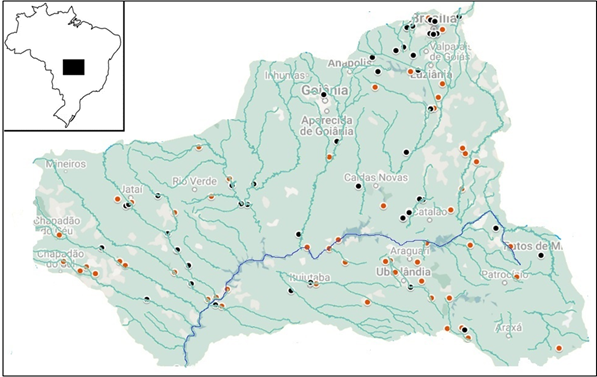
The information used in this study was obtained from Brazil’s National Water and Sanitation Agency (ANA) through the National Water Resources Information System (SNIRH) and complemented with satellite‑image analyses. The database comprises 64 dams existing in the basin at the end of 2024 and 47 hydrosedimentometric stations with available time series (Figure 1). Among the impoundments cataloged, 22 are small capacity reservoirs (≤5 MW), 20 are of medium capacity (5-30 MW), 19 are of large capacity (>30 MW) and three of them are exclusively for public water supply. As regards the operating regime, 48 are run-of-river and 16 are storage reservoirs.
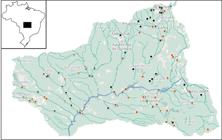
Spatial location of dams (in red) and monitoring stations (in black) used in the Paranaíba River basin as of 12/31/2024. The course of the Paranaíba River is depicted in dark blue. Lower-order streams are omitted for clarity.
Daily mean streamflow data with time series ranging from 4 to 74 years were considered. The oldest sediment‑discharge measurements date to 1992, and the most recent to 2024. At most stations, sediment sampling frequency was four times a year.
Only stations with at least three years of sediment records were included, as calibrations based on shorter records tend to reduce methodological reliability in hydrosedimentometric modeling (Pandit et al., 2025). To model transport synergies, the geographical disposition of dams and the hierarchy among sub‑basins was considered. The data employed (DA: drainage area; Qmlt: long-term mean discharge) is available in the link provided in the topic Data availability. For sediment-data consolidation, each measurement included mean depth and velocity, river width and suspended sediment concentration, which ranged from 0.13 to 2,632.50 mg/L, with mean 96.58 mg/L and median 12.53 mg/L.
2.3. Methodology
A spatially distributed hydrosedimentological modeling framework was adopted focused on estimating the annual mean total sediment discharge (Qst) flowing into each of the 64 reservoirs in the Paranaíba River basin. Qst was determined using the Simplified Method of Colby 1957, recognized for its applicability in basins with limited direct sediment data (Silva et al., 2013). The method combines suspended sediment load with bedload estimated indirectly from the former. The method requires, in addition to discharge, the availability of mean flow depth and velocity, cross-sectional width and mean suspended-sediment concentration. The full dataset was obtained from Brazil’s National Water and Sanitation Agency (ANA) via the National Water Resources Information System (SNIRH) (supplemental data is available in the link provided in the topic Data availability). This approach is appropriate for large‑scale studies focused on relative trends in total sediment discharge (Colby, 1957). Prior to use, the dataset was screened to remove outliers that could bias station-specific results. The method computes total sediment load (Qst) at the level of each individual field measurement rather than as a station-level mean; for every cross-section observation with concurrent hydraulic measurements and suspended-sediment concentration, the suspended and bed-material loads are obtained from Colby’s empirical relationships and tabulations and then summed (Qst = Qsus + Qbed). Results are therefore retained as instantaneous measurement-specific Qst values that preserve the temporal variability observed at a given station.
Given streamflow and Qst computed by the Simplified Method of Colby, station‑specific sediment rating curves using a power‑law model were established (supplemental data is available in the link provided in the topic Data availability). The power-law model was selected for its superior curve fits, yielding higher R². These curves were applied to the streamflow series to estimate each station’s annual mean Qst (supplemental data is available in the link provided in the topic Data availability). This approach is critical to preserve the representativeness of sediment peaks during extreme events (Oliveira et al., 2024). Where no direct streamflow data were available for a sub‑basin - 22% of cases - hydrological regionalization based on topographic, climatic, and land‑cover similarity was applied to estimate flows in ungauged basins (Parajka et al., 2005).
Sediment trapping efficiency (supplemental data is available in the link provided in the topic Data availability) was estimated for different reservoirs using widely employed empirical methods (Michalec and Plesiński, 2022). For small‑surface reservoirs the Churchill method was used, which relates a sedimentation index based on residence time adjusted by mean velocity to retention efficiency (Churchill, 1948). For larger reservoirs the Brune curve was adopted, which correlates the capacity‑to‑flow ratio with retention efficiency (Brune, 1953). The resulting TE across the reservoir set ranged from 0 to 99%, with a mean of 62.5% and a median of 85.5%.
To enable a sensitivity analysis of increased sediment discharges under projected increases in water discharge during the current century, three scenarios were simulated with long‑term mean flow (Qmlt) increases of +1%, +5%, and +10%, set within the positive branch of the previously noted ±20% annual mean discharge range. These scenarios were applied directly to the daily streamflow series, rather than to annual means, to preserve hydrological variability and avoid damping of extreme sediment‑transport events, especially during the rainy season. New Qst values (+1% Q, +5% Q and +10% Q, supplemental data is available in the link provided in the topic Data availability) were then recalculated from the sediment rating curves, respecting their nonlinear behavior.
Also, to assess the effect of cascade reservoirs, the Qst values (current and increased) were compared with the results of a reference scenario (REF), which considers each dam without interference from upstream structures. For the cascade scenario, inflowing Qst at each reservoir was evaluated accounting for all dams upstream of the site under analysis. Calculations proceeded upstream to downstream and combined sediment from the reservoir’s incremental area with effluent from immediately upstream dams. For the REF case, inflow at the site was reconstructed by summing sediment previously retained upstream, the corresponding effluents and contributions from the incremental drainage area.
Although simplified regarding internal reservoir dynamics, such as sediment remobilization, this methodological approach yields a robust estimate of the basin’s relative behavior under intensified hydrological conditions, focusing on tendencies and sensitivities rather than absolute values.
It was assumed that the relative increase in sediment discharge to each reservoir was due exclusively to higher basin precipitation raising the annual mean water inflow. For simplicity, land‑use changes over time were ignored in all scenarios. Thus, all scenarios employ land‑use and erosion rates consistent with those observed in recent decades in the Paranaíba basin.
3. RESULTS AND DISCUSSION
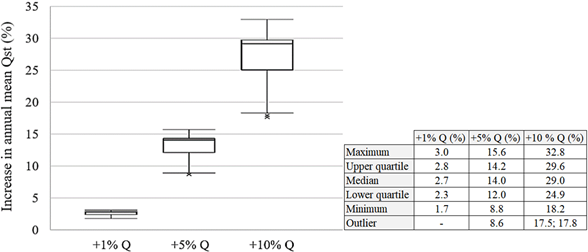
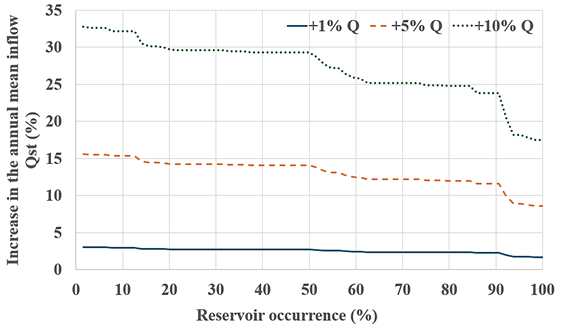
Simulations of future scenarios reveal that the annual mean total sediment discharge (Qst) flowing into each of the 64 reservoirs shows considerable sensitivity even to small increases in mean annual flow. Five dams showed the smallest impacts primarily due to their location in headwater regions with low anthropogenic disturbance, whereas for the others the 1% increase in water discharge more than doubled the mean Qst across all reservoirs, and in some cases nearly tripled it (supplemental data is available in the link provided in the topic Data availability). The three simulated scenarios - +1%, +5%, and +10% increases in water discharge - produced nonlinear responses in incoming sediment load, widening dispersion in each scenario. Qst increases computed for each reservoir reached as high as 32.8% in the “+10% Q” scenario relative to time series (Figure 2). In the “+10% Q” scenario, roughly 80% of reservoirs exhibited increases in annual mean Qst equal to or greater than 25% (Figure 3).
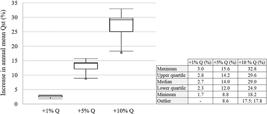
Distribution of percentage increase in annual mean total inflowing sediment load (Qst) considering each of the 64 reservoirs under three discharge-increase scenarios: +1%Q, +5%Q and +10%Q.
Among the reservoirs in the Paranaíba River basin, São Simão stands out for a drainage area dominated by agriculture and pasture - 70% and 20%, respectively, showing the highest disturbance scores among regional reservoirs (Morais et al., 2017). Such land-use pressure is reflected in the simulations of the three flow-increasing scenarios: +1%, +5%, and +10% in water discharge produce 2.8%, 14.4% and 30% increases in inflowing sediment load, respectively.
At Lago Paranoá, soil sealing and dense urban occupation markedly elevate sediment production per unit of additional flow, reaching 32.8% in the least conservative scenario (supplemental data is available in the link provided in the topic Data availability), in agreement with Franz et al. (2014). This dynamic increases sediment transport and exacerbates reservoir siltation. Global comparative studies indicate that urbanized basins generally display substantially higher sediment loads than natural conditions (Russell et al., 2017). Field studies - for example, in Melbourne - associate this increase with intensified runoff from connected impervious areas and greater sediment mobility (Russell et al., 2018).
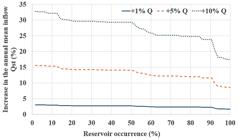
Cumulative distribution of reservoirs (%) versus minimum increase in annual mean incoming sediment discharge Qst (%) for the three water discharge increase scenarios.
In contrast, the Santa Maria reservoir, whose drainage area is much smaller and located in a headwater region under low anthropogenic pressure, showed the smallest Qst increases in each scenario: 1.7%, 8.6%, and 17.5%, respectively (supplemental data is available in the link provided in the topic Data availability). Although both reservoirs are geographically close, with Santa Maria’s drainage area contained within Lago Paranoá’s, their contrasting responses highlight the decisive role of land use and occupation in sediment production and transport.
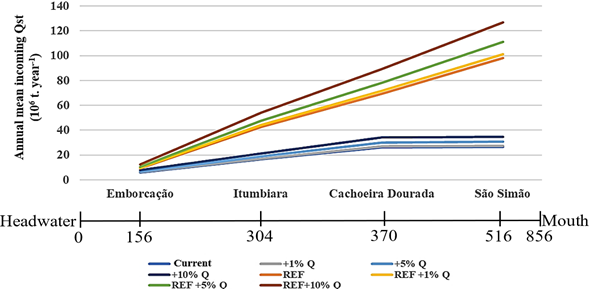
Applying the proposed methodology by considering channel geomorphology, sediment dynamics and characterization, and as well as the cascade configuration, lower incoming loads at most downstream reservoirs compared with a basin-wide estimate derived from mean loads per drainage-area unit. Along the mainstem, these reductions/differences increase downstream, reaching 265% under the +10% Q scenario at São Simão Dam (Figure 4). Under the same scenario, reductions were 160% (Cachoeira Dourada), 152% (Itumbiara) and 57% (Emborcação). The cascade-REF contrast is largely driven by upstream TE. Emborcação’s smaller reduction reflects limited upstream control: Batalha (b) and Serra do Facão (TE 93.95%, 97%) drain only 36.6% of its basin, so most sediment inflow comes from the incremental area, which is strongly affected by the scenario’s Q increases.
Across the set of reservoirs commissioned in the basin, where downstream reservoirs showed no meaningful reduction in sediment inflow when the scenarios ‘cascade’ and ‘REF’ were compared, the outcome reflects upstream reservoirs with zero or near-zero trapping efficiency (TE) at the time of commissioning, or that their incremental areas represent the dominant share of their total drainage area, as observed for Emborcação.
As seen, this progressive attenuation of sediment fluxes in cascade systems implies a relative extension of the operational lifespan of downstream reservoirs, as trapping efficiency upstream reduces the sedimentation pressure on those located further along the river course. Consequently, the cascade arrangement may not only redistribute sediment loads but also enhance the resilience and sustainability of the overall storage system.
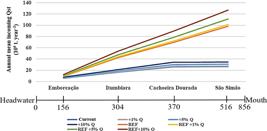
Annual mean total incoming sediment discharge (Qst) to each reservoir analyzed (from upstream to downstream: Emborcação, Itumbiara, Cachoeira Dourada, and São Simão) for the “Current” (past time series) scenario and for increased‑flow scenarios under both cascade and reference (REF) assumptions. Here, “+1% Q” denotes the annual mean Qst resulting from a 1% increase in the annual mean flow; “+5% Q” and “+10% Q” denote analogous increases of 5% and 10%, respectively. In REF scenarios, it is assumed the non-existence of upstream dams. The supplementary horizontal axis (not to scale) displays the cumulative along-river distance from the Paranaíba River headwaters to each of the four dams considered.
4. CONCLUSIONS
The results show significant heterogeneity in sediment responses among reservoirs, confirming that hydrosedimentological regimes are shaped by interactions between natural and human factors, as observed in the contrasting cases of Lago Paranoá and Santa Maria.
Reservoirs draining highly anthropized areas are more sensitive to inflow increases, as seen for Lago Paranoá and the São Bartolomeu and Tamboril dams, all near Brasília, the capital city of Brazil. Reservoirs at the ends of cascades display lower sensitivity due to upstream sediment trapping, as evidenced by comparing the REF scenario (without interference) with the cascade scenarios.
Simplifications of the scenario-simulation model include: (a) the use of a constant trapping efficiency (TE) per reservoir, fixed at its commissioning date; (b) omission of soil-texture variability, since Colby’s simplified method does not require grain-size fractions; (c) neglect of consolidation of sediments deposited within the reservoirs; and (d) not accounting for dredging events in one or more reservoirs in the cascade. However, variability in hydrological regimes across sub-basins was accounted for by using daily mean discharge to compute total sediment load, both in the baseline configuration and in the scenario simulations.
Inflow increases driven by climate change can shorten reservoir lifespans by accelerating siltation, requiring additional investment in maintenance and operational adjustments, such as emergency dredging. These impacts are exacerbated in intensively mechanized basins lacking conservation practices.
Overall, the proposed sensitivity analysis is a powerful tool to support long‑term strategic planning in both the energy sector and water‑resource management. The approach, grounded in observational time series and validated empirical models, provides robust assessments of hydrosedimentological risks under future hydrological intensification.
These findings suggest that water‑resource planning and management in the Paranaíba basin should adopt adaptive‑management frameworks that integrate climate scenarios, conservation practices and multiscale territorial governance instruments. This is particularly relevant in basins with intensive land use and cascade reservoir systems, as in this region.
5. DATA AVAILABILITY STATEMENT
Research data is available in the link: https://itaipudigital-my.sharepoint.com/:w:/g/personal/abragam_itaipu_gov_br/EVDMFW2KDMZAn-EYYV9GXpkBmPXbkpylcMrnuUMo5XZ7ow?e=0vaubm
6. REFERENCES
-
AGA, A. O.; MELESSE, A. M.; CHANE, B. An alternative empirical model to estimate watershed sediment yield based on hydrology and geomorphology of the basin in data-scarce Rift Valley lake regions, Ethiopia. Geosciences, v. 10, n. 1, 2020. https://doi.org/10.3390/geosciences10010031
» https://doi.org/10.3390/geosciences10010031 -
BERBERY, E. H.; BARROS, V. R. The hydrologic cycle of the La Plata Basin in South America. Journal of Hydrometeorology, v. 3, n. 6, p. 630-645, 2002. https://doi.org/10.1175/1525-7541(2002)003<0630:THCOTL>2.0.CO;2
» https://doi.org/10.1175/1525-7541(2002)003<0630:THCOTL>2.0.CO;2 -
BRUNE, G. M. Trap efficiency of reservoirs. Eos, Transactions American Geophysical Union, v. 34, n. 3, p. 407-418, 1953. https://doi.org/10.1029/TR034i003p00407
» https://doi.org/10.1029/TR034i003p00407 -
CABRAL, J. B. P. Estudo do processo de assoreamento em reservatórios. Caminhos de Geografia, v. 6, n. 14, 62-69, 2005. https://doi.org/10.14393/RCG61415371
» https://doi.org/10.14393/RCG61415371 -
CHAGAS, C. J.; MOREIRA, R. M.; AUGUSTIN, C. H. R. R.; BANDEIRA, J. V.; CARVALHO FILHO, C. A. de. Reuse of a dam as sediment trap and water reserve. Revista Brasileira de Recursos Hídricos, v. 27, 2022. https://doi.org/10.1590/2318-0331.272220220067
» https://doi.org/10.1590/2318-0331.272220220067 -
CHURCHILL, M. A. Discussion “Analysis and use of reservoir sedimentation data”. In: FEDERAL INTERAGENCY SEDIMENTATION CONFERENCE, May 6-8, 1948, Denver. Proceedings[…] Denver: Bureau of Reclamation 1948. p. 139-140. Available in: https://babel.hathitrust.org/cgi/pt?id=coo.31924004612622&seq=11
» https://babel.hathitrust.org/cgi/pt?id=coo.31924004612622&seq=11 -
COLBY, B. R. Relationship of unmeasured sediment discharge to mean velocity. Eos, Transactions American Geophysical Union, v. 38, n. 5, 708-717 1957. https://doi.org/10.1029/TR038i005p00708
» https://doi.org/10.1029/TR038i005p00708 -
COSTA, G. E. M.; MENEZES FILHO, F. C. M.; CANALES, F. A.; FAVA, M. C.; BRANDÃO, A. R. A.; PAES, R. P. Assessment of Time Series Models for Mean Discharge Modeling and Forecasting in a Sub-Basin of the Paranaíba River, Brazil. Hydrology, v. 10, n. 11, 2023. https://doi.org/10.3390/hydrology10110208
» https://doi.org/10.3390/hydrology10110208 -
FACHINELLI, N. P.; PEREIRA JR., A. O. Impacts of sugarcane ethanol production in the Paranaíba basin water resources. Biomass and Bioenergy, v. v. 83, p. 8-16, 2015. https://doi.org/10.1016/j.biombioe.2015.08.015
» https://doi.org/10.1016/j.biombioe.2015.08.015 -
FARJALLA, V. F. et al Turning water abundance into sustainability in Brazil. Frontiers in Environmental Science, v. 9, 2021. https://doi.org/10.3389/fenvs.2021.727051
» https://doi.org/10.3389/fenvs.2021.727051 -
FRANZ, C.; MAKESCHIN, F.; WEIß, H.; LORZ, C. Sediments in urban river basins: Identification of sediment sources within the Lago Paranoá catchment, Brasília DF, Brazil-using the fingerprint approach. Science of the Total Environment, v. 466-467, p. 513-523, 2014. https://doi.org/10.1016/j.scitotenv.2013.07.056
» https://doi.org/10.1016/j.scitotenv.2013.07.056 -
GONZALEZ RODRIGUEZ, L.; MCCALLUM, A.; KENT, D.; RATHNAYAKA, C.; FAIRWEATHER, H. A review of sedimentation rates in freshwater reservoirs: recent changes and causative factors. Aquatic Sciences, v. 85, 2023. https://doi.org/10.1007/s00027-023-00960-0
» https://doi.org/10.1007/s00027-023-00960-0 -
HOFFMANN, T. O.; BAULIG, Y.; FISCHER, H.; BLÖTHE, J. Scale breaks of suspended sediment rating in large rivers in Germany induced by organic matter. Earth Surface Dynamics, v. 8, p. 661-678, 2020. https://doi.org/10.5194/esurf-8-661-2020
» https://doi.org/10.5194/esurf-8-661-2020 -
IPCC. Climate Change 2021: The Physical Science Basis. Cambridge: Cambridge University Press, 2021. Available in: https://www.ipcc.ch/report/ar6/wg1/
» https://www.ipcc.ch/report/ar6/wg1/ -
LI, J.; GAO, Y.; CAO, L.; DONG, X.; MA, Y.; ZHENG, Y. Sediment deposition within cascade reservoirs: a case study of Baihetan Reservoir in the lower Jinshajiang River, China. Scientific Reports, v. 13, 2023. https://doi.org/10.1038/s41598-023-48052-1
» https://doi.org/10.1038/s41598-023-48052-1 -
MICHALEC, B.; PLESIŃSKI, K. Impact of floods on sediment trap efficiency of a small shallow reservoir - a case study. Sustainability, v. 14, n. 21, 2022. https://doi.org/10.3390/su142114537
» https://doi.org/10.3390/su142114537 -
MORAIS, L.; SANCHES, B. O.; SANTOS, G. B.; KAUFMANN, P. R.; HUGHES, R. M.; MOLOZZI, J. et al Assessment of disturbance at three spatial scales in two large tropical reservoirs. Journal of Limnology, v. 76, n. 2, p. 240-252, 2017. https://doi.org/10.4081/jlimnol.2016.1547
» https://doi.org/10.4081/jlimnol.2016.1547 -
OLIVEIRA, V. A.; MELLO, C. R. de; VIOLA, M. R.; SRINIVASAN, R. Modeling the effects of climate change on hydrology and sediment load in a headwater basin in the Brazilian Cerrado biome. Ecological Engineering, v. 133, p. 20-31, 2019. https://doi.org/10.1016/j.ecoleng.2019.04.021
» https://doi.org/10.1016/j.ecoleng.2019.04.021 -
OLIVEIRA, J. F. D.; COELHO, G.; CARVALHO, R. N. Determination of suspended sediment rating curve and models to estimate the suspended solids concentration in the Pandeiros River, Brazil. Revista Brasileira de Recursos Hídricos, v. 29, 2024. https://doi.org/10.1590/2318-0331.292420230138
» https://doi.org/10.1590/2318-0331.292420230138 -
PANDIT, A. et al Establishing performance criteria for evaluating watershed‐scale sediment and nutrient models at fine temporal scales. Water Research, v. 274, 2025. https://doi.org/10.1016/j.watres.2025.123156
» https://doi.org/10.1016/j.watres.2025.123156 -
PARAJKA, J.; MERZ, R.; BLÖSCHL, G. A comparison of regionalization methods for catchment model parameters. Hydrology and Earth System Sciences, v. 9, n. 3, p. 157-179, 2005. https://doi.org/10.5194/hess-9-157-2005
» https://doi.org/10.5194/hess-9-157-2005 -
QUEIROZ, A. R.; LIMA, L. M. M.; LIMA, J. W. M.; SILVA, B. C. da; SCIANNI, L. A. Climate change impacts in the energy supply of the Brazilian hydro-dominant power system. Renewable Energy, v. 99, p. 379-389, 2016. https://doi.org/10.1016/j.renene.2016.07.022
» https://doi.org/10.1016/j.renene.2016.07.022 -
RESENDE, F. M.; DENMAN, L. A. C.; SELVA, G. V.; CAMPANHÃO, L. M. B.; NOBRE, R. L. G.; JIMENEZ, Y. G. et al A conceptual model to assess the impact of anthropogenic drivers on water-related ecosystem services in the Brazilian Cerrado. Biota Neotropica, v. 20, n. 1, 2020. https://doi.org/10.1590/1676-0611-bn-2019-0899
» https://doi.org/10.1590/1676-0611-bn-2019-0899 - ROSA, R.; SANO, E. E. Uso da terra e cobertura vegetal natural na bacia do rio Paranaíba. Campo-Território: revista de geografia agrária, v. v. 9, n. 19, p. 32-56, 2014.
-
RUSSELL, K. L.; VIETZ, G. J.; FLETCHER, T. D. Global sediment yields from urban and urbanizing watersheds. Earth-Science Reviews, v. 168, p. 73-80, 2017. https://doi.org/10.1016/j.earscirev.2017.04.001
» https://doi.org/10.1016/j.earscirev.2017.04.001 -
RUSSELL, K. L.; VIETZ, G. J.; FLETCHER, T. D. Urban catchment runoff increases bedload sediment yield and particle size in stream channels. Anthropocene, v. 23, p. 53-66, 2018. https://doi.org/10.1016/j.ancene.2018.09.001
» https://doi.org/10.1016/j.ancene.2018.09.001 -
SILVA, A. M.; SANTOS, A. R.; FERNANDES, R. A.; URBAN, R. C.; CARVALHO, R. M.; MANFRÉ, L. A. et al Hydrosedimentological disequilibrium in a small, urbanized watershed. Acta Limnologica Brasiliensia, v. 25, n. 2, p. 189-200, 2013. https://doi.org/10.1590/S2179-975X2013000200005
» https://doi.org/10.1590/S2179-975X2013000200005 -
SILVA, M. V. M.; SILVEIRA, C. S.; MARTINS, F. S.; FERREIRA, W. P. M.; LIMA, J. R. S. Naturalized streamflows and affluent natural energy projections for the Brazilian hydropower sector under SSP2-4.5 and SSP5-8.5 scenarios of the CMIP6. Journal of Water and Climate Change, v. 13, 2022. https://doi.org/10.2166/wcc.2021.352
» https://doi.org/10.2166/wcc.2021.352 -
TAN, G.; CHEN, P.; DENG, J.; XU, Q.; TANG, R.; FENG, Z.; YI, R. Review and improvement of conventional models for reservoir sediment trapping efficiency. Heliyon, v. 5, 2019. https://doi.org/10.1016/j.heliyon.2019.e02458
» https://doi.org/10.1016/j.heliyon.2019.e02458 -
YANG, Q.; GAO, H.; HAN, Y.; LI, Z.; LU, K. Coupling changes in runoff and sediment and their relationships with erosion energy and underlying surface in the Wuding River basin, China. Land, v. 13, n. 4, p. 496, 2024. https://doi.org/10.3390/land13040496
» https://doi.org/10.3390/land13040496
Edited by
-
Editor-in-Chief:
Editor-in-Chief: Nelson Wellausen Dias https://orcid.org/0000-0002-9507-9211

 Source: The authors.