Mapping total mercury in rivers of Mato Grosso: baselines and contamination hotspots by biome
Abstract
Mercury (Hg) contamination is a critical environmental and public health concern due to its toxicity, persistence, and ability to biomagnify through aquatic food webs. This study mapped total mercury (HgT) concentrations in sediments from rivers across Mato Grosso, integrating geochemical parameters (HgT, organic matter, C/N ratio) and granulometric fractions. Statistical analyses included correlation, regression (OLS and GLM with Gamma distribution), and non-parametric comparisons (Kruskal-Wallis with post hoc tests). HgT concentrations ranged from 1.4 to 948.1 µg.kg⁻¹, with an overall mean of 109.1 ± 165.8 µg.kg⁻¹. Significant positive associations were observed between HgT and both organic matter (r = 0.50) and the C/N ratio (r = 0.70), with the latter emerging as the strongest predictor of Hg variability. Basin-level comparisons revealed that the Amazon had the highest mean concentrations (242.0 µg.kg⁻¹), followed by the Upper Paraguay (47.9 µg.kg⁻¹) and the Araguaia (29.3 µg.kg⁻¹). At the river scale, the Guaporé (731.5 µg.kg⁻¹) and Xingu (233.7 µg.kg⁻¹) were identified as contamination hotspots. Most rivers remained below the Threshold Effect Level (TEL = 170 µg.kg⁻¹) set by CONAMA Resolution 454/2012, but the Xingu exceeded the TEL and the Guaporé surpassed the Probable Effect Level (PEL = 486 µg.kg⁻¹), indicating high ecological risk. This study offers essential insights for environmental monitoring, water management, and biodiversity conservation, supporting Brazil’s commitments under the Minamata Convention.
Keywords:
conservation; ecotoxicology; Hg; sediments
Resumo
A contaminação por mercúrio (Hg) é uma preocupação crítica ambiental e de saúde pública devido à sua toxicidade, persistência e capacidade de biomagnificação nas cadeias tróficas aquáticas. Este estudo mapeou as concentrações de mercúrio total (HgT) em sedimentos de rios de Mato Grosso, integrando parâmetros geoquímicos (HgT, matéria orgânica, razão C/N) e frações granulométricas. As análises estatísticas incluíram correlação, regressão (OLS e GLM com distribuição Gama) e comparações não paramétricas (Kruskal-Wallis com testes post hoc). As concentrações de HgT variaram de 1,4 a 948,1 µg.kg⁻¹, com média geral de 109,1 ± 165,8 µg.kg⁻¹. Foram observadas associações positivas significativas entre HgT e matéria orgânica (r = 0,50) e entre HgT e a razão C/N (r = 0,70), sendo esta última o preditor mais forte da variabilidade do Hg. As comparações entre bacias revelaram que a Amazônia apresentou as maiores concentrações médias (242,0 µg.kg⁻¹), seguida pelo Alto Paraguai (47,9 µg.kg⁻¹) e Araguaia (29,3 µg.kg⁻¹). Em escala de rios, o Guaporé (731,5 µg.kg⁻¹) e o Xingu (233,7 µg.kg⁻¹) foram identificados como hotspots de contaminação. A maioria dos rios permaneceu abaixo do Nível de Efeito Limite (TEL = 170 µg.kg⁻¹) estabelecido pela Resolução CONAMA 454/2012, mas o Xingu ultrapassou o TEL e o Guaporé excedeu o Nível de Efeito Provável (PEL = 486 µg.kg⁻¹), indicando alto risco ecológico. Este estudo oferece subsídios essenciais para o monitoramento ambiental, a gestão dos recursos hídricos e a conservação da biodiversidade, apoiando os compromissos do Brasil no âmbito da Convenção de Minamata.
Palavras-chave:
conservação; ecotoxicologia; mercúrio; sedimentos
1. INTRODUCTION
Mercury (Hg) is recognized as one of the most toxic and persistent pollutants worldwide, owing to its high environmental mobility, capacity for bioaccumulation in organisms, and biomagnification along aquatic food webs (Beckers and Rinklebe, 2017; UNEP, 2019). In tropical environments, natural microbial processes favor the conversion of inorganic mercury into methylmercury (MeHg), its most toxic and bioavailable form (Mason et al., 1994; Skyllberg et al., 2003). Consequently, fish consumption represents the main exposure pathway for humans, with significant implications for food security and public health, particularly among riverine and traditional communities that rely heavily on fisheries (WHO, 2007).
In Brazil, mercury contamination has historically been associated with artisanal gold mining, which intensified during the second half of the 20th century. In this process, large amounts of Hg are released into the environment during amalgamation, contaminating both terrestrial and aquatic compartments (Lacerda and Pfeiffer, 1992; Bastos et al., 2006). In addition to mining, other human-driven activities, such as deforestation, biomass burning, and agricultural expansion can mobilize naturally occurring mercury from tropical soils, facilitating its transport to aquatic ecosystems (Roulet et al., 2001). This scenario is particularly critical in tropical regions, where high temperatures, strong hydrological dynamics, and large organic matter inputs create favorable conditions for Hg mobilization and transformation.
Mato Grosso State presents a unique context for investigating Hg contamination, as it encompasses three of the largest South American river basins: the Amazon, the Upper Paraguay (Pantanal), and the Araguaia-Tocantins. These basins play key roles in maintaining biodiversity, regulating climate, and supporting essential socioeconomic activities such as agriculture, tourism, and fisheries (Junk et al., 2006; Arvor et al., 2018). At the same time, they are among the most pressured regions in Brazil, facing rapid agricultural expansion, deforestation and artisanal gold mining (Silva et al., 2024). This combination of pressures increases the vulnerability of aquatic ecosystems to mercury contamination, making Mato Grosso a priority area for monitoring and risk assessment (Obrist et al., 2018; Moreno-Brush, 2020; Yuan et al., 2024).
Despite the ecological and socioeconomic importance of these basins, there are still critical knowledge gaps regarding the spatial distribution and magnitude of Hg contamination in Mato Grosso. Most existing studies are restricted to specific sites (Pierangeli et al., 2009; Lázaro et al., 2016,), often associated with mining areas, while integrated assessments covering multiple basins remain scarce. This limitation hinders the establishment of regional background values and the identification of contamination hotspots, which are essential for environmental management and compliance with international commitments such as the Minamata Convention.
This study mapped total mercury (HgT) concentrations in rivers across Mato Grosso, spanning the Amazon, Upper Paraguay, and Araguaia basins. By integrating geochemical (HgT, organic matter, C/N ratio) and textural (granulometry) parameters, we sought to establish regional baseline values and identify critical hotspots of contamination by biome. Our findings provide an unprecedented overview of Hg dynamics in a key Brazilian state, offering valuable insights for environmental monitoring, water management, and biodiversity conservation.
2. MATERIAL AND METHODS
2.1. Study area
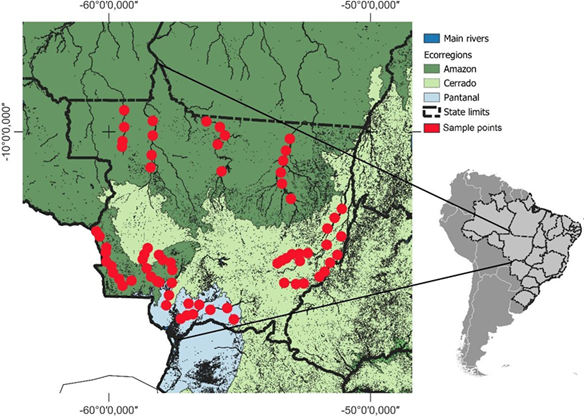
Sediment samples were collected from rivers distributed across three major hydrographic basins in Mato Grosso State, Brazil: the Amazon, the Upper Paraguay (Pantanal), and the Araguaia. These basins were selected to capture environmental variability across distinct biomes, with rivers differing in geomorphology, hydrology, and land-use pressures (Figure 1).
2.2. Sediment sampling
Surface sediments were collected using a Van Veen dredge (0-5 cm layer), which allows representative sampling of the depositional fraction. At each site, three sub-samples were obtained and homogenized to form a composite sample, minimizing micro-scale heterogeneity. Sediments were stored in pre-cleaned polyethylene containers, transported on ice, and subsequently freeze-dried in the laboratory prior to analysis.
2.3. Mercury analysis
Total mercury (HgT) concentrations were determined using a Direct Mercury Analyzer (DMA-80, Milestone), which applies thermal decomposition, catalytic conversion, amalgamation, and atomic absorption spectrophotometry (EPA Method 7473). Approximately 50-100 mg of homogenized, lyophilized sediment were analyzed in triplicate for each sample. Calibration was performed with certified reference materials (e.g., IAEA-405, estuarine sediment), and analytical precision was monitored with blanks and replicates. Detection limits for the instrument were 0.005 ng. Results are expressed as µg.kg⁻¹ dry weight.
2.4. Organic matter and C/N analysis
Organic matter content was quantified by loss-on-ignition (LOI). Subsamples of approximately 1 g were combusted at 550°C for 4 h, and weight loss was used to estimate organic matter percentage. The C/N ratio was determined from the elemental analysis of total organic carbon (TOC) and total nitrogen (TN) using a CHN analyzer (PerkinElmer 2400 Series II). Values are expressed as mass ratios (C/N).
2.5. Granulometric analysis
Sediment granulometry was determined following standard wet-sieving and sedimentation procedures (ABNT NBR 7181/2016). Fractions were separated into coarse sand (>0.5 mm), fine sand (0.05-0.5 mm), silt (0.002-0.05 mm), and clay (<0.002 mm). The relative percentage of each fraction was calculated by dry weight.
2.6. Data analysis
Descriptive statistics (mean, standard deviation, range) were computed for all variables. Differences in HgT concentrations among basins and rivers were tested using the Kruskal-Wallis test, followed by pairwise Mann-Whitney tests with Bonferroni correction for post hoc comparisons. Relationships between HgT and environmental variables (organic matter, C/N ratio) were analyzed by Generalized Linear Models (GLM, Gamma family, log link). All analyses were performed in R 4.3.2 and Python 3.11 using the packages statsmodels, scipy, and seaborn.
3. RESULTS
Total mercury (HgT) concentrations in river sediments across Mato Grosso varied widely, ranging from 1.4 to 948.1 µg.kg⁻¹, with an overall mean of 109.1 ± 165.8 µg.kg⁻¹. Organic matter content averaged 16.7 ± 7.6%, while the C/N ratio averaged 25.5 ± 12.9, reflecting substantial geochemical heterogeneity among basins and rivers (Table 1).
Summary statistics of total mercury (HgT), organic matter, and C/N ratio in sediments from rivers of Mato Grosso.
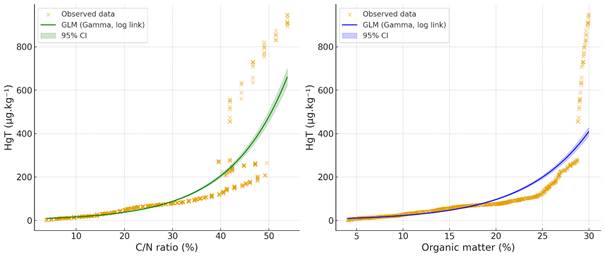
Correlation analyses showed significant positive associations between HgT and both organic matter (r = 0.50; p < 0.001) and the C/N ratio (r = 0.70; p < 0.001). Regression analyses confirmed that the C/N ratio was a stronger predictor of HgT than total organic matter (Figure 2). The GLM (Gamma family, log link) indicated that each unit increase in the C/N ratio corresponded to an 8.8% increase in HgT, while a 1% increase in organic matter was associated with a 15.5% increase in HgT concentrations.
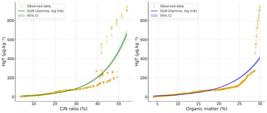
Relationship between HgT and (a) organic matter (%) and (b) C/N ratio in sediments, with GLM (Gamma, log link) regression lines and 95% confidence intervals.
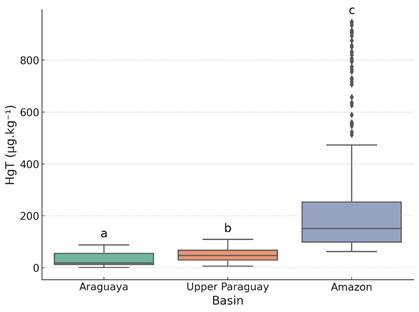
At the basin scale, significant differences were detected (Kruskal-Wallis, H = 450.7; p < 0.001). The Amazon basin showed the highest mean HgT concentrations (242.0 ± 233.4 µg.kg⁻¹), followed by the Upper Paraguay (47.9 ± 24.2 µg.kg⁻¹) and the Araguaia (29.3 ± 25.7 µg.kg⁻¹). Post hoc comparisons indicated that all three basins differed significantly from one another (Figure 3).
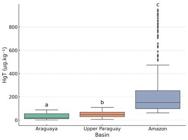
Boxplot of HgT concentrations by basin (Amazon, Upper Paraguay, Araguay), with post hoc letters indicating significant differences.
At the river level, heterogeneity was even more pronounced (Kruskal-Wallis, H = 577.6; p < 0.001). The Guaporé River exhibited the highest mean concentration (731.5 ± 151.7 µg.kg⁻¹), followed by the Xingu (233.7 ± 31.6 µg.kg⁻¹), Teles Pires (133.3 ± 26.2 µg.kg⁻¹), and Juruena (117.7 ± 35.3 µg.kg⁻¹). Intermediate values were observed in Pantanal rivers, such as the Cuiabá, Paraguai, Sepotuba, São Lourenço, and Jaurú (38-48 µg.kg⁻¹). The lowest concentrations were recorded in Araguaia tributaries, namely the Das Mortes (14.2 ± 7.1 µg.kg⁻¹) and Rio Garças (15.4 ± 3.9 µg.kg⁻¹) (Suplementary data)
The granulometric analysis indicated a consistent predominance of fine sand (56-58%), followed by coarse sand (14-16%), silt (14-16%), and clay (11-13%). This pattern was consistent across all rivers, suggesting a sedimentary environment dominated by sandy fractions. No significant differences were observed between rivers.
When compared to national legislation (CONAMA, 2012), which sets a Threshold Effect Level (TEL) of 170 µg.kg⁻¹ and a Probable Effect Level (PEL) of 486 µg.kg⁻¹, most rivers exhibited mean concentrations below the TEL. However, the Xingu River exceeded the TEL, and the Guaporé River exceeded the PEL, identifying them as areas of ecological concern (Table 2).
Comparison of mean HgT concentrations per river against Threshold Effect Level (TEL = 170 µg.kg⁻¹) and Probable Effect Level (PEL = 486 µg.kg⁻¹) from CONAMA/CCME guidelines.
4. DISCUSSION
The results of this study reveal a complex spatial mosaic of mercury contamination in rivers of Mato Grosso, reflecting the combined influence of natural biogeochemical processes and anthropogenic pressures. The wide range of HgT concentrations (1.4-948.1 µg.kg⁻¹) demonstrates that while some rivers remain relatively unaffected, others represent critical contamination hotspots. Such heterogeneity has also been documented in other tropical basins, where localized sources of Hg, coupled with differences in sediment dynamics, lead to strong spatial contrasts (Roulet et al., 2001; Bastos et al., 2006).
The Amazonian rivers, particularly the Guaporé, Xingu, Teles Pires, and Juruena, stand out with the highest concentrations, consistent with their history of artisanal gold mining, deforestation, and high organic matter inputs. These findings align with regional studies reporting elevated Hg levels in areas impacted by mining and land-use change (Lacerda and Pfeiffer, 1992; Barbosa et al., 2016). By contrast, the Araguaia basin, characterized by sandy sediments and lower organic matter retention, showed the lowest HgT levels, suggesting that natural background values for this biome are markedly lower than those for the Amazon. Pantanal rivers exhibited intermediate concentrations, consistent with their function as a sedimentary sink. This finding reinforces the idea that the Pantanal can act both as a buffer, diluting contaminants, and as a potential exporter of Hg during seasonal flood pulses, redistributing contamination downstream (Rezende et al., 2010).
Organic matter emerged as a key factor influencing Hg dynamics. The stronger relationship of HgT with the C/N ratio, compared to total organic matter, indicates that organic matter quality exerts greater control than quantity. High C/N ratios reflect more recalcitrant, terrestrially derived organic matter, which has a stronger capacity to bind Hg and reduce its mobility (Skyllberg et al., 2003). These results suggest that land-use changes altering the quality of organic input - such as deforestation, soil erosion, and replacement of natural vegetation by crops - could directly affect Hg retention and mobilization in aquatic systems.
Granulometric composition further clarifies the processes underlying Hg accumulation. The predominance of fine sand, coupled with moderate proportions of silt and clay, indicates that Hg adsorption is likely mediated by organic matter interactions rather than mineral surfaces alone (Li et al., 2024). In depositional environments of low hydrodynamic energy, this association can enhance Hg stabilization, but also increases the potential for remobilization during extreme flood events (Sun et al., 2022). This highlights the importance of considering climate variability and hydrological extremes, which are expected to intensify with climate change, in Hg risk assessments.
When benchmarked against Brazilian legislation (CONAMA Resolution 454/2012), most rivers fell below the Threshold Effect Level (TEL = 170 µg.kg⁻¹), suggesting low probability of adverse effects. However, the Xingu exceeded this limit, and the Guaporé far surpassed the Probable Effect Level (PEL = 486 µg.kg⁻¹), pointing to high ecological risk. The Guaporé, in particular, should be regarded as a critical hotspot requiring urgent attention. These results mirror international guidelines (e.g., CCME, 2002) and reinforce that Hg contamination in parts of Mato Grosso is of global concern.
The ecological implications of these findings are profound. Exceedance of TEL and PEL thresholds implies potential harm to benthic organisms, which may bioaccumulate Hg and serve as a pathway for biomagnification through the food web. Fish, the main protein source for many local communities, are particularly vulnerable. Studies in Amazonian rivers have consistently shown high levels of Hg in piscivorous fish, with direct consequences for human health (Barbosa et al., 2003; Bastos et al., 2006).
Therefore, the high sediment concentrations reported here, especially in the Guaporé and Xingu, raise concerns about trophic transfer and chronic exposure for both aquatic fauna and human populations. Once deposited, inorganic mercury can be transformed into methylmercury, a highly toxic and bioaccumulative form, which biomagnifies along food webs and reaches higher trophic levels, including piscivorous fish consumed by humans. In Amazonian riverine and indigenous communities, where fish represent a major protein source, chronic exposure to methylmercury has been associated with neurological, motor, and cognitive impairments, as well as developmental disorders and adverse maternal health outcomes (Passos and Mergler, 2008; Gibb and O’Leary, 2014; Barbosa et al., 2021). Environmentally, mercury contamination also degrades water quality and alters sediment geochemistry, affecting microbial activity, primary production, and overall aquatic biodiversity (Driscoll et al., 2013; Parks et al., 2013). These effects highlight the need for integrated monitoring approaches that link contaminant dynamics to ecological and human health risk assessments, particularly in tropical and floodplain systems where remobilization processes are intense.
From a conservation perspective, these results emphasize the urgent need for targeted management actions. Priority should be given to Amazonian rivers, particularly the Guaporé (Iténez), where trophic biomagnification and high methylation potential indicate a greater likelihood of mercury levels in fish exceeding international safety thresholds for human consumption (≥0.5 μg g⁻¹, FAO/WHO) (Pouilly et al., 2013; Lázaro et al., 2016; WWF et al., 2023). Strengthening monitoring programs in these hotspots is essential, encompassing sediments, fish, and other biota to properly assess ecological and human-health risks (Vasconcellos et al., 2022; Martoredjo et al., 2024; Lacerda et al., 2024). In addition, curbing illegal gold mining and associated deforestation is critical to reduce Hg mobilization and downstream contamination (Ferreira Neto et al., 2024; Siqueira-Gay et al., 2021). Finally, riparian forest restoration should be prioritized because it enhances sediment retention and can reduce the export of particle-bound contaminants at the catchment scale (Fachinelli et al., 2023).
These findings carry important policy implications. Brazil is a signatory of the Minamata Convention, which commits countries to reduce Hg emissions and releases. Establishing baseline values and identifying hotspots, as done in this study, provides critical evidence for compliance with these commitments. Integrating scientific data with decision-making at the state and federal levels will be key to protecting biodiversity and ensuring the health of human populations.
In summary, this study highlights that mercury contamination in Mato Grosso is not a diffuse phenomenon but a highly heterogeneous process shaped by biogeochemical interactions and anthropogenic pressures. The recognition of hotspots, the role of organic matter quality, and the influence of sediment granulometry provide valuable insights for risk assessment, monitoring, and conservation strategies. Protecting Amazonian and Pantanal rivers from further Hg contamination is essential for safeguarding biodiversity, sustaining fisheries, and securing the health of local communities in the face of ongoing environmental change.
5. CONCLUSIONS
This study provides the first integrated assessment of total mercury (HgT) in river sediments across Mato Grosso, encompassing the Amazon, Upper Paraguay (Pantanal), and Araguaia basins. Concentrations varied widely, from background levels in the Araguaia to critical hotspots in the Amazon, with the Guaporé River exceeding the Probable Effect Level (PEL) established by Brazilian and international guidelines. The findings demonstrate that mercury contamination in Mato Grosso is highly heterogeneous, shaped by basin-specific conditions, organic matter quality, sediment granulometry, and anthropogenic pressures such as deforestation and artisanal gold mining.
By combining geochemical and granulometric analyses, this study established regional baseline values and identified hotspots of contamination, providing crucial evidence for environmental monitoring and management. The strong relationship between HgT and the C/N ratio underscores the importance of organic matter quality as a key driver of Hg retention and mobilization in tropical sediments.
From a policy perspective, the results highlight the urgent need to prioritize the Guaporé and Xingu Rivers for targeted monitoring, mitigation, and conservation measures. Strengthening enforcement against illegal mining, restoring riparian vegetation, and integrating sediment monitoring with ecotoxicological assessments of fish are essential to reduce ecological and human health risks.
In the broader context, these findings support Brazil’s commitments under the Minamata Convention (Brasil, 2018) by establishing lines of evidence for mercury management in freshwater ecosystems. Future research should focus on linking sediment contamination to bioaccumulation in aquatic biota, assessing temporal variability in Hg dynamics, and evaluating the impacts of climate change on mercury mobilization.
Protecting rivers from mercury contamination is not only a matter of environmental integrity but also of food security, biodiversity conservation, and public health. Mato Grosso, at the confluence of three major biomes, emerges as both a sentinel and a priority region for advancing mercury science and implementing sustainable management strategies.
Finally, it is important to acknowledge that the methodology adopted in this study presents limitations regarding sampling depth, as it focused exclusively on the superficial sediment layer. Considering the environmental behavior of mercury - especially its tendency to deposit and accumulate in deeper sediment strata over time - further studies are recommended using advanced coring techniques, such as vibrocoring, to obtain deeper sediment profiles. Such an approach would enable a more comprehensive temporal reconstruction of mercury deposition, improve the understanding of diagenetic processes, and allow for a more accurate assessment of long-term contamination trends and associated ecological and human health risks (Bloom et al., 1999; Fitzgerald and Lamborg, 2014; Yin et al., 2023).
6. DATA AVAILABILITY STATEMENT
The survey data is only available upon request.
7. REFERENCES
-
ARVOR, D. et al Combining socioeconomic development with environmental governance in the Brazilian Amazon: the Mato Grosso agricultural frontier at a tipping point. Environment, Development and Sustainability, v. 20, p. 1-22, 2018. https://doi.org/10.1007/s10668-016-9889-1
» https://doi.org/10.1007/s10668-016-9889-1 -
BARBOSA, A. C.; SOUZA, J.; DILLENBURG, C. Mercury biomagnification in fish of the Madeira River, Amazon, Brazil. Environmental Research, v. 93, n. 3, p. 250-257, 2003. https://doi.org/10.1016/S0013-9351(03)00055-7
» https://doi.org/10.1016/S0013-9351(03)00055-7 -
BARBOSA, I. A. et al Mercury in the Amazon environment: a review of the contamination of fish, people and the environment. Acta Amazonica, v. 46, n. 4, p. 387-400, 2016. https://doi.org/10.1590/1809-4392201600844
» https://doi.org/10.1590/1809-4392201600844 -
BARBOSA, A. C.; JARDIM, W. F.; DÓREA, J. G.; FOSBERG, B.; SOUZA, J. Mercury contamination in the Amazon: a public health perspective. Environmental Research, v. 197, 111080, 2021. https://doi.org/10.1016/j.envres.2021.111080
» https://doi.org/10.1016/j.envres.2021.111080 -
BASTOS, W. R. et al Mercury in the environment and riverside population in the Madeira River Basin, Amazon, Brazil. Science of the Total Environment, v. 368, n. 1, p. 344-351, 2006. https://doi.org/10.1016/j.scitotenv.2005.09.048
» https://doi.org/10.1016/j.scitotenv.2005.09.048 -
BECKERS, F.; RINKLEBE, J. Cycling of mercury in the environment: Sources, fate, and human health implications: A review. Critical Reviews in Environmental Science and Technology, v. 47, p. 693-794, 2017. https://doi.org/10.1080/10643389.2017.1326277
» https://doi.org/10.1080/10643389.2017.1326277 -
BLOOM, N. S. et al Speciation and cycling of mercury in sediments of the Amazon Basin. Biogeochemistry, v. 48, n. 2, p. 149-170, 1999. https://doi.org/10.1023/A:1006208417268
» https://doi.org/10.1023/A:1006208417268 - BRASIL. Presidencia da República. Decreto nº 9.470, de 14 de agosto de 2018. Promulga a Convenção de Minamata sobre Mercúrio, firmada pela República Federativa do Brasil, em Kumamoto, em 10 de outubro de 2013. Diário Oficial [da] União: seção 1, Brasília, DF, n. 157, p. 65, 15 ago. 2018.
- CANADIAN COUNCIL OF MINISTERS OF THE ENVIRONMENT. Canadian sediment quality guidelines for the protection of aquatic life - Mercury. Winnipeg, 2002.
- CONAMA (Brasil). Resolução nº 454 de 01 de novembro de 2012. Estabelece as diretrizes gerais e os procedimentos referenciais para o gerenciamento do material a ser dragado em águas sob jurisdição nacional. Diário Oficial [da] União: seção 1, Brasília, DF, n. 216, p. 66-69, 08 nov. 2012.
-
DRISCOLL, C. T.; MASON, R. P.; CHAN, H. M.; JACOB, D. J.; PIRRONE, N. Mercury as a global pollutant: sources, pathways, and effects. Environmental Science & Technology, v. 47, n. 10, p. 4967-4983, 2013. https://doi.org/10.1021/es305071v
» https://doi.org/10.1021/es305071v -
FACHINELLI, N. P. et al Effects of restoration and conservation of riparian vegetation on sediment export and retention: insights from the InVEST SDR model (Corumbá IV Reservoir, Brazil). Conservation, v. 4, n. 4, p. 40, 2023. https://doi.org/10.3390/conservation4040040
» https://doi.org/10.3390/conservation4040040 -
FERREIRA NETO, L. C. et al Uncontrolled illegal mining and garimpo in the Brazilian Amazon. Nature Communications, v. 15, p. 1-12, 2024. https://doi.org/10.1038/s41467-024-54220-2
» https://doi.org/10.1038/s41467-024-54220-2 -
FITZGERALD, W. F.; LAMBORG, C. H. Geochemistry of mercury in the environment. In: HOLLAND, H. D.; TUREKIAN, K. K. (eds.). Treatise on Geochemistry. 2. ed. Oxford: Elsevier, 2014. v. 9, p. 91-129. https://doi.org/10.1016/B978-0-08-095975-7.00905-8
» https://doi.org/10.1016/B978-0-08-095975-7.00905-8 -
GIBB, H.; O’LEARY, K. G. Mercury exposure and health impacts among individuals in the artisanal and small-scale gold mining community: a comprehensive review. Environmental Health Perspectives, v. 122, n. 7, p. 667-672, 2014. https://doi.org/10.1289/ehp.1307864
» https://doi.org/10.1289/ehp.1307864 -
JUNK, W. et al Biodiversity and its conservation in the Pantanal of Mato Grosso, Brazil. Aquatic Sciences, v. 68, p. 278-309, 2006. https://doi.org/10.1007/s00027-006-0851-4
» https://doi.org/10.1007/s00027-006-0851-4 -
LÁZARO, W. L. et al Waterscape determinants of net mercury methylation in a tropical wetland (Guaporé River). Environmental Research, v. 147, p. 108-115, 2016. https://doi.org/10.1016/j.envres.2016.01.030
» https://doi.org/10.1016/j.envres.2016.01.030 -
LACERDA, L. D. et al A 35-year record (1987-2022) of mercury in Amazonian fish (Upper Madeira Basin). Toxics, v. 12, n. 2, p. 144, 2024. https://doi.org/10.3390/toxics12020144
» https://doi.org/10.3390/toxics12020144 - LACERDA, L. D.; PFEIFFER, W. C. Mercury grom Goldmining in the Amazon Environment: an Overview. Química Nova, v. 15, n. 2, p. 155-160, 1992.
-
LI, T. et al A 47.0‐kyr record of mercury deposition in lake sediments from Dahu swamp in the East Nanling Mountains, southern China: Implications for paleoclimatic and environmental changes. Journal of Quaternary Science, v. 40, 2024. https://doi.org/10.1002/jqs.3669
» https://doi.org/10.1002/jqs.3669 -
MARTOREDJO, I. et al Trends in mercury contamination among humans and aquatic biota in the Amazon. Toxics, v. 12, n. 3, p. 204, 2024. https://doi.org/10.3390/toxics12030204
» https://doi.org/10.3390/toxics12030204 -
MASON, R. P.; FITZGERALD, W. F.; MOREL, F. M. M. The biogeochemical cycling of elemental mercury: anthropogenic influences. Geochimica et Cosmochimica Acta, v. 58, n. 15, p. 3191-3198, 1994. https://doi.org/10.1016/0016-7037(94)90046-9
» https://doi.org/10.1016/0016-7037(94)90046-9 -
MORENO-BRUSH, M.; MCLAGAN, D.; BIESTER, H. Fate of mercury from artisanal and small-scale gold mining in tropical rivers: Hydrological and biogeochemical controls. A critical review. Critical Reviews in Environmental Science and Technology, v. 50, p. 437-475, 2020. https://doi.org/10.1080/10643389.2019.1629793
» https://doi.org/10.1080/10643389.2019.1629793 -
OBRIST, D. et al A review of global environmental mercury processes in response to human and natural perturbations: Changes of emissions, climate, and land use. Ambio, v. 47, p. 116-140, 2018. https://doi.org/10.1007/s13280-017-1004-9
» https://doi.org/10.1007/s13280-017-1004-9 -
PASSOS, C. J. S.; MERGLER, D. Human mercury exposure and adverse health effects in the Amazon: a review. Cadernos de Saúde Pública, v. 24, supl. 4, p. S503-S520, 2008. https://doi.org/10.1590/S0102-311X2008001600011
» https://doi.org/10.1590/S0102-311X2008001600011 -
PARKS, J. M. et al The genetic basis for bacterial mercury methylation. Science, v. 339, n. 6125, p. 1332-1335, 2013. https://doi.org/10.1126/science.1230667
» https://doi.org/10.1126/science.1230667 -
PIERANGELI, M. et al Teores de As, Pb, Cd e Hg e fertilidade de solos da região do Vale do Alto Guaporé, sudoeste do estado de Mato Grosso. Acta Amazonica, v. 39, p. 61-70, 2009. https://doi.org/10.1590/S0044-59672009000100006
» https://doi.org/10.1590/S0044-59672009000100006 -
POUILLY, M. et al Trophic structure and mercury biomagnification in tropical fish assemblages, Iténez River (Guaporé Basin). PLOS ONE, v. 8, n. 5, e65054, 2013. https://doi.org/10.1371/journal.pone.0065054
» https://doi.org/10.1371/journal.pone.0065054 -
REZENDE, C. E. et al The role of the Pantanal in South America: an ecological synthesis. Ecology of Freshwater Fish, v. 19, n. 3, p. 374-386, 2010. https://doi.org/10.1111/j.1600-0633.2010.00417.x
» https://doi.org/10.1111/j.1600-0633.2010.00417.x -
ROULET, M. et al Spatio-temporal variations of mercury concentrations in surface waters of the Amazon Basin, Brazil. Science of the Total Environment, v. 260, p. 73-86, 2001. https://doi.org/10.1016/S0048-9697(00)00643-9
» https://doi.org/10.1016/S0048-9697(00)00643-9 -
SILVA, F. et al Assessing background levels of trace elements in soils of Mato Grosso (Brazil) for environmental and food security. Catena, v. 244, 2024. https://doi.org/10.1016/j.catena.2024.108267
» https://doi.org/10.1016/j.catena.2024.108267 -
SIQUEIRA-GAY, J. et al The outbreak of illegal gold mining in the Brazilian Amazon boosts deforestation. Regional Environmental Change, v. 21, n. 28, 2021. https://doi.org/10.1007/s10113-021-01761-7
» https://doi.org/10.1007/s10113-021-01761-7 -
SKYLLBERG, U. et al Binding of mercury(II) to reduced sulfur in soil organic matter along upland-peat soil transects. Journal of Environmental Quality, v. 32, n. 5, p. 1505-1515, 2003. https://doi.org/10.2134/jeq2003.1505
» https://doi.org/10.2134/jeq2003.1505 -
SUN, R. et al Mercury Isotope Variations in Lake Sediment Cores in Response to Direct Mercury Emissions from Non-Ferrous Metal Smelters and Legacy Mercury Remobilization. Environmental Science & Technology, v. 16, n. 12, 2022. https://doi.org/10.1021/acs.est.2c02692
» https://doi.org/10.1021/acs.est.2c02692 - UNITED NATIONS. Environment Programme. Global Mercury Assessment 2018. Geneva: UNEP, 2019.
-
VASCONCELLOS, A. C. S. et al Health risk assessment from mercury-contaminated fish in the Rio Branco Basin (Roraima, Amazon). International Journal of Environmental Research and Public Health, v. 19, n. 17, 10754, 2022. https://doi.org/10.3390/ijerph191710754
» https://doi.org/10.3390/ijerph191710754 - WORLD HEALTH ORGANIZATION. Exposure to mercury: a major public health concern. Geneva: WHO, 2007.
-
WWF; FIOCRUZ; ISA; IEPÉ; GREENPEACE. New study shows daily intake of mercury exceeds safe limits in six Amazon states. May, 31 2023. Available in: Available in: https://www.wwf.org.br/en/?86000/New-study-shows-daily-intake-of-mercury-exceeds-safe-limits-in-six-Amazon-states Access in: Oct. 2025.
» https://www.wwf.org.br/en/?86000/New-study-shows-daily-intake-of-mercury-exceeds-safe-limits-in-six-Amazon-states -
YIN, R.; ZHANG, H.; WANG, Z.; LIU, C.; WANG, Z. Historical records and ecological risk of mercury in sediments from freshwater reservoirs. Science of the Total Environment, v. 857, 159550, 2023. https://doi.org/10.1016/j.scitotenv.2022.159550
» https://doi.org/10.1016/j.scitotenv.2022.159550 -
YUAN, W. et al Fate and transport of mercury through waterflows in a tropical rainforest. Environmental Science & Technology, v. 58, n. 11, 2024. https://doi.org/10.1021/acs.est.3c09265
» https://doi.org/10.1021/acs.est.3c09265
Edited by
-
Editor-in-Chief:
Editor-in-Chief: Nelson Wellausen Dias https://orcid.org/0000-0002-9507-9211