
 Spatial analysis of syphilis in pregnancy and congenital syphilis in the state of Espírito Santo, Brazil, 2011-2018
Objective: to analyze the spatial distribution of syphilis cases in pregnancy and congenital syphilis cases, from 2011 to 2018.
Methods: this was an ecological study applying spatial analysis of syphilis cases in pregnancy and congenital syphilis reported on the Notifiable Diseases Information System; TerraView 4.2.0 software was used.
Results: seventy-eight municipalities were analyzed, and evidence of a significant cluster was found for syphilis in pregnant women (Moran index=0.38; p=0.01) and for congenital syphilis (Moran index=0.31; p=0.01) in the greater Vitória region and north coast municipalities; along the north and metropolitan coastal regions some 30 municipalities were identified as having higher occurrence of the outcomes, as well as some 14 municipalities with a high proportion of congenital syphilis and a low proportion of syphilis in pregnancy.
Conclusion: the study identified places where interventions and prenatal care professional training need to be channeled, with the aim of controlling syphilis in pregnancy and congenital syphilis.
Keywords:
Syphilis; Syphilis, Congenital; Epidemiology, Descriptive; Spatial Analysis
 Thumbnail
 Thumbnail
 Thumbnail
 Thumbnail
 Thumbnail
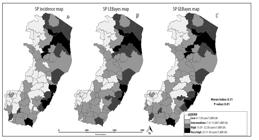
 Map A: crude incidence.Map B: adjusted and/or smoothed incidence using the local Bayesian method (LEBayes).Map C: adjusted incidence using the global Bayesian method (GEBayes).
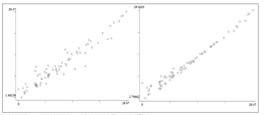
 Map A: crude incidence rate correlated with the incidence rate adjusted using the local Bayesian method (LEBayes).Map B: crude incidence rate correlated with the incidence rate adjusted using the global Bayesian method (GEBayes).
 Map A: crude incidenceMap B: incidence adjusted using the local Bayesian method (LEBayes)Map C: incidence adjusted using the global Bayesian method (GEBayes)
 Map A: crude incidence using the local Bayesian method (LEBayes).Map B: crude incidence using the global Bayesian method (GEBayes).
