|
Line I: Preparedness |
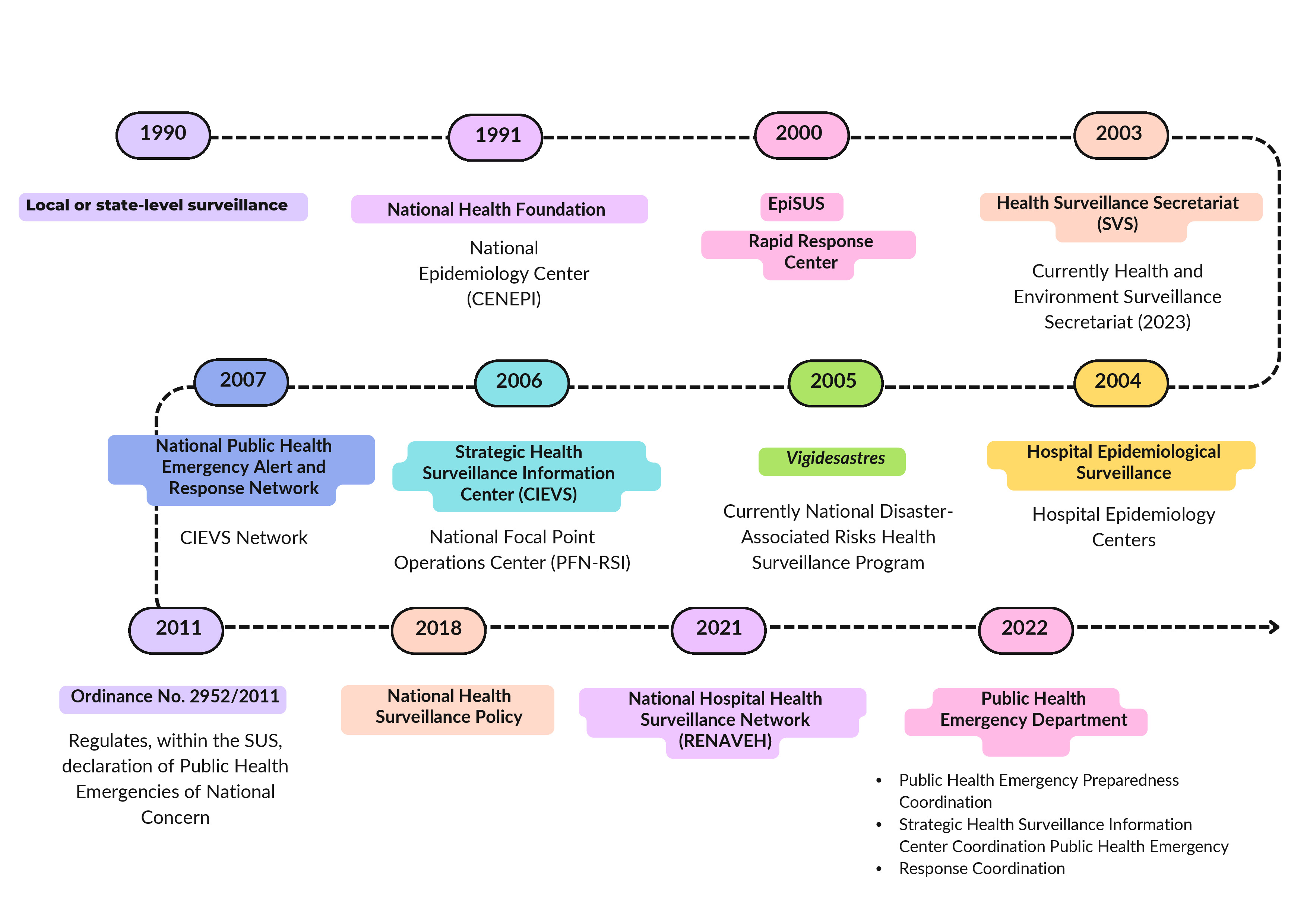
EpiSUS is a training program in epidemiology applied to SUS services, with a predominance of practical activities, focusing on epidemiological reasoning, data analysis, detection, response and communication. Characterized as a pyramidal system, offered at three levels (advanced, intermediate and fundamental), in addition to providing training for tutors in field epidemiology. |
| The Public Health Emergencies Training Program promotes training and enhancement of professionals working in health services through continuing and permanent education, on the three levels of SUS management - preparation, surveillance and response to public health emergencies. |
| Contingency plans aim to guide the organizational structure, operational procedures and responsibilities for responding to emergencies, based on a decision-making roadmap. |
| Simulations and other types of training serve to assess the organizational capacity of contingency plans, thus allowing identification of vulnerabilities and gaps within the response system. |
| Medicines and strategic supplies are bought and stored in order to maintain essential health services. These kits must be sent within 24 hours, depending on the emergency, and must consist of medicines and strategic supplies with the capacity to serve up to 500 people for a period of three months. |
|
Line II: Surveillance |
The National Strategic Health Surveillance Information Center (CIEVS Nacional) aims to detect, verify, evaluate, monitor and communicate rumors and events that may constitute health emergencies of national concern. |
| The CIEVS network, made up of decentralized CIEVS units in the states and municipalities, acts as a sentinel for public health events, expanding the capacity for early detection of emergencies. These centers are integrated by technology and information and communication, thus allowing a coordinated response. |
| The Vigidesastres program monitors, for example, the number of homeless, displaced and affected people and deaths; municipalities in states of alert or calamity; and events secondary to the disaster, such as trauma and infectious diseases that require the development of a contingency plan. |
| Health surveillance actions in environmental and epidemiological monitoring of events resulting from chemical, biological, radiological and nuclear agents. |
| Hospital Epidemiology Centers detect health problems or notifiable diseases through active searches in strategic locations in hospitals, such as the emergency room, inpatient units, laboratories and outpatient clinics. Other important resources in the hospital are the pharmacy, the medical records service and the anatomic pathology laboratory. |
| The Event Monitoring Committee discusses and assesses events of public health concern with the participation of technical areas - at the federal level. This committee meets weekly and carries out actions aimed at integrating, reviewing, sharing and discussing all monitored events. |
| The Integrated Joint Health Operations Centers are used in mass events to monitor public health emergencies, increasing the capacity for integrated responses between the three spheres of government. |
| Voluntary External Evaluation carried out by the WHO is intended to assess the country’s capacity to prevent, detect and respond quickly to risks to public health, whether natural or resulting from deliberate or accidental events. |
| The National Epidemiological Intelligence Center is made up of a multidisciplinary team, with technical and scientific support, using advanced methods and robust analyses to access and integrate health data. It aims to integrate epidemiological analysis capacity into evidence-based decision making. |
|
Line III: Response |
The Emergency Operations Center acts as a coordination structure, facilitating decision-making and ensuring the execution of actions and efficient communication during emergencies. Its characteristics include centralized decision-making and flexibility, as it is possible to adapt its functions to the size of the response required for each type of emergency. |
| Risk Communication and Community Engagement involves the exchange of clear, transparent and contextualized information about risks, with the aim of influencing informed behavior and decisions on the part of the population during an emergency. |
| Increased financial resources to fund the response to emergencies within the scope of SUS primary and specialized health care and health surveillance. |
| Rapid response teams during emergencies are made up of trained specialists and act as a task force that can be quickly mobilized. Vigidesastres, EpiSUS (advanced) and the SUS National Force are examples of teams that, among other functions, also act as rapid response teams during emergencies. |
 Historia de la implementación de la gestión de emergencias de salud pública en Brasil
 Thumbnail