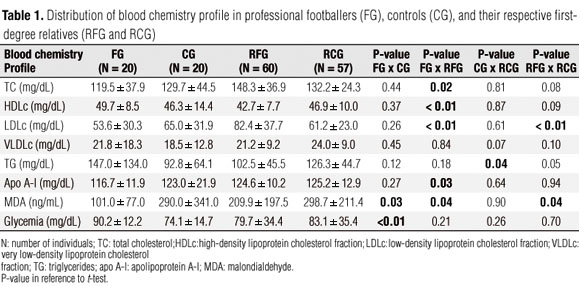
OBJECTIVE: To evaluate whether lipid profile (LP), apolipoprotein A-1 (apo A-I) and malondialdehyde (MDA) have any relationship with physical exercise by comparing the groups of footballers (FG) with sedentary individuals (CG) and their relatives (RFG and RCG). SUBJECTS AND METHODS: Twenty individuals from FG and CG, 60 from RFG, and 57 from RCG were studied. RESULTS: FG showed lower levels of total cholesterol (119.5 ± 37.9 mg/dL), LDL-cholesterol fraction (53.6 ± 30.3), apo A-I (116.7 ± 11.9), and higher level of HDL-cholesterol fraction (HDLc) (49.7 ± 8.5) compared to RFG (148.3 ± 36.9, P = 0.02; 82.4 ± 37.7, P < 0.01; 124.6 ± 10.2, P = 0.03; and 42.7 ± 7.7, P < 0.01; respectively). Moreover, FG had reduced levels of MDA (101.0 ± 77.0 ng/mL) compared to CG (290.0 ± 341.0, P = 0.03) and RFG (209.9 ± 197.5, P = 0.04). CONCLUSIONS: These results suggest an association between physical exercise and lower levels of MDA in FG. Physical activity seems to promote beneficial effects on the LP regardless of the genetic influence considering HDLc levels.
Lipids; lipoproteins; oxidative stress; physical exercise; football player