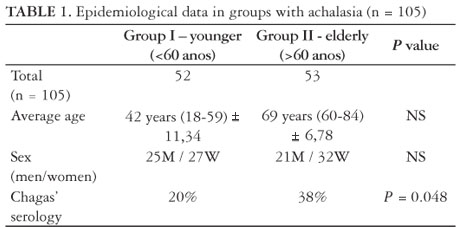
CONTEXT: Achalasia is a primary esophageal motor disorder secondary to the degeneration of ganglion cells of the inhibitory intramural myenteric plexus. It affects both sexes similarly and has two peaks of incidence, one in the 3rd to 4th decades of life and the other after 60 years of age. The effect of age on esophageal motility of patients with achalasia is not well known. Studies have shown that healthy older people, when compared to the young, have: a) a lower number of ganglion cells in the intramural myenteric plexus; b) a reduced normal relaxation of the lower esophageal sphincter; and c) a reduced esophageal peristalsis. Thus, as both age and achalasia can produce comparable degenerative changes in the intramural myenteric plexus, it is possible that advanced age could be an important factor in enhancing the clinical and manometric abnormalities commonly found in patients with achalasia. OBJECTIVES: To compare the clinical, radiological and manometric findings in young as compared to elderly (>60 years old) achalasia patients. METHODS: A retrospective study of a group of patients with untreated achalasia separated into young and elderly patients. Demographic, clinical, serology for Chagas' disease, radiological and manometric data were compared between these groups. The level of significance was P<0.05. RESULTS: The study included 105 patients, 52 young (25 M/27 F, mean age 40 years old) and 53 elderly (21 M/32 F, mean age 70 years old). The elderly group had a higher prevalence of Chagas' disease (P = 0.004) and a lower pressure of the lower esophageal sphincter [26.4 mm Hg vs 31.9 mm Hg] P = 0.001, a difference that persisted when analyzed only elderly and young patients with idiopathic achalasia. Younger patients had a higher prevalence of heartburn (P = 0.001) and chest pain (P = 0.012) than the elderly. CONCLUSION: Elderly patients with achalasia had a lower esophageal sphincter pressure than the young, even when we excluded patients with Chagas' disease but, as a group, they were less symptomatic.
Esophageal achalasia; Aged; Manometry