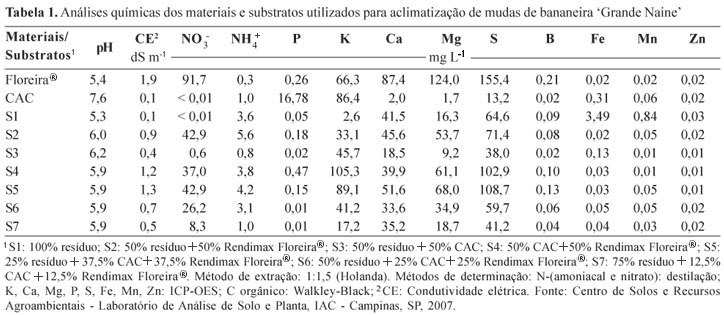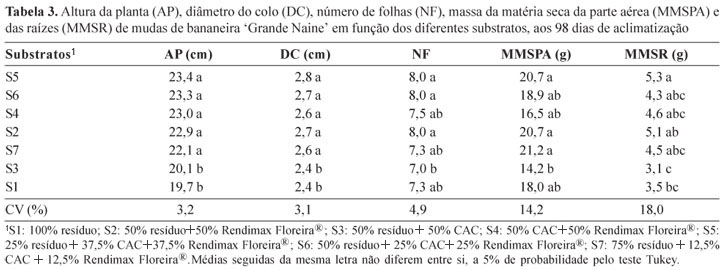
Para o rápido crescimento de mudas de bananeiras produzidas por micropropagação é necessário a utilização de substratos com adequadas características físicas, químicas e biológicas. Objetivou-se avaliar os atributos químicos e físicos de diferentes substratos contendo resíduo de mineração de areia e seu efeito sobre o desenvolvimento de mudas micropropagadas de bananeira 'Grande Naine', dispostos em delineamento em blocos ao acaso, com sete substratos e quatro repetições. Os materiais utilizados foram: resíduo de mineração de areia (RMA), Rendimax Floreira® (RF®) e casca de arroz carbonizada (CAC), com os quais se formulou os substratos: S1-100%RMA; S2-50% RMA:50% RF®; S3-50% RMA:50% CAC; S4-50% CAC:50% RF®; S5-25% RMA:37,5% CAC:37,5% RF®; S6-50% RMA:25% CAC:25% RF®; S7-75% RMA:12,5% CAC:12,5% RF®. Amostras dos materiais e dos substratos foram separadas para análises químicas e físicas. Noventa e oito dias após o transplante avaliou-se a altura, o diâmetro do colo, o número de folhas e a massa da matéria seca da parte área e das raízes das plantas. Os pHs dos substratos se encontraram na faixa adequada para o cultivo de plantas em recipientes. A CE diminuiu à medida que se aumentou a dose de RMA nos substratos. Os substratos S2, S6 e o RF® apresentaram resultados superiores para a densidade seca. Os substratos S2, S4, S5, S6 e S7 forneceram plantas superiores em altura e diâmetro do colo e, acrescidos do substrato S1, forneceram plantas superiores também no número de folhas e massa de matéria seca da parte aérea. Conclui-se que o RMA pode ser recomendado para a aclimatização de mudas micropropagadas de bananeira 'Grande Naine', desde que usado em mistura com outros materiais ou substratos, com limite máximo de 75% de inclusão.
Musa spp.; matéria orgânica; propagação