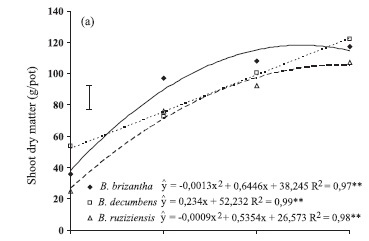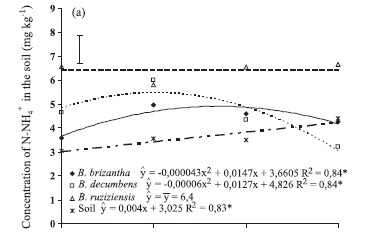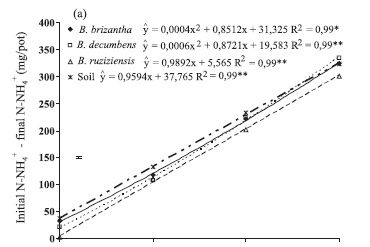
Nitrification can lead to substantial losses of the applied N through nitrate leaching and N2O emission. The regulation of nitrification may be a strategy to improve fertilizer N recovery and increase its agronomic efficiency. The objective of this study was to evaluate the inhibiting capacity of nitrification in soil by Brachiaria species. The greenhouse experiment was conducted using pots with 10 dm³ of a Red Latosol sample. The treatments consisted of the cultivation of three forage species (Brachiaria brizantha, B. ruziziensis and B. decumbens) and four n rates (0, 100, 200, and 300 mg/pot), and the control (without plants). In the absence of the forage plants, all N fertilization levels raised the N-NO3- soil levels, as a result of nitrification. The mineralization of organic matter supplied much of the N requirement of the forage plants and nitrification was influenced in the rhizosphere of B. brizantha; however, this effect was not high enough to alter the N-NH4+ level in the total soil volume of the pot.
ammonium; nitrate; nitrogen