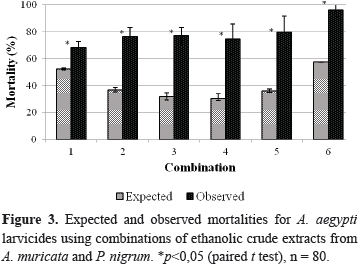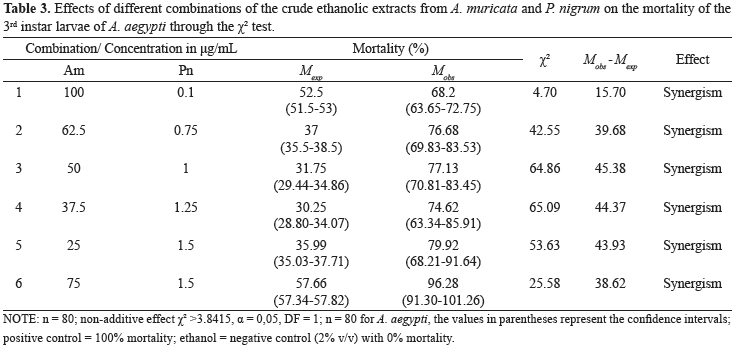
Amongst other botanical sources, Annona muricata L., Annonaceae, seeds and Piper nigrum L., Piperaceae, fruits are particularly enriched with acetogenins and piperine-related amides, respectively. These crude ethanolic extracts are potent Aedes aegypti bioactives that can kill Aedes aegypti larvae (dengue fever mosquito). A. muricata displayed a 93.48 µg/mL LC50 and P. nigrum an 1.84 µg/mL LC50. An uncommon pharmacognostical/toxicological approach was used, namely different combinations of both extracts to achieve an improved lethal effect on the larvae. The independence test (χ²) was utilized to evaluate the combination of the two crude extracts. All of the tested combinations behaved synergistically and these novel results were attributed to the completely different biochemical mechanisms of the differentiated chemical substances that were present in the two botanical sources. Besides the two above selected plants, Melia azedarach L., Meliaceae, Origanum vulgare L., Lamiaceae, and Ilex paraguariensis A. St.-Hil., Aquifoliaceae, in order of decreasing toxicity, may also be sought as potential extracts for the sake of synergic combinations.
Aedes aegypti; Annona muricata; Piper nigrum; acetogenins; piperine; synergism