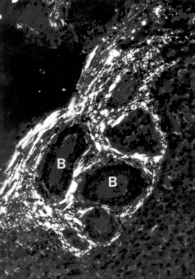
Nos últimos seis anos temos utilizado o balão de SANGESTAKEN-BLACKMORE para o tamponamento de lesões transfixantes hepáticas. Para substituir este corpo estranho, consideramos o uso de colágeno tipo I produzido na UNICAMP, o qual pode ser injetado e moldado ocupando toda a área lesada e o trajeto anfractuoso ou irregular. Desta forma, pode-se conseguir um tamponamento completo, coibindo a hemorragia e sustando a perda de bile. O colágeno será posteriormente reabsorvido não funcionando como corpo estranho. Vinte cães foram submetidos a lesão transfixante na região central do fígado, procurando simular uma lesão produzida por um projétil de arma de fogo. Quatro destes animais, não receberam tratamento e foram a óbito por choque hemorrágico. Em todos os outros 16 animais, aplicou-se o colágeno tipo I em toda a extensão do túnel formado pela lesão, através de injeção do material. Foram realizadas avaliações clínicas no pós-operatório, sendo os cães sacrificados, em grupo de quatro, aos quatro, sete, 15 e 30 dias de pós-operatório. O estudo macroscópico e o microscópico, tanto à microscopia óptica quanto à de polarização, revelou uma formação cicatricial homogênea, com regeneração hepática intensa, precoce e organizada, a partir do 7º dia de pós-operatório. Conclui-se que a aplicação do colágeno tipo I, nestes tipos de ferimentos, são de aplicação simples e segura.
Trauma; Trauma hepático; Tamponamento hepático; Colágeno tipo I; Regeneração hepática