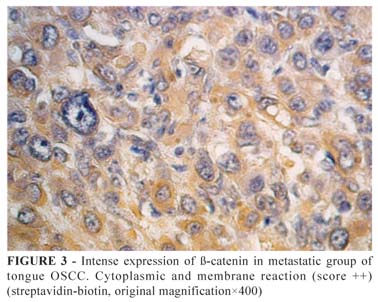
PURPOSE: It has been reported that the oral squamous cell carcinoma (OSCC) in tongue shows a more infiltrative profile, aggressive clinical course and poor prognosis, which may be related to a higher metastatic potencial. The aim of the present study was to assess the expression of β-catenin in OSCC of the tongue and its correlation with tumor metastasis. METHODS: Twenty four cases were selected and divided in two groups: metastatic group (n=12) and non-metastatic group (n=12). A semi-quantitative analysis of the β-catenin expression was performed in the invasive tumor front and cases were graded as follows: negative (score 0), positive (score +), and strongly positive (score ++). RESULTS: It was detected that 33%, 50% and 17% of the cases in metastatic group were scored 0, + and ++, respectively, and the non-metastatic group showed that 42% were scored "0", 33% scored + and 25% scored ++. Statistical analysis showed no diference between the studied groups. CONCLUSIONS: Based on these results, it can be concluded that the immunoexpression of β-catenin does not represent a valuable tool to predict metastatic potencial of OSCC in tongue.
Carcinoma, Squamous Cell; Tongue; Neoplasm Metastasis; beta Catenin; Cell Adhesion