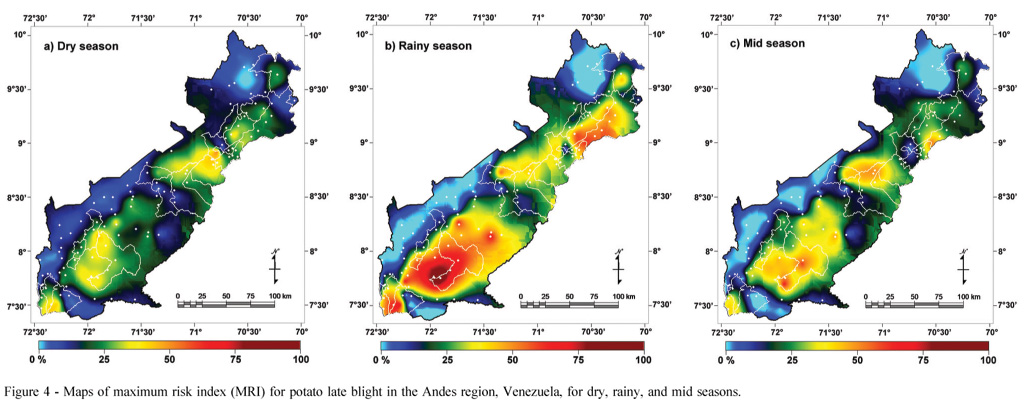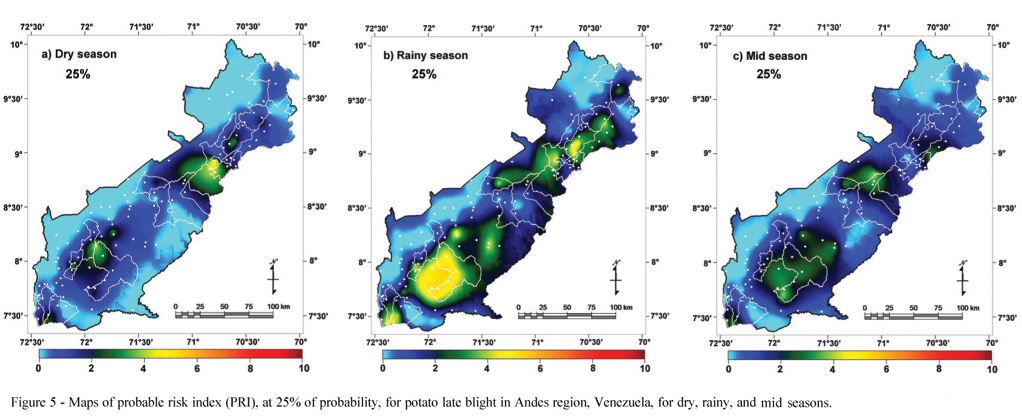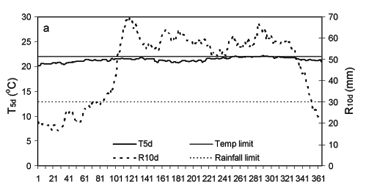
Potato is an important crop for Venezuelan agriculture. However, its production is highly affected by late blight (Phytophtora infestans), since weather is commonly favorable for this disease. The aim of this study was to determine the sowing dates of low climatic risk for potato late blight in the Andes region of Venezuela, with an agrometeorological disease model and geographical information system (GIS) tools. The disease model used in this study was developed by Hyre (1954) which requires daily rainfall and temperature data which were obtained from 106 weather stations, located at the States of Mérida, Táchira, and Trujillo, for a period of 31 years. Hyre's model was applied for all stations obtainig the following variables: number of disease favorable days (DFD); number of periods with ten consecutive favorable days, named disease occurrence (O); and number of sprays required for disease control (S). These variables were used to calculate the Maximum Risk Index (MRI) and the Probable Risk Index (PRI). The interpolation of these indexes was used to generate maps of climatic risk for each sowing date. MRI and PRI maps showed that the highest climatic risk for potato late blight occurrence was during the rainy season, from May to July, decreasing during dry and mid seasons. However, high disease risk variability was observed for all seasons. The maps generated by coupling an agrometeorological disease model and GIS also show that in great part of potato areas of Andes region the number of sprays could be reduced, but more investigations about that must be carried out.
Phytophtora infestans; Hyre's model; temperature; rainfall