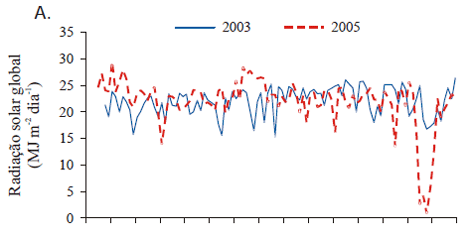
Experimento conduzido na Embrapa, em Barbalha, CE, nos anos de 2003 e 2005, objetivou a estimativa da evapotranspiração da cultura e do coeficiente de cultivo do algodoeiro BRS-200 Marrom. Sensores de radiação solar global; saldo de radiação; temperatura do ar (bulbos seco e úmido) e velocidade do vento nos níveis de 0,30 e 1,50 m acima da copa da cultura e fluxo de calor no solo foram instalados e os dados coletados por um sistema automático de aquisição de dados. A evapotranspiração da cultura (ETc) e a evapotranspiração de referência (ETo) foram estimadas pelos métodos da razão de Bowen e Penmam-Monteith, respectivamente, enquanto o coeficiente de cultivo (Kc) foi determinado pela razão ETc/ETo. A ETc da cultura variou em função de sua fenologia, obtendo-se valores médios de 3,8 mm d-1 no período da emergência a 10% da cobertura de solo (Fase I); 5,0 mm d-1 no período do crescimento vegetativo (Fase II); 5,9 mm d-1 no período do desenvolvimento reprodutivo (Fase III) e 5,4 mm d-1 no período de maturação (Fase IV). O Kc pode ser definido em função dos dias após a emergência, pela equação Kc = -0,00006 DAE² + 0,009 DAE + 0,632.
Gossypium hirsutum L.; irrigação; consumo hídrico; balanço de energia