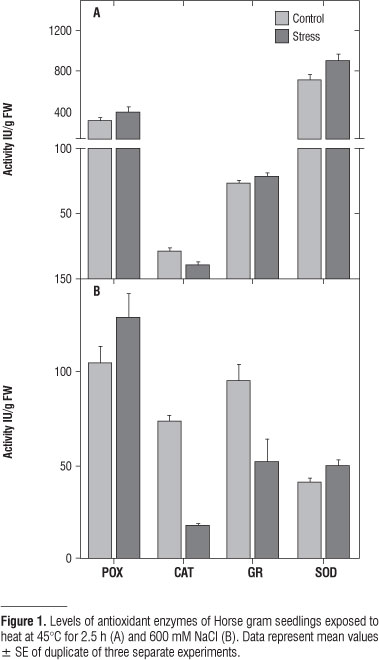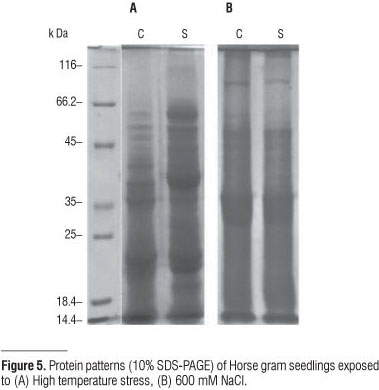
High temperature and salinity are the major ecological factors challenging crop productivity in the arid and semiarid regions of the world. Effects of high temperature (43-45°C) and salt stress (0.6 M) on Macrotyloma uniflorum (Lam.) Verdc. (Horse gram), were evaluated in terms of antioxidants and antioxidant enzymes. Both treatments caused typical stress responses in this tropical leguminosae. Oxidative stress indicators such as H2O2, TBARS, and proline were significantly elevated. Similarly, the antioxidant enzymes superoxide dismutase (SOD; EC 1.15.1.1), guaiacol peroxidase (POX; EC 1.11.1.7) and acid phosphates (AP; EC 3.1.3.2) were significantly elevated while catalase (CAT; EC 1.11.1.6) was reduced. These treatments had contrasting effects on glutathione reductase (GR; EC1.6.4.2) and β-amylase (EC 3.2.1.1). While temperature stress caused increase in GR and decrease in β-amylase, salt stress caused a counter effect. Contrast was also observed in ascorbate and glutathione which increased in temperature stress and reduced in salt stress. SDS-PAGE analysis indicated entirely different protein profiles in temperature and salt stressed seedlings. Growth rate and fresh mass were affected to same extent, relative to their controls. Taken together these data describes the similarities and peculiarities of key biochemical responses of Horse gram to high temperatures and salinity.
Antioxidant enzymes; Horse gram; Isozymes; Oxidative stress; Salinity; Stress markers