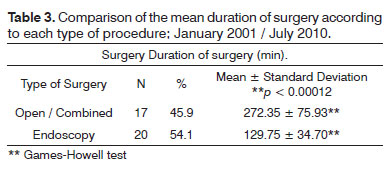
Juvenile nasopharyngeal angiofibroma is a rare benign vascular tumor of the nasopharynx. Although the treatment of choice is surgery, there is no consensus on what is the best approach. AIM: To compare surgical time and intraoperative transfusion requirements in patients undergoing endoscopic surgery versus open / combined and relate the need for transfusion during surgery with the time between embolization and surgery. MATERIAL AND METHODS: Study descriptive, analytical, retrospective study with a quantitative approach developed in the Otorhinolaryngology department of a teaching hospital. Analyzed 37 patients with angiofibroma undergoing surgical treatment. Data obtained from medical records. Analyzed with tests of the Fisher-Freeman-Halton and Games-Howell. Was considered significant if p <0.05. Study design: Historical cohort study with cross-sectional. RESULTS: The endoscopic approach had a shorter operative time (p <0.0001). There is less need for transfusion during surgery when the embolization was performed on the fourth day. CONCLUSION: This suggests that the period ahead would be ideal to perform the process of embolization and endoscopic surgery by demanding less time would be associated with a lower morbidity. This study, however, failed to show which group of patients according to tumor stage would benefit from specific technical.
angiofibroma; neoplasm staging; video-assisted surgery