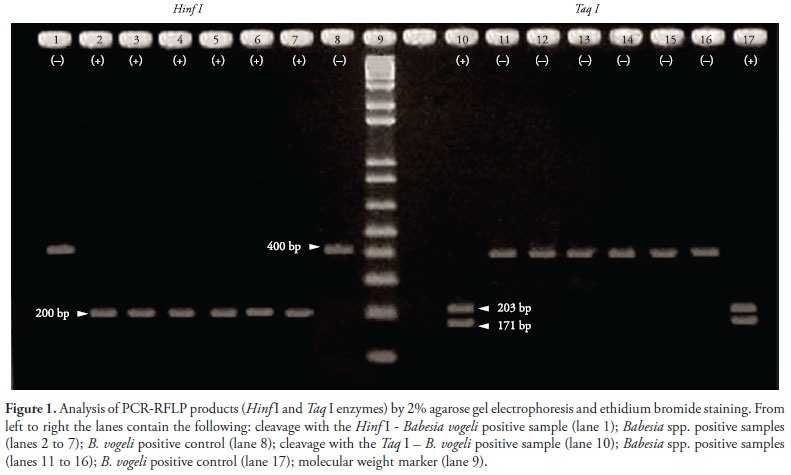
Rangelia vitalii is a protozoon described from dogs in the south and southeast regions of Brazil. It is phylogenetically related to Babesia spp. that infects dogs, but data on this enigmatic parasite is still limited. The aim of this work was to detect piroplasm species in dogs in the state of Rio de Janeiro, Brazil, by 18S rRNA gene-based PCR assay, restriction fragment length polymorphism (RFLP) and sequence analyses. Of 103 dogs examined, seven (6.8%) were positive for Babesia spp. by PCR. The amplified products were digested by restriction enzymes to differentiate the Babesia species, and one sample was identified as Babesia vogeli. The pattern observed for the other six amplification products did not match with pattern described for large Babesia infecting dogs. Sequencing analysis confirmed these six samples as R. vitalii, with high homologies (99-100%) with a sequence from south Brazil. This study confirms the presence of Babesia vogeli and Rangelia vitalii circulate in domestic dogs in Teresópolis, Rio de Janeiro, Brazil.
Babesia vogeli; Rangelia vitalii; piroplasms; dogs; PCR