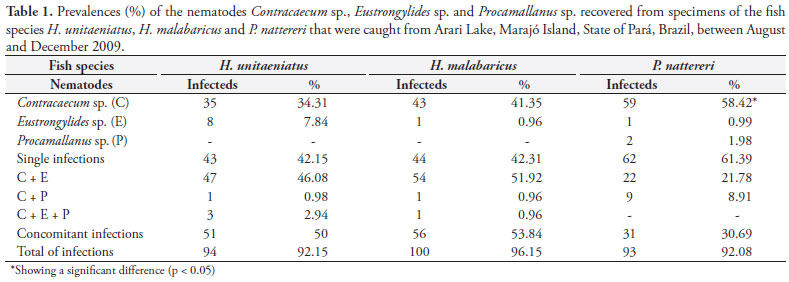
The aim of this study was to evaluate the tegument, musculature and mesentery of 102 specimens of Hoplerytrinus unitaeniatus, 104 of Hoplias malabaricus and 101 of Pygocentrus nattereri, from Arari Lake, Marajó Island, State of Pará, Brazil. Were identified the nematodes Contracaecum sp., Eustrongylides sp. and Procamallanus sp. Contracaecum sp. was the most prevalent, with rates of 84.31% (H. unitaeniatus), 95.19% (H. malabaricus), and 89.11% (P. nattereri). The highest prevalences of Eustrongylides sp. occurred in H. unitaeniatus (56.86%) and H. malabaricus (53.84%). Procamallanus sp. was only collected in the mesentery. Specimens of Eustrongylides sp. collected from the musculature were 91.9% of its population. Among the nematodes found in the mesentery, 98.34% were Contracaecum sp. with a mean intensity (MI) of 7.92 ± 8.11 (H. unitaeniatus), 8.49 ± 8.34 (H. malabaricus) and 7 ± 6.40 (P. nattereri). Contracaecum sp. presented the highest MI (8.49 ± 8.34) and mean abundance (8.09 ± 8.34). The highest MI values were observed in the mesentery. Eustrongylides sp. presented MI of 2.65 ± 3.21 (H. unitaeniatus), 3.41 ± 3.27 (H. malabaricus) and 2.17 ± 1.18 (P. nattereri). Nematodes with zoonotic potential that were found with high prevalence, shows the importance of actions by the health authorities.
Nematoda; Fish; hygienic-sanitary importance; Marajó Island; Brazil