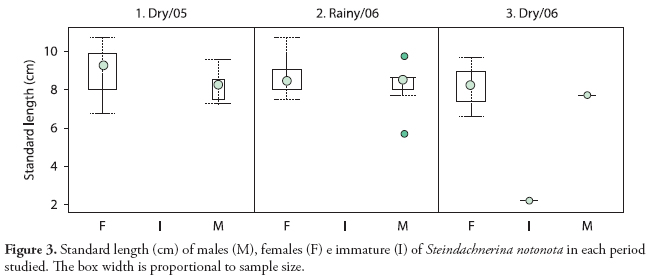
AIM: The present study investigated population structure, weight-length relationships, sex ratio and associations between feeding activity and reproductive period, diet and alimentary regime of Steindachnerina notonota at Taperoá II dam, semi-arid region of Paraíba State. METHODS: The region has the lowest pluviometric rates of Brazil. Fishes were collected during six sampling periods (October and December/2005, and March, June, August and October of 2006) encompassing two dry periods, and one rainy period. Cast, seine and gill nets were used to collect the individuals. RESULTS: Throughout the study period 120 individuals were collected, with total length ranging between 2.2 and 10.7 cm and weight between 0.31 and 43.1 g. A recruitment period, identified due to a higher abundance of small individuals in the population, was observed in the beginning of the rainy period of 2006, lasting until the beginning of the dry season. S. notonota showed a negative allometric growth type, i.e., individuals 'elongate' during their development. A significantly higher proportion of females were observed throughout the study period. The relationship between feeding and reproductive activities were not significant, given that individuals showed high feeding rates regardless of the intensity of their reproductive activities. Although the diet of S. notonota comprised several items such as plant debris, eggs, organic matter, phytoplankton, zooplankton, Nematoda, Ostracada, Conchostraca, among others, the most important feeding item was detritus, suggesting a predominant detritivirous feeding habit. CONCLUSIONS: Biological aspects of S. notonota observed in the present study suggest that this species has potential to attain great population sizes, as consequence of both diet and feeding dynamics, as well as its reproductive characteristics and growth type.
diet; Curimatidae; population structure; semi-arid; fishes