
Abstracts
The purpose of this study was to identify and quantify the magnitude of the slow component of VO2 (SC) in children during running exercise, performed at heavy intensity domain (75%delta), using two different mathematical models: a) three-exponential model and; b) deltaVO2 6-3 min. Eight healthy male children (11.92 ± 0.63 years; 44.06 ± 13.01 kg; 146.63 ± 7.25 cm; and sexual maturity levels 1 and 2), not trained, performed in different days the following tests: 1) incremental running treadmill test to determine the peak oxygen uptake (VO2peak) and the lactate threshold (LT); and 2) two transitions from baseline to 75%delta [75%D = LT + 0.75 x (VO2 peak - LT)] for six minutes on treadmill. The SC was deter mined by two models: a) three-exponential model (Exp3); and b) the VO2 difference between the sixth and the third exercise minute (deltaVO2 6-3min). The SC was expressed as the absolute (ml/min) and percent contribution (%) to the total change in VO2. The SC values determined by model Exp3 (129.69 ± 75.71 ml/min and 8.4 ± 2.92%) and deltaVO2 6-3 min (68.69 ± 102.54 ml/min and 3.6 ± 7.34%) were significantly different. So, the SC values in children during running exercise performed at heavy intensity domain (75%delta) are dependent of the analysis model (Exp3 x deltaVO2 6-3 min).
Running; Slow component; Heavy exercise; Children
O objetivo deste estudo foi verificar e quantificar a magnitude do componente lento do consumo de oxigênio (CL) em crianças submetidas a exercícios de corrida em esteira rolante, com cargas constantes de intensidade acima do limiar de lactato (75%D), utilizando para isso dois modelos de análise: a) modelo matemático com três termos exponenciais; e b) modelo deltaVO2 6-3min. Participaram do estudo oito crianças do sexo masculino (11,92 ± 0,63 anos; 44,06 ± 13,01kg; 146,63 ± 7,25cm; e níveis de maturação sexual 1 e 2), aparentemente saudáveis, não treinadas, que realizaram em diferentes dias: 1) teste incremental na esteira rolante para a determinação do consumo de oxigênio de pico (VO2pico) e do limiar de lactato (LL); e 2) dois testes de carga constante em esteira rolante durante seis minutos na intensidade de 75%delta [75%delta = LL + 0,75 x (VO2pico - LL)]. Para determinação do CL utilizaram-se: a) modelo matemático de três termos (Exp3); e b) a diferença no VO2 entre o sexto e o terceiro minuto de exercício (deltaVO2 6-3min). O CL foi expresso em valores absolutos (ml/min) e também como a contribuição percentual do CL para o aumento do VO2 no final do exercício (%CL). O CL determinado pelo modelo Exp3 (129,69 ± 75,71ml/min e 8,4 ± 2,92%) foi significantemente maior do que o obtido pelo modelo deltaVO2 6-3min (68,69 ± 102,54ml/min e 3,6 ± 7,34%). Portanto, os valores de CL obtidos em crianças durante o exercício de corrida realizado no domínio pesado (75%delta) são dependentes do modelo de análise (Exp3 x deltaVO2 6-3min).
Corrida; Componente lento; Exercício pesado; Crianças
El objetivo de este estudio ha sido el de verificar y cuantificar la magnitud del componente lento del consumo de oxígeno (CL) en niños, sometidos a ejercicios de carrera en cinta rodante, con cargas constantes de intensidad por encima del límite de lactato (75%delta), utilizando para esto dos modelos de análisis: a) modelo matemático con tres términos exponenciales; y b) modelo deltaVO2 6-3 min. Participaron del estudio 8 niños del sexo masculino (11,92 ± 0,63 años; 44,06 ± 13,01 kg; 146,63 ± 7,25 cm; y niveles de madurez sexual 1 y 2), aparentemente saludables, no entrenados, que realizaron en diferentes días: 1) Test incremental en la cinta rodante para determinar el consumo de oxígeno de pico (VO2pico) y del límite de lactato (LL); y 2) Dos tests de carga constante en cinta rodante durante seis minutos a intensidad de 75%delta [75%delta = LL + 0,75 x (VO2pico - LL)]. Para determinar el CL usamos: a) modelo matemático de tres términos (Exp3); y b) la diferencia en el VO2 entre el sexto y el tercer minuto de ejercicio (deltaVO2 6-3 min). El CL fue expresado en valores absolutos (ml/min) y también como contribución porcentual de CL para el aumento de VO2 al final del ejercicio (%CL). El CL determinado por el modelo Exp3 (129,69 ± 75,71 ml/min y 8,4 ± 2,92%) fue significativamente mayor al que fue obtenido por el modelo deltaVO2 6-3 min (68,69 ± 102,54 ml/min y 3,6 ± 7,34%). Por tanto, los valores de CL obtenidos en niños durante el ejercicio de carrera realizado en dominio pesado (75%delta) son dependientes del modelo de análisis (Exp3 x deltaVO2 6-3 min).
Carreras; Componente lento; Ejercicio pesado; Niños
ORIGINAL ARTICLE
Slow component of  O2 in children during running exercise performed at heavy intensity domain: analysis with different mathematical models*
*
Laboratório de Avaliação da Performance Humana, UNESP Rio Claro, SP.
O2 in children during running exercise performed at heavy intensity domain: analysis with different mathematical models*
*
Laboratório de Avaliação da Performance Humana, UNESP Rio Claro, SP.
Componente lento de
O2 en niños durante ejercicio arduo de carrera: análisis con base en diferentes modelos matemáticosFabiana Andrade Machado; Luiz Guilherme Antonacci Guglielmo; Camila Coelho Greco; Benedito Sérgio Denadai
ABSTRACT
The purpose of this study was to identify and quantify the magnitude of the slow component of O2 (SC) in children during running exercise, performed at heavy intensity domain (75%D), using two different mathematical models: a) three-exponential model and; b) DO2 6-3 min. Eight healthy male children (11.92 ± 0.63 years; 44.06 ± 13.01 kg; 146.63 ± 7.25 cm; and sexual maturity levels 1 and 2), not trained, performed in different days the following tests: 1) incremental running treadmill test to determine the peak oxygen uptake (O2peak) and the lactate threshold (LT); and 2) two transitions from baseline to 75%D [75%D = LT + 0.75 x (O2 peak LT)] for six minutes on treadmill. The SC was determined by two models: a) three-exponential model (Exp3); and b) the O2 difference between the sixth and the third exercise minute (DO2 6-3min). The SC was expressed as the absolute (ml/min) and percent contribution (%) to the total change in O2. The SC values determined by model Exp3 (129.69 ± 75.71 ml/min and 8.4 ± 2.92%) and DO2 6-3 min (68.69 ± 102.54 ml/min and 3.6 ± 7.34%) were significantly different. So, the SC values in children during running exercise performed at heavy intensity domain (75%D) are dependent of the analysis model (Exp3 x DO2 6-3 min).
Keywords: Running. Slow component. Heavy exercise. Children.
RESUMEN
El objetivo de este estudio ha sido el de verificar y cuantificar la magnitud del componente lento del consumo de oxígeno (CL) en niños, sometidos a ejercicios de carrera en cinta rodante, con cargas constantes de intensidad por encima del límite de lactato (75%D), utilizando para esto dos modelos de análisis: a) modelo matemático con tres términos exponenciales; y b) modelo DO2 6-3 min. Participaron del estudio 8 niños del sexo masculino (11,92 ± 0,63 años; 44,06 ± 13,01 kg; 146,63 ± 7,25 cm; y niveles de madurez sexual 1 y 2), aparentemente saludables, no entrenados, que realizaron en diferentes días: 1) Test incremental en la cinta rodante para determinar el consumo de oxígeno de pico (O2pico) y del límite de lactato (LL); y 2) Dos tests de carga constante en cinta rodante durante seis minutos a intensidad de 75%D [75%D = LL + 0,75 x (O2pico LL)]. Para determinar el CL usamos: a) modelo matemático de tres términos (Exp3); y b) la diferencia en el O2 entre el sexto y el tercer minuto de ejercicio (DO2 6-3 min). El CL fue expresado en valores absolutos (ml/min) y también como contribución porcentual de CL para el aumento de O2 al final del ejercicio (%CL). El CL determinado por el modelo Exp3 (129,69 ± 75,71 ml/min y 8,4 ± 2,92%) fue significativamente mayor al que fue obtenido por el modelo DO2 6-3 min (68,69 ± 102,54 ml/min y 3,6 ± 7,34%). Por tanto, los valores de CL obtenidos en niños durante el ejercicio de carrera realizado en dominio pesado (75%D) son dependientes del modelo de análisis (Exp3 x DO2 6-3 min).
Palabras-clave: Carreras. Componente lento. Ejercicio pesado. Niños.
INTRODUCTION
The respiratory system behavior observed during the resting-exercise transition presents variations dependent on the exertion intensity applied. In exercises of steady loads with intensities above the lactate threshold (LT), characterized from this point on as heavy exercise, we may observe an additional cost of the oxygen consumption (O2), which causes a delay in reaching a new steady state for this variable. Such overlapping of the respiratory component is called slow component (SC) of the O2(1).
The SC of the O2 has its occurrence and magnitude very diverse in relation to the type of exercise performed. The majority of work conducted with the purpose to verify and quantify the SC gives priority to exercise performed in cycle ergometer. However, the found indices in this ergometer in adults are always higher than the ones obtained during running exercise(2-4). Besides the theoretical implications, the comprehension and determination of the SC may be extremely important in the exercise prescription, once some authors have been proposing that the maximal tolerance of the performed exertion above the lactate steady maximal phase or critical power (~80-85%O2max), may be dependent on the SC behavior(5). Among other applications(5), this aspect may be important for the exercise prescription in children and adolescents, since several studies have verified that the improvement in the aerobic ability in this population seems to be dependent on the utilization of exercise intensities (> 80-85%O2max)(6) where SC may be present.
Nonetheless, few studies have analyzed the occurrence of SC and the factors that may determine it in children and adolescents. Armon et al.(7) verified the lack of occurrence of SC of O2 in approximately 50% of the children analyzed in his study. Among the ones who presented the phenomenon, a smaller magnitude in relation to adults was verified for indices expressed both in l/min and in ml/kg/min, besides not demonstrating increase with the exertion intensity. Armon et al.(7) suggested that the lack of occurrence of SC of O2 is due to the fact that children present lower concentrations of lactate in relation to adults. Similar results were obtained by Williams et al.(8) during exercise on treadmill. In this study, where the exercise was performed at 50%D (50% of the difference between the LT and the O2max), the magnitude of the SC expressed in absolute (115,9 ± 7 ml/min vs. 18,6 ± 18,9 ml/min) and relative values (8,3 ± 1,0% vs. 0,9 ± 1,2%) to the increase of the O2 for the intensity of performed exercise (gain), was significantly higher in men than in boys, respectively. The adults also obtained higher alterations in the blood lactate concentrations at the end of the exercise. However, Fawkner and Armstrong(9) verified relative values of SC (~10%) fairly higher than the ones in the study by Williams et al.(8) in boys (10,6 years) during exercise performed at 40%D in cycle ergometer. According to what has been discussed before, such antagonic data could be explained, at least partly, by the different types of exercises that were analyzed in the study by Williams et al.(8) and Fawkner and Armstrong(9) (running x cycling, respectively).
Some researchers have used a criterion that considers a strict time interval in order to estimate the magnitude of the SC with the purpose to determine and quantify this variable. Specifically, the difference of the O2 between the sixth minute and the third minute (DO2 6-3 min) of exercise is used as index for that matter(2,10-11). In this criterion, it is assumed that the O2 would only reach the index corresponding to the load after three minutes of exercise. Nonetheless, mathematical analyses which used two or three exponential terms have demonstrated that the SC of the O2 may initiate before the third minute of exercise. Such fact leads to a conclusion that other methods of verification and quantification are needed not to underestimate its value, considering other respiratory behavior characteristics during the resting-exercise transition of steady intensities above the LT(12-13). These different criteria could partly justify the antagonic data obtained by Armon et al.(7) and Fawkner and Armstrong(9) during exercise in cycle ergometer. Thus, it is possible to raise the hypothesis that not only the type of exercise, but also the applied criteria, may influence in the characterization of the slow component of O2 in children. Despite of that, one may consider that studies that have analyzed the influence of different criteria in the calculation of the SC of O2 in children during running performed at heavy intensity domain were not found (> LT). Therefore, the aim of this study was to verify and quantify the magnitude of the slow component of O2 in children submitted to running exercise on treadmill, with steady loads of intensity above the LT (75%D), using for that matter two models of analysis: a) mathematical model with three exponential terms and; b) DO2 6-3 min model.
METHODS
Subjects
Eight male children apparently healthy participated in the study (age = 11,92 ± 0,63 years; body weight = 44,06 ± 13,01 kg; height = 146,63 ± 7,25 cm), with sexual maturation 1 and 2 (pubic hair growth) determined according to the model proposed by Tanner(14). It was verified through a questionnaire that the children were regularly engaged in School Physical Education classes, besides performing other practice with working load of approximately 3 h/week. However, none of the participants were inserted in competitive training of any kind. Each participant was informed about the experiment procedures and its implications, and signed the participation consent form with his legal responsible agreement. The protocol was approved by the Research Ethics Committee of the institution where the experiment was conducted (Document CEP 22/2004).
Experimental outlining
The children paid three visits to the Laboratory of Evaluation of Human Performance, Unesp Rio Claro, SP. The first visit had the purpose to conduct a preliminary test so that the children could adapt to the ergometer and the protocol to be used, as well as to measure the body weight, height and determine the maturational status. The second visit had the purpose to conduct an incremental test in order to determine the LT and the O2peak. The third visit had the aim to conduct the steady load tests for the characterization of the kinetics of the O2 during heavy exercise (75%D).
Incremental test
The incremental test was performed on treadmill (Imbramed Millenium Super ATL, Porto Alegre, Brazil). The initial velocity was of 5 km/h with increases of 1 km/h at every 3 minutes, being kept a constant inclination equivalent to 1% during the entire test. All the stages were followed by 30 seconds of recovery. The test was kept until participants' exhaustion, who were verbally encouraged to keep exercising as far as possible. The cardiorespiratory variables were measured through a gases analyzer (Cosmed K4, Rome, Italy), collecting data breath after breath. The systems of analysis of O2 and CO2 were calibrated using the room air and a gas with known concentration of O2 and CO2 prior to each test, while the bidirectional turbine (flow measurer) was calibrated through a syringe of 3-L (Cosmed K4b2, Rome, Italy). The incremental test data were reduced to means with intervals of 15 seconds and the highest index obtained during the test, within these intervals, was accepted as the O2peak. Blood samples from the earlobe (25 µl) were collected before the test, during the pause period between the stages and its end, in order to analyze the blood lactate concentration (YSL 2300 STAT, Yellow Springs, Ohio, USA). The lactate concentrations were plotted in relation to the velocity; being considered the LT, the exercise intensity where the former occurred, and keeping lactate concentration increase above the resting concentrations as well.
Steady load tests
The children performed a 5-minute warm-up at 50% O2peak and after 5-minute rest, they performed an exercise with steady load in the intensity corresponding to 75%D. The participants performed two exercise transitions in this load, with 6 minutes duration and interval of at least 30 minutes between each transition. Blood samples (25 µl) were collected from the earlobe immediately before and after the 6 minutes of exercise in the two transitions. The difference between the final and initial lactate concentration was expressed as a delta index of the blood lactate concentration (D [La]). The intensity corresponding to 75%D was determined as:

Analysis of the kinetics of O2
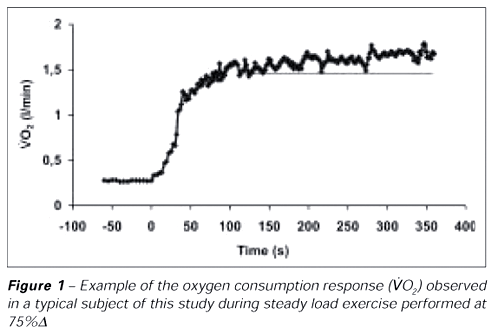
The data of breathing to O2 breathing for each exercise transition were linearly interpolated in order to obtain indices with 1 second-intervals. The data referring to the two transitions were lined and the averages for the O2 indices hence calculated with the purpose to decrease the "noise" and highlight the basic characteristics of the physiological responses. Non-linear regression techniques were used in order to adjust the O2 data after the exercise beginning with one exponential function. The mathematical model consisted of three terms, with each one representing one phase of the response. The first term began after the exercise beginning (time = 0), while the other terms began after the independent delay times.

where: O2 (t) = oxygen consumption of the t time; O2basis = oxygen consumption at the test beginning; A0, A1 and A2 are the asymptotic breadths for the three exponential terms; t0, t1 and t2 are the time constants; TA1 and TA2 are the delay times. The phase 1 term finished at the phase 2 beginning (i.e., at TA1) and the index for time (A'0) was pointed out.

The O2 at the end of phase 1 (A'0) and the breadth of phase 2 (A1) were added in order to calculate the breadth of phase 2 (A'1). The slow component breadth was determined as the increase of O2 of TA2 until the end of the exercise (A'2), instead of the asymptotic index (A2), since it frequently presents indices above the physiological limits(12). The slow component was calculated in relative indices as well.

An additional measurement of the slow component was considered as the difference in the O2 between the indices of the sixth (mean index between 5,75 and 6,0 min) and third minute of exercise (mean index between 2,75 and 3,0 min of exercise) (DO2 6-3 min).
Statistical analysis
The indices are presented as mean ± standard deviation. The Wilcoxon test was used in order to compare the SC indices of O2 (absolute and relative) by the two different methods, adopting significance level p < 0,05.
RESULTS
In table 1 the mean indices ± SD of the O2peak and its respective velocity (O2peak); of the O2 corresponding to the LT intensity; of the maximal heart rate (HRmax) and of the peak lactate obtained during the incremental test are found.
In table 2 the mean ± DP indices of the velocity related to 75%D and its respective percentage of the O2peak; of the HR (mean of the last minute of each transition) and of the D[La] obtained during the steady intensity test, are found.
The kinetics parameters of the O2 derived from the analysis with three exponential terms are found in table 3.
The absolute (ml/min) and relative (%) indices of the SC obtained in the two methods of analysis are presented in figure 2. The absolute and relative indices of SC were significantly lower through the DO2 6-3 method than through the method with three exponential terms.
DISCUSSION
The aim of this study was to verify and quantify the magnitude of the SC of O2 in children submitted to running exercises on treadmill, with steady loads of intensity above the LT (75%D), using for this matter two models of analysis: a) mathematical model with three exponential terms; and b) DO2 6-3 min model. Our main finding was that the SC indices, in the studied conditions, are dependent on the model of analysis used (exponential model with three terms x DO2 6-3 min). Thus, children submitted to steady loads exertion in running with intensities above the LT present the occurrence of overlapping of oxygen consumption (SC). Although the indices found can be specific and characteristic of this age group and the exercise mode, there is a clear occurrence of this respiratory phenomenon, generating hence a delay in reaching a new steady status of this behavior in the intention of fulfilling the needs imposed by the exercise.
Our results corroborate the ones found by Fawkner and Armstrong(9) who using an exponential model with two terms, clearly identified the occurrence of the SC (100 ± 60 ml/min and 9,4 ± 4,6%) in children with ages between 10 and 11 years, submitted to a heavy exercise protocol of steady loads in cycle ergometer. On the other hand, our results are different from the ones obtained by Armon et al.(6) who verified the lack of occurrence of the SC of O2 in the majority of the children analyzed during exercise of steady load in cycle ergometer. Armon et al.(7) used in their study a model of exponential analysis in order to determine the SC, considering that this model presented linear relation fairly consistent (73%) with the analysis of the increase of O2 between the third and sixth minute of exercise. Thus, one may initially raise the hypothesis that the disagreements between the studies conducted with children of 10 to 11 years are more due to the model of analysis of the SC than to the exercise mode (running x cycling).
Billat et al.(2) characterized the SC as the difference in O2 between the third and sixth minute of exercise of heavy intensity, assuming that close and from that time, it is possible to observe the appearance of the SC. Some studies used hence, the criterion of time interval 6-3 minutes in order to estimate the magnitude of the SC(10-11). Nonetheless, mathematical models more expressive have demonstrated that the SC of O2 begins before the third minute of exercise, leading to believe that the determination through the DO2 6-3 minutes method may underestimate the real indices of this parameter in adults(12-13).
To our knowledge, this study was the first to identify that the model of analysis (mathematical model with three exponential terms x DO2 6-3 min model) in children, modifies the characterization of the SC, with the DO2 6-3 min model probably underestimating its magnitude. Such behavior may be clearly explained when it is verified that the beginning of the SC occurred after approximately 2 minutes of exercise (TD2 = 129 sec), before hence, the time used in the DO2 6-3 model.
The SC indices found in our study cannot, in principle, be directly compared with the ones obtained in other studies conducted with children in running. Besides the differences in models of analysis, no data of the SC were found in the intensity analyzed in this study (75%D). In adults, when using the same exercise mode (running), model of analysis (three components) and intensity (75%D), Carter et al.(4) verified absolute indices (301,5 ± 58,3 ml/min) fairly higher to the ones found in the present study (129,69 ± 75,71 ml/min). However, when the relative indices are analyzed, which in our opinion is the most appropriate way of comparison, the ones obtained by Carter et al.(4) are very similar to the ones in our study (9,6 ± 1,2 x 8,49 ± 2,92%, respectively). Thus, one may suggest that at least for running, the SC indices expressed in relative indices do not seem to depend on chronological age. It is worth mentioning yet that Fawkner and Armstrong(9) verified during a longitudinal follow-up (2 years), that the SC (absolute and relative), increased significantly between the 10,6 and 12,6 years during heavy exercise (40%D) performed in cycle ergometer. Interestingly, some studies conducted in adults with different aerobic training levels, have verified that the SC (absolute and relative) is higher during heavy exercise in cycling than in running(2,4). Therefore, one may also hypothesize that the SC seems to be dependent on the interaction between the exercise type and the chronological age.
Some studies mention that the occurrence and the magnitude of the SC would be related to the accumulation of blood lactate during heavy exercise(15-16). Others verified low correlation between the variables associated to SC and blood lactate during exercise on treadmill and bicycle, though(2). In children, one of the hypothesis pointed for the lack and/or little magnitude of the SC of O2 during heavy exercise, would be due to reason that they present lower concentrations of blood lactate in relation to adults. Nevertheless, our indices of D[La] (2,02 ± 1,24 mM) are lower than the ones found by Carter et al.(4) in adults (4,0 ± 0,5 mM), suggesting that the relation between accumulation of lactate and SC may not exist, once the relative indices of SC were similar between the studies.
Therefore, we conclude that there is occurrence of SC of O2 in children submitted to running exercise on treadmill under heavy intensity; being these indices similar to the ones found in exercised adults under the same conditions. Concerning the comparison of the two methods of analysis (mathematical model with three exponential terms and DO2 6-3 min model), we observed significant statistical differences for the SC indices, leading us to agree with the existing literature which mentions underestimation of these indices when simpler models are used for analysis.
REFERENCES
Received in 17/8/05. Final version received in 3/5/06. Approved in 19/7/06.
All the authors declared there is not any potential conflict of interests regarding this article.
- 1. Denadai BS, Caputo F. Efeitos do treinamento sobre a cinética do consumo de oxigênio durante o exercício realizado nos diferentes domínios de intensidade de esforço. Motriz. 2003;9:1-7.
- 2. Billat VL, Richard R, Binsse VM, Koralsztein JP, Haouzi P. The VO2 slow component for severe exercise depends on type of exercise and is not correlated with time to fatigue. J Appl Physiol. 1998;85:2118-24.
- 3. Jones AM, McConnell AM. Effect of exercise modality on oxygen uptake kinetics during heavy exercise. Eur J Appl Physiol. 1999;80:213-9.
- 4. Carter H, Jones AM, Barstow TJ, Burnley M, Williams C, Doust JH. Oxygen uptake kinetics in treadmill running and cycle ergometry: a comparison. J Appl Physiol. 2000;89:899-907.
- 5. Jones AM, Carter H. Oxygen uptake dynamics: from muscle to mouth An introduction to the symposium. Med Sci Sports Exerc. 2005;37:1542-50.
- 6. Baquet G, van Praagh E, Berthoin S. Endurance training and aerobic fitness in young people. Sports Med. 2003;33(15):1127-43.
- 7. Armon Y, Cooper DM, Flores R, Zanconato S, Barstow TJ. Oxygen uptake dynamics during high-intensity exercise in children and adults. J Appl Physiol. 1991; 70:841-8.
- 8. Williams CA, Carter H, Jones AM, Doust JH. Oxygen uptake kinetics during treadmill running in boys and men. J Appl Physiol. 2001;90:1700-6.
- 9. Fawkner SG, Armstrong N. Longitudinal changes in the kinetic response to heavy-intensity exercise in children. J Appl Physiol. 2004;97:460-6.
- 10. Bohnert B, Ward SA, Whipp BJ. Effects of prior arm exercise on pulmonary gas exchange kinetics during high-intensity leg exercise in humans. Exp Physiol. 1998;83:557-70.
- 11. Womack CJ, Flohr JA, Weltman A, Gaesser G. The effects of a short-terms training program on the slow component of VO2 J Strength Cond Res. 2000;14: 50-3.
- 12. Barstow TJ. Characterization of VO2 kinetics during heavy exercise. Med Sci Sports Exerc. 1994;26:1327-34.
- 13. Bearden SE, Moffatt RJ. VO2 kinetics and the O2 deficit in heavy exercise. J Appl Physiol. 2000;88:1407-12.
- 14. Tanner JM. Growth and adolescence. Oxford: Blackwell, 1962.
- 15. Casaburi R, Storer TW, Ben-Dov I, Wasserman K. Effect of endurance training on possible determinants of VO2 during heavy exercise. J Appl Physiol. 1987; 62:199-207.
- 16. Roston WL, Davis JA, Cunningham DA, Efros RM, Wasserman K. Oxygen uptake kinetics and lactate concentrations during exercise in humans. Am Rev Respir Dis. 1987;135:1080-4.
Publication Dates
-
Publication in this collection
01 Apr 2008 -
Date of issue
Dec 2006
History
-
Reviewed
03 May 2006 -
Received
17 Aug 2005 -
Accepted
19 July 2006


