 Relationship between extreme daily rainfall and temperature over the Brazilian Amazon
ABSTRACT
Precipitation extremes will increase in most regions under warmer climates. However, the relationship between extreme rainfall intensity and atmospheric temperature is complex and depends on the physical processes responsible for generating the extreme rainfall event. While previous studies have explored this relationship, there is a limited understanding of regional variations and how methodological choices affect the observed patterns, particularly in the Brazilian Legal Amazon states. To address this gap, we analyze weather station data to investigate the relationship between daily precipitation (P) extremes and the corresponding daily temperatures (T) in this region, assessing whether differences in the P-T scaling method change this relationship’s pattern. Almost all 44 analyzed weather stations exhibited a monotonic decrease in the 99th percentile P with an increase in mean T, with the scaling exponent of -0.51 to +0.01%.°C-1. A single exception was observed when the whole year or the rainy season was considered, and five stations showed a positive scaling for the dry season. However, only half of the stations showed positive scaling when dew point temperature (DPT) was used, particularly in the eastern and southern Amazon. This suggests that the P-T relationship is influenced by moisture limitation. Nevertheless, P-T scaling using DPT was very sensitive to the bin size. These findings highlight the need for improved and integrated analysis to understand better the potential impacts of temperature increases on extreme rainfall events in the region. Several options for enhancing the analysis are discussed.
Keywords:
precipitation-temperature scaling; extremes events; Clausius-Clapeyron; climate sensitivity; binning method
RESUMO
Com o aquecimento global, precipitações extremas aumentarão na maioria das regiões sob climas mais quentes. No entanto, a relação entre intensidade de precipitações extremas e temperatura é complexa e depende dos processos físicos responsáveis pela geração do evento de precipitação. Embora estudos anteriores tenham explorado essa relação, há uma compreensão limitada das variações regionais e de como as escolhas metodológicas afetam os padrões observados, particularmente nos estados da Amazônia Legal Brasileira. Para abordar essa lacuna, analisamos dados de estações meteorológicas para investigar a relação entre extremos de precipitação diária (P) e as temperaturas diárias correspondentes (T) nesta região, avaliando se as diferenças no método de escala P-T alteram o padrão dessa relação. Quase todas as 44 estações meteorológicas analisadas na Amazônia exibiram uma diminuição no 99º percentil de precipitação com um aumento na temperatura média diária, com o expoente de escala variando de -0,51 a +0,01%.°C-1. Uma única exceção foi observada quando o ano inteiro ou a estação chuvosa foi considerada, e cinco estações apresentaram uma escala positiva para a estação seca. No entanto, apenas metade das estações apresentaram valores positivos quando a temperatura do ponto de orvalho (DPT) foi usada, particularmente no leste e sul da Amazônia. Isso sugere que a relação P-T é influenciada pela limitação de umidade. A escala P-T usando DPT foi muito sensível ao número de pares utilizados para os intervalos de análise. Essas descobertas destacam a necessidade de uma análise aprimorada e integrada para entender melhor os impactos potenciais dos aumentos de temperatura em eventos de precipitação extrema na Amazônia.
Palavras-chave:
escala de precipitação-temperatura; eventos extremos; Clausius-Clapeyron; sensibilidade climática; método de agrupamento
INTRODUCTION
The intensification of extreme hydrometeorological events caused by natural and anthropogenic forced climate change is of great concern to society. The projected increase in precipitation intensity under warmer climates is expected to result in more significant increases in precipitation extremes than in the mean precipitation values (IPCC 2021). In climate science, extremes are generally defined as events exceeding certain extreme thresholds, such as the maximum daily rainfall, the 99th percentile of a daily rainfall (P99) cumulative distribution function or the number of days where total rainfall exceeds a defined threshold (WMO 2009; Dunn et al. 2020). Extreme rainfall events can threaten human life, damage buildings and infrastructure, and cause loss of crops and livestock, among other impacts. The consequences depend on regional vulnerability (IPCC 2022).
The thermodynamic Clausius‐Clapeyron (CC) relationship (Carnot 1824) indicates that extreme rainfall will scale with the atmosphere’s water‐holding capacity (the capacity increases about∼6.2% for every 1°C when the atmosphere is near 20°C). However, extreme precipitation changes are more complex than the CC relationship suggests (Martinkova and Kysely 2020), as factors such as moisture transport and atmospheric dynamics play a crucial role (Neelin et al. 2022). Deviations from the CC scaling have been attributed to high temperatures’ moisture limitations, the cooling effect of extreme precipitation due to evaporation and precipitation-induced sensible heat flux, statistical biases, and binning methods that mix different rainfall types (Gao et al. 2020). In lower latitudes, thermodynamics can dominate, whereas in mid-to-high latitudes, dynamic effects can play a more significant role due to changes in atmospheric circulation (Emori and Brown, 2005). Moreover, global-scale analyses suggest that thermodynamic processes do not always amplify precipitation intensity, as factors like lapse rate and pressure can suppress deep convection, while vertical motion remains a key driver of extreme rainfall frequency (Gu et al. 2023).
Therefore, the relationship between temperature and precipitation intensity does not necessarily imply cause and effect, with warmer temperatures potentially associated with different synoptic systems and, thus, different meteorological or precipitation regimes (Hardwick Jones et al. 2010). Additionally, some studies indicated that dew point temperature drives extreme precipitation, with the direction of causality reversed only for the storm’s peak intensity (e.g., Ali and Mishra 2017 ; Barbero et al. 2018).
Studies based on in‐situ data show different results depending on the geographical location, season, and timescale and on the physical processes responsible for generating the extreme rainfall event (Berg et al. 2009; Lenderink and van Meijgaard 2010; Hardwick Jones et al. 2010; Mishra et al. 2012; Sharma and Mujumdar 2019). Utsumi et al. (2011) showed a global tendency for a monotonic increase of the P99 intensity on wet days with an increase in daily surface air temperature at very high latitudes (>55°N); a peak‐like structure for mid‐latitudes (20°-55°) and a monotonic decrease in the tropics (20°N-20°S). However, the study included only a few data from the tropics due to the limited availability of rainfall gauging stations with long, high‐quality records. The monotonic decrease in the tropics was observed in studies like Maeda et al. (2012) in Brazil and Hardwick Jones et al. (2010) in Australia. A peak shape can also be observed due to two effects (Lepore et al. 2015): moisture availability may act as a limiting agent in the scaling of extreme rainfall at high temperatures, as the dew point temperature declines (Berg et al. 2009; Hardwick Jones et al. 2010) and due to the limited resolution, as rainstorm duration is often sub-hourly for temperatures above the temperature in the peak (Utsumi et al. 2011).
In the Amazon, the limited availability of prolonged weather observational records hinders estimating long-term trends of climate change indices, and this region is commonly not included in global studies (Alexander et al. 2006; Westra et al. 2013; Alexander 2016; Groisman et al. 2004) or even in studies of South America (Vincent et al. 2005, Marengo et al. 2010; Wasko and Sharma 2017). Warming over this region is a fact and has been more evident since 1980 and on its eastern side (Marengo et al. 2024; Marengo et al. 2018; Almeida et al. 2016; Victoria et al. 1998). Wasko and Sharma (2017), using quantile regression, daily precipitation from the Global Historical Climatology Network, and daily gridded surface temperatures from Berkeley Earth, observed a P99 scaling with temperature (P-T scaling) for all continents. The Brazilian Legal Amazon (BLA) presented a monotonic decrease between -3%.°C-1 in the southern region to higher than -11%.°C-1 in the northern, similar to the pattern observed by Maeda et al. (2012). Yin et al. (2023) showed a monotonic decrease scaling type over the entire Amazon when using sub-daily data, with a negative scaling rate, as observed for most of the global tropics. However, some regions presented a peak type when daily data was used.
Due to the large size and spatial variation of local climate, variation in PT scaling patterns is expected within the Amazon, which has not been addressed in previous studies. To address this gap, this study uses in-situ data to investigate the relationship between daily precipitation extremes and the corresponding daily temperatures over the BLA. Additionally, it analyzes whether differences in the P-T scaling method change this relationship’s pattern.
MATERIAL AND METHODS
Data
We used daily data series from conventional weather stations from the Brazilian National Institute of Meteorology (INMET) situated in the states of the BLA (Figure 1). We included the entire Maranhão state, although about 20% of it, in its eastern portion, is not in the BLA. From the southeast to the northwest, the Brazilian Amazon climate varies from tropical with dry winter, tropical monsoon to tropical without dry season (Alvares et al. 2013). The northwest and coastal regions have higher average annual rainfall. During the rainy season, the Intertropical Convergence Zone governs the northern Amazon, which frequently receives moisture via easterly trade winds. Instability lines form along the coast and move inland, especially in the east. In the northwest and southeast, the South Atlantic Convergence Zone dominates convection. Additionally, diurnal convection and the atmosphere’s configuration during the rainy season help organize convective activity throughout the region (Kousky and Kagano 1981; Reboita et al. 2010; Marengo et al. 2022)
We first selected the stations based on the series length and data completeness. We removed gross errors (an easily detectable error that deviates significantly from expected physical values or patterns) and automatically identified and manually checked outliers in daily temperatures (three times the standard deviation) and precipitation, comparing them with the nearest stations.

(A) Location of all the INMET weather stations in the states that encompass the Brazilian Legal Amazon, with the indication of the selected ones and (B) number of weather stations with up to 20%, 10%, and 5% of lack of data per year and (C) from the indicated year to 2017.
Considering the data availability, we selected the 44 weather stations with at least 90% of the years from 1998 to 2017 with less than four missing days of precipitation or temperature data per year (Figure 1). This allowed us to obtain a long and reliable series with good spatial distribution in the study area, obtaining good representation. For comparison, in the context of the calculation of climatological normal, WMO (2017) recommends that data should be available for at least 80% of the years in the averaging period. An exception was made when precipitation data were missing in weather stations and months where the average number of rainy days is up to one day. This adjustment was necessary due to the strong seasonality in some regions of the study area, where certain months naturally experience little to no rainfall. In such cases, the absence of recorded precipitation was considered consistent with the region’s climatology rather than a data gap.
We chose 1998-2017 as the reference period because it corresponds to the 20 consecutive years with the largest number of stations that could be included in the analysis (Figure 1). For the 11 weather stations with up to 10% missing data from 1978-2017, we analyzed the changes in the P-T relationship between the two 20-year periods: 1978-1997 and 1998-2017. Daily mean temperature, dew point temperature, and daily rainfall intensity of the days with rainfall events (above 0.1mm) were obtained for each selected weather station. The stations presented mean monthly rainfall varying from 50 mm in August to 320 mm in March, and the eastern region presented a more severe dry season.
Precipitation-Temperature scaling
The relationship between extreme daily rainfall and daily mean temperature (Tmean) on the day of the rainfall was identified using the binning method. In this method, the series of data pairs with temperature and precipitation are grouped into bins with an equal number of samples or with fixed temperature intervals. Then, the median temperature and a high percentile of rainfall are calculated for each bin based on rainfall days.
To calculate the scaling rate (alfa, α) at which the extreme precipitation intensities (P) change with the temperature changes (∆T) between bins (i and i-1), we used an exponential regression following the methodology proposed by Hardwick Jones et al. (2010) and also used by Utsumi et al. (2011):
Previous studies show that a binning method with equal sample numbers is more robust than that with equal width (Barbero et al. 2018; Wasko and Sharma 2017; Pumo et al. 2019). Therefore, we placed paired temperature-rainfall data in bins with 300 paired samples. As the percentiles of extreme daily rainfall intensity, we calculated the scaling rate using 50% (P50), 60%, 70%, 80%, 90% (P90), 95%, and 99% (P99), but the spatial variation was performed using the percentile P90 and P99. Linear regression was fitted between the temperature variables with the logarithm of rainfall values to calculate the scaling rates (alfa).
The analytical steps were as follows:
We performed a comparison between the rainy (November to April) and dry seasons (May to October) for the 44 stations with data between 1998-2017. For the dry season, only 150 paired samples were used. April and October are usually considered the transition between the rainy and dry seasons (Fisch et al. 1998) but were included in the analyzed period. For the eleven stations with more than 40 years of data, the P-T relationships obtained for the two last periods of 20 years were compared.
The previous steps were repeated using DPT instead of T. DPT is the air temperature at which the air is saturated with water. It was used to reduce the impact of cooling by precipitation (Martinkova and Kysely 2020) since the use of mean daily temperature on the day before the event is not feasible due to the large number of sequential rainy days in the region. In tropical regions, rainfall extremes usually display a better relationship with DPT than T (Ali and Mishra 2017).
Then, the influence of the bin size in the results was analyzed, repeating the previous steps using 150 and 600 paired samples per bin.
The results were discussed considering the spatial variability and the precipitation regimes.
RESULTS
Relationship between precipitation and Tmean
The mean temperature in the bins for the 44 stations across the Amazon varies from 23 to 28°C, and the extreme daily rainfall is between 40 and 140 mm (Figure 2). A monotonic decrease in the intensity of daily rainfall extremes with mean temperature is observed at almost all locations. The stations in southwestern (Rio Branco and Padre R. Remetter stations) show a peak near 24°C, reflecting their location at the Cerrado biome, despite being on states within the Brazilian Legal Amazon.

Mean daily temperature versus 99th percentile of daily rainfall intensity (colored circles in the central map) for 10 of the 44 weather stations in the states that encompass the Brazilian Legal Amazon from 1998-2017. Triangles indicate the values considering only the rainy season, and squares only the dry season.
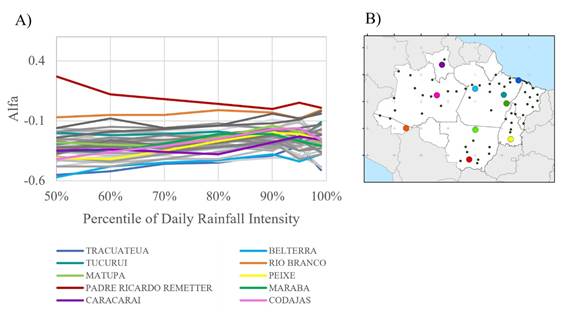
The scaling rates for the 50th (P50) to 99th (P99) percentile of daily rainfall intensity presented a high variability between the meteorological stations (Figure 3). The Padre R. Remetter station is the only one with a positive alfa, considering P50 to P99. It is also the only station that presented a decrease in alfa with an increase in the percentile from P50 to P90. In other words, the variation in precipitation expected with a 1°C increase in temperature is smaller for the most extreme daily precipitation than for the least extreme.
(A) Scaling rate for 50th to 99th percentile of daily rainfall intensity for the 44 weather stations in the states that encompass the Brazilian Legal Amazon from 1998-2017, highlighting in color the stations as named below. (B) Locations of weather stations color-highlighted in A.
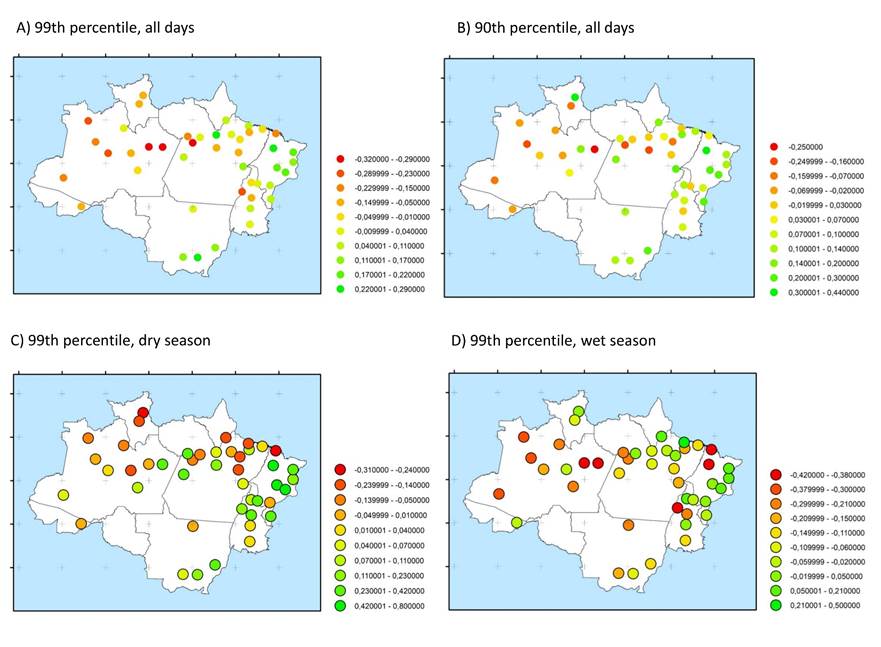
The lowest absolute of the scaling exponent is observed in the southern Amazon, and the highest absolute (more negative) values are observed in the northeastern Amazon, near the ocean (Figure 4). The scaling rate for the P99 presented a correlation of -0.51 with latitude, -0.27 with longitude, and 0.46 with altitude. The northeastern Tucuruí station shows less negative alfa for the P99 than the surrounding stations (Figure 4a). For the 90th percentile of daily rainfall intensity (P90), the Obidos station in the central-north Amazon presents the lowest (more negative) alfa (Figure 4b), closely followed by the Belterra (Figure 3 and Figure 4). The two stations are located close to the Amazonas River in its lower portion.

(A) Scaling exponent (alfa, %.°C-1) for 99th and (B) 90th percentiles of daily rainfall intensity with daily mean temperature for the 44 weather stations in the states that encompass the Brazilian Legal Amazon from 1998-2017. (C) Dry and (D) wet season scaling exponents for the 99th percentiles.
When analyzing the rainy and dry seasons separately, the results for the rainy season were similar to those obtained for the entire year, but generally with a less pronounced (less negative alfa) decrease (Figure 4d). Five stations presented a positive scaling exponent for P99 in the dry season, mainly in the eastern and southern BLA. A stronger decreasing trend is observed in the northeast, probably due to a cooling effect (Figure 4c).
P-T scaling from 1978-1997 and 1998-2017
The 11 stations with more than 40 years of data are concentrated in the central-eastern Amazon. All the stations presented a monotonic decrease in the rainfall (P99) with an increase in mean daily temperature (Figure 5). The temperature of the bins ranged from 23 to 28.5°C, and the rainfall from 30 to 140 mm. The stations near the ocean (in the northeastern Amazon) presented the highest temperatures and lowest P99, and the station of Belterra (in central Amazon and with 176m of altitude) presented the lowest temperature. An increase in the T is observed but with the same monotonic decreasing pattern.
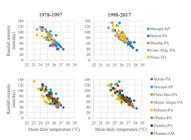
Mean daily surface temperature versus 99th percentile of daily rainfall intensity for 11 weather stations in the states that encompass the Brazilian Legal Amazon from 1978-1997 and 1998-2017.
All stations presented negative scaling exponents (alfa, %.°C-1) for P99, as expected by the observed monotonic decrease pattern, varying from -0.17 to -0.49 for 1998-2017 (Table 1). Only two weather stations presented a decrease in alfa between the two analyzed periods: Belém and Itaituba.
Scaling exponent (alfa, %.°C-1) and angular coefficient of the linear regression (%P/°C) to 99th percentile of daily rainfall intensity. Long. is the longitude; Lat., latitude; and Ele.(m), elevation.
Relationship between precipitation and DPT
When using the DPT, the pattern of the P-T relationship changes. For P99, a monotonic decrease in the intensity of daily rainfall extremes with mean DPT is observed in the northeastern Amazon (Figure 6). An increase is observed in the southern region, while other locations showed a P-T more similar to a peak-like relationship, with the peak near 22°C. The more negative values of the scaling exponent across the 44 weather stations are usually observed in the western BLA (Figure 6a). Positive values are observed in half of the stations, mainly in the eastern and southern BLA. A notable exception to this general pattern is the stations of Porto de Moz (substantial positive value), located close to the confluence of the Xingu and Amazon rivers in the lower Amazon basin. The correlation coefficient between the scaling exponent and the stations’ latitude, longitude, and altitude are -0.31, +0.52, +0.28. The spatial pattern remains when less extreme precipitation (P90) is analyzed (Figure 6b), but the Porto de Moz station does not stand out. In general, the scaling exponent slightly increases or remains almost constant with the decrease of the percentile of extreme rainfall from 90% to 50% (Figure 7).

Scaling exponent (alfa, %.°C-1) for (A) 99th and (B) 90th percentiles of daily rainfall intensity and dew point temperature for the 44 weather stations in the states that encompass the Brazilian Legal Amazon from 1998-2017. (C) Dry and (D) wet season scaling exponents for the 99th percentiles.

(A) Scaling rate for 50th to 99th percentile of daily rainfall intensity with dew point temperature for the 44 weather stations in the states that encompass the Brazilian Legal Amazon from 1998-2017, highlighting in color the stations as named below. (B) Locations of weather stations color-highlighted in A.
In the dry season we observed a difference in the scaling coefficients between the north (more negative) and the south (more positive), not observed in the wet season (Figure 6c). In both cases, the weather stations in the Maranhão state, located at the Cerrado biome, present strong positive scaling exponents (P99% increase with the increase in DPT). The higher difference between the two seasons is observed in the lower Amazon basin, whose weather stations present negative values in the dry season (Figure 6c) and positive values in the wet season (Figure 6d). The number of weather stations with positive scaling exponent was 19 for the wet and 29 for the dry seasons.
Differences due to the number of pairs in the bin and the temperature variable
The mean scaling rate obtained with data of mean daily temperature (Tmean) for the P99 varied little using 300 or 600 pairs of data in each bin (Table 2), and the correlation was 0.64 (Table 3). All weather stations, except one, presented a negative scaling rate when using a bin with 300 samples. Using only 150 pairs, the scaling rate was about 12% lower, and four stations presented negative scaling rate values.
Effect of the number of samples in each bin on the scaling exponent obtained using the 99th percentile of daily rainfall intensity and daily mean temperature or dew point temperature for the 44 weather stations in Brazilian Legal Amazon from 1998-2017.
However, when the DPT was used as the temperature variable, the mean scaling rates varied more with the variation in the number of samples per bin (Table 2). The maximum correlation coefficient between the values obtained using 150, 300, or 600 samples per bin was 0.38 (Table 3). Therefore, the bin’s definition was more important when using DPT instead of Tmean.
Correlation between the scaling exponents obtained using the 99th percentile of daily rainfall intensity and daily mean temperature (Tmean) or dew point temperature (DPT) using 150, 300, and 600 samples per bin.
DISCUSSION
This study investigated the relationship between daily precipitation extremes and the corresponding daily temperatures over the BLA and the impact of differences in the P-T scaling method. Using the daily Tmean, almost all weather stations presented negative alfa values and an increase in alfa with an increase in the percentile of daily rainfall intensity from P50 to P99. However, when using DPT, more stations presented positive values of scaling rates, mainly in the eastern and southern BLA and the results were more sensible to bin’s definition. As expected, variations within the region and exceptions were observed due to the region’s size and local climate’s variation. The scaling exponent presented a significant correlation with latitude when T mean was used and with longitude when DPT was used.
The scaling exponent for the P99 and P90 of daily rainfall intensity with daily mean temperature obtained were more negative than those observed by Wasko and Sharma (2017) for the region (-0.03 to -0.11). The negative correlation between the scaling exponent and latitude can be because, in the coastal region, annual precipitation is high due to the influence of the squall lines that form along the coastal coast during the afternoon and that are forced by the sea breeze (Fisch et al. 1998). The precipitation in the southernmost region of BLA is less intense and suffers the action of frontal systems and deforestation (Santos et al. 2015). The northern Amazon has experienced enhanced convective activity and rainfall, contrasting with the southern (Marengo et al. 2024). The tendency for mesoscale convective systems to form over elevated topographies (as observed by Dias et al. 2020) can partially explain the observed correlation of 0.46 between the scaling exponent and altitude.
Some weather stations exhibited distinct behavior, differing from the general pattern. For instance, the Padre R. Remetter, in the Cerrado biome, was the only station with a positive alfa from P50 to P99 using Tmean, and its alfa decreased with higher percentiles. The northeastern Tucuruí station showed a less negative alfa for the P99, likely influenced by its proximity to a hydroelectric reservoir, since dams are expected to affect precipitation (Zhu et al. 2022). However, only a slight increase in light rain days was previously observed HYPERLINK "https://paperpile.com/c/R5DVP0/DpTl"(Sanches and Fisch 2005). For the P90, the most negative alfa was observed in Óbidos and Belterra, near the lower Amazonas River. Future studies should further investigate the causes of these local variations.
Only the Belém and Itaituba weather stations presented a decrease in alfa between the two periods analyzed (1978-1997 and 1998-2017). Belém, which experienced expressive urban growth, showed increasing precipitation and temperature trends (Lira et al. 2020; Dias et al. 2020), whereas Itaituba, situated in a more preserved region, saw a decrease in precipitation (Satyamurty et al. 2010). The strong positive alfa for DPT observed in the Porto de Moz also warrants be investigated.
When using the DPT, the pattern of the P-T relationship changes, and the longitude begans to have a greater (and positive) correlation with the scaling exponent. The monotonic decrease observed, with exceptions in the eastern and southern Amazon, is in accordance with the pattern observed by Yin et al. (2023). The more negative values of the scaling exponent were usually observed in the western BLA. The sources of moisture to the Amazon Basin are situated in the tropical North and South Atlantic Oceans, and aerial rivers that feed the basin run mostly east to west in all seasons. As the western BLA lies farthest inland, local moisture is sourced from evapotranspiration from the forest (van der Ent et al. 2010), and nonlocal moisture must travel a longer distance from the Atlantic coast (Shi et al. 2022). Positive values were observed in half of the stations, mainly in the eastern and southern BLA (states of Maranhão and Mato Grosso) in the Cerrado biome, where the percentage of the humidity that results in precipitation from the land area is lower (Sorí et al. 2023). These regions present lower annual precipitation and a stronger dry season (Alvares et al. 2013).
The analysis of the effect of the number of observations per bin showed that the number of stations with positive scaling decreased with the increase of the number of observations per bin when Tmean was used and increased when DPT was used. This last observation is in accordance with the review of Martinkova and Kysely (2020), which indicates that a small number of observations per bin may underestimate high quantiles and cause a decrease in the P-T scaling or even negative scaling.
Changes in the number of rainy days can impact the extreme rainfall intensities based on percentiles of the rainfall. Here, we used only rainy days, but Maeda et al. (2012) indicate that when only high percentiles are considered, the results using all days are similar. Additionally, the weather stations analyzed did not show previous significant trends in the number of rainy days (Cavalcante et al. 2020). The duration of the rainy and dry seasons can also change, and the use of the same period for all stations is a limitation of the present study.
Due to long-term data availability from weather stations in the BLA, we used daily rainfall intensity, daily mean temperature, and DPT to analyze the P-T relationship in the region. However, the rainfall events and hourly data better represent rainfall intensities and should be used in future works. Regarding temperature, using the mean daily temperature can cause an underrepresentation of the highest temperatures in the data set because of the cooling by precipitation (Martinkova and Kysely 2020). The use of mean daily temperature on the day before the event is not feasible for Amazon due to the region’s large number of sequential rainy days. In the present study, we used the DPT to reduce the influence of the cooling effect. Another option to reduce the influence of P on T, which should be investigated in future studies, is using the condensation level temperature instead of surface temperature. Using day scaling relationships based on land-surface temperatures without consideration of the moisture source region is limited in indicating changes in extreme precipitation in a future climate (Hardwick Jones et al. 2010), and convective rain events can be analyzed separately. Lastly, it is also important to note that most meteorological stations are located along navigable rivers, making it difficult to extrapolate the results to other areas.
CONCLUSION
About all analyzed weather stations in the BLA presented a decrease in extreme daily rainfall intensity with an increase in Tmean, but less than half presented the same pattern when DPT is used, considering all months. The highest number of positive alfa values when DTP was used, mainly in the eastern and southern BLA, indicates that the P-T relationship is influenced by moisture limitation. However, using DPT was very sensitive to the bin size. A small number of observations per bin may underestimate high quantiles and cause a decrease in the P-T scaling or even negative scaling. Future studies should analyze weather stations that present important exceptions to the general patterns and the P-T relationship in the Amazon, especially those impacted by human activities such as rapid urbanization and water dams, and analyze the P-T relationship using hourly rainfall and the temperature of condensation level to discuss better possible impacts of temperature increase in extreme precipitation.
ACKNOWLEDGMENTS
E.A.O.S. is grateful for the postdoctoral scholarship granted by Instituto Tecnológico Vale.
REFERENCES
- Alexander, L.V. 2016. Global observed long-term changes in temperature and precipitation extremes: A review of progress and limitations in IPCC assessments and beyond. Weather and Climate Extremes 11: 4-16.
- Alexander, L.V.; Zhang, X.; Peterson, T.C.; Caesar, J.; Gleason, B.; Klein Tank, A.M.G.; et al. 2006. Global observed changes in daily climate extremes of temperature and precipitation. Journal of Geophysical Research 111: D05109.
- Ali, H.; Mishra, V. 2017. Contrasting response of rainfall extremes to increase in surface air and dewpoint temperatures at urban locations in India. Scientific Reports 7: 1228.
- Almeida, C.T.; Oliveira-Júnior, J.F.; Delgado, R.C.; Cubo, P.; Ramos, M.C. 2016. Spatiotemporal rainfall and temperature trends throughout the Brazilian Legal Amazon, 1973-2013. International Journal of Climatology 37: 2013-2026.
- Alvares, C.A.; Stape, J.L.; Sentelhas, P.C.; Gonçalves, J.L.M.; Sparovek, G. 2013. Köppen’s climate classification map for Brazil. Meteorologische Zeitschrift 22: 711-728.
- Barbero, R.; Westra, S.; Lenderink, G.; Fowler, H.J. 2018. Temperature-extreme precipitation scaling: a two-way causality? International Journal of Climatology 38: e1274-79.
- Berg, P., Haerter, J.O.; Thejll, P.; Piani, C.; Hagemann, S.; Christensen, J.H. 2009. Seasonal characteristics of the relationship between daily precipitation intensity and surface temperature. Journal of Geophysical Research 114:D18102.
- Cavalcante, R.B.L.; Ferreira, D.B.; Pontes, P.R.M.; Tedeschi, R.G.; Costa, C.P.W.; Souza, E.B. 2020. Evaluation of extreme rainfall indices from CHIRPS precipitation estimates over the Brazilian Amazonia. Atmospheric Research 238: 104879.
- Carnot, S. 1824. Réflexions sur la puissance motrice du feu et sur les machines propres à développer cette puissance. Annales Scientifiques de L’É.N.S. 1:393-457.
- Dias, L.C.; Valente, A.M.C.; Fernandes, L.L. 2020. Análise e correlação de variáveis climatológicas com os fenômenos climáticos e a urbanização na cidade de Belém, no estado do Pará, região norte do Brasil. Research, Society and Development 9: e972986790.
- Dunn, R.J.H.; Alexander, L.V.; Donat, M.G. et al. 2020. Development of an updated global land in situ-based data set of temperature and precipitation extremes: HadEX3. JGR Atmosphere 125: e2019JD032263.
- Emori, S., Brown, S.J. 2005. Dynamic and thermodynamic changes in mean and extreme precipitation under changed climate. Geophysical Research Letters 32:L17706.
- Fisch, G.; Marengo, J.A.; Nobre, C.A. 1998. Uma revisão geral sobre o clima da Amazônia. Acta Amazonica 28: 101-126.
- Gao, X.; Guo, M.; Yang, Z.; Zhu, Q.; Xu, Z.; Gao, K. 2020. Temperature dependence of extreme precipitation over mainland China. Journal of Hydrology 583: 124595.
- Groisman, P.Y.; Knight, R.W.; Easterling, D.R.; Karl, T.R.; Hegerl, G.C.; Razuvaev, V.N. 2004. Trends in intense precipitation in the climate record. Journal of Climate 18: 1326-1350.
- Gu, L.; Yin, J.; Gentine, P.; et al 2023. Large anomalies in future extreme precipitation sensitivity driven by atmospheric dynamics. Nature Communications 14: 3197.
- Hardwick Jones, R.; Westra, S.; Sharma, A. 2010. Observed relationships between extreme sub-daily precipitation, surface temperature, and relative humidity. Geophysical Research Letters 37: L22805.
-
IPCC. 2021: Summary for Policymakers. In: Climate Change 2021: The Physical Science Basis. Contribution of Working Group I to the Sixth Assessment Report of the Intergovernmental Panel on Climate Change [Masson-Delmotte, V.; Zhai, P.; Pirani, A.; Connors, S.L.; Péan, C.; Berger, S.; Caud, N. et al. (eds.)]. Cambridge University Press, Cambridge, United Kingdom and New York, NY, USA, pp. 3−32, doi:10.1017/9781009157896.001.
» https://doi.org/10.1017/9781009157896.001 -
IPCC. 2022. Summary for Policymakers [Pörtner, H.-O.; Roberts, D.C.; Poloczanska, E.S.; Mintenbeck, K.; Tignor, M.; Alegría, A.; et al. (eds.)]. In: Climate Change 2022: Impacts, Adaptation and Vulnerability. Contribution of Working Group II to the Sixth Assessment Report of the Intergovernmental Panel on Climate Change Cambridge University Press, Cambridge, UK and New York, NY, USA, pp. 3-33, doi:10.1017/9781009325844.001.
» https://doi.org/10.1017/9781009325844.001 - Kousky, V.E.; Kagano, M.T. 1981. A climatological study of the tropospheric circulation over the Amazon region. Acta Amazonica 11: 743-758.
- Lenderink, G.; van Meijgaard, E. 2010. Linking increases in hourly precipitation extremes to atmospheric temperature and moisture changes. Environmental Research Letters 5 (2): 025208.
- Lepore, C.; Veneziano, D.; Molini, A. 2015. Temperature and CAPE dependence of rainfall extremes in the eastern United States. Geophysical Research Letters 42: 74-83.
- Lira, B.R.P.; Fernandes, L.L.; Ishihara, J.H. 2022. Pluviometric behavior and trends in the legal Amazon from 1986 to 2015. Theoretical and Applied Climatology 150:1353-1367.
- Maeda, E.E.; Utsumi, N.; Oki, T. 2012. Decreasing precipitation extremes at higher temperatures in tropical regions. Natural Hazards 64: 935-41.
- Marengo, J.A.; Rusticucci, M.; Penalba, O.; Renom, M. 2010. An intercomparison of observed and simulated extreme rainfall and temperature events during the last half of the twentieth century: Part 2: Historical Trends. Climatic Change 98: 509-29.
- Marengo, J.A.; Souza Júnior, C.M.; Thonicke, K.; Burton, C.; Halladay, K.; Betts, R.A.; Alves, L.M.; Soares, W.R. 2018. Changes in climate and land use over the Amazon region: current and future variability and trends. Frontiers in Earth Science 6: 228.
- Marengo, J.A.; Jimenez, J.C.; Espinoza, JC.; Cunha, A.P.; Aragão, L.E.O. 2022. Increased climate pressure on the agricultural frontier in the Eastern Amazonia-Cerrado transition zone. Scintific Reports 12: 457.
- Marengo, J.A.; Espinoza, J.; Fu, R.; Jimenez Muñoz, J.C.; Alves, L.M.; da Rocha, H.R. et al. 2024. Open-access Long-term variability, extremes and changes in temperature and hydrometeorology in the Amazon region: A review. Acta Amazonica, 54: e54es22098.
- Martinkova, M.; Kysely, J. 2020. Overview of observed Clausius-Clapeyron scaling of extreme precipitation in midlatitudes. Atmosphere 11: 786.
- Mishra, V.; Wallace, J.M.; Lettenmaier, D.P. 2012. Relationship between hourly extreme precipitation and local air temperature in the United States: Extreme precipitation and temperature. Geophysical Research Letters, 39: L16403.
- Neelin, J.D.; Martinez-Villalobos, C.; Stechmann, S.N.; Ahmed, F.; Chen, G.; Norris, J.M. et al. 2022. Precipitation extremes and water vapor: Relationships in current climate and implications for climate change. Current Climate Change Reports 8: 17-33.
- Pumo, D.; Carlino, G.; Blenkinsop, S.; Arnone, El.; Fowler, H.; Noto, L.V. 2019. Sensitivity of extreme rainfall to temperature in semi-arid Mediterranean regions. Atmospheric Research 225: 30-44.
- Reboita, M.S.; Gan, M.A.; Rocha, R.P.; Ambrizzi, T. 2010. Regimes de precipitação na América do Sul: uma revisão bibliográfica. Revista Brasileira de Meteorologia 25: 185-204.
- Sanches, F.; Fisch, G. 2005. As possíveis alterações microclimáticas devido a formação do lago artificial da hidrelétrica de Tucuruí -PA. Acta Amazonica 35: 41-50.
- Santos, E.B.; Lucio, P.S.; Santos e Silva, C.M. 2015. Precipitation regionalization of the Brazilian Amazon: precipitation regionalization of the Brazilian Amazon. Atmospheric Science Letters 16: 185-92.
- Satyamurty, P.; Castro, A.A.; Tota, J.; Gularte, L.E.S.; Manzi, A.O. 2010. Rainfall trends in the Brazilian Amazon basin in the past eight decades. Theoretical and Applied Climatology, 99: 139-48.
- Sharma, S.; Mujumdar, P.P. 2019. On the relationship of daily rainfall extremes and local mean temperature. Journal of Hydrology 572: 179-91.
- Shi, M.; Worden, J.; Bailey, A.; Noone, D.; Risi, C.; Fu, R.; et al 2022. Amazonian terrestrial water balance inferred from satellite-derived water vapor isotopes. Nature Communications 13: 2686.
- Sorí, R.; Gimeno-Sotelo, L.; Nieto, R.; Liberato, M.L.R.; Stojanovic, M.; Pérez-Alarcón, A.; et al. 2023. Oceanic and terrestrial origin of precipitation over 50 major world river basins: Implications for the occurrence of drought. Science of The Total Environment 859: 160288.
- Utsumi, N.; Seto, S.; Kanae, S.; Maeda, E.E.; Oki, T. 2011. Does higher surface temperature intensify extreme precipitation? Geophysical Research Letters 38: L16708.
- van der Ent, R.J.; Savenije, H.H.G.; Schaefli, B.; Steele-Dunne, S.C. 2010. Origin and fate of atmospheric moisture over continents. Water Resources Research 46: W09525.
- Victoria, R.L.; Martinelli, L.A.; Ballester, M.V.; Krusche, A.V.; Pellegrino, G.; Almeida, R.M.B.; Richey, J.E. 1998. Surface air temperature variations in the Amazon region and its borders during this century. Journal of Climate 11: 1105-1110.
- Vincent, L.A.; Peterson, T.C.; Barros, V.R.; Marino, M.B.; Rusticucci, M.; Carrasco, G.; et al 2005. Observed trends in indices of daily temperature extremes in South America 1960-2000. American Meteorological Society 18:5011-5023.
- Wasko, C.; Sharma, A. 2017. Global assessment of flood and storm extremes with increased temperatures. Scientific Reports 7: 7945.
- Westra, S.; Alexander, L.V.; Zwiers, F.W. 2013. Global increasing trends in annual maximum daily precipitation. Journal of Climate 26: 3904-18.
- WMO. 2009. Guidelines on: Analysis of extremes in a changing climate in support of informed decisions for adaptation. WMO, Geneva, 52p.
- Yin, J.; Guo, S.; Wang, J. et al. 2023. Thermodynamic driving mechanisms for the formation of global precipitation extremes and ecohydrological effects. Science China Earth Science 66: 92-110.
- Zhu, X.; Xu, Z.; Liu, Z.; Liu, M.; Yin, Z.; Yin, L. et al. 2022. Impact of dam construction on precipitation: a regional perspective. Marine and Freshwater Research 74: 877-890.
Data availability
The data from the weather stations are available on the website of the national institute of meteorology: https://bdmep.inmet.gov.br and data from P-T scaling analyses are available upon request.