
 Galectin-3 organizes histological compartments associated with inflammatory reaction induced by gliadin in BALB/c mice
Abstract
Galectin-3 regulates cell-cell and cell-extracellular matrix interactions in distinct tissues, including intestinal epithelial cells interfering with inflammatory responses. In the gut, galectin-3 stabilizes epithelial junctions and intestinal permeability. Here, it was investigated whether gliadin (protein of gluten) can induce inflammatory reactions in the digestive system in the presence or absence of galectin-3. BALB/c wild-type (Lgals3+/+) and genetically mutated in LGALS3 (Lgals3-/-) mice were divided into controls (water) or orally supplemented with gliadin (100mg/day) for 30 days. Fragments of duodenum, jejunum, ileum, colon and rectum were processed for histological analysis and immunohistochemistry. Gliadin induced an inflammatory response in the gut of Lgals3+/+ and Lgals3-/- mice, but with high severity in the Lgals3-/- mice. Galectin-3 was significantly expressed by enterocytes in all fragments. However, it was drastically reduced after gliadin supplementation and directly associated with severe inflammation in all compartments of the gut. In parallel, gliadin supplemented Lgals3-/- mice showed significant inflammatory signals in the mucosa, including leukocyte infiltration in mucosal sites, hyperplasia of crypts, enhance of intraepithelial lymphocytes, and hypertrophy linked to accumulation of apoptotic bodies in the Peyer’s patches. These data suggested that galectin-3 plays protective roles in the gut submitted an inflammatory stress after gluten intake.
Key words
Galectin-3; gliadin; gluten; intestinal mucosa; celiac disease; gut inflammation
INTRODUCTION
Galectin-3 is a β-galactoside binding protein which regulates biological processes involving cell-cell and cell-extracellular matrix interactions, such as cell adhesion and migration (Xin et al. 2015), inflammatory responses (Chaudhari et al. 2015), tissue repair (Vlachou et al. 2022), and cancer progression (Capone et al. 2021). In the gut, galectin-3 is synthetized by epithelial cells in the mucosa interfering positively with the maintenance of gut health, barrier properties, and immune responses (Jiang et al. 2014, Tsai et al. 2016).
Galectin-3 affects immune responses and tolerance to dietary antigens and commensal microorganisms in the intestinal mucosa (Müller et al. 2006, Díaz-Alvarez & Ortega 2017, Liu & Stowell 2023). After intestinal injury, galectin-3 favors tissue repair by driving epithelial cell migration and proliferation, both necessary for wound healing and restoration of the epithelial layer (McLeod et al. 2018, Lee et al. 2019). Indeed, intestinal injury can be induced by distinct dietary compounds in susceptible individuals, including gluten. In accordance, specific pharmacological inhibitors, including tranglutaminase-2 inhibitors, effectively prevented gluten-induced intestinal damage and inflammation (Dotsenko et al. 2024).
In gluten-enriched foods, gliadin plays a significant immunoreactive signal (Cebolla et al. 2018) and triggers an autoimmune response characterized by an intense immune response mistakenly against the lining of the small intestine (Briani et al. 2008). In accordance, celiac disease patients have histopathological data that include severe mucosal inflammation and dysbiosis (Chander et al. 2018), villous atrophy, impaired nutrient absorption, gastrointestinal disorders (Villanacci et al. 2020), and systemic symptoms, such as neurological and psychiatric manifestations (Jackson et al. 2012). On the other hand, non-celiac gluten sensitivity induces similar symptoms to those celiac disease, but without autoimmune damages to the small intestine (Lebwohl et al. 2015).
Given that galectin-3 suppressed mucosal inflammation and reduced the severity of experimental colitis (Tsai et al. 2016) and the inclusion of galectin-3 as potential target to inflammatory and fibrotic diseases (Bouffette et al. 2023), we investigated a possible relation between gluten intake, gut inflammation and galectin-3 functions in murine experimental model. Mice supplemented with gliadin showed decreased levels of galectin-3 in the intestinal epithelial cells followed by intestinal inflammatory reactions, gastrointestinal disorders and atypical behavior. Then, we proposed that gliadin plays a central role in gluten-related intestinal inflammation by galectin-3 dependent manner.
MATERIALS AND METHODS
Mice and gliadin supplementation
Female BALB/c mice with 4 weeks of age were maintained at food and water ad libitum, 24+2oC of temperature and 12 h light/dark cycles following the standards of the local Ethics Commission in the Use of Animals from the Federal University of Rio de Janeiro (Protocol number: 071/19). Following the Ethics Commission suggestion, five mice were used in each experimental group to satisfy the law of 3Rs (reduction, refinement and replacement). These mice were aleatorily distributed in two experimental groups: (I) supplemented with gliadin and (II) that received water at the same conditions. Powdered wheat gliadin (Sigma-Aldrich, USA) was diluted in water distilled to 100 mg/mL at final concentration. Aliquots were vigorously kept stirring in a vortex mixer to complete homogenization at the time of consumption. Group I received daily 200μL (20mg of gliadin) by oral gavage for 30 consecutive days. Group II received water at the same volume of water.
Histological analysis
On day 31of the experiment, the animals were euthanized, and fragments of the intestine were collected with surgical material adequate. Subsequently, the samples were fixed in 10% formaldehyde for 48h. After fixation, the fragments were dehydrated in batteries increasing amounts of alcohol (70%, 90% and 100%) for 30 minutes in each bottle. Clarification was carried out in bottles containing xylene (two 15 minutes each immersion). Afterwards, the fragments were immersed in two bottles with liquid paraffin (60oC) for 30 minutes each passage. After making the paraffin blocks, the samples were cut into 3μm slices on a microtome (RM2125 RTS, Leica, USA), stretched in water bath at 40oC and fixed on glass slides. Hematoxylin and eosin staining protocol was used after deparaffinization in three xylene baths (5 minutes in each bottle), rehydration in vials containing decreasing concentrations of alcohol (100%-70%, for 5 minutes in each bottle), and bath in distilled water for 5 minutes. Subsequently, the slides were stained with Harris hematoxylin for 5 minutes, washed in running water and stained with eosin for 3 minutes. After washing in running water, the slides were dehydrated in increasing concentrations of alcohol (70%-100%) and were immersed in three xylene batteries for 5 minutes in each bottle, for subsequent application of mounting medium, entellan (Merck KGaA, Brazil), under a glass coverslip. The images were acquired to choose the representative photomicrograph by Evos microscope camera (EVOS M5000 Cell Imaging System, Life Technologies).
Quantification of intraepithelial lymphocytes
Slides stained with hematoxylin and eosin were analyzed at 40x/100x magnification under the microscope (EVOS M5000 Cell Imaging System, Life Technologies). Lymphocytes were counted between intraepithelial cells by identifying their general characteristic, such as small nucleus with dense chromatin on comparison with epithelial cells. The final number of intraepithelial lymphocytes was reported based on a total number of 100 epithelial cells. Thus, the final numeric value was proportional to total cells in the epithelial tissue and plotted as percentage. The photomicrographs were obtained by Evos microscope (EVOS M5000 Cell Imaging System, Life Technologies).
Immunohistochemistry
Histological sections (5μm) in appropriate slides for histochemistry (StarFrost®) were dewaxing (60oC per 30 minutes) and subsequently reheated for 40 minutes in two baths of 1% Trylogy solution (Sigma-Aldrich, Brazil) to complete dewaxing, exposure of sites antigens and rehydration. Hydrogen peroxide (3% for 25 minutes at a time) shelter from light blocked endogenous peroxidase. After three baths in triple-distilled water (5 minutes each), the slides were transferred to dark and humid chamber, and then washed with PBS+0.02% Tween20 (Sigma Aldrich, Brazil). To block non-specific sites, 10% bovine serum albumin (BSA) solution (Sigma Aldrich, Brazil) for 15 minutes followed by washing with PBS+Tween20. Incubation with anti-galectin-3 primary antibody (clone M3/38) for 1 hour and wash again with PBS+0.02% Tween20 (3 times for 2 minutes each). Incubation with secondary antibody (anti-mouse IgG – biotinylated) by 1 hour and another three washes (2 minutes each) in PBS+Tween20 solution at 0.02%. To reveal the reaction, Streptavidin−Peroxidase (Sigma Aldrich, Brazil) 1% in PBS+Tween20 solution, for 30 minutes, three washes (2 minutes each bath) in PBS+Tween20 solution at 0.02% and treatment with diluted Diaminobenzidine (DAB) solution (Spring Bioscience, USA), followed by washing again with PBS+0.02% Tween20. To stain nuclei, Harris hematoxylin (3 minutes). To seal the slide with entellan on a glass coverslip, wash in running water, dehydration in increasing concentrations of alcohol (70%-100%) and immersion in three xylene batteries (5 minutes in each bottle). Photomicrographs were generated on the Evos microscope (EVOS M5000 Cell Imaging System, Life Technologies).
Statistical analysis
The statistical tests were accomplished using t-test, and significance threshold was fixed for α = 0.05. Therefore, P values ≤ 0.05 were considered statistical differences. Each experiment was performed using 6 mice per group in three independent assays.
RESULTS
Gliadin supplementation induced severe duodenal inflammatory reaction in the absence of galectin-3
Histological analyzes were performed on the small intestine, major target of celiac disease, according to histopathological evaluation in experimental model. In the duodenum of control Lgals3+/+ mice, the mucosa was classically organized containing a simple columnar epithelial tissue in contact with lumen and lamina propria formed by loose connective tissue (Figure 1a). Villi and crypts were also clearly observed in these samples. As expected, the submucosa was filled with Brunner’s glands and the muscular layer was the most eosinophilic layer surrounding externally the submucosa (Figure 1a). In control Lgals3-/- mice, the same histological structures were observed in the duodenum, although the crypts seemed more hyperplasic in comparison to respective control (Figure 1b).

Photomicrographs of the duodenum of mice supplemented with gliadin. The images are representative of the control (a) Lgals3+/+ and (b) Lgals3-/- mice. (c) Lgals3+/+ and (d) Lgals3-/- mice supplemented with gliadin for 30 days. Images amplified from Lgals3+/+ (e) and Lgals3-/- (f) reveal details of inflammatory infiltrates (dotted lines). Data are representative of three independent experiments. n=5 mice per group. (a-d): 100x magnification. (e-f): 400x magnification.
In gliadin supplemented Lgals3+/+ mice, it was observed local signals of inflammation, including well-defined leukocyte aggregates in the mucosa. No significant morphological changes were observed in Brunner’s glands in mice supplemented with gliadin (Figure 1c). In parallel, gliadin consumption also resulted in leukocyte aggregates throughout the mucosa of Lgals3-/- mice, but the quantity of cells per clusters were substantially lesser than wild type supplemented mice (Figure 1d). In more details, it was clear that gliadin consumption induced an inflammatory response in the duodenal mucosa with distinct histopathological characteristics between Lgals3+/+ and Lgals3-/- mice. In both, the duodenal mucosa was significantly modified by the leukocyte infiltration, but the frequency of these leukocytes was higher in Lgals3-/- than Lgals3+/+ (Figure 1e and 1f). These data suggested that gliadin intake induced histological disturbance in the duodenal mucosa compatible with local inflammation in BALB/c mice and the histological perturbances were more frequent in the absence of galectin-3.
Supplementation with Gliadin reduced the expression of Gal-3 in epithelial cells of the duodenal mucosa
To identify niches containing cells expressing galectin-3 in the duodenum, samples of all experimental groups were submitted to immunohistochemistry for galectin-3. Control Lgals3+/+ mice presented strong staining for galectin-3 in mucosal epithelial cells, close to the lumen, but not in the Brunner’s glands (Figure 2a). As expected, samples of control Lgals3-/- mice did not express galectin-3 (Figure 2b). Gliadin supplementation reduced positivity for galectin-3 in the intestinal epithelium of the duodenal mucosa, but it is not influenced in Brunner’s glands (Figure 2c). Newly, gliadin supplementation did not interfere with galectin-3 expression in Lgals3-/- mice (Figure 2d).

Localization of Galectin-3 expressing cells in the duodenum of mice supplemented with gliadin. Photomicrographs are representative of control (a) Lgals3+/+ and (b) Lgals3-/- mice. Photomicrographs of gliadin supplemented (c) Lgals3+/+ and (d) Lgals3-/- mice complete the panel of duodenal samples. Inserts detail galectin-3+ epithelial cells in the duodenal mucosa (dotted line). Bar graphs indicate the percentage of intraepithelial lymphocytes (e) and cells per crypt (f) in Lgals3+/+ mice and Lgals3+/+ mice. Data are representative of three independent experiments. n=3 mice per group. (a-d): Magnification of 100x. (Inserts): 1000x.
To investigate a possible crosstalk between the reduction galectin-3 in the epithelium and inflammation, other two histological parameters were analyzed in these samples from the duodenum.: the percentage of intraepithelial lymphocytes and cellularity of the crypts. In control Lgals3+/+ mice, approximately 19 lymphocytes were counted for each 100 epithelial cells (19% of cells were lymphocytes). In control Lgals3-/- mice, this proportion was 24 lymphocytes for each 100 epithelial cells (24% of cells were lymphocytes). In mice supplemented with gliadin, the percentage of intraepithelial lymphocytes increased significantly to 27% in Lgals3+/+ and 35% in Lgals3-/- mice (Figure 2e).
The cellularity of the duodenal crypts was also measured in these experimental conditions. In control Lgals3+/+ mice, approximately 27 cells were counted in the duodenal crypts whereas 28 cells were found in the crypts of Lgals3-/- mice. However, gliadin supplementation induced hyperplasia in the duodenal crypts and the average enhanced to approximately 38 and 44 cells/crypt in Lgals3+/+ and Lgals3-/- mice, respectively (Figure 2f). These data reinforce the idea that gliadin can induce a significant inflammatory response in the duodenum of BALB/c, at least in part, associated with reduced levels of galectin-3 in the mucosal epithelial cells.
Gliadin supplementation changed the organization of the mucosa of the jejunum in the absence of galectin-3
In samples of control Lgals3+/+ and Lgals3-/- mice, the histological layers of the jejunum were perfectly observed. In the mucosa, villi and crypts were lined by simple columnar epithelial tissue, adjacent to the lamina propria formed by loose connective tissue. Moreover, the submucosa does not contain glands, such as in the duodenum, consisting basically of connective tissue widely vascularized interspersed with extracellular matrix. The muscular layer is external, eosinophilic and surrounds the submucosa (Figure 3a and 3b, respectively).
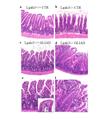
Photomicrographs of the jejunum of mice supplemented with gliadin. The images are representative of the control (a) Lgals3+/+ and (b) Lgals3-/- mice. (c) Lgals3+/+ and (d) Lgals3-/- mice supplemented with gliadin for 30 days. Images amplified from Lgals3+/+ (e) and Lgals3-/- (f) reveal details of villi reactions (dotted circular line) and morphological changes in the epithelium (dotted rectangular line. Data are representative of three independent experiments. n=5 mice per group. (a-d): 100x magnification. (e-f): 400x magnification.
Gliadin supplementation generated apparent hyperplasia both in the crypts and in the villi of the jejunum of Lgals3+/+ mice. Furthermore, the jejunal mucosa of these animals presented a high concentration of mucus-secreting goblet cells. However, rare leukocyte aggregates were observed in this compartment of the small intestine (Figure 3c and 3e). In Lgals3-/- mice, the inflammatory response induced by gliadin consumption affected both villi and crypts of the jejunum. Villi were characterized by edematous lamina propria containing leukocyte infiltration, but lower goblet cells than wild type supplemented mice. Crypts were characterized by significant epithelial hyperplasia (Figure 3d and 3f). These data indicate that the absence of galectin-3 substantially affected the histological organization of the jejunum in mice supplemented with gliadin.
Supplementation with Gliadin reduced the marking for galectin-3 in jejunal epithelial cells of Lgals3+/+ animals
To evaluate the distribution of galectin-3+ cells and possible effects of gliadin supplementation on these niches, the jejunal samples were submitted to immune- histochemistry staining. Control Lgals3+/+ mice showed epithelial cells strongly stained for galectin-3 in mucosal sites (Figure 4a). As expected, control Lgals3-/- mice were completely negative for galectin-3 (Figure 4b). Gliadin supplementation reduced dramatically the positivity for galectin-3 in the intestinal epithelium of jejunal mucosa (Figure 4c). Newly, the gliadin intake did not interfere with galectin-3 expression in Lgals3-/- mice (Figure 4d).

Localization of Galectin-3 expressing cells in the jejunum of mice supplemented with gliadin. Photomicrographs are representative of control (a) Lgals3+/+ and (b) Lgals3-/- mice. Photomicrographs of gliadin supplemented (c) Lgals3+/+ and (d) Lgals3-/- mice complete the panel of jejunal samples. Inserts detail galectin-3+ epithelial cells in the mucosa of jejunum (dotted line). Bar graphs indicate the percentage of intraepithelial lymphocytes (e) and cells per crypt (f) in Lgals3+/+ mice and Lgals3-/- mice. Data are representative of three independent experiments. n=3 mice per group. (a-d): Magnification of 100x. (Inserts): 1000x.
The reduction of galectin-3 expression by mucosal cells seems associated with severity of inflammation in the jejunum. To investigate this possible association, intraepithelial lymphocytes and crypt cells were quantified in the jejunum of Lgals3+/+ and Lgals3-/- mice. In control mice, there was approximately 10% and 12% of intraepithelial lymphocytes in the epithelium of the mucosa of Lgals3+/+ and Lgals3-/- mice, respectively. After gliadin supplementation, these percentage increased to approximately 14% and 16% in Lgals3+/+ and Lgals3-/- mice, respectively (Figure 4e). In the crypts, the cellularity was also increased after the gliadin supplementation. In controls, it was counted approximately 30 and 33 cells/crypt in Lgals3+/+ and Lgals3-/- mice, respectively. In gliadin-supplemented mice, the cellularity of the crypts changed from 43 cells/crypt to 50 cells/crypt in the jejunum of Lgals3+/+ and Lgals3-/- mice, respectively (Figure 4f).
Galectin-3 organizes Peyer’s patches niches during gliadin supplementation
A histological hallmark of the ileum consists of the organization of gut associated lymphoid tissues, including Peyer’s patches. In control Lgals3+/+ mice, Peyer’s patches showed a standard organization, marked by two patterns of staining dividing cortical (dark) zone and medullary zone (Figure 5a). In control Lgals3-/- mice, Peyer’s patches presented a hyperplasic cortical zone, suggestive of greater cellularity than wild type controls (Figure 5b).

Photomicrographs of the ileal Peyer’s patches of mice supplemented with gliadin. The images are representative of the control (a) Lgals3+/+ and (b) Lgals3-/- mice. (c) Lgals3+/+ and (d) Lgals3-/- mice supplemented with gliadin for 30 days. Peyer’s patches were marked by dotted lines. Images amplified from Peyer’s patches of Lgals3+/+ (e) and Lgals3-/- (f) reveal morphological changes compatible with apoptotic bodies (arrows). Data are representative of three independent experiments. n=5 mice per group. (a-d): 100x magnification. (e-f): 400x magnification.
Gliadin supplementation induced an expansion of both cortical and medullary zones in Lgals3+/+ mice, indicating that this diet was able to induce cellular proliferation and differentiation in this lymphoid tissue (Figure 5c). Gliadin also induced a general hyperplasia in the Peyer’s patches of Lgals3-/- mice, however, with greater tonality of cortical and medullary zones (Figure 5d). These data suggested that gliadin induced an intense reaction in the Peyer’s patches of both Lgals3+/+ and Lgals3-/- mice.
The different contrast between dark and clear zones of the Peyer’s patches led us to investigate specific niches in the parenchyma areas. In greater magnification, the microscopical analysis revealed an apparent disequilibrium between apoptotic bodies distributed by these lymphoid tissues of Lgals3+/+ and Lgals3-/- mice. In Lgals3-/- mice, gliadin intake was associated with severe accumulation of dead cells in the parenchyma when compared with Lgals3+/+ mice (Figure 5e and 5f). These data suggested that the absence of galectin-3 could be linked to dysfunctional phagocytosis of apoptotic bodies in the Peyer’s patches.
Gliadin supplementation disorganized cell niches galectin-3+ in Peyer’s patches
In the ileum, Peyer’s patches have a relevant immunological role in pathological mechanisms involving inflammation and homeostasis. In the ileum of control Lgals3+/+ mice, galectin-3 expressing cells were found in the epithelial tissue of mucosal sites and in elongated macrophage-like cells preferentially located in the edges of the Peyer’s patches (Figure 6a). As expected, the ileum of Lgals3-/- mice was completely negative to galectin-3 (Figure 6b).

Localization of Galectin-3 expressing cells in the Peyer’s patches of mice supplemented with gliadin. Photomicrographs are representative of (a) control Lgals3+/+, (b) control Lgals3-/- mice, and gliadin supplemented (c and e) Lgals3+/+ and (d and f) Lgals3-/- mice. Inserts detail galectin-3+ elongated cells in the Peyer’s patches (dotted line). Arrows point to apoptotic bodies within Peyer’s patches. Bar graphs indicate the percentage of intraepithelial lymphocytes (g), cells per crypt (h), and (i) diameter of Peyer’s patches in Lgals3+/+ mice and Lgals3+/+ mice. Data are representative of three independent experiments. n=3 mice per group. (a-d): Magnification of 100x. (Inserts): 1000x.
Gliadin supplementation disorganized these expressing galectin-3 in the ileum of Lgals3+/+ mice. As observed in the duodenum and jejunum, epithelial cells in the mucosa reduced the positiveness to galectin-3 after gliadin supplementation. Furthermore, macrophage-like cells expressing galectin-3 were widely dispersed throughout the Peyer’s patches (Figure 6c). In Lgals3-/- mice, gliadin intake did not interfere with the expression of galectin-3 (Figure 6d).
Detailed analysis indicated that phagocytosis can be a possible and interesting mechanism to future studies in this experimental model. The elongated cells expressing galectin-3 in the Peyer’s patches were directly associated with niches occurring phagocytosis. In mice supplemented with gliadin, apoptotic bodies were frequently observed inside of macrophage-like cells expressing galectin-3 (Figure 6e). These apoptotic bodies were well defined by small spherical fragments of cells within the cytoplasm of large/elongated galectin-3+ cells (Figure 6e, insert). In parallel, the gliadin supplementation of Lgals3-/- mice revealed that apoptotic bodies were intensively observed throughout the Peyer’s patches (Figure 6f), indicating that the absence of galectin-3 could be associated with accumulation of dead cells in these immunological sites, possible by interfering with phagocytic mechanisms. These data pointed to macrophage-like cells expressing galectin-3 in the Peyer’s patches as potential target to be studied in experimental models of intestinal inflammation and apoptosis/clearance during gliadin induced inflammatory reactions.
To link the reduction of galectin-3 and histopathological findings, intraepithelial lymphocytes and crypt cells were quantified in the ileum of Lgals3+/+ and Lgals3-/- mice. Moreover, the diameter of the Peyer’s patches was also measured to identify possible inflammatory findings. In control mice, there was approximately 10% of intraepithelial lymphocytes in the epithelium of the mucosa of Lgals3+/+ and about 15% in Lgals3-/- mice. After gliadin supplementation, the percentage increase to 15% in Lgals3+/+ and more than 20% in Lgals3-/- mice (Figure 6g).
The cellularity of the crypts was also increased after the gliadin supplementation. The number of cells changed from 25 cells/crypt in control Lgals3+/+ mice to 35 cells/crypt in Lgals3+/+ gliadin-supplemented mice (Figure 6h). In the absence of galectin-3, controls showed approximately 30 cells/crypt while mice supplemented with gliadin increased to 45 cells/crypt (Figure 6h).
Consistently, the diameter of Peyer’s patches had also important differences. In control Lgals3+/+ mice, Peyer’s patches presented an average size of 330 μm. In contrast, Lgals3-/- mice have Peyer’s patches measuring approximately 415 μm in length (Figure 6i). Gliadin supplementation increased the mean size of Peyer’s patches to 455 μm in Lgals3+/+ and 520 μm in Lgals3-/- mice, maintaining the proportion between groups and the significant difference (Figure 6j). This data indicated that gliadin affected the organization of the Peyer’s patches, and the absence of galectin-3 amplified these disturbances.
Large intestine was also affected by gliadin supplementation
The histological compartments and galectin-3 expression were evaluated in transverse histological sections of colon and rectum of Lgals3+/+ and Lgals3-/- animals. In both control Lgals3+/+ and Lgals3-/- mice, the histological layers of the colon were typically observed in the samples. No significant differences were detected between both groups (Figure 7a and 7b). Gliadin supplementation promoted an inflammatory response mainly in the mucous layer of the colon of Lgals3+/+ animals, characterized by organized leukocyte clusters, generally with regular shape, varying from spherical to oval (Figure 7c, circles dotted). On the other hand, in the colon of Lgals3-/-, the gliadin supplementation induced a more diffuse response, with aggregates indicating leukocyte infiltrates with smaller diameters, but more frequent and with an irregular appearance in its general morphology (Figure 7d, circles dotted).

Photomicrographs of the large intestine of mice supplemented with gliadin. The images are representative of the control (a) Lgals3+/+ and (b) Lgals3-/- mice. (c) Lgals3+/+ and (d) Lgals3-/- mice supplemented with gliadin for 30 days. Leukocytes aggregates were gated by dotted lines. Images amplified from inflammatory site of Lgals3+/+ (e) and Lgals3-/- (f). Data are representative of three independent experiments. n=5 mice per group. (a-d): 100x magnification. (e-f): 400x magnification.
By expanding the analyzes in the specific regions, it was possible to observe that the absence of galectin-3 was harmful to the large intestine. In Lgals3+/+ mice, gliadin induced a well localized inflammatory response in the mucosa of colon, predominantly marked by mononuclear cells inside of lymphocytic nodules (Figure 7e). On the other hand, the colon of Lgals3-/- mice showed an atypical inflammatory reaction, affecting tissues adjacent to the mucosa. In these mice, the leukocyte infiltrate expanded to deeper histological layers and reached the submucosa and muscularis externa (Figure 7f). Together, these findings corroborated with the premise that galectin-3 plays protective roles to the gut during tissue exposure to gliadin.
Gliadin supplementation also reduced galectin-3 in epithelial cells of the colon and rectum
Galectin-3 was also significantly detected in the epithelial cells of the mucosa of large intestines, including colon and rectum. In Lgals3+/+ control mice, mucosal epithelial cells of the colon were also strongly labeled for galectin-3. Although the villi are absent in the colon, the distribution of galectin-3 maintained the pattern of small intestines and it was substantially concentrated in the apical region of the mucosa, although this region is absent (Figure 8a). Gliadin supplementation reduced the expression of galectin-3 in mucosal epithelial cells of the colon of Lgals3+/+ mice (Figure 8b).
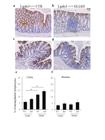
Localization of Galectin-3 expressing cells in the large intestine of mice supplemented with gliadin. Photomicrographs are representative of (a) control Lgals3+/+, (b) control Lgals3-/- mice, and gliadin supplemented (c) Lgals3+/+ and (d) Lgals3-/- mice. Bar graphs indicate the percentage of intraepithelial lymphocytes in samples of colon (e) and rectum (f) in Lgals3+/+ mice and Lgals3-/- mice. Data are representative of three independent experiments. n=3 mice per group. (a-d): Magnification of 100x. (Inserts): 1000x.
In the rectum, Gal-3 expression was detected in mucosal epithelial cells, but its expression was partially modulated by gliadin supplementation. In control Lgals3+/+ mice, galectin-3 was newly labeled at the edge proximal to the lumen and weakly distributed throughout other mucosal compartments (Figure 8c). After gliadin-based supplementation, cells that were positive for galectin-3 appeared less marked in intensity and amount (Figure 8d), indicating that gliadin can also reduce galectin-3 expression in the rectal mucosa. However, these differences were apparently less drastic than observed in other compartments of the small intestine.
These minimal differences reflected in the histopathological parameters. In the colon samples of Lgals3+/+ mice, the quantification of intraepithelial lymphocytes revealed that gliadin supplementation increased the percentage of these lymphocytes between epithelial cells in the mucosa when compared with Lgals3+/+ mice controls (Figure 8e). In parallel, it was observed that the percentage of intraepithelial lymphocytes was even greater in gliadin-supplemented Lgals3-/- mice than respective Lgals3-/- control mice (Figure 8e). In accordance with the maintenance of galectin-3 expressing cells, the percentage of intraepithelial lymphocytes in the rectum was unchanged even after the gliadin supplementation (Figure 8f).
DISCUSSION
For the first time, it was described that the absence of galectin-3 contributed to the worsening of intestinal inflammatory signals and tissue damages induced by gliadin supplementation. Overall, the data presented indicate that supplementation with gliadin in the absence of galectin-3 suggests a promising experimental model to understand some histopathological events associated with inflammatory reactions in the gut, such celiac disease and non-celiac gluten sensitivity. Here, galectin-3 appears as pivotal roles in the pathophysiology of gliadin induced inflammation.
Histopathological and histochemical analysis of different compartments of the small intestine and large intestine brought a new and promising information for the diagnosis and monitoring of progression of intestinal symptoms from associated inflammatory responses gluten consumption, as occurs in some pathologies, including celiac disease (Sharma et al. 2020).
In the small intestine of celiac patients, for example, it is very common to observe increased numbers of intraepithelial lymphocytes, crypt hyperplasia and histological disorganization of the villi (Hvas et al. 2015, Villanacci et al. 2020). In our study, duodenum, jejunum and ileum of Lgals3-/- mice supplemented with gliadin showed severe mucosal inflammation in these intestinal compartments, including a significant increase of intraepithelial lymphocytes, crypt hyperplasia and important disorganization of the villi, in comparison with Lgals3+/+ mice. These data indicated that galectin-3 can be protective roles in the mucosa of the small intestine.
The inclusion of galectin-3 in this context would be an interesting novelty. Clearly, gliadin administered orally affected the intestinal homeostasis and the reduction of galectin-3 expressing cells could be correlated with these events. To reinforce this premise, the small intestine of Lgals3-/- mice supplemented with gliadin presented significant signals of severe intestinal inflammation, more intense hyperplasia of the crypts and villi, edematous areas in the lamina propria of villi containing leukocytes, and accumulation of apoptotic bodies in Peyer’s patches. Together, these data suggested a greater severity of gliadin associated inflammation in the absence of galectin-3.
In the gut, galectin-3 contributes epithelial adhesion and favors the intestinal barrier, selective permeability and maintenance of microbiota (Jiang et al. 2009). Although it is necessary to continue this study to identify possible mechanism, it was clear that gliadin consumption affected the distribution of galectin-3+ epithelial cells of the mucosa of the duodenum, jejunum and ileum. Corroborating, Delacour and colleagues revealed that galectin-3 is required to regulate the flow of molecules from the intestinal lumen and Lgals3-/- intestinal epithelial cells exhibit structural defects (Delacour et al. 2008).
In this study, it was also observed that the absence of galectin-3 affected the organization of Peyer’s patches after gliadin supplementation. Again, the absence of galectin-3 was decisive to disorganize the Peyer’s patches and develop cortical medullary hyperplasia. Given that Peyer’s patches have been considered “sensors immune systems” of the intestine, these cells can be activated after recognition, destruction and clearance of pathogens, frequently by phagocytosis (Arandjelovic et al. 2015, Jung et al. 2010). Our data indicate that galectin-3 has a relevant role in phagocytosis and removal of apoptotic bodies, because Peyer’s patches of gliadin supplemented Lgals3-/- mice showed significant accumulation of apoptotic bodies.
The morphology of galectin-3+ cells indicates that these cells are macrophages. They are elongated cells, with shaped irregular, vacuolated cytoplasm, nuclei with loose chromatin, and perform phagocytosis. The presence of apoptotic bodies accumulated in lymphoid follicles has already been observed in other organs of animals Lgals3-/-, such as mesenteric lymph nodes (Oliveira et al. 2011) and spleen (Brand et al. 2012). Other experimental models also point to this function of removing apoptotic residues impaired in the absence of galectin-3 (Wright et al. 2017, Erriah et al. 2019). Failure to correctly execute programmed cell death, or even efficient removal of apoptotic bodies, are largely associated with chronic inflammatory and/or autoimmune diseases, such as example, celiac disease (Wickman et al. 2012).
In the absence of galectin-3, the gliadin-induced inflammatory response was also more intense and diffuse in the colon and rectum. Nimri and colleagues confirmed that there is a significant association between celiac disease and microscopic colitis (Nimri et al. 2022). In experimental model of colitis in mice induced by dextran sulfate sodium, recombinant galectin-3 inhibited mucosal inflammation and reduced disease severity (Lippert et al. 2015). This possible protective effect during intestinal inflammation, exerted by galectin-3, was also evident in this experimental model of gliadin supplementation.
There are not clearly defined cellular and molecular mechanisms when galectin-3, gliadin and histological organization of the intestine are associated together. However, translational studies using mouse models to investigate galectin and gliadin individually have made it possible to propose common mechanisms. Mouse models of celiac disease, for instance, which are characterized by mice genetically modified to express specific human genes (like HLA-DQ2 or HLA-DQ8) are often used to investigate immune responses to gliadin (Rossi et al. 2021). On the other hand, other models may not have the genetic predisposition for celiac disease, such as gluten sensitivity models, but still respond to gluten, allowing for the study of non-celiac gluten sensitivity (Freitag et al. 2020). These experimental models often examine how gliadin triggers an immune response, leading to intestinal inflammation and damage in susceptible mice. However, never associated with galectin-3 functions.
In our research, it was identified an interesting association between gliadin consumption and galectin-3 reduction in the intestinal mucosa. Given that galectin-3 is a multifunctional protein that plays significant roles in the gut mucosa, particularly in inflammation, immune response, and tissue repair, it is plausible to suggest that gluten diet can disturb the intestinal integrity interfering with galectin-3 functions. It is important to note that galectin-3 binds specific glycoproteins on the surface of intestinal epithelial cells and immune cells, influencing cell adhesion and migration (Jiang et al. 2014). This binding affects interactions between immune cells and epithelial cells, which is crucial for maintaining gut integrity (Delacour et al. 2008) and inflammatory response modulation during inflammatory processes (Tsai et al. 2016).
For the first time, gliadin and galectin-3 interactions have been suggested in our experimental model. In parallel, combined or alone free-gluten diet has been used to help manage symptoms related to gliadin and promote better gut health for those diagnosed with celiac disease or gluten sensitivity (Drabińska et al. 2020). The benefits of gluten-free diet for these patients are clear and mechanisms can be linked to galectin-3 functions, at least in part, given that disruption of the intestinal barrier can lead to increased intestinal permeability (“leaky gut”) that perturbs the gut microbiota (Aleman et al. 2023) and galectin-3 favors the epithelial interactions at these histological sites. These aspects should be investigated as soon as possible.
Considering other galectins in this context, duodenal biopsies of celiac patients exhibited an increase in Galectin-1 immunoreactivity, but no significant differences were observed in the expression of Galectin-4 (Sundblad et al. 2018). Regarding to mechanisms, these authors suggest that gluten-free diet can be directly linked to upregulation of Galectin-1, maybe contributing to restrain the chronic inflammatory response. The reduced levels of Galectin-1 expression observed in untreated celiac patients indicate that galectin-1 regulates gut homeostasis under physiologic conditions (Sundblad et al. 2018). A similar association can be applied to galectin-3 and experimental conditions can be designed to future studies.
In conclusion, our data indicated that galectin-3 has significant potential to be studied as genetic factor related to intestinal inflammation mediated by gliadin. Moreover, these data also indicate that gliadin may be a food trigger that stimulates such intense inflammatory responses in genetically predisposed individuals. Perhaps, the Lgals3-/- can be extensive investigated to identify cellular and molecular mechanisms associated with gut inflammation.
ACKNOWLEDGMENTS
The authors thank the Fundação de Amparo à Pesquisa do Estado do Rio Janeiro (FAPERJ, grant number: APQ1 - E-26/210.287/2019) by funding sources of consumable materials. Moreover the authors thank the Conselho Nacional de Desenvolvimento Científico e Tecnológico (CNPq) and Coordenação de Aperfeiçoamento de Pessoal de Nível Superior (CAPES) by scholarships of postgraduate students.
REFERENCES
- ALEMAN RS, MONCADA M & ARYANA KJ. 2023. Leaky Gut and the Ingredients That Help Treat It: A Review. Molecules 28(2): 619.
- ARANDJELOVIC S & RAVICHANDRAN KS. 2015. Phagocytosis of apoptotic cells in homeostasis. Nat Immunol 16(9): 907-917.
- BOUFFETTE S, BOTEZ I & DE CEUNINCK F. 2023. Targeting galectin-3 in inflammatory and fibrotic diseases. Trends Pharmacol Sci 44(8): 519-531.
- BRAND C, OLIVEIRA FL, TAKIYA CM, PALUMBO A JR, HSU DK, LIU FT, BOROJEVIC R, CHAMMAS R & EL-CHEIKH MC. 2012. The involvement of the spleen during chronic phase of Schistosoma mansoni infection in galectin-3-/- mice. Histol Histopathol 27(8): 1109-1120.
- BRIANI C, SAMAROO D & ALAEDINI A. 2008. Celiac disease: from gluten to autoimmunity. Autoimmun Rev 7(8): 644-50.
- CAPONE E, IACOBELLI S & SALA G. 2021. Role of galectin 3 binding protein in cancer progression: a potential novel therapeutic target. J Transl Med 19(1): 405.
- CEBOLLA Á, MORENO ML, COTO L & SOUSA C. 2018. Gluten Immunogenic Peptides as Standard for the Evaluation of Potential Harmful Prolamin Content in Food and Human Specimen. Nutrients 10(12): 1927.
- CHANDER AM, YADAV H, JAIN S, BHADADA SK & DHAWAN DK. 2018. Cross-Talk Between Gluten, Intestinal Microbiota and Intestinal Mucosa in Celiac Disease: Recent Advances and Basis of Autoimmunity. Front Microbiol 9: 2597.
- CHAUDHARI AD, GUDE RP, KALRAIYA RD & CHIPLUNKAR SV. 2015. Endogenous galectin-3 expression levels modulate immune responses in galectin-3 transgenic mice. Mol Immunol 68(2 Pt A): 300-311.
- DELACOUR D, KOCH A, ACKERMANN W, EUDE-LE PARCO I, ELSÄSSER HP, POIRIER F & JACOB R. 2008. Loss of galectin-3 impairs membrane polarisation of mouse enterocytes in vivo. J Cell Sci 121(4): 458-65.
- DÍAZ-ALVAREZ L & ORTEGA E. 2017. The Many Roles of Galectin-3, a Multifaceted Molecule, in Innate Immune Responses against Pathogens. Mediators Inflamm 2017: 9247574.
- DOTSENKO V ET AL. 2024. Transcriptomic analysis of intestine following administration of a transglutaminase 2 inhibitor to prevent gluten-induced intestinal damage in celiac disease. Nat Immunol 25(7): 1218-1230.
- DRABIŃSKA N, KRUPA-KOZAK U & JAROCKA-CYRTA E. 2020. Intestinal Permeability in Children with Celiac Disease after the Administration of Oligofructose-Enriched Inulin into a Gluten-Free Diet-Results of a Randomized, Placebo-Controlled, Pilot Trial. Nutrients 12(6): 1736.
- ERRIAH M, PABREJA K, FRICKER M, BAINES KJ, DONNELLY LE, BYLUND J, KARLSSON A & SIMPSON JL. 2019. Galectin-3 enhances monocyte-derived macrophage efferocytosis of apoptotic granulocytes in asthma. Respir Res 20(1): 1.
- FREITAG TL ET AL. 2020. Gliadin Nanoparticles Induce Immune Tolerance to Gliadin in Mouse Models of Celiac Disease. Gastroenterology 158(6): 1667-1681.e12.
- HVAS CL, JENSEN MD, REIMER MC, RIIS LB, RUMESSEN JJ, SKOVBJERG H, TEISNER A & WILDT S. 2015. Celiac disease: diagnosis and treatment. Dan Med J 62(4): C5051.
- JACKSON JR, EATON WW, CASCELLA NG, FASANO A & KELLY DL. 2012. Neurologic and psychiatric manifestations of celiac disease and gluten sensitivity. Psychiatr Q 83(1): 91-102.
- JIANG HR ET AL. 2009. Galectin-3 deficiency reduces the severity of experimental autoimmune encephalomyelitis. J Immunol 182(2): 1167-73.
- JIANG K, RANKIN CR, NAVA P, SUMAGIN R, KAMEKURA R, STOWELL SR, FENG M, PARKOS CA & NUSRAT A. 2014. Galectin-3 regulates desmoglein-2 and intestinal epithelial intercellular adhesion. J Biol Chem 289(15): 10510-10517.
- JUNG C, HUGOT JP & BARREAU F. 2010. Peyer’s Patches: The Immune Sensors of the Intestine. Int J Inflam 2010: 823710.
- LEE HJ ET AL. 2019. Proteomics-based functional studies reveal that galectin-3 plays a protective role in the pathogenesis of intestinal Behçet’s disease. Sci Rep 9(1): 11716.
- LIPPERT E, STIEBER-GUNCKEL M, DUNGER N, FALK W, OBERMEIER F & KUNST C. 2015. Galectin-3 Modulates Experimental Colitis. Digestion 92(1): 45-53.
- LIU FT & STOWELL SR. 2023. The role of galectins in immunity and infection. Nat Rev Immunol (8): 479-494.
- MCLEOD K, WALKER JT & HAMILTON DW. 2018. Galectin-3 regulation of wound healing and fibrotic processes: insights for chronic skin wound therapeutics. J Cell Commun Signal 12(1): 281-287.
- MÜLLER S, SCHAFFER T, FLOGERZI B, FLEETWOOD A, WEIMANN R, SCHOEPFER AM & SEIBOLD F. 2006. Galectin-3 modulates T cell activity and is reduced in the inflamed intestinal epithelium in IBD. Inflamm Bowel Dis 12(7): 588-597.
- NIMRI FM, MUHANNA A, ALMOMANI Z, KHAZAALEH S, ALOMARI M, ALMOMANI L & LIKHITSUP A. 2022. The association between microscopic colitis and celiac disease: a systematic review and meta-analysis. Ann Gastroenterol 35(3): 281-289.
- OLIVEIRA FL ET AL. 2011. Lack of galectin-3 disturbs mesenteric lymph node homeostasis and B cell niches in the course of Schistosoma mansoni infection. PLoS ONE 6(5): e19216.
- ROSSI S, GIORDANO D, MAZZEO MF, MAURANO F, LUONGO D, FACCHIANO A, SICILIANO RA & ROSSI M. 2021. Transamidation Down-Regulates Intestinal Immunity of Recombinant α-Gliadin in HLA-DQ8 Transgenic Mice. Int J Mol Sci 22(13): 7019.
- SHARMA N, BHATIA S, CHUNDURI V, KAUR S, SHARMA S, KAPOOR P, KUMARI A & GARG M. 2020. Pathogenesis of Celiac Disease and Other Gluten Related Disorders in Wheat and Strategies for Mitigating Them. Front Nutr 7: 6.
- SUNDBLAD V ET AL. 2018. Galectins in Intestinal Inflammation: Galectin-1 Expression Delineates Response to Treatment in Celiac Disease Patients. Front Immunol 9: 379.
- TSAI HF, WU CS, CHEN YL, LIAO HJ, CHYUAN IT & HSU PN. 2016. Galectin-3 suppresses mucosal inflammation and reduces disease severity in experimental colitis. J Mol Med (Berl) 94(5): 545-56.
- VILLANACCI V, VANOLI A, LEONCINI G, ARPA G, SALVIATO T, BONETTI LR, BARONCHELLI C, SARAGONI L & PARENTE P. 2020. Celiac disease: histology-differential diagnosis-complications. A practical approach. Pathologica 112(3): 186-196.
- VLACHOU F ET AL. 2022. Galectin-3 interferes with tissue repair and promotes cardiac dysfunction and comorbidities in a genetic heart failure model. Cell Mol Life Sci 79(5): 250.
- WICKMAN G, JULIAN L & OLSON MF. 2012. How apoptotic cells aid in the removal of their own cold dead bodies. Cell Death Differ 19(5): 735-742.
- WRIGHT RD, SOUZA PR, FLAK MB, THEDCHANAMOORTHY P, NORLING LV & COOPER D. 2017. Galectin-3-null mice display defective neutrophil clearance during acute inflammation. J Leukoc Biol 101(3): 717-726.
- XIN M, DONG XW & GUO XL. 2015. Role of the interaction between galectin-3 and cell adhesion molecules in cancer metastasis. Biomed Pharmacother 69: 179-85.


