 Exploring the past to protect the future: an analysis of conservation paleobiology in South America
Abstract
Conservation paleobiology, an expanding field, employs taphonomy tools to investigate past environmental conditions and organisms before human impacts, thereby addressing key conservation issues. This review examines the concepts, approaches and events in conservation paleobiology, emphasizing aquatic and coastal organisms and the often-overlooked contributions from Brazil and South America. South America, with its vulnerable biodiversity, unique geology and rich fossil diversity, is a natural laboratory for understanding ecosystems—a considerable potential as a center for leading conservation paleobiology research. However, South America is underrepresented, contributing to only 5% of total publications (67% of it is from Brazil). Most South American authors are geoscientists publishing mainly on mollusks, also they produced fewer studies than those from more developed countries. Noteworthy, the Brazilian National Council for Scientific and Technological Development ranks third globally in funding for conservation paleobiology articles. Clearly, conservation paleobiology is still predominantly practiced in developed nations and geoscience fields. Other challenges include underutilization of geohistorical data and a gap between theory and practice. To address these issues, future studies should integrate conservationist perspectives and align them with societal and conservation needs. Hence, the anticipated growth in South American conservation paleobiology could bolster environmental conservation and promote sustainability for future generations.
Key words
Brazil; conservation; fossil record; human impact; literature review; Taphonomy
CONSERVATION PALEOBIOLOGY
General Characteristics
Since its dawn, humanity has modified the environment, depleted essential resources, and impacted organisms inhabiting the Earth. However, it is clear that our well-being depends on healthy ecosystems and there are urgent needs for alternative solutions in conservation, biodiversity restoration, and ecosystem services (defined as the “direct and indirect contributions of ecosystems to human well-being,” such as carbon sequestration, water filtration, and biological control; The Economics of Ecosystems and Biodiversity TEEB Foundations 2010). These alternative solutions require robust long-term management plans and conservation strategies (Dietl & Flessa 2009, 2011, Jeffers et al. 2015, Velez et al. 2018, Dietl et al. 2023, Kemp et al. 2023).
Modern biological monitoring methods provide important indices of ecosystems health; however, due to their recent implementation (short time scale), they have low temporal resolution for analyzing population trends over generations and under different ecological conditions (Willis et al. 2005, Jackson & Hobbs 2009, Dietl & Flessa 2009, 2011, Kidwell & Tomašových 2013, Grace et al. 2019, Duda et al. 2021, Kemp et al. 2023). Most management and conservation monitoring programs are reactive to population changes rather than predictive, resulting in a lack of robust data for conservation (Bonebrake et al. 2010, Duda et al. 2021). Furthermore, recent monitoring data may be expensive and limited (Albano & Sabelli 2011, Lindenmayer & Likens 2018).
Modern species-monitoring techniques should preferably be combined with palaeoecological methods over a broad time scale to predict future population trends. Then, it would be feasible to (i) identify the species in the past and present, assess its risk of extinction, and (ii) understand the drivers of population dynamics and their changes over time (e.g., Kowalewski et al. 2000, Willis & Birks 2006, Dietl & Flessa 2009, 2011, Kowalewski 2009, Erthal et al. 2011, Kidwell 2015, Kusnerik et al. 2018, 2022, Clapham 2019, Dietl 2019, Albano et al. 2020, Duda et al. 2021, Barclay & Leighton 2022). Conservation paleobiology was developed to address this need. This interdisciplinary field—rooted in paleontology but incorporating the domain of conservation—is rapidly growing and continues to face various challenges and opportunities (Dietl & Flessa 2009, 2011, Conservation Paleobiology Workshop 2012, Kidwell & Tomašových 2013, Dietl et al. 2015, Dietl 2016, Dillon et al. 2022).
Conservation paleobiology primarily uses taphonomy lato sensu techniques and theories, analyzing data from geo-historical records (naturalist diaries, journals, archaeological structures and artifacts, fossils and sediments; National Research Council 2005). It aims to establish baselines (conditions at which environments were pristine or less impacted than today) and uses a longer time scale than those typically used in ecological monitoring (Dietl & Flessa 2009, 2011, Conservation Paleobiology Workshop 2012, Thurstan et al. 2015, Tyler & Schneider 2018, Monsarrat et al. 2019). As a result, we can accurately create past and present environment scenarios to support current and future conservation strategies with more robust data (National Research Council 2005, Dietl & Flessa 2009, 2011, Kowalewski 2009, Conservation Paleobiology Workshop 2012, Kusnerik et al. 2018, 2022, Dietl, 2019, Monsarrat et al. 2019) (Figure 1).

Infographic of the panorama of conservation paleobiology. The scope of the discipline allows access to long-term data that helps understand possible changes in the environment and organisms compared with data on the current degraded environment, resulting in a more robust management and conservation plan to provide a prosperous future for all species.
Living, death, and fossil assemblages
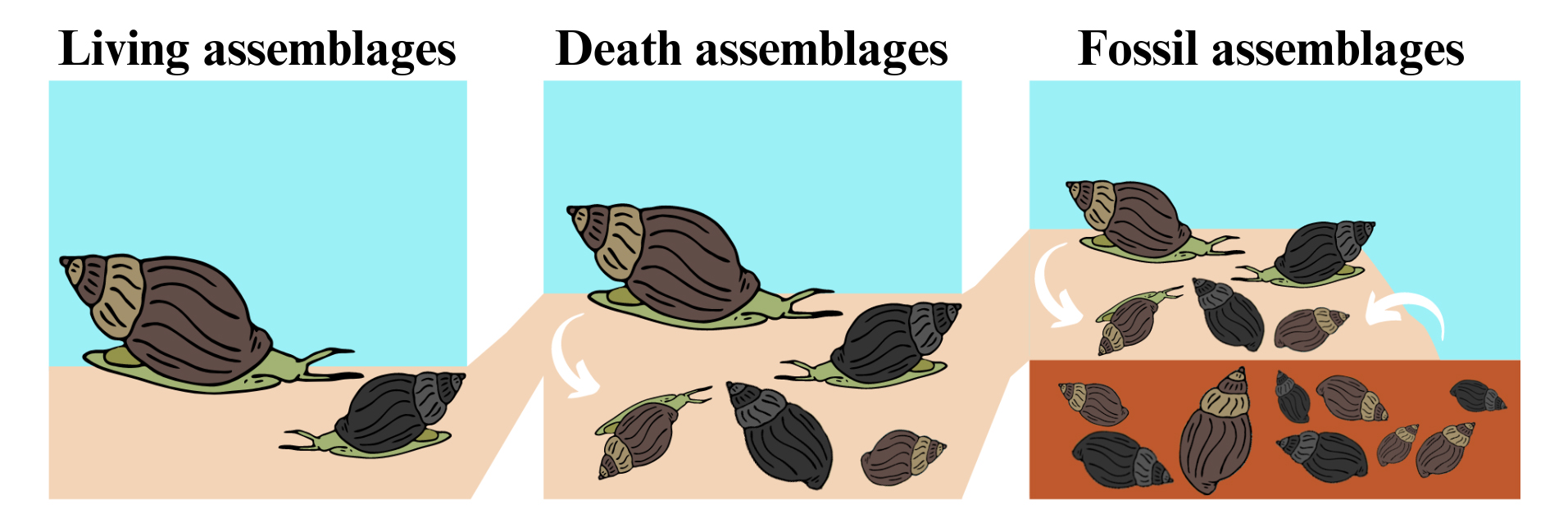
We would first like to clarify some important concepts. A set of living organisms coexisting in a given place and time and interacting with one another is called a living assemblage (Figure 2). A death assemblage refers to the taxonomically identifiable dead or discarded organic remains (e.g., leaves, flower parts, and insect exoskeletons) found on the surface of terrestrial or seabed sediment layers (usually up to 20 cm deep) (Kidwell & Bosence 1991, Kidwell 2013, Kidwell & Tomašových 2013, Tomašových et al. 2023) (Figure 2). Death assemblages are subject to post-mortem processes (e.g., bioturbation, reworking, and disintegration) and continuously receive fresh remains from living assemblages (Kidwell 2013, Kidwell & Tomašových 2013, Tomašových et al. 2023) and fossil assemblages, particularly if these are exposed or undergoing the aforementioned processes.

The living assemblage is the set of living individuals at a given place and time. Soon after death, these organisms will be part of the death assemblage, along with preserved shells from past generations. Shells below the surface layer and not receiving new inputs will form the fossil assemblage, but may return to the death assemblage if exposed. White arrows indicate the source of the death assemblage.
The fossil assemblage (Figure 2) refers to remains buried beneath the surface layer. It is distinguished from the death assemblage not by the age of the remains but because it does not receive new additions of dead individuals from the living assemblage, being situated below the zone where biotic and physical mixing occurs (Kidwell & Tomašových 2013, Tomašových et al. 2023). The term “fossil” is used to refer to evidence of past life with potential for preservation, regardless of age, as defined by Carta de Porto Alegre, a letter from Brazilian taphonomists to the Brazilian Society of Paleontology (written at the II Brazilian Taphonomy Symposium in 2023) and Finnegan et al. (2024). Therefore, both death and fossil assemblages contain fossils and encompass past and recent generations that did not coexist, as well as remains from other locations that were transported to the same site (Kidwell & Bosence 1991, Kidwell 2013, Kidwell & Tomašových 2013, Tomašových et al. 2023).
Taphonomy and conservation paleobiology go hand in hand
Time-averaging and compositional fidelity are complementary taphonomy concepts used in conservation paleobiology. The composition of death and fossil assemblages reflects the past generations of organisms that occupied the area, and provides strong evidence of species occurrence and abundance. The longer the duration of the assemblage and greater the durability of the tissues, the greater the extent of time-averaging (Walker & Bambach 1971, Kidwell & Bosence 1991, Kidwell 2013, 2015). Time-averaging, estimated from dated remains, is the process by which biological remnants accumulate over a time interval that exceeds the lifespan of any single organism, mixing non-contemporary generations that preserve together (Kowalewski 1996, Olszewski 1999). This process causes dyssynchronous events in the living assemblage to appear synchronous in the death and fossil assemblages, often due to low or absent sedimentation and material destruction (Walker & Bambach 1971, Kowalewski 1996, Olszewski 1999, Kowalewski & Bambach 2003, Kidwell & Tomašových 2013; for a review on the subject in Portuguese, see Ritter & Erthal 2016).
The access of dead and fossil assemblages time-averaging makes it an essential tool in paleoecology, evolutionary studies, and fossil record formation (Walker & Bambach 1971, Kidwell & Bosence 1991, Flessa et al. 1993, Kowalewski 1996, Olszewski 1999, Kowalewski & Bambach 2003, Hunt 2004, Kidwell 2013, Kowalewski et al. 2018, Nawrot et al. 2018, 2022, Tomašových et al. 2022, Ritter et al. 2023a). It has also been fundamental to conservation paleobiology because past states (baselines) of the community recorded in the death and fossil assemblages may differ from the current living assemblage (Kidwell 2007, 2013, 2015, Kusnerik et al. 2018, 2020, Tomašových et al. 2023). This potential difference between the death/fossil and living assemblages (or how much of the original community is preserved in the fossil record) is estimated based on compositional fidelity. Compositional fidelity examines the discordance of ecological indices and specific metrics (e.g., richness, abundance, equitability, similarity, size, age class, and biomass) between living and death or fossil assemblages that helps to hypothesize the impact of disturbances, anthropogenic or not, on a community (Kidwell & Bosence 1991, Behrensmeyer et al. 2000, Kowalewski et al. 2000, Kidwell 2013, Smith et al. 2020, Tomašových et al. 2023). Time-averaging and compositional fidelity are essential for assessing past ecosystem baselines in marine and coastal conservation paleobiology. These tools contribute to the management of areas and species affected by human disturbances that lack historical surveys or biomonitoring data for a robust approach (National Research Council 2005, Dietl & Flessa 2011, Kidwell 2013, Dietl et al. 2015, Kusnerik et al. 2018, Smith et al. 2020).
SOUTH AMERICA IN SIGHT
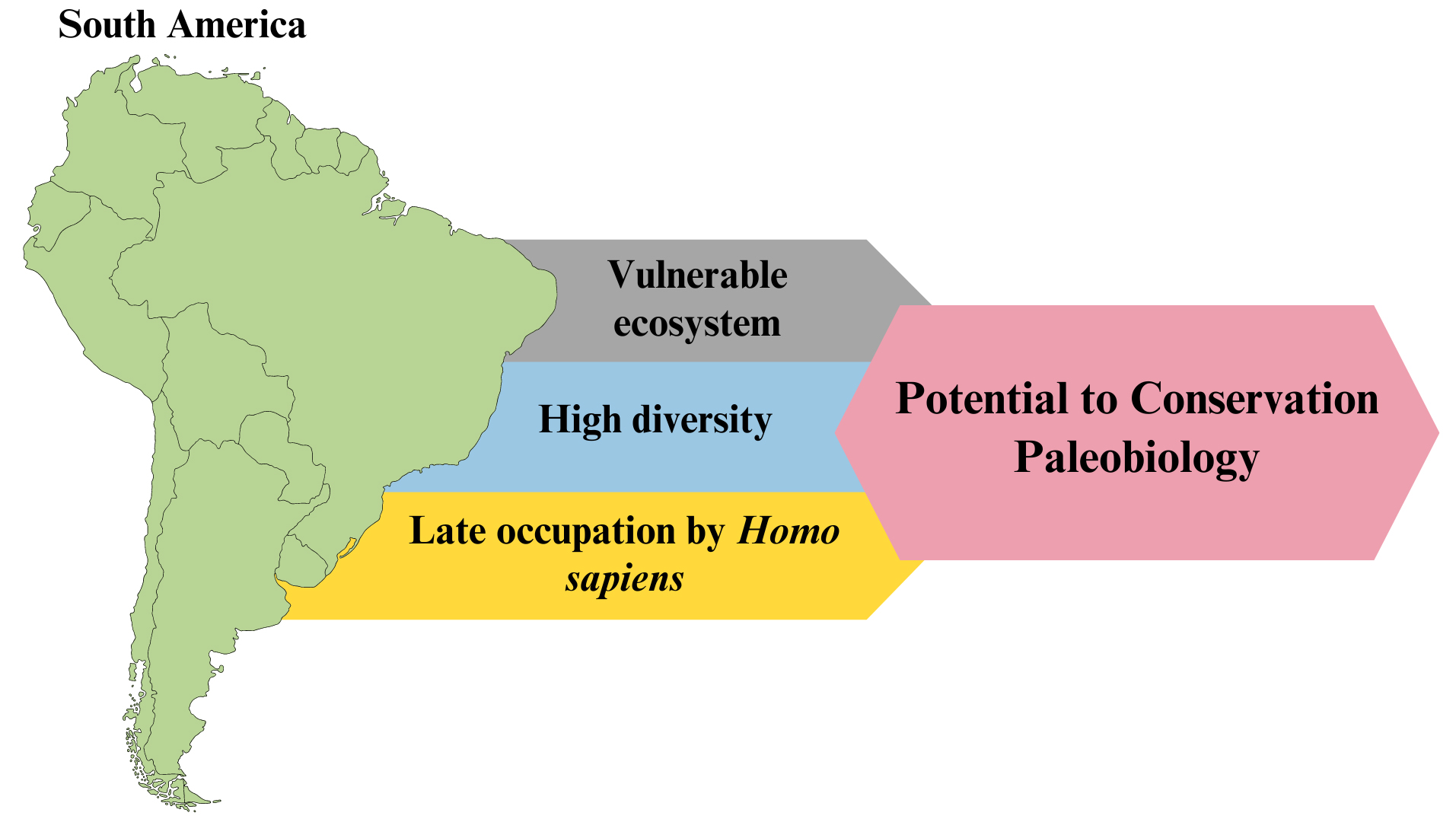
South America is one of the most biodiverse regions in the world (Antonelli & Sanmartín 2011), with various vulnerable and irreplaceable conservation areas (Myers et al. 2000, Olson & Dinerstein 2002, Brooks et al. 2006, Nobre et al. 2019) (Figure 3). However, most studies on anthropogenic climate impacts are conducted in the northern hemisphere (Winter et al. 2016, Feeley et al. 2017, Taheri et al. 2021, Kemp et al. 2023), which is also true for the countries participating in the International Long Term Ecological Research Network (ILTER; Vanderbilt & Gaiser 2017). The latter aims to conduct long-term ecological studies on the biotic and abiotic impacts on ecosystems, both current and future (Armesto 1990, Vanderbilt & Gaiser 2017). In South America, only Venezuela, Chile, and Brazil are members of the ILTER (Vanderbilt & Gaiser 2017), with Brazil currently having 45 surveyed sites1 (35 continental and 10 coastal and marine).

Vulnerable ecosystems; biological, geological, and environmental diversity; and late occupation by Homo sapiens as promoters of conservation paleobiology potential in South America.
Some of the sites studied by ILTER were established at the beginning of the 20th century; thus, the data already reflect ecosystems affected by anthropogenic disturbances (Kosnik & Kowalewski 2016). Only some studies have used data from longer time scales. Consequently, the identification of species baselines and associated information (e.g., extinction risk, population dynamics and causes, and biogeography) is insufficient to effectively address conservation issues from a higher temporal resolution (Dietl & Flessa 2009, 2011, Kowalewski 2009, Kidwell 2015, Clapham 2019, Dietl 2019, Kowalewski et al. 2023). Conservation paleobiology offers potential solutions, and South America, in particular, holds great promise.
Beyond biological diversity
South America is extraordinarily rich in biological diversity owing to its unique range of ecological environments. It stretches from the majestic heights of the Andes to remote islands, spanning vast deserts, extensive freshwater systems, coastal plains, grasslands, tropical rainforests, booming marine ecosystems, and coastal saline lagoons. Each of these environments offers unique habitats, providing the ecological conditions to support specialized organisms and unparalleled biodiversity.
Geological data are essential for understanding current environments and how biodiversity evolved in South America (Ramos 1989, Jackson et al. 1996, Kellog & Mohriak 2001, Wilf et al. 2013, Garcia et al. 2022). Important geological events, including the formation of the Andes (200 million years ago), the Atlantic Ocean (180 million years ago), and the Isthmus of Panama (3 million years ago), have altered the habitats of organisms and promoted their evolution (Jones & Hasson 1985, Coates et al. 1992, Bisbal 1995, Kellog & Mohriak 2001, Hughes & Eastwood 2006, Aleixo & Rossetti 2007, Floeter et al. 2008, Sedano & Burns 2010, Madriñán et al. 2013, Carrillo et al. 2015, Lagomarsino et al. 2016, Esquérre et al. 2019). Additionally, there are differences between the continental margins (Coulbourn 1981, Ramos 1989, Orme et al. 2007), which are bounded in the east by the Atlantic Ocean (featuring a divergent tectonic plate margin) and in the west by the Pacific Ocean (featuring a convergent margin). The coastal region has also experienced recent changes due to relative sea-level oscillations since the Pleistocene (Angulo et al. 2006, Martínez & Rojas 2013, Barboza et al. 2021), leading to notable alterations in the coastline and coastal environments.
The diverse environmental and geological characteristics of South America (Figure 3) have provided favorable conditions for the preservation of aquatic and coastal invertebrate fossils from a wide range of organisms, environments, and geological periods (e.g., Gomez et al. 2009, Luque & Gerken 2019, Lopes et al. 2024). These paleontological treasures contribute significantly to taphonomy and conservation paleobiology (Ritter et al. 2016), offering insights into the evolution of life and ecosystem dynamics over time, and are crucial for developing species conservation and management strategies in the region.
Late human occupation as a catalyst
Another factor making South America a unique center for conservation paleobiology is its geographical history and relatively late human occupation (Figure 3). Homo sapiens arrived on the South American continent within the last 20,000 years (Neves et al. 2007, Moreno-Mayar et al. 2018, Bisso-Machado & Fagundes 2019), and European colonization began only at the end of the 15th century. This delay in settlement preserved much of the original characteristics of ecosystems compared to other regions in the world. Thus, baselines may be derived from geohistorical records that are <10,000 years old (see Fossile et al. 2023).
Considering that South American organisms have only relatively recently been introduced to anthropogenic impacts, it is easier to observe their responses. It is even possible to determine whether the behavior of a specific species is related to anthropogenic impacts and identify species adaptations and response strategies (National Research Council 2005). This provides a deeper understanding of ecological patterns, evolution, distribution, and interactions among species, as well as how environmental changes have influenced biological communities over time (e.g., Simões et al. 2009, Archuby & Roche 2020, Fossile et al. 2020, 2023, Rivadeneira & Nielsen 2022). The information obtained is crucial for planning and implementing conservation and management projects and protecting South America’s sensitive ecosystems from ongoing climate and environmental changes. South America is a remarkable study locale for conservation paleobiology, offering unique opportunities to explore natural history and paleontological records.
CONSERVATION PALEOBIOLOGY IN SOUTH AMERICA
Given the potential and the importance of South America as described above, the progress in conservation paleobiology will be described from just before the coining of the discipline (1998) to the last complete year (2023) (for other reviews of the area, see: Conservation Paleobiology Workshop 2012, Dietl et al. 2015, Barnosky et al. 2017, Tyler & Schneider 2018, Dillon et al. 2022, Finnegan et al. 2023, Walker 2023). The key research publications of aquatic and coastal invertebrates are grouped accordingly to themes and/or techniques, chronologically, using subsections. Lastly, symposia, workshops, events, organizations and university subjects that occurred in South America are addressed.
Invertebrate paleolimnology
Although the term “conservation paleobiology” was coined in 2002, South American research utilizing fossil records to access human impact and for conservation purposes dates back to the 1990s (e.g., Chepstow-Lusty et al. 1998). Notably, a study published in Aquatic Conservation: Marine and Freshwater Ecosystems by Massaferro & Corley (1998) (Figure 4) investigated the relative abundance and diversity of chironomid head capsules from Lake Mascardi (Northern Patagonia, Argentina) core sediments. Their findings revealed that chironomid diversity levels remained constant during the 15.000 yrs covered by the core, with reductions attributed to natural events (volcanic episodes and temperature change) rather than human disturbances (Massaferro & Corley 1998). This underscores the importance of paleolimnological approaches to obtain historical data and investigate diversity patterns through time for conservation purposes (Massaferro & Corley 1998), given that chironomids are sensitive to environmental changes and are valuable to manage aquatic systems (Walker 1995).

South American contributions to conservation paleobiology included in this review, in chronological order. TAAS: Taphonomy in South America workshop; CBP: Brazilian Congress of Paleontology; PALEO RS: Annual Meeting of the Brazilian Paleontological Society - RS region; UFRGS: Federal University of Rio Grande do Sul; UNISINOS: University of Vale dos Sinos; ME: Marine Ecosystem.
Compositional fidelity
As previously explained, compositional fidelity is a valuable tool in conservation paleobiology and several South American studies employ it. In 2009, Marcello Simões and his collaborators published the first article titled with the term “conservation paleobiology” in the journal Historical Biology (Simões et al. 2009; Figure 4). Building on the work of previous authors (e.g., Kowalewski et al. 2000, Kidwell 2007), the study compared specimens from living and dead assemblages and revealed a significant decline in the population of the brachiopod Bouchardia rosea (Mawe 1823) since 1970 on a marine platform off the north coast of São Paulo, Southeastern Brazil. Of 6,627 specimens collected, only six were alive (Simões et al. 2009). This population decline may have been caused by changes in temperature, nutrient availability, population history, and water pollution (Simões et al. 2009), reinforcing the idea that compositional fidelity (comparison of ecological indices between living, dead, and fossil assemblages) is an effective and inexpensive method for studying the ecology of modern ecosystems and detecting long-term changes (Simões et al. 2009). Current research also underscores the potential for Brazil in this field of study.
Brazil was also the pioneer of the study on compositional fidelity involving fluvial mollusks in conservation paleobiology, published in Palaios by Erthal et al. (2011) (Figure 4). The freshwater mollusks were collected from living, dead, and fossil assemblages (from the Pleistocene period) in the Touro Passo River, Rio Grande do Sul, Southern Brazil. There was greater fidelity between the living and dead assemblages and less fidelity between the living/dead and fossil assemblages (Erthal et al. 2011). This can be explained by differences in the dominant species in the assemblages: while the native bivalve Cyanocyclas limosa (Maton 1811) and gastropod Heleobia aff. bertoniana (Pilsbry 1911) predominated in the fossil assemblage, the exotic species Corbicula fluminea (O. F. Müller 1774) was predominant in the living and dead assemblages and was absent in the fossil assemblage (Erthal et al. 2011). The study demonstrated that the sedimentary record (fossil assemblage) provides insights into the biodiversity of mollusks in an environment unaffected by humans, and that the introduction of exotic species reduced the fidelity between records (Erthal et al. 2011).
Martínez et al. (2013) published a study that did not include the term “conservation paleobiology,” yet it falls within the field. In the Cananéia-Iguape estuarine-lagoon system (São Paulo, Brazil), a canal was opened in 1852 to connect the lagoon with a nearby river, thereby facilitating the transport of agricultural products but also introducing mining contaminants into the freshwater system (GEOBRÁS 1966, Eysink et al. 1988, Moraes et al. 2004). The study analyzed changes in the malacofauna based on three samples collected along the main lagoon canal, reporting large shifts in mollusk composition since the construction of the canal; before, marine and euryhaline species predominated, then opportunistic and freshwater-tolerant species dominated (Martínez et al. 2013). Martínez et al. (2013) demonstrated that mollusk death assemblages are promising indicators of environmental changes caused by human activities and provide a baseline for conservation, supporting Kidwell’s (2013) findings.
Shell Mounds
Sambaquis (from “Tupi-Guarani,” tamba = shell, ki = huddle) are archaeological shell mounds formations found along the Brazilian coast, dating from between 10,000 and 1,000 BP, and contain a mix of vertebrate and invertebrate remains, plants, sediments and human artifacts (Lima 1999, Schmitz 2006, Giannini et al 2010). The information from the organisms preserved in shell mounds can be helpful to analyze past species and inform the conservation of current ones. Mendes et al. (2019) (Figure 4) confirmed that ichthyological records from shell mounds in the states of Rio de Janeiro, São Paulo, and Espírito Santo (Southeastern Brazil) showed no difference from current ichthyological diversity, as measured by the compositional fidelity index proposed by Kidwell & Bosence (1991), although this index has fallen out of favor because it ignores the effects of sample size (Kidwell 2002, Ritter & Erthal 2013). Shell mounds provide valuable records of past biodiversity and are recommended for use in ecological conservation and broad temporal studies (Mendes et al. 2019).
Fossile et al. (2020) (Figure 4) reviewed studies containing faunal information from 110 shell mounds in Babitonga Bay, Santa Catarina, Brazil, and compared these with records of species currently living in the region. A total of 244 species were recorded, from Annelida to Mammalia—14 species were under some degree of conservation threat and 12 no longer existed in Babitonga Bay (one fish, and 11 mollusks; Fossile et al. 2020). Fossile et al. (2020) demonstrated that sambaquis provides snapshots of past biodiversity on Atlantic Forest (one of the most threatened biomes), reinforcing the value of archaeological sites for conservation.
Recently, Assumpção et al. (2022) (Figure 4) discussed the challenges of detecting potential body size changes between ancient mollusk valves from shell mounds and modern ones, in the Rio Grande do Sul coast, Brazil. The comparisons of body size aimed to address the main challenges of this approach: the unknown origins and collection methods of sambaqui shells and determining which hypothesis tests and data are most appropriate (Assumpção et al. 2022). The researchers noted that bivalves from shell mounds were generally larger than the living ones, but comparisons between these and those from specific beach zones (supralittoral and infralittoral) showed no significant differences. This suggests that the preferred collection areas for shell mounds were zones with larger shells (Assumpção et al. 2022). Therefore, data from organisms found in archaeological sites should be used cautiously in conservation paleobiology, and further studies on shell mounds are needed to clarify their conservation importance (Assumpção et al. 2022).
The humboldt current marine ecosystem
The Humboldt Current Marine Ecosystem, located between Peru and Chile in western South America, is one of the most productive marine ecosystems in existence, influenced by strong seasonal or permanent upwelling (Barber & Chavez 1983, Bakun & Broad 2003, Thiel et al. 2007, Gutiérrez et al. 2016, 2017). Due to its productivity, the region has been historically overexploited, what ads to worsening environmental changes such as rising water temperatures, acidification, and environmental degradation (Chatwin 2007, Coll et al. 2008, Rivadeneira et al. 2010, Gutiérrez et al. 2016, 2017). Consequently, it is essential to establish baselines to evaluate the magnitude and direction of anthropogenic impacts on organisms within the Humboldt Current Marine Ecosystem.
Recently, researchers from the Centro de Estudios Avanzados en Zonas Áridas, Chile, published a series of articles laying the groundwork for conservation paleobiology in this ecosystem (e.g., Rivadeneira & Carmona 2008, Rivadeneira 2010, Rivadeneira et al. 2010, Martinelli et al. 2017, Rivadeneira & Nielsen 2022). Rivadeneira & Nielsen (2022) (Figure 4) compiled a database of bivalves and gastropods from modern and fossil outcrops to assess the impact of human activities on their diversity. While species diversity remained stable from the Pleistocene to the Holocene, comparisons between fossil and modern species revealed changes in species composition and a decreased relative abundance of exploited species (Rivadeneira & Nielsen 2022). Thus, this conservation paleobiology approach proved very useful for achieving the intended objective, and the insights gained from these studies will be crucial for advancing the field in South America.
Events and organizations in South America
South American events and organizations focused on, or involving, conservation paleobiology developed significantly later than those in the USA. While North America had numerous symposia, workshops, and courses by the early 2000s (Dillon et al. 2022), such initiatives only began to emerge in South America over a decade later. In 2016, a research group specializing in actualistic taphonomy was established in South America (South American School of Taphonomy) and published a manifesto highlighting the unique contributions of this locality to the field, including conservation paleobiology (Ritter et al. 2016) (Figure 4). This manifesto led to the 1st Workshop on Actualistic Taphonomy, in Montevideo, Uruguay, in 2017 (Martínez et al. 2020). The second edition, in 2021, was an online event due to the COVID-19 pandemic situation, gathering more than 60 participants, and 35 abstracts were presented (including one with the conservation paleobiology theme; Ritter et al. 2021; see also Ritter et al. 2023b).
In 2017, Marcello Simões conducted the first mini-course on conservation paleobiology at the XXIII Brazilian Congress of Paleontology (Figure 4). Later, at the 2018 Annual Meeting of the Brazilian Paleontological Society, RS (PaleoRS), in São Leopoldo, Rio Grande do Sul, Matias Ritter also taught a mini-course about the discipline (Figure 4).
The Graduate Program in Geosciences at the Federal University of Rio Grande do Sul (PPGGEO/UFRGS) and Graduate Program in Geology at the University of Vale dos Sinos (PPGGEO/UNISINOS) offered specialized courses on conservation paleobiology (course codes GEB00146 and 093531_T20, respectively) in 2020 (Figure 4). At UFRGS, Matias Ritter taught the course, with contributions from Fernando Erthal and guest lectures by Paolo Albano, Sabrina Rodrigues, Claudio De Francesco, and Gabriela Hassan, who covered fundamental concepts, applications, case studies, and future perspectives. Hugo Schmidt-Neto led the course at UNISINOS, under the supervision of Rodrigo Horodyski. Besides theoretical instruction, the course included a practical field activity along the coastal zone of Rio Grande do Sul. During this activity, students investigated the effects of invasive species on native species dynamics and the impacts of human settlement in areas undergoing constant geomorphological changes.
At the end of 2023, Archuby et al. (2023) published a note on conservation paleobiology in the Boletín de la Asociación Argentina de Malacología. The authors provided an overview of the field and insights that can be gleaned from marine mollusks, emphasizing their importance (Archuby et al. 2023). Additionally, they discussed the potential of research in South America. They introduced the South America Conservation Paleobiology Network, which aims to advance the field on the continent by exploring its diverse environments (Archuby et al. 2023).
CONSERVATION PALEOBIOLOGY BY THE NUMBERS
The search platform Web of Science - Main Collection1, maintained by Clarivate Analytics, can be used to analyze the growth of publications on conservation paleobiology, as its databases include journals from a wide range of fields. The comprehensive search tool uses linked references, allowing searches for exact phrases, control of plurals and variant spellings, and use of search operators (Web of Science 2022).
A search by topic (title, abstract, author’s keywords, and keywords plus), covering the period from 1945 to 2023 (the last full year), using the search term “TS= ((paleo* OR palaeo*) AND (*ecology OR *biology OR ecolog* OR biolog*) AND (conserv* OR restor* OR manag*))” (for any doubt related to the search operators, see Web of Science, 2022) identified articles that do not necessarily contain the term “conservation paleobiology” but are still relevant and noteworthy (Groff et al. 2023). This search yielded 2,927 articles as of January 23, 2024 (Additional Material 1), illustrating the growth of the field over the years: in 1987, one article was published; from 1991 to 2000, 167 articles were published, with 31 in 1999 alone; there were 527 articles from 2001 to 2010, with 2009 recording the highest number at 94 articles; from 2011 to 2020, there were 1,578 publications; and in 2021–2023, there were 651 publications, representing more than 40% of the total publications between 2011 and 2020 (Figure 5).

Publications of topics related to conservation paleobiology (totals by decade), and the percentage of articles published in the countries with the most publications (United States of America, England, Australia) and in Brazil between 1987 and 2023. Web of Science database, on January 23, 2024.
The countries with the most publications were the USA, UK, and Australia, which accounted for 35%, 18%, and 11% of the total, respectively (Additional Material 2; Figure 5), consistent with the rankings of Dillon et al. (2022). This trend was also reflected in other fields such as conservation, paleontology, and ecology, which are predominantly practiced in North America and Western Europe (Martin et al. 2012, Di Marco et al. 2017, Nuñez et al. 2021, Raja et al. 2022). Dillon et al. (2022) suggested that this uneven distribution may be due to biases in funding and investment in scientific research, especially in developing countries in South America. Despite having high-priority areas for biodiversity conservation (Myers et al. 2000, Tabarelli et al. 2005, Overbeck et al. 2015) and benefiting from conservation paleobiology, South America accounted for only 10% of the total publications (290 articles) (Additional Material 2). Brazil led the South American countries in the number of publications, ranking tenth overall with 141 publications, which represents ~5% of the total and nearly 50% of those from Latin America (Additional Material 2; Figure 5).
Using another research platform with an academic database, Elsevier’s Scopus1, a search was performed for articles containing specifically the term “conservation paleobiology” [TITLE-ABS-KEY (conservation AND paleobiology)] in the title, abstract, or keywords, as of January 29, 2024. Notably, this excluded articles on conservation paleobiology that did not mention the specific field in the title, abstract, or keywords. The search yielded a total of 181 publications between 1996 and 2023, with nine articles (5.5% of the total) focusing only on the available South American countries (Additional Material 3). Of these nine articles, six were conducted in Brazil (five exclusively in Brazil and one including other countries; Simões et al. 2009, Ritter et al. 2013, Lima-Ribeiro et al. 2017, Fossile et al. 2020, Assumpção et al. 2022, Lopes et al. 2022), two in Argentina (one exclusively in Argentina; Archuby et al. 2015, Lima-Ribeiro et al. 2017), three in Chile (one exclusively in Chile; Lima-Ribeiro et al. 2017, Martinelli et al. 2017, Rivadeneira & Nielsen 2022), two in Peru (Lima-Ribeiro et al. 2017, Rivadeneira & Nielsen 2022), and one including all countries (Lima-Ribeiro et al. 2017) (Figure 6; Additional Material 3). Most of the South American publications deal exclusively with mollusks (66.67%); despite that, Simões et al. (2009) researched brachiopods, Fossile et al. (2020) investigated the fauna, and Lima-Ribeiro (2017) studied the jaguar (Additional Material 3). Only the last one focused on terrestrial environments; the other articles were conducted in marine and coastal environments.

The number of conservation paleobiology publications in South American countries. The listed articles were exclusively conducted in each country. Scopus database, on January 29, 2024.
Of the foundations funding articles on conservation paleobiology (Additional Material 4), the National Council for Scientific and Technological Development (CNPq, Brazil) is tied for third place with the German Alexander von Humboldt-Stiftung and Austrian Science Fund, each supporting four publications. However, there is a notable gap between the National Science Foundation (USA), which leads with 30 publications, and British Natural Environment Research Council, which ranks second with only six publications. This disparity underscores the varying approaches to science and conservation across different countries, highlighting the dedicated conservation projects and funding of the National Science Foundation.
Regarding the most published authors and coauthors (Additional Material 5), paleontologists predominated, with Gregory Dietl leading with 17 publications, Michal Kowalewski following with seven, and Susan Kidwell and Martin Zuschin tied for third place, each with six publications (Figure 7). Geoscience authors were also prevalent in South America, where paleontologist Matias Ritter led with three articles, followed by Eduardo Barboza and Felipe Caron (geologists), Fernando Erthal (paleontologist), Julietta Martinelli, and Marcelo Rivadeneira (paleobiologists), each with two articles (Figure 7). There was a notable disparity between the top-ranking authors worldwide and those in South America, with Dietl having published approximately five times more articles on conservation paleobiology than Ritter (Figure 7). The authors’ area of expertise is reflected in their research and in the journals where their work is published: five out of the nine journals that published articles from South America focus on Earth sciences (i.e., Historical Biology, Journal of South American Earth Sciences, Palaios, Revista Brasileira de Paleontologia and Quaternary International; Additional Material 3). Thus, conservation paleobiology remains a niche field, predominantly involving paleontologists from developed countries, which indicates a lack of participation by conservation biologists and a delay in engagement by the researchers of countries most in need of conservation policies (issues discussed in “Challenges and Perspectives in South America”).

Authors worldwide (Zuschin to Dietl) and in South America (Rivadeneira to Ritter) with more publications in the field of conservation paleobiology between 1996 and 2023. Scopus database, on January 29, 2024.
According to the Scopus database, the most recent article from 2023 on conservation paleobiology was authored by Martin Zuschin and published in Palaios. He emphasized the importance of establishing reliable baselines and addressed pertinent challenges in this field (Zuschin 2023). An analysis of closely related articles (similar in citations and references) using the tool Connected Papers1 showed an indirect connection with three articles by South American authors: one by Matias Ritter and two by Fernando Archuby (Figure 8, Additional Material 6). These studies discussed age estimates, time-averaging, and compositional fidelity (Archuby et al. 2015, Ritter et al. 2017, Archuby & Roche 2020), topics that Zuschin (2023) identified as crucial for accurately considering past states in conservation paleobiology. Historically, these issues were extensively explored by Marcello Simões and Michal Kowalewski in the early 2000s in Brazil.

Connections between articles based on similarities (citations and references) with the article by Zuschin (2023). Each node is a publication related to the original article. The circle size indicates the number of citations and is colored according to the year of publication (light colors for older articles and darker for more recent ones). Similar articles have thicker connecting lines and are grouped more closely together. Connected Papers database (image modified), on January 29, 2024.
Interest in conservation paleobiology is expected to grow in South America and worldwide in the coming years, as evidenced by the notable increase in publications today compared to the field’s first decade, along with the potential contributions of South American ecosystems to the field. Global initiatives and projects, such as the United Nations Decade of Ocean Science for Sustainable Development, highlight the urgent need for solutions to conservation issues, biodiversity restoration, and ecosystem services in coastal and marine environments, which underscores the potential applications of conservation paleobiology. Additionally, challenges in the field should encourage the development of new approaches and applications in conservation.
CHALLENGES AND PERSPECTIVES IN SOUTH AMERICA
Theoretical studies are just as critical as practical ones, especially in the initial stages of research in South America. They provide crucial information about the environment, organisms, and ecological processes to be analyzed in the future (Albano & Sabelli 2011, Dietl & Flessa 2011). This information contributes to the development of hypotheses, models, and approaches for guiding conservation decision-making (Dietl & Flessa 2011). Unfortunately, geohistorical data are underused in conservation studies (Willis et al. 2005, Willis & Birks 2006, Dietl & Flessa 2011, Vegas-Vilarrubia et al. 2011, Kittinger et al. 2015, Thurstan et al. 2015, Savarese 2018, Smith et al. 2018), which often rely on short time scales. This limits the potential of management and investment interventions (Froyd & Willis 2008, Davies et al. 2014, Durham & Dietl 2015, Kittinger et al. 2015, Thurstan et al. 2015). Moreover, the integration of conservation paleobiology data with conservation tools presents a global challenge, exacerbating the disconnect between theoretical and practical applications (Willis & Birks 2006, Knight et al. 2008, Flessa 2009, Davies et al. 2014, Dietl & Flessa 2017, Dillon et al. 2022, Dietl et al. 2023, Groff et al. 2023). This mirrors a broader problem in conservation biology related to the weak association among monitoring, research questions, and conservation actions, thereby complicating effective problem-solving (Redford & Sanjayan 2003, Baldwin 2004, Diffendorfer & Doherty Jr 2004).
Much of the gap between theory and practice is due to a need for more of dialogue and collaboration between conservation paleobiologists and professional conservationists involved in management and decision-making (Davies et al. 2014). Several factors contribute to this gap, including prejudice and resistance to the unknown, and the rigid mindset of conservationists and environmental managers (e.g., Carrion & Fernandez 2009), who often resist using geohistorical data and insights from conservation paleobiology (Dietl & Flessa 2011). One issue leading to the underutilization of conservation paleobiology by conservationists and environmental managers is their concern with the differences between current and past conditions and organisms, making geohistorical records seem irrelevant to current conservation efforts (Willis et al. 2007, Durham & Dietl 2015). However, these data are valuable for reconstructing biotic responses to various past changes (e.g., climate change) and serve as natural experiments that have enhanced our understanding of ecosystem dynamics. This enhanced understanding may help predict responses to similar disturbances (Valentine 1989, Willis et al. 2010, Dietl & Flessa 2011, Vegas-Vilarrubia et al. 2011, Conservation Paleobiology Workshop 2012, Dietl et al. 2015, Fordham et al. 2020), since the underlying processes and laws remain consistent (Valentine 1973). Furthermore, effective conservation requires obtaining comparable baseline values for species ecological indices before impacts occur (National Research Council 2005, Durham & Dietl 2015, Tyler & Schneider 2018). Initiatives such as the International Union for Conservation of Nature (IUCN) Green Status of Species help demystify and promote the application of geohistorical records in conservation (see Akçakaya et al. 2018, Grace et al. 2019, 2021a, b, c).
The methods used to train and familiarize conservation paleobiologists also contribute to the theoretical-practical gap in the field. Given its recency, even professors specializing in “conservation paleobiology” may lack an interdisciplinary understanding and/or approach that considers conservation and management groups (Conservation Paleobiology Workshop 2012, Kelley et al. 2018, 2019, Savarese 2018). Consequently, students are not encouraged to participate in training and interactions with conservationists (Davies & Bunting 2010, Kelley et al. 2018, 2019, Savarese 2018) or communicate socially consequential research to varied professionals through technical reports and oral presentations (Burbidge & Wallace 1995, Arlettaz et al. 2010, Davies et al. 2014, Kelley et al. 2018, Savarese 2018, Norström et al. 2020).
The pressures to publish scientific papers within tight deadlines (Voltarelli 2002, Rosa 2008, Patrus et al. 2015, Silva et al. 2017) reduce student’s and researcher’s time and financial resources. Moreover, by assigning lower rankings to national and native-language journals—often not even recognized in graduate programs—, South American educational institutions push students and researchers to publish in foreign English scientific journals. These journals frequently require the payment of article processing charges for open access. This not only devalues national scientific efforts (science in the country, for the country) but also limits the audience for these publications to specialists (e.g., Figueiredo et al. 2024). Consequently, the publications may be excluded from conservation and management decisions (Froyd & Willis 2008, Knight et al. 2008, Caudron et al. 2012, Cook et al. 2013, Fuller et al. 2014, Bertuol-Garcia et al. 2018, Savarese 2018, Dietl et al. 2023).
Changing the perceptions and trends of educational institutions is a challenging endeavor that involves complex issues such as the distribution of union funds, interdisciplinary collaboration among institutional departments, and engagement with the conservation community (i.e., NGOs, government agencies, and other stakeholders) (Israel et al. 1998, Kelley et al. 2018, Savarese 2018, Smith et al. 2018). However, it may be worthwhile to promote conservation-oriented studies that do not necessarily aim for publication in scientific journals but instead focus on making broader contributions to the environment and society (Kelley et al. 2018, Savarese 2018, Dietl et al. 2023).
Although most conservation paleobiologists understand the importance of their field, only a few collaborate directly with conservationists to implement their findings (Dillon et al. 2022, Groff et al. 2023). A crucial first step, particularly for overcoming biases and establishing professional connections, is to proactively promote the communication of critical practical studies in conservation paleobiology with conservationists, especially to emphasize the value of geohistorical records (Caudron et al. 2012, Davies et al. 2014, Durham & Dietl 2015, Kittinger et al. 2015, Savarese 2018, Smith et al. 2018). Once the contact between conservation paleobiologists and conservationists is established, they should discuss together (i) what to conserve, where, and how; (ii) what are the societal benefits; and (iii) verify the available and necessary resources (Sutherland et al. 2011, Thurstan et al. 2015). This collaboration would facilitate the translation of palaeobiological insights into practical recommendations and enable the adaptation of conservation strategies to include relevant palaeobiological information (Davies & Bunting 2010, Cook et al. 2013). Additionally, the researchers will be able to effectively implement the knowledge co-production model (Dietl et al. 2023, Finnegan et al. 2024).
Newly graduating paleobiologists and conservation biologists with such collaborative visions require training that encompasses both scientific knowledge and practical skills (Kelley et al. 2018). This training should include (after Cook et al. 2013, Schwartz et al. 2017, and Kelley et al. 2018, 2019): (i) the development of interpersonal skills such as communicating effectively, resolving conflict, influencing others, building trusting relationships, and leadership; (ii) participation in interdisciplinary curricula that provide informal opportunities for interaction; (iii) exposure to problem-solving approaches and understanding of political contexts; (iv) practical experience with various methodologies in real-world settings; and (v) establishment of connections with stakeholders.
Advancing the field of paleobiology conservation in South America may take some time due to its reliance on multiple operational factors. However, significant progress can be achieved by fostering collaboration between conservation paleobiologists and conservationists to make science together. Future research should focus on aligning with societal and conservation interests, not only to address theoretical gaps but also to bridge the divide between theory and practice by effectively implementing scientific advances into practice. In particular, the potential of studies on past climate and environmental changes, past extinction events, and historical human impacts is immense.
Research into past climate and environmental conditions can reveal how historical shifts influenced biodiversity and ecosystem structures, offering crucial insights into how current and future climate changes might affect South American ecosystems. Understanding past extinction events will help identify patterns and causes of species loss, guiding strategies to prevent modern extinctions and enhance species recovery. Additionally, investigating the impact of historical human activities on the environment can provide valuable lessons for managing current conservation challenges and developing effective policies to mitigate anthropogenic effects on biodiversity. By focusing on these areas, conservation paleobiology can substantially contribute to theoretical knowledge and practical conservation efforts in South America.
CONCLUSIONS
The field of conservation paleobiology represents a vital intersection between paleontological research and conservation efforts. As detailed throughout this document, the integration of paleontological data provides invaluable insights into historical ecological dynamics, enabling a more comprehensive understanding of past and present biodiversity patterns in aquatic environments. By leveraging data from geohistorical records, conservation paleobiology offers a broader temporal framework that enhances our ability to predict and mitigate future ecological changes and species extinctions. This approach overcomes the limitations of short-term monitoring and management strategies by incorporating long-term ecological perspectives.
The application of conservation paleobiology in South America is particularly significant due to the region’s complex and diverse ecosystems. Recent studies have highlighted compositional fidelity’s importance in accurately reconstruct historical environmental conditions and species distributions. The research conducted in Brazil, Argentina, Chile, Peru, and Uruguay, showcases the field’s potential to set appropriate baselines and assess environmental impacts on aquatic organisms. Moreover, events and organizations play a crucial role in promoting and disseminating conservation paleobiology to other fields of knowledge and to the broader public, enhancing the visibility and impact of the discipline.
The increasing number of publications reflects the growth of conservation paleobiology research. The USA, UK, and Australia lead in publication output, while South America, despite its rich biodiversity, contributes only 10% (in the broader search term than just “conservation paleobiology”) and 5.5% (in the restrict term) of the total publications. Notably, Brazil is the South American country with the most publications in the discipline, highlighting its significant, though still limited, contribution. These data underscore the global interest in conservation paleobiology and the need for increased support and collaboration to enhance research contributions from South America.
Advancing conservation paleobiology in South America involves addressing theoretical gaps and improving the application of scientific findings in practical contexts. Future research should focus on bridging the divide between theory and practice by aligning studies with societal and conservation interests. Examining past climate changes, extinction events, and historical human impacts has immense potential for enhancing our understanding and managing contemporary ecological challenges. Strengthening connections between research and conservation practices will enable conservation paleobiology to play a pivotal role in both advancing theoretical knowledge and enhancing practical conservation efforts in the region.
Acknowledgements
The authors thank Fernando Erthal, Rodrigo S. Horodyski and Sabrina C. Rodrigues for their initial suggestions about the text. We are also significantly indebted to Fernando M. Archuby and two anonymous reviewers for their valuable comments on this report. ACAA thanks the Conselho Nacional de Desenvolvimento Científico e Tecnológico (CNPq) for the PhD grant (process 140721/2022-3). MNR thanks to CNPq grant (process 313830/2023-1).
References
-
AKÇAKAYA HR ET AL. 2018. Quantifying species recovery and conservation success to develop an IUCN Green List of Species. Conserv Biol 32: 1128-1138. https://doi.org/10.1111/cobi.13112.
» https://doi.org/10.1111/cobi.13112 -
ALBANO PG, AZZARONE M, AMATI B, BOGI C, SABELLI B & RILOV G. 2020. Low diversity or poorly explored? Mesophotic molluscs highlight undersampling in the Eastern Mediterranean. Biodivers Conserv 29: 4059-4072. https://doi.org/10.1007/s10531-020-02063-w.
» https://doi.org/10.1007/s10531-020-02063-w -
ALBANO PG & SABELLI B. 2011. Comparison between death and living molluscs assemblages in a Mediterranean infralittoral off-shore reef. Palaeogeogr Palaeoclimatol Palaeoecol 310: 206-215. https://doi.org/10.1016/j.palaeo.2011.07.012.
» https://doi.org/10.1016/j.palaeo.2011.07.012 -
ALEIXO A & ROSSETTI DDF. 2007. Avian gene trees, landscape evolution, and geology: towards a modern synthesis of Amazonian historical biogeography? J Ornithol 148: 443-453. https://doi.org/10.1007/s10336-007-0168-7.
» https://doi.org/10.1007/s10336-007-0168-7 -
ANGULO RJ, LESSA GC & SOUZA MC. 2006. A critical review of Mid- to Late-Holocene Sea-level fluctuations on the eastern Brazilian coastline. Quaternary Sci Rev 25: 486-506. https://doi.org/10.1016/j.quascirev.2005.03.008.
» https://doi.org/10.1016/j.quascirev.2005.03.008 -
ANTONELLI A & SANMARTÍN I. 2011. Why are there so many plant species in the Neotropics? Taxon 60: 403-414. https://doi.org/10.1002/tax.602010.
» https://doi.org/10.1002/tax.602010 -
ARCHUBY FM, ADAMI M, MARTINELLI JC, GORDILLO S, BORETTO GM & MALVÉ ME. 2015. Regional-scale compositional and size fidelity of rocky intertidal communities from the Patagonian Atlantic coast. Palaios 30: 627-643. https://doi.org/10.2110/palo.2014.054.
» https://doi.org/10.2110/palo.2014.054 - ARCHUBY FM, DE FRANESCO CG, ERTHAL F, RITTER, MN & SCARABINO F. 2023. Paleobiología de la conservación: sumando la ecología del pasado para comprender el presente. Bol Asoc Argent Malacol 13: 8-18.
- ARCHUBY FM & ROCHE A. 2020. Intertidal death assemblages as proxies of marine biodiversity. An example from Northern Patagonia, Argentina. In: Martínez S, Rojas A & Cabrera F (Eds), Actualistic Taphonomy in South America, Springer, Cham: Topics in Geobiology, p. 35-60. https://doi.org/10.1007/978-3-030-20625-3_3.
-
ARLETTAZ R, SCHAUB M, FOURNIER J, REICHLIN TS, SIERRO A, WATSON JEM & BRAUNISCH V. 2010. From publications to public actions: When conservation biologists bridge the gap between research and implementation. Bioscience 60: 35-842. https://doi.org/10.1525/bio.2010.60.10.10.
» https://doi.org/10.1525/bio.2010.60.10.10 - ARMESTO JJ. 1990. Estudios a largo plazo: Una prioridad para la investigación ecológica de hoy. Rev Chil Hist Nat 63: 7-9.
-
ASSUMPÇÃO ACA, CARON F, ERTHAL F, BARBOZA EG, PINOTTI RM & RITTER MN. 2022. The Tricky Task of Fisher-Gardener Research in Conservation Paleobiology. Front Ecol Evol 10: 838839. https://doi.org/10.3389/fevo.2022.838839.
» https://doi.org/10.3389/fevo.2022.838839 -
BAKUN A & BROAD K. 2003. Environmental ‘loopholes’ and fish population dynamics: comparative pattern recognition with focus on El Niño effects in the Pacific. Fish Oceanogr, 12: 458-473. https://doi.org/10.1046/j.1365-2419.2003.00258.x.
» https://doi.org/10.1046/j.1365-2419.2003.00258.x - BALDWIN R. 2004. Lifting Cassandra’s curse. Conserv Biol 8: 601-601.
-
BARBER RT & CHAVEZ FP. 1983. Biological consequences of El Niño. Science 222: 1203-1210. https://doi.org/10.1126/science.222.4629.1203.
» https://doi.org/10.1126/science.222.4629.1203 -
BARBOZA EG, DILLENBURG SR, RITTER MN, ANGULO RJ, SILVA AB, ROSA MLC, CARON F & SOUZA MC. 2021. Holocene sea-level changes in southern Brazil based on high-resolution radar stratigraphy. Geosciences 11: 326. https://doi.org/10.3390/geosciences11080326.
» https://doi.org/10.3390/geosciences11080326 -
BARCLAY KM & LEIGHTON LR. 2022. Predation scars reveal declines in crab populations since the Pleistocene. Front Ecol Evol 10: 810069. https://doi.org/10.3389/fevo.2022.810069.
» https://doi.org/10.3389/fevo.2022.810069 -
BARNOSKY AD ET AL. 2017. Merging paleobiology with conservation biology to guide the future of terrestrial ecosystems. Science 355: eaah4787. https://doi.org/10.1126/scien ce.aah4787.
» https://doi.org/10.1126/scien -
BEHRENSMEYER AK, KIDWELL SM & GASTALDO R. 2000. Taphonomy and paleobiology. Paleobiology 26: 103-147. https://doi.org/10.1017/S0094837300026907.
» https://doi.org/10.1017/S0094837300026907 -
BERTUOL-GARCIA D, MORSELLO C, EL-HANI CN & PARDINI R. 2018. A conceptual framework for understanding the perspectives on the causes of the science–practice gap in ecology and conservation. Biol Rev 93: 1032-1055. https://doi.org/10.1111/brv.12385.
» https://doi.org/10.1111/brv.12385 -
BISBAL GA. 1995. The Southeast South American shelf large marine ecosystem: Evolution and components. Mar Policy 19: 21-38. https://doi.org/10.1016/0308-597X(95)92570-W.
» https://doi.org/10.1016/0308-597X(95)92570-W - BISSO-MACHADO R & FAGUNDES NJR. 2019. Homo sapiens dispersal and the peopling of the Americas. In: O’Rourke DH (Ed), A companion to anthropological genetics, New York: J Wiley & Sons, New York, USA, p. 165-185. https://doi.org/10.1002/9781118768853.ch12.
-
BONEBRAKE TC, CHRISTENSEN J, BOGGS CL & EHRLICH PR. 2010. Population decline assessment, historical baselines, and conservation. Conserv Lett 3: 371-378. https://doi.org/10.1111/j.1755-263X.2010.00139.x.
» https://doi.org/10.1111/j.1755-263X.2010.00139.x -
BROOKS TM, MITTERMEIER RA, DA FONSECA GAB, GERLACH J, HOFFMANN M, LAMOREUX JF, MITTERMEIER CG, PILGRIM JD & RODRIGUES ASL. 2006. Global biodiversity conservation priorities. Science 313: 58-61. https://doi.org/10.1126/science.1127609.
» https://doi.org/10.1126/science.1127609 - BURBIDGE AA & WALLACE KJ. 1995. Practical methods for conserving biodiversity. In: Bradstock RA, Auld TD, Keith DA, Kingsford RT & Lunney D (Eds), Conserving biodiversity: threats and solutions, Sidney: Surrey Beatty and Sons, p. 11-26.
-
CARRILLO JD, FORASIEPI A, JARAMILLO C & SÁNCHEZ-VILLAGRA MR. 2015. Neotropical mammal diversity and the Great American Biotic Interchange: spatial and temporal variation in Southern America’s fossil record. Front Genet 5: 451. https://doi.org/10.3389/fgene.2014.00451.
» https://doi.org/10.3389/fgene.2014.00451 -
CARRION JS & FERNANDEZ S. 2009. The survival of the ‘natural potential vegetation’ concept (or the power of tradition). J Biogeogr 36: 2202-2203. https://doi.org/10.1111/j.1365-2699.2009.02209.x.
» https://doi.org/10.1111/j.1365-2699.2009.02209.x -
CAUDRON A, VIGIER L & CHAMPIGNEULLE A. 2012. Developing collaborative research to improve effectiveness in biodiversity conservation practice. J Appl Ecol 49: 753-757. https://doi.org/10.1111/j.1365-2664.2012.02115.x.
» https://doi.org/10.1111/j.1365-2664.2012.02115.x - CHATWIN A. 2007. Priorities for coastal and marine conservation in South America. Arlington, Virginia, USA: The Nature Conservancy, 63 p.
-
CHEPSTOW-LUSTY AJ, BENNETT KD, FJELDSÅ J, KENDALL A, GALIANO W & HERRERA AT. 1998. Tracing 4,000 years of environmental history in the Cuzco area, Peru, from the pollen record. Mount Res Dev 18: 159-172. https://doi.org/10.2307/3673971
» https://doi.org/10.2307/3673971 -
CLAPHAM ME. 2019. Conservation evidence from climate-related stressors in the deep-time marine fossil record. Philos Trans R Soc B 374: 20190223. https://doi.org/10.1098/rstb.2019.0223
» https://doi.org/10.1098/rstb.2019.0223 -
COATES A, JACKSON JBC, COLLINS AG, CRONIN TM, DOWSETT HJ, BYBELL LM, JUNG P & OBANDO JA. 1992. Closure of the Isthmus of Panama: the near-shore marine record of Costa Rica and western Panama. Geol Soc Am Bull 104: 814-828. https://doi.org/10.1130/0016-7606(1992)104<0814:COTIOP>2.3.CO;2.
» https://doi.org/10.1130/0016-7606(1992)104 -
COLL M, LIBRALATO S, TUDELA S, PALOMERA I & PRANOVI F. 2008. Ecosystem overfishing in the ocean. PloS ONE 3: e3881. https://doi.org/10.1371/journal.pone.0003881.
» https://doi.org/10.1371/journal.pone.0003881 - CONSERVATION PALEOBIOLOGY WORKSHOP. 2012. Conservation Paleobiology: Opportunities for the Earth Sciences. Report to the Division of Earth Sciences, National Science Foundation. Ithaca, New York: Paleontological Research Institution, 32 p.
-
COOK CN, MASCIA B, SCHWARTZ MW, POSSINGHAM HP & FULLER RA. 2013. Achieving conservation science that bridges the knowledge-action boundary. Conserv Biol 27: 669-678. https://doi.org/10.1111/cobi.12050.
» https://doi.org/10.1111/cobi.12050 - COULBOURN WT. 1981. Tectonics of the Nazca plate and the continental margin of western South America, 18 S to 23 S. Geol Soc Am Mem 154: 587-618.
-
DAVIES AL & BUNTING MJ. 2010. Applications of palaeoecology in conservation. Open Ecol J 3: 54-67. https://doi.org/10.2174/1874213001003020054.
» https://doi.org/10.2174/1874213001003020054 -
DAVIES AL, COLOMBO S & HANLEY N. 2014. Improving the application of long‐term ecology in conservation and land management. J App Ecol 51: 63-70. https://doi.org/10.1111/1365-2664.12163.
» https://doi.org/10.1111/1365-2664.12163 -
DI MARCO M ET AL. 2017. Changing trends and persisting biases in three decades of conservation science. Glob Ecol Conserv 10: 32-42. https://doi.org/10.1016/j.gecco.2017.01.008.
» https://doi.org/10.1016/j.gecco.2017.01.008 -
DIETL GP. 2016. Brave new world of conservation paleobiology. Front Ecol Evol 4: 21. https://doi.org/10.3389/fevo.2016.0002.
» https://doi.org/10.3389/fevo.2016.0002 -
DIETL GP. 2019. Conservation palaeobiology and the shape of things to come. Philos Trans R Soc B 374: 0190294. https://doi.org/10.1098/rstb.2019.0294.
» https://doi.org/10.1098/rstb.2019.0294 -
DIETL GP, DURHAM SR, CLARK C & PRADO R. 2023. Better together: Building an engaged conservation paleobiology science for the future. Ecol Solut Evid 4: e12246. https://doi.org/10.1002/2688-8319.12246.
» https://doi.org/10.1002/2688-8319.12246 - DIETL GP & FLESSA KW. 2009. Conservation Paleobiology: Using the Past to Manage for the Future. Lubbock: Paleontological Society, v. 15.
-
DIETL GP & FLESSA KW. 2011. Conservation paleobiology: putting the dead to work. Trends Ecol Evol 26: 30-37. https://doi.org/10.1016/j.tree.2010.09.010.
» https://doi.org/10.1016/j.tree.2010.09.010 -
DIETL GP & FLESSA KW. 2017. Conservation paleobiology: Science and practice. Chicago: University of Chicago Press. https://doi.org/10.7208/9780226506869
» https://doi.org/10.7208/9780226506869 -
DIETL GP, KIDWELL SM, BRENNER M, BURNEY DA, FLESSA KW, JACKSON ST & KOCH PL. 2015. Conservation paleobiology: leveraging knowledge of the past to inform conservation and restoration. Annu Rev Earth Planet Sci 43: 79-103. https://doi.org/10.1146/annurev-earth-040610-133349.
» https://doi.org/10.1146/annurev-earth-040610-133349 - DIFFENDORFER JE & DOHERTY JR PF. 2004. Lifting Cassandra’s Curse. Manag 45: 293-313.
-
DILLON EM ET AL. 2022. What is conservation paleobiology? Tracking 20 years of research and development. Front Ecol Evol 10: 1031483. https://doi.org/10.3389/fevo.2022.1031483.
» https://doi.org/10.3389/fevo.2022.1031483 -
DUDA MP, HARGAN KE, MICHELUTTI N, BLAIS JM, GROOMS C, GILCHRIST HG, MALLORY, ML, ROBERTSON GJ & SMOL JP. 2021. Reconstructing long-term changes in avian populations using lake sediments: opening a window onto the past. Front Ecol Evol 9: 698175. https://doi.org/10.3389/fevo.2021.698175.
» https://doi.org/10.3389/fevo.2021.698175 -
DURHAM SR & DIETL GP. 2015. Perspectives on geohistorical data among oyster restoration professionals in the United States. J Shellfish Res 34: 227-239. https://doi.org/10.2983/035.034.0204.
» https://doi.org/10.2983/035.034.0204 -
ERTHAL F, KOTZIAN CB & SIMÕES MG. 2011. Fidelity of molluscan assemblages from the Touro Passo Formation (Pleistocene–Holocene), southern Brazil: taphonomy as a tool for discovering natural baselines for freshwater communities. Palaios 26: 433-446. https://doi.org/10.2110/palo.2010.p10-145r.
» https://doi.org/10.2110/palo.2010.p10-145r -
ESQUERRÉ D, BRENNAN IG, CATULLO RA, TORRES-PÉREZ F & KEOGH JS. 2019. How mountains shape biodiversity: The role of the Andes in biogeography, diversification, and reproductive biology in South America’s most species-rich lizard radiation (Squamata: Liolaemidae). Evolution 73: 214-230. https://doi.org/10.1111/evo.13657.
» https://doi.org/10.1111/evo.13657 - EYSINK GG, PÁDUA HB, PIVA-BERTOLETTI SAE, MARTINS MC, PEREIRA DN & ROBERTO S. 1988. Metais pesados no Vale do Ribeira e Iguape-Cananéia. Ambiente 2: 6-13.
- FEELEY KJ, STROUD JT & PEREZ TM. 2017. Most ‘global’ reviews of species’ responses to climate change are not truly global. Divers Distrib 23: 231-234. https://doi.org/10. 1111/ddi.12517.
-
FIGUEIREDO C, NEVES AAB, PIMENTEL F, PIMENTEL D, MOTA-ARAUJO HP, BEM AFD, NETO, BAD & MCMANUS, C. 2024. Impact of open access policy on Brazilian science and global trends. An Acad Bras Cienc 96: e20231068. https://doi.org/10.1590/0001-3765202420231068.
» https://doi.org/10.1590/0001-3765202420231068 -
FINNEGAN S, HARNIK PG, LOCKWOOD R, LOTZE HK, MCCLENACHAN L & KAHANAMOKU, SS. 2024. Using the Fossil Record to Understand Extinction Risk and Inform Marine Conservation in a Changing World. Annu Rev Mar Sci 16: 307-333. https://doi.org/10.1146/annurev-marine-021723-095235.
» https://doi.org/10.1146/annurev-marine-021723-095235 - FLESSA K. 2009. Putting the dead to work: translational paleoecology. In: DIETL GP & FLESSA KW (Eds), Conservation paleobiology: using the past to manage for the future. Paleontological Society Papers, 285 p.
-
FLESSA KW, CUTLER AH & MELDAHL KH. 1993. Time and taphonomy: quantitative estimates of time-averaging and stratigraphic disorder in a shallow marine habitat. Paleobiology 19: 266-286. https://doi.org/10.1017/S0094837300015918.
» https://doi.org/10.1017/S0094837300015918 -
FLOETER SR ET AL. 2008. Atlantic reef fish biogeography and evolution. J Biogeogr 35: 22-47. https://doi.org/10.1111/j.1365-2699.2007.01790.x.
» https://doi.org/10.1111/j.1365-2699.2007.01790.x -
FORDHAM DA ET AL. 2020. Using paleo-archives to safeguard biodiversity under climate change. Science 369: eabc5654. https://doi.org/10.1126/science.abc5654.
» https://doi.org/10.1126/science.abc5654 -
FOSSILE T, FERREIRA J, BANDEIRA DR, DIAS-DA-SILVA S & COLONESE AC. 2020. Integrating zooarchaeology in the conservation of coastal-marine ecosystems in Brazil. Quat Int 545: 38-44. https://doi.org/10.1016/j.quaint.2019.04.022.
» https://doi.org/10.1016/j.quaint.2019.04.022 -
FOSSILE T ET AL. 2023. Bridging archaeology and marine conservation in the Neotropics. PLoS ONE 18: e0285951. https://doi.org/10.1371/journal.pone.0285951.
» https://doi.org/10.1371/journal.pone.0285951 -
FROYD CA & WILLIS KJ. 2008. Emerging issues in biodiversity and conservation management: the need for a palaeoecological perspective. Quat Sci Rev 27: 1723-1732. https://doi.org/10.1016/j.quascirev.2008.06.006.
» https://doi.org/10.1016/j.quascirev.2008.06.006 -
FULLER RA, LEE JR & WATSON JEM. 2014. Achieving open access to conservation science. Conserv Biol 28: 1550-1557. https://doi.org/10.1111/cobi.12346.
» https://doi.org/10.1111/cobi.12346 -
GARCIA MG, QUEIROZ DS & MUCIVUNA VC. 2022. Geological diversity fostering actions in geoconservation: An overview of Brazil. Int J Geoheritage Parks 10: 507-522. https://doi.org/10.1016/j.ijgeop.2022.08.008.
» https://doi.org/10.1016/j.ijgeop.2022.08.008 - GEOBRÁS. 1966. Complexo Valo Grande, Mar Pequeno, Rio Ribeira de Iguape. Relatório para o serviço do Vale do Ribeira. São Paulo: DAEE.
-
GIANNINI PCF, VILLAGRAN XS, FORNARI M, NASCIMENTO JUNIOR DR, MENEZES PML, TANAKA APB, ASSUNÇÃO DC, DEBLASIS P & AMARAL PGC. 2010. Interações entre evolução sedimentar e ocupação humana pré-histórica na costa centro-sul de Santa Catarina, Brasil. Bol Mus Para Emílio Goeldi. Cienc Hum 5: 105-128. https://doi.org/10.1590/S1981-81222010000100008.
» https://doi.org/10.1590/S1981-81222010000100008 -
GOMEZ AA, JARAMILLO CA, PARRA M & MORA A. 2009. Huesser horizon: a lake and a marine incursion in northwestern South America during the early Miocene. Palaios 24: 199-210. https://doi.org/10.2110/palo.2007.p07-074r.
» https://doi.org/10.2110/palo.2007.p07-074r -
GRACE M, AKÇAKAYA HR, BENNET E, HILTON-TAYLOR C, LONG B, MILNER-GULLAN EJ, YOUNG R & HOFFMANN M. 2019. Using historical and palaeoecological data to inform ambitious species recovery targets. Philos Trans R Soc B, 374: 20190297. https://doi.org/10.1098/rstb.2019.0297.
» https://doi.org/10.1098/rstb.2019.0297 -
GRACE MK ET AL. 2021a. Testing a global standard for quantifying species recovery and assessing conservation impact. Conserv Biol 35: 1833-1849. https://doi.org/10.1111/cobi.13756
» https://doi.org/10.1111/cobi.13756 -
GRACE MK ET AL. 2021b. Building robust, practicable counterfactuals and scenarios to evaluate the impact of species conservation interventions using inferential approaches. Biol Conserv, 261: 109259. https://doi.org/10.1016/j.biocon.2021.109259
» https://doi.org/10.1016/j.biocon.2021.109259 -
GRACE MK, BENNET EL, AKÇAKAYA HR, HILTON-TAYLOR C, HOFFMANN M, JENKINS R, MILNER-GULLAND EJ, NIETO A, YOUNG RP & LONG B. 2021c. IUCN launches Green Status of Species: A new standard for species recovery. Oryx 55: 651-652. https://doi.org/10.1017/S0030605321000880.
» https://doi.org/10.1017/S0030605321000880 -
GROFF DV, MACKENZIE CM, PIER JQ, SHAFFER AB & DIETL GP. 2023. Knowing but not doing: Quantifying the research-implementation gap in conservation paleobiology. Front Ecol Evol 11: 1058992. https://doi.org/10.3389/fevo.2023.1058992.
» https://doi.org/10.3389/fevo.2023.1058992 -
GUTIÉRREZ D, AKESTER M & NARANJO L. 2016. Productivity and sustainable management of the Humboldt Current Large Marine Ecosystem under climate change. Environ Dev 17: 126–144. https://doi.org/10.1016/j.envdev.2015.11.004.
» https://doi.org/10.1016/j.envdev.2015.11.004 -
GUTIÉRREZ TM, CASTILLO PJ, NARANJO BL & AKESTER MJ. 2017. Current state of goods, services and governance of the Humboldt current Large marine ecosystem in the context of climate change. Environ Dev 22: 175-190. https://doi.org/10.1016/j.envdev.2017.02.006.
» https://doi.org/10.1016/j.envdev.2017.02.006 -
HUGHES C & EASTWOOD R. 2006. Island radiation on a continental scale: exceptional rates of plant diversification after uplift of the Andes. Proc Natl Acad Sci 103: 10334-10339. https://doi.org/10.1073/pnas.060192810.
» https://doi.org/10.1073/pnas.060192810 -
HUNT G. 2004. Phenotypic variation in fossil samples: modeling the consequences of time-averaging. Paleobiology 30: 426-443. https://doi.org/10.1666/0094-8373(2004)030<0426:PVIFSM>2.0.CO;2.
» https://doi.org/10.1666/0094-8373(2004)030 -
ISRAEL BA, SCHULZ AJ, PARKER EA & BECKER AB. 1998. Review of community-based research: Assessing partnership approaches to improve public health. Annu Rev Public Health 19: 173-202. https://doi.org/10.1146/annurev.publhealth.19.1.173.
» https://doi.org/10.1146/annurev.publhealth.19.1.173 - JACKSON JB, BUDD AF & COATES AG. 1996. Evolution & Environment in Tropical America. Chicago & Londres: The University of Chicago Press, 436 p.
-
JACKSON ST & HOBBS RJ. 2009. Ecological restoration in the light of ecological history. Science 325: 567-569. https://doi.org/10.1126/science.1172977.
» https://doi.org/10.1126/science.1172977 -
JEFFERS ES, NOGUE S & WILLIS KJ. 2015. The role of palaeoecological records in assessing ecosystem services. Quat Sci Rev 112: 17-32. https://doi.org/10.1016/j.quascirev.2014.12.018.
» https://doi.org/10.1016/j.quascirev.2014.12.018 - JONES DS & HASSON PF. 1985. History and development of the marine invertebrate faunas separated by the Central American Isthmus. In: Stehli FG & Webb SD (Eds), The Great American Biotic Interchange, Boston: Springer, Topics in Geobiology, 4. https://doi.org/10.1007/978-1-4684-9181-4_13.
- KELLEY PH, DIETL GP & VISAGGI CC. 2018. Training tomorrow’s conservation paleobiologists. In: Tyler CL & Schneider CL (Eds), Marine conservation paleobiology, Springer Nature, p. 209–255. https://doi.org/10.1007/978-3-319-73795-9_9.
-
KELLEY PH, DIETL GP & VISAGGI CC. 2019. Model for improved undergraduate training in translational conservation science. Conserv Sci Pract 1: e5. https://doi.org/10.1111/csp2.5.
» https://doi.org/10.1111/csp2.5 - KELLOGG JN & MOHRIAK WU. 2001. The Tectonic and Geological Environment of Coastal South America. In: Seeliger U & Kjerfve B (Eds), Coastal Marine Ecosystems of Latin America. Berlin-Heidelberg: Springer, Ecological Studies, p. 1–17. https://doi.org/10.1007/978-3-662-04482-7_1.
-
KEMP ME, BOVILLE AE, CARNEIRO CM, JACISIN JJ, LAW CJ, LEDESMA DT, MEZA A, SHIELDS-ESTRADA A & XU T. 2023. Looking Back for the Future: The Ecology of Terrestrial Communities Through the Lens of Conservation Paleobiology. Annu Rev Ecol Evol Syst 54: 259-282. https://doi.org/10.1146/annurev-ecolsys-110421-101343.
» https://doi.org/10.1146/annurev-ecolsys-110421-101343 -
KIDWELL SM. 2002. Time-averaged molluscan death assemblages: palimpsests of richness, snapshots of abundance. Geology 30: 803-806. https://doi.org/10.1130/0091-7613(2002)030<0803:TAMDAP>2.0.CO;2.
» https://doi.org/10.1130/0091-7613(2002)030 -
KIDWELL SM. 2007. Discordance between living and death assemblages as evidence for anthropogenic ecological change. Proc Natl Acad Sci U S A 104: 17701-17706. https://doi.org/10.1073/pnas.0707194104.
» https://doi.org/10.1073/pnas.0707194104 -
KIDWELL SM. 2013. Time-averaging and fidelity of modern death assemblages: building a taphonomic foundation for conservation palaeobiology. Palaeontology 56: 487-522. https://doi.org/10.1111/pala.12042.
» https://doi.org/10.1111/pala.12042 -
KIDWELL SM. 2015. Biology in the Anthropocene: Challenges and insights from young fossil records. Proc Natl Acad Sci 112: 4922-4929. https://doi.org/10.1073/pnas.1403660112.
» https://doi.org/10.1073/pnas.1403660112 - KIDWELL SM & BOSENCE DWJ. 1991. Taphonomy and time-averaging of marine shelly faunas. In: Alisson PA & Briggs DEG (Eds), Taphonomy: releasing the data locked in the fossil record, New York: Plenum, Topics in Geobiology, p. 115-209.
-
KIDWELL SM & TOMAŠOVÝCH A. 2013. Implications of time-averaged death assemblages for ecology and conservation biology. Annu Rev Ecol Evol Syst 44: 539-563. https://doi.org/10.1146/annurev-ecolsys-110512-135838.
» https://doi.org/10.1146/annurev-ecolsys-110512-135838 - KITTINGER JN, BLIGHT LK, GEDAN KB & MCCLENACHAN L. 2015. Managing human legacies in a changing sea. In: Kittinger JN, McClenachan L, Gedan KB & Blight LK (Eds), Marine historical ecology in conservation: applying the past to manage for the future, University of California Press, p. 1-11.
-
KNIGHT AT, COWLING RM, ROUGET M, BALMFORD A, LOMBARD AT & CAMPBELL BM. 2008. Knowing But Not Doing: Selecting Priority Conservation Areas and the Research–Implementation Gap. Conserv Biol 22: 610-617. https://doi.org/b10.1111/j.1523-1739.2008.00914.x.
» https://doi.org/10.1111/j.1523-1739.2008.00914.x -
KOSNIK MA & KOWALEWSKI M. 2016. Understanding modern extinctions in marine ecosystems: the role of palaeoecological data. Biol Lett 12: 20150951. https://doi.org/10.1098/rsbl.2015.0951.
» https://doi.org/10.1098/rsbl.2015.0951 -
KOWALEWSKI M. 1996. Time-averaging, overcompleteness, and the geological record. J Geol 104: 317-326. https://doi.org/10.1086/629827.
» https://doi.org/10.1086/629827 - KOWALEWSKI M. 2009. The youngest fossil record and conservation biology: Holocene shells as eco-environmental recorders. In: Dietl GP & Flessa KW (Eds), Conservation Paleobiology: Using the Past to Manage for the Future, Boulder, CO: The Paleontological Society Papers, p. 1-23.
- KOWALEWSKI M & BAMBACH RK. 2003. The limits of paleontological resolution. In: Harries PJ (Ed), Approaches in high-resolution stratigraphic paleontology, New York: Springer, Topics in Geobiology, p. 1-48.
-
KOWALEWSKI M, SERRANO GEA, FLESSA KW & GOODFRIEND GA. 2000. Dead delta’s former productivity: two trillion shells at the mouth of the Colorado River. Geology 28: 1059-1062. https://doi.org/10.1130/0091-7613200028<1059:DDFPTT>2.0.CO;2.
» https://doi.org/10.1130/0091-7613200028 - KOWALEWSKI M ET AL. 2003. Quantitative fidelity of brachiopod-mollusk assemblages from modern subtidal environments of San Juan Islands, USA. J Taphon 1: 43-65.
-
KOWALEWSKI M, CASEBOLT S, HUA Q, WHITACRE KE, KAUFMAN DS & KOSNIK MA. 2018. One fossil record, multiple time resolutions: disparate time-averaging of echinoids and mollusks on a Holocene carbonate platform. Geology 46: 51-54. https://doi.org/10.1130/G39789.1.
» https://doi.org/10.1130/G39789.1 -
KOWALEWSKI M, NAWROT R, SCARPONI D, TOMAŠOVÝCH A & ZUSCHIN M. 2023. Marine conservation palaeobiology: What does the late Quaternary fossil record tell us about modern-day extinctions and biodiversity threats? Camb Prisms: Extinction: 1-47. https://doi.org/10.1017/ext.2023.22
» https://doi.org/10.1017/ext.2023.22 - KUSNERIK KM, LOCKWOOD R & GRANT AN. 2018. Using the fossil record to establish a baseline and recommendations for oyster mitigation in the Mid-Atlantic US. In: Tyler CL & Schneider CL (Eds), Marine conservation paleobiology, Springer, p. 75-103. https://doi.org/10.1007/978-3-319-73795-9_5.
-
KUSNERIK KM, MEANS GH, PORTELL RW, BRENNER M, HUA Q, KANNAI A, MEANS R, MONROE MA & KOWALEWSKI M. 2020. Live, dead, and fossil mollusks in Florida freshwater springs and spring-fed rivers: Taphonomic pathways and the formation of multisourced, time-averaged death assemblages. Paleobiology 46: 356-378. https://doi.org/10.1017/pab.2020.25.
» https://doi.org/10.1017/pab.2020.25 - KUSNERIK KM, MEANS GH, PORTELL RW, KANNAI A, MONROE MM, MEANS R & KOWALEWSKI M. 2022. Long-Term Shifts in Faunal Composition of Freshwater Mollusks in Spring-Fed Rivers of Florida. Front Ecol Evol 10: 851499. https://10.3389/fevo.2022.851499344
-
LAGOMARSINO LP, CONDAMINE FL, ANTONELLI A, MULCH A & DAVIES CC. 2016. The abiotic and biotic drivers of rapid diversification in Andean bellflowers (Campanulaceae). New Phytol 210: 1430-1442. https://doi.org/10.1111/nph.13920
» https://doi.org/10.1111/nph.13920 -
LIMA-RIBEIRO MS, MORENO AKM, TERRIBILE LC, CATEN CT, LOYOLA R, RANGEL TF & DINIZ-FILHO JAF. 2017. Fossil record improves biodiversity risk assessment under future climate change scenarios. Divers Distrib 23: 922-933. https://doi.org/10.1111/ddi.12575.
» https://doi.org/10.1111/ddi.12575 -
LIMA TA. 1999. Em busca dos frutos do mar os pescadores-coletores do litoral centro-sul do Brasil. Rev USP: 270-327. https://doi.org/10.11606/issn.2316-9036.v0i44p270-327
» https://doi.org/10.11606/issn.2316-9036.v0i44p270-327 - LINDENMAYER D & LIKENS G. 2018. Effective ecological monitoring. Clayton: Csiro Publishing.
-
LOPES RP, PEREIRA, JC, RITTER MN, BARBOZA EG, CARON F, DILLENBURG SR & ROSA MLCC. 2024. Fossiliferous sites of the southern coast of Rio Grande do Sul state, Brazil: geoheritage records of Quaternary sea-level, climate and environmental changes. J Geoll Surv Braz 7. https://doi.org/10.29396/jgsb.2024.v7.SI2.1
» https://doi.org/10.29396/jgsb.2024.v7.SI2.1 -
LOPES RP, RITTER MN, BARBOZA EG, ROSA MLCC, DILLENBURG SR & CARON F. 2022. The influence of coastal evolution on the paleobiogeography of the bivalve Anomalocardia flexuosa (Linné, 1767) along the southwestern Atlantic Ocean. J S Am Earth Sci 113: 103662. https://doi.org/10.1016/j.jsames.2021.103662.
» https://doi.org/10.1016/j.jsames.2021.103662 -
LUQUE J & GERKEN S. 2019. Exceptional preservation of comma shrimp from a mid-Cretaceous Lagerstätte of Colombia, and the origins of crown Cumacea. Proc R Soc B 286: 20191863. https://doi.org/10.1098/rspb.2019.1863.
» https://doi.org/10.1098/rspb.2019.1863 -
MADRIÑÁN S, CORTÉS AJ & RICHARDSON JE. 2013. Páramo is the world’s fastest evolving and coolest biodiversity hotspot. Front Genet 4: 192. https://doi.org/10.3389/fgene.2013.00192.
» https://doi.org/10.3389/fgene.2013.00192 - MARTINELLI JC, SOTO LP, GONZÁLEZ J & RIVADENEIRA MM. 2017 Benthic communities under anthropogenic pressure show resilience across the Quaternary. R Soc Open Sci 4: 170796. http://dx.doi.org/10.1098/rsos.170796.
-
MARTIN LJ, BLOSSEY B & ELLIS E. 2012. Mapping where ecologists work: biases in the global distribution of terrestrial ecological observations. Front Ecol Env 10: 195-201. https://doi.org/10.1890/110154.
» https://doi.org/10.1890/110154 -
MARTÍNEZ SA, MAHIQUES MM & BURONE L. 2013. Mollusks as indicators of historical changes in an estuarine-lagoonal system (Cananéia-Iguape, SE Brazil). Holocene 23: 888-897. https://doi.org/10.1177/0959683612470175.
» https://doi.org/10.1177/0959683612470175 -
MARTÍNEZ S & ROJAS A. 2013. Relative sea level during the Holocene in Uruguay. Palaeogeogr Palaeoclimatol Palaeoecol 374: 123-131. https://doi.org/10.1016/j.palaeo.2013.01.010.
» https://doi.org/10.1016/j.palaeo.2013.01.010 -
MARTÍNEZ S, ROJAS A & CABRERA F. 2020. Actualistic Taphonomy in South America. Springer Cham, 272 p. https://doi.org/10.1007/978-3-030-20625-3
» https://doi.org/10.1007/978-3-030-20625-3 -
MASSAFERRO J & CORLEY J. 1998. Environmental disturbance and chironomid palaeodiversity: 15 kyr BP of history at Lake Mascardi, Patagonia, Argentina. Aquatic Conserv: Mar Freshw Ecosyst 8: 315-323. https://doi.org/10.1002/(SICI)1099-0755(199805/06)8:3<315::AID-AQC289>3.0.CO;2-A.
» https://doi.org/10.1002/(SICI)1099-0755(199805/06)8:3 - MATON WG. 1811. Description of seven new species of Testacea. Trans Linn Soc Lond 10: 325-332.
- MAWE J. 1823. The Linnaean system of conchology: describing the orders, genera, and species of shells arranged into divisions and families: with a view to facilitate the student’s attainment of the science. Londres, 207 p.
-
MENDES AB, SILVA EP & DUARTE MR. 2019. Can sambaquis (shell mounds) be used as records of the Holocene marine fish biodiversity? Biodivers Conserv 29: 39-56. https://doi.org/10.1007/s10531-019-01868-8.
» https://doi.org/10.1007/s10531-019-01868-8 -
MONSARRAT S, JARVIE S & SVENNING JC. 2019. Anthropocene refugia: integrating history and predictive modelling to assess the space available for biodiversity in a human-dominated world. Philos Trans R Soc B 374: 20190219. https://doi.org/10.1098/rstb.2019.0219.
» https://doi.org/10.1098/rstb.2019.0219 - MORAES RP, FIGUEIREDO BR & LAFON JM. 2004. Pb-Isotopic tracing of metal-pollution sources in the Ribeira Valley, Southeastern Brazil. Terræ 1: 26-33.
-
MORENO-MAYAR JV ET AL. 2018. Early human dispersals within the Americas. Science 362: eaav2621. https://doi.org/10.1126/science.aav2621.
» https://doi.org/10.1126/science.aav2621 - MÜLLER OF. 1774. Vermium terrestrium et fluviatilium, seu animalium infusorium, Helminthicorum, et testaceorum, non marinorum, succincta historia. vol 2: I-XXXVI, 1-214, 10 unnumbered pages. Havniae et Lipsiae, apud Heineck et Faber, ex officina Molleriana.
-
MYERS N, MITTERMEIER RA, MITTERMEIER CG, DA FONSECA GA & KENT J. 2000. Biodiversity hotspots for conservation priorities. Nature 403: 853-858. https://doi.org/10.1038/35002501.
» https://doi.org/10.1038/35002501 - NATIONAL RESEARCH COUNCIL. 2005. The Geological Record of Ecological Dynamics: Understanding the Biotic Effects of Future Environmental Change. National Academies Press.
-
NAWROT R, BERENSMEIER M, GALLMETZER I, HASELMAIR A, TOMAŠOVÝCH A & ZUSCHIN M. 2022. Multiple phyla, one time resolution? Similar time averaging in benthic foraminifera, mollusk, echinoid, crustacean, and otolith fossil assemblages. Geology 50: 902-906. https://doi.org/10.1130/G49970.1.
» https://doi.org/10.1130/G49970.1 - NAWROT R, SCARPONI D, AZZARONE M, DEXTER TA, KUSNERIK KM, WITTMER JM, AMOROSI A & KOWALEWSKI M. 2018 Stratigraphic signatures of mass extinctions: ecological and sedimentary determinants. Proc R Soc B 285: 20181191. http://dx.doi.org/10.1098/rspb.2018.1191.
-
NEVES WA, BERNARDO DV & OKUMURA MMM. 2007. A origem do homem americano vista a partir da América do Sul: uma ou duas migrações? Rev Antropol 50: 9-44. https://doi.org/10.1590/S0034-77012007000100001.
» https://doi.org/10.1590/S0034-77012007000100001 - NOBRE CA, MARENGO JA & SOARES WR. 2019. Climate change risks in Brazil. Cham, Switzerland: Springer International Publishing, p. 219.
-
NORSTRÖM AV ET AL. 2020. Principles for knowledge co-production in sustainability research. Nat Sust 3: 182-190. https://doi.org/10.1038/s41893-019-0448-2.
» https://doi.org/10.1038/s41893-019-0448-2 -
NUÑEZ MA, CHIUFFO MC, PAUCHARD A & ZENNI RD. 2021. Making ecology really global. Trends Ecol Evol 36: 766-769. https://doi.org/10.1016/j.tree.2021.06.004.
» https://doi.org/10.1016/j.tree.2021.06.004 -
OLSON D & DINERSTEIN E. 2002. The global 200: priority ecoregions for global conservation. Ann Mo Bot Gard 89: 199-224. https://doi.org/10.2307/3298564.
» https://doi.org/10.2307/3298564 -
OLSZEWSKI TD. 1999. Taking advantage of time-averaging. Paleobiology 25: 226-238. https://doi.org/10.1017/S009483730002652X.
» https://doi.org/10.1017/S009483730002652X - ORME AR, VEBLEN TT & YOUNG KR. 2007. The tectonic framework of South America. In: Veblen TT, Young KR & Orme AR (Eds), The physical geography of South America, Nova York: Oxford University Press, p. 3–22.
-
OVERBECK GE ET AL. 2015. Conservation in Brazil needs to include non‐forest ecosystems. Divers Distrib 21: 1455-1460. https://doi.org/10.1111/ddi.12380.
» https://doi.org/10.1111/ddi.12380 -
PATRUS R, DANTAS DC & SHIGAKI HB. 2015. O produtivismo acadêmico e seus impactos na pós-graduação stricto sensu: Uma ameaça à solidariedade entre pares? Cadernos EBAPE.BR 13: 1-18. https://doi.org/10.1590/1679-39518866
» https://doi.org/10.1590/1679-39518866 - PILSBRY HA. 1911. Non-marine Mollusca of Patagonia. Reports of the Princeton University Expeditions to Patagonia, 1896-1899 3: 513-633.
-
RAJA NB, DUNNE EM, MATIWANE A, KHAN TM, NÄTSCHER PS, GHILARDI AM & CHATTOPADHYAY D. 2022. Colonial history and global economics distort our understanding of deep-time biodiversity. Nat Ecol Evol 6: 145-154. https://doi.org/10.1038/s41559-021-01608-8.
» https://doi.org/10.1038/s41559-021-01608-8 - RAMOS VA. 1989. The Birth of Southern South America. Am Sci 77: 444-450.
- REDFORD K & SANJAYAN MA. 2003. Retiring cassandra. Conserv Biol 17: 1473-1474.
-
RITTER MN, DE FRANCESCO CG, ERTHAL F, HASSAN GS, TIETZE E & MARTÍNEZ SA. 2016. Manifesto of the South American School of (actualistic) taphonomy. Palaios 31: 20-24. https://doi.org/10.2110/palo.2015.065.
» https://doi.org/10.2110/palo.2015.065 -
RITTER MN & ERTHAL F. 2013. Fidelity bias in mollusk assemblages from coastal lagoons of southern Brazil. Rev Bras Paleontol 16: 225-236. https://doi.org/10.4072/rbp.2013.2.05.
» https://doi.org/10.4072/rbp.2013.2.05 -
RITTER MN & ERTHAL F. 2016. Time-averaging e suas implicações para o registro fóssil marinho. Terræ Didatica 12: 81-103. https://doi.org/10.20396/td.v12i2.8646318.
» https://doi.org/10.20396/td.v12i2.8646318 -
RITTER MN, ERTHAL F & HORODYSKI RS. 2021. Abstracts Volume – 2nd Workshop on Actualistic Taphonomy (Version 1). Presented at the 2nd Workshop on Actualistic Taphonomy (2nd TAAS), Imbé, Rio Grande do Sul: Zenodo. https://doi.org/10.5281/zenodo.5114543
» https://doi.org/10.5281/zenodo.5114543 -
RITTER MN, ERTHAL F, KOSNIK MA, COIMBRA JC & KAUFMAN DS. 2017. Spatial variation in the temporal resolution of subtropical shallow-water molluscan death assemblages. Palaios 32: 572-583. https://doi.org/10.2110/palo.2017.003.
» https://doi.org/10.2110/palo.2017.003 -
RITTER MN, ERTHAL F & HORODYSKI RS. 2023a. The present is the key to the past: actualistic taphonomy in South America. Palaios 38:109-110. https://doi.org/10.2110/palo.2023.008.
» https://doi.org/10.2110/palo.2023.008 -
RITTER MN, ERTHAL F, KOSNIK MA, KOWALEWSK M, COIMBRA JC, FELIPE C & KAUFMAN DS. 2023b. Onshore-offshore trends in the temporal resolution of molluscan death assemblages: how age-frequency distributions reveal Quaternary sea-level history. Palaios 38: 148-157. https://doi.org/10.2110/palo.2021.041.
» https://doi.org/10.2110/palo.2021.041 -
RIVADENEIRA MM. 2010. On the completeness and fidelity of the Quaternary bivalve record from the temperate Pacific coast of South America. Palaios 25: 40-45. https://doi.org/10.2110/palo.2009.p09-035r.
» https://doi.org/10.2110/palo.2009.p09-035r -
RIVADENEIRA MM & CARMONA ER. 2008. A late Pleistocene microbenthic assemblage in Caleta Patillos, northern Chile: Paleoecological and paleobiogeographical interpretations. Rev Geol Chile 35: 163-173. https://doi.org/10.5027/andgeoV35n1-a08.
» https://doi.org/10.5027/andgeoV35n1-a08 -
RIVADENEIRA MM & NIELSEN SN. 2022. Deep anthropogenic impacts on benthic marine diversity of the Humboldt Current Marine Ecosystem: Insights from a Quaternary fossil baseline. Front Mar Sci 9: 948580. https://doi.org/10.3389/fmars.2022.948580.
» https://doi.org/10.3389/fmars.2022.948580 -
RIVADENEIRA MM, SANTORO CM & MARQUET. 2010. Reconstructing the history of human impacts on coastal biodiversity in Chile: Constraints and opportunities. Aquat Conservat Mar Freshw Ecosyst 20: 74-82. https://doi.org/10.1002/aqc.1051.
» https://doi.org/10.1002/aqc.1051 -
ROSA A. 2008. Nós e os índices: um outro olhar sobre a pressão institucional por publicação. Rev Adm Empr 48: 108-114. https://doi.org/10.1590/S0034-75902008000400010.
» https://doi.org/10.1590/S0034-75902008000400010 - SAVARESE M. 2018. Effectively connecting conservation paleobiological research to environmental management: Examples from the greater Everglades restoration of Southwest Florida. In: Tyler CL & Schneider CL (Eds), Marine conservation paleobiology, New York, NY: Springer, p. 55-73. https://doi.org/10.1007/978-3-319-73795-9_4.
- SCHMITZ PI. 2006. Arqueologia do Rio Grande do Sul, Brasil. São Leopoldo: Instituto Anchietano de Pesquisas – UNISINOS, 165 p.
-
SCHWARTZ MW, HIERS JK, DAVIS FW, GARFIN GM, JACKSON ST, TERANDO AJ, WOODHOUSE CA, MORELLI TL, WILLIAMSON MA & BRUNSON MW. 2017. Developing a translational ecology workforce. Front Ecol Environ 15: 587-596. https://doi.org/10.1002/fee.1732.
» https://doi.org/10.1002/fee.1732 -
SEDANO RE & BURNS KJ. 2010. Are the Northern Andes a species pump for Neotropical birds? Phylogenetics and biogeography of a clade of Neotropical tanagers (Aves: Thraupini). J Biogeogr 37: 325-343. https://doi.org/10.1111/j.1365-2699.2009.02200.x.
» https://doi.org/10.1111/j.1365-2699.2009.02200.x - SILVA EP, PÁDUA SC, SOUZA RCCL & DUARTE MR. 2017. Shell mounds of the Southeast coast of Brazil: recovering information on past malacological biodiversity. In: Mondini M, Muñoz A & Fernández P (Eds), Zooarchaeol Neotrop, Cham, Springer, p. 47-60. https://doi.org/10.1007/978-3-319-57328-1_4.
-
SIMÕES MG, RODRIGUES SC & KOWALEWSKI M. 2009. Bouchardia rosea, a vanishing brachiopod species of the Brazilian platform: taphonomy, historical ecology and conservation paleobiology. Hist Biol 21: 123-137. https://doi.org/10.1080/08912960903315559.
» https://doi.org/10.1080/08912960903315559 -
SMITH JA, DIETL GP & DURHAM SR. 2020. Increasing the salience of marine live–dead data in the Anthropocene. Paleobiology 46: 279-287. https://doi.org/10.1017/pab.2020.19.
» https://doi.org/10.1017/pab.2020.19 - SMITH JA, DURHAM SR & DIETL GP. 2018. Conceptions of long-term data among marine conservation biologists and what conservation paleobiologists need to know. In: Tyler CL & Schneider CL (Eds), Mar Conserv Paleobiol, New York, NY: Springer, p. 23–54. https://doi.org/10.1007/978-3-319-73795-9_3.
-
SUTHERLAND WJ, FLEISHMAN E, MASCIA MB, PRETTY J & RUDD MA. 2011. Methods for collaboratively identifying research priorities and emerging issues in science and policy. Met Ecol Evol 2: 238-247. https://doi.org/10.1111/j.2041-210X.2010.00083.x.
» https://doi.org/10.1111/j.2041-210X.2010.00083.x -
TABARELLI M, PINTO LP, SILVA JMC, HIROTA M & BEDÊ L. 2005. Challenges and opportunities for biodiversity conservation in the Brazilian Atlantic Forest. Conserv Biol 19: 695-700. https://doi.org/10.1111/j.1523-1739.2005.00694.x.
» https://doi.org/10.1111/j.1523-1739.2005.00694.x - TAHERI S, NAIMI B, RAHBEK C & ARAÚJO MB. 2021. Improvements in reports of species redistribution under climate change are required. Sci Adv 7: eabe1110. https://doi.org/10.1126/ sciadv.abe1110.
- TEEB FOUNDATIONS. 2010. In: Kumar P (Ed), TEEB-The Economics of Ecosystems and Biodiversity (TEEB). Ecological and Economic Foundations. Earthscan, London.
-
THIEL M ET AL. 2007. The Humboldt Current System of northern and central Chile: oceanographic processes, ecological interactions and socioeconomic feedback. Ocean Mar Biol Annu Rev 45: 195-344. https://doi.org/10.1201/9781420050943.ch6.
» https://doi.org/10.1201/9781420050943.ch6 -
THURSTAN RH, MCCLENACHAN L, CROWDER LB, DREW JA, KITTINGER JN, LEVIN PS, ROBERTS CM & PANDOLFI JM. 2015. Filling historical data gaps to foster solutions in marine conservation. Ocean Coast Manag 115: 31-40. https://doi.org/10.1016/j.ocecoaman.2015.04.019.
» https://doi.org/10.1016/j.ocecoaman.2015.04.019 -
TOMAŠOVÝCH A, DOMINICI S, NAWROT R & ZUSCHIN M. 2023. Temporal scales, sampling designs and age distributions in marine conservation palaeobiology. Geol Soc Lond, Special Publications 529: SP529-2022. https://doi.org/10.1144/SP529-2022-361.
» https://doi.org/10.1144/SP529-2022-361 -
TOMAŠOVÝCH A, GALLMETZER I, HASELMAIR A & ZUSCHIN M. 2022. Inferring time averaging and hiatus durations in the stratigraphic record of high-frequency depositional sequences. Sedimentology 69: 1083-1118. https://doi.org/10.1111/sed.12936.
» https://doi.org/10.1111/sed.12936 - TYLER CL & SCHNEIDER CL. 2018. An overview of conservation paleobiology. In: Tyler CL & Schneider CL (Eds), Marine Conservation Paleobiology, New York, NY: Springer, p. 1-10. https://doi.org/10.1007/978-3-319-73795-9_1.
- VALENTINE JW. 1973. Evolutionary paleoecology of the marine biosphere. New Jersey: Prentise-Hall.
-
VALENTINE JW. 1989. Phanerozoic marine faunas and the stability of the earth system. Palaeogeogr Palaeoclimatol Palaeoecol 75: 137-155. https://doi.org/10.1016/0031-0182(89)90188-0.
» https://doi.org/10.1016/0031-0182(89)90188-0 -
VANDERBILT K & GAISER E. 2017. The international long term ecological research network: a platform for collaboration. Ecosphere 8: e01697. https://doi.org/10.1002/ecs2.1697.
» https://doi.org/10.1002/ecs2.1697 -
VEGAS-VILARRÚBIA T, RULL V, MONTOYA E & SAFONT E. 2011. Quaternary palaeoecology and nature conservation: a general review with examples from the neotropics. Quat Sci Rev 30: 2361-2388. https://doi.org/10.1016/j.quascirev.2011.05.006.
» https://doi.org/10.1016/j.quascirev.2011.05.006 -
VELEZ MI, CONDE D, LOZOYA JP, RUSAK JA, GARCÍA-RODRÍGUEZ F, SEITZ C, HARMON T, PERILLO GME, ESCOBAR J & VILARDY SP. 2018. Paleoenvironmental Reconstructions Improve Ecosystem Services Risk Assessment: Case Studies from Two Coastal Lagoons in South America. Water 10: 1350. https://doi.org/10.3390/w10101350.
» https://doi.org/10.3390/w10101350 - VOLTARELLI JC. 2002. Estresse e produtividade acadêmica. Rev Med 35: 451-454.
- WALKER I. 1995. Chironomids as indicators of past environmental change. In: Armitage PD, Cranston P & Pinder LCV (Eds), The Chironomidae: The Biology and Ecology of Non-biting Midges, Springer, Dordrecht, 405–422. https://doi.org/10.1007/978-94-011-0715-0_16.
- WALKER KR & BAMBACH RK. 1971. The significance of fossil assemblages from fine-grained sediments: Time-averaged communities. Geol Soc Am Abstr Programs 3: 783-784.
-
WALKER SE. 2023. Conservation biology and conservation paleobiology meet the Anthropocene together: history matters. Front Earth Sci 11: 1166243. https://doi.org/10.3389/feart.2023.1166243
» https://doi.org/10.3389/feart.2023.1166243 -
WEB OF SCIENCE. 2022. PRINCIPAL COLECTION: reference guide. 2022. Available in: <https://clarivate.com/webofsciencegroup/wpcontent/uploads/sites/2/dlm_uploads/2022/09/WoS-User-Guide_PT.pdf>. Access: 28 jun. 2023.
» https://clarivate.com/webofsciencegroup/wpcontent/uploads/sites/2/dlm_uploads/2022/09/WoS-User-Guide_PT.pdf> -
WILF P, CÚNEO NR, ESCAPA IH, POL D & WOODBURNE MO. 2013. Splendid and seldom isolated: the paleobiogeography of Patagonia. Annu Rev Earth Planet Sci 41: 561-603. https://doi.org/10.1146/annurev-earth-050212-124217.
» https://doi.org/10.1146/annurev-earth-050212-124217 -
WILLIS KJ, ARAÚJO MB, BENNETT KD, FIGUEROA-RANGEL B, FROYD CA & MYERS N. 2007. How can a knowledge of the past help to conserve the future? Biodiversity conservation and the relevance of long-term ecological studies. Philos Trans R Soc B Biol Sci 362: 175-187. https://doi.org/10.1098/rstb.2006.1977.
» https://doi.org/10.1098/rstb.2006.1977 -
WILLIS KJ, BENNETT KD, BHAGWAT SA & BIRKS HJB. 2010. 4° C and beyond: what did this mean for biodiversity in the past? Sys Biodivers 8: 39. https://doi.org/10.1080/14772000903495833
» https://doi.org/10.1080/14772000903495833 -
WILLIS KJ & BIRKS HJB. 2006. What is natural? The need for a long-term perspective in biodiversity conservation. Science 314: 1261-1265. https://doi.org/10.1126/science.1122667.
» https://doi.org/10.1126/science.1122667 -
WILLIS KJ, GILLSON L, BRNCIC TM & FIGUEROA-RANGEL BL. 2005. Providing baselines for biodiversity measurement. Trends Ecol Evol 20: 107-108. https://doi.org/10.1016/j.tree.2004.12.003.
» https://doi.org/10.1016/j.tree.2004.12.003 -
WINTER M, FIEDLER W, HOCHACHKA WM, KOEHNCKE A, MEIRI S & RIVA ID. 2016. Patterns and biases in climate change research on amphibians and reptiles: a systematic review. R S Open Sci 3: 160158. https://doi.org/10.1098/rsos.160158.
» https://doi.org/10.1098/rsos.160158 -
ZUSCHIN M. 2023. Challenges of Conservation Paleobiology: From baselines to novel communities to the necessity for granting rights to nature. Palaios 38: 259-263. https://doi.org/10.2110/palo.2023.020.
» https://doi.org/10.2110/palo.2023.020