 Calcium and pH preferences and establishment responses of a common biocrust moss from Brazilian rocky outcrops
Abstract
Brazilian rocky outcrops are home to prominent biological soil crusts (biocrusts), with mosses standing out due to their specific adaptations, such as desiccation tolerance and the ability to regulate toxic element concentrations. These outcrops—quartzite, ironstone (Cangas), and limestone—represent a gradient of calcium and pH levels in the soil: quartzite < ironstone < limestone. This study explores the calcium and pH preferences of Bryum atenense R.S. Williams (Bryaceae), a common moss in biocrusts from Brazilian outcrops, to assess potential ecotypic variation in response to these edaphic conditions. Our findings show that higher calcium concentrations (≥156.35 mmol/L) and elevated pH levels (≥ 7.0) can reduce or inhibit establishment and asexual reproduction in B. atenense plants collected from the ironstone outcrop. We further hypothesize that B. atenense populations from distinct outcrop types may exhibit varying levels of calcium adaptability. These insights contribute to understanding how calcium influences bryophyte ecology and their adaptability to different rocky outcrop ecosystems in Brazil.
Key words
asexual reproduction; biological soil crusts; bryophytes; calcium tolerance
INTRODUCTION
Bryophytes, a monophyletic group of plants encompassing mosses, liverworts, and hornworts (Sousa et al. 2019), are characterized by a haplo-diplophasic life cycle dominated by the gametophytic phase and the absence of lignified water-conducting cells (Goffinet & Shaw 2009). Although often associated with moist ecosystems, bryophytes also thrive in extreme environments, such as hot deserts (Stark et al. 2002), cold deserts (Sancho et al. 1999), and dry forests (Silva et al. 2019), particularly within biological soil crusts (biocrusts; Weber et al. 2022).
Biocrusts are cohesive layers of organisms, including mosses, algae, cyanobacteria, liverworts, lichens, fungi, and bacteria, that bind topsoil particles (Belnap et al. 2016, Weber et al. 2022). Mosses are notable components of biocrusts due to their resilience, including adaptations such as desiccation tolerance (Proctor et al. 2007) and specialized structures for water absorption (e.g., hyaline hairpoints and lamellae; Proctor 1982). Some moss species demonstrate the ability to endure extreme heat (Stark et al. 2009, Zhuo et al. 2020) and regulate toxic concentrations of elements such as copper (Shaw 1988) and calcium (Meng et al. 2023). These adaptations enable mosses to colonize harsh habitats using both sexual and asexual reproduction (Peñaloza-Bojacá et al. 2018a, Warren et al. 2019).
In Brazil, bryophytes are prominent in vegetation on rocky outcrops (Silva & Germano 2013, Peñaloza-Bojacá et al. 2018b, Silva et al. 2018, Oliveira et al. 2021), with a first register of bryophytes as part of biocrust communities on ironstone, quartzite, and limestone formations (Oliveira et al. 2024). These ecosystems exhibit unique soil characteristics that shape plant species composition. Brazilian ironstone outcrops, locally known as Cangas, are distinguished by their high iron concentrations (Carmo & Kamino 2015). In contrast, quartzite outcrops have higher aluminum content (Benites et al. 2007), while limestone outcrops are typically rich in calcium (Galvão & Peñaranda 2020).
Among these elements characteristic of each type of rocky outcrop, calcium (Ca²⁺) plays a vital role in plant physiology. It is essential for maintaining cell wall and membrane structure (Demarty et al.1984, Demidchik et al. 2018), and functions as an intracellular messenger coordinating responses to both developmental and environmental cues (White & Broadley 2003). However, excess calcium can disrupt cellular processes, especially under elevated pH, which exacerbates Ca²⁺ toxicity by impairing the pH-dependent function of Ca²⁺/H⁺ antiporters (Pittman et al. 2005). To mitigate calcium toxicity, plants store calcium in vacuoles (Conn et al. 2011) and activate specialized transporters (Kamiya et al. 2006). While such mechanisms are well-documented in angiosperms, research on bryophyte-calcium interactions remains limited (e.g., Vicherová et al. 2015, Meng et al. 2023).
For instance, experimental studies suggest that calcium-sensitive mosses are limited by insufficient regulation of intracellular Ca²⁺ and pH-dependent transporter activity, whereas calcium-tolerant species can compartmentalize Ca²⁺ and maintain physiological functions, with nutrient availability further modulating these responses (Vicherová et al. 2015). Additionally, bryophytes growing in limestone environments tolerate high Ca²⁺ through regulation of osmolytes, activation of antioxidant enzymes, and modulation of photosynthetic pigments, with abscisic acid (ABA) coordinating stress responses (Meng et al. 2023). These mechanisms have been studied in a few moss species, but their relevance for Neotropical bryophytes remains largely unexplored. Given the widespread occurrence of limestone outcrops in the region (Galvão & Peñaranda 2020), this represents a promising avenue for further research.
Within this framework, this study investigates the calcium and pH preferences of bryophytes, focusing on Bryum atenense R.S. Williams (Bryaceae), a moss commonly found in biocrusts across various rocky outcrops in Brazil (Oliveira et al. 2024). The widespread occurrence of this species suggests a high degree of adaptability to diverse edaphic conditions, potentially leading to the formation of ecotypes—populations within a species genetically adapted to specific environmental conditions (Gregor 1944). This study evaluates whether B. atenense populations from ironstone outcrops are specifically adapted to Cangas ecosystems or exhibit broader establishment potential by examining their responses to varying calcium and pH conditions typical of the distinct types of Brazilian outcrops. These findings will provide critical insights into ecotypic variation and the role of calcium in bryophyte ecology.
MATERIALS AND METHODS
Collection site
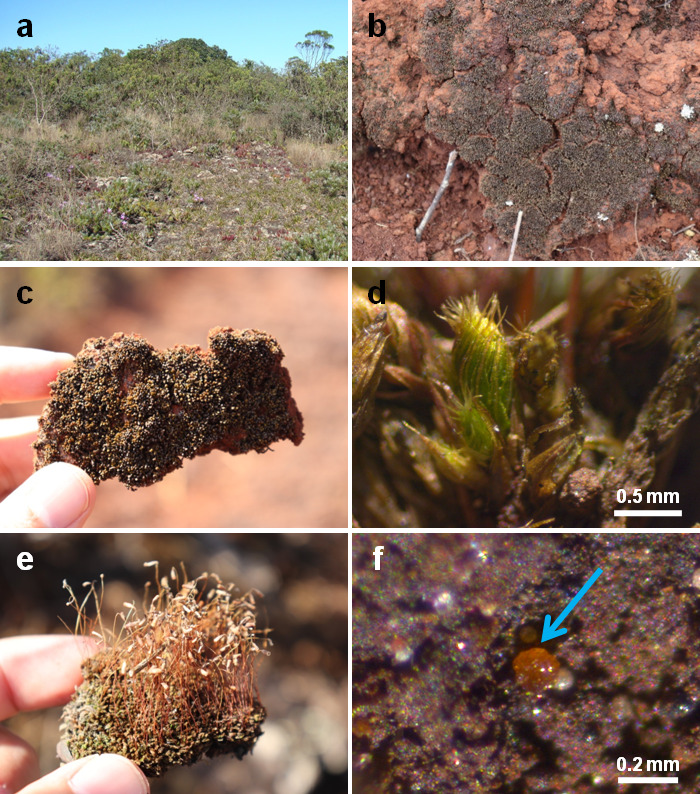
Since B. atenense is a common moss in biocrusts across three distinct types of Brazilian rocky outcrops but is most abundant on ironstone outcrops (Oliveira et al. 2021, 2024), these ecosystems were selected as the collection site. Specifically, plants were sampled in the Natural Monument Serra da Calçada (Figure 1a; 20°05’43”S, 43°58’59”W) in Minas Gerais, Brazil. The collection site is located within the Quadrilátero Ferrífero region, a key area for Brazil’s iron ore deposits (Carmo et al. 2012). This region serves as a transitional zone between two major biodiversity hotspots, the Atlantic Forest and the Cerrado (Brazilian savanna), both characterized by high species richness and significant levels of endemism (Myers et al. 2000). The climatic conditions of the area include a mean annual temperature ranging from 11.8°C to 23.9°C and an average annual precipitation of 1,559 mm (accessed through WorldClim 2).
Target species and biocrust sampling
Bryum atenense is a commonly found moss in Cangas, thriving on both soil islands and termite mounds (Figure 1b; Oliveira et al. 2021), and capable of forming biocrusts by binding the soil (Figure 1c; Oliveira et al. 2024). It is a small acrocarpous moss (3–4 mm in height; Figure 1d), dioicous, frequently observed with sporophytes (Figure 1e), and able to produce rhizoidal tubers (Figure 1f) as asexual propagules (Ochi 1980, Canestraro & Peralta 2022).
Six patches of biocrusts dominated by B. atenense were selected from soil islands within the ironstone rocky outcrop, ensuring a minimum distance of 2 meters between each patch. Biocrust samples, each approximately 100 cm², were carefully extracted from the topsoil layer using a spatula and stored in small plastic bags. The samples were then stored in a freezer at 7°C until the day of the experiment setup. Samples were collected during the rainy season, on October 10, 2022.
The classification of the samples as biocrusts was determined using the decision tree methodology proposed by Weber et al. (2022). The moss species identification was confirmed following Canestraro & Peralta (2022) with the aid of a stereomicroscope and a light microscope. Voucher specimens (211376, 211379, 211383, 211385, 211387, 211389) were deposited in the BHCB herbarium (Centro de Coleções Taxonômicas, Universidade Federal de Minas Gerais).
Determination of calcium concentrations and pH for experimental solutions
To assess the establishment responses of B. atenense populations from ironstone outcrops under varying calcium and pH conditions typical of the environments where they were originally registered, we first determined these parameters for the soils of these ecosystems. Six soil samples (approximately 300 g each) were collected from the topsoil (0–20 cm) of each of three outcrop types: ironstone (Natural Monument Serra da Calçada; 20°05’43”S, 43°58’59”W), quartzite (Natural Monument Serra da Calçada; 20°06’08”S, 43°59’27”W), and limestone (Environmental Protection Area of Lagoa Santa Karst; 19°32’56”S, 43°59’34”W), following the methodology outlined by Santos et al. (2015).
The samples were collected with at least a 2-meter gap between each, using a gardening shovel and a PVC pipe (15 cm in diameter and 10 cm in height). After being passed through a 2 mm mesh sieve, the samples were dried at 40°C for 72 hours, labeled, and then sent to the Soil Analysis Laboratory at Universidade Federal de Lavras, Brazil. All soil samples underwent chemical analysis using the procedures outlined by Teixeira et al. (2017), wherein the parameters pH in H2O and exchangeable content of calcium were measured. The average concentrations of calcium (Ca²⁺) and pH for each type of outcrop are shown in Table I, which were used as parameters for designing our experiment. We highlight that the three types of outcrops in Brazil exhibit a gradient of calcium concentrations and pH in the soil: quartzite < ironstone < limestone.
Mean and standard deviation (SD) of calcium concentrations and pH values for soils from distinct types of Brazilian rocky outcrops.
Experimental design
We established five treatments for the experiment (Table II): control (0.0 mmol/L of calcium and pH 4.7), quartzite-like (1.4 mmol/L and pH 4.7), ironstone-like (12.0 mmol/L and pH 4.7), limestone-like (156.5 mmol/L and pH 7.0), and 2x limestone-like (312.5 mmol/L and pH 8.5). These concentrations and pH values were chosen to replicate the conditions of rocky outcrops where B. atenense has been recorded (Table I), along with a neutral solution and a high-calcium treatment for comparison. We emphasize that calcium is typically measured in cmolc/dm³ for soil analysis; however, for this experiment, the values were converted to mmol/L (details in Supplementary Material - Table SI). Ca²⁺ solutions were prepared with anhydrous CaCl₂, and the pH was adjusted with NaOH or HCl to match the parameters observed in the different rocky outcrops.
Treatments used in the experiment on the preferences and establishment responses of a common biocrust moss from Brazilian rocky outcrops.
We separated the moss gametophytes from the substrate by isolating a mixed sample of 240 shoots from all six collected biocrust patches and cleaning them with distilled water. Each shoot was placed individually in a well of a cell plate on clean cotton (approximately 1 cm high), with each treatment comprising 48 plants, each moistened with 5 mL of the corresponding solution. The plates were kept in a growth room with temperatures ranging from 16.2°C to 22.7°C, light intensity of 24 μmol.m²s⁻¹, and a 12h photoperiod.
Using a stereomicroscope, we observed the presence or absence of rhizoids in the plants under different treatments over time. We chose to use rhizoid presence as a response variable due to the importance of rhizoids in anchoring plants to the substrate and indicating successful establishment. Additionally, since B. atenense can produce asexual propagules, we quantified the final number of these propagules per plant as another response variable. The experiment was terminated after 98 days, as both variables (rhizoids and propagules) reached a plateau in the same samples, and no further changes in the observed responses were detected.
Statistical analysis
To assess whether the plants exhibited distinct rates of establishment across treatments, we applied a Generalized Linear Mixed-Effects Model (GLMM) using the glmer function from the “lme4” package (Bates et al. 2015). Calcium concentration and associated pH were treated as fixed factors, while time of observation was accounted for as a random factor. The presence-absence data per treatment were modeled using a binomial distribution with a logit link function. Additionally, we examined whether the final number of asexual propagules differed among treatments using a Generalized Linear Model (GLM) with a Gaussian family and identity link function, implemented via the glm function from the “glm2” package (Marschner 2011). All analyses were conducted in R version 4.0.2 (R Development Core Team 2024).
RESULTS
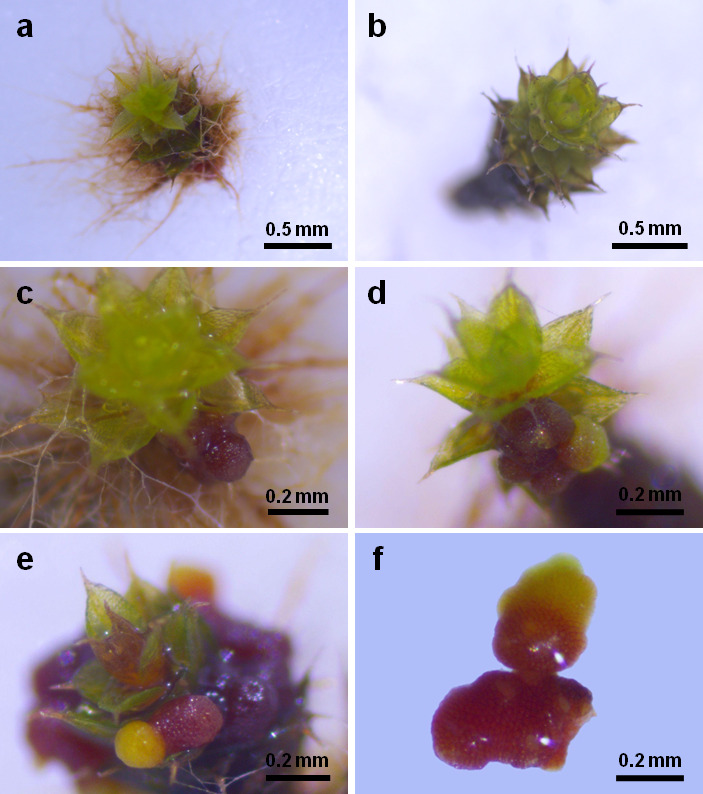
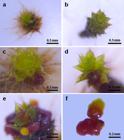
The shoots of B. atenense produced rhizoids throughout the experiment (Figure 2a), except for plants exposed to the extreme 2x limestone-like treatment (Figure 2b). Vegetative propagules were also observed (Figure 2c-e), although these were atypical for the species, developing in the axils of the leaves. These gemmae predominantly exhibited a ginger-like shape with some greenish edges (Figure 2f). Notably, propagules were also absent in plants exposed to the 2x limestone-like treatment.
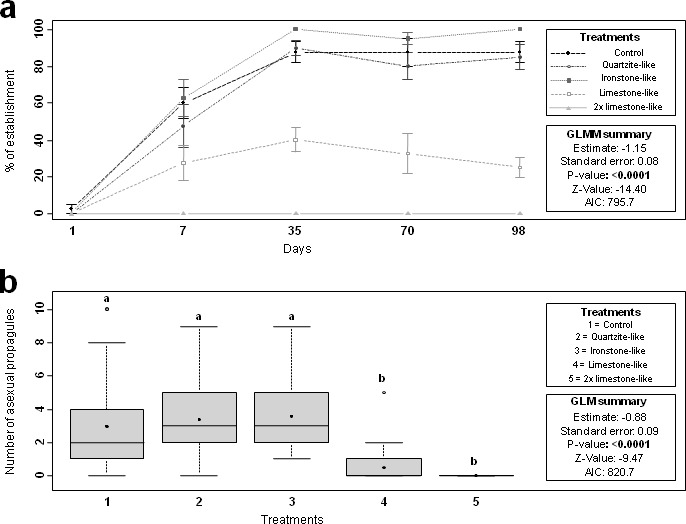
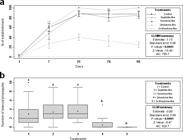
Statistical analyses revealed significant differences (P < 0.0001) in the observed variables (rhizoids and asexual propagules) across the treatments applied in the experiment. a - Results from the Generalized Linear Mixed-Effects Model (GLMM), with the ironstone-like treatment showing the highest percentage of rhizoid production. b - Results from the Generalized Linear Model (GLM), demonstrating that the control, quartzite-like, and ironstone-like treatments had statistically similar values, which were significantly different from the limestone-like and 2x limestone-like treatments, the latter two being similar to each other.
The GLMM analysis revealed that treatments significantly influenced the proportion of B. atenense shoots producing rhizoids (Figure 3a). This proportion was highest in plants subjected to the ironstone-like treatment, the natural environment from which the plants used in this experiment were collected. In contrast, plants exposed to the extreme treatment did not produce rhizoids at all. Notably, plants subjected to the limestone-like treatment produced rhizoids, albeit at a lower proportion.
Ironstone rocky outcrop and the abundant biocrust moss Bryum atenense. a - Collection site in the Natural Monument Serra da Calçada. b - B. atenense growing on a termite mound. c - B. atenense contributing to soil aggregation. d - Close-up of the gametophyte. e - Sample with numerous sporophytes, illustrating its successful sexual reproduction. f - Tuber (blue arrow), a subterranean structure for vegetative propagation.
Similarly, the GLM analysis revealed that treatments significantly affected the final number of asexual propagules produced by B. atenense (Figure 3b). The control, ironstone-like, and quartzite-like treatments showed statistically similar numbers of propagules, which differed significantly from the limestone-like and 2x limestone-like treatments, which were more similar to each other. Despite these differences, it is noteworthy that under the limestone-like treatment, plants were capable of producing asexual propagules, albeit in very low numbers. However, no asexual propagules were observed under the 2x limestone-like treatment.
Indeed, both plant establishment and asexual propagule production in B. atenense followed the same pattern across treatments (Figure 3). Additionally, shoots grown under control, ironstone-like, and quartzite-like treatments produced seven times more rhizoids and asexual propagules than plants grown under limestone-like and 2x limestone-like treatments. Moreover, gametophytes subjected to the 2x limestone-like treatment failed to develop, and many shoots died.
DISCUSSION
The propagules produced by B. atenense in this study have not been previously documented by bryologists. While mosses in the family Bryaceae typically produce spherical to ovoid rhizoidal tubers in their subterranean parts (Ochi 1980, Spence 2015), the gemmae observed in the experimental shoots of B. atenense were axillary propagules with a predominantly ginger-like shape and greenish edges. Notably, many bryophyte species are known to produce unusual asexual propagules when subjected to stressful conditions involving light, humidity, temperature, or nutrient availability (Duckett et al. 2004). Given that even the control group plants produced gemmae, we believe this unusual production of asexual propagules is not a result of the treatments applied but rather a response to the cultivation room conditions.
Bryophyte communities in high-calcium substrates are well-documented (e.g., Downing & Selkirk 1993, Palmer & Wilson 2021), highlighting the distinction between calcicoles, which favor calcium-rich environments, and calcifuges, which thrive in calcium-deficient conditions (Lee 1998). Conversely, some species occur across a range of substrates and are considered edaphic generalists (Palmer & Wilson 2021). Bryum atenense, a common biocrust moss found in varied edaphic conditions (Oliveira et al. 2024), could be perceived as an edaphic generalist. However, our findings contrast with this assumption, revealing that a population from an ironstone outcrop exhibits clear preferences for low calcium and pH levels, characteristic of its native habitat. While phenotypic plasticity allows plants to alter traits in response to environmental conditions (Schlichting 1986, Coe et al. 2024), our study suggests that this population of B. atenense demonstrates increasing specialization to local conditions.
Mosses are known for their highly plastic traits, enabling adaptation to various environmental conditions (Coe et al. 2024). Our results showed that B. atenense populations collected from Cangas, when exposed to limestone-like treatments, demonstrated a certain level of adaptability. Despite not achieving the best outcomes, these populations were still able to produce rhizoids and asexual propagules. Similarly, populations of Philonotis fontana (Hedw.) Brid. (Bartramiaceae) have exhibited phenotypic plasticity under varying light and water regimes (Buryová & Shaw 2005), highlighting the potential for such adaptive responses.
In contrast, some moss populations go beyond plasticity and exhibit genetic differentiation, evolving into ecotypes. For example, Funaria hygrometrica Hedw. (Funariaceae) populations from metal-rich soils show enhanced heavy metal tolerance (Shaw 1988), and geographically isolated populations of Bryum argenteum Hedw. (Bryaceae) demonstrate significant variation in thermal resilience (Greenwood et al. 2019). To determine whether the observed responses in B. atenense are solely due to population adaptability or indicate ecotypic differentiation, further studies on populations from all outcrops types are essential. Investigating them individually will provide valuable insights into how local environmental factors shape their ecological strategies and performance.
The differential responses of B. atenense to calcium and pH treatments raise intriguing questions about its tolerance mechanisms and adaptive strategies. For instance, Hyophila involuta (Hook.) A. Jaeger (Pottiaceae) demonstrates a remarkable capacity to tolerate high calcium concentrations (100–200 mmol/L), a trait linked to its robust antioxidant enzyme systems that maintain membrane integrity under calcium stress (Meng et al. 2023). In our study, the B. atenense populations from Cangas showed limited establishment success under limestone-like and 2x limestone-like treatments, suggesting that calcium tolerance adaptations might be scarce in this population. Conversely, populations of B. atenense inhabiting limestone outcrops may employ similar mechanisms to those observed in H. involuta, allowing them to tolerate calcium stress. Such populations could represent distinct ecotypes, finely tuned to the specific calcium concentrations of their native outcrop soils.
CONCLUSIONS
Our study shows that B. atenense populations exhibit clear substrate-dependent patterns in vegetative establishment and asexual reproduction, with ironstone-origin populations performing best under pH and calcium conditions similar to their natural environment. Substrate conditions strongly influenced growth and reproductive success, with extreme treatments limiting rhizoid and propagule formation. While conducted under controlled conditions, these findings highlight the ecological importance of substrate properties. Future studies combining field observations, experiments, and molecular analyses could clarify local adaptations and determine whether populations from different outcrops represent distinct ecotypes adapted to specific substrate conditions.
Acknowledgements
We are grateful to Conselho Nacional de Desenvolvimento Científico e Tecnológico (CNPq, 407321/2018-7) and Programa de Pós-Graduação em Biologia Vegetal da Universidade Federal de Minas Gerais for financial support; to Coordenação de Aperfeiçoamento de Pessoal de Nível Superior (CAPES, 88887.663692/2022-00) and (FAPEMIG, APQ-05454-18) for first author scholarship; to Nivea Dias dos Santos and Fernando Augusto de Oliveira e Silveira for their constructive criticism of previous versions of this manuscript; and to Vale S.A. for collect permission.
References
-
BATES D, MÄCHLER M, BOLKER B & WALKER S. 2015. Fitting linear mixed-effects models using lme4. J Stat Softw 67: 1-48. http://dx.doi.org/10.18637/jss.v067.i01.
» https://doi.org/10.18637/jss.v067.i01 - BELNAP J, WEBER B & BÜDEL B. 2016. Biological soil crusts as an organizing principle in drylands. In: Weber B, Büdel B & Belnap J (Eds), Biological soil crusts: an organizing principle in drylands, Cham: Springer, Cham, Switzerland, p. 3-13.
-
BENITES VM, SCHAEFER CEGR, SIMAS FNB & SANTOS HG. 2007. Soils associated with rock outcrops in the Brazilian mountain ranges Mantiqueira and Espinhaço. Braz J Bot 30: 569-577. https://doi.org/10.1590/S0100-84042007000400003.
» https://doi.org/10.1590/S0100-84042007000400003 -
BURYOVÁ B & SHAW AJ. 2005. Phenotypic plasticity in Philonotis fontana (Bryopsida: Bartramiaceae). J Bryol 27(1): 13-22. https://doi.org/10.1179/174328205X40545.
» https://doi.org/10.1179/174328205X40545 -
CANESTRARO BK & PERALTA DF. 2022. Synopsis of Anomobryum and Bryum (Bryaceae, Bryophyta) in Brazil. Acta Bot Brasilica 36. https://doi.org/10.1590/0102-33062021abb0283
» https://doi.org/10.1590/0102-33062021abb0283 - CARMO FF, CARMO FF, CAMPOS IC & JACOBI CM. 2012. Cangas: ilhas de ferro estratégicas para a conservação. Ciência Hoje 295: 48-53.
- CARMO FF & KAMINO LH. 2015. Geossistemas Ferruginosos do Brasil: áreas prioritárias para conservação da diversidade geológica e biológica, patrimônio cultural e serviços ambientais. Belo Horizonte: Instituto Prístino, 553 p.
-
COE K, CARTER B, SLATE M & STANTON D. 2024. Moss functional trait ecology: Trends, gaps, and biases in the current literature. Am J Bot 111(2): e16288. https://doi.org/10.1002/ajb2.16288.
» https://doi.org/10.1002/ajb2.16288 -
CONN SJ ET AL. 2011. Cell-specific vacuolar calcium storagemediated by CAX1 regulates apoplastic calcium concentration, gas exchange,and plant productivity in Arabidopsis Plant Cell 23: 240-257. https://doi.org/10.1105/tpc.109.072769.
» https://doi.org/10.1105/tpc.109.072769 -
DEMARTY M, MORVAN C & THELLIER M. 1984. Calcium and the cell wall. Plant Cell Environ 7(6): 441-448. https://doi.org/10.1111/j.1365-3040.1984.tb01434.x.
» https://doi.org/10.1111/j.1365-3040.1984.tb01434.x -
DEMIDCHIK V, SHABALA S, ISAYENKOV S, CUIN TA & POTTOSIN I. 2018. Calcium transport across plant membranes: mechanisms and functions. New Phytol 220(1): 49-69. https://doi.org/10.1111/nph.15266.
» https://doi.org/10.1111/nph.15266 - DOWNING AJ & SELKIRK PM. 1993. Bryophytes on the calcareous soils of Mungo National Park, an arid area of southern central Australia. Great Basin Nat 53(1): 13-23. https://www.jstor.org/stable/41712753.
-
DUCKETT JG, BURCH J, FLETCHER PW, MATCHAM HW, READ DJ, RUSSELL AJ & PRESSEL S. 2004. In vitro cultivation of bryophytes: a review of practicalities, problems, progress and promise. J Bryol 26: 3-20. https://doi.org/10.1179/174328213X13789822578469.
» https://doi.org/10.1179/174328213X13789822578469 - GALVÃO P & PEÑARANDA J. 2020. The Geology of Lagoa Santa Karst. In: Auler AS & Pessoa P (Eds), Lagoa Santa Karst: Brazil’s Iconic Karst Region, Cham: Springer, Cham, Switzerland, p. 13-25.
- GOFFINET B & SHAW AJ. 2009. Bryophyte biology. New York: Cambridge University Press, 565 p.
-
GREENWOOD JL, STARK LR & CHIQUOINE LP. 2019. Effects of rate of drying, life history phase, and ecotype on the ability of the moss Bryum argenteum to survive desiccation events and the influence on conservation and selection of material for restoration. Front Ecol Evol 7: 388. https://doi.org/10.3389/fevo.2019.00388.
» https://doi.org/10.3389/fevo.2019.00388 -
GREGOR JW. 1944. The ecotype. Biol Rev 19(1): 20-30. https://doi.org/10.1111/j.1469-185X.1944.tb00299.x.
» https://doi.org/10.1111/j.1469-185X.1944.tb00299.x -
KAMIYA T, AKAHORI T, ASHIKARI M & MAESHIMA M. 2006. Expression of the vacuolar Ca2+/H+ exchanger, OsCAX1a, in rice: cell and age specificity of expression, and enhancement by Ca2+. Plant Cell Physiol 47: 96-106. https://doi.org/10.1093/pcp/pci227.
» https://doi.org/10.1093/pcp/pci227 -
LEE JA. 1998. The calcicole—calcifuge problem revisited. Adv Bot Res 29: 1-30. https://doi.org/10.1016/S0065-2296(08)60306-7.
» https://doi.org/10.1016/S0065-2296(08)60306-7 - MARSCHNER IC. 2011. glm2: Fitting generalized linear models with convergence problems. R J 3: 12-15.
-
MENG W, RAN J, DAI Q, TU N, LENG T & REN Q. 2023. Morphological and physiological adaptation characteristics of lithophytic bryophytes to karst high calcium environment. BMC Plant Biol 23: 160. https://doi.org/10.1186/s12870-022-03980-4.
» https://doi.org/10.1186/s12870-022-03980-4 -
MYERS N, MITTERMEIER RA, MITTERMEIER CG, FONSECA GA & KENT J. 2000. Biodiversity hotspots for conservation priorities. Nature 403: 853–858. https://doi.org/10.1038/35002501.
» https://doi.org/10.1038/35002501 - OCHI H. 1980. A revision of the Neotropical Bryoideae, Musci (first part). Journal of the Faculty of Education, Tottori University, Natural Science 29: 49-154.
-
OLIVEIRA BA, OLIVEIRA MF & MACIEL-SILVA AS. 2021. What can bryophyte diversity on Cangas (ironstone outcrops) teach us? J Veg Sci 32(3): e13029. https://doi.org/10.1111/jvs.13029.
» https://doi.org/10.1111/jvs.13029 -
OLIVEIRA MF, FIGUEREDO CC, KONELL AH & MACIEL-SILVA AS. 2024. A first evaluation of biological soil crusts diversity in three distinctive rocky outcrops in Brazil. Flora 320: 152613. https://doi.org/10.1016/j.flora.2024.152613.
» https://doi.org/10.1016/j.flora.2024.152613 -
PALMER DK & WILSON P. 2021. Calcicolous and calcifugous bryophytes along the desert edge of the California Floristic Province. The Bryologist 124: 9-19. https://doi.org/10.1639/0007-2745-124.1.009.
» https://doi.org/10.1639/0007-2745-124.1.009 -
PEÑALOZA-BOJACÁ GF, OLIVEIRA BA, ARAÚJO CAT, FANTECELLE LB & MACIEL-SILVA AS. 2018a. Bryophyte reproduction on ironstone outcrops: delicate plants in harsh environments. Flora 238: 155-161. https://doi.org/10.1016/j.flora.2017.02.017.
» https://doi.org/10.1016/j.flora.2017.02.017 -
PEÑALOZA-BOJACÁ GF, OLIVEIRA BA, ARAÚJO CAT, FANTECELLE LB, SANTOS ND & MACIEL-SILVA AS. 2018b. Bryophytes on Brazilian ironstone outcrops: Diversity, environmental filtering, and conservation implications. Flora 238: 162-174. https://doi.org/10.1016/j.flora.2017.06.012.
» https://doi.org/10.1016/j.flora.2017.06.012 -
PITTMAN JK, SHIGAKI T & HIRSCHI KD. 2005. Evidence of differential pH regulation of the Arabidopsis vacuolar Ca2+/H+ antiporters CAX1 and CAX2. Febs Letters 579(12): 2648-2656. https://doi.org/10.1016/j.febslet.2005.03.085.
» https://doi.org/10.1016/j.febslet.2005.03.085 - PROCTOR MC. 1982. Physiological ecology: Water relations, light and temperature responses, carbon balance. In: Smith AJE (Ed), Bryophyte ecology, London: Chapman and Hall, London, UK, p. 333-381.
-
PROCTOR MC, OLIVER MJ, WOOD AJ, ALPERT P, STARK LR, CLEAVITT NL & MISHLER BD. 2007. Desiccation-tolerance in bryophytes: a review. The Bryologist 110(4): 595-621. https://doi.org/10.1639/0007-2745(2007)110[595:DIBAR]2.0.CO;2.
» https://doi.org/10.1639/0007-2745(2007)110 - R DEVELOPMENT CORE TEAM. 2024. R: A language and environment for statistical computing. Vienna: R Foundation for Statistical Computing.
- SANCHO LG, SCHULZ F, SCHROETER B & KAPPEN L. 1999. Bryophyte and lichen flora of South Bay (Livingston Island: South Shetland Islands, Antarctica). Nova Hedwig 68(3): 301-338.
- SANTOS RD, SANTOS HG, KER JC, ANJOS LHC & SHIMIZU SH. 2015. Manual de descrição e coleta de solo no campo. Viçosa: SBCS, 102 p.
-
SCHLICHTING CD. 1986. The evolution of phenotypic plasticity in plants. Annu Rev Ecol Syst 17: 667–693. https://doi.org/10.1146/annurev.es.17.110186.003315.
» https://doi.org/10.1146/annurev.es.17.110186.003315 -
SHAW J. 1988. Genetic variation for tolerance to copper and zinc within and among populations of the moss, Funaria hygrometrica Hedw. New Phytologist 109(2): 211-222. https://doi.org/10.1111/j.1469-8137.1988.tb03710.x.
» https://doi.org/10.1111/j.1469-8137.1988.tb03710.x -
SILVA JB & GERMANO SR. 2013. Bryophytes on rocky outcrops in the caatinga biome: a conservationist perspective. Acta Bot Bras 27: 827-835. https://doi.org/10.1590/S0102-33062013000400023.
» https://doi.org/10.1590/S0102-33062013000400023 -
SILVA JB, SFAIR JC, SANTOS ND & PÔRTO KC. 2018. Bryophyte richness of soil islands on rocky outcrops is not driven by island size or habitat heterogeneity. Acta Bot Bras 32(2): 161-168. https://doi.org/10.1590/0102-33062017abb0281.
» https://doi.org/10.1590/0102-33062017abb0281 -
SILVA JB, GERMANO SR, MACIEL-SILVA AS & SANTOS ND. 2019. A small elevational gradient shows negative bottom-to-top bryophyte richness in a seasonally dry forest in Brazil. Cryptogam Bryol 40(17): 219-231. https://doi.org/10.5252/cryptogamie-bryologie2019v40a17.
» https://doi.org/10.5252/cryptogamie-bryologie2019v40a17 -
SOUSA F, FOSTER PG, DONOGHUE PC, SCHNEIDER H & COX CJ. 2019. Nuclear protein phylogenies support the monophyly of the three bryophyte groups (Bryophyta Schimp.). New Phytol 222(1): 565-575. https://doi.org/10.1111/nph.15587.
» https://doi.org/10.1111/nph.15587 - SPENCE JR. 2015. Bryaceae. In: Flora North America Editorial Committee (Eds), Flora of North America Vol. 28: Bryophyta: Mosses part 2. New York: Oxford University Press, p. 117-191.
- STARK LR, WHITTEMORE AT & MISHLER BD. 2002. Noteworthy bryophyte records from the Mojave Desert. Madroño 49(1): 49-53.
-
STARK LR, MCLETCHIE DN & ROBERTS SP. 2009. Gender differences and a new adult eukaryotic record for upper thermal tolerance in the desert moss Syntrichia caninervis. J Therm Biol 34(3): 131 137. https://doi.org/10.1016/j.jtherbio.2008.12.001.
» https://doi.org/10.1016/j.jtherbio.2008.12.001 - TEIXEIRA PC, DONAGEMMA GK, FONTANA A & TEIXEIRA WG. 2017. Manual de métodos de análise de solo. Brasília: EMBRAPA, 574 p.
-
VICHEROVÁ E, HÁJEK M & HÁJEK T. 2015. Calcium intolerance of fen mosses: physiological evidence, effects of nutrient availability and successional drivers. Perspect Pl Ecol Evol Syst 17(5): 347-359. https://doi.org/10.1016/j.ppees.2015.06.005.
» https://doi.org/10.1016/j.ppees.2015.06.005 -
WARREN SD, STARK LR, LEWIS LA, POMBUBPA N, KURBESSOIAN T, STAJICH JE & AANDERUD ZT. 2019. Reproduction and dispersal of biological soil crust organisms. Front Ecol Evol 7: 344. https://doi.org/10.3389/fevo.2019.00344.
» https://doi.org/10.3389/fevo.2019.00344 -
WEBER B ET AL. 2022. What is a biocrust? A refined, contemporary definition for a broadening research community. Biol Rev 97: 1768-1785. https://doi.org/10.1111/brv.12862.
» https://doi.org/10.1111/brv.12862 -
WHITE PJ & BROADLEY MR. 2003. Calcium in plants. Ann Bot 92: 487-511. https://doi.org/10.1093/aob/mcg164.
» https://doi.org/10.1093/aob/mcg164 -
ZHUO L, LIANG YQ, YANG HL, LI XS, ZHANG Y, ZHANG YG, GUAN KY & ZHANG DY. 2020. Thermal tolerance of dried shoots of the moss Bryum argenteum J Therm Biol 89: 102469. https://doi.org/10.1016/j.jtherbio.2019.102469.
» https://doi.org/10.1016/j.jtherbio.2019.102469
Edited by
-
Handling editor
Marcia Couri
The datasets generated and analyzed during the current study are available from the corresponding author upon reasonable request. Moss vouchers are deposited in the BHCB Herbarium at the Universidade Federal de Minas Gerais and are available for loan upon request.