 New report of Cerambycidae beetles captured using synthetic pheromones in Alto Mayo, Peru: Filling gap
Abstract
We report the capture of several new species of longhorn beetles from Peruvian fauna using synthetic pheromones, syn-2,3-hexanediol, fuscumol, and fuscumol acetate. A total of seven species of longhorn beetles from the subfamily Lamiinae were captured. These longhorn beetles were distributed into the following tribes and species: Acanthocinini (Hylettus spilotus, Leptostylus sp., Nealcidion emeritum, and Paroecus charpentierae), Acanthoderini (Oreodera bituberculata), Colobotheini (Colobothea osculatii), and Compsosomatini (Aerenea brunnea). All specimens were captured in traps baited with fuscumol, either alone or in blend. Our findings suggest that blends of pheromones containing fuscumol are crucial for monitoring potential invasive species in new agricultural and forestry environments.
Key words
Synthetic pheromone; longhorn beetles; invasive species; woodboring beetle
INTRODUCTION
Longhorn beetles, in the family Cerambycidae, play a crucial role in ecosystems by decomposing wood, contributing to nutrient cycling, and facilitating forest regeneration (Atmowidi & Noerdjito 2016, Karpiński et al. 2021). Certain species within the Cerambycidae family assist in the pollination of specific plants, influencing ecosystem structure and function (Atmowidi & Noerdjito 2016). Larvae of these beetles feed on living wood, which can classify them as pests due to their potential to damage crops or young trees (Monné et al. 2017), either in their native habitats or in regions where they have become established and became invasive species.
In this context, the use of pheromones emerges as a viable alternative for monitoring pest insects, including potentially invasive species. Pheromones have high content specificity, attracting only target species and minimizing collateral damage to the ecosystem, and they are effective even in low-density populations, facilitating early detection of non-native species and the possible prevention of deleterious infestations (Allison et al. 2004). These pheromones reduce reliance on insecticides, thereby contributing to environmental preservation and enhanced human health (Sohrawardy et al. 2021).
In various countries, synthetic pheromones have become a powerful tool for monitoring native and non-native species, highlighting their importance in monitoring insects within the Cerambycidae (Millar & Hanks 2017). In Mexico, Mitchell et al. (2018), reported responses of Megacyllene antennata (Cerambycinae: Clytini) to traps baited with (S)-α-terpineol + (E)-2-hexenol during samplings in July, 2007. Similarly, Fonseca et al. (2010), reported the attraction of Hedypathes betulinus (Lamiinae: Acanthoderini) to (E)-6,10-dimethyl-5,9-undecadien-2-yl acetate (major component), (E)-6,10-dimethyl-5,9-undecadien-2-one, and (E)-6,10-dimethyl-5,9-undecadien-2-ol in Brazil. Additionally, Silva et al. (2019), reported the attraction of Psapharochrus maculatissimus (Lamiinae: Acanthoderini) to (R)- and (S)-fuscumol acetate during September and October, 2018, as well as Eupromerella plaumanni (Lamiinae: Acanthoderini) to racemic fuscumol acetate, and Hylettus seniculus (Germar) (Lamiinae: Acanthocinini) to (R)-fuscumol acetate.
In Peru, recent studies have demonstrated the effectiveness of synthetic pheromones, both individually and in blend, for attracting and capturing longhorned beetles (Aguirre-Gil et al. 2021, 2024). Aguirre-Gil et al. (2021) recorded the occurrence of 13 cerambycid species, two of them belonging to the subfamily Lamiinae and tribe Acanthoderini: Oreodera bituberculata Bates, which exhibited attraction to fuscumol, while all pheromones, individually and in blend attracted Aegomorphus longitarsis (Bates). Likewise, Aguirre-Gil et al. (2024) reported the response of Megacyllene andesiana (Casey) (Cerambycinae: Clytini) to anti-2,3-hexanediol and anti-2,3-hexanediol + fuscumol acetate, and the response of Oreodera bituberculata Bates (Lamiinae: Acanthoderini) to fuscumol and anti-2,3-hexanediol + fuscumol in field experiments between September, 2021 and January, 2022.
Ongoing research reinforces the importance of synthetic pheromones as an ecological and sustainable tool for managing agricultural and forestry pests (Sohrawardy et al. 2021). In Peru, and other South American countries, the use of cerambycid pheromones remains limited to pest management and is essentially non-existent in surveillance programs. Most of the research conducted has focused on single species with short-term importance or specific regions, where there is a lack of comprehensive data on the diversity of cerambycid species that can be monitored by and attracted to pheromones in different ecological areas. The use of synthetic pheromones is promising for pest species management, however, their potential for broader application in preventing new invasions of non-native species is economically significant for agricultural and forestry systems in Peru. Unfortunately, this potential currently remains underexplored. This study addresses these gaps by providing the first report on longhorn beetle species from the Alto Mayo region, an area with high relevant agricultural and forestry activity, where non-native species may play a significant threat to the economy. By evaluating the capture success of synthetic pheromones, particularly fuscumol and their blends, this research contributes to unveil new knowledge about the biodiversity of Peruvian fauna and highlights the potential of pheromone-based monitoring strategies aimed to mitigate the risks associated with non-native species.
MATERIALS AND METHODS
A field trapping experiment was conducted weekly from January 3-31, 2024 in a wildfire area, a forest edge habitat, and in a rainforest (without wildfire), located at Centro de Producción e Investigación Pabloyacu, Alto Mayo, Peru (-6.066 lat., -76.943 long.). The experiment was replicated three times in a completely randomized block design. The field trial sampled the number of adult longhorn beetles (Coleoptera: Cerambycidae) using traps baited with all possible combinations of three different cerambycid pheromone lures. The bubble cap lures containing the pheromones racemic syn-2,3-hexanediol [a mixture of (2R,3R) and (2S,3S) isomers], racemic E,Z-fuscumol and racemic E,Z-fuscumol acetate were purchased from Synergy Semiochemicals Corp., Delta, Canada. The treatments were (1) syn-2,3-hexanediol + fuscumol (C6+Fu), (2) syn-2,3-hexanediol + fuscumol acetate (C6+FA), (3) fuscumol + fuscumol acetate (Fu+FA), and (4) syn-2,3-hexanediol + fuscumol + fuscumol acetate (C6+Fu+FA). A blank control (without pheromones) was not used in order to reduce the treatments with no captures. The treatments and replicates were located in each area of study (wildfire area, edge, and rainforest). The type of intercept trap used here was a black, four-sided panel trap purchased from Synergy Semiochemicals Corp. The traps were coated with 12% fluon (EZ fluon kit; Synergy Semiochemicals Corp.) to increase trap captures (Allison et al. 2011, 2016), and were equipped with a wet collection cup with 500 ml of an odorless soap solution. The traps containing pheromone lures were suspended individually from iron frames 100 cm above the ground, and were distributed 25 m apart and placed randomly within the wildfire area, edge, and rainforest locations. The traps were located 30 m apart among the areas of study (Figure 1). Longhorn beetles were collected from traps weekly and returned to the laboratory in 50 ml lidded cups. Samples were preserved in 70% ethanol at room temperature. Cerambycidae were identified to species and voucher specimens were deposited in the Colección Entomológica de Referencia, Servicio Nacional de Sanidad Agraria (SENASA), Lima, Peru, under the following registration code: LM-01-24 to LM-07-24. This study was conducted according to Research Permissions N° 006-MIDAGRI-SENASA, N° 007-MIDAGRI-SENASA, and N° 008-MIDAGRI-SENASA.

Design and collection methods for longhorn beetles (Coleoptera: Cerambycidae): (a) Distribution of traps baited with combinations of synthetic pheromones in three types of sampling areas; (b) Installation of four-sided black panel interceptor traps; (c) Placement of pheromone lures in the traps; (d) Insect collection in the 500 ml collecting cup.
A two-tailed exact binomial test was used to determine whether the total number of longhorn beetles captured during the experiment deviated from the expected binomial distribution (p = 0.5). The total number of longhorn beetles captured by traps including, and not including, fuscumol as a component of the blend were defined as the observed data. The capture rate of 1:1 was used to define the expected data. Data analysis was performed using R software for Windows (R Core Team 2024).
RESULTS
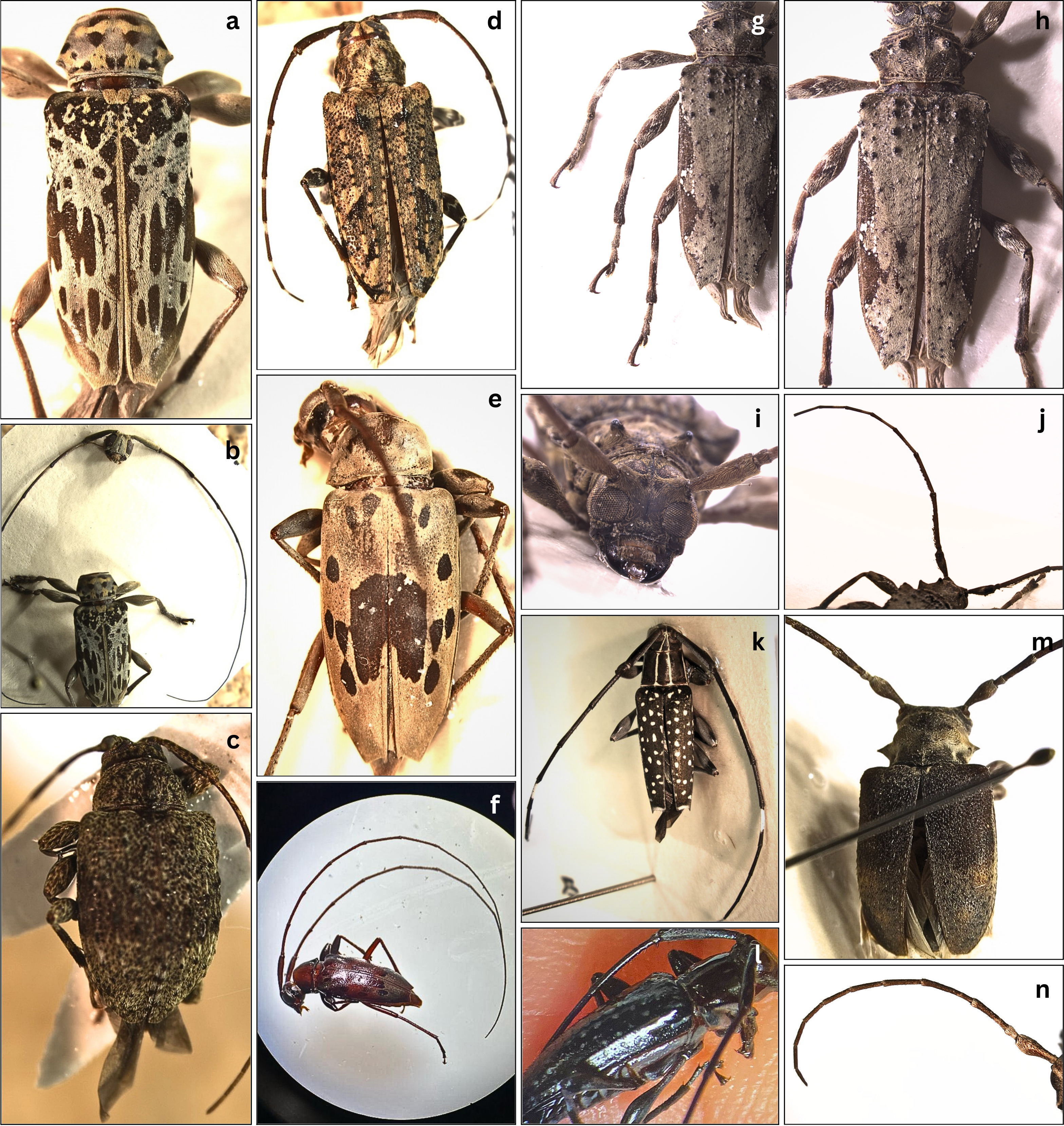
Traps baited with synthetic pheromones in Alto Mayo, Peru, successfully captured seven longhorn beetles from the family Cerambycidae, specifically from the subfamily Lamiinae (Figure 2, Appendix). These longhorn beetles were distributed into the following tribes and species: Acanthocinini (Hylettus spilotus [LM-01-24], Leptostylus sp. [LM-03-24], Nealcidion emeritum [LM-06-24], and Paroecus charpentierae [LM-04-24]), Acanthoderini (Oreodera bituberculata [LM-07-24]), Colobotheini (Colobothea osculatii [LM-02-24]), and Compsosomatini (Aerenea brunnea [LM-05-24]) (Table I). Among the captured species, four were found in the wildfire area (Table II), demonstrating the feasibility of using fuscumol in attracting Lamiinae beetles within the study area.

Longhorn beetle species captured by synthetic pheromone-baited traps in Alto Mayo, Peru: (a, b) Hylettus spilotus [LM-01-24]; (c) Leptostylus sp. [LM-03-24]; (d) Nealcidion emeritum [LM-06-24]; (e, f) Paroecus charpentierae [LM-04-24]; (g, h, i, j) Oreodera bituberculata [LM-07-24]; (k, l) Colobothea osculatii [LM-02-24]; (m, n) Aerenea brunnea [LM-05-24].
Number of beetles per tribe captured in synthetic pheromone baited traps in rainforest, forest edge habitat, and wildfire areas in Alto Mayo, Peru.
Number of beetles per tribe captured by traps baited with syn-2,3-hexanediol (C6), fuscumol (Fu), and fuscumol acetate (FA) in Alto Mayo, Peru.
In traps baited with syn-2,3-hexanediol + fuscumol + fuscumol acetate, four species were collected. Here, two species, Paroecus charpentierae and Hylettus spilotus belonged to the Acanthocinini, one species, Aerenea brunnea belonged to the Compsosomatini, and one species, Colobothea osculatii belonged to the Colobotheini. Traps baited with fuscumol + fuscumol acetate caught two species, (Nealcidion emeritum and Leptostylus sp.) from the Acanthocinini, and traps baited with syn-2,3-hexanediol + fuscumol acetate caught one species, Oreodera bituberculata from the Acanthoderini tribe. The total number of longhorn beetles captured in traps with fuscumol (N = 7) is significantly different than the total number of longhorn beetles captured in traps without fuscumol (N = 0) using the two-tailed exact binomial test (p < 0.05).
DISCUSSION
In this study, we focused on documenting new species of longhorn beetles captured in traps baited with cerambycid pheromones. Our research confirms that longhorn beetles from the subfamily Lamiinae are frequently captured in traps blended with fuscumol, and six new species (H. spilotus, Leptostylus sp., N. emeritum, P. charpentierae, C. osculatii, and A. brunnea) are reported being captured by four-sided panel traps in Peru. The seventh species, Oreodera bituberculata was already reported by Aguirre-Gil et al. (2021, 2024).
The capture of longhorn beetles from Lamiinae by blends containing fuscumol suggests that members of this subfamily have a particular affinity and sensitivity to this compound. The literature reported that fuscumol is produced by several species of longhorn beetles (Mitchell et al. 2011, 2018) and the presence of this compound increases the potential response of these beetles to it (Millar & Hanks 2017).
The capture of only seven longhorn beetles may have been influenced by several ecological and biological factors, including the structure and composition of the surrounding vegetation, which can affect pheromone dispersion and its release (Dunn et al. 2016). For example, precipitation and wind played a limiting role during this study despite the literature stating the occurrence of longhorn beetles throughout the year in this Peruvian region (Aguirre-Gil et al. 2021). The precipitation in the area also limited the flight activity of longhorn beetles and, in some cases, the wind caused the traps to occasionally be filled with leaves.
The record of these six new species is relevant to the implementation of surveillance strategies of non-native longhorn beetles throughout the world. In the case of O. bituberculata, a generalist species associated to host plants from the families Apocynaceae, Euphorbiaceae, Moraceae, and Sapotaceae (Tavakilian et al. 1997), the species can be monitored using traps baited with fuscumol (Aguirre-Gil et al. 2021).
The host range of the other longhorn beetles is quite extensive. For example, Hylettus spilotus is a specialist species associated with host plants from the Burseraceae, H. coenobita is associated to host plants from the Moraceae (Tavakilian et al. 1997), and H. seniculus was already reported as a pest species in citrus cultivation (Moreira et al. 2003) and attracted to (R)-fuscumol acetate (Silva et al. 2019).
The host plants of Leptostylus sp., Nealcidion emeritum, Colobothea osculatii, and A. brunnea are still unknown, however, P. charpentierae was reported as a species specialist of plants in family Lauraceae (Tavakilian et al. 1997). Therefore, the higher capture rate of target species using synthetic pheromones is relevant for forest health should an invasion occur.
This study faced unexpected limitations that caused interruptions in our field evaluations e.g., (1) logistic constraints to replace broken traps, (2) restrictive regulations for importing new traps, and (3) a limited budget and deadline. However, despite these limitations the study demonstrated the feasibility of using synthetic pheromones to monitor longhorn beetles and assess the biodiversity of Peruvian fauna.
Finally, our study recorded the capture of six new species by traps baited with fuscumol in binary or tertiary blends. We encourage national and international stakeholders to foster additional research in developing inventories of Peruvian fauna and attraction to known cerambycid pheromones in different ecosystems.
CONCLUSIONS
The binary and tertiary blends, including fuscumol as a component, frequently captured more longhorn beetles from the subfamily Lamiinae. We suggest screening new cerambycid pheromones for activity within the Peruvian fauna, including wildfire areas, and innovative and detailed analysis of the local biodiversity.
ACKNOWLEDGMENTS
We would like to express our gratitude to the Instituto de Investigación on behalf of Universidad Nacional de San Martín for its support on acquisition of traps and pheromones. This research was funded by Universidad Nacional de San Martín under Resolución 611-2022-UNSM/CU-R.
REFERENCES
-
AGUIRRE-GIL OJ, PAREDES‐ESPINOSA R, AGUILAR R, MEZONES I, GUERRERO TE, MONNÉ ML, GONZALES A & ALLISON J. 2021. Screening known Cerambycidae pheromones for activity with the Peruvian fauna. Agric For Entomol 23(4): 506-511. https://doi.org/10.1111/afe.12454.
» https://doi.org/10.1111/afe.12454 - AGUIRRE-GIL OJ, PAREDES‐ESPINOSA R, EGOÁVIL-JUMP G & ALLISON JD. 2024. Responses of Megacyllene andesiana and Oreodera bituberculata (Coleoptera: Cerambycidae) to anti-2,3-hexanediol, fuscumol and fuscumol acetate in Peru. Can Entomol 156: e24. doi:10.4039/tce.2024.23.
-
ALLISON JD, BORDEN JH & SEYBOLD SJ. 2004. A review of the chemical ecology of the Cerambycidae (Coleoptera). Chemoecology 14: 123-150. https://doi.org/10.1007/s00049-004-0277-1.
» https://doi.org/10.1007/s00049-004-0277-1 -
ALLISON JD, GRAHAM EE, POLAND TM & STROM BL. 2016. Dilution of fluon before trap surface treatment has no effect on longhorned beetle (Coleoptera: Cerambycidae) captures. J Econ Entomol 109: 1215-1219. https://doi.org/10.1093/jee/tow081.
» https://doi.org/10.1093/jee/tow081 -
ALLISON JD, JOHNSON C, MEEKER J, STROM B & BUTLER SM. 2011. Effect of aerosol surface lubricants on the abundance and richness of selected forest insects captured in multiple-funnel and panel traps. J Econ Entomol 104: 1258-1264. https://doi.org/10.1603/ EC11044.
» https://doi.org/10.1603/ EC11044 -
ATMOWIDI T & NOERDJITO WA. 2016. Diversity and abundance of cerambycid beetles in the four major land-use types found in Jambi Province, Indonesia. HAYATI J Biosci 23(2): 56-61. https://doi.org/10.1016/j.hjb.2016.06.001.
» https://doi.org/10.1016/j.hjb.2016.06.001 -
DUNN E, HOUGH-GOLDSTEIN J, HANKS LM, MILLAR JG & D’AMICO V. 2016. Range of attraction of pheromone lures and dispersal behavior of cerambycid beetles. Ann Entomol Soc Am 109(6): 872-880. https://doi.org/10.1093/aesa/saw055.
» https://doi.org/10.1093/aesa/saw055 -
FONSECA M, VIDAL D & ZARBIN P. 2010. Male-Produced Sex Pheromone of the Cerambycid Beetle Hedypathes betulinus: Chemical Identification and Biological Activity. J Chem Ecol 36: 1132-1139. https://doi.org/10.1007/s10886-010-9850-y.
» https://doi.org/10.1007/s10886-010-9850-y -
KARPIŃSKI L, MAÁK I & WEGIEREK P. 2021. The role of nature reserves in preserving saproxylic biodiversity: using longhorn beetles (Coleoptera: Cerambycidae) as bioindicators. Eur Zoo J 88(1): 487-504. https://doi.org/10.1080/24750263.2021.1900427.
» https://doi.org/10.1080/24750263.2021.1900427 - MILLAR JG & HANKS LM. 2017. Chemical Ecology of cerambycids. In: Wang Q (Ed), Cerambycidae of the world: Biology and pest management. CRC Press, p. 161-196.
-
MITCHELL RF ET AL. 2011. Fuscumol and fuscumol acetate are general attractants for many species of cerambycid beetles in the subfamily Lamiinae. Entomol Exp Appl 141(1): 71-77. https://doi.org/10.1111/j.1570-7458.2011.01167.x.
» https://doi.org/10.1111/j.1570-7458.2011.01167.x -
MITCHELL RF, RAY AM, HANKS LM & MILLAR JG. 2018. The Common Natural Products (S)-α-Terpineol and (E)-2-Hexenol are Important Pheromone Components of Megacyllene antennata (Coleoptera: Cerambycidae). Environ Entomol 47(6): 1547-1552. https://doi.org/10.1093/ee/nvy126.
» https://doi.org/10.1093/ee/nvy126 - MONNÉ ML, MONNÉ MA & WANG Q. 2017. General Morphology, Classification and Biology of Cerambycidae. In: Wang Q (Ed), Cerambycidae of the world. Biology and Pest Management. Taylor and Francis, Boca Raton, p. 1-70.
-
MOREIRA MAB, OLIVEIRA JÚNIOR JOLD & MONNÉ MA. 2003. Ocorrência de Hylettus seniculus (Germar, 1824) (Coleoptera: Cerambycidae), em pomares cítricos de Roraima, Brasil, e alternativas de controle. Acta Amazon 33: 607-612. https://doi.org/10.1590/S0044-59672003000400006.
» https://doi.org/10.1590/S0044-59672003000400006 -
R CORE TEAM. 2024. R: A Language and Environment for Statistical Computing. R Foundation for Statistical Computing, Vienna, Austria. https://www.R-project.org/
» https://www.R-project.org/ -
SILVA WD, ZOU Y, HANKS LM, BENTO JMS & MILLAR JG. 2019. Enantiomers of fuscumol acetate comprise the aggregation‐sex pheromone of the South American cerambycid beetle Psapharochrus maculatissimus, and likely pheromones of the cerambycids Eupromerella plaumanni and Hylettus seniculus. Entomol Exp Appl 167(11): 915-921. https://doi.org/10.1111/eea.12846.
» https://doi.org/10.1111/eea.12846 - SOHRAWARDY H, DEBNATH J, FATEMA AAMR & ISLAM T. 2021. Eco-Friendly management of insect pests in agriculture by pheromones: A review. Ecol J 3(2): 203-215.
-
TAVAKILIAN G, BERKOV A, MEURER-GRIMES B & MORI S. 1997. Neotropical tree species and their faunas of xylophagous longicorns (Coleoptera: Cerambycidae) in French Guiana. Bot Rev 63: 303-355. https://doi.org/10.1007/BF02856596.
» https://doi.org/10.1007/BF02856596
APPENDIX
APPENDIX. Database of Cerambycidae beetles captured with pheromone traps in Alto Mayo, Peru.| ID | Collecting date | Latitude (S) | Longitude (W) | Elevation (masl) | Transect | Tramp | Block | Treatment | Order | Family | Subfamily |
|---|---|---|---|---|---|---|---|---|---|---|---|
| 1 | 3/1/2024 | -6.06771 | -76.94324 | 1051 | Wildfire area | TR9 | B3 | syn-2,3-hexanediol + fuscumol (C6+Fu) | Coleoptera | Cerambycidae | Lamiinae |
| 2 | 3/1/2024 | -6.06786 | -76.9426 | 1049 | Rainforest | TR11 | B3 | syn-2,3-hexanediol + fuscumol + fuscumol acetate (C6+Fu+FA) | Coleoptera | Cerambycidae | Lamiinae |
| 3 | 10/1/2024 | -6.06835 | -76.94321 | 1055 | Wildfire area | TR12 | B3 | syn-2,3-hexanediol + fuscumol + fuscumol acetate (C6+Fu+FA) | Coleoptera | Cerambycidae | Lamiinae |
| 4 | 17/01/2024 | -6.06814 | -76.94315 | 1054 | Wildfire area | TR11 | B3 | fuscumol + fuscumol acetate (Fu+FA) | Coleoptera | Cerambycidae | Lamiinae |
| 5 | 17/01/2024 | -6.06835 | -76.94321 | 1055 | Wildfire area | TR12 | B3 | syn-2,3-hexanediol + fuscumol + fuscumol acetate (C6+Fu+FA) | Coleoptera | Cerambycidae | Lamiinae |
| 6 | 17/01/2024 | -6.06615 | -76.94268 | 1014 | Edge | TR1 | B1 | fuscumol + fuscumol acetate (Fu+FA) | Coleoptera | Cerambycidae | Lamiinae |
| 7 | 17/01/2024 | -6.06633 | -76.94289 | 1024 | Edge | TR2 | B1 | syn-2,3-hexanediol + fuscumol + fuscumol acetate (C6+Fu+FA) | Coleoptera | Cerambycidae | Lamiinae |
| Tribe | Genus | Scientific name | Voucher SENASA | Country | Department | City | Location | Collector |
|---|---|---|---|---|---|---|---|---|
| Acanthoderini | Oreodera | Oreodera bituberculata | LM-07-24 | Peru | San Martín | Moyobamba | Centro de Producción e Investigación Pabloyacu | Jhon Jairo López-Rojas |
| Compsosomatini | Aerenea | Aerenea brunnea | LM-05-24 | Peru | San Martín | Moyobamba | Centro de Producción e Investigación Pabloyacu | Jhon Jairo López-Rojas |
| Acanthocinini | Paroecus | Paroecus charpentierae | LM-04-24 | Peru | San Martín | Moyobamba | Centro de Producción e Investigación Pabloyacu | Jhon Jairo López-Rojas |
| Acanthocinini | Nealcidion | Nealcidion emeritum | LM-06-24 | Peru | San Martín | Moyobamba | Centro de Producción e Investigación Pabloyacu | Jhon Jairo López-Rojas |
| Colobotheini | Colobothea | Colobothea osculatii | LM-02-24 | Peru | San Martín | Moyobamba | Centro de Producción e Investigación Pabloyacu | Jhon Jairo López-Rojas |
| Acanthocinini | Leptostylus | Leptostylus sp. | LM-03-24 | Peru | San Martín | Moyobamba | Centro de Producción e Investigación Pabloyacu | Jhon Jairo López-Rojas |
| Acanthocinini | Hylettus | Hylettus spilotus | LM-01-24 | Peru | San Martín | Moyobamba | Centro de Producción e Investigación Pabloyacu | Jhon Jairo López-Rojas |