 Citizen complaints in local media as source of mosquito data: the case of Aedes albifasciatus in an intermediate city of temperate Argentina
Abstract
Floodwater mosquitoes provoke nuisance due to their mass emergence. Citizen complaints about outstanding events of mosquitoes in urban areas are usually reflected in local media and could be potentially used as data. Our objective was to build a temperature dependent function to characterize the immature development time of the floodwater mosquito Ae. albifasciatus in Tandil (Argentina), and validate it using citizen complaints in local media and field collected mosquitoes. The development time obtained ranges from 5-47 days at 30-7°C, respectively. During 2000-2021, nine mosquito abundance peaks were identified through local journalistic records. For these events, the estimated hatching date was successfully associated with a previous precipitation, with a maximum difference of two days. The precipitation identified as the trigger for egg hatching ranged from 15 to 121 mm. Then, to associate mosquito news with the target species, female mosquitoes were captured by a battery-powered aspirator in green areas of the city during September 2019-June 2021. Six mosquito abundance peaks were detected in which Ae. albifasciatus accounted for 97.3% of the captures. Among them, journalistic records were able to detect the largest two; i.e. in our study above 15 mosquitoes in a five minute collection. Citizen complaints related to nuisance or vector species could be valuable retrospective data for researchers of different fields.
Key words
Culicidae; floodwater mosquitoes; immature development time; journalistic records; mosquito abundance peaks; passive data collection
INTRODUCTION
Floodwater mosquitoes deposit their eggs singly on moist soil when the water recedes and hatch when submerged later due to the rain, river overflow, tidal, or irrigation (Horsfall 1963, Clements 1999). The hatching process occurs within minutes or hours, depending on the species, and this synchronization could produce mosquito abundance peaks due to the mass emergence. Some floodwater mosquitoes were described as bothersome biters responsible for most mosquito nuisance complaints and recognized as the most serious pests in a given region due to their abundance. Some well-known examples are Aedes sollicitans in North America (Shone et al. 2006), Aedes sticticus in Europe and North America (Schäfer Lundström 2006), and Aedes vexans throughout the globe (Trpis Shemanchuk 1970).
In South America, the floodwater mosquito Aedes albifasciatus is present in Bolivia, Paraguay, Chile, Brazil, Uruguay, and Argentina (Forattini 2002). In the latter, it is the most widely distributed mosquito species, found up to Tierra del Fuego (Rossi 2015), and was highlighted as one of the most abundant species in different climatic regions (e.g. Gleiser et al. 1997, Vezzani et al. 2006, Grech et al. 2019). It was incriminated in the transmission of the western equine encephalomyelitis virus, and also was found infected with bunyamwera and Saint Louis encephalomyelitis viruses during enzootic periods (Contigiani et al. 2016). It is also considered a potential vector of the dog heartworm Dirofilaria immitis (Vezzani et al. 2006). In addition, they can cause allergic reactions (Docena et al. 1999) and reduction on milk and beef production due to the nuisance they provoke to livestock during abundance peaks (Ludueña Almeida Gorla 1995, Gleiser et al. 1997).
Scientific research incorporating observations by citizens, creates opportunities for ecological research at spatial and temporal scales unattainable by research teams (Dickinson et al. 2012, Bonney et al. 2014). The most remarkable examples are those covered under citizen science initiatives, in which active communication of the project and its results was crucial in stimulating media and public attention (Kampen et al. 2015, Pernat et al. 2022). In other cases, spontaneous complaints by inhabitants about nuisance species reflected in local media also contributed with valuable and unique data, although these be without any intention of scientific contribution. Some clear examples are the earlier detection by citizen complaints of Aedes albopictus in Spain (Aranda et al. 2006), and Aedes aegypti in Madeira (Portugal; Almeida et al. 2007) and Tandil (Argentina; Vezzani et al. 2022). From traditional newspapers to online platforms, local media are still the most important source of local information, playing a key role in people’s daily life and helping them to be active citizens (Möhring 2019). This interaction between media and citizens might creates, in certain circumstances, an opportunity to use journalistic news dealing with citizen complaints as an alternative data source.
The effects of the temperature on immature development have been studied for many mosquito species, including Ae. albifasciatus (Ludueña Almeida Gorla 1995, Silver 2008). This knowledge could be used to project floodwater mosquito abundance peaks using local meteorological data as input. However, Ae. albifasciatus showed different development rates for populations from different climatic regions (Garzón Schweigmann 2015), suggesting that immature development times could not be extrapolated from one latitude to another. The main objective of this research was to characterize the immature development time of Ae. albifasciatus in an intermediate city of temperate climate. With this aim, we developed a model using available data of this mosquito species from other latitudes, and then we used two different proxies (i.e. journalistic news and field collections) to validate it. Finally, both approaches were compared to address the question: Are journalistic records any good for detecting mosquito abundance peaks?
MATERIALS AND METHODS
Study area
This study was carried out in Tandil (37°04’S 59°08’W; Figure 1a), Buenos Aires province (Argentina), in the center of the Tandilia mountain system on its northeast slope, where agricultural and livestock exploitation is developing in conjunction with mining and tourism (Campo et al. 2010, Guzman Ramos et al. 2015). Tandil is an intermediate city, not only by its population size (130000 inhabitants) but also because it plays a strategic role between rural areas and urban networks, and due to its strong influence on the region and the country (Albaladejo et al. 2017, Bolay Kern 2019, Migueltorena 2019). The region has a temperate continental climate with annual accumulated precipitation reaching 892.6 mm, and mean annual temperature of 13.4 °C, with mean monthly values ranging from 6 °C in winter to 20.5 °C in summer (Campo et al. 2010). Regarding culicid fauna of the city, there are only published records of artificial container mosquitoes (Vezzani et al. 2022), but Ae. albifasciatus was the only species observed in abundance and biting in open recreational areas (D. Vezzani, personal observation).
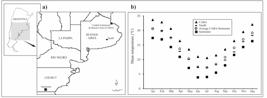
a) Study area. Geographic location of Tandil and the other localities mentioned in the text (CABA and Sarmiento). b) Historical mean monthly temperatures of CABA, Sarmiento and Tandil (period 1982-2012).
Model fitting
Data about the relationship between Ae. albifasciatus immature development time and the temperature were searched among papers available in Scopus, PubMed, Scielo, and Google Scholar. This information was found for Ae. albifasciatus populations from two different climatic regions of Argentina, one at the north of Tandil (Ciudad Autónoma de Buenos Aires, CABA; 34°55’S 58°22’W) and the other at the south (Sarmiento city; 45°36’S 69°05’W) (Figure 1a). For CABA, 20 data (i.e. temperature-development time) from Fontanarrosa et al. (2000) and 50 data from Garzón Schweigmann (2015) were obtained, whereas for Sarmiento 38 data were extracted from Garzón Schweigmann (2015). For each data set (two for CABA and one for Sarmiento), we fitted a negative exponential function following Fontanarrosa et al. (2000), that estimates the immature development time as a function of the temperature, ƒ(T). Both functions for CABA were averaged to obtain a new model. These calculations were done using the open source software R 3.5.1 (R Core Team 2018).
Then, the historical mean monthly temperatures of both cities and Tandil were obtained from Climate-Data.org (2021) and analyzed (Figure 1b). As the monthly average temperatures between CABA and Sarmiento resulted similar to those of Tandil, we proposed that the immature development time of Ae. albifasciatus in Tandil will be an average between those observed in CABA and Sarmiento. Therefore, to obtain the model formulation for Tandil, the functions of CABA and Sarmiento were linearized applying natural logarithm, and for different values of temperature the average development time between both localities was calculated. Then, we fitted these values with a linear function and finally, the development time in Tandil was obtained applying an exponential transformation.
Model validation with journalistic records
For the period 2000-2021, a database of meteorological and journalistic records was created. For the former, the mean daily temperature and the daily accumulated rainfall were provided by the National Meteorological Service. For the journalistic records, all news related to mosquitoes published in the local media El Eco de Tandil were searched in a digital database and classified as follows: municipal fumigation campaigns, dengue, insects associated with garbage, and complaints from citizens due to mosquito bites in green spaces. The news associated with mosquito abundance peaks in open areas of the city were identified and used as validation data.
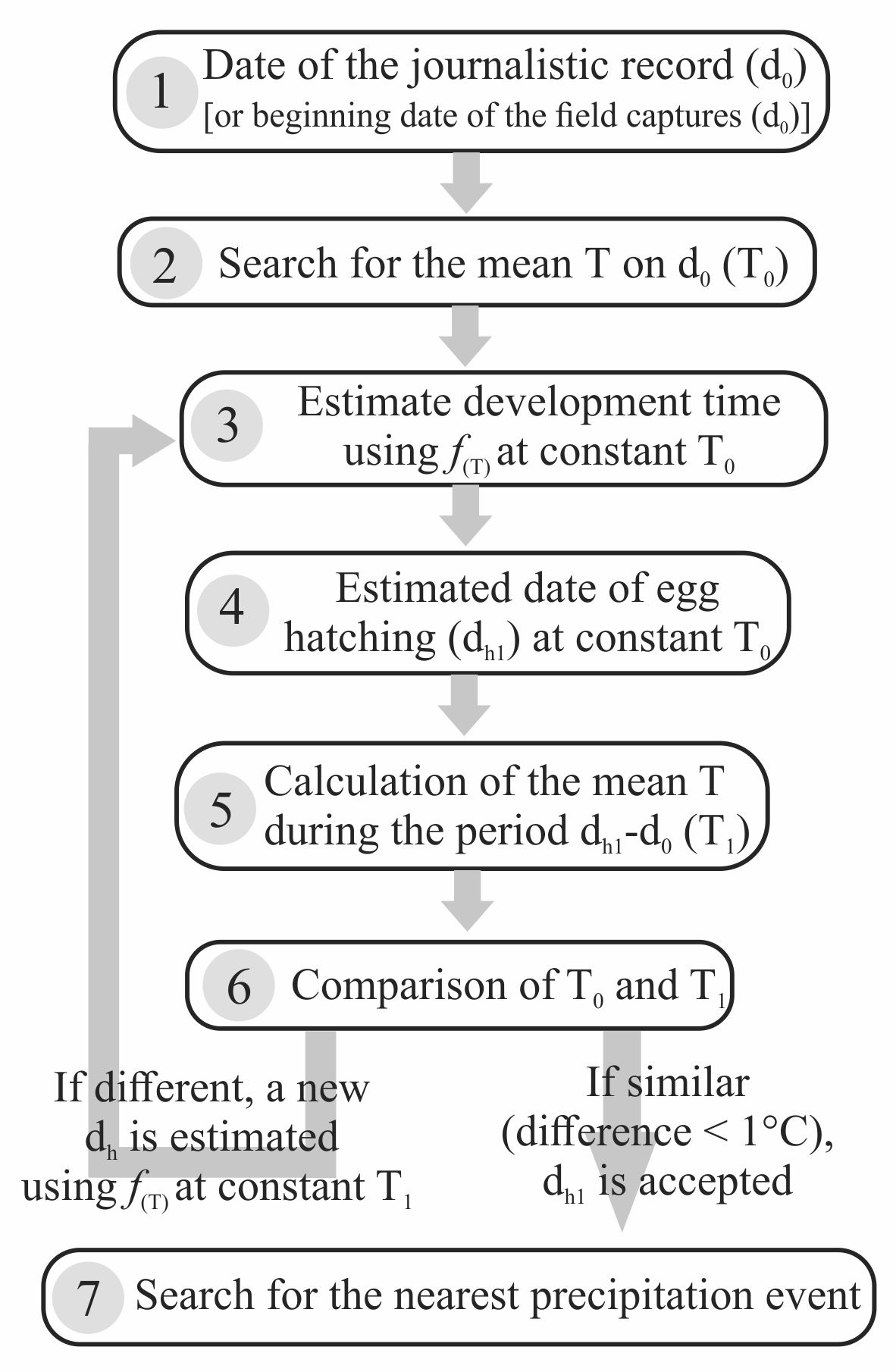
Then, considering the date of the journalistic record as a proxy of the period in which the mosquito abundance peak occurred, the function ƒ(T) was used to identify the previous rainfall event that produced the beginning of the larval development (i.e. egg hatching). For this, the procedure detailed in the Figure 2 was applied. In brief, for a given peak, the temperature of the report date was used to estimate the date of egg hatching, assuming a constant temperature. Then, the mean temperature for the period between the report date and the estimated hatching date was calculated and compared with the temperature of the report day. If the temperature difference was 1 °C, the nearest rainfall event was identified; else, the procedure was repeated until a difference 1 °C was obtained. Finally, for model validation we calculate the difference (in days) between the estimated hatching date and the precipitation record date; e.g., if the value is zero the model fits perfectly with the journalistic record.

Scheme of the procedure used to identify the hatching date of Aedes albifasciatus using the journalistic records [or the beginning of field captures] and the proposed function ƒ(T) for Tandil city.
Model validation with field records
The main bias of journalistic records as source of mosquito data is the identification of the mosquito species. To associate those mosquito news with Ae. albifasciatus, adult mosquitoes were collected from September 2019 to June 2021. Weekly captures of five minutes were made using a battery-powered aspirator adapted from Vázquez-Prokopec et al. (2009) in two major parks of the city, namely Banderas and Monte Calvario, used by citizens as recreational green spaces. Additionally, a five minutes capture with the battery-powered aspirator were performed in any of 16 other green spaces of the city, each day that some of the authors perceive mosquito bites. All captures were made on vegetation or other structures present in the parks such as benches or small edifications. In the laboratory, mosquitoes were killed by freezing, separated from debris and females identified under a 80x stereomicroscope using the taxonomic keys by Rossi et al. (2002).
From this field information, the beginning dates of Ae. albifasciatus abundance peaks were identified, and the function ƒ(T) was applied following the procedure of Figure 2 to identify the rainfall event that produced the egg hatching. As with the journalistic record, we calculate the difference (in days) between the estimated hatching date and precipitation record date for model validation. Finally, the results obtained using journalistic and field records during the matching period (September 2019-June 2021) were compared.
Goodness of fit
We estimated the error of the fitting of the models by the coefficient of determination R2 (Zar 1996) in two instances. First, for the averaged function of CABA using all field data for this locality from Garzón Schweigmann (2015) and Fontanarrosa et al. (2000). Second, for the proposed function for Tandil using our journalist and field records for the locality.
RESULTS
The models that allow estimating the immature development time of Ae. albifasciatus for other localities are expressed by the following functions:
where T is the mean air temperature. The coefficient of determination for the averaged function of CABA was R2=0.89. Since the mean monthly temperature of Tandil resulted similar to the average between CABA and Sarmiento (Fig. 1b), we proposed that the immature development time of Ae. albifasciatus in Tandil can be modeled averaging the development times of CABA and Sarmiento. The model obtained was:
According to this function for the Ae. albifasciatus population from Tandil, once the eggs have hatched, the development time ranges from 5.03 days at 30° C to 46.78 days at 7 °C (Figure 3).

Aedes albifasciatus larval development time as a function of the temperature in CABA and Sarmiento using available data from Fontanarrosa et al. (2000) and Garzón Schweigmann (2015). The proposed function for Tandil was obtained averaging the development times between CABA and Sarmiento. Linear and negative exponential curves are shown in a) and b), respectively.
A total of 51 journalistic records related with mosquitoes in Tandil during the period 2000-2021 were found. Among them, 18 dealt specifically with mosquito abundance peaks in open green areas, and considering duplicated news on consecutive days, only 9 events were identified (Table I). For these events, the hatching dates were estimated using the proposed function ƒ(T). Each of these events were successfully associated with a previous precipitation, validating the proposed function; 4 events with the exact date of the previous precipitation and the others with a maximum difference of 2 days. The precipitation identified as trigger for egg hatching ranged between 15 and 121 mm, and adding the accumulated values of the previous ten days ranged 37-137 mm.
Validation data for development time function using journalistic records and field sampling. Aedes albifasciatus abundance peaks in Tandil detected by journalistic records (period 2000-2021) and by field sampling (September 2019 – June 2021), and estimation of the hatching date and the nearest precipitation using the proposed function ƒ(T). Shaded rows highlight events detected by both journalistic and field records.
During September 2019-June 2021, a total of 1949 female mosquitoes were captured in 235 collections by battery-powered aspirator in 18 green open areas of the city. All individuals belonged to 3 floodwater mosquito species. The overwhelming majority were Ae. albifasciatus (97.3%), followed by Psorophora cyanescens (1.6%) and Aedes crinifer (1.1%). Field captures allowed to identify 6 Ae. albifasciatus abundance peaks (Table I, Figure 4). For these events, the difference between the estimated hatching date using the proposed function ƒ(T) and the previous precipitation was 1 day (4 events), 2 days (1 event) and 5 days (1 event). In general terms, field data validate the model. The precipitation identified as trigger for egg hatching ranged between 8 and 53 mm, and adding the accumulated values of the previous ten days ranged 8.6-82.1 mm. Using pooled data of our journalistic and field records (see the Table I), the coefficient of determination for the proposed ƒ(T) for Tandil was R2=0.95.

Aedes albifasciatus abundance peaks detected in Tandil by field sampling during the period September 2019 – June 2021. Each value is the average number of individuals captured per 5-min aspiration event in 18 green open areas. The dates with arrows indicate the beginning of the abundance peak.
Finally, among the 6 peaks detected by field sampling, only the greatest 2 were noticed by the local media, reaching 30 and 98 mean individuals captured in five minute collections (Table I, Figure 4). In contrast, the 4 peaks unnoticed by local media recorded values below 15 mean individuals captured in five minute collections. Both peaks displayed by the news had a delay of 3 and 9 days regarding field data.
DISCUSSION
This study intended to incorporate conceptual frameworks from mosquito ecology, alternative forms of data collection, and the importance of local media in an intermediate city. A function describing the development time of a floodwater mosquito in a given city was adjusted starting from published data of two other localities (one colder and one warmer), and was then validated with two decades of available journalistic news in a local media. As previously stressed, the main limitation of this kind of approach is the mosquito species identity in journalistic records. In other cases of spontaneous complaints, as for the conspicuous dengue vector Ae. aegypti, the simple pictures captured by neighbors with their smart phones allowed to reach mosquito species identification (e.g. Vezzani et al. 2022). But contrary to most of citizen science projects, in which participants had the opportunity to submit mosquito material for further scientific analysis (see Kampen et al. 2015), in our approach the news about complaints do not allow mosquito species identification. In the current study, it was unavoidable to carry on field samplings to corroborate mosquito species in the laboratory. During the 22 months of active survey, the only species that reached perceivable abundances in open green areas was Ae. albifasciatus. As was stressed by Kampen et al. (2015), passive mosquito surveillance does not replace active survey, but may provide a background alert system for triggering active surveillance when necessary, designing less costly and more effective activities.
Floodwater mosquitoes are bothersome when a mass emergence occurs, regardless if they are transmitting a particular disease at any given time. In addition to interrupting the normal development of outdoors activities, when mosquitoes are abundant they cause allergies, either skin reactions during mosquito bite or asthma and rhinitis probably due to body allergens (Cantillo Puerta 2021). So, floodwater mosquito abundance peaks could produce from allergic reactions to pathogen transmission and citizen irritability due to aggressive bites. The function obtained for Ae. albifasciatus development at local level could serve to predict these floodwater mosquito abundance peaks and thus, activate some preventive actions. Although massive fumigation is not recommended out of a disease transmission context (WHO 2012), a municipal warning could alert neighbors to avoid green spaces or using personal repellents for a few days. Also, if an important mosquito abundance peak is predicted, piping works on key floodable areas could prevent subsequent flooding thus eliminating important mosquito breeding sites, as was observed by Fontanarrosa et al. (2000). In this sense, mosquito surveillance involving citizens (with or without intentionality) has great potential to assist local health authorities, but also face many challenges in ensuring translatable outcomes to improved public health policy and practice (Souza et al. 2022).
The media can play different roles related to passive forms of data collection for scientists. In some citizen science projects related with mosquito monitoring, media activate the participation by drawing initial attention to the project; e.g. the Mückenatlas in Germany. In addition to quantitative media coverage, the mosquito affectedness of the resident population also influences citizen participation (Pernat et al. 2022). In our case, in which there is no citizen science project associated, neighbors’ complaints were spontaneous and the inconveniences caused by mosquitoes were the solely reason of the general public involvement. Unnoticed mosquito peaks by local media could be attributed to different factors. At first, a relative low interest by journalists to inform complaints regarding mosquito bites, depending on the number of current news to write about. Another factor could be the climatic condition. In cold weeks, neighbors wear warmer clothes, green open areas are less visited, and mosquitoes have lower biting activity. However, this does not seem to be the case considering that some unnoticed mosquito peaks were in summer (February 2020 and 2021). Finally, other confounding factor could involve the COVID-19 pandemic effects; for example, the mosquito abundance peaks of June and November 2020 could be unnoticed due to restrictions to use open green areas for recreational activities during this period. In brief, our results strongly suggest that there is a threshold of mosquito abundance that provokes citizen complaints; in our study above 15 mosquitoes in a five minute collection. In accordance, the last peak observed began with a mean number of 12 individuals and remained unnoticed by the news until a few days later when captures reached higher values.
Regarding the precipitation volume that trigger Ae. albifasciatus egg hatching, it was observed around 16-17 mm in the fall-winter period, 25 mm in the spring, and 30 mm in the summer by Fontanarrosa et al. (2000). However, we detected mosquito abundance peaks activated by precipitations so limited as 8 mm in spring and 10 mm in summer. It is relevant to mention that local conditions of the soil could determine if a given precipitation will produce a mass emergence of mosquitoes. For example, Fontanarrosa et al. (2000) observed that new cohorts started when the soil had dried completely before the rain. This, and other unexplored variables (e.g. elevation, availability of nutrients, etc) were not considered here and will be matter of future research.
As science progress, human and financial resources are limited whereas data requirement increases, turning passive forms of data collection into a resource increasingly used by scientists (Kampen et al. 2015). Another passive form of data collection, like those based on Internet search activity, might be more sensitive than our approach; for example, providing useful signals of disease activity ahead of standard healthcare-based surveillance methods (Aiken et al. 2020). However, local media are tied to a specific territory, i.e. are primarily focused on covering circumscribed geographic areas, and this matters to the local community (Möhring 2019). In consequence, local media in intermediate cities, and probably even more in small towns, has a central role in reflecting any citizen complaints. When these complaints are related to species perceived as nuisance or dangerous (e.g. mosquitoes, ticks, rats, scorpions, bats, snakes), they could be used as data. In other words, local media can be full of valuable retrospective data for researchers of different fields.
ACKNOWLEDGMENTS
To the Library Bernardino Rivadavia and El Eco de Tandil for providing access to digital newspapers, and to the National Meteorological Service for providing rainfall and temperature data. Alejandra Gallego is a graduate student in the Environment and Health Applied Sciences Doctoral Program (DCAAS) at UNICEN, Argentina. Study financing was provided by Agencia Nacional para la Promoción de Ciencia y Técnica (PICT 2018-02033).
REFERENCES
- AIKEN EL, MCGOUGH SF, MAJUMDER MS, WACHTEL G, NGUYEN AT, VIBOUD C SANTILLANA N. 2020. Real-time estimation of disease activity in emerging outbreaks using internet search information. PLoS Comp Biol 16: e1008117.
- ALBALADEJO C, BARTHE L, BUSTOS R, ISCARO M, PETRANTONIO M TAULELLE F. 2017. The role of intermediate cities in Argentinan Pampa in the Province of Buenos Aires regarding the structuration of agrarian areas: an analysis of governance process in three municipalities. TEM 33: 1-21.
- ALMEIDA AP, GONÇALVES YM, NOVO MT, SOUSA CA, MELIM M GRACIO AJ. 2007. Vector monitoring of Aedes aegypti in the Autonomous Region of Madeira, Portugal. Eurosurveillance 12: e3311.
- ARANDA C, ERITJA R ROIZ D. 2006. First record and establishment of the mosquito Aedes albopictus in Spain. Med Vet Entomol 20: 150-152.
- BOLAY J KERN A. 2019. Intermediate cities. In: Orum A (Ed), The Wiley Blackwell Encyclopedia of Urban and Regional studies, Hoboken, NJ: Wiley-Blackwell, p. 1-5.
- BONNEY R, SHIRK JL, PHILLIPS TB, WIGGINS A, BALLARD HL, MILLER-RUSHING AJ PARRISH JK. 2014. Next Steps for Citizen Science. Science 343: 1436-1437.
- CAMPO A, PICONE N FERNANDEZ AM. 2010. Análisis anual de las precipitaciones en la ciudad de Tandil (Noviembre 2008 – Octubre 2009). Est Socioterrit 8: 177-195.
- CANTILLO JF PUERTA L. 2021. Mosquitoes: important sources of allergens in the tropics. Front Allergy 2: 690406.
- CLEMENTS AN. 1999. The Biology of Mosquitoes, volume 2: Sensory Reception and Behaviour. Wallingford: CAB1 Publishing, 740 p.
-
CLIMATE-DATA.ORG. 2021. Climate data of Tandil, Ciudad Autónoma de Buenos Aires and Sarmiento. Available: https://es.climate-data.org/america-del-sur/argentina-11/ [accessed on July 1, 2019].
» https://es.climate-data.org/america-del-sur/argentina-11/ - CONTIGIANI MS, DÍAZ LA, SPINSANTI LI TAURO LB. 2016. Arbovirus. In: Berón CM et al. (Eds), Investigaciones sobre Mosquitos de Argentina, Universidad Nacional de Mar del Plata, p. 157-178.
- DICKINSON JL, SHIRK J, BONTER D, BONNEY R, CRAIN RL, MARTIN J, PHILLIPS T PURCELL K. 2012. The current state of citizen science as a tool for ecological research and public engagement. Front Ecol Environ 10: 291-297.
- DOCENA GH, BENÍTEZ P, CAMPOS RE, MACIÁ A, FERNÁNDEZ R FOSSATI CA. 1999. Detection of allergens in Aedes albifasciatus mosquito (Diptera: Culicidae) extracts by immunological methods. J Invest Allerg Clin 9: 165-171.
- FONTANARROSA MS, MARINONE MC, FISCHER S, ORELLANO P SCHWEIGMANN N. 2000. Effects of flooding and temperature on Aedes albifasciatus development time and larval density in two rain pools at Buenos Aires University City. Mem Inst Oswaldo Cruz 95: 787-793.
- FORATTINI OP. 2002. Culicidologia Médica, vol. 2. Universidade de Sao Paulo, 864 p.
- GARZÓN MJ SCHWEIGMANN N. 2015. Thermal response in pre-imaginal biology of Ochlerotatus albifasciatus from two different climatic regions. Med Vet Entomol 29: 380-386.
- GLEISER RM, GORLA D LUDUEÑA ALMEIDA F. 1997. Monitoring the abundance of Aedes (Ochlerotatus) albifasciatus (Macquart 1838) (Diptera: Culicidae) to the south of Mar Chiquita Lake, central Argentina, with the aid of remote sensing. Ann Trop Med Parasitol 91: 917-926.
- GRECH MG, MANZO LM, EPELE LB, LAURITO M, CLAVERIE AÑ, LUDUEÑA ALMEIDA FF, MISERENDINO ML ALMIRÓN WR. 2019. Mosquito (Diptera: Culicidae) larval ecology in natural habitats in the cold temperate Patagonia region of Argentina. Parasites Vectors 12: 214.
- GUZMAN RAMOS A, FERNANDEZ G, VALENZUELA S RICCI S. 2015. Patrimonio Geológico-Minero y Recreación en una Ciudad Intermedia: Tandil, Argentina. Rosa Ventos 7: 70-86.
- HORSFALL WR. 1963. Eggs of floodwater mosquitoes (Diptera: Culicidae) IX. Local distribution. Ann Entomol Soc Am 56: 426-441.
- KAMPEN H, MEDLOCK JM, VAUX AGC, KOENRAADT CJM, VLIET AJH, BARTUMEUS F, OLTRA A, SOUSA CA, CHOUIN S WERNER D. 2015. Approaches to passive mosquito surveillance in the EU. Parasites Vectors 8: 9.
- LUDUEÑA ALMEIDA FF GORLA DE. 1995. The biology of Aedes (Ochlerotatus) albifasciatus Macquart, 1838 (Diptera: Culicidae) in Central Argentina. Mem Inst Oswaldo Cruz 90: 463-468.
- MIGUELTORENA A. 2019. Producción de la vivienda y mercado inmobiliario en la ciudad intermedia de Tandil (Argentina), a comienzos del siglo XXI. Bol Campineiro Geogr 9: 139-163.
- MÖHRING W. 2019. Local Media. In: Orum A (Ed), The Wiley Blackwell Encyclopedia of Urban and Regional studies, Hoboken, NJ: Wiley-Blackwell, p. 1-2.
- PERNAT N, ZSCHEISCHLER J, KAMPEN H, OSTERMANN-MIYASHITA E-F, JESCHKE JM WERNER D. 2022. How media presence triggers participation in citizen science–The case of the mosquito monitoring project ‘Mückenatlas’. PLoS ONE 17: e0262850.
-
R CORE TEAM. 2018. R: A Language and Environment for Statistical Computing [software]. Available: http://www.R-project.org/ [accessed on July 1, 2019].
» http://www.R-project.org/ - ROSSI GC. 2015. Annotated checklist, distribution, and taxonomic bibliography of the mosquitoes (Insecta: Diptera: Culicidae) of Argentina. Check List 11: 1712.
- ROSSI GC, MARILUIS JC, SCHNACK JA SPINELLI GR. 2002. Dipteros Vectores (Culicidae y Calliphoridae) de la Provincia de Buenos Aires. Secretaria de Política Ambiental y Universidad de la Plata, Buenos Aires.
- SCHÄFER ML LUNDSTRÖM JO. 2006. Different responses of two floodwater mosquito species, Aedes vexans and Ochlerotatus sticticus (Diptera: Culicidae), to larval habitat drying. J Vector Ecol 31: 123-128.
- SHONE SM, CURRIERO FC, LESSER CR GLASS GE. 2006. Characterizing population dynamics of Aedes sollicitans (Diptera: Culicidae) using meteorological data. J Med Entomol 43: 393-402.
- SILVER JB. 2008. Mosquito ecology. Field sampling methods. Dordrecht: Springer, 1486 p.
- SOUZA LB, CRAIG A, CHITKARA U, FRICKER S, WEBB C, WILLIAMS C BALDOCK K. 2022. Methodological diversity in citizen science mosquito surveillance: A scoping review. Citiz Sci: Theory Pract 7(1): 8.
- TRPIS M SHEMANCHUK JA. 1970. Effect of constant temperature on the larval development of Aedes vexans (Diptera: Culicidae). Can Entomol 102: 1048-1051.
- VAZQUEZ-PROKOPEC GM, GALVIN WA, KELLY R KITRON U. 2009. A new, cost-effective, battery-powered aspirator for adult mosquito collections. J Med Entomol 46: 1256-1259.
- VEZZANI D, CETRARO H SÁNCHEZ CHOPA F. 2022. Vigilancia del vector del dengue en el límite de su distribución. Una experiencia colaborativa entre los ámbitos científico, municipal y ciudadano. Medicina (B Aires) 82: 505-512.
- VEZZANI D, EIRAS DF WISNIVESKY C. 2006. Dirofilariasis in Argentina: Historical review and first report of Dirofilaria immitis in a natural mosquito population. Vet Parasitol 136: 259-273.
- WHO. 2012. Global strategy for dengue prevention and control 2012-2020. World Health Organization, Geneva, Switzerland.
- ZAR JH. 1996. Biostatistical Analysis. Prentice-Hall, Upper Saddle River, NJ, 662 p.