 First record of Dermanura gnoma for the threatened Pernambuco Endemism Center, northern Atlantic Forest, with phylogenetic insights
Abstract
Dermanura gnoma (Handley, 1987) is a phyllostomid bat that occurs in South America. In Brazil, most of the records are concentrated in the Amazon Forest, with sparse data from Cerrado and Atlantic Forest. This study presents the first record of D. gnoma for Alagoas state, and for the Pernambuco Endemism Center (PEC), the most threatened region of the Brazilian Atlantic Forest, characterized by its high rate of endemism, habitat loss, and fragmentation. The species was surveyed at Murici Ecological Station and its identification was supported by morphological and molecular data. We provide the first COI and CYTB gene sequences for this species in the entire Atlantic Forest. Phylogenetic analyses reveal that the generated sequences were recovered in the same clade as the published sequences of D. gnoma from the Amazonian Forest, corroborating the disjunct distribution pattern between Amazonia and PEC, as already reported for other vertebrate taxa. Also, this record increases the number of bat species to 71 for the PEC and extends the geographic distribution of D. gnoma by 758 kilometers to the northeast of its range.
Key words
Alagoas; bat; disjunct distribution; Phyllostomidae; range extension
INTRODUCTION
Neotropical leaf-nosed bats (family Phyllostomidae) represent one of the most diverse mammalian families, harboring 227 species, that exploit different dimensions of the dietary niche in tropical ecosystems (Fenton & Simmons 2015, Mammal Diversity Database 2023). They play different roles in complex ecological processes, acting as pollinators and seed dispersers, including for plant species with economic importance (Kunz et al. 2011, García-Morales et al. 2012). Some species of phyllostomids also act as natural predators of insects, mitigating the potential threat of certain species that could otherwise become pests (Kalka et al. 2008).
Among the fruit-eating bats from the Neotropical region, the phylogenetic relationships and taxonomy within the subtribe Artibeina Allen, 1898 remain without consensus in the scientific literature, mainly with regards to the taxonomic status of Dermanura Gervais, 1856. In several studies this taxon is treated as a distinct genus (Baker et al. 2003, Solari et al. 2009, Díaz et al. 2021), or as a subgenus of Artibeus (Cirranello et al. 2016, Wilson & Mittermeier 2019, Quintela et al. 2020).
Dermanura (as genus or subgenus) is currently composed of 11 species (Solari et al. 2009, Baker et al. 2016, Mammal Diversity Database 2023): Dermanura anderseni (Osgood, 1916); Dermanura azteca (Andersen, 1906); Dermanura bogotensis (Andersen, 1906); Dermanura cinerea Gervais, 1856; Dermanura glauca (Thomas, 1893); Dermanura gnoma (Handley, 1987); Dermanura phaeotis Miller, 1902; Dermanura rava Miller, 1902; Dermanura rosenbergi (Thomas, 1897); Dermanura tolteca (Saussure, 1860) and Dermanura watsoni (Thomas, 1901). In Brazil, only four of these species occur: D. anderseni, D. bogotensis, D. cinerea, and D. gnoma (Nogueira et al. 2014, Abreu et al. 2023).
Dermanura gnoma is mainly distributed along the humid forests of cis-Andean South America, with records in Bolivia, Peru, Ecuador, Colombia, Venezuela, Guyana, Suriname, French Guiana, and Brazil (Marques-Aguiar 2008). In Brazil, most records have been made in the Amazonian Forest, with few records in the Cerrado (Gonçalves & Gregorin 2004, Marques-Aguiar 2008, Redondo et al. 2008), and in the central portion of Atlantic Forest (Aguiar et al. 1995, Falcão et al. 2005, Faria et al. 2006). Redondo et al. (2008) pointed out that although D. gnoma forms a monophyletic group, it is recovered into two sister clusters: one represented by Amazonian samples, and another composed of sequences from Cerrado. This suggests that further investigations are needed to consider the possibility of D. gnoma be represented by two distinct taxa. Also, the phylogenetic position of the Atlantic Forest specimens remains unknown.
Here we report the first record of the Dwarf fruit-eating bat, D. gnoma for the Alagoas state, and for the Pernambuco Endemism Center (PEC), a portion of the Atlantic Forest located in northeastern Brazil, north of the São Francisco River. We also clarify the phylogenetic position of this Atlantic Forest specimen within the clades that have been previously recovered within D. gnoma.
MATERIALS AND METHODS
One adult male specimen was captured with ground-level mist-nets (12 x 3 meters) on December 7th, 2021, at 8:20 pm (latitude -09.244o S; longitude -35.790o W; Figure S1 – Supplementary Material, ecoregions limits by Dinerstein et al. 2017) during a survey at Murici Ecological Station (ESEC Murici – Estação Ecológica de Murici; 6,116.43 ha), at Flexeiras municipality, in the state of Alagoas, Brazil. ESEC Murici is a federal protected area of restrictive use, aligning its objectives closely with the IUCN (International Union for Conservation of Nature) classification “Ia: Strict Nature Reserve” as defined by Dudley (2008). ESEC Murici encompasses one of the largest remnants of the original Atlantic Forest north of the São Francisco River (Dias et al. 2023). This forest remnant exhibits diverse vegetation formations, including areas of moist broadleaf forests, characterized by dense and towering tree canopies, as well as seasonal forests and expansive rocky outcrops, in terrains ranging from 150 to 640 m.a.s.l. (Oliveira et al. 2020). The climate is predominantly tropical with a dry summer from September to February (type As according to Köppen’ classification), followed by a rainy period from March to August (Alvares et al. 2013). Annual precipitation ranges from 800 to 1,800 mm, and temperatures vary between 22 to 26°C (Alvares et al. 2013, SEPLAG-AL 2021).
ESEC Murici is part of the biogeographical region known as PEC, a subdivision of the Atlantic Forest that encompasses coastal forests of four Brazilian states: Alagoas, Pernambuco, Paraíba and Rio Grande do Norte (Silva & Tabarelli 2000). The PEC is one of the most devastated regions within the biome, encompassing about 12% of the original Atlantic Forest area (Ribeiro et al. 2009). Currently, forest remnants within the PEC are represented by small fragments isolated and surrounded by sugarcane plantations and pasture (Tabarelli & Roda 2005). Nevertheless, this region hosts a unique biota, being characterized by its high endemism levels, and a large number of endemic species at extinction risk (Garbino et al. 2018, Figueiredo et al. 2021, Marques & Grelle 2021).
The permits for the fieldwork were obtained by the Brazilian Ministry of the Environment, at the Sistema de Autorização e Informação em Biodiversidade (SISBIO numbers 77804 and 80754). Survey and handling procedures followed the Guidelines of the American Society of Mammalogists for the use of wild mammals in research and education (Sikes & The Animal Care and Use Committee of the American Society of Mammalogists 2016). Tissue samples (muscle) were extracted and preserved in 95% ethanol prior to specimen preservation in 10% formalin and subsequent immersion in 70% ethanol. Tissue samples are housed in the LASISMA (Laboratório de Sistemática de Mamíferos, UFSCar, Sorocaba, SP), and the fluid-preserved specimen deposited in the Mammal Collection of the Universidade Federal da Paraíba (UFPB 12487). The specimen skull was removed and cleaned, and external and cranial measurements were taken with a digital caliper (to the nearest 0.01 mm) following Velazco et al. (2010). The species was primarily identified using taxonomic keys by Marques-Aguiar (2008) and Díaz et al. (2021).
On January 9th 2024 we searched for D. gnoma registers from three online databases: Global Biodiversity Information Facility (GBIF 2024; www.gbif.org), SpeciesLink project (www.splink.cria.org.br), Biodiversity Conservation Status Assessment System (SALVE/ICMBio; www.salve.icmbio.gov.br), considering only records with vouchers deposited in scientific collections and museums, and with geographic coordinate information (see Figure S1).
Ethics
All research was conducted based on SISBIO-ICMBio (Authorization System and Biodiversity Information-Chico Mendes Institute for Biodiversity Conservation, Ministry of Environment, Federal Government, Brazil, numbers 77804 and 80754) and through the National Management System for Genetic Heritage, and Associated Traditional Knowledge (SisGen), under registration code AB30ED8.
Data availability
Gene sequences are deposited in GenBank accession number OR600194 and BoldSystem accession number ABGBR001-24.
Molecular analysis
To further ascertain the identification of the specimen UFPB 12487, we carried out a molecular characterization using two mitochondrial markers, the cytochrome oxidase subunit 1 (COI) and cytochrome b (CYTB) genes, amplified by PCR. We selected these markers due to the high availability of bat sequences in the GenBank and BOLD databases, and their relevance for clarifying the taxonomic status of mammal species, being the most used mitochondrial DNA (mtDNA) markers in the group (see Bradley & Baker 2001, Clare et al. 2007). Total DNA was extracted from a small piece of muscle using DNeasy Blood & Tissue (Qiagen), following the manufacturer’s recommendations. PCRs were performed on the Applied Biosystems ProFlex PCR System thermocycler (Life Technologies) following the conditions proposed for suitable amplification of mitochondrial regions using primers (COXI-L2 and COXI-H) for the COI gene (Lara-Ruiz et al. 2008), and the primers Bat 05A_F (5’-CGACTAATGAC ATGAAAAATCACCGTTG-3’) and Bat 14A_R (5’-TATTCCCTTTGCCGGTTTACAAGACC-3’) for the CYTB gene (Martins et al. 2007).
The PCR conditions to amplify the COI fragment were carried out in a total volume of 12.5 μl following the concentrations: 50-100 ng of DNA template, 1X buffer (Invitrogen), 2.5 mM of MgCl2 (Invitrogen), 0.25 mM of deoxyribonucleotide triphosphates (dNTPs) (Invitrogen), 0.6 mM of each primer, 0.5 U of Taq DNA Polymerase Platinum (Thermo Scientific), and ultrapure water to complete the final volume. The program consisted of an initial denaturing step at 94°C for 5 min followed by 35 cycles of denaturation at 94 for 1 min, annealing at 58°C for 1 min and extension at 72°C for 1 min, and a final extension step at 72°C for 10 min. For the CYTB fragment, the PCR conditions were carried out in a total volume of 12 μl following the concentrations: 50-100 ng of DNA template, 1X buffer (Invitrogen), 2 mM of MgCl2 (Invitrogen), 0.16 mM of deoxyribonucleotide triphosphates (dNTPs) (Invitrogen), 0.6 mM of each primer, 0.5 U of Taq DNA Polymerase Platinum (Thermo Scientific), and ultrapure water to complete the final volume. The program consisted of an initial denaturing step at 94°C for 3 min followed by 35 cycles of denaturation at 94 for 30 seconds, annealing at 50°C for 45 seconds and extension at 72°C for 1.5 min, and a final extension step at 72°C for 10 min.
PCR products were verified in electrophoresis using 1.5% agarose gel with GelRed (Biotium), purified using ExoSAP-IT enzyme (Cellco), and sequenced in ABI3730XL sequencer (Applied Biosystems). Sequences obtained were manually edited and aligned using the CLUSTAL method (Thompson et al. 1994) in the Geneious software (Kearse et al. 2012). The obtained sequences from both markers were compared with the deposited sequences in the National Center for Biotechnology Information (NCBI), using the Basic Local Alignment Search Tool (BLAST) (Altschul et al. 1990).
Phylogenetic analyses
We used the Bayesian inference (BI) method to reconstruct the most likely gene tree based on the COI marker (585 base pairs) to obtain the phylogenetic position of the ESEC Murici UFPB 12487 sequence. Our dataset includes 49 deposited sequences in the BOLDSystems database representing eight Dermanura species, and Ectophylla alba used as external group. The tree was built in the BEAST v.2.2.1 software (Bouckaert et al. 2014), with a nucleotide substitution model based on the Bayesian information criterion (BIC), determined by JModeltest v.2.1.10 (HKY+G) (Darriba et al. 2012), a relaxed log-normal clock (Drummond & Bouckaert 2015), and a Birth and Death model as tree priors. Three independent runs of the Markov chains with 10 million iterations each were carried out, with trees and parameters being saved every 10,000 generations. Tree and log files were combined using LogCombiner v.1.8 (Drummond et al. 2012). The convergence of the chains and the ESS values for the estimated parameters were checked in Tracer v.1.7 (Rambaut et al. 2018), considering values above 200 for all parameters. The tree was summarized with TreeAnnotator v.1.8 (Rambaut & Drummond 2012) and viewed later and edited in FigTree v.1.4. (http://tree.bio.ed.ac.uk/). For the CYTB gene (1134 base pairs) we also used the BI algorithm in BEAST as described above, considering a set of three sequences of Dermanura gnoma from Solari et al. (2009) and nine sequences of other D. gnoma specimens from Redondo et al. (2008), using Ectophylla alba as outgroup. No sequences from the central or southern Atlantic Forest were found in these databases. A nucleotide substitution model based on the BIC, determined by JModeltest v.2.1.10 (GTR+G) (Darriba et al. 2012), a strict molecular clock, and a Birth and Death model were used as tree priors, which is the most suitable for intraspecific data (Drummond & Bouckaert 2015).
RESULTS AND DISCUSSION
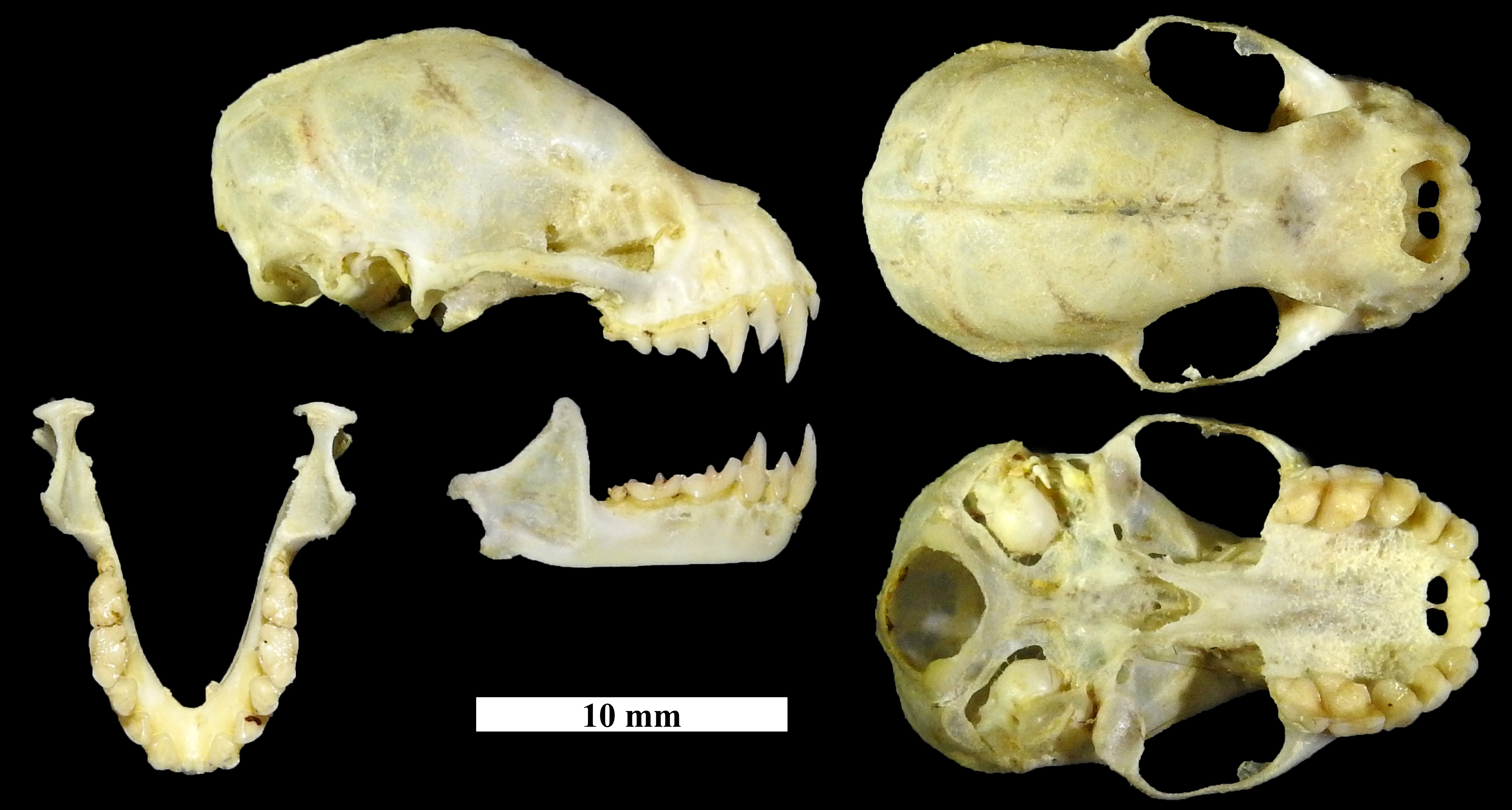
Both morphology and molecular data support the record of D. gnoma in the PEC. The specimen UFPB 12487 presents the following combination of diagnostic morphological characters: a pale base of nose-leaf; well-defined facial stripes; posterior margin of interfemoral membrane broadly U-shaped; three lower molars; mesopterygoid fossa constricted posteriorly on basicranium (internal margin of pterygoid with a ridge on each side); posterior margin of palate deeply incised, V-shaped with nearly straight sides (Figure 1), which distinguish D. gnoma from its congeners (Marques-Aguiar 2008, Díaz et al. 2021). The cranial measurements (Table I) are similar to the range reported for this species in the literature (Maas et al. 2013, 2018).

Dorsal, ventral, and lateral views of the skull and lateral and occlusal views of the mandible of an adult male Dermanura gnoma (UFPB 12487) from Alagoas, northeastern Brazil.
Measurements (in mm) of the Dermanura gnoma specimen reported in the present study in comparison with other adult male specimens.
The molecular phylogenetic analyses recovered a closer affinity between Amazonian and PEC specimens. The sequence of the COI gene fits into a D. gnoma clade (Figure 2). For the CYTB gene, our sequence aligns with the sequences of D. gnoma from the Amazonian Forest, while the sequences from Cerrado remain segregated and well-supported in a distinct clade (Figure 3). The high CYTB sequence divergence (7.1%) between the two clusters pointed out by Redondo et al. (2008) suggests that these clades may represent different OTUs, at least at the subspecies level. The disjunct distribution pattern of rainforest mammals has been considered as evidence that Amazonian and Atlantic Forest were once connected, facing repeated expansion and retraction during different epochs (Cavalcanti & Tabarelli 2004, Batalha-Filho et al. 2013, Silva 1996). This pattern of disjunct distribution between Amazonian and Atlantic Forests has been modeled for other bat species, indicating a disjunctive geographical distribution for Centronycteris maximiliani, Trinycteris nicefori, Lampronycteris brachyotis, Mesophylla macconnelli, but a potential connection for Peropteryx kappleri (Rocha et al. 2015, Silva et al. 2023). Nevertheless, further molecular and morphological analyses are essential to clarify the biogeography and systematics of the Dermanura group, especially including samples from central and southern portions of the Atlantic Forest. The D. gnoma deposited sequences of CYTB (GenBank accession number OR600194) and COI (BoldSystem accession number ABGBR001-24) are the first from the Atlantic Forest.

Bayesian phylogenetic inference based on 49 partial sequences of the COI gene (585 bp) of the genus Dermanura. Specimens’ sequences downloaded from BOLDSystems (accession numbers and species names cited in the terminals). The bold red color indicates Dermanura gnoma sequence generated in this study. Nodes with a black circle indicate Bayesian posterior probability above 0.95. Photo by Patrício A. Rocha.

Bayesian phylogenetic inference based on 12 partial CYTB gene sequences (1134 bp) of Dermanura gnoma downloaded from GenBank, based on Redondo et al. (2008) and Solari et al. (2009). Nodes with black circles indicate Bayesian posterior probability above 0.95.
From literature and online databases, we recovered 291 records of D. gnoma (Figure S1, Table SI – Supplementary Material). Of these records, most are located in Guyana, adding up to 88 records; Brazil comes in second, with 70 records (including the states of Amapá, Amazonas, Bahia, Espírito Santo, Mato Grosso, Minas Gerais, Pará, Piauí, Rio de Janeiro and Rondônia). The remaining 133 records are divided into Venezuela (45, including the type locality), Peru (28), Colombia (26), Suriname (13), Ecuador (11), French Guiana (7) and Bolivia (3). The records are concentrated in tropical forest habitats, with the vast majority in the Amazonian Forest, and few in the Cerrado and Atlantic Forest. In the Atlantic Forest, there were 21 previous records, 15 in the state of Espírito Santo (Aguiar et al. 1995, Marques-Aguiar 2008), four in southern Bahia (Falcão et al. 2005, Faria et al. 2006) and two in Rio de Janeiro.
The present record extends the known geographic distribution of D. gnoma to the northern Atlantic Forest by approximately 758 kilometers northeastern of the nearest record, located at Una municipality (BA). The nearby western record was found in Colônia do Gurguéia, in Piauí state, approximately 878 km away from the new record (Maas et al. 2013). The absence of records beyond 20 degrees south of latitude, which encompasses the best-sampled areas of the Atlantic Forest, such as those in Rio de Janeiro and São Paulo states (Muylaert et al. 2017), may suggest that this species is less tolerant to low temperatures, with a strictly inter-tropical distribution.
In recent years, the PEC has been the subject of several conservation studies that have been improving the knowledge about its persisting biodiversity (Lima et al. 2020, Ramos et al. 2021), with special regard to the Alagoas state, with descriptions of new species across different groups of animals and plants (Oliveira Junior et al. 2020, Dubeux et al. 2022). Feijó et al. (2023) point out bats as the most diverse group in the PEC, representing over half of the remaining mammal fauna, and expected new discoveries with further studies in the region. The most recent updated list of mammals from the PEC recorded a total of 70 bat species (Feijó et al. 2023), being 66 species reported for the state of Alagoas (Leal et al. 2022). The new record presented here increases these numbers to 71 and 67 species in the PEC and Alagoas state, respectively. To the best of our knowledge, there are only two bat species officially reported for ESEC Murici in the literature so far, Peropteryx kappleri (confirmed with a voucher) and Natalus macrourus (based on bioacoustics), and a published bat inventory for this preserved area is lacking (Leal et al. 2022). Thus, our results increase the number of known bat species for ESEC Murici.
The new record here obtained highlights the high species richness of the northern Atlantic Forest and underscores the limited knowledge we still have about its bat diversity. As suggested by Rocha et al. (2017) for D. anderseni, some specimens of D. gnoma may have been misidentified in collections. Therefore, a revision of Dermanura specimens housed in scientific collections is essential, as well as the sequencing of mtDNA markers for the Dermanura specimens as species from this taxon are morphologically very similar.
SUPPLEMENTARY MATERIAL
ACKNOWLEDGMENTS
The authors thank Carolina B. Machado, Miguel H.V. Sanches and the ESEC Murici staff. CFG thanks Coordenação de Aperfeiçoamento de Pessoal de Nível Superior for PhD fellowship (CAPES, Financial Code 001, 2020/88887.498109) and Programa de Pós-Graduação em Ecologia e Recursos Naturais, Universidade Federal de São Carlos (PPGERN – UFSCar). PMGJ thanks Conselho Nacional de Desenvolvimento Científico e Tecnológico (CNPq, 303524/2019-7). CFG, MGB, APC, PMGJ and PAR thank Fundação de Amparo à Pesquisa do Estado de São Paulo (FAPESP, 2017/23548-2). The authors are also thankful for the constructive comments of three anonymous reviewers, which improved the manuscript.
REFERENCES
- ABREU EF ET AL. 2023. Lista de Mamíferos do Brasil (2023-1). Zenodo. doi.org/10.5281/zenodo.10428436.
- AGUIAR LMS, ZORTÉA M & TADDEI VA. 1995. New records of bats for the Brazilian Atlantic Forest. Mammalia 59(4): 667-671.
- ALTSCHUL SF, GISH W, MILLER W, MYERS EW & LIPMAN DJ. 1990. Basic local alignment search tool. J Mol Biol 215(3): 403-410. doi.org/10.1016/S0022-2836(05)80360-2.
-
ALVARES CA, STAPE JL, SENTELHAS PC, GONÇALVES JLM & SPAROVEK G. 2013. Köppen’s climate classification map for Brazil. Meteorol Z 22(6): 711-728. doi.org/10.1127/0941-2948/2013/0507.
» https://doi.org/10.1127/0941-2948/2013/0507. -
BAKER RJ, HOOFER SR, PORTER CA & VAN DEN BUSSCHE RA. 2003. Diversification among New World leaf-nosed bats: an evolutionary hypothesis and classification inferred from digenomic congruence of DNA sequence. Occas Pap Mus Tex Tech Univ 230: 1-32. doi.org/10.5962/bhl.title.156931.
» https://doi.org/10.5962/bhl.title.156931. -
BAKER RJ, SOLARI S, CIRRANELLO A & SIMMONS NB. 2016. Higher-level classification of Phyllostomid bats with a summary of DNA synapomorphies. Acta Chiropt 18: 1-38. doi.org/10.3161/15081109ACC2016.18.1.001.
» https://doi.org/10.3161/15081109ACC2016.18.1.001. - BATALHA-FILHO H, FJELDSÅ J, FABRE PH & MIYAKI CY. 2013. Connections between the Atlantic and the Amazonian forest avifaunas represent distinct historical events. J Ornithol 154: 41-50. doi.org/10.1007/s10336-012-0866-7.
-
BOUCKAERT R, HELED J, KÜHNERT D, VAUGHAN T, WU CH, XIE D, SUCHARD MA, RAMBAUT A & DRUMMOND AJ. 2014. BEAST 2: a software platform for Bayesian evolutionary analysis. PLoS Comput Biol 10: e1003537. doi.org/10.1371/journal.pcbi.1003537.
» https://doi.org/10.1371/journal.pcbi.1003537. - BRADLEY RD & BAKER RJ. 2001. A test of the genetic species concept: cytochrome-b sequences and mammals. J Mammal 82(4): 960-973. doi.org/10.1644/1545-1542(2001)082<0960:ATOTGS>2.0.CO;2.
- CAVALCANTI D & TABARELLI M. 2004. Distribuição das plantas amazônico-nordestinas no centro de endemismo Pernambuco: brejos de altitude vs. florestas de terras baixas. Brejos de altitude em Pernambuco e Paraíba. Ministério do Meio Ambiente, Brasília, p. 285-296.
-
CIRRANELLO A, SIMMONS NB, SOLARI S & BAKER RJ. 2016. Morphological diagnoses of higher-level phyllostomid taxa (Chiroptera: Phyllostomidae). Acta Chiropt 18(1): 39-71. doi.org/10.3161/15081109ACC2016.18.1.002.
» https://doi.org/10.3161/15081109ACC2016.18.1.002. - CLARE EL, LIM BK, ENGSTROM MD, EGER JL & HEBERT PD. 2007. DNA barcoding of Neotropical bats: Species identification and discovery within Guyana. Mol Ecol Notes 7(2): 184-190. doi.org/10.1111/j.1471-8286.2006.01657.x.
- DARRIBA D, TABOADA GL, DOALLO R & POSADA D. 2012. jModelTest 2: more models, new heuristics and parallel computing. Nat Methods 9(8): 772.
-
DIAS TDC, SILVEIRA LF & FRANCISCO MR. 2023. Spatiotemporal dynamics reveals forest rejuvenation, fragmentation, and edge effects in an Atlantic Forest hotspot, the Pernambuco Endemism Center, northeastern Brazil. PLoS ONE 18(9): e0291234. doi.org/10.1371/journal.pone.0291234.
» https://doi.org/10.1371/journal.pone.0291234. - DÍAZ MM, SOLARI S, GREGORIN R, AGUIRRE LF & BARQUEZ RM. 2021. Clave de Identificación de los murciélagos neotropicales. Publicación Especial N° 4 PCMA (Programa de Conservación de los Murciélagos de Argentina), Tucumán, Argentina, 207 p.
-
DINERSTEIN E ET AL. 2017. An ecoregion-based approach to protecting half the terrestrial realm. BioSci 67(6): 534-545. doi.org/10.1093/biosci/bix014.
» https://doi.org/10.1093/biosci/bix014. - DRUMMOND AJ & BOUCKAERT RR. 2015. Bayesian evolutionary analysis with BEAST. Cambridge University Press, 263 p.
-
DRUMMOND AJ, SUCHARD MA, XIE D & RAMBAUT A. 2012. Bayesian phylogenetics with BEAUti and the BEAST 1.7. Mol Biol Evol 29(8): 1969-1973. doi.org/10.1093/molbev/mss075.
» https://doi.org/10.1093/molbev/mss075. -
DUBEUX MJ, GONCALVES U, PALMEIRA CN, NUNES PM, CASSIMIRO J, GAMBLE T, WERNECK FP, RODRIGUES MT & MOTT T. 2022. Two new species of geckos of the genus Phyllopezus PETERS, 1878 (Squamata: Gekkota: Phyllodactylidae) from northeastern Brazil. Zootaxa 5120(3): 345-372. doi.org/10.11646/zootaxa.5120.3.3.
» https://doi.org/10.11646/zootaxa.5120.3.3. - DUDLEY N. 2008. Guidelines for Applying Protected Area Management Categories. International Union for the Conservation of Nature (IUCN). Gland, Switzerland, 106 p.
- FALCÃO FC, SOARES-SANTOS B & DRUMMOND S. 2005. Espécies de morcegos do Planalto da Conquista, Bahia, Brasil. Chiroptera Neotrop 11(1-2): 220-223.
- FARIA D, SOARES-SANTOS B & SAMPAIO E. 2006. Bats from the Atlantic rainforest of southern Bahia, Brazil. Biota Neotrop, vol. 6, n° 2. doi.org/10.1590/S1676-06032006000200022.
- FEIJÓ A, BELTRÃO M, COSTA-PINTO AL, ROCHA PA, FREITAS MA, CAMPOS BATP, ASTÚA D & CORDEIRO-ESTRELA P. 2023. Mammals of the Pernambuco Endemism Center: Diversity, Biogeography, Research Gaps, and Conservation Concerns. In: Animal Biodiversity and Conservation in Brazil’s Northern Atlantic Forest, p. 201-228, Cham: Springer International Publishing. doi.org/10.1007/978-3-031-21287-1_13.
- FENTON MB & SIMMONS NB. 2015. Bats. A World of Science and Mystery. University of Chicago Press, Chicago, 240 p. doi.org/10.7208/chicago/9780226065267.001.0001.
- FIGUEIREDO MDSL, WEBER MM, BRASILEIRO CA, CERQUEIRA R, GRELLE CE, JENKINS CN, SOLIDADE CV, THOMÉ MTC, VALE MM & LORINI ML. 2021. Tetrapod diversity in the Atlantic Forest: maps and gaps. In: Marques MCM & Grelle CEV (Eds), The Atlantic Forest: History, Biodiversity, Threats and Opportunities of the Mega-diverse Forest. Springer, Switzerland, p. 185-204.
-
GARBINO GST, REZENDE GC, FERNANDES–FERREIRA H & FEIJÓ A. 2018. Reconsidering mammal extinctions in the Pernambuco Endemism Center of the Brazilian Atlantic Forest. Anim Biodiv Conserv 41(1): 175-184. doi.org/10.32800/abc.2018.41.0175.
» https://doi.org/10.32800/abc.2018.41.0175. - GARCÍA-MORALES R, CHAPA-VARGAS L, GALINDO-GONZÁLEZ J & BADANO IE. 2012. Seed dispersal among three different vegetation communities in the Huasteca region, Mexico, analyzed from bat feces. Acta Chiropt 14: 357-367. doi.org/10.3161/150811012X661675.
-
GBIF. 2024. https://www.gbif.org/ (08 January 2024). GBIF Occurrence Download, (doi.org/10.15468/dl.mqfvqz; doi.org/10.15468/dl.qjyk7a).
» https://www.gbif.org/ - GONÇALVES E & GREGORIN R. 2004. Quirópteros da Estação Ecológica da Serra das Araras, Mato Grosso, Brasil, com o primeiro registro de Artibeus gnomus e Artibeus anderseni. Lundiana 5(2): 143-149. doi.org/10.35699/2675-5327.2004.22016.
-
KALKA MB, SMITH AR & KALKO EKV. 2008. Bats limits arthropods and herbivory in a tropical forest. Science 320: 71. doi.org/10.1126/science.115335.
» https://doi.org/10.1126/science.115335. -
KEARSE M ET AL. 2012. Geneious Basic: an integrated and extendable desktop software platform for the organization and analysis of sequence data. Bioinformatics 28: 1647-1649. doi.org/10.1093/bioinformatics/bts199.
» https://doi.org/10.1093/bioinformatics/bts199. - KUNZ TH, BRAUN DE TORREZ E, BAUER D, LOBOVA T & FLEMING TH. 2011. Ecosystem services provided by bats. Ann N Y Acad Sci 1223: 1-38. doi.org/10.1111/j.1749-6632.2011.06004.x.
-
LARA-RUIZ P, CHIARELLO AG & SANTOS FR. 2008. Extreme population divergence and conservation implications for the rare endangered Atlantic Forest sloth, Bradypus torquatus (Pilosa: Bradypodidae). Biol Conserv 141(5): 1332-1342. doi.org/10.1016/j.biocon.2008.03.002.
» https://doi.org/10.1016/j.biocon.2008.03.002. -
LEAL ESB ET AL. 2022. Bats from Alagoas State, Northeastern Brazil: Updated checklist based on literature, collections and acoustic records. Mastozoologia Neotrop 29: e0613. doi.org/10.31687/saremmn.22.29.29.2.02.e0613.
» https://doi.org/10.31687/saremmn.22.29.29.2.02.e0613. - LIMA JHA, FREITAS MA, ROBERTO IJ, KOKUBUM MN, DUBEUX MM & NUNES PS. 2020. New records of Xenodon rabdocephalus (Wied-Neuwied, 1824) (Serpentes: Dipsadidae) in the Pernambuco Endemism Center, Northeastern Brazil. Heretol Notes 13: 517-522.
- MAAS ACS, DIAS D, POL A, MARTINS MA, ARAÚJO RMD, GIL BB, SCHUTTE M & PERACCHI AL. 2013. New records of bats for the state of Piauí, northeastern Brazil. Mammalia: Chiroptera. Check List 9(5): 445-449.
- MAAS ACS, GOMES LAC, MARTINS MA, DIAS D, POL A, CHAVES FG, SCHUTE M, ARAÚJO RM & PERACCHI AL. 2018. Bats in a Cerrado landscape of Northern Brazil: Species occurrence, influence of environmental heterogeneity and seasonality, and eight new records for the State of Tocantins. Mammalia 82(5): 469-480. doi.org/10.1515/mammalia-2017-0023.
- MAMMAL DIVERSITY DATABASE. 2023. Mammal Diversity Database (Version 1.11). Zenodo. doi.org/10.5281/zenodo.7830771.
- MARQUES-AGUIAR SA. 2008. Genus Artibeus Leach, 1821. In: Gardner AL (Ed), Mammals of South America. Vol. 1, Marsupials, xenarthrans, shrews and bats, The University of Chicago Press, Chicago, IL. p. 301-321.
- MARQUES MC & GRELLE CE. 2021. The Atlantic Forest. History, Biodiversity, Threats and Opportunities of the Mega-diverse Forest. Springer International Publishing, 527 p.
- MARTINS FM, DITCHFIELD AD, MEYER D & MORGANTE JS. 2007. Mitochondrial DNA phylogeography reveals marked population structure in the common vampire bat, Desmodus rotundus (Phyllostomidae). J Zool Syst Evol 45: 372-378. doi.org/10.1111/j.1439-0469.2007.00419.x.
-
MUYLAERT RDL ET AL. 2017. ATLANTIC BATS: a data set of bat communities from the Atlantic Forests of South America. Ecology 98(12): 3227. doi.org/10.1002/ecy.2007.
» https://doi.org/10.1002/ecy.2007. -
NOGUEIRA MR, LIMA IP, MORATELLI R, TAVARES VC, GREGORIN R & PERACCHI AL. 2014. Checklist of Brazilian bats, with comments on original records. Check List 10(4): 808-821. doi.org/10.15560/10.4.808.
» https://doi.org/10.15560/10.4.808. - OLIVEIRA ANS, AMORIM CMF & LYRA-LEMOS RP. 2020. Alagoas-Unidades de Conservação: as riquezas das áreas protegidas no território alagoano. 2ª ed, Maceió: Instituto de Meio Ambiente do Estado de Alagoas, 346 p.
- OLIVEIRA JUNIOR I, APTROOT A, SANTOS LA, CAVALCANTE JG, KOŠUTHOVÁ A & CÁCERES MES. 2020. Two further new lichen species from the Atlantic Forest remnant Pedra Talhada (Alagoas, Brazil), with a species list. Bryologist 123(4): 617-632. doi.org/10.1639/0007-2745-123.4.617.
- QUINTELA F, ROSA CA & FEIJÓ A. 2020. Updated and annotated checklist of recent mammals from Brazil. An Acad Bras Cienc 92: e20191004. doi.org/10.1590/0001-3765202020191004.
- RAMBAUT A & DRUMMOND AJ. 2012. TreeAnnotator, version 1.7. 5. Available at beast.bio.ed.ac.uk/TreeAnnotator. Accessed on October, 2023.
- RAMBAUT A, DRUMMOND AJ, XIE D, BAELE G & SUCHARD MA. 2018. Posterior summarization in Bayesian phylogenetics using Tracer 1.7. Syst Biol 67(5): 901-904.
-
RAMOS DMS, SILVA LG, SOUZA-ALVES JP, CARLOS IR & MONTES MA. 2021. New record of Ocelot, Leopardus pardalis (Linnaeus, 1758) (Felidae), in an Atlantic Forest fragment in the Pernambuco Endemism Center, northeastern Brazil. Check List 17(4): 1067-1073. doi.org/10.15560/17.4.1067.
» https://doi.org/10.15560/17.4.1067. -
REDONDO RA, BRINA LP, SILVA RF, DITCHFIELD AD & SANTOS FR. 2008. Molecular systematics of the genus Artibeus (Chiroptera: Phyllostomidae). Mol Phylogenet Evol 49(1): 44-58. doi.org/10.1016/j.ympev.2008.07.001.
» https://doi.org/10.1016/j.ympev.2008.07.001. - RIBEIRO MC, METZGER JP, MARTENSEN AC, PONZONI FJ & HIROTA MM. 2009. The Brazilian Atlantic Forest: How much is left, and how is the remaining forest distributed? Implications for conservation. Biol Conserv 142(6): 1141-1153.
-
ROCHA PA, FERRARI SF, FEIJÓ A & GOUVEIA SF. 2015. Zoogeography of South American forest-dwelling bats: Disjunct distributions or sampling deficiencies?. PLoS ONE 10(7): e0133276. doi.org/10.1371/journal.pone.0133276.
» https://doi.org/10.1371/journal.pone.0133276. - ROCHA PA, TAVARES VDC, PEDROSO MA, BELTRÃO-MENDES R, RUIZ-ESPARZA J & FERRARI SF. 2017. First record of Dermanura anderseni (Chiroptera, Phyllostomidae) for the Atlantic Forest. Mammalia 82(4): 388-392. doi.org/10.1515/mammalia-2017-0034.
-
SEPLAG-AL – SECRETARIA DE ESTADO DO PLANEJAMENTO, GESTÃO E PATRIMÔNIO (ALAGOAS). 2021. Mapas de caracterização territorial. Available at: https://dados.al.gov.br/catalogo/pt_PT/dataset/mapas-de-caracterizacao-territorial
» https://dados.al.gov.br/catalogo/pt_PT/dataset/mapas-de-caracterizacao-territorial -
SIKES RS & THE ANIMAL CARE AND USE COMMITTEE OF THE AMERICAN SOCIETY OF MAMMALOGISTS. 2016. 2016 Guidelines of the American Society of Mammalogists for the use of wild mammals in Research and Education. J Mamm 97: 663-688. doi.org/10.1093/jmammal/gyw078.
» https://doi.org/10.1093/jmammal/gyw078. - SILVA FP, SILVA LGD, SEMEDO TB, SANTOS T, LOPES GP, MONTES MA & GARBINO GS. 2023. Pleistocene distribution of MacConnell’s Bat (Phyllostomidae) suggests intermittent connections between Amazonia and Atlantic Forest. Therya 14(1): 55-62. doi.org/10.12933/therya-23-2219.
- SILVA JMC. 1996. Distribution of Amazonian and Atlantic birds in gallery forests of the Cerrado region, South America. Ornitol Neotrop 7(1): 1-18.
-
SILVA JMC & TABARELLI M. 2000. Tree species impoverishment and the future flora of the Atlantic Forest of northeast Brazil. Nature 404: 72-74. doi.org/10.1038/35003563.
» https://doi.org/10.1038/35003563. -
SOLARI S, HOOFER SR, LARSEN PA, BROWN AD, BULL RJ, GUERRERO JA, ORTEGA J, CARRERA JP, BRADLEY RD & BAKER RJ. 2009. Operational criteria for genetically defined species: analysis of the diversification of the small fruit-eating bats, Dermanura (Phyllostomidae: Stenodermatinae). Acta Chiropt 11(2): 279-288. doi.org/10.3161/150811009X485521.
» https://doi.org/10.3161/150811009X485521. - TABARELLI M & RODA S. 2005. Uma oportunidade para o Centro de Endemismo Pernambuco. Natureza & Conservação 3(2): 22-28.
-
THOMPSON JD, HIGGINS DG & GIBSON TJ. 1994. CLUSTAL W: improving the sensitivity of progressive multiple sequence alignment through sequence weighting, position-specific gap penalties and weight matrix choice. Nucleic Acids Res 22(22): 4673-4680. doi.org/10.1093/nar/22.22.4673.
» https://doi.org/10.1093/nar/22.22.4673. - VELAZCO PM, GARDNER AL & PATTERSON BD. 2010. Systematics of the Platyrrhinus helleri species complex (Chiroptera: Phyllostomidae), with descriptions of two new species. Zool J Linn Soc 159: 785-812.
- VIZOTTO LD & TADDEI VA. 1973. Chave para a determinação de quirópteros brasileiros. São José do Rio Preto, São Francal, Brazil, 72 p.
- WILSON DE & MITTERMEIER RA. 2019. Handbook of the Mammals of the World. Vol. 9, Bats, Lynx Editions, Barcelona, 1008 p.