 Extending the Geographic Range of Pterosaurs in the Araripe Basin: First Record from the Romualdo Formation (Araripe Basin) in Piauí, Brazil
Abstract
The Araripe Basin in northeastern Brazil is a key site for Cretaceous pterosaur fossils from Gondwanan deposits. Most discoveries are concentrated in its northern portion, particularly in Ceará state, within the Crato and Romualdo formations. In contrast, records from the southern part of the basin, especially in Piauí and Pernambuco, remain scarce. This study reports the first pterosaur fossils from the Romualdo Formation in Piauí, represented by two three-dimensionally preserved, incomplete wing phalanges: LPP Pt-002 and LPP Pt-005. Osteohistological analysis of LPP Pt-002 reveals a cortex composed of parallel-fibered bone, with endosteal lamellae and an external fundamental system (EFS), indicating skeletal maturity. In contrast, LPP Pt-005 displays a cortex of woven bone and circumferential lamellae, with a highly vascularized matrix and no evidence of EFS or endosteal lamellae, suggesting a post-juvenile stage. These differences indicate that the specimens represent distinct individuals. Although the reasons for the lower abundance of pterosaur remains in the southern Araripe Basin are unclear, these findings expand the known geographic range of Pterosauria within the basin and underscore the importance of further paleontological exploration in underrepresented regions to better understand pterosaur diversity and distribution during the Cretaceous.
Key words
Araripe Basin; Cretaceous; Piauí; Pterosauria; Romualdo Formation; Osteohistology
INTRODUCTION
Among the pterosaur occurrences from Gondwana, the majority are documented in South America, particularly within Cretaceous sedimentary rocks of the Araripe Basin in Brazil (Campos & Kellner 1985, Kellner & Tomida 2000, Vila Nova et al. 2011, Kellner et al. 2013, Bantim et al. 2014, 2021a, b, Pentland & Poropat 2023). These rocks encompass the Fossil Lagerstätten of the Crato and Romualdo formations, renowned for their exceptionally well-preserved fossils (Kellner & Campos 2002). Notably, the Romualdo Formation, dating to the late Aptian/early Albian, is particularly distinguished for its pterosaur fossils preserved in three dimensions (e.g. Kellner 1989, Vila Nova et al. 2011, Kellner et al. 2013).
The limestone concretions that encase these fossils from the Romualdo Formation provide exceptional preservation by minimizing morphological distortion, in contrast to the typically compressed fossils of the Crato Formation (Cavalcanti & Viana 1990, Kellner & Campos 2002). This remarkable preservation including wings, skulls, vertebrae, and limbs, with occasional soft tissue remains, facilitating detailed investigations into pterosaur anatomy (e.g. Kellner & Tomida 2000), neuroanatomy (Witmer et al. 2003), osteohistology (Sayão 2003, Eleutério et al. 2015, Bantim et al. 2021a), dietary habits (Kellner & Campos 2002, Veldmeijer et al. 2012, Bestwick et al. 2018, Pêgas et al. 2018) and biomechanics (Wellnhofer 1988, Chatterjee & Templin 2004, Costa et al. 2014a, b). Although the first descriptions of a pterosaur from this deposit date back to the 1970s (Price 1971), the discovery and publication of new species from this unit have significantly accelerated since the late 20th century (Kellner & Tomida 2000, Fastnacht 2001, Veldmeijer 2003, Bantim et al. 2014, Pinheiro & Rodrigues 2017, Cerqueira et al. 2021).
Most of these discoveries, however, have been concentrated in the northern part of the basin, particularly in Ceará state. Conversely, pterosaur occurrences in the southernmost regions of the basin, specifically in Piauí and Pernambuco states, are notably scarce (Martill 2008, Aureliano et al. 2014). The reasons for this disparity remain unclear but may include environmental variations during the Aptian/Albian period, differences in taphonomic processes — since the preservation quality varies depending on the stratigraphic layers and the specific locality— or sampling bias favoring the more extensively studied areas of Ceará. This geographic bias in fossil collection limits our understanding of the true geographic provenance of the pterosaur in the Araripe Basin.
In this context, we report the first occurrence of Pterosauria in the Romualdo Formation in the Piauí portion of the Araripe Basin, emphasizing the importance of continued research in understudied regions of the basin. Osteohistology has been widely used in studies of pterosaurs from the Araripe Basin (Sayão 2003, Kellner et al. 2013, Aureliano et al. 2014, Eleutério et al. 2015, Cheng et al. 2020, Bantim et al. 2021a). In this study, we employed bone histology to assess the ontogenetic stage of the analyzed specimens. Additionally, the material was tentatively assigned to Anhangueridae based on estimated wingspan measurements.
Geological setting
The Araripe Basin is located in northeastern Brazil, spanning the states of Ceará, Pernambuco, and Piauí. The portion of the basin exposed in Piauí is considerably smaller than those in Ceará and Pernambuco (Brito Neves 1990). The southeastern edge of the Araripe Plateau in Piauí is marked by an extensive highland area, with elevations ranging from 800 to 850 meters. This plateau is sharply bounded by steep erosional escarpments, with elevation drops exceeding 300 meters (Silva et al. 2023). In this area, the Romualdo, Araripina, and Exu formations are exposed, forming part of the basin’s westernmost margin. The Romualdo Formation, dated to the Aptian–Albian (Barreto et al. 2022), consists of interbedded shales, marls, and limestones, and is particularly well known for its numerous calcareous concretions that have yielded exceptionally well-preserved fossils (Konservat-Lagerstätten) (Maisey 1991, Valença et al. 2003).
In the municipality of Simões, located 356 km from the capital Teresina, crops out the upper Romualdo Formation are exposed at the base of the plateau, where the landscape is defined by steep, intensely weathered escarpments. Additional exposures occur in adjacent areas marked by pronounced slopes. One notable site is Sítio Capim Grande (Fig. 1), where numerous limestone concretions have been recovered from the soil horizon. These concretions yield a diverse fossil assemblage, including microfossils, coprolites, plant remains and, most notably, fish. To this assemblage, two additional pterosaur specimens are now being added. The concretions are scattered across the surface without a discernible pattern of orientation and display significant variation in size and shape.

Location map of the Araripe Basin. a) Overview of South America, with a marked area indicating the northeastern region of Brazil shown in (b); b) enlarged view of northeastern Brazil, highlighting the geographic position of the Araripe Basin, which is further detailed in (c); c) map of the Araripe Basin showing its extension across the states and fossiliferous areas of Ceará (Araripe, Santana do Cariri, Crato and Missão Velha), Piauí (Caldeirão Grande and Simões), and Pernambuco (Araripina, Ipubi, Trindade and Exu). Red triangle refers to the location of the site “Sítio Capim Grande”.
MATERIALS AND METHODS
The specimens described here were collected by the LPP team (Laboratório de Paleontologia de Picos), Federal University of Piauí, during fieldwork at the Capim Grande site in Simões municipality, Piauí state, Brazil. Although they were found closed, they were not articulated and were approximately 10 meters apart. This relatively flat area lies near the foothills of the Araripe Plateau, where numerous Romualdo Formation concretions are scattered amidst vegetation and within private outcrop sites. Such exposure is common in areas where the Romualdo Formation is present, with concretions often visible on the soil surface due to agricultural activities.
This collection was registered in the fossil extraction control system of the Agência Nacional de Mineração – ANM (Brazil’s national mining agency) for paleontological research – Copal platform with number 047/2020. The material is stored in the Scientific Collection of the LPP, Piauí state (Brazil), with numbers LPP Pt-002 and LPP Pt-005.
All mechanical preparation was completed at the Paleontology Laboratory of Universidade Regional do Cariri, Crato municipality Ceará, Brazil. The specimens consist of two fragmented limestone concretions: LPP Pt-002 and LPP Pt-005. In the first phase of preparation, the aid of a pneumatic pen model Paleo Tools ® ME – 9100 was required. After part of the bedrock had been mechanically ground away (Leiggi & May 1994), the bone structure was already prominent under the sediment. At this point, it was necessary to apply Paraloid® B-72/Acryloide B-72 at 3% and then 10%, which offered an increase in the control capacity of fossil preparation, since the 3% concentration can penetrate the bone micro-openings, and the 10% concentration provides surface protection of the material (Silva & Kellner 2006). This procedure was repeated throughout the preparation process until the sediment was removed.
Wingspan estimation
The methodology proposed by Kellner et al. (2013) was used to estimate wing element proportions based on related specimens, including both the maximum and normalized wingspan values. The dataset and proportional ratios applied in this study were derived from Aureliano et al. (2014). Wingspan was calculated by summing the estimated lengths of all forelimb elements - scapula, humerus, ulna, carpals, metacarpal IV, and the four wing phalanges - and multiplying the total by two.
To estimate wingspan, we first reconstructed the total length of the first wing phalanx (Ph1D4) of specimen LPP-PT02 using the following formula: proportion of the preserved length relative to the total estimated length:
Once the full length of Ph1D4 was determined, it served as a reference for estimating the lengths of the remaining forelimb elements, based on proportional relationships observed in closely related taxa. These reconstructed measurements were then used to calculate the wingspan, assuming morphological similarity to previously described pterosaurs.
Osteohistological Procedures
Osteohistological procedures followed the protocol outlined by Lamm (2013). Sampling and preparation were conducted at the Paleohistology Laboratory, Department of Geology and Paleontology, National Museum, Rio de Janeiro. A small fragment from the diaphysis of each specimen was extracted and embedded in clear epoxy resin (Arazyn 25108 T-10, Redelease, Brazil) catalyzed with Butanox M-50 (Redelease, Brazil). The embedded samples were sectioned using a Buehler Isomet precision saw with a diamond-tipped circular blade. Wet grinding and polishing were performed using an Arotec metallographic polishing machine with progressively finer abrasive papers. Prepared thin sections were examined under a Zeiss optical microscope to assess histological features.
RESULTS
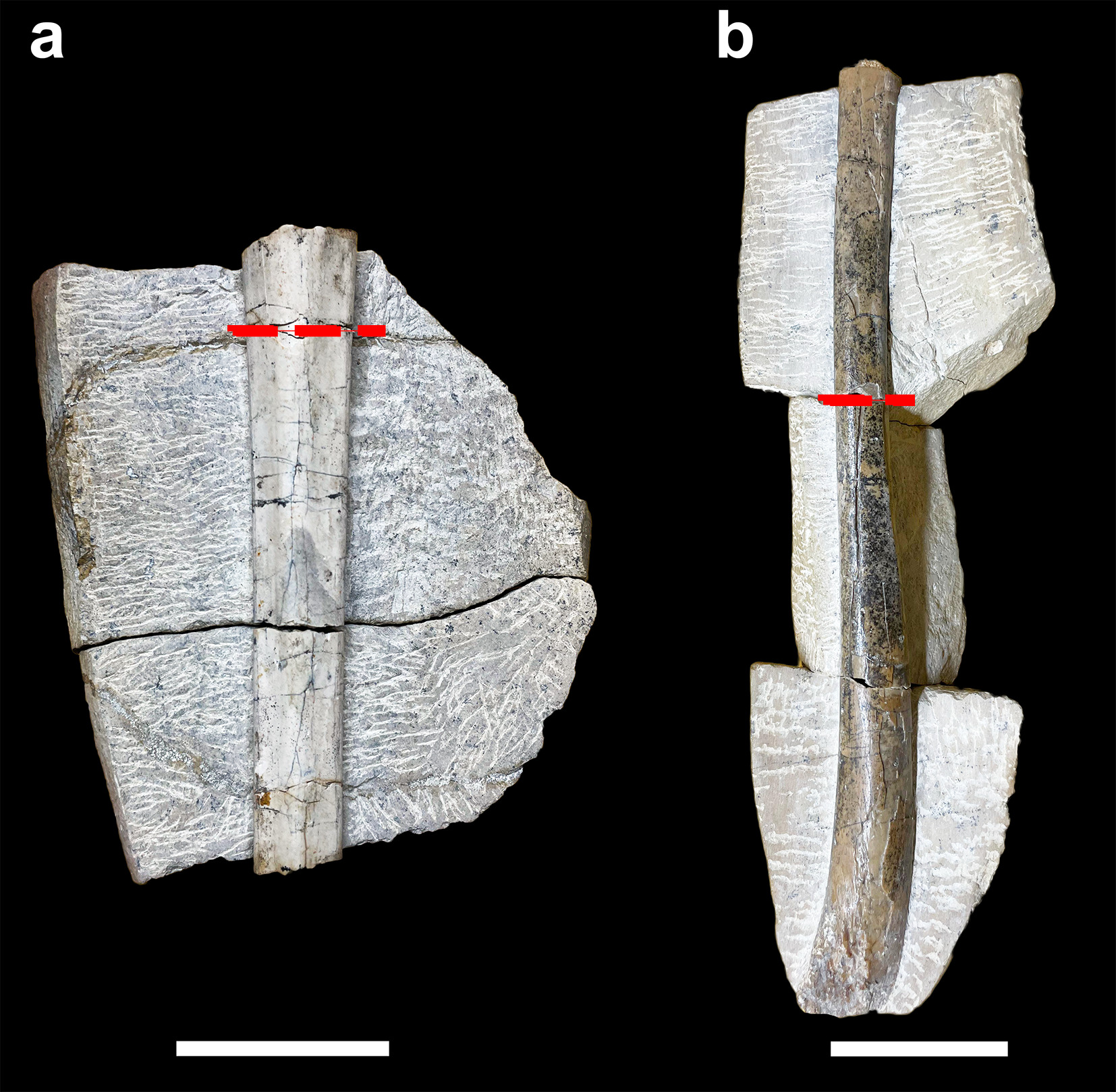
Both specimens (LPP Pt-002 and LPP Pt-005) consist of incompletely preserved wing phalanges, exhibiting three-dimensional preservation (Fig. 2). LPP Pt-002 represents a partial first right-wing phalanx, with a preserved length of 24.5 cm. LPP Pt-005, found in two separate fragments, corresponds to a second wing phalanx. Only the diaphyseal portion is preserved, limiting the potential for precise anatomical identification. Both specimens were recovered from the surface and display signs of prolonged exposure, as evidenced by weathering on the bone surfaces.

Incomplete pterosaur wing phalanges from the Araripe Basin. Both specimens are three-dimensionally preserved. a) LPP Pt-002, an incomplete first right-wing phalanx, with a preserved length of 24.5 cm; b) LPP Pt-005, divided into two pieces and representing a fragment of a probable second-wing phalanx. Only the diaphyseal portion is preserved in this specimen, hindering precise anatomical identification. Both elements were found on the surface and exhibit signs of long-term weathering, as evidenced by alterations in the bone surfaces. Red lines represent the sectioned areas.
The estimation of the wingspan was calculated using the average measurements of Anhanguera piscator and Santanadactylus pricei (Table I). The maximum wingspan was estimated between 3.07 m and 3.12 m, while the normalized wingspan, calculated as 95% of the maximum wingspan, ranged between 3.04 m and 3.08 m. These estimates assume that LPP Pt-002 shares similar forelimb proportions than Anhanguera piscator and Santanadactylus pricei (Table II).
Histological description
The specimens exhibit typical pterosaurian bone tissue. The cortex of LPP Pt-002 is composed of fast-growing woven bone (Fig. 3a), with circumferential lamellae (CL) throughout the entire cortex, which are visible under polarized light (Fig. 3b, c). The vascular network is abundant and consists of anastomosed canals, with some primary osteons. Vascular canals are opening at the periosteal surface. Osteocyte lacunae are abundant, randomly distributed, and rounded in shape, and in the CL they appear shipled, characterizing a parallel-fibered bone zone (Fig. 3d). No Lines of Arrested Growth (LAGs), secondary osteons, even External Fundamental System (EFS) and Endosteal Lamellae (EL) have been seen; all these features are indicative that this specimen is a late juvenile.
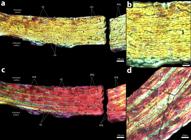
a) Cross-section of LPP Pt-002 under normal light; b) Highlight of the PFB zones into the woven bone matrix; c) Cross-section of LPP Pt-002 under polarized light with lambda filter, showing woven bone with circumferential lamellae throughout the entire cortex; d) Highlight of the PFB zones into the woven bone matrix under polarized light. Abbreviations: WB: Woven Bone; PFB: Paralell-Fibered Bone; VC: Vascular Canals; PO: Primary Osteon; OL: Osteocyte Lacunae.
LPP Pt-005 displays a periosteal cortex composed of parallel-fibered bone (Fig. 4a, b). There is a well-developed EL composed of lamellar bone and CL; under polarized light, the differential collagen fibers arrangement is highlighted (Fig. 4c, d). The cortical bone is densely vascularized with longitudinal canals and primary osteons, with some anastomoses evident. The osteocyte lacunae are abundant, randomly distributed, and have rounded and flattened shape; those within the CL are shipped. No LAG or secondary osteons have been observed. The presence of EFS, as well as all histological observations, indicates that LPP Pt-005 is probably an adult that achieves its asymptotic growth, determining its body size.

Histological section of Wing Phalanx LPP Pt-005. (a) Cross section under normal light. (b) Cross section under polarized light. (c) Highlight Parallel fibered bone and vascular canals, note the endosteal lamellae and External Fundamental System in evidence under polarized light. (d) Region with well organized PFB and presence of the CL composed by lamelar bone. Abbreviations: PFB: Parallel-Fibered bone; LB: Lamellar Bone; VC: Vascular canal; PO: Primary osteon; CL: Circumferential lamellae; EL: Endosteal lamellae; EFS: External Fundamental System. OL: Osteocyte lacunae.
DISCUSSION
Pterosaur records from the Araripe Basin have been documented since the early 1970s, beginning with the description of the species initially named Araripesaurus castilhoi Price 1971. In the following decade, several studies reported exceptionally well-preserved specimens from these deposits (Kellner 1984, 1989, Campos & Kellner 1985, 1997, Leonardi & Borgomanero 1985, Wellnhofer 1985, 1987, 1988, Maisey 1991, Frey & Martill 1994), a trend that continues to the present day (Kellner et al. 2013, Bantim et al. 2014, 2021a, Pêgas et al. 2016, Pinheiro & Rodrigues 2017, Cerqueira et al. 2021, Duque et al. 2022, 2023, Silva et al. 2024). Traditionally, most specimens have come from Ceará, collected over decades by local workers and deposited in museums worldwide, mainly in Europe (e.g., Wellnhofer 1987, 1991, Frey & Martill 1994, Fastnacht 2001, Veldmeijer 2003, 2012, Elgin & Frey 2011), United States of America (Maisey 1991, Wellnhofer 1991, Pinheiro & Rodrigues 2017), and even Japan (Kellner & Tomida 2000). Despite this promising scenario, only a few of these specimens have stratigraphic accuracy (Vila Nova et al. 2011, Bantim et al. 2014, Kellner et al. 2013, Aureliano et al. 2014, Duque & Barreto 2018a, b, Bantim et al. 2021a, Duque et al. 2022, 2023). This situation began to change with the intensification of collections made with stratigraphic rigor by research groups that settled in the region for further study (Fara et al. 2005, Saraiva et al. 2007, Vila Nova et al. 2011, Bantim et al. 2015, Saraiva et al. 2016, Lima et al. 2019, 2020, Storari et al. 2021).
Recently, pterosaur records from the Romualdo Formation outside Ceará include some isolated specimens from the southeastern part of the Araripe Basin in Pernambuco state (Kellner et al. 2013, Aureliano et al. 2014, Duque & Barreto 2018a, b, Duque et al. 2022, 2023). While most of the specimens referenced in studies from this region are associated with gypsum quarries, such as the Zé Gomes and Cedro Sites in Exu municipality (Aureliano et al. 2014, Duque & Barreto 2018a, b, Duque et al. 2022), Lagoa de Dentro Site in Araripina (Duque & Barreto 2018a, b) and Escorrego Site in Ipubi (Duque & Barreto 2023) their stratigraphic context remains unverified. In addition, the record of specimen MCT 1838-R described by Kellner et al. (2013) has an undefined collection site, with only provenance information indicating an outcrop in the state of Pernambuco.
Fossil occurrences from the Romualdo Formation in the state of Piauí, however, are much rarer, even when considering all vertebrate records. The two most recognized localities are Pau dos Ferros in Fronteira municipality, mainly with invertebrate occurrences (Pereira et al. 2017), and Ladeira do Berlenga at Simões municipality, with records of fish and crocodyliforms (Price 1959, Santos 1971, Maisey 1993, Kellner et al. 2002). In 1946, an expedition organized by the Conselho Nacional do Petroleo (CNP) and led by Frederick B. Plummer went to this region and collected several fossils (Conselho Nacional do Petróleo 1948). Among them is the crocodyliform Araripesuchus gomesii described by Price (1959), the first tetrapod from the Romualdo Formation and the paratype of the albuloid fish Paraelops cearensis described by Santos (1971). Maisey (1993) named the first clupeomorph from the Romualdo Formation Santanaclupea silvasantosi. Kellner et al. (2002) reported the occurrence of the fish species Rhacolepis buccalis, Calamopleurus cylindricus, Vinctifer comptoni, and Tharrhias araripis, all found at Ladeira do Berlenga.
Considering pterosaurs there is a dubious occurrence of a pterosaur humerus found on the road between Marcolândia in Pernambuco and Simões in Piauí, associated with the sandstones of the Exu Formation (Martill 2008). However, the author mentions that the humerus fragment may be associated with a concretion, which is not reported for the Exu Formation. Therefore, its occurrence might not be from the Exu Formation. The map indicates that the findings were located on the boundary between the states, but still within the domain of Pernambuco (see Martill 2008, Figure 1). Consequently, no records have been confirmed for the state of Piauí so far. In this context, the occurrence described here in the municipality of Simões (Site Capim Grande) represents the first confirmed occurrence of pterosaurs in the state of Piauí. Furthermore, it adds to the list of specimens with precise provenance, contributing to the geographic distribution of the group across the Araripe Basin. Identifying the Simões region as one of the main fossiliferous areas of the Romualdo Formation in Piauí, when considering all the vertebrate occurrences recorded at different sites in this locality. Despite nearly two centuries of history and research, this basin continues to yield new fossil discoveries, as pointed out twenty years ago by Carvalho & Santos (2005). Since Pterosaurs represent the most diverse clade of tetrapods preserved in the Romualdo Formation (e.g. Vila Nova et al. 2011, Bantim et al. 2021a), the proper identification of the fossil occurrence areas, along with their stratigraphic accuracy, will increasingly refine studies on interactions between groups and faunal successions.
The methodology used to estimate wingspan was first proposed by Bennet et al. (2001) and later refined by Kellner et al. (2013), with subsequent studies reinforcing the robustness of this proposal (Aureliano et al. 2014, Duque & Barreto 2018b, Bellardini & Codorniú 2019, Bantim et al. 2021a, Silva et al. 2024). This type of analysis aids in understanding the dimensions of pterosaurs, even when dealing with fragmented records or isolated bones. Although numerous pterodactyloid pterosaur fossils are well-preserved, including a substantial portion of their components, especially those coming from bonebeds (e.g., Pterodaustro guiñzui, Hamipterus tianshanensis and Caiuajara dobrouski), many occurrences remain fragmented and incomplete (e.g. Barrett et al. 2008, Bantim et al. 2021a, b, Martill & Smith 2025). Although there are records from the Romualdo Formation of complete or nearly complete skulls, as well as some partial post-cranial skeletons (Elgin & Frey 2011, Pinheiro & Rodrigues 2017, Cerqueira et al. 2021), this is not the case for most of the records from this formation. In general, the specimens are isolated or incomplete but well-preserved (e.g. Dalla Vecchia & Ligabue 1993, Vila Nova et al. 2011), with the exception of Anhanguera piscator (Kellner & Tomida 2000), which has a skull associated with an almost complete skeleton and Anhanguera spielbergi (according to Kellner 2006, Rodrigues & Kellner 2008) with 60% of the skeleton preserved (Veldmeijer 2003).
In addition to providing insights into the body dimensions of the specimens, this methodology can aid in the identification of isolated bones. This is particularly relevant since the pterosaurs from the Romualdo Formation are exclusively members of either the Anhangueridae or Azhdarchoidea, which are characterized by distinct wing proportions (Kellner 2003, Vila Nova & Sayão 2012, Araújo et al. 2023). According to Kellner et al. (2013) while pteranodontoids (which includes anhanguerids) have comparatively large wings compared to body size, the reverse is true for azhdarchoids that have shorter wings and, therefore, comparatively smaller wingspans (Kellner 2003). The estimated wingspan ranged between 3.04 and 3.08 meters, consistent with the proportions observed in small to medium-sized Anhangueridae. These proportions are similar to those found by Silva et al. (2024), ranging between 3.7 and 3.9 meters. As noted by those authors, these values are close to those observed in Anhanguera piscator. Other studies have reported slightly larger proportions, such as the 4.37 to 4.6 meters estimated by Aureliano et al. (2014) and the 5.47 to 5.54 meters reported by Bantim et al. (2021a), both considered Anhangueridae indet. Therefore, the specimen is also smaller than those classified as giant, such as Tropeognathus, which has an estimated wingspan of 8 meters (Kellner et al. 2013). The Anhangueridae (Campos & Kellner 1985) is the most well represented pterosaur clade in the Romualdo Formation, which leads us to tentatively identify the specimens described here as belonging to this group.
Histological studies of pterosaurs from the Araripe Basin, particularly those from the Romualdo and Crato formations, have provided key insights into the growth, ontogeny, and biomechanical adaptations of these flying reptiles. Early work, such as that by Sayão (2003), identified histovariability and allometric growth, observing varying growth rates in the bones of the same individual, highlighting the complexity of pterosaur development. Kellner et al. (2013), who analyzed T. mesembrinus, noted the presence of an External Fundamental System (EFS) and lines of arrested growth (LAGs), suggesting that this specimen had reached asymptotic growth and was adult. Subsequent works, such as those by Aureliano et al. (2014) and Eleutério et al. (2015), also revealed the presence of EFS and LAGs in pterosaurs at different ontogenetic stages, with the analysis of bone tissues such as “plywood” suggesting biomechanical influences on bone development (Eleutério et al. 2015). More recent studies by Cheng et al. (2020) and Bantim et al. (2021a) indicated that, although some pterosaurs reached giant sizes, such as the Anhangueridae from the Crato Formation, many remained in subadult stages, emphasizing the distinction between gigantism and bone maturation.
Despite the fibro-lamellar complex being the most common tissue described in pterosaurs, any of our specimens exhibited it, presenting both parallel-fibred matrices. The parallel fibered bone was reported in pterosaurs like Rhamphorynchys and other specimens of Pterodactyloidea (Prondvai et al. 2012, Lü et al. 2016, Fernandes et al. 2022, Araújo et al. 2023).
The histological differences between LPP Pt-002 and LPP Pt-005 provide new insights into the ontogenetic stages. LPP Pt-002, with its woven bone and absence of EFS, LAGs, and secondary osteons, aligns with the characteristics of late juvenile or post-juvenile pterosaurs, similar to the findings of Sayão (2003) and Eleutério et al. (2015) for juvenile specimens. The presence of primary osteons and abundant vascular canals suggests that LPP Pt-002 was still in an active growth phase, although it had likely reached a size where further growth would be less rapid.
In contrast, LPP Pt-005 exhibits advanced histological features, including the presence of EFS and the absence of LAGs in the parallel-fibered matrix, marking it as an adult. This is consistent with the findings of Kellner et al. (2013) and Aureliano et al. (2014), who observed similar characteristics in adult specimens, indicating that LPP Pt-005 had achieved its asymptotic growth. The presence of EFS and well-vascularized bone tissue also suggests that this specimen reached its full size, with no further significant growth occurring after this stage.
The comparison of these two specimens with earlier studies highlights the diversity of ontogenetic stages in pterosaurs from the Romualdo Formation. While some specimens exhibit juvenile characteristics, others show clear signs of adulthood, with well-developed EFS and a cessation of growth. These findings underscore the importance of osteohistological analysis in understanding the growth dynamics and life history of pterosaurs, particularly in differentiating between juvenile and adult stages. The continued study of histological variation in pterosaur bones will provide further insights into their growth patterns, biomechanics (e.g Araújo et al. 2025), and the evolutionary adaptations that allowed these reptiles to become the giants of the Mesozoic skies.
CONCLUSIONS
The discoveries presented here indicate that pterosaurs were distributed throughout the Basin where the Romualdo Formation emerged. Implementing geographic and stratigraphic control of pterosaur collections is crucial for understanding the distribution of this group. This can provide population data, allowing researchers to establish interactions between species or their isolation in certain regions of the basin. Additionally, these data significantly impact our knowledge of pterosaur distribution in Gondwana, especially during the Lower Cretaceous.
The histological analysis of LPP Pt-002 and LPP Pt-005 adds to the growing body of evidence that pterosaurs from the Romualdo Formation exhibit diverse growth patterns, with juvenile and adult specimens displaying distinct histological features. The absence of EFS and LAGs in LPP Pt-002 suggests a late juvenile or post-juvenile stage, while the presence of EFS in LPP Pt-005 points to an adult that has reached its asymptotic growth. These findings contribute to our understanding of pterosaur ontogeny and underscore the value of osteohistology in interpreting the life history of these remarkable flying reptiles.
Acknowledgements
The authors thank A.H. Fernandes Júnior and Mr. E.S. Fernandes for fieldwork assistance, as well as to Mr. L. Fernandes, who kindly allowed the access to his property, where the fossils were collected. The Universidade Federal do Piauí, Campus Senador Helvídio Nunes de Barros (UFPI/CSHNB), Núcleo de Pesquisa em Ciências Naturais do Semiárido do Piauí (NUPECINAS) for the infrastructure provided in fieldwork and to the executive power of the municipality of Simões. This research was funded by the Conselho Nacional de Desenvolvimento Científico e Tecnológico (CNPq #309245/2023-0 to JMS; CNPq #141138/2022-0 to EVA; CNPq #406902/2022-4 - INCT PALEOVERT). Fundação Cearense de Apoio ao Desenvolvimento Científico e Tecnológico (FUNCAP PV1-00187- 00052.01.00/21 to RAMB). Fundação Carlos Chagas Filho de Amparo à Pesquisa do Estado do Rio de Janeiro (FAPERJ #E-26/210.066/2023, #E-26/204.280/2024 to JMS). Fundação de Amparo à Ciência e Tecnologia de Pernambuco (FACEPE - APQ-2024-1.07/24 to FJL). We would like to thank Mariana Valéria de Araújo Sena for her valuable review and contributions during the publication process and Francielma Amparo for assisting in the preparation of the fossil specimens used in this study.
References
- ARAÚJO EV, BANTIM RAM, HOLGADO B, SAYÃO JM, WEINSCHÜTZ LC & KELLNER AWA. 2023. Osteohistological characterization and ontogeny of Caiuajara dobruskii (Pterosauria, Pterodactyloidea, Tapejaridae). Hist Biol 36(7): 1204-1219.
- AURELIANO T, GHILARDI AM, DUQUE RRC & BARRETO AMF. 2014. On the occurrence of pterosauria in Exu, Pernambuco (lower cretaceous Romualdo Formation, Araripe Basin), northeastern Brazil. Est Geol 24(2): 15-27.
- BANTIM RAM, ANDRADE RCLP, FERREIRA JS, SARAIVA AAF, KELLNER AWA & SAYÃO JM. 2021a. Osteohistology and growth pattern of a large pterosaur from the Lower Cretaceous Romualdo Formation of the Araripe Basin, Northeastern Brazil. Cretac Res 118: 104667.
- BANTIM RAM, BARROS OA, SILVA JH, LIMA FJ, SAYÃO JM & SARAIVA AAF. 2015. Paleometria do conteúdo fossilífero de uma camada arenitica da Formação Romualdo (Bacia Do Araripe). Cad Cult Ciênc 14(1): 54-64.
- BANTIM RAM, LIMA FJ, BARROS OA & SARAIVA AAF. 2021b. Guia de fósseis da Bacia do Araripe. Laboratório de Paleontologia da URCA - LPU. Crato/CE. 1a ed., 330 p.
- BANTIM RAM, SARAIVA AAF, OLIVEIRA GR & SAYÃO JM. 2014. A new toothed pterosaur (Pterodactyloidea: Anhangueridae) from the Early Cretaceous Romualdo Formation, NE Brazil. Zootaxa 869(3): 201-223.
- BARRETO AMF ET AL. 2022. U/Pb geochronology of fossil fish dentine from Romualdo Formation, Araripe Basin, northeast of Brazil. J South Am Earth Sci 116: 103774.
- BARRETT PM ET AL. 2008. Pterosaur distribution in time and space: an atlas. Zitteliana B 28: 61-107.
- BENNETT D, COVERT E & OLVIVER T. 2001. The wing grid: a new approach to reducing induced drag. MIT Final. Rep 16: 622.
- BELLARDINI F & CODORNIÚ L. 2019. First pterosaur post-cranial remains from the Lower Cretaceous Lohan Cura Formation (Albian) of Patagonia, Argentina. Ameghiniana 56(2): 116-134.
- BESTWICK J, UNWIN DM, BUTLER RJ, HENDERSON DM & PURNELL MA. 2018. Pterosaur dietary hypotheses: a review of ideas and approaches. Biol Rev Camb Philos Soc 93(4): 2021-2048.
- BRITO NEVES BB. 1990. A Bacia do Araripe no contexto geotectônico regional. In: 1º Simpósio sobre a Bacia do Araripe e Bacias Interiores do Nordeste, Crato, CE, Atas, p. 43-51.
- CAMPOS DA & KELLNER AWA. 1985. Panorama of the flying reptiles study in Brazil and South America. An Acad Bras Cienc 57(4): 453-466.
- CAMPOS DA & KELLNER AWA. 1997. Short note on the first occurrence of Tapejaridae in the Crato Member (Aptian), Santana Formation, Araripe Basin, Northeast Brazil. An Acad Bras Cienc 69: 83-87.
- CARVALHO MSS & SANTOS MECM. 2005. Histórico das pesquisas Paleontológicas na Bacia do Araripe, Nordeste do Brasil. Anu Inst Geocienc 28(1): 15-34.
- CAVALCANTI VMM & VIANA MSS. 1990. Faciologia dos sedimentos não-lacustres da Formação Santana (Cretáceo Inferior da bacia do Araripe, Nordeste do Brasil). Simpósio sobre a Bacia do Araripe e Bacias interiores do Nordeste, vol. 1, p. 193-202.
- CERQUEIRA GM, SANTOS MA, MARKS MF, SAYÃO JM & PINHEIRO FL. 2021. A new azhdarchoid pterosaur from the Lower Cretaceous of Brazil and the paleobiogeography of the Tapejaridae. Acta Palaeontol Pol 66(3): 555-570.
- CHATTERJEE S & TEMPLIN R. 2004. Posture, locomotion, and paleoecology of pterosaurs. Geol Soc Am Spec Pap 376: 1-64.
- CHENG X, BANTIM RA, SAYÃO JM, KELLNER AWA, WANG X & SARAIVA AAF. 2020. The largest flying reptile from the Crato formation, lower cretaceous, Brazil. Hist Biol 32(3): 321-329.
- CONSELHO NACIONAL DO PETRÓLEO. 1948. Relátorio de 1946. Presidência da República. Rio de Janeiro.
- COSTA FR, ROCHA-BARBOSA O & KELLNER AWA. 2014a. A biomechanical approach on the optimal stance of Anhanguera piscator (Pterodactyloidea) and its implications for pterosaur gait on land. Hist Biol 26: 582-590.
- COSTA FR, ROCHA-BARBOSA O & KELLNER AWA. 2014b. Myological reconstruction of the pelvic girdle of Anhanguera piscator. Rev Bras Paleontolog 17(1): 11-21.
- DALLA VECCHIA F & LIGABUE G. 1993. On the presence of a giant pterosaur in the Lower Cretaceous (Aptian) of Chapada do Araripe (northeastern Brazil). Boll Soc Paleont Italiana 32: 131-136.
- DUQUE RRC & BARRETO AMF. 2018a. Novos Sítios Fossilíferos da Formação Romualdo, Cretáceo Inferior, Bacia do Araripe, Exu, Pernambuco, Nordeste do Brasil. Anu Inst Geocienc 41(1): 5-14.
- DUQUE RRC & BARRETO AMF. 2018b. New exceptionally well-preserved pterosauria from the lower cretaceous Araripe Basin, Northeast Brazil. Cretac Res 91: 299-311.
- DUQUE RRC, PINHEIRO FL & BARRETO AMF. 2022. The ontogenetic growth of Anhangueridae (Pterosauria, Pterodactyloidea) premaxillary crests as revealed by a crestless Anhanguera specimen. J Vert Paleont 42(1): e2116984.
- DUQUE RRC, PINHEIRO FL, COUTINHO DLC & BARRETO AMF. 2023. New pterosaur specimens with geographic and stratigraphic procedence from the Romualdo Formation (Lower Cretaceous, Araripe Basin, Brazil). J South Am Earth Sc 127: 104408.
- ELEUTÉRIO LHS, BANTIM RAM, LIMA FJ, ANDRADE RCLP, SARAIVA AAF, KELLNER AWA & SAYÃO JM. 2015. Biomechanical and physiological influences on the osteohistological deposition of Anhangueria (Pterosauria, Pterodactyloidea). RBP 18(3): 403e412.
- ELGIN RA & FREY EA. 2011. New ornithocheirid, Barbosania gracilirostris gen. et sp. nov. (Pterosauria, Pterodactyloidea) from the Santana Formation (Cretaceous) of NE Brazil. Swiss J Palaeontol 130: 259-275.
- FARA E, SARAIVA AAF, CAMPOS DA, MOREIRA JKR, SIEBRA DC & KELLNER AWA. 2005. Controlled excavations in the Romualdo Member of the Santana Formation (Early Cretaceous, Araripe Basin, northeastern Brazil): stratigraphic, palaeoenvironmental and palaeoecological implications. Palaeogeogr Palaeoclimatol Palaeoecol 218: 145-160.
- FASTNACHT M. 2001. First record of Coloborhynchus (Pterosauria) from the Santana Formation (Lower Cretaceous) of the Chapada do Araripe, Brazil. Palaontol Z 75: 23-36.
- FERNANDES AE, MATEUS O, ANDRES B, POLCYN MJ, SCHULP AS, GONÇALVES AO & JACOBS LL. 2022. Pterosaurs from the Late Cretaceous of Angola. Diversity 14(9): 741.
- FREY E & MARTILL DM. 1994. A new pterosaur from the Crato Formation (Lower Cretaceous, Aptian) of Brazil. Neues Jahrb Geol Pcilaontol Abh 194: 319-412.
- KELLNER AWA. 1984. Ocorrência de uma mandíbula de pterosauria (Brasileodactylus araripensis, nov. gen.; nov. sp) na Formação Santana, Cretáceo da Chapada do Araripe, Ceará – Brasil. In: Anais do XXXIII Congresso Brasileiro de Geologia, volume II. XXXIII Congresso Brasileiro de Geologia. Oct 1984. Rio de Janeiro (Brazil): Sociedade Brasileira de Geologia, p. 578-590.
- KELLNER AWA. 1989. A new edentate pterosaur of the Lower Cretaceous from the Araripe Basin, Northeast Brazil. An Acad Bras Cienc 61(4): 439-446.
- KELLNER AWA. 2003. Pterosaur phylogeny and comments on the evolutionary history of the group. Geol Soc London Special Publications 217(1): 105-137.
- KELLNER AWA. 2006. Pterossauros – os Senhores do Céu do Brasil. Relato inédito da aventura de importantes descobertas da paleontologia. Rio de Janeiro, Vieira & Lent, 176 p.
- KELLNER AWA & CAMPOS DA. 2002. The function of the cranial crest and jaws of a unique pterosaur from the Early Cretaceous of Brazil. Science 297(5580): 389-392.
- KELLNER AWA, CAMPOS DA, SAYÃO JM, SARAIVA AAF, RODRIGUES T, OLIVEIRA GR, CRUZ LA, COSTA FR, SILVA HP & FERREIRA JS. 2013. The largest flying reptile from Gondwana: A new specimen of Tropeognathus cf. T. mesembrinus Wellnhofer, 1987 (Pterodactyloidea, Anhangueridae) and other large pterosaurs from the Romualdo Formation, Lower Cretaceous, Brazil. An Acad Bras Cienc 85: 113-135. DOI 10.1590/S0001-37652013000100009.
- KELLNER AWA, GALLO V, SARAIVA AAF, SAYÃO JM & SILVA HP. 2002. On the fossil locality “Ladeira do Berlenga” (Santana Formation, Araripe Basin), Piauí, Northeastern Brazil. Arq Mus Nac 60(3): 111-116.
- KELLNER AWA & TOMIDA Y. 2000. Description of a new species of Anhangueridae (Pterodactyloidea) with comments on the Pterosaur Fauna from the Santana Formation (Aptian-Albian), Northeastern Brazil. Nat Sci Mus Monogr 17: 1-135.
- LAMM ET. 2013. Preparation and Sectioning of Specimens. In: Padian K & Lamm ET (Eds), Bone Histology of Fossil Tetrapods, University of California Press. California, p. 55-160.
- LEIGGI P & MAY P. 1994. Vertebrate Paleontological Techniques. vol. 1, Cambridge: Cambridge University Press.
- LEONARDI G & BORGOMANERO G. 1985. Cearadactylus atrox nov. gen., nov. sp., novo pterosauria (Pterodactyloidea) da Chapada do Araripe, Ceara, Brasil. D.N.P.M. Coletanea de Trabalhos Paleontologicos. Geol 27(2): 75-85.
- LIMA FJ, PIRES EF, JASPER A, UHL D, SARAIVA AAF & SAYÃO JM. 2019. Fire in the paradise: evidence of repeated palaeo-wildfires from the Araripe Fossil Lagerstätte (Araripe Basin, Aptian-Albian), Northeast Brazil. Paleobiodivers Paleoenviron 99(3): 367-378.
- LIMA FJ, PIRES EF, SARAIVA AAF, SAYÃO JM, JASPER A & UHL D. 2020. Early Cretaceous (Aptian–Albian) wildfires in the Araripe Basin, Northeast Brazil: palaeoclimatic and palaeoenvironmental implications. Brazilian Paleofloras: From Paleozoic to Holocene, In: Ianuzzi R, Robler R & Kunzmann L (Eds), Springer Nature, p. 1-12.
- LÜ J, MARTIN K & CAIZHI S. 2016. New material of the pterosaur Gladocephaloideus Lü et al., 2012 from the Early Cretaceous of Liaoning Province, China, with comments on its systematic position. PLoS ONE 11(6): e0154888.
- MAISEY JG. 1991. Santana fossils: an illustrated atlas. New Jersey: TFH Publications Incorporated, 459 p.
- MAISEY JG. 1993. A new clupeomorph fish from the Santana Formation (Albian) of NE Brazil. Am Mus Nov 3076: 1-15.
- MARTILL DM. 2008. First pterosaur remains from the Exu Formation (Cretaceous) of the Araripe Basin, Brazil. Zitteliana 28: 243-248.
- MARTILL DM & SMITH RE. 2025. Cretaceous pterosaur history, diversity and extinction. Geol Soc Spec Publ 544(1): 501-524.
- PÊGAS RV, COSTA FR & KELLNER AWA. 2018. New information on the osteology and a taxonomic revision of the genus Thalassodromeus (Pterodactyloidea, Tapejaridae, Thalassodrominae). J Vertebr Paleontol 38(2): e1443273.
- PÊGAS RV, LEAL MEDC & KELLNER AWA. 2016. A basal tapejarine (Pterosauria; Pterodactyloidea; Tapejaridae) from the Crato Formation, Early Cretaceous of Brazil. PLoS ONE 11(9): e0162692.
- PENTLAND AH & POROPAT SF. 2023. A review of the Jurassic and Cretaceous Gondwanan pterosaur record. GR 119: 341-383.
- PEREIRA PA, CASSAB RCT & BARRETO AMF. 2017. Paleoecologia e paleogeografia dos moluscos e equinoides da Formação Romualdo, Aptiano–Albiano da Bacia do Araripe, Brasil. Anu Inst Geocienc 40(2): 180-198.
- PINHEIRO FL & RODRIGUES T. 2017. Anhanguera taxonomy revisited: is our understanding of Santana Group pterosaur diversity biased by poor biological and stratigraphic control? PeerJ 5: e3285.
- PRICE LI. 1959. Sobre um novo crocodilideo notosuquio do Cretacico Brasileiro. Bol Dept Nac Prod Miner Div Geol Miner 188: 1-155.
- PRICE LI. 1971. A presença de Pterosauria no Cretáceo inferior da Chapada do Araripe, Brasil. An Acad Bras Cienc 43: 451-461.
- PRONDVAI E, STEIN K, ŐSI A & SANDER MP. 2012. Life history of Rhamphorhynchus inferred from bone histology and the diversity of Pterosaurian growth strategies. PLoS ONE 7: e31392.
- RODRIGUES T & KELLNER AWA. 2008. Review of the pterodactyloid pterosaur Coloborhynchus. Zitteliana 28: 219-228.
- SANTOS RS. 1971. Nouveau genre et espece d Jopidae du Bassin Sedimentaire de la Chapada do Araripe. An Acad Bras Cienc 43: 439-442.
- SARAIVA AAF, HESSEL MH, GUERRA NC & FARA E. 2007. Concrecões calcárias da Formação Santana, Bacia do Araripe: Uma proposta de classificacão. Est Geol 17: 40-57.
- SARAIVA AAF, LIMA FJ, BANTIM RAM, VILA NOVA BC, SAYÃO JM & KELLNER AWA. 2016. Sítio Baixa Grande nova localidade fossilífera para a Formação Romualdo (Grupo Santana), Bacia Do Araripe. Cad Cult Ciênc 15(1): 2-18.
- SAYÃO JM. 2003. Histovariability in bones of two pterodactyloid pterosaurs from the Santana Formation, Araripe Basin, Brazil: preliminary results. In: Buffetaut E & Mazin JM (Eds), Evolution and Palaeobiology of Pterosaurs. Geol Soc Spec Publ 217: 335-342.
- SILVA HP & KELLNER AWA. 2006. A combinação de técnicas na preparação de vertebrados fósseis: o exemplo de Thalassodromeus sethi (Pterosauria, Tapejaridae). In: Paleontologia de Vertebrados: Grandes Temas e Contribuições Científicas. In: Gallo V, Brito PM, Silva HMA & Figueiredo FJ (Eds), Editora Interciência, p. 293-301.
- SILVA HVM, ARAUJO GL, AQUINO CMS, VIANA MSS & OLIVEIRA PV. 2023. Visitando a Geodiversidade. In: Paulo Victor de Oliveira (Ed), Patrimônio Paleontológico do Piauí: os fósseis como testemunhos do passado. São Paulo. Dialética, p. 11-56.
- SILVA JL, BENTES T, PÊGAS RV, KELLNER AWA & COSTA FR. 2024. A new anhanguerid pterosaur specimen from the Romualdo Formation, Araripe Basin (Lower Cretaceous, Northeastern Brazil). Hist Biol 37(2): 1-22.
- STORARI AP, RODRIGUES T, BANTIM RAM, LIMA FJ & SARAIVA AAF. 2021. Mass mortality events of autochthonous faunas in a Lower Cretaceous Gondwanan Lagerstätte. Sci Rep 11: 6976.
- VALENÇA LMM, NEUMANN VH & MABESOONE JM. 2003. An overview on Callovian-Cenomanian intracratonic basins of Northeast Brazil: Onshore stratrigraphic record of the opening of the southern Atlantic. Geol Acta 1(3): 261-175.
- VELDMEIJER AJ. 2003. Description of Coloborhynchus spielbergi sp. nov. (Pterodactyloidea) from the Albian (Lower Cretaceous) of Brazil. Scr Geol 125: 35-139.
- VELDMEIJER AJ, WITTON MP & NIEUWLAND I. 2012. Pterosaurs: Flying Contemporaries of the Dinosaurs. Sidestone Press, Lieden.
- VILA NOVA BC, SARAIVA AAF, MOREIRA JKR & SAYÃO JM. 2011. Controlled excavations in the Romualdo Formation Lagerstatte (Araripe Basin, Brazil) and pterosaur diversity: remarks based on new findings. Palaios 26(3): 173-179.
- VILA NOVA BC & SAYÃO JM. 2012. On wing disparity and morphological variation of the Santana Group pterosaurs. Hist Biol 24: 567-574.
- WELLNHOFER P. 1985. Neue Pterosaurier aus der Santana Formation (Apt) der Chapada do Araripe, Brasilien. Palaeontogr Abt A 187(4-6): 105-182.
- WELLNHOFER P. 1987. New crested Pterosaur from the Lower Cretaceous of Brazil. Mitt Bayer Staatsslg Palaont Hist Geol 27: 175-186.
- WELLNHOFER P. 1988. Terrestrial locomotion in pterosaurs. Hist Biol 1(1): 3-16.
- WELLNHOFER P. 1991. Weitere Pterosaurierfunde aus der Santana-Formation (Apt) der Chapada do Araripe, Brasilien Palaeontogr Abt A 215: 43-101.
- WITMER LM, CHATTERJEE S, FRANZOSA J & ROWE T. 2003. Neuroanatomy of flying reptiles and implications for flight, posture and behaviour. Nature 425(6961): 950-953.