 Projected effects of climate change on the potential distribution range of Manihot species endemic to Northeast Brazil
Abstract
Climate change is a global concern, with far-reaching implications for biodiversity and ecosystems. Understanding impact on species distribution is crucial for effective conservation strategies. The aims of this study were to evaluate the projected effects of climate change on the potential distribution of Manihot species endemic to Northeast Brazil and estimate the presence of climate suitability within protected areas in the future. We used ecological niche models to assess the potential distribution of 11 endemic species, providing predictions of current and future scenarios using an optimistic and pessimistic climate change scenario. The results revealed that in the optimistic scenario, 45% of the species may experience a partial reduction in their potential distribution range by 2100, and this percentage increases to 54% in the pessimistic scenario. Other species, on the other hand, will increase their potential distribution. The climatically suitable area for most species will be inserted in some protected areas, but species with limited current distribution and decreasing potential range must be prioritized for conservation. This study provides valuable information about the future potential distribution of endemic species of Manihot.
Key words
Euphorbiaceae; Ecological Niche Models; future scenarios; global warming; Maxent
INTRODUCTION
Climate change causes physicochemical changes in the atmosphere, resulting in cycles of heating and cooling (De Oliveira et al. 2017, Simões et al. 2019). These changes are natural but have been intensified by human actions after the Industrial Revolution in the late 18th century which has increased the concentrations of greenhouse gasses in the atmosphere, causing global climate change and disruptions in natural climate cycles (Ghini et al. 2008, Karki & Gc 2020). These changes can have impacts on biodiversity, modifying the geographic distribution and increasing the extinction rate of many species in the world (Jump & Peñuelas 2005, Ravenscroft et al. 2015, Garza et al. 2020, Alves-Ferreira et al. 2022), especially in areas with high species richness or endemism (Simões et al. 2019, Teles et al. 2022).
The distribution of plants can be modified by the increase in temperatures during warmer months and the decrease of rainfall rates (Garza et al. 2020). It is predicted that the species will move towards higher elevations and latitudes to seek more suitable conditions to face climatic changes (Walther et al. 2002, Walther 2003, Parmesan & Yohe 2003). Some species may persist within their original range due to acclimatization and phenotypic plasticity or migration to new areas (Silva et al. 2019, Sosa et al. 2019). For plants that are endemic, survive in fragmented areas, or have low dispersal ability, it can be difficult to adapt to these changes because they are more susceptible and more quickly affected by them, increasing the chances of extinction (Isik 2011, Zuber & Villamil 2016, Rocha et al. 2020, Garza et al. 2020).
The genus Manihot Mill. includes around 150 species distributed exclusively in the Neotropics, with the Amazon as its probable center of origin (Simon et al. 2022). Manihot is characterized by the shrub, subshrub, arboreal or lianescent habit, presence of latex, simple, alternate, sometimes peltate, entire to lobed leaves, unisexual flowers with nectariferous disks, capsular fruits, and carunculate seeds (Müller Argoviensis 1866, Rogers & Appan 1973). It is considered an emblematic group due to the cultivable species Manihot esculenta Crantz, which stands as one of the primary sources of starch in the world (Hershey 2008). The cultivated taxa are considered resilient to the effects of climate change because they have physiological, morphological, and anatomical traits that enable them to tolerate stress in hot and dry climates, contrary to wild species, especially endemic ones, that are negatively affected by these conditions, decreasing in population size (Duputié et al. 2007, Pushpalatha & Gangadharan 2020). For example, Garza et al. (2020) evaluated the potential effects of climate change on the distribution of M. walkerae Croizat in the U.S.A. and Mexico and found a potential reduction in its climatic suitable area. They also evaluated the potential role of protected natural areas (PA) in the future conservation of the species. While they identified several PAs in the USA that could be suitable for M. walkerae, no PAs were found in Mexico.
Ecological Niche Models (ENM) represent one of the tools used to determine the role of environmental factors in distribution patterns. They use occurrence records and environmental data (Pulliam 2000, Phillips et al. 2006, Farias et al. 2017, De Lima et al. 2020, Garza et al. 2020) to provide mathematical approximations to the climatic niche of the species and can contribute to map areas with environmental conditions potentially suitable for their occurrence (Guisan & Zimmermann 2000, Loiselle et al. 2003, Araújo & Guisan 2006, Siqueira & Durigan 2007).
ENMs has been used by several authors to evaluate the effectiveness of protected areas in the conservation of species in the present and to calculate the loss of climatically suitable areas for their occurrence in the future (Coetzee et al. 2009, Araújo et al. 2011, Qin et al. 2017, D’Arrigo et al. 2020, Ferreira et al. 2022). Furthermore, ENMs provide information that can help in reserve design, ecological restoration (Taylor et al. 2017, Jinga & Ashley 2019), invasive species management (Barbet-Massin et al. 2018), species reintroductions (Sanchez et al. 2010), and prediction of the potential impacts of global environmental change on biogeographic patterns (e.g. Garza et al. 2020, Alves-Ferreira et al. 2022).
Understanding the potential effects of climate change on the distribution patterns of endemic taxa of Manihot can help prevent the reduction of natural populations and the genetic erosion of the group. In this context, spatial analyses such as ENM prove to be essential tools for assessing the conservation status of the species, especially endemic ones, in different climate scenarios (Simões et al. 2019). The aims of this work were to evaluate the projected effects of climate change on the potential distribution of endemic species of the genus Manihot in Northeast Brazil and estimate the presence of future climatic suitability in protected areas. We hypothesize that the aggravation of climate change in this region of Brazil may lead to a reduction in the potential distribution of endemic species of Manihot.
METHODS
Occurrence points
A total of 428 occurrence records of 11 species endemic to the Northeast of Brazil (Table I) were found in the databases Global Biodiversity Information Facility (GBIF:http://www.gbif.org ), speciesLink (http://www.splink.org.br/), and Reflora Virtual Herbarium (http://reflora.jbrj.gov.br/). The collections of the following herbaria were also consulted: ALCB, ASE, BAH, BHCB, CEN, CEPEC, CPAP, EAC, ESA, F, FLOR, FUEL, FURB, G, HBR, HDJF, HEPH, HRCB, HTSA, HUEFS, HUESB, HUFSJ, HUNEB, HURB, HVASF, HVC, IAC, IAN, INPA, IPA, JPB, MAC, MBM, MG, MO, MOSS, NY, P, PEUFR, R, RON, SP, SPF, UB, UEC, UFP, US, VIC, VIES, and HST (not indexed), including the type specimens (acronyms according to Thiers 2024, continuously updated). Field expeditions were carried out between 2010 and 2022 in Brazil, in the states of Alagoas, Bahia, Maranhão, Paraíba, Pernambuco, Rio Grande do Norte, and Sergipe, in areas where the predominant vegetation was Caatinga, Cerrado, and Dense Ombrophilous Forest. Species with less than four occurrence records were excluded from the study. Also, the records of each species were filtered in order to obtain the maximum number of occurrences that were at least 1.5 km apart from each other using the ‘spThin’ R package (Aiello et al. 2015), so as to reduce sampling bias and improve model performance (Boria et al. 2014).
Number of initial occurrence records of Manihot species endemic to Northeast Brazil and maximum number of occurrences that were at least 1.5 km apart from each other using the “spThin” package. Data obtained in online databases such as GBIF, Species Link, Reflora, and field expeditions.
Climate data
A set of 19 bioclimatic variables was obtained through the WorldClim database version 2.1 (Fick & Hijmans 2017) with a spatial resolution of 2.5 arc minutes. A correlation matrix was calculated using Pearson’s correlation coefficients, applying a cut-off value of 75% to reduce problems of collinearity. Each variable was evaluated based on its biological relevance or according to the species of interest, and those with Pearson’s correlation coefficients below 75% were selected. Six variables were considered as predictors: BIO1 (Annual Mean Temperature), BIO2 [Mean Diurnal Range (Max temp -Min temp)], BIO3 (Isothermality), BIO12 (Annual Precipitation), BIO13 (Precipitation of Wettest Month), and BIO14 (Precipitation of Driest Month).
Ecological niche modeling
Ecological Niche Models were constructed by relating the known occurrences of the species to bioclimatic variables using the MaxEnt algorithm (version 3.4.1, Phillips et al. 2017) using the ENMwizard R package (Heming et al. 2019). To model the distribution of the species, this algorithm applies the maximum entropy method using presence data and environmental variables (Phillips et al. 2017). The ENMwizard R package (Heming et al. 2019) was also used to establish the calibration area for each species by creating a minimum convex polygon around all occurrences based on 100% of the species occurrence points, surrounded by a 1.5° buffer and we masked the environmental variables using this minimum convex polygon. This approach was used to improve MaxEnt predictive power given that the buffer represents areas potentially accessible for the species and increases the heterogeneity of variables, therefore performing more realistic niche estimations (Anderson & Raza 2010, Barve et al. 2011, Mota et al. 2022).
The “ENMevaluate_b” function from the ENMwizard R package (Heming et al. 2019) was used for model cross-validation. We used the “block” partitioning method for species with more than 16 records, which improves spatial and temporal transferability (Hijmans 2012, Veloz 2009) and the method “jackknife” for species with less than 15 records (Shcheglovitova & Anderson 2013).
Optimization of the MaxEnt parameters was performed using the ENMeval R package (Muscarella et al. 2014) to conduct spatially independent evaluations and estimate optimal model complexity. The candidate models were adjusted using various options of Feature Classes (FC) and Regularization Multipliers (RMs). The models were built using all combinations of four feature classes: L, P, Q, H, LP, LQ, LH, PQ, PH, QH, LPQ, LPH, LQH, PQH, LPQH where “L” is linear, “P” is product, “Q” is quadratic, and “H” is hinge (0.5–5.0 with 0.5 intervals). To select the best model, we evaluated each candidate model according to the ecologically based pest management (EBPM), using the calib_model_b function of ENMwizard R package (Heming et al. 2019).
Three General Circulation Models (GCMs) were selected to generate the future projections: CNRM, MIROC, and MRI. We projected the climate models using two Shared Socioeconomic Pathways (SSPs): SSP245 and SSP585, considered an optimistic and a pessimistic scenario for greenhouse gas emissions, respectively. The projection area was defined as the limits of the Northeast region of Brazil with a buffer of 1.5°.
Richness and protected areas
The ‘common_spatial_metric’ function from the ENMwizard R package was used to evaluate species richness patterns (Heming et al. 2019). The percentage of climatically suitable areas covered by protected areas was estimated for each species and for each scenario using the “mask_thr_projs_mscn_b” function from the ENMwizard R package (Heming et al. 2019). The shapefile of the spatial distribution of protected areas was obtained through the databases UNEP-WCMC and IUCN (UNEP-WCMC and IUCN 2023). All analyses were carried out in R version 4.2.2 (RStudio 2022) and the maps were generated in QGIS v3.28.2 (QGIS 2022).
RESULTS
Eleven of the 15 species reported as endemic to Northeast Brazil (Martins et al. 2014, 2017, Suarez-Contento et al. 2024, Flora e Funga do Brasil 2020) had the minimum number of records for ecological niche modeling in this study (Table I). One hundred and fifteen models were generated for each species, of which 15 had omission rates moderately close to expected values and had acceptable and high AUC values (Supplementary Material - Table SI). Potential distributions generated by ENM identified areas in Northeast Brazil suitable for the endemicity of Manihot associated with the physiographic blocks of the Espinhaço Range, especially in Chapada Diamantina, in the state of Bahia, Brazil. The current potential distribution consensus model was used to estimate the percent change of range size in relation to future climatic models.
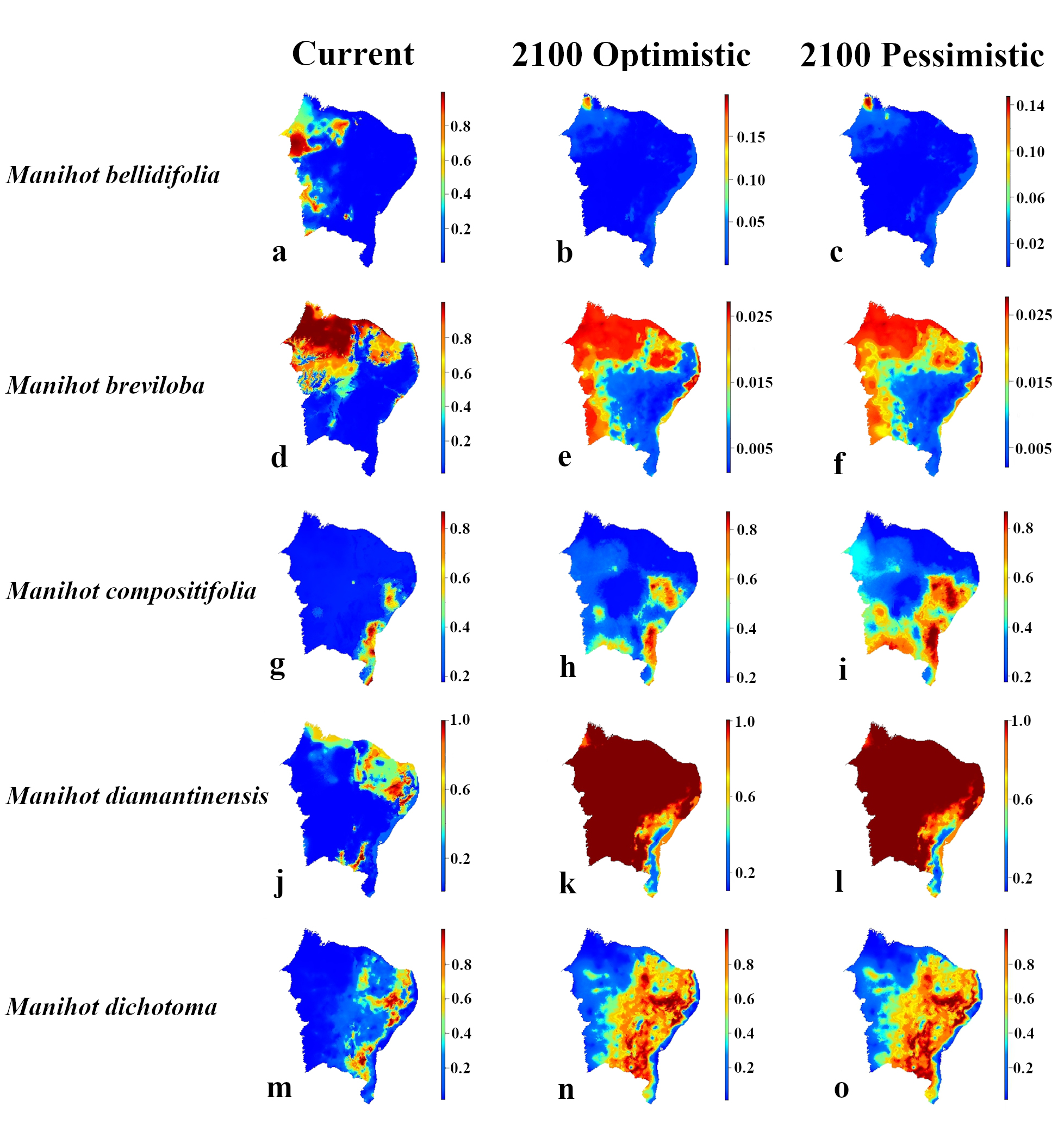
Most species showed a reduction or total loss in their potential distribution area projected for 2100. In the pessimistic scenario, 18% will experience a decrease in their climatically suitable area (e.g. M. longiracemosa, M. maracasensis) and 36% (e.g. M. bellidifolia, M. breviloba, M. reflexifolia, M. reniformis) will experience a total loss of their climatically suitable area (0 km²) (Table II). In the optimistic scenario, these percentages are 9% (e.g. M. maracasensis) and 36%, respectively. Although most species will suffer reductions in their climatically suitable area, some species (M. compositifolia, M. dichotoma, M. diamantinensis, M. jacobinensis, M. longiracemosa and M. quinquefolia) will gain new areas, especially in the south and southeast of Bahia in the future, 55% in the optimistic scenario and 46% in the pessimistic (Table II).
Area (km²) and percent of change in the geographic distribution of Manihot species between current and future (year 2100) scenarios (threshold ten percentile). SSP - Shared Socioeconomic Pathways (0 represent total loss of their climatically suitable area in the future scenarios).
Among the different species studied, M. maracasensis has the largest current suitability area, but this species is expected to suffer a decrease of 60% and 76% in the climatically suitable area by 2100 in the pessimistic and optimistic scenario, respectively (Fig. 2g-i). Manihot jacobinensis is the second species with largest climatically suitable area and M. diamantinensis has one of the smallest areas in the current scenario. Both are predicted to expand their distribution by 2100 in both climatic scenarios (Figs. 1j-l and 2a-c). Manihot bellidifolia, M. breviloba, M. reflexifolia, and M. reniformis, in turn, are expected to completely lose climatically suitable area in both climatic scenarios (Figs. 1 and 2).
Consensus models of potential distribution of Manihot bellidifolia (a-c), M. breviloba (d-f), M. compositifolia (g-i), M. diamantinensis (j-l), M. dichotoma (m-o) in the present and in the future (2100), under optimistic and pessimistic scenarios. Blue color represents regions with low climatic suitability and orange and red colors represent regions with high climatic suitability.

Consensus models of potential distribution of M. jacobinensis (a-c), M. longiracemosa (d-f), M. maracasensis (g-i), M. quinquefolia (j-l), M. reflexifolia (m-o), M. reniformis (p-r) in the present and in the future (2100), under optimistic and pessimistic scenarios. Blue color represents regions with low climatic suitability and orange and red colors represent regions with high climatic suitability.
The area with the highest predicted richness of endemic species of Manihot is located in the physiographic blocks of the Espinhaço Range, particularly in Chapada Diamantina (Fig. 3a). A second area with high predicted richness is located in the south portion of the state of Bahia, Brazil (Fig. 3a). We also detected that the richness of endemic species in Northeast Brazil will increase in the central and southern portions of Bahia in both climatic scenarios (Fig. 3b-c). Some protected areas in Northeast Brazil, specifically in Bahia, have high potential to harbor most endemic Manihot species in the future and are expected to be unaffected by climate change (Table III), as for example the Baía de Camamu Environmental Protection Area (EPA), Lagoa Encantada EPA, Marimbus/Iraquara EPA, Serra do Conduru State Park, Morro do Chapéu State Park, and Chapada Diamantina National Park. For some species such as M. bellidifolia, M. breviloba, M. maracasensis, M. reflexifolia, and M. reniformis, protected areas with high potential to encompass suitable areas for their occurrence will decrease or completely disappear (0 km²).

Richness patterns of species of Manihot reported as endemic to Northeast Brazil. The panel (a) shows the current potential distribution, (b) shows the future distribution in the optimistic scenario projected for 2100, and the panel (c) shows the future distribution in the pessimistic scenario projected for 2100. Gray and yellow colors represent regions with low species richness and orange and red colors represent regions with high species richness.
Area (km²) of climatic suitability for endemic species that is encompassed in protected areas in current and the future (year 2100) optimistic and pessimistic scenarios. SSP - Shared Socioeconomic Pathways (0 represent total loss of their climatically suitable area in the future scenarios).
DISCUSSION
The models showed that the potential geographic distribution of Manihot species endemic to Northeast Brazil may be slightly reduced by 2100 in response to climate change. About 45% (optimistic scenario) and 54% (pessimistic scenario) of the studied species will partially or totally lose climatically suitable areas (e.g. M. bellidifolia, M. breviloba, M. reflexifolia, M. reniformis). These species currently have a restricted distribution and inhabit fragmented landscapes, which will probably pose barriers to colonizing new climatically suitable areas in the future. They are restricted to areas associated with Rupestrian Grasslands in the state of Bahia (M. bellidifolia, M. reflexifolia, M. reniformis) and “Restinga” vegetation in the states of Sergipe and Alagoas (M. breviloba) (Suarez-Contento et al. 2024).
Rupestrian Grasslands are a megadiverse hotspot that provides essential ecosystem services, harboring more than 5,000 species of vascular plants and high levels of endemism (Fernandes et al. 2018). They are mostly associated with the Espinhaço Range, in the ecotone between Cerrado, Atlantic rainforest, and Caatinga (Fernandes et al. 2020) and consist of a mosaic of open vegetation types in mountains with ancient geological formation, with some “islands” isolated amidst a continuous matrix of lowland vegetation (De Bano et al. 1995, Mattos et al. 2019, Vasconcelos et al. 2020). This isolation facilitated allopatric speciation, which explains the high rates of endemism (40%). At the same time, the species may have been exposed to environmental filters (such as water availability, temperature or soil quality) that have favored the establishment of slow-growing species with specific strategies for resource acquisition and conservation, low fecundity, and limited dispersal (Messias et al. 2012, Negreiros et al. 2014, Fernandes 2016, Oliveira et al. 2016, Dayrell et al. 2018, Le Stradic et al. 2018, Fernandes et al. 2020).
However, despite hosting approximately 17% of the plant diversity of Brazil, a high number of endemic species and species with specific environmental requirements, Rupestrian Grasslands remain greatly underestimated and are currently threatened by deforestation, land use change, pollution, and introduction of invasive species (Fernandes et al. 2018, 2020). Furthermore, a loss of 90% of the extension of Rupestrian Grasslands is expected to occur by 2080 according to projections of the distribution of environmentally suitable areas for these vegetation complexes in a pessimistic scenario carried out by Barbosa & Fernandes (2016), with more pronounced loss in the north of Minas Gerais and the south of Bahia. These areas have already been targeted by public authorities (PAN-Brasil 2004) for presenting a high risk of desertification and increased temperatures.
In “Restinga”, there are also plants facing extreme environmental conditions (Scarano 2002, Marques et al. 2015). One of them is M. breviloba, a species considered extremely vulnerable to climate change and highly exposed to deforestation and biological invasion (Zamith & Scarano 2006, Inague et al. 2021). These threats may further contribute to the reduction or disappearance of this species in future climatic scenarios.
On the other hand, some species are expected to experience significant increases in their potential distribution area in both climatic scenarios. This may be related to the high environmental tolerance that some Manihot species have, which has been observed specially in cultivable species such as M. esculenta (Pushpalatha & Gangadharan 2020). These species are currently widely distributed in the Caatinga and are adapted to dry environments with high temperatures. Similar results have been found in other studies, with some plant species being positively affected by climate change and expanding their distribution. For example, in a study of the potential effects of climate change on the distribution of M. walkerae in Mexico using the CM3 and CMIP5 circulation models under the RCP 4.5 emission scenario for the year 2050, Garza et al. (2020) found that the distribution range of the species increased. Gülçin et al. (2021) found that the potential distribution areas of Carpinus betulus L. will expand in the north of the European continent due to climate change. In East Africa, the modeling of the potential distribution of three critically endangered endemic Aloe species under the impacts of climate change showed that one of these species, A. penduliflora, is expected to have an increased total area of suitable habitat between 2050 and 2070 (Mkala et al. 2022).
According to Pörtner et al. (2022), the temperature and concentrations of carbon dioxide (CO2) and ozone (O3) will continue to increase due to global warming by 2100. Precipitation patterns are also expected to change, with more frequent drought events predicted for regions that are currently arid (Pörtner et al. 2022). In Northeast Brazil, higher temperatures, consecutive dry days, and lower water availability are expected in the future (Marengo 2008, Da Silva 2019), which may explain future migrations of Manihot species to regions further south of Northeast Brazil observed in our projections. Environmental stresses caused by climate change have various effects on different plant organs and tissues. Responses can be generated at molecular, cellular, and morphological levels and can vary among tissues and throughout the developmental stages of the plants (Gray & Brady 2016). The ability to change developmental processes in response to the environment is key to plant success in these new habitats (Berg et al. 2010, Nicotra et al. 2010, Urban et al. 2013, Gray & Brady 2016). Temperature and precipitation directly affect the morphology and physiology of plants. For example, alterations in temperature modify the leaf size and permanence time, root length, reproductive development, and high temperatures may cause heat damage (Gray & Brady 2016). However, it is known that some species are not negatively influenced by higher temperatures; for example, the cultivable species M. esculenta can withstand high temperatures and high rainfall variability (Pushpalatha & Gangadharan 2020).
The Chapada Diamantina is an area between the ‘‘Cerrado’’ and ‘‘Caatinga’’ domains, which constitutes an ecological corridor that links the northern and southern portions of the Espinhaço Range and contains a highly diverse flora and several vegetation formations (Campos et al. 2016). The Chapada Diamantina encompasses current areas highly suitable for richness of Manihot species, which correspond to actual areas with high observed richness of endemic species (Suarez-Contento et al. 2024). In the future, these areas will move towards the south of Northeast Brazil, and Chapada Diamantina will continue to harbor the greatest richness of endemic species of Manihot. Current suitable areas were also observed in the northwest region of Northeast Brazil. However, the models may overpredict the distribution of the species because the environmental conditions of a predicted ecological niche could be represented in multiple areas throughout a geographic space (Urbina & Loyola 2008, Jetz et al. 2008), and yet this does not mean that the species can effectively colonize these areas in view of other factors, such as limited dispersal capacity or presence of biological barriers (Mendes et al. 2020, Velazco et al. 2020).
The ENMs showed that some protected areas have the potential to maintain climatically suitable conditions for some species in the future. For example, the Chapada Diamantina National Park has been recognized as a biodiversity hotspot with a high number of Manihot species, not only endemic ones (Duputié et al. 2011, Martins 2013, Simon et al. 2022). These high levels of endemism and diversity may be explained by the topographical and environmental conditions of this area that favor the establishment of these species. However, we found that five species (M. bellidifolia, M. breviloba, M. maracasensis, M. reflexifolia, and M. reniformis) currently have a restricted distribution and are at risk of having their suitable habitats further shrunk in both optimistic and pessimistic scenarios, and should thus benefit from the creation of more conservation areas.
Although climate change does not seem to pose an imminent threat to the other species of Manihot analyzed here, dramatic decreases in their distribution mays still be triggered by other factors such as deforestation, fragmentation, urban expansion, and the introduction of invasive species (Thomas et al. 2004, Oliver & Morecroft 2014). The present study provides valuable information on the future distribution of Manihot species endemic to Northeast Brazil that can be used as a basis for the development of public policies aimed at the conservation of these species and phytogeographic domains, especially those that are seriously threatened.
SUPPLEMENTARY MATERIAL
ACKNOWLEDGMENTS
The authors thank the Conselho Nacional de Desenvolvimento Científico e Tecnológico (CNPq) for the granting of a scholarship to KYS-C and Facepe (APQ-0995-2.03/21) and Universal CNPq (405265/2021-2) for supporting the project “Diversidade de Euphorbiaceae e Phyllanthaceae em Pernambuco: Taxonomia, Distribuição e Conservação”. GA-F and CBT were supported by a doctoral fellowship funded by the Coordenação de Aperfeiçoamento de Pessoal de Nível Superior (CAPES) during the preparation of this study (001).
REFERENCES
- AIELLO LM, BORIA RA, RADOSAVLJEVIC A, VILELA B & ANDERSON RP. 2015. spThin: an R package for spatial thinning of species occurrence records for use in ecological niche models. Ecography 38: 541-545.
- ALVES-FERREIRA G, TALORA DC, SOLÉ M, CERVANTES LM & HEMING NM. 2022. Unraveling global impacts of climate change on amphibians’ distributions: A life-history and biogeographic-based approach. Front Ecol Evol 10: 987237.
- ANDERSON RP & RAZA A. 2010. The effect of the extent of the study region on GIS models of species geographic distributions and estimates of niche evolution: preliminary tests with montane rodents (genus Nephelomys) in Venezuela. J Biogeogr 37: 1378-1393.
- ARAÚJO MB, ALAGADOR D, CABEZA M, NOGUÉS-BRAVO D & THUILLER W. 2011. Climate change threatens European conservation areas. Ecol Lett 14: 484-492.
- ARAUJO MB & GUISAN A. 2006. Five (or so) challenges for species distribution modelling. J Biogeogr 33(10): 1677-1688.
- BARBET-MASSIN M, ROME Q, VILLEMANT C & COURCHAMP F. 2018. Can species distribution models really predict the expansion of invasive species?. PLoS ONE 13: 3: e0193085.
- BARBOSA NP & FERNANDES GW. 2016. Rupestrian Grassland: Past, Present and Future Distribution. In: Fernandes G (Ed). Ecology and Conservation of Mountaintop grasslands in Brazil. Springer, 531-544.
- BARVE N, BARVE V, JIMÉNEZ-VALVERDE A, LIRA-NORIEGA A, MAHER SP, PETERSON AT, SOBERÓN J & VILLALOBOS F. 2011. The crucial role of the accessible area in ecological niche modeling and species distribution modeling. Ecol Modell 222: 1810-1819.
- BERG MP, KIERS ET, DRIESSEN G, VAN-DER HM, KOOI BW, KUENEN F, LIEFTING M, VERHOEF H & ELLERS J. 2010. Adapt or disperse: understanding species persistence in a changing world. Glob Chang Biol 16(2): 587-598.
- BORIA RA, OLSON LE, GOODMAN SM & ANDERSON RP. 2014. Spatial filtering to reduce sampling bias can improve the performance of ecological niche models. Ecol Modell 275: 73-77.
- CAMPOS L, GUEDES MLS, ACEVEDO-RODRIGUES P & ROQUE N. 2016. Contributions to the floristic and vegetation knowledge of Espinhaço Septentrional, Bahia, Brazil. Revista Brasil Bot 40: 427-437.
- COETZEE BW, ROBERTSON MP, ERASMUS BF, VAN-RENSBURG BJ & THUILLER W. 2009. Ensemble models predict important bird areas in southern Africa will become less effective for conserving endemic birds under climate change. Glob Ecol Biogeo 1518: 701-710.
- DA SILVA PE, SANTOS E, SILVA CM, SPYRIDES MH & ANDRADE LD. 2019. Precipitation and air temperature extremes in the Amazon and northeast Brazil. International J Clim 39(2): 579-595.
- D’ ARRIGO RCP, LORINI ML & RAJÃO H. 2020. A seleção de áreas para conservação na Mata Atlântica Brasileira: Revisão dos estudos voltados para priorização espacial. BioBrasil 2: 36-49.
- DAYRELL RL, ARRUD AJ, PIERCE S, NEGREIROS D, MEYER PB, LAMBERS H & SILVEIRA FAO. 2018. Ontogenetic shifts in plant ecological strategies. Funct Ecol 32: 2730-2741.
- DE BANO LF, FOLLIOTT PF, ORTEGA-RUBIO A, GOTTFRIED GJ, HAMRE RH & EDMINSTER CB. 1995. Biodiversity and Management of the Madrean Archipelago: The Sky Islands of Southwestern United States and Northwestern Mexico. Tucson, Arizona. Vol. GTR. The Station, 1995.
- DE LIMA VV, SCARIOT A & SEVILHA AC. 2020. Predicting the distribution of Syagrus coronata palm: Challenges for the conservation of an important resource in Northeastern Brazil. Flora 269: 2-11.
- DE OLIVEIRA MJ, CARNEIRO CD, DA SILVA VF & DE MELLO BG. 2017. Ciclos climáticos e causas naturais das mudanças do clima. Terrae didat 13: 149-184.
- DUPUTIÉ A, DAVID P, DEBAIN C & MCKEY D. 2007. Natural hybridization between a clonally propagated crop, cassava (Manihot esculenta Crantz) and a wild relative in French Guiana. Mol Ecol 16(1): 3025-3038.
- DUPUTIÉ A, SALICK J & MCKEY D. 2011. Evolutionary biogeography of Manihot (Euphorbiaceae), a rapidly radiating Neotropical genus restricted to dry environments. J Biogeogr 1: 1-11.
- FARIAS RS, PEREIRA SMP, MACIEL-SILVA AS & PÔRTO KC. 2017. Influence of environmental factors on the distribution of Calymperesand Syrrhopodon (Calymperaceae, Bryophyta) in the Atlantic Forest of Northeastern Brazil. Flora 234: 158-164.
- FERNANDES GW. 2016. Ecology and conservation of mountaintop grasslands in Brazil. Switzerland. Springer International Publishing, p. 3-14.
- FERNANDES GW, ARANTES-GARCIA L, BARBOSA M, BARBOSA NP, BATISTA EK, BEIROZ W & SILVEIRA FA. 2020. Biodiversity and ecosystem services in the Campo Rupestre: A road map for the sustainability of the hottest Brazilian biodiversity hotspot. Perspect Ecol Conserv 18(4): 213-222.
- FERNANDES GW, BARBOSA NPU, ALBERTON B, BARBIERI A, DIRZO R, GOULART F, GUERRA TJ, MORELLATO LPC & SOLAR R. 2018. The deadly route to collapse and the uncertain fate of the rupestrian grasslands. Biodivers Conserv 27: 2587-2603.
- FERREIRA RB, PARREIRA MR, DE ARRUDA FV, FALCÃO MJ, DE FREITAS MV & NABOUT JC. 2022. Combining ecological niche models with experimental seed germination to estimate the effect of climate change on the distribution of endangered plant species in the Brazilian Cerrado. Environ Monit Assess 194(4): 1-15.
- FICK SE & HIJMANS RJ. 2017. WorldClim 2: new 1-km spatial resolution climate surfaces for global land areas. Int J Climatol 37: 4302-4315.
-
FLORA E FUNGA DO BRASIL. 2020. Jardim Botânico do Rio de Janeiro. Manihot in Flora do Brasil 2020. https://floradobrasil2020.jbrj.gov br/FB130728. 10 Jan. 2023.
» https://floradobrasil2020.jbrj.gov - GARZA G, RIVERA A, VENEGAS BCS, MARTINEZ-ÁVALOS JG, DALE J & FERIA ATP. 2020. Potential effects of climate change on the geographic distribution of the endangered plant species Manihot walkerae. Forests 11(6): 689.
- GHINI R, HAMADA E & BETTIOL W. 2008. Climate change and plant diseases. Sci Agric 65: 98-107.
- GRAY SB & BRADY SM. 2016. Plant developmental responses to climate change. Dev Biol 419(1): 64-77.
- GUISAN A & ZIMMERMANN NE. 2000. Predictive habitat distribution models in ecology. Ecol Modell 135(2-3): 147-186.
- GÜLÇIN D, ARSLAN E S, ÖRÜCÜ & ÖME K. 2021. Effects of climate change on the ecological niche of common hornbeam (Carpinus betulus L.). Ecol Inform 66: 101478.
- HEMING NM, DAMBROS C & GUTIÉRREZ EE. 2019. ENMwizard: Advanced Techniques for Ecological Niche Modeling Made Easy.
- HERSHEY C. 2008. A global conservation strategy for cassava (Manihot esculenta) and wild Manihot species. Summary of stakeholder deliberations and recommendations prepared for the Global Crop Diversity Trust.
- HIJMANS RJ. 2012. Cross-validation of species distribution models: removing spatial sorting bias and calibration with a null model. Ecology 93: 679-688.
- INAGUE GM, ZWIENER VP & MARQUES MC. 2021. Climate change threatens the woody plant taxonomic and functional diversities of the Restinga vegetation in Brazil. Perspect Ecol Conserv 19(1): 53-60.
- IŞIK K. 2011. Rare and endemic species: why are they prone to extinction?. Turk J Bot 35(4): 411-417.
- JETZ W, SEKERCIOGLU CH & WATSON JEM. 2008. Ecological Correlates and Conservation Implications of Overestimating Species Geographic Ranges. Conserv Biol 22: 110-119.
- JINGA P & ASHLEY MV. 2019. Climate change threatens some miombo tree species of sub-Saharan Africa. Flora 257: 151421.
- JUMP AS & PEÑUELAS J. 2005. Running to stand still: adaptation and the response of plants to rapid climate change. Ecol Lett 8(9): 1010-1020.
- KARKI A & GC S. 2020. Impact of Climate Change on Plant Diseases. J Plant Prot Res 6: 1-16.
- LE STRADIC S, BUISSON E, FERNANDES GW & MORELLATO LPC. 2018. Reproductive phenology of two contrasting neotropical mountain grasslands. Appl Veg Sci 29: 15-24.
- LOISELLE BA, HOWELL CA, GRAHAM CH, GOERCK JM, BROOKS T, SMITH KG & WILLIAMS PH. 2003. Avoiding pitfalls of using species distribution models in conservation planning. Conserv Biol 17(6): 1591-1600.
- MARENGO JA. 2008. Vulnerabilidade, impactos e adaptação à mudança do clima no semi-árido do Brasil. Parcerias estratégicas. Brasília, DF 27: 149-175.
- MARQUES MC, SILVA SM, LIEBSCH D. 2015. Coastal plain forests in southern and southeastern Brazil: ecological drivers, floristic patterns and conservation status. Rev Bras Bot 38: 1-18.
- MARTINS ML. 2013. Avanços Taxonômicos em Manihot Mill. (Euphorbiaceae) do Brasil. PhD Thesis, Universidade Estadual de Feira de Santana, Feira de Santana
- MARTINS ML, CARVALHO PL, LEDO CD & AMORIM AM. 2017. Manihot macrocarpa (Euphorbiaceae), an unusual rain forest species from Brazil. Phytotaxa 309: 179-183.
- MARTINS ML, DE CARVALHO PCL, DA SILVA LEDO CA & AMORIM AM. 2014. What’s new in Manihot (Euphorbiaceae)? Syst Bot 39: 485-489.
- MATTOS JS, CAMARGO MGG, MORELLATO LPC & BATALHA MA. 2019. Plant phylogenetic diversity of tropical mountaintop rocky grasslands: local and regional constraints. Plant Ecol 220: 1119-1129.
- MENDES P, VELAZCO SJE, DE ANDRADE AFA & JÚNIOR PDM. 2020. Dealing with overprediction in species distribution models: How adding distance constraints can improve model accuracy. Ecol Modell 431: 109180.
- MESSIAS MCT, LEITE MG, MEIRA-NETO JA & KOZOVITS AR. 2012. Fitossociologia de campos rupestres quartzíticos e ferruginosos no Quadrilátero Ferrífero, Minas Gerais. Acta Bot Bras 26: 230-242.
- MKALA EM ET AL. 2022. Modeling impacts of climate change on the potential distribution of three endemic Aloe species critically endangered in East Africa. Ecol Inform 71: 101765.
- MOTA FM, HEMING NM, MORANTE-FILHO JC & TALORA DC. 2022. Climate change is expected to restructure forest frugivorous bird communities in a biodiversity hot-point within the Atlantic Forest. Divers Distrib 28(12): 2886-2897.
- MÜLLER ARGOVIENSIS. 1866. Euphorbiaceae (excl. Euphorbieae). p. 189-1286. In: ALPP de Candolle (Ed). Prodromus systematis naturalis regni vegetabilis 15(2). Treuttel et Würtz, Paris.
- MUSCARELLA R, GALANTE PJ, SOLEY-GUARDIA M, BORIA RA, KASS JM, URIARTE M & ANDERSON RP. 2014. ENMeval: an R package for conducting spatially independent evaluations and estimating optimal model complexity for Maxent ecological niche models. Methods Ecol Evol 5: 1198-1205.
- NEGREIROS D, LE STRADIC S, FERNANDES GW & RENNÓ HC. 2014. CSR analysis of plant functional types in highly diverse tropical grasslands of harsh environments. Plant Ecol 215: 379-388.
- NICOTRA AB, ATKIN OK, BONSER SP, DAVIDSON AM, FINNEGAN EJ, MATHESIUS U, POOT P, PURUGGANAN MD, RICHARDS CL, VALLADARES F & VAN-KLEUNEN M. 2010. Plant phenotypic plasticity in a changing climate. Trends Plant Sci 15(12): 684-692.
- OLIVEIRA RS, ABRAHÃO A, PEREIRA C, TEODORO GS, BRUM M, ALCANTARA S & LAMBERS H. 2016. Ecophysiology of campos rupestre’s plants. In: Fernandes GW (Ed), Ecology and Conservation of Mountaintop Grasslands in Brazil. Springer, Switzerland, p. 227-272.
- OLIVER TH & MORECROFT MD. 2014. Interactions between climate change and land use change on biodiversity: attribution problems, risks, and opportunities. Wiley Interdiscip Rev Clim Change 5: 317-335.
- PAN-BRASIL. 2004. Programa de ação nacional de combate à desertificação e mitigação dos efeitos da seca. PAN-Brasil. Brasília: Ministério do Meio Ambiente.
- PARMESAN C & YOHE G. 2003. A globally coherent fingerprint of climate change impacts across natural systems. Nature 421(6918): 37-42.
- PHILLIPS SJ, ANDERSON RP, DUDÍK M, SCHAPIRE RE & BLAIR ME. 2017. Opening the black box: an open-source release of Maxent. Ecography 40: 887-893.
- PHILLIPS SJ, ANDERSON RP & SCHAPIRE RE. 2006. Maximum entropy modeling of species geographic distributions. Ecol Modell 190: 231-259.
- PULLIAM HR. 2000. On the relationship between niche and distribution. Ecol Lett 3: 349-361.
- PUSHPALATHA R & GANGADHARAN B. 2020. Is cassava (Manihot esculenta Crantz) a climate “smart” crop? A review in the context of bridging future food demand gap. Trop Plant Biol 13: 201-211.
- PÖRTNER HO ET AL. 2022. Climate change 2022: Impacts, adaptation and vulnerability. Geneva, Switzerland: IPCC.
-
QGIS. 2022. Quantum GIS Geographic Information System. Open Source Geospatial, Foundation Project. http://qgis.osgeo.org/ (accessed: 10 August 2022).
» http://qgis.osgeo.org/ - QIN A, LIU B, GUO Q, BUSSMANN RW, MA F, JIAN Z & PEI S. 2017. Maxent modeling for predicting impacts of climate change on the potential distribution of Thuja sutchuenensis Franch., an extremely endangered conifer from southwestern China. GECCO 10: 139-146.
- RAVENSCROFT CH, WHITLOCK R & FRIDLEY JD. 2015. Rapid genetic divergence in response to 15 years of simulated climate change. Glob Chang Biol 21(11): 4165-4176.
- ROCHA LF, DO CARMO IEP, PÓVOA JSR & DE CARVALHO D. 2020. Effects of climate changes on distribution of Eremanthus erythropappus and E. incanus (Asteraceae) in Brazil. J For Res 31: 353-364.
- ROGERS DJ & APPAN SG. 1973. Manihot, Manihotoides (Euphorbiaceae). Fl Neotrop Monogr 13: 272.
-
RSTUDIO TEAM. 2022. RStudio: Integrated Development Environment for R. RStudio, PBC, Boston, MA. http://www.rstudio.com/ (accessed 10 July 2022).
» http://www.rstudio.com/ - SANCHEZ AC, OSBORNE PE & HAQ N. 2010. Identifying the global potential for baobab tree cultivation using ecological niche modelling. Agrofor Syst 80: 191-201.
- SCARANO FR. 2002. Structure, function, and floristic relationships of plant communities in stressful habitats marginal to the Brazilian Atlantic rainforest. Ann Bot 90(4): 517-524.
- SHCHEGLOVITOVA M & ANDERSON RP. 2013. Estimating optimal com plexity for ecological niche models: A jackknife approach for species with small sample sizes. Ecol Modell 269: 9-17.
- SILVA JLS, CRUZ-NETO O, PERES CA, TABARELLI M & LOPES AV. 2019. Climate change will reduce suitable Caatinga dry forest habitat for endemic plants with disproportionate impacts on specialized reproductive strategies. PLoS ONE 14(5): e0217028.
- SIMÕES SDS, ZAPPI D, COSTA GM, DE OLIVEIRA G & AONA LY. 2019. Spatial niche modelling of five endemic cacti from the Brazilian Caatinga: Past, present and future. Austral Ecol 45(1): 35-47.
- SIMON MF ET AL. 2022. Phylogenomic analysis points to a South American origin of Manihot and illuminates the primary gene pool of cassava. New Phytol 233(1): 534-545.
- SIQUEIRA M & DURIGAN G. 2007. Modelagem da distribuição geográfica de espécies lenhosas de cerrado no Estado de São Paulo. Rev Bras Bot 30(2): 233-243.
- SOSA V, LOERA I, ANGULO DF, VÁSQUEZ-CRUZ M & GÁNDARA E. 2019. Climate change and conservation in a warm North American desert: Effect in shrubby plants. PeerJ 7: e6572.
- SUAREZ-CONTENTO KY, MARTINS MLL & ATHIÊ-SOUZA SM. 2024. A look at endemic Manihot species for northeastern Brazil: taxonomy, richness, distribution and conservation. Acta Bot Bras 38: e20230097.
- TAYLOR C, CADENHEAD N, LINDENMAYER DB & WINTLE BA. 2017. Improving the design of a conservation reserve for a critically endangered species. PLoS ONE 12(1): e0169629.
- TELES CB, MAGNAGO LFS, CARILO-FILHO LM & PIOTTO D. 2022. Relationship between the richness of tree species and edaphoclimatic characteristics of the south region of Bahia, Brazil. Austral Ecol 47(7): 1448-1455.
-
THIERS BM. 2024. Index Herbariorum (continuously updated). Available online: https://sweetgum.nybg.org/science/ih/ (accessed on 4 December 2023).
» https://sweetgum.nybg.org/science/ih/ - THOMAS CD ET AL. 2004. Extinction risk from climate change. Nature 427: 145-148.
-
UNEP-WCMC AND IUCN. 2023. Protected Planet: The World Database on Protected Areas (WDPA) [Online], January 2023, Cambridge, UK: UNEP-WCMC and IUCN. www.protectedplanet.net. (accessed 15 January 2023).
» https://www.protectedplanet.net - URBAN MC, ZARNETSKE PL & SKELLY DK. 2013. Moving forward: dispersal and species interactions determine biotic responses to climate change. Ann NY Acad Sci 1297: 44-60.
- URBINA CJ & LOYOLA RD. 2008. Applying niche-based models to predict endangered-hylid potential distributions: are neotropical protected areas effective enough?. Trop Conserv Sci 1(4): 417-445.
- VASCONCELOS TN, ALCANTARA S, ANDRINO CO, FOREST F, REGINATO M, SIMON MF & PIRANI JR. 2020. Fast diversification through a mosaic of evolutionary histories characterizes the endemic flora of ancient Neotropical mountains. Proc R Soc B 287: 1-10.
- VELAZCO SJE, RIBEIRO BR, LAURETO LM & JÚNIOR PD. 2020. Overprediction of species distribution models in conservation planning: A still neglected issue with strong effects. Biol Conserv 252: 108822.
- VELOZ SD. 2009. Spatially autocorrelated sampling falsely inflates measures of accuracy for presence-only niche models. J Biogeogr 36: 2290-2299.
- WALTHER GR. 2003. Plants in a warmer world. Perspect. Plant Ecol Evol Syst 6(3): 169-185.
- WALTHER GR, POST E, CONVEY P, MENZEL A, PARMESAN C, BEEBEE TJ & BAIRLEIN F. 2002. Ecological responses to recent climate change. Nature 416(6879): 389-395.
- ZAMITH LR & SCARANO FR. 2006. Restoration of a restinga sandy coastal plain in Brazil: survival and growth of planted woody species. Restor Ecol 14(1): 87-94.
- ZUBER SM & VILLAMIL MB. 2016. Meta-analysis approach to assess effect of tillage on microbial biomass and enzyme activities. Soil Biol Biochem 97: 176-187.