 Three new records of Hudson’s Humming Frog, Chiasmocleis hudsoni (Microhylidae; Anura) (records, to eastern Amazonia)
Abstract
We present three new records of C. hudsoni, a secretive and small-sized Amazonian species of frog, from the municipalities of Barcarena, Santa Bárbara, and Primavera, all in the state of Pará, Brazil. These records extend the known species distribution in 520 km account to the first geographical records from the Belém Area of Endemism (BAE), the most threatened region of the Amazon basin. The records have relevant implications for several aspects of the biology of Chiasmocleis, especially biogeography, taxonomy, and conservation.
Key words
Belém area of endemism; New occurrences; Fossorial; Microhylidae
INTRODUCTION
The Neotropical region is the most biodiverse on the planet, harboring one-third of the global species (Raven et al. 2020). The Amazon is the main repository for such diversity, particularly in relation to amphibians (Antonelli et al. 2018). However, scientific knowledge of Amazonian amphibians is still very limited (Peloso 2010), especially for smaller and secretive species, such as those in the family Microhylidae Günther, 1858 (Stuttgart & Salas 1991, Lima et al. 2012). Microhylidae is one of the most diverse frog families worldwide and has approximately 60 documented species in the Brazilian Amazon (Segalla et al. 2021, Frost 2025). Many genera that compose this family, Chiasmocleis Méhely, 1904 stands out as the most species-rich genus, with 36 species. In addition, it is also the genus with the most recently named species, showcasing considerable morphological, acoustic and genetic variations (Peloso & Sturaro 2008, Santana et al. 2009, Peloso et al. 2014, Morales & Mcdiarmid 2016, de Sá et al. 2019). Nevertheless, many species in the genus remain understudied. Peloso et al. (2014) and de Sá et al. (2019) provided thorough revisions of the systematics of Chiasmocleis based on a combination of genetic and phenotypic characters. The first focused on Amazonian species and provided a revised taxonomy and distributional data for all species occurring in the Amazon. The latter focused on the genus as a whole and provided important insights into the group’s taxonomy. Despite these two monumental efforts to study Chiasmocleis biology, large gaps remain to be filled, especially regarding distribution and behavior for most species. Here, we present three new records of Chiasmocleis hudsoni Parker, 1940 for Amazonia, based on recently collected specimens. All records are from the Belém Area of Endemism (hereafter BAE) (Figure 2), in the eastern most portion of the Amazonia. BAE, located in the Tocantins–Pindaré rivers interfluve is the smallest, most deforested, and most severely fragmented of the recognized Amazonian areas of endemism (da Silva et al. 2005, Castro et al. 2020). Consequently, the region harbors several vertebrate species endangered with extinction, including amphibians.

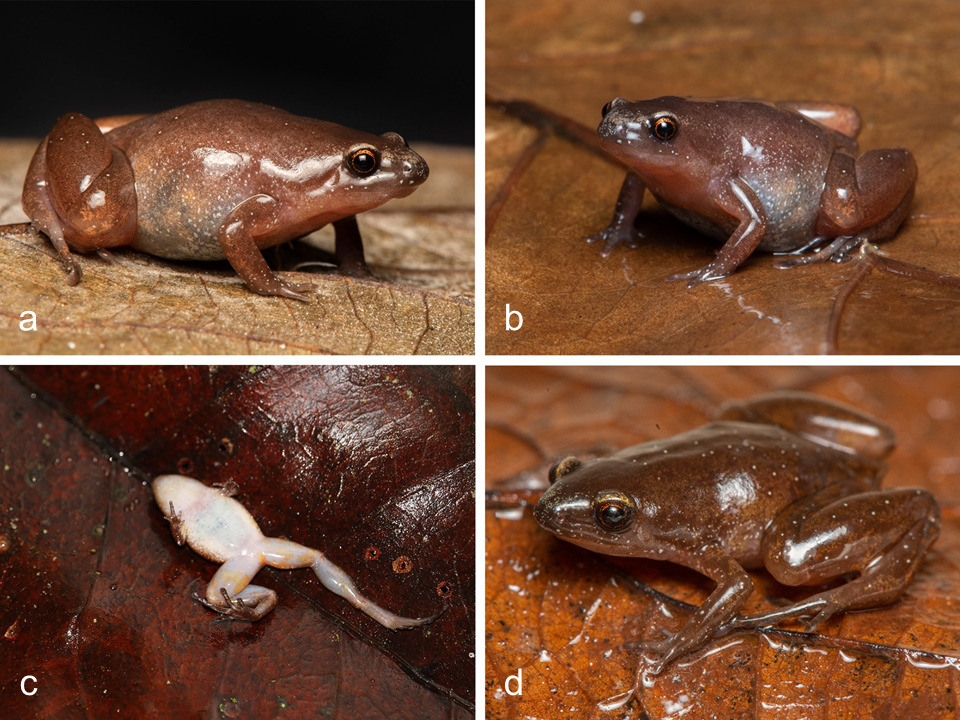
a, b) Lateral views of a female specimen (MPEG 43505) from Parque Ecológico do Gunma, Santa Bárbara do Pará. c) Ventral and d) lateral views of a male specimen (MPEG 43506) from Barcarena.

Known distribution of C. hudsoni based on literature records (red dots) and our tree new occurrence sites (Purple dots) at BAE (Yellow stain).
The three distributional records presented herein are based on four specimens, of which three were collected by us and another was found in the herpetology collection Oswaldo Rodrigues da Cunha, deposited at Museu Paraense Emílio Goeldi, Belém, Pará, Brazil (MPEG). Collected specimens during this study (permit number 72325-2 issued by Sistema de Autorização e Informação em Biodiversidade - SISBIO) were deposited at MPEG and Museu de Zoologia, Universidade Federal do Pará, Pará, Brazil (MUZUFPA). Parque Ecológico do Gunma (PEG), municipality of Santa Bárbara do Pará, Pará, Brazil. PEG is a 400 hectare protected area composed by ‘terra firme’, secondary and ‘várzea’ forest mosaic located in the Santa Bárbara municipality, of the Belém metropolitan area, Pará, Brazil (Figure 2). Two specimens were collected at this locality (lat: -1.20277778; log: -48.29555556), both crossing roads that border the limits of PEG. The first one, an adult gravid female (MZUFPA 986), was spotted on December 15, 2020. The second specimen (MPEG 43505, (Figures 1a and 1b)), also an adult gravid female, was collected at night on March 8, 2021, crossing the same dirt road (close to where the other specimen was found) after a day of very heavy rains. Municipality of Barcarena, Pará, Brazil: On April 17 and October 3, 2021, we found an adult male specimen (MPEG 43506, Figures 1c and 1d) crawling under the leaflitter on argillaceous terrain on the edge of a temporary pond. This specimen was found at a (‘terra firme’ forest fragment), protected by a mining company, near a vicinal highway, located between roads PA483 and PA403 (lat: -1.61194444; log: -48.73166667). Municipality of Primavera, Pará, Brazil. After an exhaustive search for additional specimens of C. hudsoni from the BAE in the MPEG collection, we found a single specimen under (MPEG 41068) from Primavera, a small town near the Pará and Maranhão state borders (Figure 2). No ecological data was retrieved from the MPEG records.
The taxonomy of the C. hudsoni/jimi complex is unsettled. Based on an integrative analysis of genetic data, morphology, and advertisement calls Peloso et al. (2014) suggested that C. jimi is indistinguishable from C. hudsoni and proposed that both species should be treated as synonyms. On the other hand, de Sá et al. (2019) considered, that both species represent distinct evolutionary lineages based on species delimitation analyses of genetic data. However, de Sá et al. (2019) did not provide any phenotypic data that could be used to diagnose these two taxa. Peloso et al. (2014) had already clearly stated that the two could not be diagnosed based on their original descriptions. Moreover, de Sá et al. (2019) did not include genetic samples from the type locality of either species. Considering that; (1) the lineages identified as C. hudsoni and C. jimi overlap geographically, (2) there are no diagnostic characters able to separate the two taxa, and (3) no genetic samples of the type-locality of C. jimi were used in either study; we followed the original suggestion of Peloso et al. (2014) that treats these two taxa as synonyms. Chiasmocleis hudsoni was previously recorded from multiple localities in Brazil (Caramaschi & Cruz 2001, Rodrigues et al. 2008, Avila-Pires et al. 2010, Ribeiro-Júnior et al. 2011, Bernardo et al. 2012, Lima et al. 2012, Bernarde et al. 2013, Prudente et al. 2013, Waldez et al. 2013, Vaz-Silva et al. 2015, Ferreira et al. 2017, Menin et al. 2017, Costa-Campos et al. 2019), Colombia (Peloso et al. 2014), Cooperative Republic of Guyana (de Sá et al. 2012, Cole et al. 2013, Peloso et al. 2014), French Guiana (Lescure & Marty 2000), Surinam (Ouboter & Jairam 2012) and Venezuela (Barrio-Amorós & Schargel 2003, Barrio-Amorós 2004, Barrio-Amorós et al. 2019). In Brazil, the known eastern limit of the specie’s distribution was the Tocantins River, in the Eastern Amazonia. These new occurrences extend the C. hudsoni, distribution area approximately 520 km eastern from closest known published locality in this region Floresta Nacional de Caxiuanã (Ribeiro-Júnior et al. 2011). Furthermore, it is the first record of this species in localities east of the Tocantins River, into BAE. BAE is the most highly threatened region of the Amazon, as it’s highly fragmented and deforested, with only 30% of it’s original vegetation remaining (da Silva et al. 2005). Most of our records occurred within lightly protected areas—both areas are currently protected by private owners or parks. It is important that further searches for this species are conducted within more strictly protected areas, such as those protected by the state of Pará alongside BAE. The record is also of great relevance for a better understanding of biogeographic and evolutionary relations of modern Amazonian biota, such as part of BAE was a climate refugium due to past glacial cycles (de Moraes et al. 2020). This new occurrence can also interfere with Chiasmocleis genus biogeography framework, as proposed by de Sá et al. (2019), as historical biogeographic inferences can be affected by new modern occurrence data. We also hope this work can serve as a step to future research on BAE species occurrence.
Acknowledgements
We thank Conselho Nacional de Desenvolvimento Científico e Tecnológico (CNPq) for support (post graduate fellowship and research fellowships Members of research team was also supported by an award from the Maxwell/Hanrahan Foundation). We thank the curators and staff at MPEG and UFPA herpetological collections for access to specimens under their care and Jesse Daniel Carlton for English review.
References
- ANTONELLI A, ZIZKA A, ANTUNES F & SCHARN R. 2018. Amazonia is the primary source of Neotropical biodiversity. Proc Natl Acad Sci 115: 6034-6039.
- AVILA-PIRES TCS, ROCHA WA DA & STEVEN HM. 2010. Notes on the Vertebrates of northern Pará, Brazil: a forgotten part of the Guianan Region, I. Herpetofauna. Bol Mus Para Emílio Goeldi sér Ciencias Naturais 5: 13-112.
- BARRIO-AMORÓS CL. 2004. Amphibians of Venezuela: Systematic list, distribution and references; an update. Rev Ecol Latino Am 9: 1-48.
- BARRIO-AMORÓS CL, ROJAS-RUNJAIC FJM & SEÑARIS C. 2019. Catalogue of the amphibians of Venezuela: Illustrated and annotated species list, distribution, and conservation. Amphib Reptile Conserv 13: 1-198.
- BARRIO-AMORÓS CL & SCHARGEL WE. 2003. Chiasmocleis hudsoni (NCN). Herpetol Rev 34: 380.
- BERNARDE PS, DE ALBUQUERQUE S, DE MIRANDA DB & TURCI LCB. 2013. Herpetofauna da floresta do baixo rio Moa em Cruzeiro do Sul, Acre - Brasil. Biota Neotrop 13: 220-244.
- BERNARDO PH, MATIAZZI W & GUERRA-FUENTES RA. 2012. Distribution extension and distribution map of Chiasmocleis jimi Caramaschi and Cruz, 2001 (Amphibia: Anura: Microhylidae) and Proceratophrys concavitympanum Giaretta, Bernarde and Kokubum, 2000 (Amphibia: Anura: Cycloramphidae). Check List 8: 152-154.
- CARAMASCHI U & CRUZ CAG. 2001. A New Species of Chiasmocleis Méhelÿ, 1904 From Brazilian Amazonia (Amphibia, Anura, Microhylidae). Bol Mus Nac Nova Sér Zool 469: 1-8.
-
CASTRO RB, PEREIRA JLG, ZANIN M & ALBERNAZ ALKM. 2020. Connectivity, spatial structure and the identification of priority areas for conservation of Belém area of endemism, Amazon. An Acad Bras Cienc 92: e20181357. DOI 10.1590/0001-3765202020181357.
» https://doi.org/10.1590/0001-3765202020181357 - COLE CJ, TOWNSEND CR, REYNOLDS RP, ROSS D, LATHROP A & MACCULLOCH RD. 2013. Amphibians and reptiles of Guyana, South America: illustrated keys, annotated species accounts, and a biogeographic synopsis annotated species account, and a biogeographic synopsis. Proc Biol Soc Wash 125: 317-578.
- COSTA-CAMPOS CE, SOUSA JC & MENIN M. 2019. Chiasmocleis hudsoni parker, 1940 (Anura, microhylidae): A new record for Amapá state, Brazil. Herpetol Notes 12: 405-408.
- DA SILVA JMC, RYLANDS AB & DA FONSECA GAB. 2005. THE Fate of the Amazonian Areas of Endemism. Conserv Biol 19: 689-694.
- DE MORAES KF, SANTOS MPD, GONÇALVES GSR, DE OLIVEIRA GL, GOMES LB & LIMA MGM. 2020. Climate change and bird extinctions in the Amazon. PLoS ONE 15: e0236103.
- DE SÁ RO, STREICHER JW, SEKONYELA R, FORLANI MC, LOADER SP, GREENBAUM E & HADDAD CF. 2012. Molecular phylogeny of microhylid frogs (Anura: Microhylidae) with emphasis on relationships among New World genera. BMC Evol Biol 12: 2-41.
- DE SÁ RO, TONINI JFR, VAN HUSS H, LONG A, CUDDY T, FORLANI MC & HADDAD CF. 2019. Multiple connections between Amazonia and Atlantic Forest shaped the phylogenetic and morphological diversity of Chiasmocleis Mehely, 1904 (Anura: Microhylidae: Gastrophryninae). Mol Phylogenet Evol 130: 198-210.
- FERREIRA GC, STURARO MJ & PELOSO PLV. 2017. Amphibians and reptiles from Floresta Nacional de Pau-Rosa, Amazonas, Brazil: an important protected area at the heart of Amazonia. Acta Amaz 47: 259-268.
-
FROST DR. 2025. Amphibian Species of the World: an Online Reference. Version 6.0. American Museum of Natural History, New York, USA. Electronic Database accessible at: http://research.amnh.org/vz/herpetology/amphibia/index.php Accessed on October 25, 2025.
» http://research.amnh.org/vz/herpetology/amphibia/index.php - LESCURE J & MARTY C. 2000. Atlas des Amphibiens de Guyane. 45th ed., Muséum national d’Histoire naturelle (Patrimoníes naturels), Paris, 388 p.
- LIMA AP, MAGNUSSON WE, MENIN M, ERDTMANN LK, RODRIGUES DJ, KELLER C & HÖDL W. 2012. Guia de Sapos da Reserva Adolpho Ducke - Amazônia Central. Áttema Design Editorial, Manaus, 168 p.
- MENIN M, CARVALHO VT DE, ALMEIDA AP, GORDO M, OLIVEIRA P, LUIZ LF & HRBEK T. 2017. Amphibians from Santa Isabel do Rio Negro, Brazilian Amazonia. Phyllomedusa 16: 183-199.
- MORALES VR & MCDIARMID RW. 2016. A new species of Chiasmocleis (Anura: Microhylidae) from southern Amazonian Peru with comments on some other michrohylids. Biotempo 9: 71-76.
- OUBOTER PE & JAIRAM R. 2012. Amphibians of Suriname (Fauna of Suriname). 1st ed., Brill. 476 p.
- PELOSO PLV. 2010. A safe place for amphibians? A cautionary tale on the taxonomy and conservation of frogs, caecilians, and salamanders in the Brazilian Amazonia. Zoologia (Curitiba) 27: 667-673.
- PELOSO PLV, GAUCHER P, WHEELER WC, MOTTA AP, FORLANI MC & STURARO MJ. 2014. Phylogeny, Taxonomic Revision, and Character Evolution of the Genera Chiasmocleis and Syncope (Anura, Microhylidae) in Amazonia, with Descriptions of Three New Species. Bull Am Mus Nat Hist 386: 1-112.
- PELOSO PLV & STURARO MJ. 2008. A new species of narrow-mouthed frog of the genus Chiasmocleis Méhelÿ 1904 (Anura, Microhylidae) from the Amazonian rainforest of Brazil. Zootaxa 1947: 39-52.
- PRUDENTE ALC, STURARO MJ, TRAVASSOS AEM, MASCHIO GF & SANTOS-COSTA MC. 2013. List Anurans of the Urucu Petrol Basin, municipality of Coari, State of Amazonas, northern Brazil. Check List 9: 601-606.
- RAVEN PH, GEREAU RE, PHILLIPSON PB, CHATELAIN C, JENKINS CN & ULLOA CU. 2020. The distribution of biodiversity richness in the tropics. Sci Adv 6: 5-10.
- RIBEIRO-JÚNIOR MA, ROSSI RV, MIRANDA CL & ÁVILA-PIRES TCS. 2011. Influence of pitfall trap size and design on herpetofauna and small mammal studies in a Neotropical Forest. Zoologia (Curitiba) 28: 80-91.
- RODRIGUES DJ, MENIN M, LIMA AP & MOKROSS KS. 2008. Tadpole and vocalizations of Chiasmocleis hudsoni (Anura, Microhylidae) in Central Amazonia, Brazil. Zootaxa 58: 55-58.
- SANTANA DJ, SANT’ANNA AC, DE AVELAR VSP & FEIO RN. 2009. The Advertisement Call of Chiasmocleis bassleri (Anura, Microhylidae) from Southern Amazon, Mato Grosso, Brazil. South Am J Herpetol 4: 225-228.
- SEGALLA MV ET AL. 2021. List of Brazilian amphibians. Herpetol Bras 10: 121-217.
- STUTTGART AS & SALAS WA. 1991. Reproduction, Tadpoles, and Ecological Aspects of Three Syntopic Microhylid Species from Peru (Amphibia: Microhylidae). Stuttg Beitr Naturkd 458: 1-18.
- VAZ-SILVA W, OLIVEIRA RM, GONZAGA AFN, PINTO KC, POLI FC, BILCE TM & PINHEIRO RD. 2015. Contributions to the knowledge of amphibians and reptiles from Volta Grande do Xingu, northern Brazil. Braz J Biol 75: 205-218.
- WALDEZ F, MENIN M & VOGT RC. 2013. Diversidade de anfíbios e répteis Squamata na região do baixo rio Purus, Amazônia Central, Brasil. Biota Neotrop 13: 300-316.
Edited by
-
Handling editor
Patrik Viana
Data will be available under request.