 Morphological and chloroplast haplotype variation of the tropical seagrass Cymodocea rotundata from offshore Vietnam: implications for conservation
Abstract
Cymodocea rotundata, a tropical seagrass abundant in Southeast Asia, exhibits considerable morphological plasticity. However, consistent morphological differences among populations may reflect genetic divergence potentially influenced by local environmental conditions, particularly in geographically isolated systems. We examined populations from two offshore Vietnam islands , Ly Son (more disturbed) and Phu Quy (less impacted), using morphological traits, biomass measurements, nuclear SSR markers, and chloroplast haplotypes (trnL-trnF). Morphological and biomass analyses revealed clear differences between islands: Phu Quy exhibited significantly longer and wider leaves, greater sheath length, and taller shoots, while Ly Son individuals had thicker rhizomes and higher below-ground biomass, suggesting phenotypic differentiation associated with contrasting environmental conditions. Although the SSR polymorphism was limited, the results indicated moderate differentiation and higher intra-population variability in Ly Son. Chloroplast sequencing of nine individuals identified four haplotypes, including both shared and island-specific lineages, with Ly Son exhibiting higher haplotype diversity. Together, these results support the recognition of Ly Son and Phu Quy as distinct conservation units. Overall, populations from both islands appear vulnerable to coastal development and environmental change, highlighting the need for site-specific conservation strategies to preserve their genetic and morphological diversity.
Keywords:
biomass; chloroplast markers; Cymodocea rotundata; seagrass genetics; SSR
Introduction
Seagrasses, comprising approximately 72 species identified globally, are the only group of flowering plants that have fully adapted to life in the marine environment (Short et al., 2011). They play critical ecological roles in coastal ecosystems by stabilizing sediments, improving water quality, storing carbon, and providing habitats and nursery grounds for a wide range of marine species (Hemminga & Duarte, 2000; Duarte et al., 2008). However, under the increasing pressure from climate change and human activities, seagrass meadows worldwide are experiencing severe declines in both extent and ecological function (Waycott et al., 2009; Short et al., 2011). Understanding the biological variation of seagrass populations, both morphologically and genetically, is essential for designing effective conservation and restoration strategies to enhance their adaptability in dynamic environments.
Cymodocea rotundata Ehrenb. & Hempr. ex Aschers (Cymodoceaceae), a dominant tropical seagrass in the Indo-Pacific, thrives across diverse habitats in Southeast Asia, from intertidal flats to subtidal zones up to 10 meters deep, on substrates such as sand or mud, and in salinities of 29 - 35 ‰ (Green & Short, 2003; Ramili et al., 2018; Short et al., 2007). Characterized by linear, flat, and strap-like leaves and extensive rhizome systems, C. rotundata supports sediment stabilization and primarily reproduces clonally, though sexual reproduction via seeds occurs under specific conditions, such as water temperatures of 27 - 31 °C (McMillan, 1982; Larkum et al., 2006; Arriesgado et al., 2016). Morphological traits such as leaf size, shoot height, and rhizome diameter often vary between habitats and are influenced by local environmental conditions (Larkum et al., 2006). While such plasticity is well known, consistent morphological differences between populations may reflect underlying genetic divergence or environmentally associated differentiation, especially in geographically isolated systems (Procaccini et al., 2007; Pazzaglia et al., 2021).
Molecular markers are powerful tools to explore the genetic structure, connectivity, and evolutionary history of seagrass populations. Nuclear markers, including microsatellite (SSR), Random Amplified Polymorphic DNA (RAPD), Amplified Fragment Length Polymorphism (AFLP), Internal Transcribed Spacer (ITS), and Single Nucleotide Polymorphism (SNP), have been widely used to evaluate genetic diversity and population structure in seagrasses (Procaccini et al., 2007; Davey et al., 2016). In C. rotundata, SSR markers have been employed popularly and revealed significant genetic differentiation and varying clonal richness across Indo-Pacific populations, with varying clonal richness linked to environmental conditions and oceanographic barriers (Arriesgado et al., 2016; 2023). More recently, Start Codon Targeted (ScoT) markers have been applied to C. rotundata and C. serrulata on India’s Palk Bay Coast, showing moderate genetic diversity (h: 0.33 for C. rotundata), which highlights habitat degradation as a limiting factor (Dilipan & Arulbalachandran, 2022). Chloroplast markers, such as matK and rbcL, have been employed to assess haplotype diversity and historical biogeographic patterns (Nguyen XV et al., 2015). For instance, matK sequences revealed high haplotype diversity in C. rotundata populations at Tidore Island, North Maluku, Indonesia (Hd: 0.975), compared to nearby islands, highlighting their potential as conservation units, while rbcL showed lower resolution for detecting genetic variation (Ramili et al., 2020). In Vietnam, most genetic studies on seagrasses have focused on species such as Enhalus acoroides, Thalassia hemprichii, Ruppia brevipedunculata, and Halophila beccarii, revealing strong genetic structuring driven by coastal currents and habitat fragmentation (Dierick et al., 2021; Nguyen et al., 2022a; 2021; Phan et al., 2017; Triest et al., 2021). Given the geographic isolation of C. rotundata populations in the Vietnam island systems, such populations may harbor unique genetic traits or haplotypes, providing important insights into population differentiation and highlighting the need for site-specific conservation strategies. In addition to molecular data, morphological characteristics, particularly those related to leaves and rhizomes, can provide useful information on phenotypic variation among populations (Hughes et al., 2009; McDonald et al., 2016). Although seagrass morphology is highly plastic and influenced by environmental conditions, consistent morphological differences between island populations may reflect underlying genetic divergence or environmentally associated differentiation.
To address these gaps, this study investigates morphology, biomass, and genetic variation in C. rotundata from two offshore islands in Vietnam - Ly Son and Phu Quy. These two islands differ markedly in their levels of anthropogenic disturbance: Phu Quy is more remote (110 km from the mainland), less populated, and minimally affected by tourism or coastal development (Binh Thuan Statistics Office, 2024), whereas Ly Son is closer to the mainland (28 km offshore), heavily populated, and subjected to intense human impacts - including historical coral sand extraction from seagrass beds to support long-established garlic cultivation (Quang Ngai Statistics Office, 2024). Such contrasts in environmental pressure provide an opportunity to examine the morphological and genetic variation of C. rotundata under contrasting island environmental contexts. Thus, we hypothesize that populations of C. rotundata in Ly Son and Phu Quy exhibit distinct morphological traits, biomass allocation patterns, and genetic structures associated with differing degrees of environmental disturbance and habitat stability. Biomass and morphological traits related to leaves and rhizomes were measured to assess phenotypic variation between island populations. Nuclear SSR markers were first applied to assess nuclear variation and to guide the selection of representative individuals, followed by chloroplast trnL-trnF sequencing to evaluate haplotype diversity and phylogenetic relationships. Together, these data provide a foundation for improved conservation and restoration strategies targeting C. rotundata in Vietnam’s island seagrass ecosystems.
Materials and Methods
Study area
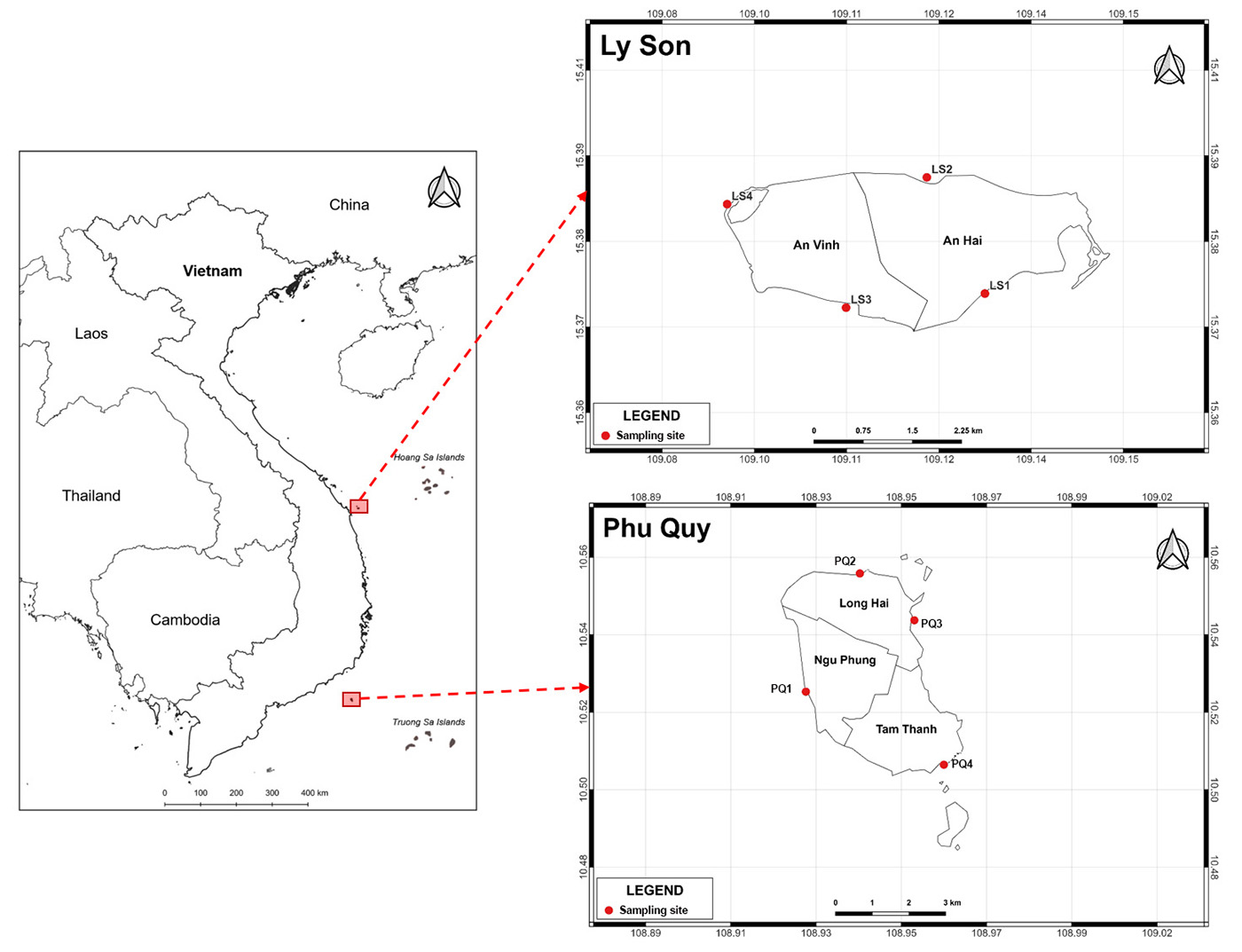
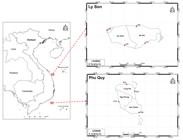
This study was conducted on two offshore islands in Vietnam: Ly Son Island (Quang Ngai Province, Central Vietnam, 15.38°N, 109.12°E) and Phu Quy Island (Lam Dong Province, South-Central Vietnam, 10.52°N, 108.94°E). Both islands feature coarse sandy substrates mixed with coral debris, typical of those found on extinct volcanic islands, supporting extensive Cymodocea rotundata meadows in shallow subtidal zones (Nguyen et al., 2009; 2018; Tin et al., 2021). On each island, four sampling sites were selected (LS1 - LS4 on Ly Son in August 2023; PQ1 - PQ4 on Phu Quy in August 2024) based on the continuous presence of C. rotundata in shallow subtidal zones (< 2 m depth), strategically distributed around islands to ensure geographic representation (Figure 1).
Sampling and sample processing
At each site, a 50-meter transect was established parallel to the shoreline across C. rotundata meadows. Five short shoots were collected at 10-m intervals along the transect for genetic analysis to minimize the probability of sampling the same genet. Samples were rinsed with seawater and kept fresh during transport to the laboratory.
For morphological and biomass assessment, three 0.25-m² quadrats were placed at 25-m intervals along the same transect. All seagrass material within each quadrat was collected and transported to the laboratory for analysis. Within each quadrat, 10-30 short shoots, leaves, and rhizomes were randomly selected for measurement, depending on the abundance of C. rotundata. Morphological traits, including leaf length, leaf width, sheath length, horizontal rhizome internode length, and horizontal rhizome diameter, were measured using a 30-cm plastic ruler or digital calipers (precision ± 0.01 mm), selected based on their relevance to seagrass growth and environmental adaptation (Short & Coles, 2001). Above- and below-ground biomass was determined by separating seagrass material into shoots (leaves and sheaths) and rhizomes (including roots), oven-drying at 60 °C for 48 hours until constant weight, and weighing with an electronic balance (± 0.01 g) to calculate dry weight per square meter (Short & Coles, 2001).
DNA extraction
Genomic DNA was extracted from fresh leaf tissues using the FavorPrep Plant Genomic DNA Extraction Mini Kit (Favorgen Biotech Corp, Taiwan), following the manufacturer’s instructions. DNA quality and concentration were assessed using a Nanodrop spectrophotometer and by visualization on 1% agarose gels. One sample yielded poor DNA quality and was excluded, resulting in 39 C. rotundata individuals retained for subsequent genetic analyses.
SSR exploratory analysis
To provide complementary information on nuclear variation and to guide the selection of cpDNA samples, twelve SSR primer pairs (Cymrot040, Cymrot166, Cymrot015, Cymrot004, Cymrot044, Cymrot164, Cymrot006, Cymrot027, Cymrot162, Cymrot003, Cymrot039, and Cymrot153) previously developed for Cymodocea rotundata (Arriesgado et al., 2014) were used on 39 individuals. SSR loci were amplified individually, and band presence or absence was recorded as binary data (1 = presence, 0 = absence) (Chaudhary et al., 2018). This exploratory approach enabled a preliminary assessment of genetic variation and guided the selection of divergent individuals for subsequent cpDNA sequencing.
Primers were diluted from 100 µM stock to 10 µM working solutions. Each 20 µL PCR reaction included 10 µL of 2× Go Taq® Green Master Mix (M7502, Promega, USA), 0.5 µL each of forward and reverse primers (10 µM), 1 µL of template DNA, and 8 µL of nuclease-free water. Amplification was carried out in a Bio-Rad T100 thermal cycler under the following conditions: initial denaturation at 95 °C for 15 minutes; 30 cycles of 95 °C for 30 seconds, 57 °C for 30 seconds, and 72 °C for 45 seconds, followed by a final extension at 72 °C for 5 minutes. PCR products were resolved on 2 % agarose gels using a horizontal gel electrophoresis system (Mupid-Exu, Japan). Gels were stained with SafeView Classic Nucleic Acid Stain (abm, Canada) and visualized under UV illumination (Figure 1S). Band sizes of primers were estimated by comparison with the GeneRuler 1 kb DNA Ladder (#SM0313, Thermo Fisher Scientific). All molecular procedures were conducted at the Biotechnology Laboratory, Biology Department, University of Sciences, Hue University.
cpDNA sequencing
Based on the SSR results, nine genetically distinct C. rotundata individuals were selected for sequencing of the trnL-trnF chloroplast intergenic spacer. The universal primer pair UniC (5'-CGAAATCGGTAGACGCTACG-3') and UniF (5'-ATTTGAACTGGTGACACGAG-3') was used. PCR reactions were performed in a 50 μL volume containing 100 ng of DNA, 20 pmol of each primer, 25 μL of 2× Go Taq® Green Master Mix (M7502, Promega, USA), and nuclease-free water to achieve the final volume. The thermal cycling profile included an initial denaturation at 95 °C for 10 minutes, followed by 30 cycles of denaturation at 95 °C for 1 minute, annealing at 57 °C for 1 minute, and extension at 72 °C for 1 minute, with a final extension at 72 °C for 10 minutes (a Bio-Rad T100). PCR products were checked on 1 % agarose gels stained with SafeView Classic Nucleic Acid Stains (abm, Canada) and compared to a GeneRuler 1 kb DNA Ladder (#SM0313). PCR products were purified and sequenced at DNA Sequencing Company (Can Tho, Vietnam).
Data analysis
Morphological data
Morphological traits were compared between island populations using Mann-Whitney U tests, as the data did not meet the assumptions of normality and homogeneity of variances (tested using Shapiro-Wilk and Levene’s tests). In contrast, comparisons of above-ground biomass, below-ground biomass, and above-/below-ground biomass ratio (A/B biomass ratio) were performed using independent-samples t-tests, as these variables met the normality assumption (Shapiro-Wilk test, p > 0.05). All statistical analyses were conducted in R v4.3.1, and boxplots of morphological traits and biomass variables were generated using the ggplot2 package.
SSR data
SSR presence/absence data were scored as binary (1 = presence, 0 = absence) and used to compute pairwise genetic distances using the Jaccard coefficient via the 'vegdist()' function in the vegan package in R v4.3.1 (R Core Team, 2023). Principal Coordinates Analysis (PCoA) was performed using 'cmdscale()' to visualize genetic relationships among individuals. The first two axes were used to generate biplots, and eigenvalues were extracted to calculate the proportion of explained variance. Visualization of the PCoA results was done using ggplot2 and ggrepel to display sample codes and enhance clarity.
A UPGMA dendrogram was constructed based on the Jaccard distance matrix using the 'hclust()' function with the “average” method. The resulting tree was visualized using the 'fviz_dend()' function in the factoextra package, with group rectangles added to highlight clustering patterns among individuals.
cpDNA data from the trnL-trnF region
Raw sequence chromatograms were edited in BioEdit v7.2.5 and aligned using the MUSCLE algorithm implemented in MEGA11 (Tamura et al., 2021). Sequence identity was confirmed through BLAST searches against the NCBI NR-NT database (Altschul et al., 1990). Phylogenetic trees were reconstructed using the Maximum Likelihood method with IQ-TREE v2.1.3 (Nguyen LT et al., 2015), employing the best-fit nucleotide substitution model determined by ModelFinder and 1,000 ultrafast bootstrap replicates. Tree visualization was performed in Interactive Tree of Life (iTOL) v6 (Letunic & Bork, 2021). Haplotypes and haplotype diversity (Hd) were obtained with the pegas package in R v4.3.1. The number of variable sites, haplotypes, and sequence divergence among individuals were summarized to support phylogenetic interpretation.
Results
Morphological variation of Cymodocea rotundata between islands
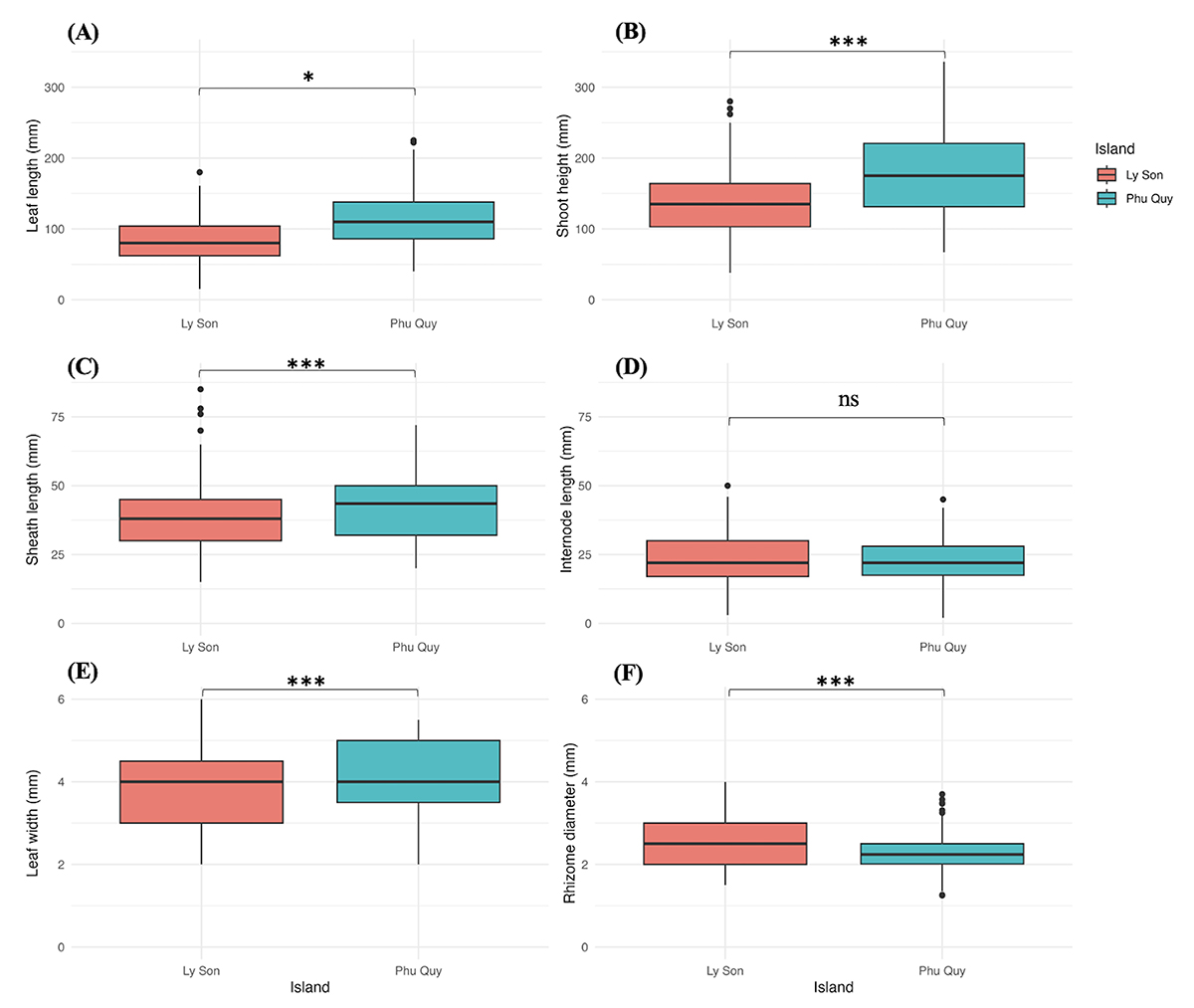
Morphological traits of Cymodocea rotundata exhibited significant variation between populations from Ly Son and Phu Quy islands (Figure 2). Mann-Whitney U tests indicated that samples from Phu Quy had significantly greater leaf length (112.5 ± 38.9 mm), shoot height (181.9 ± 64.4 mm), sheath length (45.3 ± 19.9 mm), and leaf width (4.06 ± 0.79 mm) compared to those from Ly Son (83.3 ± 29.0 mm, 138.0 ± 44.3 mm, 38.3 ± 12.2 mm, and 3.98 ± 0.81 mm, respectively; p < 0.05 for all comparisons). In contrast, rhizome diameter was significantly larger in Ly Son (2.54 ± 0.45 mm) than in Phu Quy (2.26 ± 0.43 mm; p < 0.05). No significant difference was observed in internode length (p > 0.05). These morphological differences indicate phenotypic differentiation between island populations and are associated with biomass distribution patterns. The higher below-ground biomass in Ly Son (281.080 g DW/m²) compared to Phu Quy (148.623 g DW/m²; p = 0.009) aligns with the larger rhizome diameter, indicating a potential investment in below-ground structures. Above-ground biomass showed no significant difference between the two islands (43.15 vs 44.95 g DW m⁻²; p = 0.876). However, the above-ground/below-ground biomass ratio was higher in Phu Quy (0.305) than in Ly Son (0.153) and approached statistical significance (p = 0.066), suggesting a tendency toward greater above-ground allocation in Phu Quy (Figure 3).
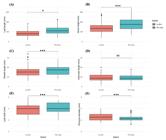
Boxplots showing the variation in six morphological traits of Cymodocea rotundata between Ly Son and Phu Quy Islands. (A) Leaf length, (B) Shoot height, (C) Sheath length, (D) Rhizome internode length, (E) Leaf width, and (F) Rhizome diameter. Asterisks indicate significant differences (* : p < 0.05; ** : p < 0.01; ***: p < 0.001), ns: non-significant.
Boxplots showing the variation in biomass allocation of Cymodocea rotundata between Ly Son and Phu Quy Islands. (A) Above-ground biomass, (B) Below-ground biomass, (C) Above-/below-ground biomass ratio. *, p indicates significant differences.
Genetic variation between island populations based on SSR markers
A total of 39 C. rotundata individuals were analyzed using 12 SSR loci. All loci amplified successfully, but polymorphism was limited: the number of alleles per locus ranged from 1 to 2, with only a few loci (e.g, Cymrot044, Cymrot003, Cymrot039) showing variation, while the majority (7/12) were monomorphic (Table S1).
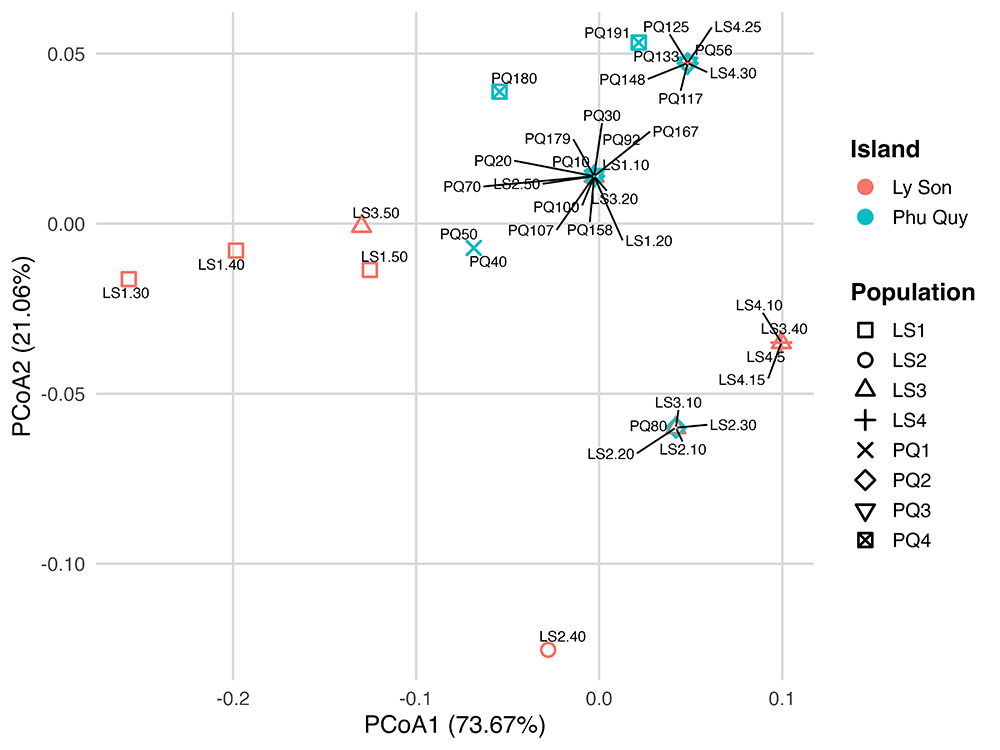
PCoA based on Jaccard distances explained 94.73 % of the total variation (PCoA1 = 73.67 %; PCoA2 = 21.06 %), revealing a clearer clustering of individuals by population (Figure 4). Samples from Phu Quy (PQ1-PQ4) tended to cluster tightly near the origin of the PCoA plot, indicating high genetic similarity among these populations. In contrast, samples from Ly Son (particularly LS1) were distributed along negative values of PCoA1, indicating greater genetic divergence. A few individuals, such as LS1.30 and LS1.50, remained distinct from the main clusters, possibly reflecting localized genetic structure or limited gene flow within the island.

PCoA of C. rotundata based on binary SSR data using Jaccard distances. Samples are grouped by population (LS1-LS4: Ly Son Island; PQ1-PQ4: Phu Quy Island).
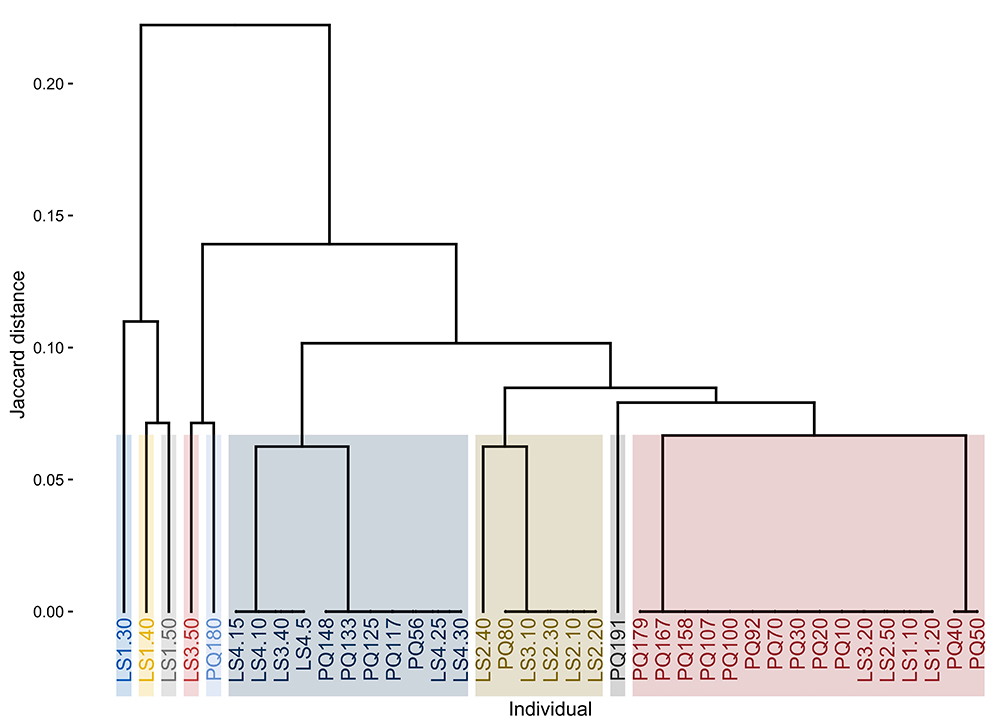
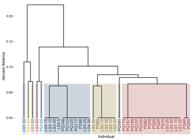
The UPGMA clustering tree based on Jaccard distances supported the PCoA results, with most sample clusters corresponding to their respective islands or populations (Figure 5). The LS1-LS3 group formed a separate clade, while some PQ samples (e.g, PQ191, PQ180) were positioned near the LS cluster, suggesting potential allele sharing or low differentiation among certain individuals. Genetic distances between major clusters ranged from approximately 0.05 to over 0.2, with LS1.30, LS1.40, and LS1.50 forming the most divergent branches.
Overall, the binary SSR dataset provided only limited resolution due to low polymorphism. Nevertheless, these exploratory analyses were informative for assessing moderate differentiation between islands and were also used to guide the selection of representative individuals for subsequent cpDNA sequencing.
Genetic variation based on trnL-trnF sequences
The trnL-trnF region was successfully sequenced with high quality, yielding a length of 974 bp (Figure S2). The sequences showed high similarity to the Cymodocea rotundata reference sequence from GenBank (accession number: NC_079845), ranging from 99.90 % (LS1.50) to 100 % (LS1.30). Nucleotide sequence alignment among the nine C. rotundata samples revealed a high degree of similarity, with variation observed at only three nucleotide positions: position 868 (T deletion in LS2.40, LS3.50, and PQ30), position 909 (T deletion in LS1.50, PQ80, and PQ191), and position 929 (T deletion in LS2.40) (Figure S2).
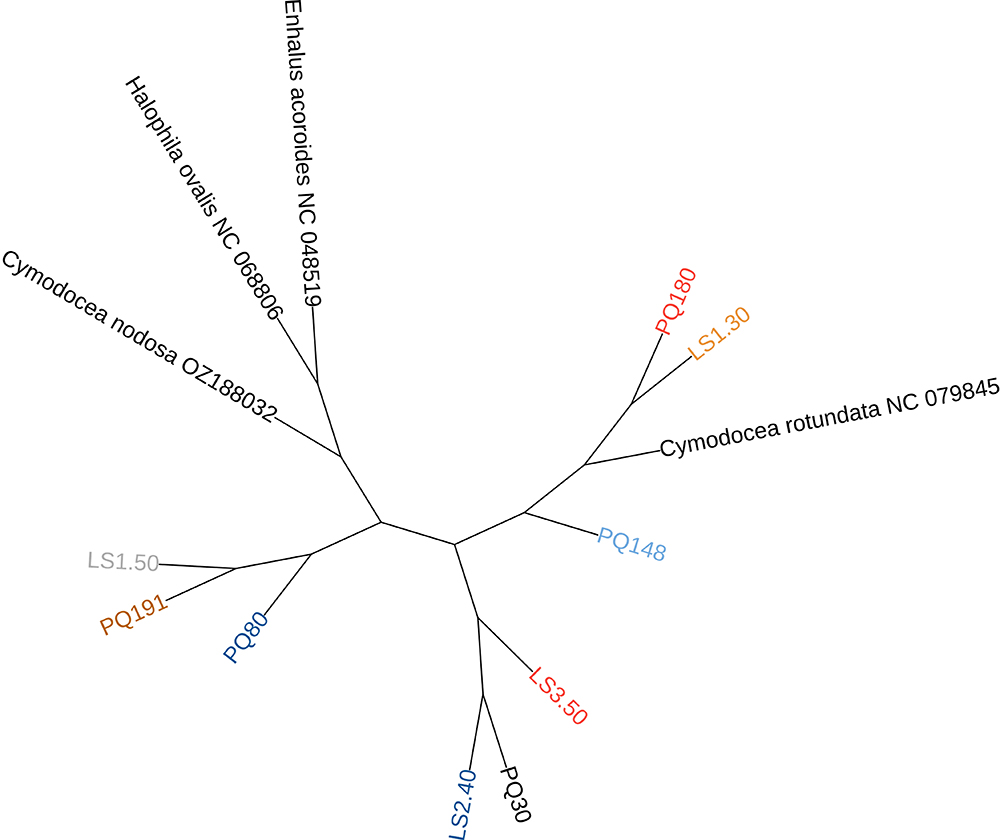
A total of four haplotypes were identified from the nine sequences (Table 1). Hap_1 consisted of LS1.30, PQ148, and PQ180, which shared identical sequences; Hap_2 included LS1.50, PQ80, and PQ191; Hap_3 corresponded to LS2.40; and Hap_4 comprised LS3.50 and PQ30. The haplotypes differed from each other by only 1-2 nucleotides. Comparison with previously published sequences confirmed high similarity among the study samples and substantial divergence from other seagrass species, particularly those from different genera and families (Cymodoceaceae vs. Hydrocharitaceae) (Figure S3).
Distribution of haplotypes and haplotype diversity (Hd) of Cymodocea rotundata at Ly Son and Phu Quy Islands.
Phylogenetic analysis showed that all study samples and the reference C. rotundata sequence clustered together in a distinct clade, separated from other species (Figure 6). Among the nine samples, LS1.50 exhibited the greatest sequence divergence, showing 99.90 % similarity to C. rotundata (NC_079845) and 95.38 % similarity to Cymodocea nodosa (OZ188032). No distinct clustering was observed between samples from Ly Son and Phu Quy, as individuals from both islands were intermixed within the phylogenetic tree. This pattern suggests recent historical gene flow from the same source or eventually between these remote islands. For example, LS1.50 and PQ191 shared the same haplotype, while LS1.30 and PQ180 had 100 % sequence identity.
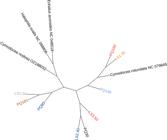
Maximum Likelihood phylogenetic tree of Cymodocea rotundata samples from Ly Son (LS) and Phu Quy (PQ) Islands based on trnL-trnF sequences, including reference sequences from GenBank.
Discussion
Genetic variation and haplotype diversity across islands
Genetic analysis based on both nuclear (SSR) and chloroplast (trnL-trnF) markers revealed moderate genetic variation between Cymodocea rotundata populations from Ly Son and Phu Quy Islands. Despite the within-species overlap, individuals from the two islands generally formed somewhat distinct genetic clusters, suggesting restricted gene flow and population differentiation between islands. The exploratory SSR analysis showed that Phu Quy individuals formed a tight genetic cluster, whereas Ly Son individuals, particularly from site LS1, were more scattered. This pattern points to higher intra-island variability in Ly Son, possibly due to heterogeneous environmental conditions or historical colonization events. A few samples (e.g, LS1.30, LS2.40, PQ180) were separated from their respective island clusters, indicating the presence of unique genotypes. These may reflect localized demographic processes, microhabitat differentiation, or historical admixture. Similar spatial genetic structuring has been reported in C. rotundata populations in the Western Pacific, where limited seed dispersal and habitat discontinuity constrain gene flow (Arriesgado et al., 2016).
Although clonal reproduction is known to be a dominant reproductive strategy in many seagrass species (Hughes & Stachowicz, 2009; Sherman et al., 2016), including C. rotundata (Arriesgado et al., 2023), the present study was not designed to quantify clonal richness or clone size structure. Shoots were sampled at 10-m intervals to reduce repeated sampling of the same genet for population-level comparison. Given the limited number of individuals per site and the absence of spatially explicit sampling within meadows, robust estimation of clonal structure would require dedicated sampling designs with finer spatial resolution and higher-resolution genotyping approaches.
Chloroplast trnL-trnF sequence variation further supported this genetic structure by revealing both shared and island-specific haplotypes. Shared haplotypes imply occasional gene flow, possibly mediated by ocean currents as in Posidonia oceanica (Micheli et al., 2010) and Enhalus acoroides (Nakajima et al., 2014) or by large marine herbivores (Tol et al., 2017). However, the detection of island-specific haplotypes, such as those found in Ly Son highlights the existence of distinct maternal lineages.
The combined evidence from nuclear and chloroplast markers suggests that Ly Son may serve as a regional genetic reservoir. Its higher within-population variability and presence of rare genotypes may contribute to the evolutionary resilience of the population under environmental change (Hughes et al., 2008; Hughes & Stachowicz, 2011, 2004). However, increasing anthropogenic pressures, particularly tourism and agricultural expansion for garlic cultivation, could threaten this diversity through habitat fragmentation (Cao et al., 2012; Nguyen et al., 2022b), as observed in other disturbed seagrass systems (Triest et al., 2021). While SSR markers revealed broad-scale genetic structure and individual divergence, the use of trnL-trnF sequences provided insights into maternal lineage diversity. Although less commonly used than matK or rbcL (Ramili et al., 2020; Pazzaglia et al., 2021), the trnL-trnF region proved useful in resolving haplotypes in C. rotundata. Future studies incorporating more variable chloroplast markers (e.g, matK, psbA-trnH) or high-resolution nuclear markers such as single-nucleotide polymorphisms (SNPs) could provide finer-scale resolution of gene flow and population history (Pazzaglia et al., 2021; Yu et al., 2023).
Morphological variation and potential links to genetic and environmental factors
Environmental heterogeneity, including variation in light, water depth, sediment type, nutrients, and hydrodynamic conditions, has been widely recognized as a driver of seagrass morphology (Japar Sidik et al., 1999; Kou & den Hartog, 2006; McDonald et al., 2016). The present findings in C. rotundata add to the growing body of evidence that morphological plasticity in seagrasses is an important component of their ecological response to local environmental conditions. Significant morphological differences were observed between Ly Son and Phu Quy populations of C. rotundata. Individuals from Phu Quy exhibited longer and wider leaves, taller shoots, and longer sheaths, whereas those from Ly Son had significantly thicker rhizomes and greater belowground biomass. These differences likely reflect environmental influences, with potential contributions from genetic variability. In particular, the larger rhizome diameter and higher belowground biomass observed in Ly Son may represent a morphological response associated with sediment disturbance. Seagrass species in high-energy or physically unstable environments often allocate more biomass belowground to enhance anchorage and resistance to burial or erosion (Terrados et al., 1998; Hemminga & Duarte, 2000; Tanaka & Nakaoka, 2006). The long-documented extraction of coral sand from Ly Son seagrass meadows for garlic cultivation and other coastal disturbances (Nguyen et al., 2018; Quang Ngai Statistics Office, 2024) may have caused sediment instability, potentially contributing to the development of thicker rhizomes in C. rotundata. A similar morphological differentiation in relation to wave exposure has been observed in Zostera marina in the Yellow Sea, China. Individuals at a wave-exposed site were found to develop shorter, narrower leaves and longer roots, which enhance resistance to hydrodynamic stress (Li et al., 2023). In addition, Ly Son exhibited higher haplotype diversity, suggesting the presence of multiple maternal lineages, which may be associated with observed morphological variability. While direct genotype-phenotype associations were not assessed in this study, increased genetic diversity has been linked to broader trait expression and resilience in clonal seagrass populations (Reusch et al., 2005; Ehlers et al., 2008; Hughes et al., 2009).
In contrast, individuals from Phu Quy, which is more isolated and less disturbed, exhibited longer and wider leaves, taller shoots, and thinner rhizomes. This suite of traits is commonly associated with seagrasses growing in more stable environments, where mechanical constraints are reduced, and allocation to photosynthetic tissue is favored (Hemminga & Duarte, 2000; Tanaka & Nakaoka, 2006). The compact genetic structure and more uniform morphology observed in Phu Quy further support the role of local environmental conditions in shaping population-level traits.
Conservation and restoration implications
The genetic and morphological divergence between Ly Son and Phu Quy populations underscores their potential as distinct conservation units. The higher haplotype diversity in Ly Son and unique genotypes (e.g, Hap_3 in LS2.40) suggest that these populations may harbor distinct genetic lineages with conservation relevance, similar to high-diversity Pacific populations of Z. marina (Yu et al., 2023). Ly Son, with its high anthropogenic pressure from tourism and coastal development, faces greater risks of habitat degradation (Cao et al., 2012; Nguyen et al., 2022b), as observed in other degraded seagrass systems (Dilipan & Arulbalachandran, 2022). Conservation strategies should prioritize the protection of Ly Son’s seagrass meadows from anthropogenic disturbances such as anchoring, pollution, and sediment disruption associated with coastal agriculture (e.g, garlic cultivation), while preserving the relatively undisturbed conditions of Phu Quy to maintain its genetic and morphological diversity. Restoration efforts could leverage observed gene flow between islands to enhance genetic connectivity through seed or propagule transplantation, as suggested for other seagrass species (Jahnke et al., 2015; Pazzaglia et al., 2021).
In summary, this study demonstrates moderate genetic and morphological variation between Cymodocea rotundata populations from Ly Son and Phu Quy Islands. Despite some genetic overlap, unique genotypes and significant differences in morphology and biomass suggest these populations may represent separate conservation units. Higher haplotype diversity and below-ground biomass in Ly Son highlight distinct population characteristics under disturbed environmental conditions, whereas Phu Quy represents a comparatively more stable system. Both populations remain vulnerable to coastal development and environmental change, necessitating site-specific conservation strategies to preserve local genetic diversity and prevent homogenization.
Supplementary Data
The following supplementary materials are available online:
Table S1.
Figure S1.
Figure S2.
Figure S3.
Acknowledgments
We thank the People’s Committees of Ly Son and Phu Quy Districts for their assistance in facilitating fieldwork and granting access to research sites. Additionally, we extend our appreciation to the management boards of the Ly Son marine protected area for their essential support and coordination during field activities. We are grateful to Timothy Sierens (Biology Department, Vrije Universiteit Brussel, Belgium) for valuable discussions during this research. The authors also acknowledge the support of Hue University under the Core Research Program, Grant No. NCTB. DHH.2025.02.
References
- Altschul SF, Gish W, Miller W, Myers EW, Lipman DJ. 1990. Basic local alignment search tool. Journal of Molecular Biology 215: 403-410.
- Arriesgado DM, Kurokochi H, Arriesgado EM et al 2023. Clonal diversity and recruitment strategy of the two dominant seagrass species Cymodocea rotundata and Enhalus acoroides in the southern Philippines. Aquatic Botany 187: 103646.
- Arriesgado DM, Kurokochi H, Nakajima Y et al 2016. Population genetic diversity and structure of a dominant tropical seagrass, Cymodocea rotundata, in the Western Pacific region. Marine Ecology 37: 786-800.
- Arriesgado DM, Nakajima Y, Matsuki Y et al 2014. Development of novel microsatellite markers for Cymodocea rotundata Ehrenberg (Cymodoceaceae), a pioneer seagrass species widely distributed in the Indo-Pacific. Conservation Genetic Resources 6: 135-138.
- Binh Thuan Statistics Office. 2024. Binh Thuan statistical yearbook 2023. Hanoi, Statistical Publishing House.
- Cao VL, Nguyen VT, Komatsu T, Nguyen DV, Dam DT. 2012. Status and threats on seagrass beds using GIS in Vietnam. SPIE - Remote Sensing of the Marine Environment II 8525: 12.
- Chaudhary S, Kharb P, Yashveer S, Prajapati DR, Kamboj MC. 2018. Utilization of SSR markers for studying genetic diversity of popular maize and its hybrids. Bulletin of Environment, Pharmacology and Life Sciences 7: 36-42.
- Davey PA, Pernice M, Sablok G et al 2016. The emergence of molecular profiling and omics techniques in seagrass biology; furthering our understanding of seagrasses. Functional and Integrative Genomics 16: 465-480.
- Dierick J, Phan TTH, Luong QD, Triest L. 2021. Persistent Clones and Local Seed Recruitment Contribute to the Resilience of Enhalus acoroides Populations Under Disturbance. Frontiers in Plant Science 12: 658213.
- Dilipan E, Arulbalachandran D. 2022. Genetic diversity of seagrass Cymodocea species as an ecological indicator on the Palk Bay Coast, India. Ecological Genetics and Genomic 23: 100119.
- Duarte CM, Borum J, Short FT, Walker DI. 2008. Seagrass ecosystems: Their global status and prospects. In: Polunin NVC (ed.). Aquatic Ecosystems. Cambridge, Cambridge University Press. p. 281-294.
- Ehlers A, Worm B, Reusch TBH. 2008. Importance of genetic diversity in eelgrass Zostera marina for its resilience to global warming. Marine Ecology Progress 355: 1-7.
- Green EP, Short F. 2003. World Atlas of Seagrasses. Berkeley, University of Califonia Press.
- Hemminga MA, Duarte CM. 2000. Seagrass Ecology. Cambridge, Cambridge University Press .
- Hughes AR, Stachowicz JJ. 2004. Genetic diversity enhances the resistance of a seagrass ecosystem to disturbance. Proceedings of the National Academy of Sciences of the United States of America 101: 8998-9002.
- Hughes AR, Inouye BD, Johnson MTJ, Underwood N, Vellend M. 2008. Ecological consequences of genetic diversity. Ecology Letters 11: 609-623.
- Hughes AR, Stachowicz JJ, Williams SL. 2009. Morphological and physiological variation among seagrass (Zostera marina) genotypes. Oecologia 159: 725-733.
- Hughes AR, Stachowicz JJ. 2009. Ecological impacts of genotypic diversity in the clonal seagrass Zostera marina Ecology 90: 1412-1419.
- Hughes AR, Stachowicz JJ. 2011. Seagrass genotypic diversity increases disturbance response via complementarity and dominance. Journal of Ecology 99: 445-453.
- Jahnke M, Serra I, Bernard G, Procaccini G. 2015. The importance of genetic make-up in seagrass restoration: A case study of the seagrass Zostera noltei Marine Ecology Progress Series 532: 111-122.
- Japar Sidik B, Muta Harah Z, Mohd PA, Madhavan S. 1999. Halodule species from Malaysia - Distribution and morphological variation. Aquatic Botany 65: 33-45.
- Kou J, den Hartog C. 2006. Seagrass morphology, anatomy, and ultrastructure. In: Larkum AWD, Orth RJ, Duarte CM (ed.). Seagrasses: Biology, Ecology and Conservation. Cham, Springer. p. 51-87.
- Larkum AWD, Orth RJ, Duarte CM. 2006. Seagrasses: Biology, ecology and conservation. Cham, Springer .
- Letunic I, Bork P. 2021. Interactive tree of life (iTOL) v5: An online tool for phylogenetic tree display and annotation. Nucleic Acids Research 49: W293-W296.
- Li WT, Liang N, Zhan J, Wang H, Zhang P. 2023. Morphological and anatomical characteristics of eelgrass Zostera marina L. at two distinct environments of Shandong Peninsula, China: An implication of adaptation strategy of seagrasses. Aquatic Botany 186: 103612.
- McDonald AM, Prado P, Heck KL et al 2016. Seagrass growth, reproductive, and morphological plasticity across environmental gradients over a large spatial scale. Aquatic Botany 134: 87-96.
- McMillan C. 1982. Flowering under controlled conditions by Cymodocea rotundata from the Palau Islands, Micronesia. Journal of Experimental Marine Biology and Ecology 64: 223-227.
- Micheli C, Spinosa F, Aliani S, Gasparini GP, Molcard A, Peirano A. 2010. Genetic input by Posidonia oceanica (L.) Delile fruits dispersed by currents in the Ligurian Sea. Plant Biosystems 144: 333-339.
- Nakajima Y, Matsuki Y, Lian C et al 2014. The Kuroshio Current influences genetic diversity and population genetic structure of a tropical seagrass, Enhalus acoroides Molecular Ecology 23: 6029-6044.
- Nguyen HD, Pham HT, Nguyen XV. 2009. Species composition and resources of seaweed and seagrass of Phu Quy Island, Binh Thuan Province. Marine Research Collection XVI: 225-243.
- Nguyen HQ, Nguyen HY, Luongng VK, Nguyen VT. 2018. Characteristics of seagrass ecosystem in Ly Son island, Quang Ngai province. In: The 5th Conference on Marine Science and Technology, March 27-28, Nha Trang University, Vietnam.
- Nguyen LT, Schmidt HA, Von Haeseler A, Minh BQ. 2015. IQ-TREE: A fast and effective stochastic algorithm for estimating maximum-likelihood phylogenies. Molecular Biology and Evolution 32: 268-274.
- Nguyen XV, Höfler S, Glasenapp Y, Thangaradjou T, Lucas C, Papenbrock J. 2015. New insights into DNA barcoding of seagrasses 37-41.
- Nguyen XV, Nguyen-Nhat NT, Nguyen XT, Dao VH, Liao LM, Papenbrock J. 2021. Analysis of rDNA reveals a high genetic diversity of Halophila major in the Wallacea region. PLoS One 16: e0258956.
- Nguyen XV, Nguyen-Nhat NT, Nguyen XT, Dao VH, McDermid KJ, Papenbrock J. 2022a. Microsatellite-based analysis of the genetic diversity and population structure of the seagrass species Thalassia hemprichii from southern Viet Nam. Aquatic Botany 178: 103497.
- Nguyen XV, Phan TTH, Cao VL et al 2022b. Current advances in seagrass research: A review from Viet Nam. Frontiers in Plant Science 13: 991865.
- Pazzaglia J, Nguyen HM, Santillán-Sarmiento A et al 2021. The genetic component of seagrass restoration: What we know and the way forwards. Water 13: 829.
- Phan TTH, De Raeymaeker M, Luong QD, Triest L. 2017. Clonal and genetic diversity of the threatened seagrass Halophila beccarii in a tropical lagoon: Resilience through short distance dispersal. Aquatic Botany 142: 96-104.
- Procaccini G, Olsen JL, Reusch TBH. 2007. Contribution of genetics and genomics to seagrass biology and conservation. Journal of Experimental Marine Biology and Ecology 350: 234-259.
- Quang Ngai Statistics Office. 2024. Quang Ngai Statistical Yearbook 2023. Hanoi, Statistical Publishing House .
-
R Core Team. 2025. R: A language and environment for statistical computing. https://www.R-project.org/ 10 Apr. 2026.
» https://www.R-project.org/ - Ramili Y, Bengen DG, Madduppa H, Kawaroe M. 2020. Genetic diversity information of seagrass Enhalus acoroides and Cymodocea rotundata for the local genetic conservation at North Maluku. IOP Conference Series: Earth and Environmental Science 584: 012021.
- Ramili Y, Bengen DG, Madduppa HH, Kawaroe M. 2018. Morphometric characteristics of two seagrass species (Enhalus acoroides and Cymodocea rotundata) in four small islands in North Maluku, Indonesia. Biodiversitas 19: 2035-2043.
- Reusch TBH, Ehlers A, Hämmerli A, Worm B. 2005. Ecosystem recovery after climatic extremes enhanced by genotypic diversity. Proceedings of the National Academy of Sciences of the United States of America 102: 2826-2831.
- Sherman CDH, York PH, Smith TM, Macreadie PI. 2016. Fine-scale patterns of genetic variation in a widespread clonal seagrass species. Marine Biology 163: 1-11.
- Short F, Carruthers T, Dennison W, Waycott M. 2007. Global seagrass distribution and diversity: A bioregional model. Journal of Experimental Marine Biology and Ecology 350: 3-20.
- Short FT, Coles RG. 2001. Global Seagrass Research Methods. Amsterdam, Elsevier.
- Short FT, Polidoro B, Livingstone SR et al 2011. Extinction risk assessment of the world’s seagrass species. Biological Conservation 144: 1961-1971.
- Tamura K, Stecher G, Kumar S. 2021. MEGA11: Molecular Evolutionary Genetics Analysis Version 11. Molecular Biology and Evolution 38: 3022-3027.
- Tanaka Y, Nakaoka M. 2006. Morphological variation in the tropical seagrasses, Cymodocea serrulata and C. rotundata, in response to sediment conditions and light attenuation. Botanica Marina 49: 365-371.
- Terrados J, Duarte CM, Fortes MD et al 1998. Changes in Community Structure and Biomass of Seagrass Communities along Gradients of Siltation in SE Asia. Estuarine, Coastal and Shelf Science 46: 757-768.
- Tin HC, Phung BT, Hieu DV. 2021. Species biodiversity and distribution of seagrass beds in several coastal areas of central Vietnam. Regional Studies in Marine Science 41: 101531.
- Tol SJ, Jarvis JC, York PH, Grech A, Congdon BC, Coles RG. 2017. Long distance biotic dispersal of tropical seagrass seeds by marine mega-herbivores. Scientific Reports 7: 4458.
- Triest L, Dierick J, Phan TTH, Luong QD, Huy NQ, Sierens T. 2021. Low Genetic Connectivity of Strongly Inbred Ruppia brevipedunculata in Aquaculture Dominated Lagoons (Viet Nam). Frontiers in Conservation Science 2: 723376.
- Waycott M, Duarte CM, Carruthers TJB et al 2009. Accelerating loss of seagrasses across the globe threatens coastal ecosystems. Proceedings of the National Academy of Sciences of the United States of America 106: 12377-12381.
- Yu L, Khachaturyan M, Matschiner M et al 2023. Ocean current patterns drive the worldwide colonization of eelgrass (Zostera marina). Nature Plants 9: 1207-1220.
-
Data Availability
The datasets supporting the findings of this study are available in Zenodo at doi: 10.5281/zenodo.17173059.
-
Funding information
We express our sincere gratitude to the National Foundation for Science and Technology Development (NAFOSTED), Grant No. 106.06-2020.40, for their generous funding support.
The datasets supporting the findings of this study are available in Zenodo at doi: 10.5281/zenodo.17173059.