 A new species of Luehea (Malvaceae, Grewioideae) from the Brazilian Atlantic Forest
Abstract
We describe here the new species Luehea peruzziana Gerace, Bovini & Baumgratz, endemic to the Brazilian Atlantic Forest, and restricted to the state of Espírito Santo, in the south-eastern region of the country. Morphological description, illustration with details of vegetative and reproductive structures, and comments on taxonomy, distribution, phenology, and conservation status are provided. Furthermore, given the morphological similarity with L. ochrophylla Mart., a comparative analysis between these two taxa is reported.
Keywords:
Espírito Santo; Grewioideae; Flora of Brazil; Neotropics; taxonomy
Introduction
The family Malvaceae Juss. is the richest of the order Malvales Dumort. It is represented by 243 genera and ca. 4.225 species, almost three-quarters of the order, and divided into nine subfamilies: Byttnerioideae Burnett, Grewioideae Hochr., Sterculioideae Beilschm., Tilioideae Arnott, Dombeyoideae Beilschm., Brownowioideae Burret, Helicteroideae Meisn., Malvoideae Burnett and Bombacoideae Burnett (Bayer et al., 1999; Bayer & Kubitzki, 2003). Of these, the second most diverse subfamily is Grewioideae, with ca. 770 species, including the genus Luehea Willd. (Bayer & Kubitzki, 2003). Luehea Willd. (Willdenow 1801: 410) is a Neotropical genus including 39 described taxa, of which 21 species and three varieties are accepted (Bayer et al., 1999; Bayer & Kubitzki, 2003). In the molecular phylogenetic analysis of Malvaceae, Luehea belongs to the clade Grewia, the second major and strongly supported clade of the subfamily Grewioideae. The genus belongs to the subclade Microcos, together with the genera Colona Cav., Microcos L., Goethalsia Pittier, and Lueheopsis Burret (Brunken & Muellner, 2012).
The distribution of this genus goes from Mexico to Northern Argentina, but with its greatest diversity in Brazil, specifically in the Atlantic Forest biome (Gerace et al., 2022; Gerace & Bovini, 2020). Luehea is characterized by the arboreal or shrubby habit, unarmed and leaves simples, involucral bracts 7-11, persistent or caducous, androecium polyadelphy, five phalanges free, rarely fused around the stylus, staminodes present, and fruits capsule woody, with seeds samaroids (Bayer & Kubitzki 2003; Gerace 2021). The genus is present in all biomes with different species based on the type of vegetation, such as L. grandiflora Mart. in open and anthropized areas, L. conwentzii K.Schum. and L. cymulosa Spruce ex Benth. in closed forest areas, L. paniculata Mart. and L. candicans Mart. in savannah and rock field areas, and L. ochrophylla Mart. in areas of coastal vegetation (Gerace & Bovini, 2020).
The complete taxonomic treatments reference for Luehea are still those of Schumann (1886) and Burret (1926), who proposed descriptions of new species, synonyms, and nomenclatural corrections, but which are out of date for the present day. More recently, we also have the works of Setser (1977), which proposed nomenclatural and morphological novelties but were not effectively published, and of Cunha (1985), which revised the species in Rio de Janeiro State. Currently, we are carrying out the taxonomic revision of the genus Luehea for the Neotropics, including the analysis of the protologues and type specimens (Gerace et al., 2022). Within the Project Flora e Funga do Brasil (Gerace & Bovini, 2020), we are studying the diversity of the genus in Brazil, with particular attention to the Atlantic Forest and Amazon biomes.
Analyzing specimens from different herbaria, including collections available on websites, we found several of them collected in the Espírito Santo state whose morphological reproductive structures, were not compatible with the other Luehea species. Studying these specimens, a set of peculiar characteristics of the flowers and fruits was identified, supporting the circumscription of a new species.
We present here a full description of the new species, with comments on taxonomy, distribution, habitat, and conservation status, as well as detailed illustrations and distribution map. Furthermore, we report here a comparison table between the new species, L. ochrophylla and L. conwentzii, morphologically close species.
Materials and methods
We have analyzed the Luehea collections, including the indeterminate specimens, of the herbaria CEPEC, COL, CVRD, ESA, F, G, K, MBM, MBML, MG, MO, NY, R, RB, SP, SORO, UEC, and VIES (acronyms follow Thiers, 2023 - continually updated), in person or consulting their online databases (http://sweetgum.nybg.org/science/ih/). The specimens were studied to determine in detail the morphological circumscription and to carry out the measurements necessary for the description. The terminology used for vegetative and reproductive morphology followed Radford et al. (1974), Briggs & Johnson (1979), Harris & Harris (2001), and Hickey & King (2002). The conservation status was determined with the collaboration of the Centro Nacional de Conservação da Flora (CNCFlora), with the sending of georeferenced points of the species for parameter calculation following the IUCN guidelines (IUCN, 2022), and cross-analysis with complete information on the use and exploitation of the affected region. For the distribution map, the program QGIS v.3.16.10 (QGIS, 2022).
Result and discussion
Taxonomic treatment
Luehea peruzziana Gerace, Bovini & Baumgratz, sp. nov. (Figs. 1, 2, 3)
Type: BRAZIL. Espírito Santo: Linhares, Reserva Natural da Vale do Rio Doce, estrada Alameda, km 1.5, 20-30 m a.s.l., 19°09’32” S 40°04’32” W, 04 December 2003 (fl., fr.), J.M.A. Braga, C.M. Mynssen & L.C. Giordano 7320 (Holotype: RB [barcode 00436818], two sheets; Isotypes: CEPEC, COL, CVRD, F, G, K [barcode 001209858], MBM, MG, MO, NY [barcode 00885975], SP).
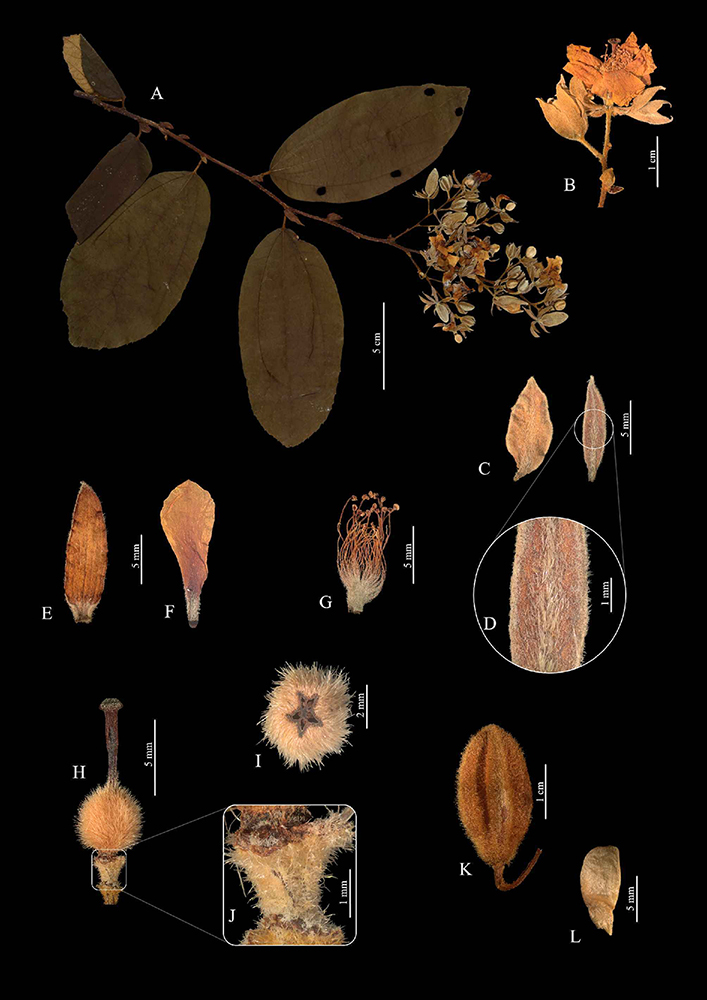
Diagnosis: Luehea peruzziana is morphologically similar to L. ochrophylla Mart. (Martius 1841: 50), having in common the number and length of involucral bracts, the shape of the ovary, including cross-section, and the sinuosity of the surface of capsules. This new species can be distinguished from L. ochrophylla for the two sizes of trichomes in the adaxial surface of involucral bracts (Fig. 1 D ), the presence of an anthopodium supporting the flowers (Fig. 1 I ), white corolla, and elliptic capsules (Fig. 1 K ).
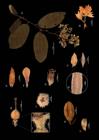
Vegetative and reproductive structures of Luehea peruzziana. A. Flowering branch. B. Flower. C. Involucral bracts. D. Detail of the indumentum of bracteoles on the adaxial surface, showing the trichomes of two sizes. E. Sepal in view adaxial. F. Petal in view adaxial. G. Androecium. H. Gynoecium. I. Transversal section of ovary. J. Detail of the anthopodium. K. Capsule. L. Seed. Photographs by S. Gerace. (J.M.A. Braga et al. 7320 [RB]).
Description: Tree, 5-27 m tall. Branches cylindrical, glabrous, when young tomentose. Stipules caducous, 9-13 × 2-4 mm, narrowly ovate, tomentose. Petiole 0.6-0.9 cm long, tomentose. Leaves blade 8.6-13.8 × 4.3-6.5 cm, obovate to elliptic, apex acuminate to cuspidate, base symmetric, rounded to obtuse, margin 1/2-superior slightly serrate; adaxial surface green, with trichomes stellate mainly on the veins, abaxial surface white, with trichomes arachnoid and stellate. Inflorescence 6.5-11 cm long, terminal, panicle; involucral bracts 7-9, 9-14 × 3-5 mm, elliptic, apex acute, base cuneate to rounded, abaxial surface tomentose, adaxial surface tomentose with two types of trichomes, stellate on the margins, smaller, 0.2-0.3 mm long, simples in the middle, bigger, 0.8-1 mm long, appressed; anthopodium 2-3 mm long. Flower sessile, 3.5-4 cm diam.; calyx 5 sepals, 15-18 × 3-5 mm, narrowly ovate, revolute, apex acute, base rounded, adaxial surface with trichomes simple only on the base, abaxial surface tomentose with trichomes stellate; corolla white, 17-21 × 6-9.5 mm, narrowly obovate to obovate, apex rounded to the acute, adaxial surface glabrous, abaxial surface with trichomes simples, mainly on central vein up to 1/3 of the length, claw tomentose; androecium with 5 phalanges free, tomentose, filaments many, 1/3-inferior with trichomes simples; stamens 10-12 mm long, anther dorsifixed, bilocular, oblong; staminodes 7-9 mm long, 1/3-inferior fused; gynoecium 9.5-11 mm long; ovary 3.5-4 × 3.5-4 mm, globoid transversally sulcate, tomentose, 5-locular; stylus 5-7 × 0.5-0.7 mm, 1/3-inferior pubescent; stigma 0.5-1 mm long, 2-2.5 mm diameter, capitate, glabrous. Capsule woody loculicidal, 2.2-2.5 × 1.3-1.4 cm, elliptic, apex acute, base cuneate, 5-locular, dehiscence 1/2-superior, ferruginous-tomentose, dorsal surface valve deeply sulcate in the middle, valve margins planes. Seed many, samaroid, 1-1.2 × ca. 0.5 cm, brown, winged 2/3-superior.
Morphological comparison between Luehea peruzziana, L. ochrophylla and L. conwentzii, based on diagnostic characters.
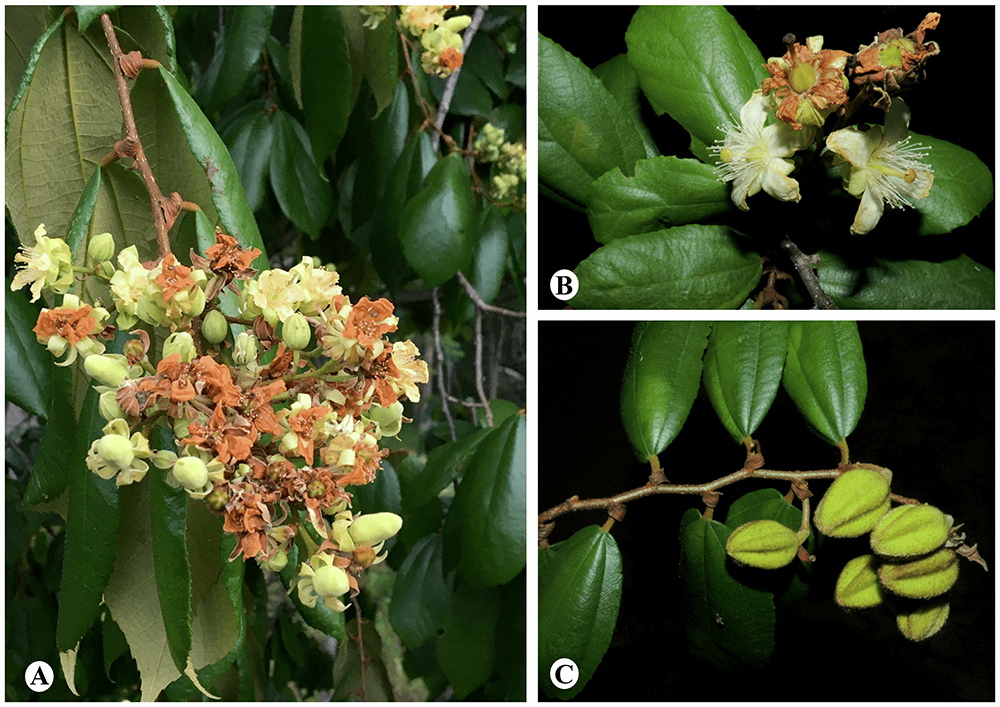
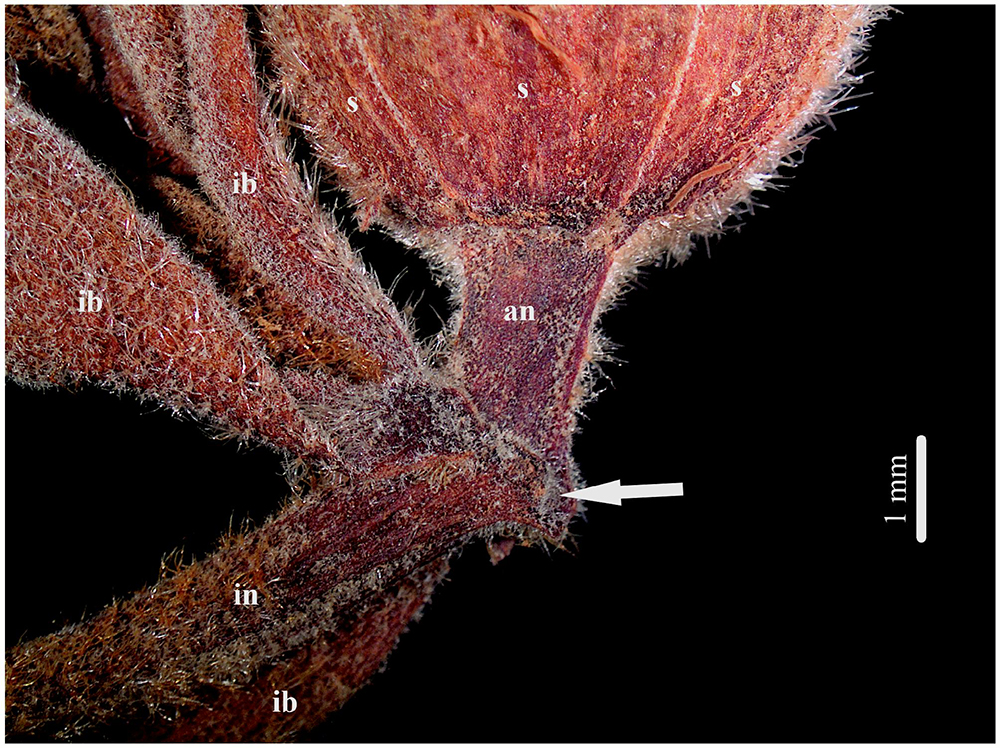
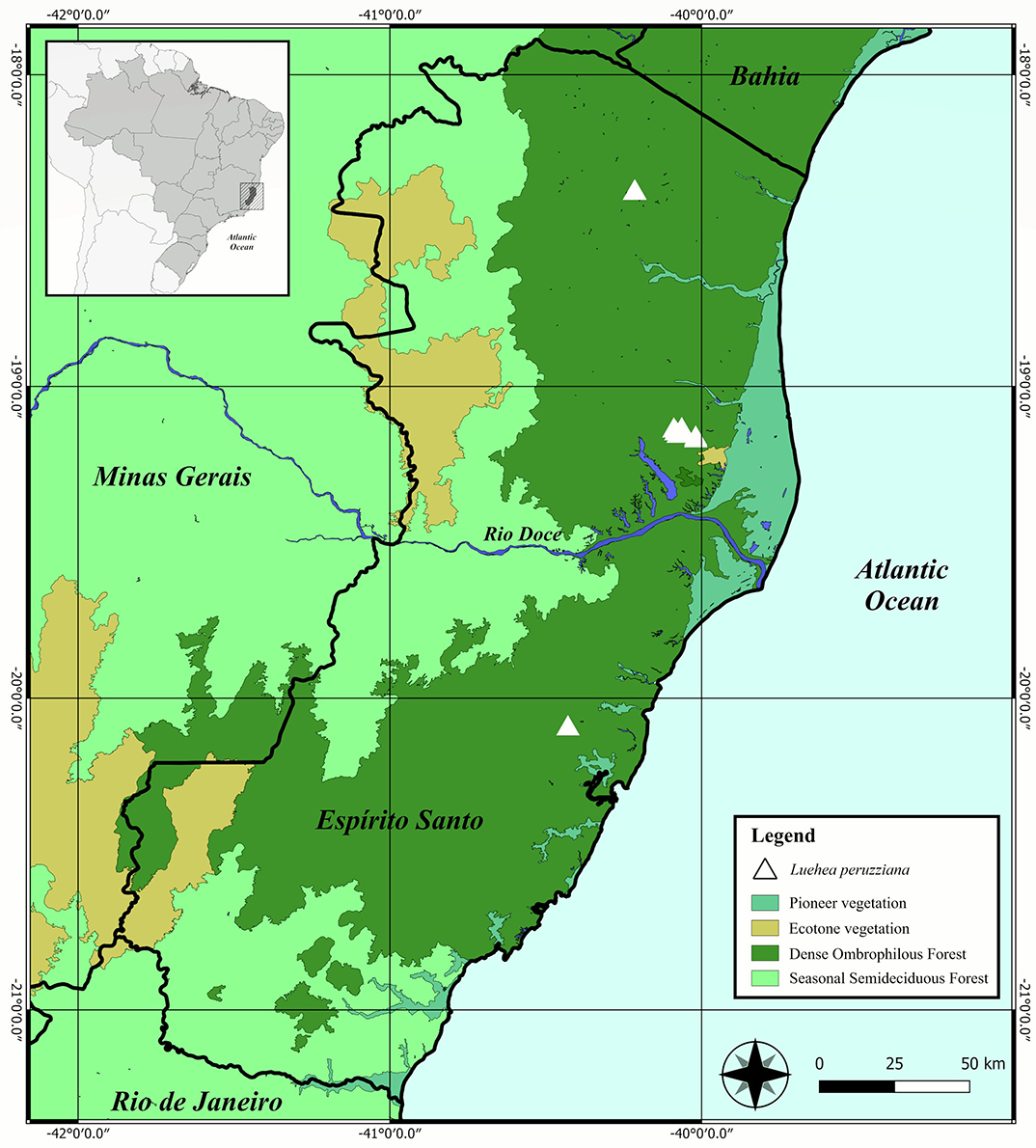
Taxonomic notes: Most specimens of L. peruzziana were previously identified as L. ochrophylla due to the morphological similarity of vegetative and floral structures, and the shortage of thorough taxonomic studies on the genus Luehea. Table 1 reports the comparison between these two species, based on the most important morphological characteristics that distinguish them, mainly the sizes and types of trichomes in the adaxial surface of involucral bracts, the presence of anthopodium, the color of the corolla, and the shape of the capsules (Figs. 1A-L; 2A-C). In L. peruzziana, there is an anthopodium, which constitutes the internode between the flower and the most distal node of the axis where it terminates. This structure is rare in Luehea, being known until now only for one species, L. steinbachii, endemic to Bolivia. The anthopodium represents the last axis that supports the flower, just as the most distal node is represented by the involucral bracts (Fig. 3). Thus, the flowers are sessile, and the involucre is part of the inflorescence, in which each of the laminar structures represents a bract or metaxyphyll (sterile hypsophyll). Another morphologically close species of L. peruzziana in the Espírito Santo state is L. conwentzii, distinct by the size of involucral bracts, the sizes and types of trichomes in the adaxial surface of involucral bracts, the presence of anthopodium, the size and form of petals, and the size and trichomes of the capsules (Tab. 1). Furthermore, L. ochrophylla has a wider range of distribution including coastal regions from the state of Rio Grande do Norte to Rio de Janeiro, L. conwentzii is distributed from the state of Espírito Santo to Paraná, while L. peruzziana is endemic to the state of Espírito Santo (Fig. 4).

Luehea peruzziana. A. Flowering branch. B. Flowers. C. Fruits branch. Photographs by G.S. Siqueira (A) and F.R.M. Fraga (B and C).
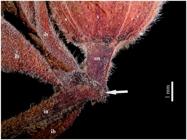
Detail of the inflorescence distal part of Luehea peruzziana (indumentum partially removed) showing: anthopodium (an); internode (in); involucral bracts (ib); sepals (s); distal node (arrow). Photography by S. Gerace. (J.M.A. Braga et al. 7320 [RB]).
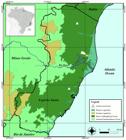
Distribution map of Luehea peruzziana in Espírito Santo state (Brazilian vegetation types follow IBGE 2012).
Distribution and habitat: Luehea peruzziana is native to central and northern regions of the Espírito Santo state, in Southeastern Brazil, which belongs to the Atlantic Forest biome (Fig. 4). This species occurs in forest environment between 20 and 160 m above sea level, in vegetation of the type Dense Ombrophilous Forest of lowlands or Tabuleiro Forest, characterized by dense and dry vegetation with presence of species of Caesalpinia (Leguminosae) and Lecythis (Lecythidaceae) (IBGE, 2012; Rolim et al., 2016).
Conservation status: The species is known only for the Espírito Santo state, in the municipalities of Linhares, Pinheiros, Serra, and Sooretama, presenting EOO equal to 2.549km², AOO equal to 20km² and about three locations. Considering records within the Vale Natural Reserve and agricultural activities along with disorderly real estate expansion as the main vectors of pressure that attest against the maintenance of the species in nature, at least two distinct locations that house endangered subpopulations are defined. In 2020, the species had 14.86% of its AOO converted into agriculture and pasture mosaic areas. With the spatial visualization, it can be observed that the fragments in which the species occurs are small and dispersed among cultivated areas. According to Ribeiro et al. (2009), more than 80% of the fragments in the Atlantic Forest have less than 50 ha. For large trees, the ideal fragment size is 500 hectares, considered the minimum recommended to guarantee the survival of rare and threatened species, maintain ecological processes, and promote connectivity between fragments (Castro, 2006). Given this scenario, it is inferred a decline in the EOO, AOO, and habitat quality/extension. For these reasons, the species is here assessed as Endangered (EN, B1ab(i,ii,iii)+2ab(i,ii,iii)). It is recommended further research on population data (census and reduction estimates), in addition to the elaboration and implementation of conservation actions both in situ and ex-situ, guaranteeing the perpetuation of the species in nature in the near future. (Amorim et al., pers. comm.)
Phenology: Flowering was recorded from November to January, and fruiting from December to February.
Etymology: The specific epithet was dedicated to the botanist Lorenzo Peruzzi, current director of the Botanic Garden of Pisa and professor of Botany at the University of Pisa, Italy, whose contributions are very important in the study of the vascular plants in Mediterranean flora. Furthermore, he had an important influence on the first author as professor and supervisor to undertake the study of botanical taxonomy, as well as having been part of the work on the genus Luehea in southeastern Brazil.
Additional specimens examined (Paratypes): BRAZIL. Espírito Santo: Linhares, Reserva Natural da Vale do Rio Doce, estrada da Mantegueira, 11 December 2016 (fl.), K.S. Valdemarin et al. 384 (CVRD, ESA, RB, SORO, UEC); próximo a estrada X-1 talhão 505, 19 January 1973 (fl.), J. Spada 145 (CVRD, R, RB); próximo a estrada X-1 talhão 601, 25 January 1973 (fl.), J. Spada 160 (CVRD, R, RB); estrada da Mantegueira, km 0.8, 26 November 2003 (fl.), D.A. Folli 4678 (CVRD, R, RB). Pinheiros, 130 m a.s.l., 29 January 2008 (fl., fr.), L. Kollmann & L. Magnago 10485 (MBML, RB); Fazenda de mamão próximo a Reserva Natural Victorio Orletti, 154 m a.s.l., 18°22’44” S 40°12’50” W, 19 January 2008 (fl., fr.), V.F. Mansano et al. 07-557 (CEPEC, MBM, MO, NY, RB, UEC). Serra, Morro Agudo, 135-400 m a.s.l., 20°05’51” S 40°25’44” W, 28 January 2008 (fr.), V. Demuner et al. 4906 (MBML, RB). Sooretama, Fazenda da Reserva da Vale, 25 m a.s.l., 19°09’03” S 40°04’58” W, 14 December 2016 (fl., fr.), F.R.M. Fraga et al. 50 (CVRD, K, MBML, RB, VIES); Reserva Natural da Vale do Rio Doce, estrada MME - talhão 32, 68 m a.s.l., 19°08’31.99” S 40°05’21.6” W, 03 December 2019 (bot.), G. Felitto 1280 (CVRD, RB).
Identification key for Luehea species in Espírito Santo state (Brazil)
1. Inflorescence uniflora (solitary flower) … 2.
1’. Inflorescence with many flowers … 3.
2. Involucral bracts partially fused; petals orbicular; staminodes shorter than stamens; capsule 5-7.4 × 3.6-4.2 cm … Luehea candida
2’. Involucral bracts completely free; petals linear; staminodes larger than stamens; capsule 3-4.5 × 1.5-2.5 cm … Luehea candicans
3. Corolla pinkish … 4.
3’. Corolla white or yellow … 5.
4. Petals orbicular; filaments free; capsule elliptic … Luehea paniculata
4’. Petals obovate; filaments fused around the stylus; capsule ovate … Luehea divaricata
5. Flowers > 5 cm diam.; sepals > 3 cm long; petals > 2.5 cm long; capsule > 3.5 cm long … 6.
5’. Flowers < 4 cm diam.; sepals ≤ 2 cm long; petals ≤ 2.1 cm long; capsule ≤ 2.5 cm long … 7.
6. Ovary oblong to elliptic, transversal section angular; capsule oblong, dorsal surface valve deeply sulcate in the middle … Luehea crispa
6’. Ovary circular, transversal section circular; capsule ovate, dorsal surface valve rounded … Luehea grandiflora
7. Corolla yellow; capsule obovate … Luehea ochrophylla
7’. Corolla white; capsule elliptic … 8.
8. Involucral bracts 0.3-0.6 × 0.1-0.15 cm, adaxial surface with trichomes of the same size; anthopodium absent; sepals 0.85-1.3 × 0.15-0.3 cm; petals 0.8-1.7 × 0.2-0.34 cm, linear; capsule 1.2-1.7 × 0.6-1.1 cm, indumentum villous … Luehea conwentzii
8’. Involucral bracts 0.9-1.4 × 0.3-0.5 cm, adaxial surface with two sizes of trichomes; anthopodium present; sepals 1.5-1.8 × 0.3-0.5 cm; petals 1.7-2.1 × 0.6-0.95 cm, obovate; capsule 2.2-2.5 × 1.3-1.4 cm, indumentum tomentose … Luehea peruzziana
Acknowledgments
We thank the directors, curators, and staff of the cited herbaria for their assistance and for providing information about the specimens referenced in this work. We also thank Geovane S. Siqueira (Vale Natural Reserve, Espírito Santo) and Fernanda R.M. Fraga (Rio de Janeiro Botanical Garden, Rio de Janeiro) for the field photographs, the team of Centro Nacional de Conservação da Flora (CNCFlora, Rio de Janeiro) for the classification of conservation status, the International Association for Plant Taxonomy (IAPT) for the awarded research grant to the first author (S.G.), and the Conselho Nacional de Desenvolvimento Científico e Tecnológico (CNPq) for the productivity fellowship awarded (No. 304576/2018-2) to the last author (J.F.A.B.). The first author extends gratitude to Coordenadoria de Aperfeiçoamento de Pessoal de Nível Superior - Brasil (CAPES) - Finance Code 001, for the financial support.
References
- Amorim ET, Fernandez EF, Bicalho M, Wimmer F, Gerace S, in press. Luehea peruzziana in Lista Vermelha da Flora do Brasil. Centro Nacional de Conservação da Flora, Jardim Botânico do Rio de Janeiro.
-
Bayer C, Fay MF, Bruijn AY et al 1999. Support for an expanded family concept of Malvaceae within a circumscribed Order Malvales: A combined analysis of Plastid atpB and rbcL DNA sequences. Botanical Journal of the Linnean Society 129: 267-303. doi: 10.1111/j.1095-8339.1999.tb00505.x
» https://doi.org/10.1111/j.1095-8339.1999.tb00505.x -
Bayer C, Kubitzki K. 2003. Malvaceae. Flowering Plants Dicotyledons. In: Kubitzki K, Bayer C (eds.). The Families and Genera of Vascular Plants. Heidelberg, Springer. vol V, p. 225-311. doi: 10.1007/978-3-662-07255-4_28
» https://doi.org/10.1007/978-3-662-07255-4_28 -
Briggs BG, Johnson LAS. 1979. Evolution in the Myrtaceae - Evidence from inflorescence structure. Proceedings of The Linnean Society of New South Wales 102: 157-256. https://biostor.org/reference/67846
» https://biostor.org/reference/67846 -
Brunken U, Muellner AN. 2012. A New Tribal Classification of Grewioideae (Malvaceae) Based on Morphological and Molecular Phylogenetic Evidence. Systematic Botany 37: 699-711. doi: 10.1600/036364412X648670
» https://doi.org/10.1600/036364412X648670 -
Burret KEM. 1926. Beiträge zur Kenntnis der Tiliaceen. Notizblatt des Botanischen Gartens und Museums zu Berlin-Dahlem 9: 592-880. doi: 10.2307/3994327
» https://doi.org/10.2307/3994327 -
Castro EC. 2006. The Atlantic Forest of South America: Biodiversity status, threats and outlook. Landscape Ecology 21: 953-955. doi: 10.1007/s10980-005-1788-z
» https://doi.org/10.1007/s10980-005-1788-z - Cunha MCS. 1985. Revisão das espécies do gênero Luehea Willd. (Tiliaceae), ocorrentes no estado do Rio de Janeiro. Sellowia, Anais Botanicos do Herbário Barbosa Rodrigues 37: 5-41.
- Gerace S. 2021. Revisione tassonomica delle specie appartenenti al genere Luehea (Malvaceae) presenti in un frammento del Bioma Foresta Atlantica nel sud-est brasiliano. MSc Thesis, Università di Pisa, Italy.
-
Gerace S, Bovini MG. 2020. Luehea (Malvaceae) in Flora e Funga do Brasil. Jardim Botânico do Rio de Janeiro, Rio de Janeiro, Brazil. https://floradobrasil.jbrj.gov.br/FB9091 01 Aug. 2023.
» https://floradobrasil.jbrj.gov.br/FB9091 -
Gerace S, Bovini MG, Peruzzi L, Baumgratz JFA. 2022. Typification of names in the neotropical genus Luehea (Malvaceae: Grewioideae). Phytotaxa 542: 180-188. doi: 10.11646/phytotaxa.542.2.5
» https://doi.org/10.11646/phytotaxa.542.2.5 - Harris JG, Harris MW. 2001. Plant Identification Terminology: An illustrated glossary. 2nd. edn. Payson, Spring Lake Publishing.
- Hickey M, King C. 2002. The Cambridge Illustrated Glossary of Botanical Terms. 2nd. edn. Cambridge, Cambridge University Press.
- IBGE. 2012. Manual Técnico da Vegetação Brasileira: sistema fitogeográfico, inventário das formações florestais e campestres, técnicas e manejo de coleções botânicas, procedimentos para mapeamentos. 2nd. edn. Rio de Janeiro, IBGE.
-
IUCN. 2022. Guidelines for Using the IUCN Red List Categories and Criteria. Version 15.1. https://www.iucnredlist.org/resources/redlistguidelines 01Aug. 2023.
» https://www.iucnredlist.org/resources/redlistguidelines - Martius CFPV. 1841. Beiblatter zur Flora oder Botanische Zeitung. Flora oder Botanische Zeitung: welche Recensionen, Abhandlungen, Aufsätze, Neuigkeiten und Nachrichten, die Botanik betreffend, enthält 24: 1-112.
-
QGIS. 2022. QGIS Geographic Information System version 3.16.10. Open-Source Geospatial Foundation Project. http://www.qgis.org/ 01Aug. 2023.
» http://www.qgis.org/ - Radford AE, Dickison WC, Massey JR, Bell CR. 1974. Vascular Plant Systematics. New York, Harper & Row Publishers.
-
Ribeiro MC, Metzger JP, Martensen AC, Ponzoni FJ, Hirota MM. 2009. The Brazilian Atlantic Forest: How much is left, and how is the remaining forest distributed? Implications for conservation. Biological Conservation 142: 1141-1153. doi: 10.1016/j.biocon.2009.02.021
» https://doi.org/10.1016/j.biocon.2009.02.021 - Rolim SG, Ivanauskas NM, Engel VL. 2016. As florestas de tabuleiro do norte do Espírito Santo são ombrófilas ou estacionais? In: Rolim SG, Menezes LTF, Srbek-Araujo AC. (eds.). Floresta Atlântica de Tabuleiro: diversidade e endemismos na Reserva Natural Vale. p. 47-60. Belo Horizonte, Editora Rona.
-
Schumann K. 1886. Tilliaceae. Flora Brasiliensis, enumeratio plantarum in Brasilia hactenus detectarum: quas suis aliorumque botanicorum studiis descriptas et methodo naturali digestas partim icone illustratas 12: 117-200. doi: 10.5962/bhl.title.454
» https://doi.org/10.5962/bhl.title.454 - Setser HL. 1977. A revision of neotropical Tiliaceae: Apeiba, Luehea and Lueheopsis PhD Thesis, University of Kentucky, United States of America.
-
Thiers B. 2023 [continuously updated]. Index Herbarium. http://sweetgum.nybg.org./science/ih/ 01 Aug. 2023.
» http://sweetgum.nybg.org./science/ih/ - Willdenow CL. 1801. XXIV Drei Neue Pflanzen-Gattungen. Neue Schriften, Gesellschaft Naturforschender Freunde zu Berlin 3: 403-412.