
 What are we planting in ecological restoration of tropical open ecosystems? A systematic review of controlled experiments
Abstract
Tropical grasslands, savannas, and shrublands comprise open ecosystems that are experiencing growing anthropogenic pressures and lack theoretical and practical knowledge on ecological restoration. Natural regeneration in these ecosystems is very slow and often unfeasible, making planting and seeding increasingly important restoration techniques. We conducted a systematic review to investigate the richness, origin, and functional groups of the plant species used to restore tropical open ecosystems. Identifying species and their functional groups used in restoration experiments allows us to better plan, implement, and monitor restoration. We identified 220 plant species introduced to restore tropical open ecosystems in 37 controlled restoration sites located in Brazil, Australia, the USA, Kenya, Venezuela, South Africa, and Congo. Nearly 55% of plant species were shrubs or trees, and 80% were native to the country where they were used. Strikingly, 51% of the plants were used only once. We found no evidence of biotic homogenization in the restoration of tropical open ecosystems. Only six reintroduced species were classified as endangered, suggesting an untapped potential for enhancing conservation-oriented restoration. Our results indicate that despite the predominant use of native species, woody species remain disproportionately planted compared to herbaceous species, which constitute the bulk of diversity in grasslands and savannas.
Keywords:
active restoration; grassland; savanna; shrubland; tropics; tropical ecosystem; tropical grassy biome
Introduction
Ecological restoration is a global priority in the context of the emergent climate and biodiversity crises. Global restoration efforts are increasingly supported by the United Nations Decade on Ecosystem Restoration (2021-2030), but a forest-centric view still dominates the scientific, governmental, and media arenas (Silveira et al., 2022). Restoration efforts in tropical open ecosystems (ancient grasslands, shrublands, and savannas) are relatively scarce despite increasing degradation levels (Buisson et al., 2022). Open ecosystems are characterized by graminoids, herbs, forbs, and shrubs. For instance, grasslands have no trees, and some savannas are known to have seven herbaceous plants for each wood species (Ribeiro & Walter, 2008). Moreover, open ecosystems feature a unique ecosystem functioning driven by soil properties, fire regimes, and large herbivores, which play important roles in shaping vegetation (Buisson et al., 2019). Open ecosystems are also biodiversity-rich, with many endemic and threatened species (Veldman et al., 2015; Bond, 2019; Buisson et al., 2019). Therefore, there is a pressing need to restore open ecosystems, aiming to protect their high biodiversity through effective management of their main ecosystem drivers, including disturbance, hydrological, and edaphic properties.
Active restoration approaches, including species reintroduction and active management, can yield better restoration outcomes in open ecosystems, as natural regeneration in these ecosystems is extremely slow or may never happen, depending on the degree of degradation (Nerlekar & Veldman, 2020). Consequently, planting and seeding native species have been employed as main techniques aimed at enhancing the resilience of open ecosystems and contributing to the maintenance of biodiversity of restored sites (Wiederhecker et al., 2024). In addition to species reintroduction, other main active restoration strategies in open ecosystems include tree cutting, invasive species control, livestock and wild herbivore management, prescribed fires, and soil acidification (Buisson et al., 2019; Haddad et al., 2021; Buisson et al., 2022; Pilon et al., 2023; Lira-Martins et al., 2024). Therefore, the efficiency of open biome restoration ultimately relies on active approaches, with planting and/or seeding native species playing important roles in restoring diverse and resilient ecosystems (Lyon et al., 2023).
The use of native species in restoration has been recommended for decades, but non-native species are still commonly used, even in forest restoration, which has received greater attention over the years (D’Antonio & Meyerson, 2002; Simões et al., 2024). The benefits of non-native species in restoration can be due to their faster growth and the income provision to landowners (timber, forage, fruit). Despite this, the choice for non-native species may also be constrained by the low availability of native species on the market (Vidal et al., 2020; Faria et al., 2025), which is especially true for herbaceous species, the main component of open ecosystems (de Castilho Silva et al., 2024). Furthermore, despite recent attempts to synthesize the common practices in the restoration of tropical open ecosystems (Pilon et al., 2023; Medeiros et al., 2024), a knowledge gap remains about the identity and richness of plant species used in active restoration approaches. Assessing the species pool used in restoration efforts in tropical open ecosystems can provide important insights into the effectiveness of these initiatives. In particular, it can help evaluate their potential to recover the diverse herbaceous layer, protect endangered species, and mitigate biotic homogenization.
To address this gap, we investigated the restoration species pool used to restore tropical open ecosystems. Specifically, we examined the richness, origin (native or non-native), and growth forms. Under the hypothesis that restoration practices follow the vegetation structure of open ecosystems, we expect grasses, forbs, and shrubs to be the most commonly reintroduced species, with a lower proportion of trees to match the open biome vegetation structure. Moreover, under the assumption that restoration is grounded in ecological theory (Barbosa-Dias et al., 2025), we expect the preferential reintroduction of native species instead of non-native ones. Finally, to address the potential of conservation-oriented restoration in open ecosystems (Volis, 2019), we examined the conservation status of the reintroduced species.
Materials and Methods
To assess the richness and functional groups of plant species used in active open biome restoration - defined as the world’s ancient grasslands, shrublands and savannas (Bond, 2019) -, we carried out a systematic literature review of peer-reviewed articles using Web of Science and Scopus databases using the following keywords: (“grassy biome” OR “grassland” OR “meadow” OR “prairie” OR “rangeland” OR “savanna*” OR “steppe” OR “shrubland” OR “cerrado”) AND (“afforestation” OR “afforested” OR “restoration” OR “restored” OR “recovery” OR “recovered” OR “reforestation” OR “reforested” OR “rehabilitation” OR “rehabilitated” OR “revegetation” OR “revegetate”) AND (“tropical” OR “subtropical”). Details of the search engine and paper screening are provided in Medeiros et al. (2024). Hence, we only included controlled restoration studies, which means studies comparing data obtained in field experiments (laboratory and greenhouse research were excluded) with a preserved and/or degraded site. However, here, we used only a subset of studies, including only those that applied active restoration techniques, including species reintroduction as well as seedling planting and direct seeding (see List S1). Studies must also provide a list of reintroduced species directly on degraded open ecosystems. We retrieved geographic coordinates and the identification of the reintroduced species, and used the Kew database (POWO, 2024) to correct species names and record the origin (native or non-native, depending on where they were planted or seeded), life cycle (annual or perennial), and growth form. We completed the growth form for 11 species using the Reflora database (FFB, 2024) because such information was not available in the Kew database. Besides, we assumed that all shrubs and trees were perennials, and we used the IUCN Red List (IUCN, 2024) to retrieve species conservation status. We conducted an ANOVA test to assess the richness of different growth forms and a GLM to evaluate the origin of planted species used in open biome restoration. All analyses were performed in the R program (R Core Team, 2025) using dplyr, tidyr, and ggplot2 packages. We made an alluvial graph to present the relationship between plant growth forms and the biome in which they were planted. To do so, we needed to assign only one growth form to each plant species; thus, we adopted a conservative approach in which, for example, if a plant species could assume an herbaceous or subshrub form, we assigned it as herb, while if it could assume a shrub or tree form, we assigned it as shrub. Hence, we classified as herbs all herb, herb-climbing-subshrub, herb-shrub, and herb-subshrub-shrub because the species could be herbaceous. Following the same criteria, we classified as shrubs all shrub, shrub-tree, subshrub, and subshrub-shrub (Medeiros et al., 2025). All other graphs were made using the ggplot2 package in the R program.
Results
The surveyed papers provided 37 restoration experiments from 29 studies that met our criteria for inclusion (see list S1). Nine sites from six studies only provided information on the richness of species planted without providing a specific species list (e.g., mixed grassland species, native species, high number of species), and were excluded from our analyses. Most experiments were concentrated in Brazil (43%), Australia (22%), the USA (19%), followed by Kenya (5%), Venezuela (5%), South Africa (3%) and Congo (3%). Moreover, we had nine experiments in grasslands, 16 in savannas and only three in shrublands.
Globally, 220 species from 45 families were reintroduced, with Poaceae (60 species), Fabaceae (47 species) and Asteraceae (14 species) standing out as the most common families (Fig. 1; Supplementary Material - Table S1). Regarding species growth form, only 45.6% of the species were herbaceous and 53.8% were shrubs or trees, reintroduced mainly into savannas, particularly in Brazil, Venezuela and Congo (Figs 2 and 3). Besides, we have not found a difference between herbs and woody species (Supplementary Material - Fig. S1; p>0.05). Regarding species life cycles, we found 180 species perennial, 12 annuals, eight annual/perennial, and two annual/biennial species. Information was missing for 18 species. As we expected, nearly 80% of the species were native to the country (Fig. 4; Supplementary Material - Fig. S2, p < 0.001), indicating that few non-natives are used to restore open ecosystems. Most non-native species reintroduced belonged to Poaceae (12), Fabaceae (3) and Gentianaceae (1) families, including invasive, fast-growing invasive African grasses such as Urochloa eminii and Urochloa dictyoneura planted in Venezuela, and forage legumes such as Stylosanthes scabra and Stylosanthes hamata planted in Australia. Ten of the 37 restoration experiments used at least one non-native species, usually without a clear justification. Moreover, we found that only 24 species were planted in more than five restoration experiments, while most species (107 plant species) were used only once (Fig. 5). Among species with available IUCN classifications, most were listed as ‘Least Concern’ (76 species). Additionally, four species were classified as ‘Vulnerable’ (Eucalyptus populnea, Dipteryx alata, Mimosa caesalpiniifolia, Metrosideros polymorpha), three species as ‘Endangered’ (Cynodon dactylon, Amburana cearensis, Andropogon leucostachyus), two species as ‘Near Threatened’ (Eucalyptus camaldulensis, Pterogyne nitens) and one species as ‘Data Deficient’ (Myracrodruon urundeuva). IUCN classification was unavailable for 145 species.

The richness of plants used in tropical open ecosystem active restoration research experiments through planting or seeding. Plant richness is grouped by families. Family used only once are not represented on this figure and includes: Acanthaceae, Annonaceae, Araliaceae, Boraginaceae, Caryocaraceae, Convolvulaceae, Dilleniaceae, Eriocaulaceae, Euphorbiaceae, Gentianaceae, Haloragaceae, Lycopodiaceae, Malpighiaceae, Metteniusaceae, Moraceae, Ochnaceae, Plantaginaceae, Polygalaceae, Rutaceae, Santalaceae, Smilacaceae, Solanaceae, Urticaceae, Verbenaceae, Vochysiaceae.
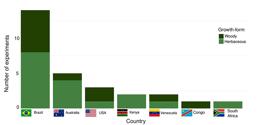
The growth-form of the plants used in tropical open ecosystem active restoration research experiments through planting or seeding experiments by country.

The proportion of herbaceous, shrub and tree species (total of 220 species) used in active restoration of tropical open biomes: grassland (nine experiments), shrubland (three experiments) and savanna (16 experiments). It is important to note that we adopted a conservative approach to classify the plant growth form. Therefore, we classified as herbs all herb, herb-climbing-subshrub, herb-shrub, and herb-subshrub-shrub because the species could be herbaceous. Following the same criteria, we classified as shrubs all shrub, shrub-tree, subshrub, and subshrub-shrub. Finally, we classified as trees the species that can only be trees. The numbers at the left panel indicate the number of species introduced in each functional group, with herbaceous species representing 45.6%, shrubs 28.8% and trees 25%.

The origin of plants used in the 28 restoration experiments of tropical open ecosystem active restoration through planting or seeding. Note that we found another nine experiments of planting/seeding species in tropical open ecosystems that were not represented here because they did not provide the plant species identification.

The bar graph represents how many times a single species was used in different tropical open ecosystem restoration experiments. The circle graph represents the growth-form proportion of the most used species (those used in five to eight experiments).
Discussion
Our review is based on a relatively low number of studies and in situ restoration experiments, highlighting the scarcity of controlled restoration studies of tropical open ecosystems using standardized, reproducible and clear protocols (Medeiros et al., 2024). This emphasizes the importance of improving and expanding restoration science to support policies that promote and assist the restoration of open ecosystems worldwide (Lyons et al., 2023). Despite a relatively high richness of plant families retrieved in restoration experiments, we still need to increase species richness in the restoration species pool for open ecosystems, as most experiments reintroduced less than three species from all plant families. Tropical open ecosystems are extremely species-rich (Murphy et al., 2016), and increasing taxonomic, functional and phylogenetic diversity in plantings is likely to promote more biodiverse and resilient restored ecosystems (Buisson et al., 2022; Mazzochini et al., 2024). For example, grasses are important in open ecosystems, but forbs also have an important, yet underappreciated role in these ecosystems, as they promote biodiversity by supporting pollinators and herbivores (Siebert et al., 2024). Thus, we highlight the need to diversify the restoration species pool and encourage the reintroduction of forbs in open biome restoration (Silveira et al., 2022; Nerlekar et al., 2024).
The mismatch between the planted species pool and the reference open biome, like savannas and grasslands, was identified here. Only 45% of the species were herbaceous, despite savannas having an herb:wood species ratio of nearly 7:1 (Ribeiro & Walter, 2008; de Castilho Silva et al., 2024). Herbaceous species dominance in open ecosystems is often neglected in open biome restoration, exemplified by a 1:1 herbs and woody species ratio (Supplementary Material - Fig. S1; p>0.05). Savannas were the main type of biome targeted in restoration experiments. This biome comprises open-canopy ecosystems with sparse and low-stature trees (Bond, 2019) that have no benefits from increasing tree density, which results in the loss of shade-intolerant herbaceous species (Wieczorkowski & Lehmann, 2022). A positive example is the use of shrubs to restore shrublands in the USA. To better align restoration efforts with open ecosystems ecology, we reinforce that trees and shrubs should be more carefully used, respecting their proportions in the native open ecosystems, especially in grasslands and savannas (Buisson et al., 2022).
Most of the reintroduced species were native; however, the reintroduction of common non-native species raises concerns, as they are fast-growing invasive grasses and forage legumes. Combining fast-growing grasses and N-fixing species usually stems from the idea that the restoration of open ecosystems needs to increase vegetation cover and improve soil nutrients, a misconception derived from forest restoration (Silveira et al., 2022). For example, many plant species in open ecosystems do not form mutualistic interactions with mycorrhizal fungi because they have evolved root specializations (Abrahão et al., 2019), thus not requiring fertilization or inoculation treatment (Silveira et al., 2022). Frequently, experiments had no clear justification for using non-native species. Perhaps, outdated paradigms from the 1990’s such as ideas stemming from forest restoration (Lovera & Cuenca, 1996; Cuenca et al., 1998), may help explain the use of non-native species in some cases. Another possible reason for using non-native species is the fact that legislation often fails to recognize the value of native herbaceous species in recovery and rehabilitation projects (Pimenta & Fonseca, 2021). Finally, another possibility is the paucity of native seedlings in the market (Ladouceur & Mayfield, 2017).
Regarding the species life cycle, we found that most of the species were perennial, which is consistent with the evolution of strategies to deal with natural disturbance regimes common to open ecosystems, such as recurrent fires and grazing (Bond & Midgley, 2001). Many open ecosystems are characterized by species with persistent niches, which describe the strategies that allow species to survive and grow under high disturbance regimes (Bond & Midgley, 2001). However, woody species were the most commonly reintroduced species (Fig. 2), which contrasts with our expectations and supports the idea that the restoration of grasslands and savannas is disconnected from ecological theory (Barbosa-Dias et al., 2025). To overcome this misconception, focus should be given to herbs and forbs in grasslands and shrubs in shrublands through the development of cultivation and propagation protocols (Vidal et al., 2020).
Concerns have been raised about the extent to which common restoration practices favour widespread and easily grown species with high survival and propagation knowledge promoting biotic homogenization in restored sites (Holl et al., 2022). In some cases, restored forests can be floristically more similar to one another than to reference ecosystems (Almeida et al., 2025). In tropical open ecosystems, the idea of biotic homogenization is not supported, given that a few herbaceous species have been reintroduced in more than five experiments. However, homogenization may have gone undetected because of low species richness in open biome restoration globally.
Conservation-oriented restoration stems from the idea of reintroducing threatened species as a complementary approach to traditional restoration (Volis, 2019). Most of the reintroduced species had an IUCN classification unavailable or were listed as ‘Least Concern’, which points out that open biome restoration has an untapped potential to move towards conservation-oriented practices by reintroducing threatened plant species and integrating restoration efforts into broader conservation efforts (Volis, 2019). Besides, the species pool used in the active restoration of open ecosystems through species reintroduction remains relatively small compared to the high plant biodiversity and endemism of tropical grasslands, shrublands and savannas (Murphy et al., 2016). Our results agree with those of Vidal et al. (2020), who found an underrepresentation of savanna specialists in nurseries, which may lead to afforestation and to other negative consequences for the native diversity. This result calls for further experiments that explore and enhance the diversity of plant species reintroduced in open biome restoration, reducing the dissimilarity between restored sites and reference ecosystems.
Overcoming species propagation barriers, aiming at diversifying the restoration species pool of herbaceous species would be vital to promote the reintroduction of a more diverse array of plant species in the restoration of open ecosystems (Vidal et al., 2020; Faria et al., 2025). Despite the predominant use of native species, focus is still given to woody species in many places. The reintroduction of forbs along with grasses to restore biodiverse and more resilient open ecosystems should be encouraged. Poorly planned tree plantations pose a threat to local floras, resulting in plantings that are floristically more similar to one another than to the regional species pool, even in forest restoration (Almeida et al., 2025). Moreover, the woody species focus undermines the key roles the herbs and forbs play in ecosystem functioning (Siebert et al., 2024). The species choice should respect the vegetation structure of the target open biome, which means that the herb:woody species ratio should ideally match that of the native reference ecosystem.
Supplementary Material
The following online material is available for this article:
List S1.
Figure S1.
Figure S2.
Table S1.
Acknowledgments
We thank the comments by the editor and two anonymous reviewers significantly increased the manuscript quality.
References
-
Abrahão A, Costa PB, Lambers H et al 2019. Soil types select for plants with matching nutrient-acquisition and - use traits in hyperdiverse and severely nutrient-impoverished campos rupestres in Central Brazil. Journal of Ecology 107: 1302-1316. doi: 10.1111/1365-2745.13111
» https://doi.org/10.1111/1365-2745.13111 -
Almeida C, Reid JL, Lima RAF, Pinto LFG, Viani RAG. 2025. High-diversity Atlantic Forest restoration plantings fail to represent local floras. Perspectives in Ecology and Conservatio 23: 6-11. doi: 10.1016/j.pecon.2024.12.001
» https://doi.org/10.1016/j.pecon.2024.12.001 -
Barbosa-Dias LG, Silveira FAO, de Marco Júnior P, Padilha DL. 2025. Open ecosystems restoration: a global review shows biases and mismatches between theory and practice. Restoration Ecology 33: e14307. doi: 10.1111/rec.14307
» https://doi.org/10.1111/rec.14307 - Bond WJ. 2019. Open Ecosystems: ecology and evolution beyond the forest edge. Oxford, Oxford Academic.
-
Bond WJ, Midgley JJ. 2001. Ecology of sprouting in woody plants: the persistence niche. Trends in Ecology & Evolution 16: 45-51. 10.1016/S0169-5347(00)02033-4
» https://doi.org/10.1016/S0169-5347(00)02033-4 -
Buisson E, Archibald S, Fidelis A, Suding KN. 2022. Ancient grasslands guide ambitious goals in grassland restoration. Science 377: 594-598. doi: 10.1126/science.abo4605
» https://doi.org/10.1126/science.abo4605 -
Buisson E, Le Stradic S, Silveira FAO et al 2019. Resilience and restoration of tropical and subtropical grasslands, savannas, and grassy woodlands. Biological Reviews 94: 590-609. doi: 10.1111/brv.12470
» https://doi.org/10.1111/brv.12470 -
Cuenca G, de Andrade Z, Escalante G. 1998. Diversity of glomalean spores from natural disturbed and revegetated communities growing on nutrient-poor tropical soils. Soil Biology and Biochemistry 30: 711-719. doi: 10.1016/S0038-0717(97)00191-0
» https://doi.org/10.1016/S0038-0717(97)00191-0 -
D’Antonio C, Meyerson LA. 2002. Exotic plant species as problems and solutions in ecological restoration: a synthesis. Restoration Ecology 10: 703-713. doi: 10.1046/j.1526-100X.2002.01051.x
» https://doi.org/10.1046/j.1526-100X.2002.01051.x -
de Castilho Silva AW, Pontara V, Bueno ML, Villa PM, Walter BMT, Meira-Neto JAA. 2024. The bulk of a plant hotspot: composition, species richness and conservation status of the Cerrado herbaceous-subshrub flora. Folia Geobotanica 59: 39-49. doi: 10.1007/s12224-024-09451-y
» https://doi.org/10.1007/s12224-024-09451-y -
Faria FS, Ordóñez-Parra CA, Granata L, Resende LV, Silveira FAO. 2025. Low-cost technology supports propagation of endemic species from a global biodiversity hotspot. Restoration Ecology 33: e70005. doi: 10.1111/rec.70005
» https://doi.org/10.1111/rec.70005 -
Flora e Funga do Brasil. 2024. Jardim Botânico do Rio de Janeiro. http://floradobrasil.jbrj.gov.br/ 16 Dec. 2024
» http://floradobrasil.jbrj.gov.br/ -
Haddad TM, Pilon NAL, Durigan G, Viani RAG. 2021. Restoration of the Brazilian savanna after pine silviculture: pine clearcutting is effective but not enough. Forest Ecology and Management 491: 119158. doi: 10.1016/j.foreco.2021.119158
» https://doi.org/10.1016/j.foreco.2021.119158 -
Holl KD, Luong JC, Brancalion PHS. 2022. Overcoming biotic homogenization in ecological restoration. Trends in Ecology & Evolution 37: 777-788. 10.1016/j.tree.2022.05.002
» https://doi.org/10.1016/j.tree.2022.05.002 -
IUCN. The IUCN Red List of Threatened Species. Version 2024-2. https://www.iucnredlist.org 16 Dec. 2024
» https://www.iucnredlist.org -
Ladouceur E, Mayfield MM. 2017. The early response of subtropical tussock grasslands to restoration treatments. Restoration Ecology 25: 689-695. doi: 10.1111/rec.12491
» https://doi.org/10.1111/rec.12491 -
Lira-Martins D, Xavier RO, Mazzochini GG et al 2024. Soil acidification controls invasive plant species in the restoration of degraded Cerrado grasslands. Restoration Ecology 33: e14294. doi: 10.1111/rec.14294
» https://doi.org/10.1111/rec.14294 -
Lovera M, Cuenca G. 1996. Arbuscular mycorrhizal infection in Cyperaceae and Gramineae from natural, disturbed and restored savannas in La Gran Sabana, Venezuela. Mycorrhiza, 6: 111-118. doi: 10.1007/s005720050115
» https://doi.org/10.1007/s005720050115 -
Lyons KG, Török P, Hermann J et al 2023. Challenges and opportunities for grassland restoration: a global perspective of best practices in the era of climate change. Global Ecology and Conservation 46: e02612. doi: 10.1016/j.gecco.2023.e02612
» https://doi.org/10.1016/j.gecco.2023.e02612 -
Mazzochini GG, Lira-Martins D, de Barros FV et al 2024. Effects of grass functional diversity on invasion success by exotic grasses in Cerrado grasslands. Journal of Applied Ecology 61: 271-280. doi: 10.1111/1365-2664.14561
» https://doi.org/10.1111/1365-2664.14561 -
Medeiros NF, Ordóñez-Parra CA, Buisson E, Silveira FAO. 2024. Systematic review of field research reveals critical shortfalls for restoration of tropical grassy biomes. Journal of Applied Ecology 61: 1174-1186. doi: 10.1111/1365-2664.14640
» https://doi.org/10.1111/1365-2664.14640 -
Medeiros N, Buisson E, Silveira FAO. 2025. Replication Data for ‘What are we planting in ecological restoration of tropical open ecosystems? A systematic review of controlled experiments’.https://doi.org/10.48331/SCIELODATA.YJE17N SciELO Data, V1.
» https://doi.org/10.48331/SCIELODATA.YJE17N SciELO Data -
Murphy BP, Andersen AN, Parr CL. 2016. The underestimated biodiversity of tropical grassy biomes. Philosophical Transactions of the Royal Society B 371: 20150319. doi: 10.1098/rstb.2015.0319
» https://doi.org/10.1098/rstb.2015.0319 -
Nerlekar AN, Veldman JW. 2020. High plant diversity and slow assembly of old-growth grasslands. The Proceedings of the National Academy of Sciences 117: 18550-18556. doi: 10.1073/pnas.1922266117
» https://doi.org/10.1073/pnas.1922266117 -
Nerlekar AN, Sullivan LL, Brudvig LA. 2024. Grassland restorations must better foster forbs to facilitate high diversity. Restoration Ecology 32: e14214. doi: 10.1111/rec.14214
» https://doi.org/10.1111/rec.14214 -
Pilon NAL, Campos BH, Durigan G et al 2023. Challenges and directions for open ecosystems biodiversity restoration: an overview of the techniques applied for Cerrado. Journal of Applied Ecology, 60: 849-858. doi: 10.1111/1365-2664.14368
» https://doi.org/10.1111/1365-2664.14368 -
Pimenta MA, Fonseca A. 2021. To what extent are threatened plant species considered in impact assessment decision-making? Insights from southeastern Brazil. Environmental Impact Assessment Review 86: 106516. doi: 10.1016/j.eiar.2020.106516
» https://doi.org/10.1016/j.eiar.2020.106516 -
POWO. Plants of the World Online. Facilitated by the Royal Botanic Gardens, Kew. https://powo.science.kew.org/ 16 Dec. 2024
» https://powo.science.kew.org/ -
R Core Team. 2025. R: A Language and Environment for Statistical Computing_. R Foundation for Statistical Computing, Vienna, Austria. https://www.R-project.org/
» https://www.R-project.org/ - Ribeiro JF, Walter BMT. 2008. As principais fitofisionomias do bioma Cerrado. In: Sano SM, Almeida SP, Ribeiro JF (eds.) Cerrado: ecologia e flora. Brasília, Embrapa Cerrados. p.152-212
-
Siebert F, te Beest M, Fynn R et al 2024. Past, present and future of forbs in old-growth tropical and subtropical grasslands. Annual Review of Ecology, Evolution and Systematics 55: 395-421. doi: 10.1146/annurev-ecolsys-102722-022331
» https://doi.org/10.1146/annurev-ecolsys-102722-022331 -
Silveira FAO, Ordóñez-Parra C, Moura LC et al 2022. Biome Awareness Disparity is BAD for tropical ecosystem conservation and restoration. Journal of Applied Ecology 59: 1967-1975. doi: 10.1111/1365-2664.14060
» https://doi.org/10.1111/1365-2664.14060 -
Simões LHP, Guillemot J, Ronquim CC et al 2024. Green deserts, but not always: A global synthesis of native woody species regeneration under tropical tree monocultures. Global Change Biology 30: e17269. doi: 10.1111/gcb.17269
» https://doi.org/10.1111/gcb.17269 -
Veldman JW, Overbeck GE, Negreiros D et al 2015. Where tree planting and forest expansion are bad for biodiversity and ecosystem services. BioScience 65: 1011-1018. doi: 10.1093/biosci/biv118
» https://doi.org/10.1093/biosci/biv118 -
Vidal CY, Naves RP, Viani RAG, Rodrigues RR. 2020. Assessment of the nursery species pool for restoring landscapes in southeastern Brazil. Restoration Ecology 28: 427-434. doi: 10.1111/rec.13096
» https://doi.org/10.1111/rec.13096 -
Volis S. 2019. Conservation-oriented restoration - a two for one method to restore both threatened species and their habitats. Plant Diversity 41: 50-58. doi: 10.1016/j.pld.2019.01.002
» https://doi.org/10.1016/j.pld.2019.01.002 -
Wieczorkowski JD, Lehmann CER. 2022. Encroachment diminishes herbaceous plant diversity in grassy ecosystems worldwide. Global Change Biology, 28: 5532-5546. doi: 10.1111/gcb.16300
» https://doi.org/10.1111/gcb.16300 -
Wiederhecker A, Ferreira MC, Rodrigues SB et al 2024. Ten Years of directing seeding restoration in the Brazilian savanna: lessons learned and the way forward. Journal of Environmental Management 365: 121576. doi: 10.1016/j.jenvman.2024.121576
» https://doi.org/10.1016/j.jenvman.2024.121576
-
Data Availability
The datasets and the code used in the current study are available at the GitHub repository: git@github.com:nataliafmedeiros/planting_seeding_tgb.git and at SciELO Data: Medeiros N, Buisson E, Silveira FAO. 2025. Replication Data for 'What are we planting in ecological restoration of tropical open ecosystems? A systematic review of controlled experiments'. Available at: https://doi.org/10.48331/SCIELODATA.YJE17N, SciELO Data, V1.
-
Funding Information
We thank CNPq and FAPEMIG for providing scholarships and grants that support this research.
The datasets and the code used in the current study are available at the GitHub repository: git@github.com:nataliafmedeiros/planting_seeding_tgb.git and at SciELO Data: Medeiros N, Buisson E, Silveira FAO. 2025. Replication Data for 'What are we planting in ecological restoration of tropical open ecosystems? A systematic review of controlled experiments'. Available at: https://doi.org/10.48331/SCIELODATA.YJE17N, SciELO Data, V1.


