 Narrow mycorrhizae and large non-mycorrhizal fungal diversity associated with roots of Cattleya milleri, an endemic and endangered orchid from a rupestrian hotspot in the “Quadrilátero Ferrífero” of Minas Gerais - Brazil
Abstract
The threatened orchid Cattleya milleri is a microendemic orchid of a Brazilian savanna hotspot. As endophytes and mycorrhizae may improve its propagation and conservation, we investigated its root fungal community. Cattleya milleri roots were sampled in five natural sites and at a greenhouse. Fungal root endophytes were isolated for characterization and molecular ITS (Internal Transcribed Spacer) identification. Total DNA was extracted from endorhiza and rhizosphere for ITS amplification and sequencing. Sixteen fungal isolates were clustered in 6 Operational Taxonomic Units (OTUs) and endorhizal and rhizospheric sequences were clustered in 327 OTUs. Endorhiza presented from 25 to 89 OTUs, and rhizosphere 56 OTUs. Cluster analysis showed high divergence between natural and greenhouse fungal communities, but similarity among natural samples. From the 94 genera, 24 were annotated as endophytes, two mycorrhizas, 33 pathotrophs, 40 saprotrophs, and 17 symbiotrophs based on the FunGuild database. Endophytes of the orders Capnodiales, Hypocreales, Pleosporales, and mycorrhizae of Sebacinales occurred in all sites. The mycorrhizae Tulasnella occurred in all natural samples. The interaction with only two mycorrhizal taxa may limit C. milleri distribution. However, the recruitment of many non-mycorrhizal endophytes is essential to natural development. Pleosporales, Tulasnella, and Sebacinalles may be considered for C. milleri propagation and conservation.
Keywords:
Endophytes; Endorhiza; Greenhouse; Mycorrhiza; Rhizosphere
Introduction
The plant family Orchidaceae presents around 25,000 species, many of which have enormous ornamental importance, and some application in the medical and food industry, which increases the economic value of this family (Dodson 2022). Many orchids are reported as endangered or extinct, because of predatory collection and habitat loss (Wraith & Pickering 2019), including Cattleya milleri. Cattleya milleri is a microendemic orchid, native to the “Quadrilátero Ferrífero” - Minas Gerais, Brazil (Teixeira & Lemos Filho 2013), which occurs on rocky outcrops in iron-rich rupestrian grasslands areas of the Brazilian savanna (Cerrado) (CNCFlora 2020). It is considered under critical threat status. Its appealing and attractive vegetative and floral features stimulated its illegal collection for trade and personal collection. Besides, its habitat has been destroyed by mining activities (CNCFlora 2020). Consequently, its natural population is under drastic reduction, which requires strategies to preserve C. milleri and its habitat (Silveira et al. 2016; Fernandes-Filho et al. 2022).
The mutualistic interaction with fungal endophytes is essential for the orchid life cycle (Bayman & Otero 2006; Ma et al. 2015; Hossain 2022). As orchid seeds are devoid of endosperm to support embryo development (Peterson et al. 2004; Bhatti & Thakur 2022), interaction with a mycorrhizal endophytic fungus is required (Dearnaley et al. 2016; Yeh et al. 2019). A compatible mycorrhizal fungus can infect and colonize the basal cells of the orchid embryo, where it forms intracellular hyphal coils called pelotons (Peterson et al. 2004; Dearnaley et al. 2016). The embryo cells produce hydrolytic enzymes, degrade fungal hyphae, and assimilate the released simple sugar to support the seed germination and embryo development to protocorm (Peterson et al. 2004; Bhatti & Thakur 2022). When the protocorm becomes a seedling and produces its first root, the mycorrhizal and other fungal endophytes colonize its endorhiza (Peterson et al. 2004). The pelotons in the root cortex cells show the seedling interacting with the mycorrhizal fungi (Rasmussen et al. 2015; Selosse et al. 2022). Besides, non-mycorrhizal fungal endophytes can be still present, but without forming any typical structure (Bayman & Otero 2006; Ma et al. 2015; Selosse et al. 2022). The interaction with root fungal endophytes has nutritional and physiological relevance during seedling and plant development since they facilitate the assimilation of nutrients from the substrate/soil, promote resistance against pathogens, and become an additional source of organic carbon (Ma et al. 2015; Dearnaley et al. 2016). Indeed, the addition of endophytes improves the germination and development of orchid species with conservational, ornamental, medicinal, and food importance, which strengthens their relevance during orchid propagation (Guimarães et al. 2013; Gantait & Kundu 2017; Thakur et al. 2018; Shah et al. 2019; Chand et al. 2020; Li et al. 2021b ).
Current techniques for orchid propagation implement culture media containing simple sugar to support seed germination and seedling growth, despite the mycorrhizal fungal inoculation (asymbiotic propagation) (Gantait & Kundu 2017; Kunakhonnuruk et al. 2018; Juras et al. 2019). Nevertheless, the co-inoculation of seed and a compatible mycorrhizal fungus in culture media containing complex sugar (symbiotic propagation) has achieved better results, presenting a higher percentage of seed germination, and faster protocorm and seedling growth (Mahendran et al. 2013; Guimarães et al. 2013; Figura et al. 2021). The introduction of non-mycorrhizal fungal endophyte inoculation on seedlings has also obtained positive impacts on orchid growth (Wang et al. 2016; Sisti et al. 2019; Chand et al. 2020). Both mycorrhizal and non-mycorrhizal fungi can help plants during adverse field conditions, including acclimatisation, drought period, and pathogen infection. Thus, their inoculation is suitable during plant cultivation, especially during the propagation of the species toward reintroduction (Cribb et al. 2003; Nogueira et al. 2005; Li et al. 2021 b ). Once an orchid is reintroduced in nature with endophytes, both the plant and its symbionts are preserved and reintroduced, which increases the chances of occurrence of natural propagation and the maintenance of the orchid life cycle (Cribb et al. 2003; Nogueira et al. 2005; Zhao et al. 2021).
Implementing symbiotic propagation requires culture-dependent studies, where endophytic fungi are isolated, classified, and then, used in a co-inoculation test to select appropriate isolates for orchid propagation (Pereira & Valadares 2012, 2017; Tian et al. 2021). Although fungal isolation has been an important source of information about orchid mycorrhizal root endophytes (Pereira & Valadares 2017; Li et al. 2021 a ), culture-independent studies are performed using next-generation sequence (NGS) platforms, which improve knowledge about root fungal community (Waud et al. 2016; Li et al. 2021a), provide broad information about the most important fungal endophytes on orchid roots, and so as give support during the selection of appropriate fungal isolates to be applied in further orchid propagation programs.
Considering the need for suitable endophytes to improve the protocols designed for C. milleri propagation and conservation, the fungal community of its root endorhiza and rhizosphere was investigated by applying culture-dependent and culture-independent methods. The roots were sampled from C. milleri grown in three native areas and a greenhouse of the “Biofábrica”, the seedling propagation laboratory of Vale S.A. The analysis addressed the following questions: first, what is the diversity of the fungal community on roots of C. milleri? Second, which taxa are essential components of the C. milleri root fungal community and persist on its roots after transference from natural to controlled environmental conditions (greenhouse)? And finally, what is the putative role of fungi associated with orchid roots? With the answers to these questions, we expect to select suitable fungal isolates to be applied to the C. milleri conservation program.
Material and methods
Sampling process
Roots of C. milleri (Blumensch. ex Pabst) Van den Berg (Fig. 1) were collected from plants grown in three natural areas (N1, N2, and N3) and in a greenhouse (GH), totalling four areas (Table 1). The plants sampled in natural areas were grown on rocky outcrops (Fig. 1 a ), in a rupestrian grassland fragment near the city of Nova Lima, MG, Brazil (SISBIO Authorization number 26431-5). The geographic location was omitted, as requested by the owner of the area, to protect the occurring natural region of C. milleri and avoid illegal collection. The plants growing in the greenhouse (Fig. 1 b ) had been collected from native areas under mining exploration and transferred to a greenhouse as part of a conservational program of endangered species of the “Quadrilátero Ferrífero”. This program is currently maintained by the “Biofábrica”, located in Nova Lima - MG, Brazil. The plants sampled in area N2 presented three different habitats, while those sampled in areas N1 and N3 had only one habitat (Table 1). Combining area and habitat, a total of five different sites were studied in the natural environment - one site in N1, three in N2 (N2E, N2R, and N2S), and one in N3. The plants sampled in a greenhouse were considered to belong to the same area and habitat, which formed the sixth site (Table 1).
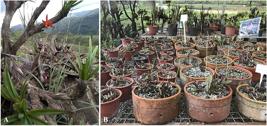
Cattley milleri growing on quartzite rocky outcrop in natural area (A) and in vases with gneiss gravels in a greenhouse (B).
Environments, site codes of Cattleya milleri root sampling, and description of orchids habitat and environment features. C. milleri was growing in two environments (natural and greenhouse), in three areas in the natural environment (N1, N2 and N3) and in the greenhouse (GH). Samples from area N2 were distinguished in three samples by orchid habitat. Orchids from the other areas (N1, N3 and GH) presented only one habitat.
At least 12 roots were collected from plants occurring in the same population at each site. The roots were sampled from different plants in the populations to obtain a composite sample, which avoided impacting one individual and increased the chances of accessing high fungal diversity. The samples were packed in plastic bags and transported in a thermal bag to the Soil Microbiology Laboratory (Federal University of Lavras), where they were stored at 4 °C for 5 days until finishing the root processing.
Preparation of roots sampled in natural and greenhouse conditions
The roots were washed in running water and cut into fragments of around 7 cm. Four to six fragments were submerged in 20 mL of sterile saline solution (NaCl 0.85 %) and shacked on a vortex for 1 minute to obtain a suspension of rhizospheric cells (SRC 100). The roots were transferred to a new sterile tube for further superficial disinfection. The SRC 100 was stored at -40 °C for further culture-independent fungal rhizospheric community study.
Root superficial disinfection was performed in a series of immersions in 70 % ethanol for 1 min and 0.5 % sodium hypochlorite for 5 min, followed by three washes in sterile deionized water (Pereira et al. 2005). The roots were then aseptically transversely sectioned under a magnifying glass, and the crosscuts were analysed to confirm mycorrhizal colonisation by the presence of pelotons in cortical cells. Part of the crosscuts containing pelotons was separated for fungal isolation to culture-dependent fungal endophyte identification. The other part was transferred to two 1.5 mL Eppendorf tubes (two tubes per site) containing 0.5 μL of CTAB buffer (Cetyltrimethylammonium bromide) (Schäfer & Wöstemeyer 1992) until the solution volume achieved 1 mL. The tubes containing crosscuts on CTAB buffer were stored at -40 °C for further endorhizal endophytic DNA extraction for culture-independent fungal community study.
Culture-dependent study of root fungal endophytes
Fungal endophyte isolation was performed using crosscuts with pelotons, according to Pereira et al. (2009). The crosscuts had their velamen removed, and a portion of the colonised cortical tissue was transferred to Petri dishes containing Potato Dextrose Agar (PDAH - HIMEDIA; Pereira et al. 2005, 2009). Around five portions of cortex were transferred to each plate, and five plates per site were inoculated. The plates were then incubated in the dark at 25 °C and monitored. Even if this strategy selects a cortex portion containing mycorrhizal structure (pelotons), non-mycorrhizal fungi can colonise the tissue, without presenting any typical structure, and grow from the tissue inoculated in the medium. Then, this protocol permitted accessing different kinds of root fungal endophytes. Once mycelium growth was observed from the root fragments, a piece of medium containing fungal hyphae was transferred to another plate with lab-prepared PDA (PDAP - 1 L of broth obtained from boiling 200 g of potato for 10 minutes, dextrose 20 g and agar-agar 20 g). Successive subcultures were performed to obtain a pure culture. Fragments of medium containing fungal hyphae were transferred to 2 mL tubes containing 1 mL sterile water, which were stored at 4 °C. Plates with pure culture were also preserved at 4 °C.
The cultural characteristics of fungal isolates were evaluated in the PDAH medium, considering colour (front and back of the colony), aspect, aerial mycelium (presence or absence), and margin (colour, uniformity, and whether it is submerged or not). The Gower similarity index was calculated from cultural data, and the cluster analyses were performed by the Complete Linkage Method using the ‘vegan’ package (v. 2.5-6, Oksanen et al. 2017), on RStudio (v. 1.3.1093, RStudio Team 2020) and R (v. 4.0.2, R Core Team 2019). Isolates representing the morphological groups were selected to perform ITS sequence identification.
Fungal DNA was extracted from fresh mycelia of representative isolates grown on Potato Dextrose Broth (HIMEDIA) or PDAH. A volume of fresh mycelia was transferred to a 1.5 mL Eppendorf tube, containing 250 µL of the extraction buffer (HiPura™ Soil DNA Purification kit - Himedia), until the volume into the tube archive 0.5 mL. The mycelia were macerated manually with a pistil, and DNA extraction was performed according to the manufacturer’s instructions. The ITS region of nuclear rDNA was amplified from the fungal endophytic total DNA. ITS amplification was performed in polymerase chain reaction (PCR) with the ITS1/ITS4 primer pair, according to White et al. (1990). The two strands of the amplified fragments were sequenced by WEMSeq Biotecnologia (State of Paraná, Brazil).
The forward and reverse ITS sequences obtained from each isolate were merged in contigs using the Sequencher program version 4.5 (Gene Codes). The ITS sequences were annotated according to sequences deposited in the NCBI database (GenBank, http://www.ncbi.nlm.nih.gov), using the BLASTn algorithm (Altschul et al. 1997), and the UNITE Community database (https://unite.ut.ee). For BLASTn, annotation considered the lowest e-value and higher identity (ID %), while for UNITE the highest ID % was considered. The sequences were clustered using uncorrected pairwise distances and non-aligned sequences to OTUs definition (MOTHUR v.1.42.0). Isolate sequences were submitted to GenBank, accession number from OM427490 to OM427499 (Table 2).
Fungal endophytes isolated from roots of Cattleya milleri growing in five natural and the greenhouse. The code, morphological clade, ITS-sequence-based Operational Taxonomic Units (OTUs), classification considering bootstrap and identity to Unite and NCBI data, respectively, Blast and Sequence access are presented for each isolate. N1, N2E, N2R, N2S e N3 address to sites in the natural environment and GH address to the greenhouse
Culture-independent study of rhizospheric and endorhizal fungal community
To perform rhizospheric DNA extraction, the SCR 100 solution (see topic 2.2) was filtrated using a sterilized nitrocellulose membrane (0.22 μ MF-Millipore®) and suitable support. The membrane was aseptically cut into two parts, and each part was submitted to an independent extraction of replicates ##a_Rhi and ##b_Rhi (## represent the sample code, Table S2) using NucleoSpin® Plant II (Macherey-Nagel) and HiPura™ Soil DNA Purification kits, respectively, according to the manufacturer’s instructions. Two independent extractions of total rhizospheric DNA were performed per site.
Endorhizal total DNA was extracted from the tubes containing crosscuts stored in CTAB (see topic 2.2). Two Eppendorf tubes were used to build from each site the replicates ##a_End and ##b_End (## represent the sample code, according to Table S2). First, crosscuts were incubated in an ultra-freezer until deep freezing was obtained. Further, the samples were lyophilized and macerated manually with a pistil. DNA extraction was performed using NucleoSpin® Plant II and HiPura™ Soil DNA Purification kits, respectively, according to the manufacturer’s instructions. Two independent extractions of total endorhizal DNA were performed per site.
The ITS2 amplicons were prepared for Illumina sequencing using a multiplex strategy in two rounds of PCR (Cevallos et al. 2018) using both DNA extractions obtained from the rhizosphere and both from endorhiza of each site. The first round of PCR was performed using forward (fITS7 - GTGARTCATCGAATCTTTG) and reverse (ITS4 - TCCTCCGCTTATTGATATGC) primers containing the proper overhang sequence for Nextera XT DNA Library Preparation Kit. The first-round PCR amplification was performed according to the following conditions: an initial denaturation at 94°C for 2 min, 35 cycles of denaturation at 94°C for 30 s, annealing at 56°C for 1 min, and extension at 72°C for 30 s, with a final extension at 72°C for 7 min. PCR products were visualized at 1 % acrylamide gel electrophoresis. The positive PCR products were purified (AmPure XP beads, Beckman Coulter). A second-round PCR was performed to introduce the sample-related dual-index Nextera XT (illumine) under the following reaction: 2.5 µL of each index, 12.5 µL of 2x Kapa Hifi HotStart Ready Mix, 5 µL of ultra-pure water, and 2.5 µL of PCR amplicon. The second PCR run was as follows: an initial denaturation was carried out at 95°C for 3 minutes, followed by 8 cycles of denaturation at 95°C for 30 seconds, annealing at 55°C for 30 seconds, and extension at 72°C for 30 seconds, and a final extension at 72°C for 5 minutes. Amplicons were purified (AmPure XP beads, Beckman Coulter), quantified using a Qubit™ dsDNA HS (High Sensitivity) Assay (Thermo Fisher Scientific) in a Qubit 3.0 Fluorometer (Thermo Fisher Scientific Inc.) and qualified for the size in the TapeStation 4200 platform (Agilent Technologies) using a DNA 1000 ScreenTape kit (Agilent Technologies). An equimolar pool (4nM) was prepared, denatured (0,2 N NaOH for 5 minutes), and sequenced using a 2×300-bp paired-end run [MiSeq Reagent Kit, v. 3 (MS-102-3001)] on a MiSeq (Illumina, San Diego, CA, USA) instrument, according to instructions of the manufacturer.
The Illumina sequencing data was assembled and reached a low number of contigs (data not presented). To avoid the underestimation of the fungal community, only the forward data (R1) was analysed. The sequences were trimmed with maxee = 1.0 and truncated at the 19th nucleotide. After the calculation of unique sequences and OTUs (UPARSE; Edgar 2013), the OTU table was built and normalised. The sequences of forward OTUs were named R1OTU_###, where ### refers to the automatic number generated during UPARSE. The taxonomy of each OTU was predicted with a cutoff = 0.7, using USEARCH/UTAX reference datasets (Abarenkov et al. 2020). The sequences were filtered discarding sequences not classified at least in phylum level. OTU sequences were submitted to GenBank, assession number from ON561955 to ON562354.
OTU data analysis
Fungal diversity in C. milleri rhizosphere and endorhiza was calculated using the OTU tables obtained from ITS culture-dependent and ITS2 culture-independent data. The culture-dependent and -independent fungal richness was calculated from culture-dependent and -independent OTU tables (software MOTHUR). The culture-independent OTU table was analysed to cluster the sites in a dendrogram, using the Jaccard index and the Complete Linkage Method, and in a Nonmetric multidimensional scaling (NMDS) plot using the Bray-Curtis Index [‘vegan’ package v. 2.6-2, ‘ggplot2’ package v. 3.3.2 (Wickham 2016), software R in RStudio]. The phylum and order abundance were presented based on the classification of OTU table sequences to describe the fungal community [‘ggplot2’ package v. 3.3.2 (Wickham 2016), R in RStudio]. The replicate results of culture-independent-OTU data were merged and isolate classification was added to the OTU table. Afterward, shared OTUs and fungal occurrence per site were analysed.
Shared OTUs among replicates, sites, areas, and environments were accessed using a Venn diagram (MOTHUR). OTUs shared between replicates in each site were studied using an OTU table containing data per sample. OTU data of replicates were merged to build an OTU table per site and the OTU shared among sites into N2 (N2E, N2R, and N2S) was calculated. N2E, N2R, and N2S data were merged and generated an OTU table containing data per area and sphere (N1, N2, N3, and GH endorhizal data, and GH rhizosphere data). From this table, the shared OTUs were calculated considering the contrasts: endorhiza in areas N1, N2, N3, and GH; endorhiza and rhizosphere in GH. Finally, the natural and GH OTU data were obtained by merging N1, N2, and N3 data endorhiza and rhizosphere GH data, respectively, and OTUs shared between natural and GH environments were calculated.
The putative role of fungi was predicted based on the merged OTU table. The fungi were classified as endophyte (only non-mycorrhizal taxa) and mycorrhiza, according to literature information (Dearnaley et al. 2012; Ma et al. 2015). The OTU taxonomy data was analysed against the FunGuild database (Nguyen et al. 2016, http://www.funguild.org/) for fungal putative trophic strategy definition.
Results
Abundance, diversity, and classification of fungi associated with C. milleri roots
Nineteen fungal endophytes were isolated from the C. milleri roots sampled at five natural sites performing the culture-dependent method (Table 2, S1a), but no isolate was obtained from the samples of the greenhouse (GH). This isolate number represents 12.6 % of the isolation effort, as for each site, around five root fragments were analysed and twenty-five root crosscuts presenting mycorrhizal colonization were selected for fungal isolation, performing 150 attempts of fungal isolation. Among the sites with positive isolation, N3 presented the highest number of isolates (7 isolates), and N1 presented the smallest (2 isolates). Ten isolates were obtained from area N2, including five isolates obtained from site N2E. The mean of isolates per sample was 3.2 (Fig. S1b) and a total of 19 isolates (Fig. S1c).
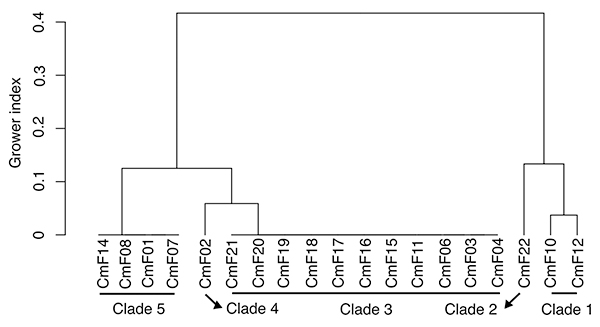
All fungal endophytes presented submerged margins, but the other cultural characteristics differed from each other (Table S1). Cluster analysis, performed using cultural data (Table S1), grouped the isolates into five clades (Fig. 2). Most endophytes were placed in the same clade (C3 - Fig. 2 and Table 2) and their culture was cream coloured on the front and back sides; scarce aerial mycelia; cream coloured and uniform margin; and velvety aspect. The isolates of clade 4 (C4) and 5 (C5) revealed similarity with C3 and were placed close to it. C4 isolates differed from C3 in aspect (smooth). C5 isolates differed from C3 in the margin uniformity (low). The clades 1 (C1) and 2 (C2) were placed near each other in the cluster and presented low similarity with the other clades (C3, C4 and C5). The two isolates from C1 were dark grey coloured on the front and black on the back; with moderate aerial mycelia; grey coloured and low uniform margin; and cottony aspect. The unique isolate from C2 differed from C1 isolates for presenting culture colour grey colour in front and dark brown in the back (grey and dark brown, respectively), and uniform and white margin.
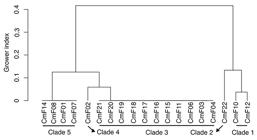
Cluster of root endophytic isolates of Cattleya milleri. The Gower index was calculated from cultural characteristics (Table S1) and analysed using the UPGMA method. Cultural data (Sup. 1) were. The cultural characteristics (front colour, back colour, aerial mycelia, colony aspect, margin colour, margin uniformity, and submerged margin) were evaluated after one week of fungal cultivation on Potato Dextrose Agar medium.
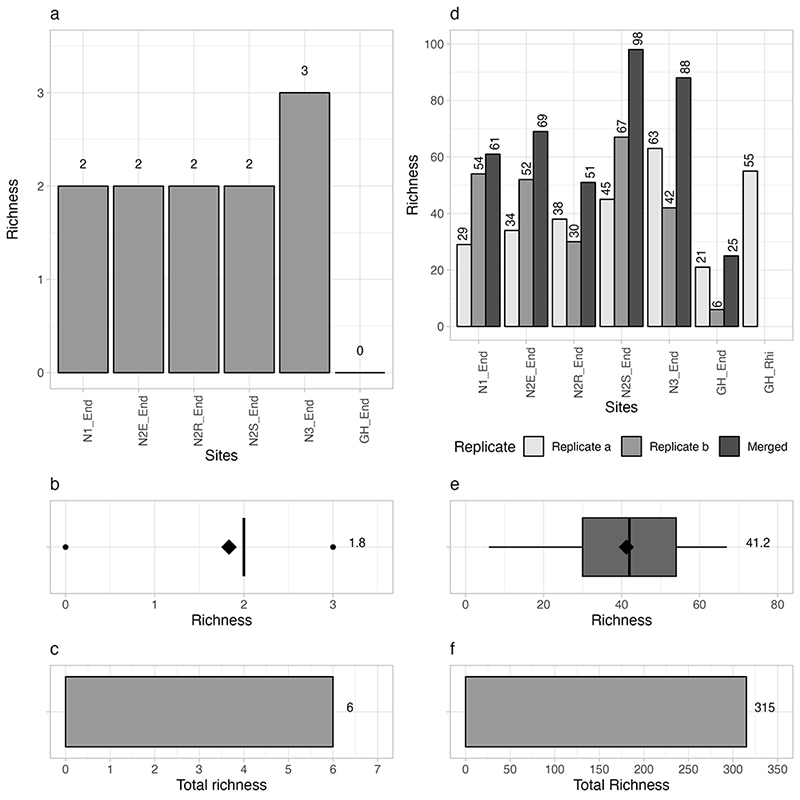
Sixteen isolates, representing the five morphological clades, were submitted to DNA extraction and ITS amplification and sequencing, ten of which produced sequences with good quality for molecular identification, thus allowing the classification of all five morphological clades (Table 2). The culture-dependent method allowed the clustering of sequences in 6 OTUs: two fungal species were obtained from roots sampled at sites N1, N2E, N2R, and N2S; three were achieved from roots of site N3; a richness mean of 1.8 species (Fig. 3 b ); and 6 species in total (Fig. 3 c ).
Sequence annotation of isolates presented two phyla, three orders, four families, three genera, and two species (Table 3). Two OTUs were annotated with high confidence as Pleosporales (ISOOTU_1 and ISOOTU_5) (Table 2). Isolates of clades C3 and C5, represented by OTUs ISOOTU_2, ISOOTU_4, and ISOOTU_6 (Fig. 2), were classified as Basidiomycota, order Cantharellales, family Tulasnellaceae and genus Tulasnella (Table 2). The unique isolate from clade C4, ISOOTU_3, was classified as Basidiomycota, order Sebacinales, and genus Serendipita. Pleosporales isolates, some Tulasnellaceae, and the Serendipta were annotated at the species level, but with low confidence (Table 2).
Number of taxa and OTUs annotated for each taxonomic level applying culture-dependent and -independent methods, samples from two root spheres (endorhiza and rhizosphere) and two environments (Natural and Greenhouse). The total of OTUs, stablished considering ITS sequence similarity of 97 %, were presented
The culture-independent method generated 56,339 ITS2 sequences. All endorhizal samples generated a positive result for fungal sequencing. Only one GH sample had a positive result for sequencing rhizospheric fungal ITS2, which was the unique rhizospheric fungal community data presented in the paper. After sequence filtering (Topic 2.4), the samples presented from 6,811 (N2Sb_End) to 923 (N2Ea_End) sequences, with site N2S_End presenting the highest sequence number (Fig. S1d). The mean of sequence per site was 4,230 (Fig. S1e) from a total of 55,001 (Fig. S1f).
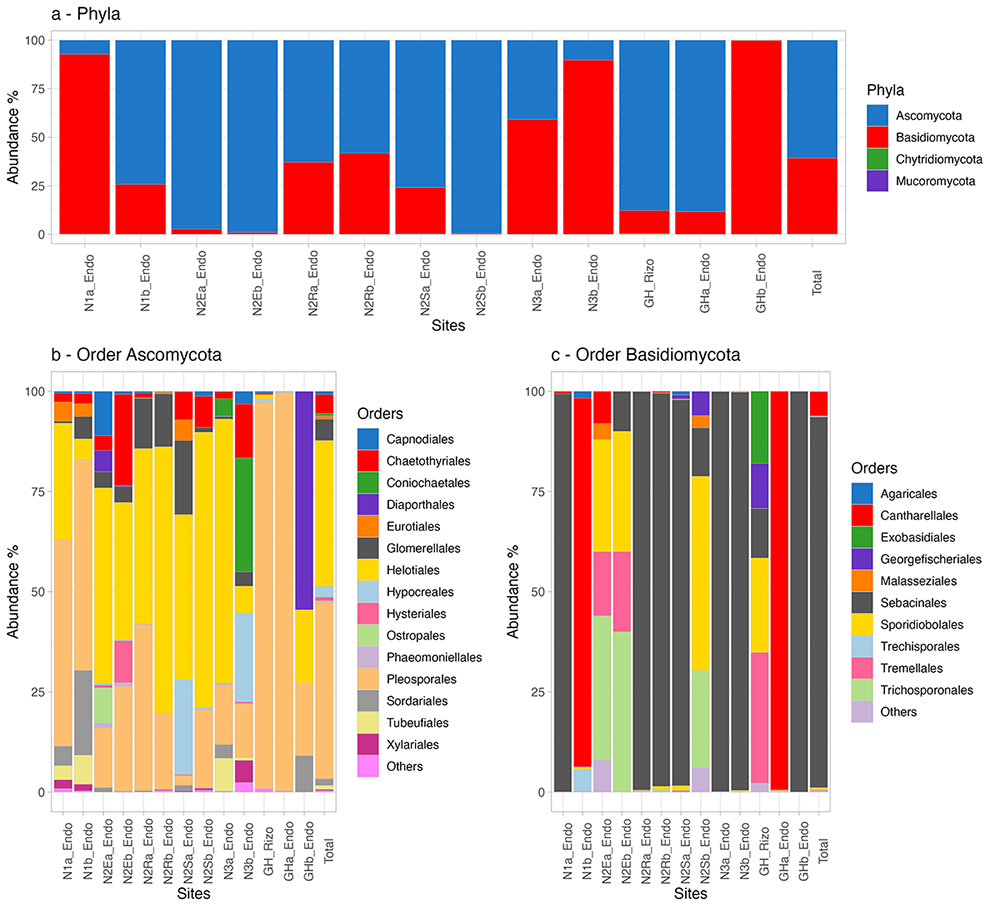
The richness per sample ranged from 67 (N2Sb_End) to 6 (GHb_End), with site N2S_End presenting the highest richness (Fig. 3 d ). The richness mean was 41 (Fig. 3 e ), from a total of 315 (Fig. 3 f ). These sequences were annotated in four phyla, 48 orders, 81 families, 93 genera and 57 species (Table 4). The fungal community on C. milleri roots varied among the samples (Fig. 4). In general, Ascomycota was the most abundant fungal phyla, occurring in higher abundance in nine sites (Fig. 4 a ). Basidiomycota occurred in high abundance in four samples. Chytridiomycota and Mucoromycota were assigned with an abundance of less than 1 %. Furthermore, as Chytridiomycota and Mucoromycota presented a few numbers of orders, only orders of Ascomycota and Basidiomycota were presented in Fig. 4.
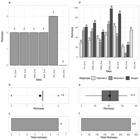
Richness, mean, and standard error of fungi associated with Cattleya milleri roots. The richness was assessed using culture-dependent (A-C) and independent (E-F) data. Culture-dependent richness (A-C) was calculated based on morphological and molecular OTU identification of isolates. Culture-independent richness (E-F) was calculated based on the number of OTUs identified from the analysis of normalised ITS2 sequence data. OTU criterion was 97 % of ITS similarity among sequences. The boxplot presenting the mean, median, and quartiles of isolates and sequences (B-E) were calculated considering site results. Site codes containing _End address for endorhizal samples and containing _Rhi for rhizospheric samples. GH address for greenhouse and codes starting with N represent samples from the natural environment.
Summary of fungal taxa observed in Cattleya milleri roots and their putative role. The environment (natural and greenhouse) and the root sphere (endorhiza and rhizosphere) where they occurred were indicated with X. Fungal classification was performed based ITS sequence analysis. The phylum, class, order, family and genus were presented. Unclassified fungi at family, genus and species were listed when the order was annotated. The putative role of fungus was annotated based on FUNGuild data source, Dearnaley et al. (2021) and Ma et al. (2015)
Twenty-seven Ascomycota orders and eighteen Basidiomycota orders were assigned on sequence data. Orders occurring in only one site were suppressed and presented as Others (Fig. 4 b and c). The orders Capnodiales, Chaetothyriales, Helotiales, and Pleosporales, from Ascomycota, as well as Cantharellales and Sebacinales, from Basidiomycota, presented an abundance higher than 4 % each. In total, around 40 % of the Ascomycota and 4 % of the Basidiomycota sequences were not classified at the order level and were presented as Unclassified (data not presented). When contrasting the number of taxa in the levels order, family, genus, and species, endorhiza presented higher taxon numbers than the rhizosphere, and the natural environment had higher taxon numbers than the greenhouse (Table 3).
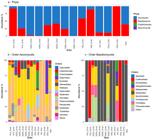
Composition of fungal community associated with endorhiza and rhizosphere of Cattleya milleri roots. Relative abundance of fungal phyla (A) and orders of Ascomycota (B) and Basidiomycota (C) were calculated from the sequence number of OTUs annotated during culture-independent ITS2 sequence analysis. Sample codes containing _End address for endorhizal samples and containing _Rhi for rhizospheric samples. GH address for greenhouse and codes starting with N represent samples from the natural environment.
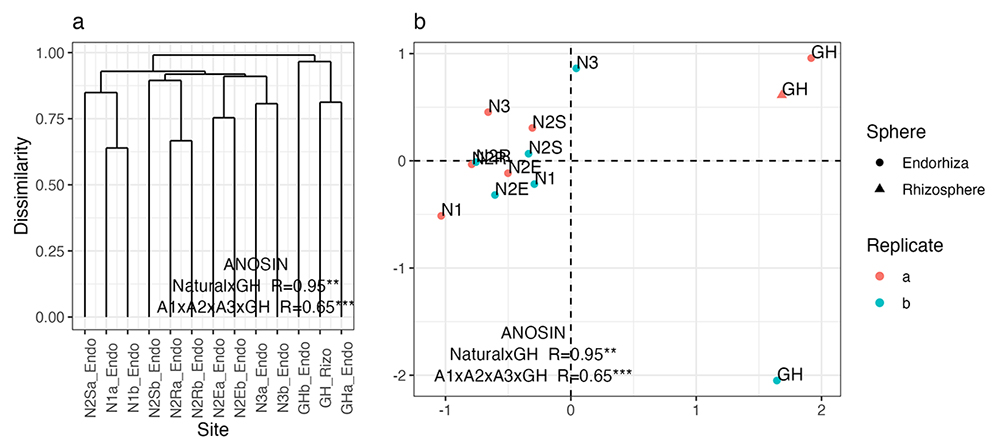
The dendrogram and NMDS results showed high divergency when contrasting fungal communities of natural samples against the greenhouse environment (Fig. 5), with samples from the natural environment forming a group distinct from samples from GH. High similarity was observed among samples of site N1 and from site N2R. Samples from endorhiza of GH presented high dissimilarity.
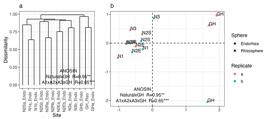
Cluster analysis of Cattleya milleri root based on their fungal OTUs. Dendrogram (A) and nonmetric multidimensional scaling analysis (NMDS - B) were calculated using the culture-independent data of the fungal community associated with endorhiza and rhizosphere of C. milleri roots. The cluster used the Jaccard dissimilarity and complete linkage method. The NMDS scores were calculated using the Bray-Curtis index. Site codes containing _End address for endorhizal samples and containing _Rhi for rhizospheric samples. GH address for greenhouse and codes starting with N represent samples from the natural environment.
Fungal occurrence in C. milleri
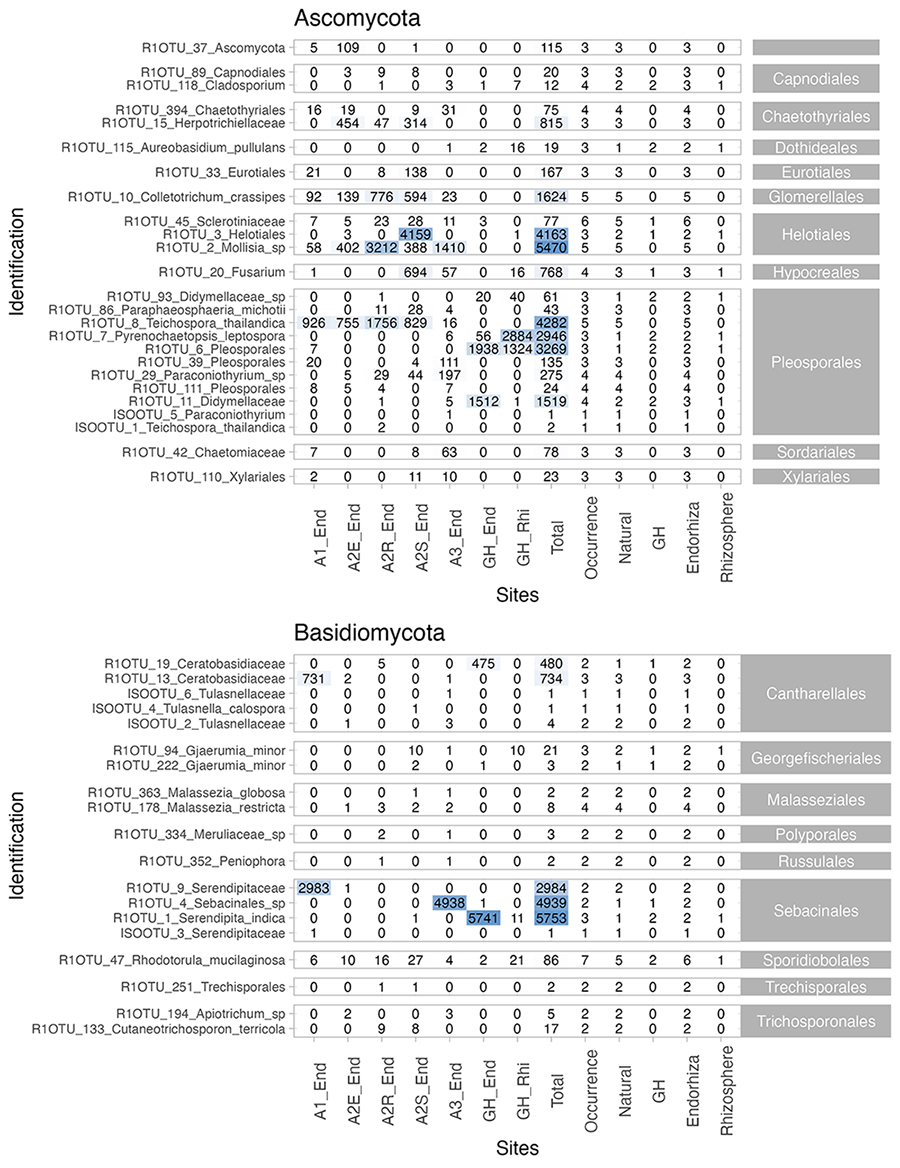
Twenty-eight OTUs occurred in at least three sites (Fig. 6). Only one OTU, the Basidiomycota fungus Rhodotorula mucilaginosa (R1OTU_47), was detected in all seven sites. This OTU and R1OTU_45, an Ascomycota from Sclerotiniaceae family, were shared by all endorhizal sites. Three other OTUs occurred only in the natural sites, Colletotrichum crassipes (R1OTU_10), Mollisia sp. (R1OTU_2), and Teichospora thailandica (R1OTU_8), all OTUs from Ascomycota, totalling five OTUs shared among these sites. Mollisia sp. was the second most abundant OTU, as the most abundant OTU was Serendipita indica, which occurred in three sites. OTUs belonging to Helotiales, Pleosporales, and Sebacinales orders detached for presenting the highest sequence numbers and occurring in all sites. As well, Capnodiales fungi were detected in all sites.
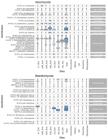
Occurrence of more abundant OTUs observed in Cattleya milleri roots. The abundance was calculated after merging culture-dependent and -independent data. The OTUs were presented by Phylum and Order. Site codes containing _End address for endorhizal samples and containing _Rhi for rhizospheric samples. GH address for greenhouse and codes starting with N represent samples from the natural environment.
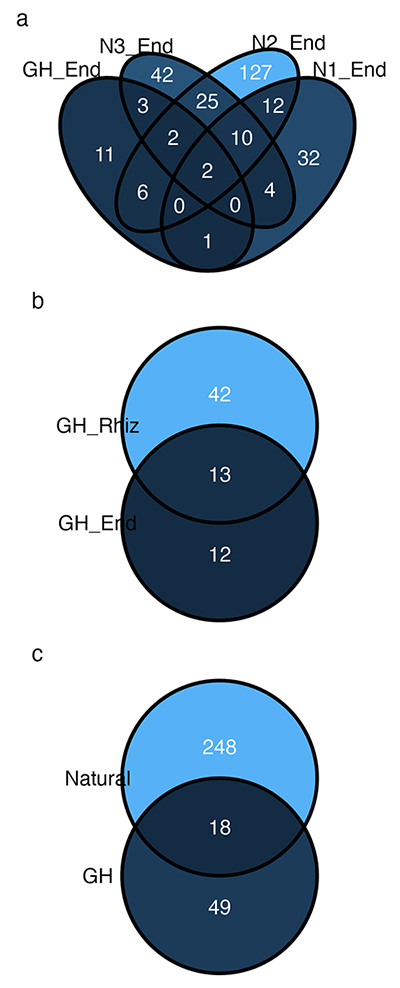
Venn diagrams showed site replicates shared from two (GH_Endo replicates) to 22 (N1_Endo replicates) OTUs (Figs. S2a-f). Venn diagram contrasting sites of N2 presented 16 OTUs shared among endorhiza of sites N2E_End, N2R_End, and N2S_End (Fig. S2g). The endorhiza of natural areas (N1_End, N2_End, and N3_End) shared 10 OTUs and only two OTUs were shared among endorhiza of different areas (N1_End, N2_End, N3_End and GH_End; Fig. 7 a ). The endorhiza and rhizosphere of GH shared 13 OTUs with GH endorhiza (Fig. 7 b ), and natural and GH environments shared 18 OTUs (Fig. 7 c ).

Venn diagram presenting the fungal OTUs of C. milleri roots shared among endorhiza of areas N1, N2, N3, and GH (A), endorhiza (GH_End) and rhizosphere (GH_Rhi) in area GH (B), and between natural and greenhouse (GH) environment (C). The diagrams were calculated using the normalised OTU data of ITS sequencing. Codes containing _End address for endorhizal space. GH address for greenhouse and codes starting with N represent samples from the natural environment.
Putative role of fungi associated with C. milleri
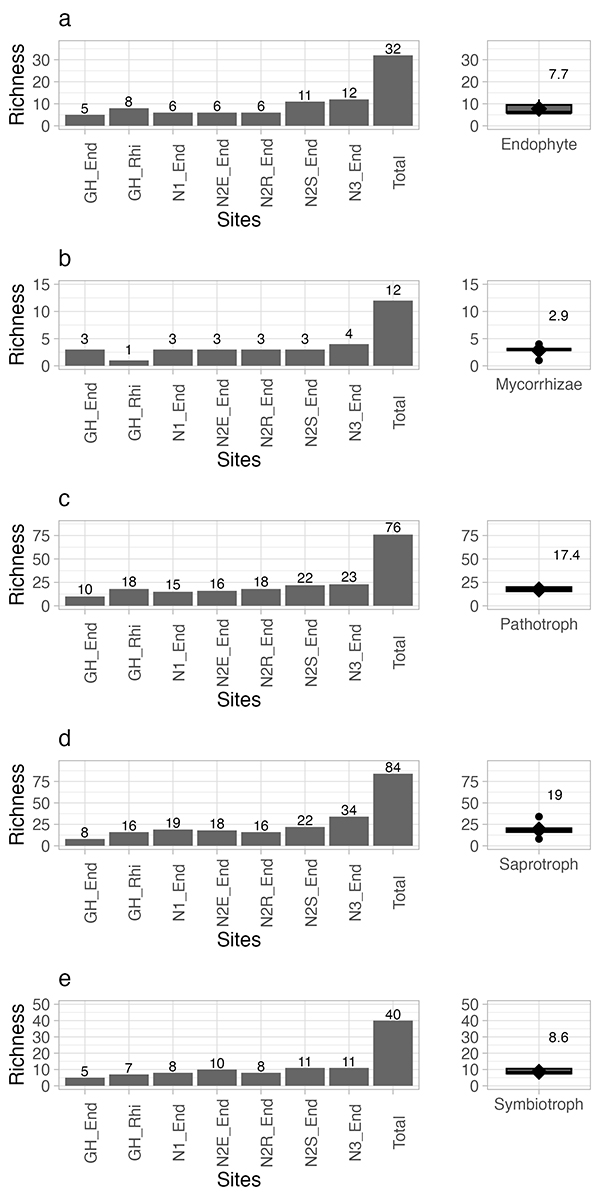
The putative role of fungi was described considering their kind of interaction with orchids (non-mycorrhizal endophyte or mycorrhizae) and their putative trophic strategy (pathotroph, saprotroph, and symbiotroph). The total number of non-mycorrhizal endophytes was higher (32) than the total of mycorrhizae (12), and occurred on an average of 7.7 and 2.9, respectively (Figs. 8a, b). However, the abundance of mycorrhizal fungi sequences was higher (19,806 in total and 2,820 on average) than non-mycorrhizae (3,306 in total and 472 on average) (Figs. S3a and b). The richness of non-mycorrhizal endophytes and mycorrhizae varied from 5 to 12 and from 1 to 4, respectively (Figs. 8a and b). Natural sites presented richness higher than the controlled environment. The non-mycorrhizal sequence abundance varied from 20 to 1,671 as mycorrhizal from 4 to 6,217 (Figs. S3a and b). The natural site N2S presented the higher non-mycorrhizal endophytic abundance, while the endorhizal sample from the greenhouse (GH_End) presented the highest mycorrhizal abundance.
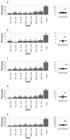
Richness, mean, and standard error of endophytes (A), mycorrhizae (B), pathotroph (C), saprotroph (D) and symbiotroph (E) fungi associated with Cattleya milleri roots. The richness was calculated after merging data culture-dependent and independent OTU data. The putative role of 134 OTUs was annotated based on FUNGuild data source, Dearnaley et al. (2021) and Ma et al. (2015). The boxplot presenting the mean, median, and quartiles of isolates and sequences richness were calculated considering site results. Site codes containing _End address for endorhizal samples and containing _Rhi for rhizospheric samples. GH address for greenhouse and codes starting with N represent samples from the natural environment.
Saprotrophic fungi were observed in higher richness (84 in total and 19 on average) and sequence abundance (13,828 in total and 1,975 on average) when contrasted to pathotrophs (richness of 76 in total and 17.4 on average; abundance of 8,015 in total and 1,145 on average) and symbiotrophs (richness of 40 in total and 8.6 on average; abundance of 8,244 in total and 1,178 on average) (Figs. 8c-e; S3c-e). Two sites from the natural environment (N2S and N3) presented the highest richness in saprotroph, pathotroph, and symbiotroph fungi. The rhizospheric sample of the greenhouse (GH_Rhi) presented the highest sequence abundance of pathotroph and saprotroph but the lowest of symbiotroph. Eighteen OTUs were shared among natural and greenhouse samples (Fig. 7): three genera were previously reported as endophyte (Cladosporium sp., Fusarium sp., and Talaromyces sp.), and three groups as mycorrhizae (Ceratobasidiaceae, Sebacinales, and Serendipita indica) in orchids. The others were not annotated or had their trophic model annotated in other systems, living as pathotroph or symbiotroph of other plants or growing as saprotroph (Table 4).
The putative role of 81 species and 67 genera were predicted (Table 4), and they belonged to phyla Ascomycota (58 species and 50 genera), Basidiomycota (22 species and 16 genera) and Mucoromycota (one species and one genera). Twenty-eight species were endophytes, two mycorrhizae, 33 pathotrophs, 42 saprotrophs, and 21 symbiotrophs. Twenty-four genera were endophytes, two mycorrhizas, 35 pathotrophs, 40 saprotrophs, and 16 symbiotrophs. species and two genera were mycorrhizae. The majority occurred in the endorhiza of roots from the natural environment (54 species and 55 genera). The GH endorhiza presented nine species and eight genera, as rhizosphere 15 species and 16 genera.
Discussion
Diversity of fungi in C. milleri roots
Cattleya milleri, a microendemic orchid in “Quadrilátero Ferrífero” region of Minas Gerais/ Brazil, presented a large endorhizal and rhizospheric fungal diversity. A richness of 327 OTUs and a mean of 41 OTUs per site were observed in roots using the culture-independent method. Moreover, the cluster and NMDS analysis presented high divergence in the root fungal community, which was supported by the low number of OTUs shared among sites, areas, and environments.
High richness of endophytes was previously observed in three orchids from “Quadrilátero Ferrífero”. Oliveira et al. (2014) observed 118 OTUs in Cattleya caulescens (Lindl.) Van den Berg, Cattleya cinnabarina (Bateman ex Lindl.) van den Berg and Cattleya jongheana (Rchb.f.) Van den Berg [former Hoffmannseggella caulescens (Lindl.) HG Jones, Hoffmannseggella cinnabarina (Bateman ex Lindl.) HG Jones and Hadrolaelia jongheana (Rchb. f.) Chiron, respectively]. These authors interpreted this diversity as high for orchids growing on ironing rock outcrops. Nevertheless, once ironing areas present stressing factors, such as compacted soil, low water content, poor nutrient content, and acid and high levels of heavy metals, the plants tend to interact with a high number of endophytes as a strategy to survive under such conditions (Oliveira et al. 2014). Therefore, the large number of fungal OTUs we observed in C. milleri corroborates the hypothesis that the ironing environment promotes interaction between plants and many endophytes.
Fungal taxa responsible for the essential process of the orchid cycle occurred in all sites, as mycorrhizal endophytes of Sebacinales and Cantharellales, as well some typical non-mycorrhizal endophytes of Capnodiales, Helotiales, and Pleosporales. Pelotons, the anatomic structure formed due to orchid mycorrhizal symbiosis, were observed in all roots selected for fungal isolation and DNA extraction, which confirmed the mycorrhizal association in C. milleri roots in all studied sites. Despite the identification of only six OTUs by culture-dependent method, mycorrhizal endophytes Serendipta and Tulanella were isolated. Sebacinales fungi, from the Basidiomycota phylum, was the unique order of orchid mycorrhizae detected in all sites, even in the greenhouse. Among the Sebacinales, one sequence was annotated as Serendipitaceae and another one as Serendipita indica (Sav. Verma, Aj. Varma, Rexer, G. Kost & P. Franken) M. Weiß, Waller, A. Zuccaro & Selosse. The genera Serendipta and Sebacina, both Sebacinales, were already reported as mycorrhizae of other native Cattleya orchids at the “Quadrilátero Ferrífero” and in “Serra do Cipó”, both regions located at Minas Gerais, Brazil (Oliveira et al. 2014; Miranda et al. 2021).
Moreover, fifteen isolates and three OTUs of Cantharellales, another order from Basidiomycota, were obtained during the culture-dependent study. All Cantharellales isolates were Tulasnella, one of the main mycorrhizal genera of Brazilian orchids (Pereira et al. 2005; 2009; 2014; Nogueira et al. 2005; 2014; Freitas et al. 2020; Miranda et al. 2021) and the unique mycorrhizal fungi previously isolated from C. milleri on the “Quadrilátero Ferrífero” during a culture-dependent study (Nogueira et al. 2005). Tulasnella was isolated from roots sampled in natural sites, but not from the greenhouse. However, neither Tulasnella nor its family Tulasnellaceae were detected among Cantharellales observed in culture-independent results. The absence of Tulasnellaceae sequences in culture-independent data may be a consequence of low homology between primers and their annealing region in the Tulasnellaceae genome, which led to none or low amplification of the ITS2 fragments of this group; or/ and due to the low abundance of this group in C. milleri roots, which could result in the absence of Tulasnella ITS2 sequences, once more abundant fungal groups would be preferentially amplified. But Tulasnella fungi corresponded to more than 75 % of the endophytic isolates, which indicates they are abundant in C. milleri roots. None or low Tulasnella ITS2 amplification, as well as high unclassified sequences, were achieved in previous papers when general primers were applied (Bidartondo et al. 2003; Suárez et al. 2006; Oliveira et al. 2014; Han et al. 2016; Jacquemyn et al. 2016; Voyron et al. 2017). Tulasnella sequences were obtained using a Tulasnellaceae-specific primer (Suárez et al. 2006; Fujimori et al. 2019), the eucaryotic-universal primers nrDNA ITS-5.8S (Suárez et al. 2006; Herrera et al. 2019) and primers that cover ITS-5.8S and the D1/D2 region of 28S rRNA (Fujimori et al. 2019). Despite the limitations of the primers applied to ITS amplification, this region is still the main fungal barcode, which can solve the identification of many related groups (Schoch et al. 2012). The use of different primer combinations would allow the amplification of a wide range of fungi and improve future diversity studies (Ma et al. 2015).
Ascomycota fungi have been frequently reported as orchid endophytes (Bayman & Otero 2006; Ma et al. 2015; Cevallos et al. 2018). In Brazil, Ascomycota was also reported as an orchid endophyte (Oliveira et al. 2014; Miranda et al. 2021), but no mycorrhizal Ascomycota, as Pezizales, was reported in Brazilian orchid roots (Dearnaley et al. 2012). Many Ascomycota are considered plant growth promoters (Bayman & Otero 2006; Ma et al. 2015; Chand et al. 2020), but few studies have clarified how they collaborate with orchid development (Ma et al. 2015; Chand et al. 2020). Capnodiales, Helotiales, and Pleosporales deserve special attention. They were detected in C. milleri roots of all sites and were reported as endophytes of native orchids from “Quadrilátero Ferrífero” (Oliveira et al. 2014) and other areas of Brazilian savanna (Miranda et al. 2021). Helotiales fungi form ectomycorrhizae and ericoid mycorrhizae (Tedersoo et al. 2009; Walker et al. 2011; Koizumi & Nara 2017). Some authors suggested some Helotiales as orchid mycorrhizal, considering that they are frequently found associated with roots of terrestrial and epiphytic orchids (Jacquemyn et al. 2016). Capnodiales fungi were reported as endophytes in neotropical orchids (Miranda et al. 2021; Cevallos et al. 2018), as Epidendrum secundum Jacq. Pleosporales was obtained during fungal isolation (three isolates) and strongly annotated during culture-independent data analysis. C. cinnabarina from the “Quadrilátero Ferrífero” also presented Phoma Sacc. (Oliveira et al. 2014), a endophytic fungi from Pleosporales. Even some Pleosporales present latent phytopathogenic and saprophytic characteristics, Makwela et al. (2022) also noted the potential of these Pleosporales acting as orchid mycorrhizae in the genus Habenaria. Thus, the mutualistic/symbiotic nature of an orchid fungal symbiont can evolve from other trophic models as a survival strategy due to changes in various molecular mechanisms (Zeilinger et al. 2016).
Even C. milleri fungal community presented high dissimilarity among sites and shared a low number of OTUs, fungi with ecological importance to orchid development were observed in almost all roots, such as mycorrhizal endophytes of Sebacinales and/ or Tulasnellaceae taxa and non-mycorrhizal endophytes of Capnodiales, Helotiales and Pleosporales orders. It suggests C. milleri requires interaction with fungi that provide essential services for its growth. A broad gamma of non-mycorrhizal endophytes from Capnodiales, Helotiales, and Pleosporales was observed, but a narrow gamma of mycorrhizae (only two genera). Indeed, the specificity of C. milleri and fungus association may change according to the fungal role - it does not require a specific non-mycorrhizal endophyte during its life cycle and presents a low specificity to them, but require specific mycorrhizal fungi, presenting high specificity to establish mycorrhizal association. In this way, the occurrence of mycorrhizae in the environment may be more limiting than the presence of non-mycorrhizal endophytes, once C. milleri recruits a narrow gamma of mycorrhizae and a large diversity of non-mycorrhizal endophytes. Then, the association of C. milleri with specific genera of mycorrhizal fungi possibly guarantees better benefits than interactions with many non-mycorrhizal fungi. Therefore, orchids can select effective fungi to support their life cycle, presenting changes in the root fungal community at a chronological level (related to the developmental phase) and spatial level (related to infected organs and the nature of interaction) (Rasmussen 2002; Oktalira et al. 2019).
Persistence in C. milleri Root Fungi across natural and greenhouse environments
The transfer of orchids from natural to greenhouse can change the diversity of fungi. In C. milleri root endorhiza, the sample from the greenhouse presented low endophyte richness and a distinct fungal community, which indicated that the greenhouse condition led to low richness and changed fungal diversity. In natural conditions, endophytic interaction acts to alleviate the stress of drought, heat, nutrient deficiency, and diseases over plant growth (Meena et al. 2017; Inbaraj 2021; Kumar et al. 2023). In general, the greenhouse is less stressful, as plants have a controlled supply of nutrients, temperature, and water, as well they are less accessible to potential pathogens. Consequently, the interaction with many endophytes is not required to ensure the resilience of the plant. Moreover, plants can present traits, such as carbon and nutrient composition, that lead to lower microbial diversity (Oono et al. 2020), besides, the low variation of abiotic conditions may reduce fungal diversity as they may increase the abundance of more adapted fungi and suppress other groups.
Contrasting fungi occurring in natural and greenhouse environments, we observed these environments shared some endophytes previously described as non-mycorrhizae and mycorrhizae of orchids. Considering the amount of OTUs, the order Pleosporales may be a relevant group of non-mycorrhizal endophytes, but Capnodiales, Eurotiales, and Hypocreales were represented by the occurrence of the respective genera Cladosporium, Fusarium and Talaromyces in both environments. These environments still shared the mycorrhizae species Serendipita indica and the other two OTUs from Ceratobasidiacea and Sebacinales. These shared endophytes may have potential applications in ex-situ orchid cultivation. Even the greenhouse presented a small number of OTUs, the richness of fungi previously described as orchid endophytes and mycorrhizae were like natural samples. It would suggest C. milleri holds a limited number of endophytes, despite the environment.
The diversity and richness of fungi in the rhizosphere and the endorhiza in greenhouse roots were different. Higher fungal richness occurred in the rhizosphere. From the 55 OTUs observed in greenhouse roots, 42 occurred in the rhizosphere, 12 in the endorhiza, and 13 in both. The rhizosphere may be a repository for root microbial endophytes (Sharma et al. 2022). Molecular signals released by the roots attract some fungi (Dearnaley et al. 2016), but the orchid may recruit fungus on its growing demand, as the 13 shared between endorhiza and rhizosphere of roots sampled in the greenhouse. As a limited number of rhizospheric samples presented positive results for PCR amplification, more efforts are necessary for better understanding the selection of endophytes from the environmental community.
Orchid Root Fungi: Their Putative Contributions
When considering putative roles, 153 OTUs (around 48 % of total richness) were annotated. Almost 48 % of these OTUs (73) represented more than one role, while nearly 40 % (61) had only one role. Even the majority of OTUs were obtained from endorhiza, a small number were endophyte (~ 21 %) and mycorrhizae (~ 8 %), against a high percentage of pathotroph (~ 50 %), saprotrophs (~ 55 %), and symbiotroph (~ 26 %). The kind of interaction established between an orchid and a fungus previously described as pathotroph, saprotroph, and/ or symbiotroph is still unclear. Rhodotorula mucilaginosa, a pathotroph and saprotroph fungi, was observed in all sites and, as many other non-symbiotrophic fungi, its role in orchid growth is not clear. Some mycorrhizal fungi may have silent or conditional pathogenicity, which is related to the health conditions of the host and their deleterious effects may arise due to environmental stress conditions or during plant senescence (Kusari et al. 2014; Alurappa et al. 2018). However, even species with pathogenic activity in other plants can be recruited by orchids as symbionts.
For instance, Sarsaiya et al. (2020) investigated the diversity of endophytic fungi in orchids of the genus Dendrobium. The researchers identified the presence of species commonly reported as pathogens, such as Fusarium keratoplasticum, F. oxysporum, and F. solani (Srivastava et al. 2018). Additionally, they observed the occurrence of vertical transmission of these fungi among orchids, where the mycorrhizal association resulted in benefits in plant host development, resistance, and alkaloid stimulation. Then many of the fungi annotated as pathotroph and saprotroph can act as endophyte or mycorrhizae. Moreover, less than half of OTUs had their putative role annotated. It shows that more studies are required to understand the interactions that orchids establish with their fungal community.
Conclusion
Our data revealed a high diversity of endophytes at the endorhiza and rhizosphere of C. milleri, with the orders Capnodiales, Helotiales, Pleosporales and Sebacinales detaching for occurring in all sites and containing putative orchid endophytes/ mycorrhiza, as well the order Cantharellales, which occurred in all the natural sites and contained putative orchid mycorrhiza. Sebacinalles (Sebacina and Serendipita genera) and Cantharellales (Ceratobasidium, Thanatephorus and Tulasnella genera) were reported as promoters of seed germination and seedling growth (Guimarães et al. 2013; Pereira et al. 2015; Hoang et al. 2017; Herrera et al. 2017; Duran-Lopez et al. 2019; Fritsche et al. 2020; Tian et al. 2021). Pleosporales contain many endophytes, such as Curvularia sp. (Table 4; Ma et al. 2015), that increment Grammatophyllum speciosum Blume embryo development (Salifah et al. 2011). High diversity of non-mycorrhizal fungi and limited taxa of mycorrhizae suggest C. milleri has low specificity during non-mycorrhizal endophytes and specificity to Sebacinales and Tulasnella mycorhizae. Isolates of Pleosporales, Sebacinales, and Tulasnella were obtained and have the potential to be used in further conservation programs of C. milleri. However, new efforts are required to obtain fungal cultures of these taxa, and from Capnodiales and Hypocreales, to perform tests of seed germination and seedling development.
Acknowledgment
This study and the scientific initiation scholarships were funded by the National Council for Scientific and Technological Development (CNPq - 429102/2016-0) and FAPEMIG (CAG - APQ-01744-13). The author FMS Moreira was supported by CNPQ (PQ CNPq 310015/2021-9). We thank “Biofábrica”, the seedling propagation laboratory of Vale SA, located in Nova Lima - MG, Brazil, for providing the greenhouse orchid samples.
References
-
Abarenkov K, Zirk A, Piirmann T et al 2020. UNITE USEARCH/UTAX release for Fungi Version 04.02.2020. https://doi.org/10.15156/BIO/786375 21 May 2022.
» https://doi.org/10.15156/BIO/786375 -
Adit A, Koul M, Kapoor R, Tandon R. 2022. Topological analysis of orchid-fungal endophyte interaction shows lack of phylogenetic preference. South African Journal of Botany 149:339-346. doi: 10.1016/j.sajb.2022.06.025.
» https://doi.org/10.1016/j.sajb.2022.06.025. -
Altschul S, Madden TL, Schäffer AA et al 1997. Gapped BLAST and PSI-BLAST: A new generation of protein database search programs. Nucleic Acids Research 25: 3389-3402. doi: 10.1093/nar/25.17.3389.
» https://doi.org/10.1093/nar/25.17.3389. -
Alurappa R, Chowdappa S, Narayanaswamy R et al 2018. Endophytic Fungi and Bioactive Metabolites Production: An Update. In: Patra J, Das G, Shin HS (eds.). Microbial Biotechnology. doi: 10.1007/978-981-10-7140-9_21.
» https://doi.org/10.1007/978-981-10-7140-9_21. - Arnold AE. 2007. Understanding the diversity of foliar endophytic fungi: Progress, challenges and frontiers. Fungal Biology Reviews 21: 51-66.
- Bayman P, Otero JT. 2006. Microbial Endophytes of Orchid Roots. In: Schulz B, Boyle C, Sieber T (eds.). Microbial Root Endophytes, Soil Biology. Berlin, Springer Berlin Heidelberg.
-
Bhatti SK, Thakur M. 2022. An Overview on Orchids and their Interaction with Endophytes. The Botanical Review 88: 485-504. doi: 10.1007/s12229-022-09275-5.
» https://doi.org/10.1007/s12229-022-09275-5. -
Bidartondo MI, Bruns TD, Weiß M et al 2003. Specialized cheating of the ectomycorrhizal symbiosis by an epiparasitic liverwort. Proceedings of the Royal Society B: Biological Sciences 270: 835-842. doi: 10.1098/rspb.2002.2299.
» https://doi.org/10.1098/rspb.2002.2299. -
Cevallos S, Herrera P, Sánchez-Rodríguez A et al 2018. Untangling factors that drive community composition of root associated fungal endophytes of Neotropical epiphytic orchids. Fungal Ecology 34: 67-75. doi: 10.1016/j.funeco.2018.05.002.
» https://doi.org/10.1016/j.funeco.2018.05.002. -
Chand K, Shah S, Sharma J et al 2020. Isolation, characterization, and plant growth-promoting activities of endophytic fungi from a wild orchid Vanda cristata Plant Signaling & Behavior 15: 1744294. doi: 10.1080/15592324.2020.1744294.
» https://doi.org/10.1080/15592324.2020.1744294. -
CNCFlora. 2020. Hoffmannseggella milleri in Lista Vermelha da flora brasileira versão 2012.2 Centro Nacional de Conservação da Flora. http://cncflora.jbrj.gov.br/portal/pt-br/profile/Hoffmannseggella milleri 21 May 2022.
» http://cncflora.jbrj.gov.br/portal/pt-br/profile/Hoffmannseggella milleri - Cribb PJ, Kell SP, Dixon KW, Barrett RL. 2003. Orchid Conservation: A Global Perspective. In: Dixon KW, Kell SP, Barrett RL, Cribb PJ (eds.). Orchid Conservation. Kota Kinabalu, Natural History Publications. p. 1-24.
-
Dearnaley J, Perotto S, Selosse MA. 2016. Structure and development of orchid mycorrhizas. In: Molecular Mycorrhizal Symbiosis. New Jersey, John Wiley & Sons, Inc. p. 63-86. doi: 10.1002/9781118951446.ch5.
» https://doi.org/10.1002/9781118951446.ch5. -
Dearnaley JDW, Martos F, Selosse MA. 2012. 12 Orchid Mycorrhizas: Molecular Ecology, Physiology, Evolution and Conservation Aspects. In: Fungal Associations. Berlin, Springer Berlin Heidelberg . p. 207-230. doi: 10.1007/978-3-642-30826-0_12.
» https://doi.org/10.1007/978-3-642-30826-0_12 -
Dodson CH. 2022. Orchid. Encyclopedia Britannica. https://www.britannica.com/plant/orchid 26 Jul. 2023.
» https://www.britannica.com/plant/orchid -
Duran-Lopez ME, Caroca-Caceres R, Jahreis K et al 2019. The micorryzal fungi Ceratobasidium sp. and Sebacina vermifera promote seed germination and seedling development of the terrestrial orchid Epidendrum secundum Jacq. South African Journal of Botany 125: 54-61. doi: 10.1016/j.sajb.2019.06.029.
» https://doi.org/10.1016/j.sajb.2019.06.029. -
Edgar RC. 2013. UPARSE: Highly accurate OTU sequences from microbial amplicon reads. Nature Methods 10: 996-998. doi: 10.1038/nmeth.2604.
» https://doi.org/10.1038/nmeth.2604. -
Fernandes- Filho EI, Schaefer CEGR, Faria RM, Lopes A, Francelino MR, Gomes LC. 2022. The unique and endangered Campo Rupestre vegetation and protected areas in the Iron Quadrangle, Minas Gerais, Brazil. Journal for Nature Conservation 66: 126131. doi: 10.1016/j.jnc.2022.126131.
» https://doi.org/10.1016/j.jnc.2022.126131. -
Figura T, Tylová E, Jersáková J, Vohník M, Ponert J. 2021. Fungal symbionts may modulate nitrate inhibitory effect on orchid seed germination. Mycorrhiza 31: 231-241. doi: 10.1007/s00572-021-01021-w.
» https://doi.org/10.1007/s00572-021-01021-w. -
Freitas EFS, Silva M, Cruz ES et al 2020. Diversity of mycorrhizal Tulasnella associated with epiphytic and rupicolous orchids from the Brazilian Atlantic Forest, including four new species. Scientific Reports 10 : 7069. doi: 10.1038/s41598-020-63885-w.
» https://doi.org/10.1038/s41598-020-63885-w. -
Fritsche Y, Lopes ME, Selosse MA et al 2020. Serendipita restingae sp. nov. (Sebacinales): An orchid mycorrhizal agaricomycete with wide host range. Mycorrhiza 31: 1-15. doi: 10.1007/s00572-020-01000-7.
» https://doi.org/10.1007/s00572-020-01000-7. -
Fujimori S, Abe JP, Okane I, Yamaoka Y. 2019. Three new species in the genus Tulasnella isolated from orchid mycorrhiza of Spiranthes sinensis var. amoena (Orchidaceae). Mycoscience 60: 71-81. doi: 10.1016/j.myc.2018.09.003.
» https://doi.org/10.1016/j.myc.2018.09.003. -
Gantait S, Kundu S. 2017. In vitro biotechnological approaches on Vanilla planifolia Andrews: Advancements and opportunities. Acta Physiologiae Plantarum 39: 1-19. doi: 10.1007/s11738-017-2462-1.
» https://doi.org/10.1007/s11738-017-2462-1. -
Guimarães FAR, Pereira MC, Felício CS et al 2013. Symbiotic propagation of seedlings of Cyrtopodium glutiniferum Raddi (Orchidaceae). Acta Botanica Brasilica 27: 590-596. doi: 10.1590/S0102-33062013000300016.
» https://doi.org/10.1590/S0102-33062013000300016. -
Han JY, Xiao H, Gao J. 2016. Seasonal dynamics of mycorrhizal fungi in Paphiopedilum spicerianum (Rchb. f) Pfitzer - A critically endangered orchid from China. Global Ecology and Conservation 6: 327-338. doi: 10.1016/j.gecco.2016.03.011.
» https://doi.org/10.1016/j.gecco.2016.03.011. -
Herrera H, Soto J, de Bashan LE et al 2019. Root-Associated Fungal Communities in Two Populations of the Fully Mycoheterotrophic Plant Arachnitis uniflora Phil. (Corsiaceae) in Southern Chile. Microorganisms 7: 586. doi: 10.3390/microorganisms7120586.
» https://doi.org/10.3390/microorganisms7120586. -
Herrera H, Valadares R, Contreras D et al 2017. Mycorrhizal compatibility and symbiotic seed germination of orchids from the Coastal Range and Andes in south central Chile. Mycorrhiza 27: 175-188. doi: 10.1007/s00572-016-0733-0.
» https://doi.org/10.1007/s00572-016-0733-0. -
Hoang NH, Kane ME, Radcliffe EN et al 2017. Comparative seed germination and seedling development of the ghost orchid, Dendrophylax lindenii (Orchidaceae), and molecular identification of its mycorrhizal fungus from South Florida. Annals of Botany 119. doi: 10.1093/aob/mcw220.
» https://doi.org/10.1093/aob/mcw220. -
Hossain MM. 2022. Orchid mycorrhiza: Isolation, culture, characterization and application. South African Journal of Botany 151: 365-384. doi: 10.1016/j.sajb.2022.10.003.
» https://doi.org/10.1016/j.sajb.2022.10.003. -
Inbaraj MP. 2021. Plant-Microbe Interactions in Alleviating Abiotic Stress - A Mini Review. Frontiers in Agronomy 28. doi: 10.3389/fagro.2021.667903.
» https://doi.org/10.3389/fagro.2021.667903. -
Jacquemyn H, Waud M, Lievens B, Brys R. 2016. Differences in mycorrhizal communities between Epipactis palustris, E. helleborine and its presumed sister species E. neerlandica Annals of Botany 118: 105-114. doi: 10.1093/aob/mcw015.
» https://doi.org/10.1093/aob/mcw015. -
Juras MCR, Jorge J, Pescador R, Ferreira WDM, Tamaki V, Suzuki RM. 2019. In vitro culture and acclimatization of Cattleya xanthina (Orchidaceae), an endangered orchid of the Brazilian Atlantic Rainforest. Rodriguésia 70: e01422017. doi: 10.1590/2175-7860201970014.
» https://doi.org/10.1590/2175-7860201970014. -
Koizumi T, Nara K. 2017. Communities of Putative Ericoid Mycorrhizal Fungi Isolated from Alpine Dwarf Shrubs in Japan: Effects of Host Identity and Microhabitat. Microbes and Environments 32: 147-153. doi: 10.1264/jsme2.ME16180.
» https://doi.org/10.1264/jsme2.ME16180. -
Kumar A, Maurya VK, Susmita C et al 2023. Chapter 15 - Environmental factors and plant-microbes (endophytes) interaction: An overview and future outlook. In: Microbial Endophytes and Plant Growth. Cambridge, Academic Press, p. 245-257. doi: 10.1016/B978-0-323-90620-3.00009-X.
» https://doi.org/10.1016/B978-0-323-90620-3.00009-X. -
Kunakhonnuruk B, Inthima P, Kongbangkerd A. 2018. In vitro propagation of Epipactis flava Seidenf., an endangered rheophytic orchid: A first study on factors affecting asymbiotic seed germination, seedling development and greenhouse acclimatization. Plant Cell, Tissue and Organ Culture 135: 419-432. doi: 10.1007/s11240-018-1475-9.
» https://doi.org/10.1007/s11240-018-1475-9. - Kusari P, Spiteller M, Kayser O, Kusari S. 2014. Recent Advances in Research on Cannabis sativa L. Endophytes and Their Prospect for the Pharmaceutical Industry. In: Kharwar R, Upadhyay R, Dubey N, Raghuwanshi R (eds.). Microbial Diversity and Biotechnology in Food Security. Berlin, Springer. p. 3-16.
-
Li T, Yang W, Wu S et al 2021a. Progress and Prospects of Mycorrhizal Fungal Diversity in Orchids. Frontiers in Plant Science 12. doi: 10.3389/fpls.2021.646325.
» https://doi.org/10.3389/fpls.2021.646325. -
Li Y, Kang Z, Zhang X et al 2021b. The mycorrhizal fungi of Cymbidium promote the growth of Dendrobium officinale by increasing environmental stress tolerance. PeerJ 9: e12555. doi: 10.7717/peerj.12555.
» https://doi.org/10.7717/peerj.12555. - Ma X, Kang J, Nontachaiyapoom S, Wen T, Hyde KD. 2015. Non-mycorrhizal endophytic fungi from orchids. Current Science 109: 36-51.
-
Mahendran G, Muniappan V, Ashwini M et al 2013. Asymbiotic seed germination of Cymbidium bicolor Lindl. (Orchidaceae) and the influence of mycorrhizal fungus on seedling development. Acta Physiologiae Plantarum 35: 829-840. doi: 10.1007/s11738-012-1127-3.
» https://doi.org/10.1007/s11738-012-1127-3. -
Makwela MC, Hammerbacherb A, Vivasc M et al 2022. Uncovering the mycorrhizal community of two Habenaria orchids in South Africa. South African Journal of Botany 146: 856-863. doi: 10.1016/j.sajb.2022.02.020.
» https://doi.org/10.1016/j.sajb.2022.02.020. -
Meena KK, Sorty AM, Bitla U et al 2017. Abiotic stress responses and microbe-mediated mitigation in plants: The omics strategies. Frontiers in Plant Science 8: 172. doi: 10.3389/fpls.2017.00172.
» https://doi.org/10.3389/fpls.2017.00172. -
Miranda L, Pereira MC, Veloso TGR et al 2021. Endophytic fungi in roots of native orchids of rupestrian grasslands (campos rupestres) in Serra do Cipó, Brazil. Iheringia, Série Botânica 76: e2021021. doi: 10.21826/2446-82312021v76e2021021.
» https://doi.org/10.21826/2446-82312021v76e2021021. -
Nguyen NH, Song Z, Bates ST et al 2016. FUNGuild: An open annotation tool for parsing fungal community datasets by ecological guild. Fungal Ecology 20: 241-248. 10.1016/j.funeco.2015.06.006.
» https://doi.org/10.1016/j.funeco.2015.06.006 -
Nogueira RE, Berg C, Pereira OL, Kasuya MCM. 2014. Isolation and molecular characterization of Rhizoctonia-like fungi associated with orchid roots in the Quadrilátero Ferrífero and Zona da Mata regions of the state of Minas Gerais, Brazil. Acta Botanica Brasilica 28: 298-300. doi: 10.1590/S0102-33062014000200017.
» https://doi.org/10.1590/S0102-33062014000200017. -
Nogueira RE, Pereira OL, Kasuya MCM et al 2005. Fungos micorrízicos associados a orquídeas em campos rupestres na região do Quadrilátero Ferrífero, MG, Brasil. Acta Botanica Brasilica 19: 298-300. doi: 10.1590/S0102-33062005000300001.
» https://doi.org/10.1590/S0102-33062005000300001. -
Oksanen J, Blanchet FG, Friendly M et al 2017. Vegan: Community Ecology Package. R package version 2.0-2. https://www.researchgate.net/publication/282247686_Vegan_Community_Ecology_Package_R_package_version_20-2. 26 Jul. 2023.
» https://www.researchgate.net/publication/282247686_Vegan_Community_Ecology_Package_R_package_version_20-2. -
Oktalira FT, Whitehead MR, Linde CC. 2019. Mycorrhizal specificity in widespread and narrow-range distributed Caladenia orchid species. Fungal Ecology 42: 100869. doi: 10.1016/j.funeco.2019.100869.
» https://doi.org/10.1016/j.funeco.2019.100869. -
Oliveira SF, Bocayuva MF, Veloso TGR et al 2014. Endophytic and mycorrhizal fungi associated with roots of endangered native orchids from the Atlantic Forest, Brazil. Mycorrhiza 24: 55-64. doi: 10.1007/s00572-013-0512-0.
» https://doi.org/10.1007/s00572-013-0512-0. -
Oono R, Black D, Slessarev E et al 2020. Species diversity of fungal endophytes across a stress gradient for plants. New Phytologist 228: 210-225. doi: 10.1111/nph.16709.
» https://doi.org/10.1111/nph.16709. -
Pereira MC, Silva CI, Silva VRB et al 2014. Morphological and molecular characterization of Tulasnella spp. fungi isolated from the roots of Epidendrum secundum, a widespread Brazilian orchid. Symbiosis 62: 111-121. doi: 10.1007/s13199-014-0276-0.
» https://doi.org/10.1007/s13199-014-0276-0. -
Pereira MC, Pereira OL, Costa MD et al 2009. Diversidade de fungos micorrízicos Epulorhiza spp. isolados de Epidendrum secundum (Orchidaceae). Revista Brasileira de Ciência do Solo 33: 1187-97. doi: 10.1590/S0100-06832009000500012.
» https://doi.org/10.1590/S0100-06832009000500012. -
Pereira MC, Rocha DI, Veloso TGR et al 2015. Characterization of seed germination and protocorm development of Cyrtopodium glutiniferum (Orchidaceae) promoted by mycorrhizal fungi Epulorhiza spp. Acta Botanica Brasilica 29: 567-74. doi: 10.1590/0102-33062015abb0078.
» https://doi.org/10.1590/0102-33062015abb0078. - Pereira MC, Valadares RBS. 2012. Diversidade e aplicação dos fungos micorrízicos de orquídeas brasileiras. In: Pazza R, Souza EA, Pereira JD et al (eds.). Biodiversidade em foco. Rio Paranaíba, Araucária Comunicação Integrada.
- Pereira MC, Valadares RBS. 2017. Perspectivas de utilização de fungos micorrízicos de orquídeas. In: Moreira FMS, Kasuya MCM (eds.). Fertilidade e biologia do solo - Integração e tecnologia para todos. Viçosa, Sociedade Brasileira de Ciência do Solo.
-
Pereira OL, Kasuya MCM, Borges AC, Araújo EF. 2005. Morphological and molecular characterization of mycorrhizal fungi isolated from neotropical orchids in Brazil. Canadian Journal of Botany 83: 54-65. doi: 10.1139/b04-151.
» https://doi.org/10.1139/b04-151. - Peterson RL, Massicotte HB, Melville LH. 2004. Mycorrhizas: Anatomy and cell biology. Ottawa, NRC Research Press.
- R Core Team. 2019. R: A language and environment for statistical computing. Austria, R Foundation for Statistical Computing.
-
Rasmussen HN. 2002. Recent developments in the study of orchid mycorrhiza. Plant Soil 244: 149-163. doi: 10.1023/A:1020246715436.
» https://doi.org/10.1023/A:1020246715436. -
Rasmussen HN, Dixon KW, Jersáková J, Těšitelová T. 2015. Germination and seedling establishment in orchids: a complex of requirements. Annals of Botany 116: 391-402 . doi: 10.1093/aob/mcv087.
» https://doi.org/10.1093/aob/mcv087. -
RStudio Team. 2020. RStudio: Integrated Development for R. http://www.rstudio.com/ 21 May 2022.
» http://www.rstudio.com/ - Salifah HAB, Muskhazli M, Rusea G, Nithiyaa P. 2011. Variation in mycorrhizal specificity for in vitro symbiotic seed germination of Grammatophyllum speciosum Blume. Sains Malaysiana 40: 451-455.
-
Sarsaiya S, Jain A, Jia Q et al 2020. Molecular Identification of Endophytic Fungi and Their Pathogenicity Evaluation Against Dendrobium nobile and Dendrobium officinale International Journal of Molecular Sciences 21: 316. doi: 10.3390/ijms21010316.
» https://doi.org/10.3390/ijms21010316. -
Schäfer C, Wöstemeyer J. 1992. Random Primer Dependent PCR Differentiates Aggressive from Non-Aggressive Isolates of the Oilseed Rape Pathogen Phoma lingam (Leptosphaeria maculans). Journal of Phytopathology 136: 124-136. doi: 10.1111/j.1439-0434.1992.tb01290.x.
» https://doi.org/10.1111/j.1439-0434.1992.tb01290.x. -
Schoch CL, Seifert KA, Huhndorf S et al 2012. Nuclear ribosomal internal transcribed spacer (ITS) region as a universal DNA barcode marker for Fungi. Proceedings of the National Academy of Sciences 109: 6241-6246. doi: 10.1073/pnas.1117018109.
» https://doi.org/10.1073/pnas.1117018109. -
Selosse MA, Petrolli R, Mujica MI et al 2022. The Waiting Room Hypothesis revisited by orchids: Were orchid mycorrhizal fungi recruited among root endophytes? Annals of Botany 129: 259-270. doi: 10.1093/aob/mcab134.
» https://doi.org/10.1093/aob/mcab134. -
Shah S, Thapa BB, Chand K et al 2019. Piriformospora indica promotes the growth of the in-vitro-raised Cymbidium aloifolium plantlet and their acclimatization. Plant Signaling & Behavior 14: 1-7. doi: 10.1080/15592324.2019.1596716.
» https://doi.org/10.1080/15592324.2019.1596716. -
Sharma B, Singh BN, Dwivedi P, Rajawat MVS. 2022. Interference of Climate Change on Plant-Microbe Interaction: Present and Future Prospects. Frontiers in Agronomy 3: 725804. doi: 10.3389/fagro.
» https://doi.org/10.3389/fagro. -
Silveira FAO, Negreiros D, Barbosa NPU et al 2016. Ecology and evolution of plant diversity in the endangered campo rupestre: A neglected conservation priority. Plant Soil 403: 129-152. doi: 10.1007/s11104-015-2637-8.
» https://doi.org/10.1007/s11104-015-2637-8 -
Sisti LS, Borges DNAF, Andrade SA et al 2019. The Role of Non-Mycorrhizal Fungi in Germination of the Mycoheterotrophic Orchid Pogoniopsis schenckii Cogn. Frontiers in Plant Science 10. doi: 10.3389/fpls.2019.01589.
» https://doi.org/10.3389/fpls.2019.01589. -
Srivastava S, Kadooka C, Uchida JY. 2018. Fusarium species as pathogen on orchids. Microbiological Research 207: 188-195. doi: 10.1016/j.micres.2017.12.002.
» https://doi.org/10.1016/j.micres.2017.12.002. -
Suárez JP, Weiß M, Abele A et al 2006. Diverse tulasnelloid fungi form mycorrhizas with epiphytic orchids in an Andean cloud forest. Mycological Research 110: 1257-1270. doi: 10.1016/j.mycres.2006.08.004.
» https://doi.org/10.1016/j.mycres.2006.08.004 -
Tedersoo L, Pärtel K, Jairus T et al 2009. Ascomycetes associated with ectomycorrhizas: Molecular diversity and ecology with particular reference to the Helotiales Environmental Microbiology 11: 3166-3178. doi: 10.1111/j.1462-2920.2009.02020.x.
» https://doi.org/10.1111/j.1462-2920.2009.02020.x. -
Teixeira WA, Lemos Filho JP. 2013. A flórula rupestre do Pico de Itabirito, Minas Gerais, Brasil: lista das plantas vasculares. Boletim de Botânica 31: 199-230. doi: 10.11606/issn.2316-9052.v31i2p199-230.
» https://doi.org/10.11606/issn.2316-9052.v31i2p199-230. -
Thakur J, Dwivedi MD, Uniyal PL. 2018. Ultrastructural studies and molecular characterization of root-associated fungi of Crepidium acuminatum (D. Don) Szlach.: A threatened and medicinally important taxon. Journal of Genetics 97: 1139-1146. doi: 10.1007/s12041-018-1007-8.
» https://doi.org/10.1007/s12041-018-1007-8. -
Tian F, Liao XF, Wang LH et al 2021. Isolation and identification of beneficial orchid mycorrhizal fungi in Paphiopedilum barbigerum (Orchidaceae). Plant Signaling & Behavior 17. doi: 10.1080/15592324.2021.2005882.
» https://doi.org/10.1080/15592324.2021.2005882. -
Voyron S, Ercole E, Ghignone S et al 2017. Fine-scale spatial distribution of orchid mycorrhizal fungi in the soil of host-rich grasslands. New Phytologist 213: 1428-1439. doi: 10.1111/nph.14286.
» https://doi.org/10.1111/nph.14286. -
Walker JF, Aldrich-Wolfe L, Riffel A et al 2011. Diverse Helotiales associated with the roots of three species of Arctic Ericaceae provide no evidence for host specificity. New Phytologist 191: 515-527. doi: 10.1111/j.1469-8137.2011.03703.x.
» https://doi.org/10.1111/j.1469-8137.2011.03703.x. -
Wang X, Yam TW, Meng Q et al 2016. The dual inoculation of endophytic fungi and bacteria promotes seedlings growth in Dendrobium catenatum (Orchidaceae) under in vitro culture conditions. Plant Cell, Tissue and Organ Culture 126: 523-531. doi: 10.1007/s11240-016-1021-6.
» https://doi.org/10.1007/s11240-016-1021-6. -
Waud M, Busschaert P, Lievens B, Jacquemyn H. 2016. Specificity and localised distribution of mycorrhizal fungi in the soil may contribute to co-existence of orchid species. Fungal Ecology 20: 155-165. doi: 10.1016/j.funeco.2015.12.008.
» https://doi.org/10.1016/j.funeco.2015.12.008. - White TJ, Bruns T, Lee S, Taylor J. 1990. Amplification and Direct Sequencing of Fungal Ribosomal RNA Genes for Phylogenetics. In: Innis MA, Garfield DH, Sninsky JJ, White TJ (eds.). PCR Protocols: A guide to methods and applications. Cambridge, Academic Press, Inc . p. 315-322.
-
Wickham H. 2016. ggplot2: Elegant Graphics for Data Analysis. https://ggplot2.tidyverse.org 20 Jan, 2023.
» https://ggplot2.tidyverse.org -
Wraith J, Pickering C. 2019. A continental scale analysis of threats to orchids. Biological Conservation 234: 7-17. doi: 10.1016/j.biocon.2019.03.015.
» https://doi.org/10.1016/j.biocon.2019.03.015. -
Yeh CM, Chung K, Liang CK, Tsai WC. 2019. New Insights into the Symbiotic Relationship between Orchids and Fungi. Applied Sciences 9: 585. doi: 10.3390/app9030585.
» https://doi.org/10.3390/app9030585. -
Zeilinger S, Gupta VK, Dahms TE et al 2016. Friends or foes? Emerging insights from fungal interactions with plants. FEMS Microbiol Rev 40: 182-207. doi: 10.1093/femsre/fuv045.
» https://doi.org/10.1093/femsre/fuv045. -
Zhao DK, Selosse MA, Wu L, Luo Y, Shao SC, Ruan YL. 2021. Orchid Reintroduction Based on Seed Germination-Promoting Mycorrhizal Fungi Derived From Protocorms or Seedlings. Frontier in Plant Science. 12: 701152. doi: 10.3389/fpls.2021.701152.
» https://doi.org/10.3389/fpls.2021.701152.
Supplementary Material
The following online material are available for this article:
Fig. S1
Fig. S2
Fig. S3
Table S1