 Phenological mismatches of Myracrodruon urundeuva Allemão (Aroeira) between an anthropogenic and preserved Caatinga fragment
Abstract
Plant phenological responses are highly sensitive to micro- and macroclimatic changes, which can be intensified by anthropogenic disturbances in the Caatinga. This study investigates the differences in the phenological timing (i.e., phenological mismatches) of vegetative and reproductive phenophases of Myracrodruon urundeuva Allemão (Aroeira) in a young and mature anthropogenic forest area within the same Caatinga fragment. We tested the effects of temperature and precipitation on the temporal variation of the phenophases. For one year, plants from a young forest area (21 years) and a mature forest area (over 90 years) were monitored monthly to record vegetative phenophases (leaf emergence, senescence, and leaf abscission) and reproductive phenophases (flowering and fruiting). We calculated the activity (presence/absence) and phenological intensity of the plants. Circular statistics were used to study phenological patterns in both forests. Compared to the mature forest, the younger forest exhibited increased leaf emergence and a prolonged period of leaf abscission. Early fruiting observed in the anthropized forest may affect its reproductive success, depending on annual precipitation patterns for the germination of its recalcitrant seeds. Decreased rainfall and higher temperatures in the Brazilian semi-arid region increase the vulnerability of this tree, potentially aggravated by anthropogenic disturbances.
Keywords:
Caatinga; flowering; fruiting; woody resource; young forest
Introduction
Plants are extremely sensitive to climatic fluctuations in temperature and precipitation, which have a significant impact on their vegetative and reproductive growth cycles (Schwartz, 2003; Richardson et al., 2013; Luna-Nieves et al., 2017). In semi-arid environments, these variables are even more critical, as the distribution of annual precipitation, as well as its interannual and seasonal variability, are key determinants of the timing of phenophases (Amorim et al., 2009; Miranda et al., 2014; Zeppel et al., 2014; Silva et al., 2023 a ,b). Temperature variations are considered a secondary 'trigger' (Chambers et al., 2013; Morellato et al., 2013) that interacts with water availability and can affect the activity and intensity of vegetative phenophases.
Although plants may exhibit plasticity in their response, anticipating or delaying phenological events (Lesica & Kittelson, 2010; Dunnell & Travers, 2011; Aguiar et al., 2020), the magnitude of this plasticity can be affected by species sensitivity to temperature, photoperiod, and water restriction (Amorim et al., 2009; Richardson et al., 2013; Oliveira et al., 2015). Woody vegetation in the Caatinga loses its leaves and reproduces (flowering and fruiting) during the dry season (Machado et al., 1997; Amorim et al., 2009), a period of higher temperature and lower water availability. These phenological responses allow diaspore dispersion to occur close to the beginning of the next rainy season (Souza et al., 2014; Silva et al., 2023 a ), a period when soil water availability is higher, favoring germination and seedling growth (Silva et al., 2015). Other species adjust the occurrence of their reproductive phenophases to the rainy season or the transition between climatic seasons (Araújo et al., 2007; Silva et al., 2023a; Aguiar et al., 2024), but a complete absence of reproduction within the population may occur if the total annual precipitation is deficient (Amorim et al., 2009; Luna-Nieves et al., 2017).
However, anthropogenic actions may also induce changes in microclimate conditions in the forest. Removal of plant cover for the establishment of agro-pastoral systems and selective plant cutting, for example, are frequent in semi-arid areas. Some areas are abandoned after use, and the forest naturally regenerates, forming a landscape mosaic of small young forests, with little diversity of microhabitats and, sometimes, isolated from the mature forests (Calegari et al., 2010; Araujo et al., 2019).
The microclimate conditions in young anthropogenic forests, particularly those in early successional stages, differ from the interior of mature forests due to higher incidence of sunlight and wind speed, as well as lower relative humidity (Athayde & Morellato, 2014; Araujo et al., 2017). The interaction of these variables increases evapotranspiration and decreases soil water availability, which can impact plant growth and the natural regeneration process of the forest. Moreover, they may also cause changes in the timing of annual phenophases, including inhibition, anticipation, or delay in flowering and fruiting, as well as reduced production of flowers and fruits (Amorim et al., 2009; Dunnell & Travers, 2011; Silva et al., 2015; Araujo et al., 2017; Araujo et al., 2019; Aguiar et al., 2020; Silva et al., 2023b). Thus, the conditions of forests at different ages can be very heterogeneous between years and seasons, causing greater variation in the phenological responses of plants. Therefore, describing the phenological responses of plants in mature and young forests allows for tracking changes in the ecophysiology of species and highlighting adjustment strategies. These strategies can be used to define actions that aid in the conservation of natural systems (Morellato et al., 2016).
Understanding variations in plant phenological responses becomes more important, chiefly because numerous species are significant resources for the survival of low-income families in semi-arid areas (Nascimento et al., 2019). The use pressure is often intense, and some species are already classified as vulnerable in the IUCN Red List of Endangered Species (Rivers, 2024). These species are not able to recover swiftly from the impacts of recurrent use or anthropogenic disturbances in forests. A good case study is Myracrodruon urundeuva Allemão ("aroeira-do-sertão"), a woody dioecious plant widely used and traded by local populations due to its medicinal and timber value (Monteiro et al., 2011 a ; Silva et al., 2019), which is on the IUCN Red List of Threatened Species (Prado, 1998). For this species, future climate scenarios indicate a significant reduction in the potential occurrence area, notably affected by deforestation (Capo et al., 2022).
Considering the aforementioned assumptions, this study aims to evaluate the differences in the activity and intensity of vegetative and reproductive phenophases in two populations of Myracrodruon urundeuva, located in a young anthropized forest area and a preserved forest area within the same fragment of Caatinga. We expect to identify significant differences in the timing, intensity, and synchrony of these phenophases, which we attribute to the historical effect of the anthropization process that the area has undergone. Additionally, we intend to assess how climatic variations, particularly temperature and precipitation, may influence the phenological rhythm of this valuable tree species in the semi-arid region of northeastern Brazil.
Materials and Methods
Study area
The study was conducted at the Experimental Station of the Instituto Agronômico de Pernambuco - IPA (8º14'18" S and 35º55'20" W, 537m altitude) in Caruaru municipality, Pernambuco, Brazil. The climate is classified as semi-arid BSh according to the Köppen classification, with a mean temperature of 21.7ºC and an average annual precipitation of 663 mm (Alvares et al., 2013). However, during the study period, the annual precipitation was 550.01 mm. Approximately 80% of the total annual precipitation occurs between March and August (Araujo et al., 2019). Although the rainy and dry seasons are well-defined temporally, occasional rainfall can occur in the dry season, and an "Indian summer" may occur during the rainy season, or there may be an anticipation or delay in the onset of each season (Araújo et al., 2007).
The area is drained by the Olaria stream, part of the Ipojuca River Basin, and the native vegetation is classified as a seasonally dry tropical forest (Caatinga). Within the IPA Station, there are experimental agriculture and pasture areas adjacent to a fragment of mature forest preserved for over 90 years. In 1994, approximately 3 ha of land on the edge of this mature forest (MF) was cleared for the establishment of a giant palm (Opuntia ficus-indica (L.) Mill.) experimental plantation without the use of fire or pesticides. Subsequently, the crop was abandoned, and the forest has since been naturally regenerating, resulting in a young forest (YF) separated from the mature forest by a narrow mud road measuring three to five meters in width. The YF also exhibits areas not yet colonized by woody plants, greater spacing between plants, lower woody species richness, and differences in microclimatic conditions compared to the original MF, indicating that its successional stage has not yet reached maturity after 21 years (Lopes et al., 2012; Souza et al., 2014). The soil in both the young and mature forests is classified as Yellow Eutrophic Podzolic, with similar physical and chemical compositions (Araujo et al., 2019).
Selected species
Myracrodruon urundeuva Allemão (Anacardiaceae), popularly known as 'aroeira-do-sertão', is a dioecious, anemochoric tree that disperses its seeds during the transition between dry and rainy seasons (Leite, 2002; Monteiro et al., 2012). The species is represented by a reference material deposited in the Professor Vasconcelos Sobrinho Herbarium (PEUFR), under the registration number 46639. This tree is widely distributed in Caatinga vegetation, found in both preserved and anthropogenic forests. It blooms and bears fruit during the dry season, when it exhibits deciduous characteristics (Andrade et al., 2000). It is considered a vulnerable species according to the National Center for Plant Conservation, mainly due to its wood being widely used for medicinal and forage purposes. Apart from its use as firewood, the wood is extensively employed in construction, carpentry, and furniture making as stakes, posts, beams, slats, and other applications (Figueirôa et al., 2005; Capo et al., 2022). Its bark, peel, and fruit are pharmacologically utilized for their anti-inflammatory, astringent, antiallergic, and cicatrizing properties, commonly used in treatments for bronchitis, wound healing, vaginal discharge, diabetes, influenza, cough, sore throat, spinal pain, stomach pain, and gastritis (Monteiro et al., 2011a; Silva et al., 2019). Due to its high medicinal value, it is also commercially traded in open markets, increasing collection pressure (Monteiro et al., 2011b). As a forage resource, it is important for native bees, sheep, and goats (Figueirôa et al., 2005).
These characteristics underscore the species' importance for populations in semi-arid environments, prompting us to select it for evaluating whether modifications to forests would adversely affect its phenology, fruit, and seed production, thus posing conservation challenges.
Data collection
The studied fragment of Caatinga forest is divided into 100 plots of 25 m², with 50 plots in each of the MF and YF areas, which have been used in other ecological studies (Souza et al., 2014; Silva et al., 2015; Araujo et al., 2017; 2019). In each of these areas, considering the previously marked plots, 15 adult plants of Myracrodruon urundeuva were randomly selected and marked for monthly monitoring of vegetative phenology (bud break or leaf emergence, senescence, and leaf abscission) and reproductive phenology (flowering and fruiting), totaling 30 plants. It is important to highlight that there was an active search for individuals in all plots to meet the minimum required quantity for this study, as individuals were not present in all sampled plots.
These plants ranged in height from approximately 4 to 9 meters (6.7 ± 1.2) in the YF and 4 to 12 meters (7.6 ± 1.4) in the MF. Leaf budding was assessed by the emergence of new leaves, senescence was determined by the yellowing of over 50% of the leaf mesophyll and leaf abscission was identified by the occurrence of leaf drop. Flowering was recognized by the presence of buds and open flowers, while fruiting was monitored from the onset of ovary development to the complete maturation of fruits. Phenological monitoring was conducted from August 2015 to July 2016.
Because it is a dioecious species, the number of male and female plants sampled in each forest was counted. The presence (1) or absence (0) of each vegetative and reproductive phenophase was recorded monthly for each plant. Additionally, each plant was classified based on five visual categories of phenophase expression magnitude, as proposed by Fournier (1974): 0 - phenophase absence, 1 - plants with up to 25% of the crown expressing the phenophases, 2 - plants with more than 25% up to 50%, 3 - plants with more than 50% up to 75%, and 4 - plants with more than 75% up to 100% expressing the phenophase.
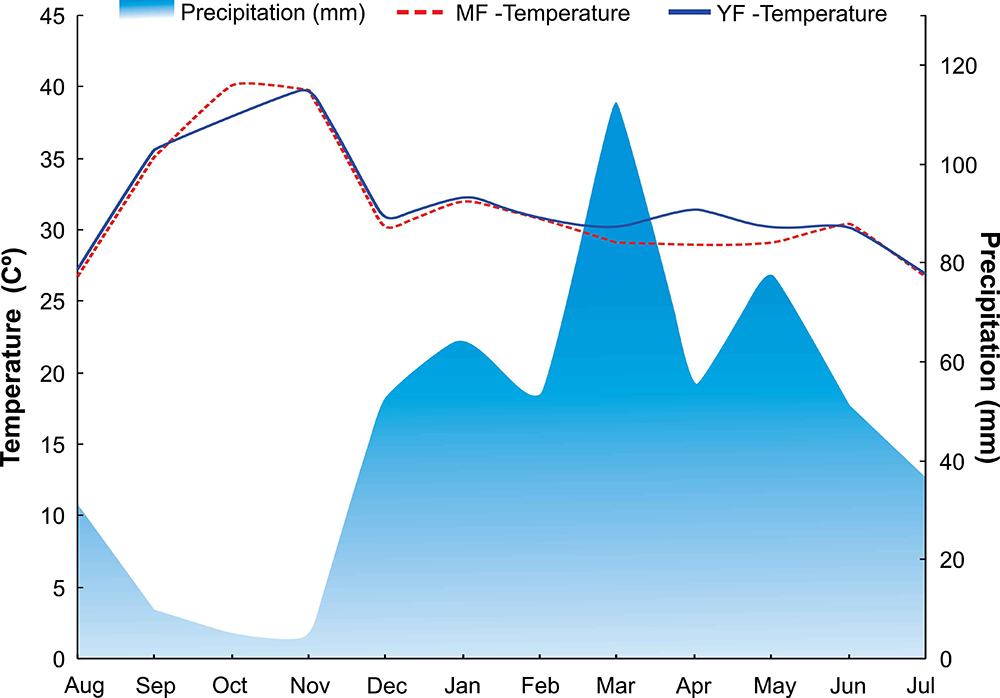
To assess the effects of temperature and precipitation on the temporal variation of the phenophases, monthly precipitation data were obtained from the meteorological station in the study area (IPA), with a single set of values for both forests due to the presence of only one weather station in the region. Temperature data were collected monthly at a height of 1.50 m above the ground, at the same time (12:00 PM), from 10 different points within each forest, using a portable digital thermo-hygro-anemometer-luxmeter, model THAL-300. The monthly temperature and precipitation values, detailed in Figure 1, were the climatic data correlated with the analyzed phenophases. We used the THAL to collect data on wind speed, relative humidity, and luminosity to describe the differences between the microenvironments of the young and mature forests.

Precipitation and temperature recorded from August 2015 to July 2016, in the mature (MF) and young (YF) forests from Caatinga vegetation, Caruaru, Pernambuco, Brazil.
Phenological analyzes
The vegetative and reproductive plant phenophases were evaluated by the indices of activity (Bencke & Morellato, 2002), intensity (Fournier, 1974), and the species phenological strategy (Newstrom et al., 1994). The activity index of each phenophase expresses the percentage of plants that are simultaneously manifesting each phenophase in the population. For this, the percentage of plants expressing each phenophase during the monitoring period was calculated (Bencke & Morellato, 2002). The Fournier intensity index indicates the phenophase magnitude during sampling. To calculate this index, the values of the categories attributed to each plant were summed and divided by the total number of plants, multiplied by the value adopted in the category of greatest magnitude, which is equivalent to 4, and this resulting division is expressed as a percentage (Fournier, 1974; Bencke & Morellato, 2002).
The analysis of the phenological strategy indicates phenophase duration, classified based on its occurrence period (Newstrom et al., 1994; Le Stradic et al., 2018) as: continuous, if present throughout the year (non-seasonal); seasonal or short term, lasting up to two months; seasonal medium or intermediate, lasting more than 2 up to 6 months; extended or extended seasonal, with phenophases lasting between 6 months and one year. Besides, considering the study area's seasonality, the timing of the phenophases in the climatic season of the region was indicated, such as the rainy season (February to July), dry season (September to December), and the transition seasons from the dry-rainy (January) and rainy-dry (August).
Statistical analyzes
To test the species' seasonality and synchrony in vegetative and reproductive phenophases between young and mature forests, we applied circular statistics (Morellato et al., 2010), using the monthly percentages of activity and intensity of the phenological event. The circle was divided into 12 intervals equidistant at 30º, representing the 12 months of observation, completing 360º with the closing of the circle. In each forest, for each phenological event, a matrix was constructed containing, in the first column, the 12 months of observation represented by the angle intervals, the monthly values of phenological activity in the second column, and the values of phenological intensity in the third column. The circular statistics (Kovach 2011) were performed with the help of the Oriana 4.2 software (Kovach, 2011). The percentages of activity and intensity of each phenophase per week were used to calculate the circular statistics parameters: mean angle (µ), mean angle significance (Z), and mean vector length (r).
The mean angle (µ) is the central angle that corresponds to a point, i.e., to an average date or week, in which the mean percentages of activity and intensity of each individual's phenophase were high (Morellato et al., 2010). It is important to remember that the mean angle (or corresponding date/ week) does not necessarily represent the peak week for each phenophase but rather indicates the central trend of the activity and intensity data for each phenophase. The significance of the mean angle (µ) was assessed by the Rayleigh test (Z), which allowed us to assess whether the individuals were concentrated around the mean angle or evenly distributed between the observation periods. The hypotheses tested in the Rayleigh test (Z) were H0 = percentages of activity and intensity of each phenophase are uniformly distributed around the mean angle, meaning no seasonality; HA = percentages of activity and intensity of each phenophase are not evenly distributed throughout the year, with a significant mean direction in the distribution, meaning the existence of a seasonal pattern. The length of the mean vector (0 ≤ r ≤ 1) indicates the magnitude of the concentration of individuals around the mean angle, that is, the degree of seasonality or synchrony of the population. Values close to one (1) indicate a higher degree of seasonality and population synchrony.
To investigate the potential association between the phenological responses of plants and the monthly temperature values (collected in each environment) and precipitation (obtained from the experimental station, which is similar for both environments), circular correlations were employed using the Oriana 4.2 software (Kovach, 2011). This approach allows not only quantifying the strength and direction of these relationships but also identifying circular patterns that show how environmental factors influence phenological stages (Fisher, 1993). The differences between the forests at the onset and peak of each phenophase were evaluated using the Watson-Williams test (F-test) with the Oriana 4.2 software (Kovach, 2011). These differences, as indicated by the test, signify that the populations were not synchronized in the timing of their phenophases. The sample dispersion was previously tested by Watson's Test (U²), to verify the presence of Von Mises distribution, which is required for the F test achievement.
Results
The mature forest (MF) and the young forest (YF) exhibit different microclimatic characteristics. In the MF, the annual average values were 10,610 lux for luminosity, 29.1ºC for average temperature, 0.34 m/s for wind speed, and 56.2% for relative humidity. YF recorded luminosity values of 13,681 lux, an average temperature of 29.6 ºC, and a wind speed of 0.83 m/s, along with an average relative humidity of only 52.4%. More details on the monthly variations in precipitation and temperature can be found in Figure 1.
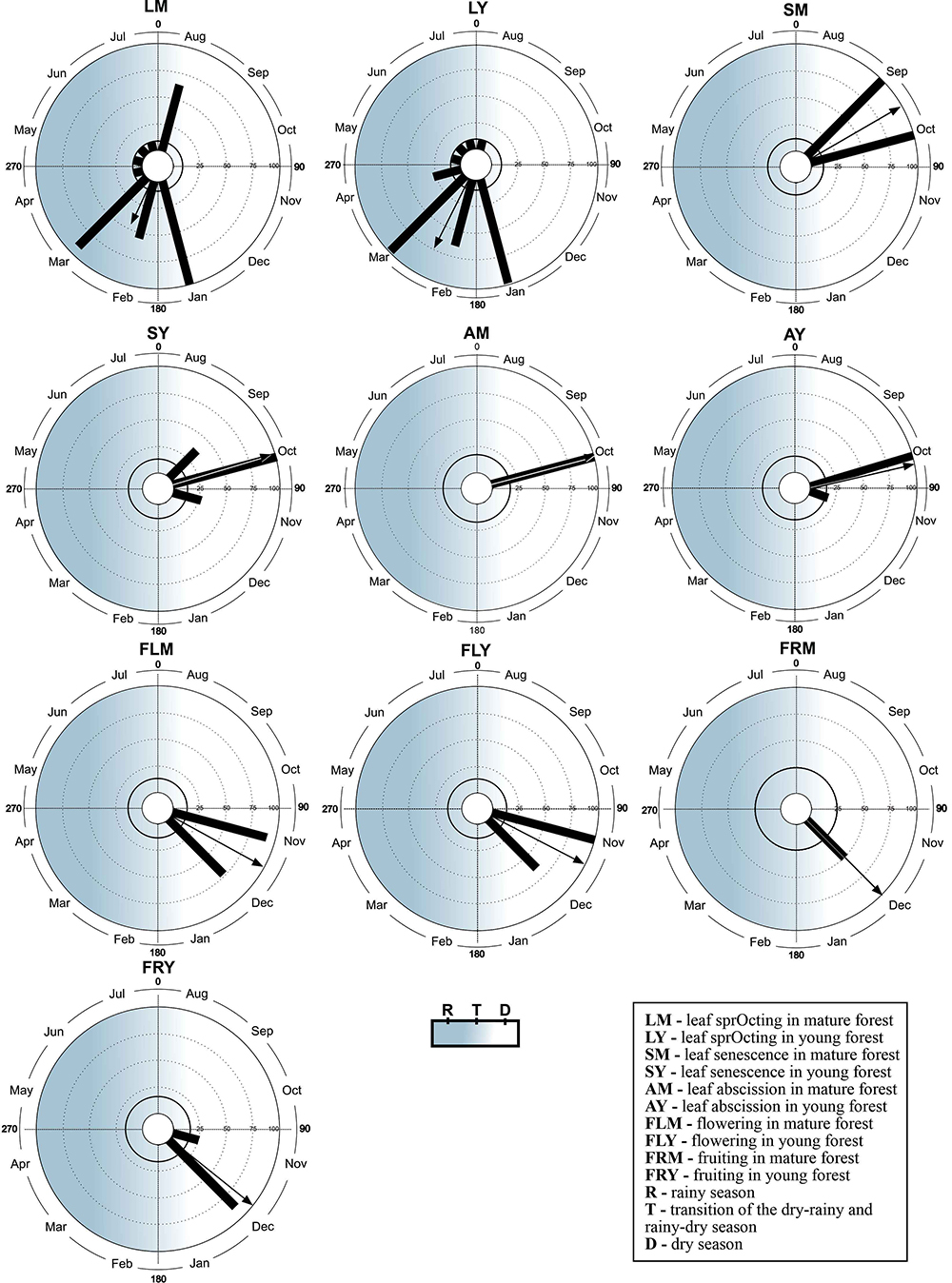
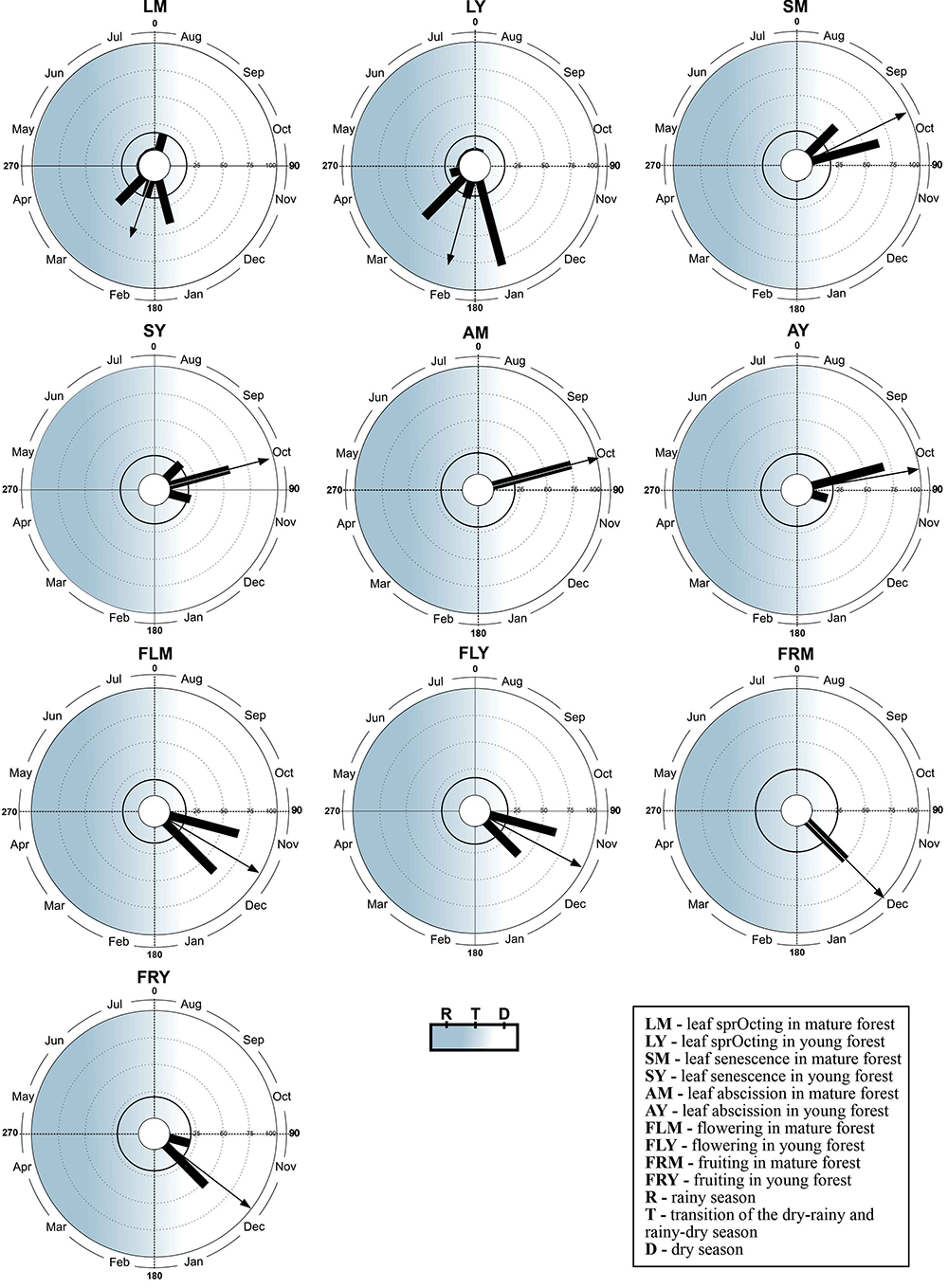
In general, M. urundeuva showed seasonal responses in its phenology. Foliar sprouting was seasonally extended, enduring eight months in both forests, with high synchrony during the rainy season and in the transition between dry and rainy seasons, and presenting no statistical difference between forests (F = 0.06; p>0.05). The leaf budding intensity ranged from 2.3 to 40.9% in MF and from 2.3 to 79.5% in YF. The leaf budding peak was more intense in January, with no significant differences between the forests. Only the precipitation correlated with the occurrence of leaf budding (MF: r=0.5; p<0.05 - YF: r=0.68; p<0.05) (Figs. 2-3, Tab. 1).
Circular distribution of percentage activity of vegetative and reproductive phenophases of Myracrodruon urundeuva Allemão in young (YF) and mature forests (MF) from Caatinga vegetation, Caruaru, Pernambuco, Brazil. Rain seasonality is represented by the color variation around the circle. The arrow indicates the month or the average angle; the arrow length indicates concentration around the mean, i.e., the seasonality degree; and the black center circle represents the mean angle significance by the Rayleigh test.
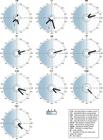
Circular distribution of percentage intensity of vegetative and reproductive phenophases of Myracrodruon urundeuva Allemão in young (YF) and mature forests (MF) from Caatinga vegetation, Caruaru, Pernambuco, Brazil. Rain seasonality is represented by the color variation around the circle. The arrow indicates the month or the average angle; the arrow length indicates concentration around the mean, i.e., the seasonality degree; and the black center circle represents the mean angle significance by the Rayleigh test.
Leaf senescence occurred during the dry season but had different responses among the forests in activity and intensity of the phenophases (F=57.1; p<0.01). Leaf senescence was short seasonal, occurring in September and October with high synchrony (r = 0.9; 100%) in the MF, and it was the seasonal median, occurring from September to November with high synchrony only in October (r = 0.9; 100%) in the YF, whose also presented an extension of this event. Intensity index of senescence ranged from 36.3 to 63.6% in MF and from 20.4 to 56.8% in YF. Precipitation was negatively correlated with leaf senescence, being significant in YF (r =-0.6; p=0.028), and marginally significant in MF (r =-0.56; p=0.055), probably because 100% of the plants presented senescence in only two months of the dry season. Temperature was positively correlated to senescence occurrence in both forests (YF: r= 0.72; p<0.01; MF: r= 0.58; p<0.05) (Figs. 2, 3, Tab. 1).
Foliar abscission occurred only in the dry season, it was short seasonal in both forests and highly synchronized in the population (MF: r=0.99; YF: r=0.98). Abscission was recorded in 100% of the plants only in October for the MF, while in YF it was recorded in 100 and 18% of the plants in October and November, respectively. The abscission intensity index was 75% in MF, while in YF it was 68 and 14% in October and November, respectively, so the abscission expression differed in both forests (F= 11.6; p<0.01). Statistically, there was no correlation between abscission and precipitation (MF: r=-0.40; p=0.19 - YF: r=-0.48; p=0.11), although this phenophase occurred only at the end of the dry season in both forests. Temperature was correlated to the abscission in the YF (r= 0.58; p< 0.5) and in the MF (r= 0.60; r< 0.05) (Figs. 2, 3, Tab. 1).
Flowering was short-seasonal occurring only in the dry season (November and December), with high activity (MF: 91%; YF: 100%) and high intensity (MF: 66%; YF: 64%) in the populations. Flowering revealed that 36% of MF plants and 76% of YF plants were female. Flowering synchrony was similar among the forests (F= 1.05; p>0.05). Flowering was not correlated with precipitation (MF: r=-0.29; p=0.35 - YF: r=-0.32; p=0.29), and neither with temperature (MF: r=0.39; p=0.20 - YF: r=0.49; p=0.09) (Figs. 2, 3, Tab. 1).
Fruiting was seasonal and short-lived within the dry season, occurring exclusively in December for MF and from November to December for YF, with an earlier onset in the latter forest. Despite the high synchrony and concentration of fruiting in both forests (r = 0.9), only 50% of female individuals fruited in MF and 87% in YF. Concerning activity and phenological intensity, there was a difference in flowering between forests (F= 14.15; p<0.01). The fruiting synchrony (in December) was low in the MF (50%) and high in the YF (87%). The fruiting intensity index was 50% in the MF and 19% and 53% in October and November, respectively for the YF. Fructification was not correlated with the precipitation (MF: r=-0.07; p=0.81 - YF: r=-0.04; p=0.89), and neither with temperature (MF: r=-0.11; p=0.73 - YF: r=0.07; p=0.80) (Figs. 2, 3, Tab. 1).
Discussion
Our expectations were partially confirmed, as differences were observed between the young and mature forests in leaf senescence and abscission, as well as in flowering and fruiting. We noticed that the timing of leaf emergence was similar between the forests but with greater intensity of this phenophase in the Young Forest (YF) throughout its occurrence. Correlations with climatic variation in precipitation and temperature occurred only in leaf emergence and senescence in both forests.
The literature consolidates evidence suggesting that light incidence, precipitation, temperature, and photoperiod are factors that influence the vegetative and reproductive phenology of plants in tropical forests (Morellato et al., 2013; Olsson & Butenko 2018; Aguiar et al., 2024). Among these, increased precipitation serves as a primary trigger, prompting numerous plant species to invest in growth and reproduction with the onset of the first rains in dry forests (Williams-Linera & Meave 2002, Richardson et al., 2013; Miranda et al., 2014; Zeppel et al., 2014; Silva et al., 2023 a ).
Higher water availability in the rainy season positively stimulates the production of new leaves (Siqueira Filho et al., 2010; Valdez-Hernández et al., 2010; Souza et al., 2014; Silva et al., 2023 a ), for activating the leaf buds from meristematic tissues (Quesada et al., 2009; Li and Zhou 2012; Mendivelso et al., 2016), which justifies the positive correlation recorded between leaf budding and precipitation in both forests.
Besides directly influencing the individual productivity of trees, the differences in vegetative phenology observed between the younger anthropized forest and the preserved forest can have profound implications for the population dynamics of Myracrodruon urundeuva. For instance, the intensified leaf emergence in the younger forest reflects in its phenology the indirect effects of past human actions, allocating more resources to foliage production. This intensification of new leaf production may be an adaptive strategy to maximize photosynthetic rates and biomass accumulation (Araujo et al., 2017; Derroire et al., 2018), which is advantageous in a young forest with higher light availability. Such a phenological response could confer significant competitive advantages to young individuals in disturbed environments but also intensify competition for space and resources within the population. This competition, which is a characteristic of regenerating environments, intensifies especially in the early stages of forest development, and trees may face difficulties in obtaining the necessary resources for their growth and survival, leading to increased mortality (Urgoiti et al., 2023).
On the other hand, the dry season induces senescence and foliar abscission as a water-saving strategy (Li & Zhou 2012; Souza et al., 2014; Mendivelso et al., 2016; Olsson & Butenko 2018; Aguiar et al., 2024), as was also recorded in this study for both forests. The profound impact of water scarcity on M. urundeuva physiology concentrated on the phenological event of leaf abscission in a few months (1-2). This concentration prevented the statistical detection of a correlation between reduced precipitation and increased abscission in the present study. This finding was unexpected, considering that deciduousness is commonly observed during periods of water restriction in semi-arid environments, a strategy aimed at retaining nutrients and allocating resources to flowering (Machado et al., 1997; Araújo et al., 2007; Amorim et al., 2009). Leaf abscission had a positive correlation with temperature and, perhaps, the interaction between temperature and precipitation increased the water restriction in the forests, favoring the concentration of abscission.
Foliar senescence and abscission in M. urundeuva were highly synchronous across the forests. However, we observed an extension of these phenophases in the YF, without differences in intensity, indicating greater tolerance of these populations to dry conditions. The reason for this phenophase prolongation in the YF, which had higher temperatures and recorded higher wind speeds and lower relative humidity (Araujo et al., 2017), is not fully understood. It could simply reflect greater plasticity in the leaf morphology of these populations, allowing for greater leaf longevity and consequently, increased tolerance to desiccation and plant survival (Pineda-García et al., 2013; Araujo et al., 2019). Alternatively, this leaf longevity could be a strategy to confer a competitive advantage in terms of light interception and growth during critical periods (Urgoiti et al., 2023). These hypotheses require further investigation in future studies. In this study, we show that the effect of precipitation on the duration of senescence and abscission seems to have less influence in the YF than in the MF, although these events were recorded during the dry season in both forests, as also reported by other studies (Amorim et al., 2009; Santos et al., 2011).
Reproductive phenophases of M. urundeuva occurred synchronously in the dry season in both forests, but the time for fruit formation was lower in YF, occurring during the same month as the beginning of flowering. This indicates that plants still perceived the microclimatic variations among forests, even after 21 years since the occurrence of anthropogenic disturbance. Furthermore, the higher fruit production observed in the YF was attributed to the species' dioecism (Leite, 2002), as the YF sample had a greater number of female plants that were only identifiable during flowering.
The climatic seasonality of the study area was perceived by the plants in both forests since reproductive phenophases occur near the end of the dry season. This response is particularly important for M. urundeuva, which is an anemochoric species that has recalcitrant seeds (Tsukamoto Filho et al., 2013). The wind speed during the dry season promotes seed dispersion (Nunes et al., 2008), and their subsequent arrival in the soil near the beginning of the following rainy season facilitates the recruitment of their seedlings. This is particularly important since M. urundeuva seeds have short longevity and lose viability after 3 months. In the younger forest, early fruit production can confer advantages or disadvantages to the species, as it may result in delayed or advanced dispersal at the onset of the rainy season (Araujo et al., 2019). If there is an anticipation of rainfall, the strategy of anticipating fruiting becomes advantageous, since the seeds would have more time to be recruited. On the other hand, if there is a delay in the onset of rains, seeds from earlier fruits tend to lose viability and subsequent mortality, representing a loss in the species' reproductive success in the young forest.
Finally, factors other than climate can influence the reproductive phenology of plants in a regenerating environment, such as soil water retention capacity in microhabitats (Morellato et al., 2016; Aguiar et al., 2020). For the species M. urundeuva, the availability of this factor is particularly relevant, as it directly influences the partitioning and allocation of carbon between aboveground and belowground plant fractions (Poorter et al., 2012). If water availability in the soil is reduced, the roots are likely to benefit from this process to maximize the absorption of the most limiting factor, which triggers changes in the timing of phenophase expressions, such as the emergence of new leaves and the start of the reproductive process (Figueirôa et al., 2004; Eziz et al., 2017).
In this context, anthropogenic disturbances emerge as an additional factor to consider in phenological studies. These disturbances can induce temporal changes in the occurrence of phenophases (Lesica & Kittelson, 2010; Dunnell & Travers, 2011), as observed in this study with the YF. The intensive use of forest resources and consequent habitat fragmentation can impair plant-pollinator interactions. Plant species dependent on these specialized interactions may face challenges in reproduction, leading to reduced fruit production in forest regeneration areas (Silva et al., 2023b). A concerning finding in this study is the occurrence of only 37% female individuals in MF, of which only 50% fruited, revealing an ecological issue that requires further investigation.
Anthropogenic disturbances in Caatinga forests are pervasive, impacting numerous animal and plant species that serve as crucial resources for local communities (Nascimento et al., 2019; Silva et al., 2019; Silva et al., 2023b). The extraction of these resources fulfills the needs of human populations, yet it also induces habitat alterations capable of disrupting the timing and intensity of phenophases, hindering the utilization of these resources by local communities for extended periods. Despite the passing of 21 years since anthropogenic disturbances, our study revealed persistent temporal changes, highlighting alterations in the timing and intensity of phenophases compared to the preserved forest. This ongoing disruption might foreseeably lead to a considerable reduction in the distribution of the species within its native range, possibly prompting migration to regions in Brazil with a presently milder climate. This shift is attributed to the combined effects of anthropogenic actions and climate change (Capo et al., 2022).
It is worth noting that M. urundeuva is a highly valued resource in the Brazilian semi-arid region due to its wood quality and medicinal properties, which make it important for the survival of many low-income families (Figueirôa et al., 2005; Monteiro et al., 2012; Monteiro et al., 2011a;b; Nascimento et al., 2019; Silva et al., 2019). However, the dioeciousness and seed recalcitrance of the species, together with the anthropogenic disturbances in the forests, highlight the urgent need for conservation measures. Currently, this species is at risk of extinction, with declining populations, (Monteiro et al., 2011a; Rivers, 2024), and the increasing number of young forests in northeastern Brazil may exacerbate resource availability issues. Moreover, there is an expectation that rainfall will decrease by about 30% to 50% in the future (Ambrizzi & Araújo, 2014; Caretta et al., 2022), which could intensify water restrictions in the forests and have a greater effect on the timing, duration, and intensity of vegetative and reproductive phenophases.
Acknowledgments
The authors thank the Pernambuco Agricultural Research Corporation Station - IPA for their logistical support. To CAPES, CNPq and FACEPE for the scholarships granted (PNPD- 88882.316828/2019-01; PQ-303504/2018-8; BCT-04272.05/18) and for projects financial support (processes: CNPQ-4652712914-6; APQ-0083.2-05/15). Thanks to all interns at the Laboratory of Vegetal Ecology of Natural Ecosystems (LEVEN) for their assistance in data collection.
References
- Aguiar BAS, Soares ESS, Araujo VKR et al 2020. The effect of reducing soil water availability on the growth and reproduction of a drought-tolerant herb. Acta Oecologica 107: 103617.
- Aguiar BAS, Soares ESS, Masrua MLA, Medeiros MJL, Lopes CGR, Sousa GM. 2024. Efeito das variações sazonais e interanuais do clima na fenologia reprodutiva de Cenostigma macrophyllum tul. (Fabaceae) em um remanescente de floresta estacional semidecidual, Piauí. Revista Brasileira De Geografia Física 17: 4279-4292.
- Alvares CA, Stape JL, Sentelhas PC, Gonçalves JLM, Sparovek G. 2013. Köppen’s climate classification map for Brazil. Meteorologische Zeitschrift 22: 711-728.
- Ambrizzi T, Araújo M. 2014. Introdução e principais questões discutidas. In: Painel Brasileiro de Mudanças Climática-PBMC (eds.). Base científica das mudanças climáticas. Primeiro relatório de avaliação nacional. Rio de Janeiro, COPPE. p. 7-24.
- Amorim IL, Sampaio EVSB, Araújo EL. 2009. Fenologia de espécies lenhosas da Caatinga do Seridó, RN. Revista Árvore 33: 491-499.
- Andrade MD, LUZ JMQ, Lacerda AS, Melo PD. 2000. Micropropagação da aroeira (Myracrodruon urundeuva Fr. All). Ciência e Agrotecnologia 24: 174-180.
- Araújo EL, Albuquerque UP, Castro CC. 2007. Dynamics of Brazilian Caatinga - a review concerning the plants, environment, and people. Functional Ecosystems & Communities 1: 15-29.
- Araujo VKR, Santos JMFF, Araújo EL, Pimentel RMM, Silva KA. 2017. Influence of leaf morphometric variations on the growth of seedlings and juveniles of woody species in a semiarid environment. Brazilian Journal of Botany 40: 1019-1028.
- Araujo VKR, Silva GB, Araújo EL, Pimentel RMM, Silva KA. 2019. Spatio‑temporal variation in leaf morphofunctional attributes and relation to growth and survival of young woody plants. Brazilian Journal of Botany 42: 1-11.
- Athayde EA, Morellato LPC. 2014. Anthropogenic edges, isolation and the flowering time and fruit set of Anadenanthera peregrina, a cerrado savanna tree. International Journal of Biometeorology 58: 443-454.
- Bencke CSC, Morellato LPC. 2002. Comparação de dois métodos de avaliação da fenologia de plantas, sua interpretação e representação. Revista Brasileira de Botânica 25: 269-275.
- Calegari L, Martins SV, Gleriani JM, Silva E, Busato LC. 2010. Análise da dinâmica de fragmentos florestais no município de Carandaí, MG, para fins de restauração florestal. Revista Árvore 34: 871-880.
- Capo LFM, Moraes MLTD, Zulian DF et al 2022. Natural distribution of Myracrodruon urundeuva Fr. All. in Brazil at current and future climate scenarios due to global climate change. Revista Árvore 46: e4609.
- Caretta MA, Mukherji A, Arfanuzzaman M et al 2022. Water. In: Pörtner HO, Roberts DC, Tignor M et al (eds.). Climate Change 2022: Impacts, Adaptation and Vulnerability. Contribution of Working Group II to the Sixth Assessment Report of the Intergovernmental Panel on Climate Change. Cambridge/New York, Cambridge University Press. p. 551-712.
- Chambers LE, Altwegg R, Barbraud C et al 2013. Phenological changes in the Southern Hemisphere.PLoS One8: e75514.
- Derroire G, Powers JS, Hulshof CM, Cárdenas Varela LE, Healey JR. 2018. Contrasting patterns of leaf trait variation among and within species during tropical dry forest succession in Costa Rica. Scientific Reports 8: 1-11.
- Dunnell KL, Travers SE. 2011. Shifts in the flowering phenology of the northern Great Plains: Patterns over 100 years. American Journal of Botany 98: 935-945.
- Eziz A, Yan Z, Tian D, Han W, Tang Z, Fang J. 2017. Drought effect on plant biomass allocation: A meta‐analysis. Ecology and Evolution 7: 11002-11010.
- Figueirôa J, Barbosa DCDA, Simabukuro EA. 2004. Crescimento de plantas jovens de Myracrodruon urundeuva Allemão (Anacardiaceae) sob diferentes regimes hídricos. Acta Botanica Brasilica 18: 573-580.
- Figueirôa JM, Pareyn FGC, Drumond M, Araújo EL. 2005. Madeireiras. In: Sampaio EVSB, Pareyn FGC, Figueirôa JM, Santos Júnior AG (eds.). Espécies da flora nordestina de importância econômica potencial. Recife, Associação Plantas do Nordeste. p. 101-133.
- Fournier LA. 1974. Un método cuantitativo para la medición de características fenológicas en árbores. Turrialba 24: 422-423.
- Fisher NI. 1993. Statistical analysis of circular data. Cambridge, Cambridge University Press.
- Kovach WL. 2011. Oriana-circular statistics for Windows, ver. 4. Pentraeth, Kovach Computing Services.
- Le Stradic S, Buisson E, Fernandes GW, Morellato LP. 2018. Reproductive phenology of two co‐occurring Neotropical mountain grasslands. Journal of Vegetation Science 29: 15-24.
- Leite EJ. 2002. State-of-knowledge onMyracrodruon urundeuvaFr. Allemão (Anacardiaceae) for genetic conservation in Brazil. Perspectives in Plant Ecology, Evolution and Systematics 5: 193-206.
- Lesica P, Kittelson PM. 2010. Precipitation and temperature are associated with advanced flowering phenology in a semi-arid grassland. Journal of Arid Environments 74: 1013-1017.
- Li RP, Zhou GS. 2012. A Temperature-Precipitation Based Leafing Model and Its Application in Northeast China. PLoS One 7:e33192.
- Lopes CGR, Ferraz EMN, Castro CC et al 2012. Forest succession and distance from preserved patches in the Brazilian semiarid region. Forest Ecology and Management 271: 115-123.
- Luna-Nieves AL, Meave JA, Morellato LPC, Ibarra-Manríquez G. 2017. Reproductive phenology of useful seasonally dry tropical forest trees: Guiding patterns for seed collection and plant propagation in nurseries. Forest Ecology and Management 393: 52-62.
- Machado ICS, Barros LM, Sampaio EVSB. 1997. Phenology of Caatinga Species at Serra Talhada, PE, Northeastern Brazil. Biotropica 29: 57-68.
- Mendivelso HA, Camarero JJ, Gutiérrez E, Castaño-Naranjo A. 2016. Climatic influences on leaf phenology, xylogenesis and radial stem changes at hourly to monthly scales in two tropical dry forests. Agricultural and Forest Meteorology 216: 20-36.
- Miranda JD, Jorquera MJ, Pugnaire FI. 2014. Phenological and reproductive responses of a semiarid shrub to pulsed watering. Plant Ecology 215: 769-777.
- Monteiro JM, Araújo EDL, Amorim ELC, Albuquerque UPD. 2012. Valuation of the Aroeira (Myracrodruon urundeuva Allemão): Perspectives on conservation. Acta Botanica Brasilica 26: 125-132.
- Monteiro JM, Lins Neto EM, Araújo EL, Amorim EL, Albuquerque UP. 2011a. Bark regeneration and tannin content in Myracrodruon urundeuva Allemão after simulation of extractive damages - implications to management. Environmental Monitoring and Assessment 180: 131-139.
- Monteiro JM, Ramos MA, Araújo EDL, Amorim EL, Albuquerque UP. 2011b. Collection and commerce of the Myracrodruon urundeuva Allemao bark in the semi-arid region of Northeastern Brazil. Bioremediation, Biodiversity & Bioavailability 5: 100-102.
- Morellato LPC, Alberti LF, Hudson IL. 2010. Applications of circular statistics in plant phenology: A case studies approach. In: Hudson IL, Keatley M (eds.). Phenological research: Methods for environmental and climate change analysis. Dordrecht, Springer. p. 357-371
- Morellato LPC, Alberton B, Alvarado ST et al 2016. Linking plant phenology to conservation biology. Biological Conservation 195: 60-72.
- Morellato LPC, Camargo MGG, Gressler E. 2013. A review of plant phenology in South and Central America. In: Schwartz MD (ed.). Phenology: An Integrative Environmental Science. Dordrecht, Springer . p. 91-113.
- Nascimento LGDS, Ramos MA, Albuquerque UP, Araújo EL. 2019. The use of firewood in protected forests: Collection practices and analysis of legal restrictions to extractivism. Acta Botanica Brasilica 33: 292-302.
- Newstrom LE, Frankie GW, Baker HG. 1994. A new classification for plant phenology based on flowering patterns in lowland Tropical Rain Forest Trees at La Selva, Costa Rica. Biotropica 26: 141-159.
- Nunes YRF, Fagundes M, Almeida HDS, Veloso MDDM. 2008. Aspectos ecológicos da aroeira (Myracrodruon urundeuva Allemão-Anacardiaceae): fenologia e germinação de sementes. Revista Árvore 32: 233-243.
- Oliveira CC, Zandavalli RB, Lima ALA, Rodal MJN. 2015. Functional groups of woody species in semi‐arid regions at low latitudes. Austral Ecology 40: 40-49.
- Olsson V, Butenko MA. 2018. Abscission in plants. Current Biology Magazine 28: 338-339.
- Pineda‐García F, Paz H, Meinzer FC. 2013. Drought resistance in early and late secondary successional species from a tropical dry forest: The interplay between xylem resistance to embolism, sapwood water storage and leaf shedding. Plant, Cell & Environment 36: 405-418.
- Poorter H, Niklas KJ, Reich PB, Oleksyn J, Poot P, Mommer L. 2012. Biomass allocation to leaves, stems and roots: Meta‐analyses of interspecific variation and environmental control. New Phytologist 193: 30-50.
-
Prado D. 1998. Astronium urundeuva The IUCN Red List of Threatened Species 1998. https://doi.org/10.2305/IUCN.UK.1998.RLTS.T32020A9674552.en 03 May 2023.
» https://doi.org/10.2305/IUCN.UK.1998.RLTS.T32020A9674552.en - Quesada M, Sanchez-Azofeifa GA, Alvarez-Anorve M et al 2009. Succession and management of tropical dry forests in the Americas: Review and new perspectives. Forest Ecology and Management 258: 1014-1024.
-
Rivers MC. 2024. Myracrodruon urundeuva The IUCN Red List of Threatened Species 2024. https://doi.org/10.2305/IUCN.UK.2024-1.RLTS.T32020A67701142.en 29 Mar. 2025.
» https://doi.org/10.2305/IUCN.UK.2024-1.RLTS.T32020A67701142.en - Richardson AD, Keenan TF, Migliavacca M, Ryu Y, Sonnentag O, Toomey M. 2013. Climate change, phenology, and phenological control of vegetation feedbacks to the climate system. Agricultural and Forest Meteorology 169: 156-173.
- Santos PS, Souza JT, Santos JMFF, Santos DM, Araújo EL. 2011. Diferenças sazonais no aporte de serrapilheira em uma área de Caatinga em Pernambuco. Revista Caatinga 24: 94-101.
- Schwartz MD. 2003. Phenology: An integrative environmental science. Dordrecht, Kluwer Academic Publishers.
- Silva KA, Andrade JR, Santos JMFF et al 2015. Effect of temporal variation in precipitation on the demography of four herbaceous populations in a tropical dry forest area in Northeastern Brazil. Revista de Biologia Tropical 63: 903-914.
- Silva NF, Hanazaki N, Albuquerque UP, Campos JLA, Feitosa IS, Araújo EL. 2019. Local Knowledge and Conservation Priorities of Medicinal Plants near a Protected Area in Brazil. Evidence-Based Complementary and Alternative Medicine 2019: 1-18.
- Silva JDJ, Duarte EF, Anna KDA et al 2023a. Phenological dynamics of four populations of Handroanthus spongiosus in seasonally dry tropical forest in Brazil. Flora 306: 152371.
- Silva JLS, Barros MF, Rito KF et al 2023b. Reproductive functional organization of woody plant assemblages along regeneration in a Caatinga dry forest. Forest Ecology and Management 533: 120852.
- Siqueira Filho JA, Seido CL, Campelo MJA, Santo FSE, Pequeno ID. 2010. Fenologia e síndromes de dispersão de espécies lenhosas em área prioritária para conservação da Caatinga - Afrânio, Pernambuco. In: Albuquerque UP, Moura AN, Araújo EL (ed.). Biodiversidade, potencial econômico e processos eco fisiológicos em ecossistemas nordestinos. Bauru, NUPEEA - Núcleo de Publicações em Ecologia e Etnobotânica Aplicada. p. 463-484.
- Souza JT, Ferraz EMN, Albuquerque UP, Araújo EL. 2014. Does proximity to a mature forest contribute to the seed rain and recovery of an abandoned agriculture area in a semiarid climate? Plant Biology 16: 748-756.
- Tsukamoto Filho ADA, Carvalho JLO, Costa RD, Dalmolin ÂC, Brondani GE. 2013. Regime de regas e cobertura de substrato afetam o crescimento inicial de mudas de Myracrodruon urundeuva Floresta e Ambiente 20: 521-529.
- Urgoiti J, Messier C, Keeton WS, Belluau M, Paquette A. 2023. Functional diversity and identity influence the self‐thinning process in young forest communities. Journal of Ecology 111: 2010-2022.
- Valdez-Hernández M, Andrade JL, Jackson PC, Rebolledo-Vieyra M. 2010. Phenology of five tree species of a tropical dry forest in Yucatan, Mexico: Effects of environmental and physiological factors. Plant and Soil 329: 155-171.
- Williams-Linera G, Meave H. 2002. Patrones fenológicos. In: Guariguata MR, Kattan GH (eds.). Ecologia y Conservación de Bosques Neotropicales. Cartago, Libro Universitário Regional. p. 407-431.
- Zeppel MJB, Wilks JV, Lewis JD. 2014. Impacts of extreme precipitation and seasonal changes in precipitation on plants. Biogeosciences 11: 3083-3093.
The data used in this study are available upon request from the corresponding author.