 Reddish coloration in galls and its relationship with polyamines, phytohormones, and metal accumulation
Abstract
The reddish phenomenon in galls is commonly associated with anthocyanin accumulation triggered by different stimuli, including metal, which provides a more efficient antioxidant defense. Herein, we hypothesize that red galls have higher levels of polyamines (PAs) and phytohormones, especially those involved in stress production and dissipation, than green galls do. This, in turn, is likely associated with greater metal accumulation in galls induced by Palaeomystella oligophaga (Lepidoptera) on Macairea radula (Melastomataceae). Green and red galls were sampled and opened to select only those with the galling insect in the larval stage for later analyses of phytohormones, polyamines, and metals. The putrescine and spermine levels were greater in red galls than in green galls. The contents of salicylic acid (SA) and methyl jasmonate (MeJA) were also greater in red galls, as were the contents of Al, Fe, Pb, and Cu. We suggest a possible link between PAs, SA, and MeJA and the translocation of metals to reduce the toxicity caused by these chemical elements’ accumulation, transforming them into less toxic forms and maintaining red coloration as a form of oxidative protection in galls.
Keywords:
coloration; red gall; biotic stress; primary metabolites; metallic ions
Introduction
The gall-inducing organism is a phenotype manipulator responsible for determining gall structure and metabolism, although the host plant tissue can impose constraints on gall development (Isaias et al., 2014; Oliveira et al., 2016). The biotic stress generated by gall-inducing insects is controlled by several metabolic pathways in the host tissue, allowing gall development (Arriola et al., 2020; Naves et al., 2021; Santos et al., 2024). As a result of this parasitic interaction, galls exhibit great morphological and physiological diversity (Stone & Schönrogge, 2003; Ferreira et al., 2019), including the accumulation of different pigments, especially anthocyanins, which are associated with red coloration in galls (Lev-Yadun, 2016).
Reddish coloration in galls is discussed based on distinct hypotheses, such as high light exposure leading to anthocyanin accumulation for photoprotection (Bomfim et al., 2019), carbon and phytohormone accumulation inducing the upregulation of phenolic class biosynthesis in galls (Connor et al., 2012), the predisposition of host tissues to produce these compounds at the site of induction (Cardoso et al., 2022), and their defensive role in galls (Inbar et al., 2010). Nevertheless, the reddish phenomenon in galls seems to be idiosyncratic, and investigating different physiological pathways and biomolecules involved in red color development may indicate promising ways to link these distinct hypotheses in the context of the adaptive value of plant galls. Phytohormones and polyamines, for example, are important molecules involved in plant responses to abiotic and biotic stresses and are associated with the accumulation of metals and phenolic compounds (Chen et al., 2019; Tyagi et al., 2023). However, the functions of PAs in the interaction between gall-inducing insects and host plants are poorly known, especially when they are associated with phytohormones, metal accumulation, stress dissipation, and indirect effects on gall coloration.
Polyamines (PAs) are low-molecular-weight aliphatic nitrogenous bases containing one or more amino groups that are widely distributed in the cells of living organisms (Liu et al., 2015; Vuosku et al., 2018). The main PAs found in plants are putrescine (Put), spermidine (Spd), and spermine (Spm), which are involved in the regulation of diverse morphological and physiological processes, such as the control of oxidative stress, adjustment of metal uptake, protection of membranes and proteins, and regulation of cell division (Mustafavi et al., 2018; Spormann et al., 2021). The cross-linking of PAs with phenolic derivatives is important not only for stress dissipation but also for plant morphogenesis (Falahi et al., 2018; Kumar et al., 2015). Gall development, for example, depends on tunable control of oxidative stress when the galling organism manipulates the host plant (Isaias et al., 2015). Phytohormones, PAs, and heavy metals can interfere with metabolism, development, and possibly gall color (Yadav, 2010; Malik et al., 2022). Phytohormones, such as salicylic acid (SA) and methyl jasmonate (MeJA), are biosynthesized to regulate the defense mechanism of plants (Chamandoosti, 2019; Li et al., 2019) and are directly associated with the metabolism of PAs and secondary metabolites, especially those related to colors such as chlorophylls, anthocyanins, carotenoids, and betalains (Li & Ahammed, 2023; Tyagi et al., 2023). The manipulation of the cellular machinery by gall-inducing insects involves secondary metabolites such as phytoalexins, phenolic compounds, and phytohormones such as indole-3-acetic acid (IAA), which regulate gall growth (Bedetti et al., 2014). This process occurs because secondary metabolites, for example, flavonoids, act synergistically with growth auxins and metals to control the dissipation of reactive oxygen species (Buer et al., 2010; Murphy et al., 2000; Peer & Murphy, 2007; Arriola et al., 2020). Some metals, such as zinc (Zn), copper (Cu), manganese (Mn), and nickel (Ni), are essential for both plant and galling organism nutrition at low levels (Arriola et al., 2024a), whereas others, such as cadmium (Cd), lead (Pb), and mercury (Hg), have no biological function (Angulo-Bejarano et al., 2021). However, metal accumulation can have toxic effects on plants and impair gall development (Arif et al., 2016; Sarwar et al., 2017; Arriola et al., 2024a). To avoid the effects of toxicity, they can biosynthesize polyamines and phytohormones that tend to bind to metals, forming complexes with antioxidant functions (Groppa & Benavides, 2008; Wybraniec et al., 2013; Liu et al., 2015).
In this study, we evaluated the red and green globoid galls induced by Palaeomystella oligophaga Becker and Adamski (Lepidoptera) on Macairea radula Bonpl. (Melastomataceae), which present two tissue compartments. The inner compartment, nutritive tissue, accumulates proteins and lipids adjacent to the larval chamber, and the outer compartment, storage tissue, accumulates structural carbohydrates as reserves (Rezende et al., 2019; Naves et al., 2021) and phenolic compounds such as flavonoids and anthocyanins, which may contribute to the red coloration of the gall (Kuster et al., 2019; Cardoso et al., 2022). In this study, we hypothesize that red galls accumulate higher polyamine (PA) and phytohormone levels, especially those involved in stress production and dissipation, than green galls do. This, in turn, is likely associated with increased metal accumulation, which explains the possible role of chelating and transforming these molecules into less toxic forms for the galls and maintaining red coloration as a form of oxidative protection.
Materials and Methods
Plant material
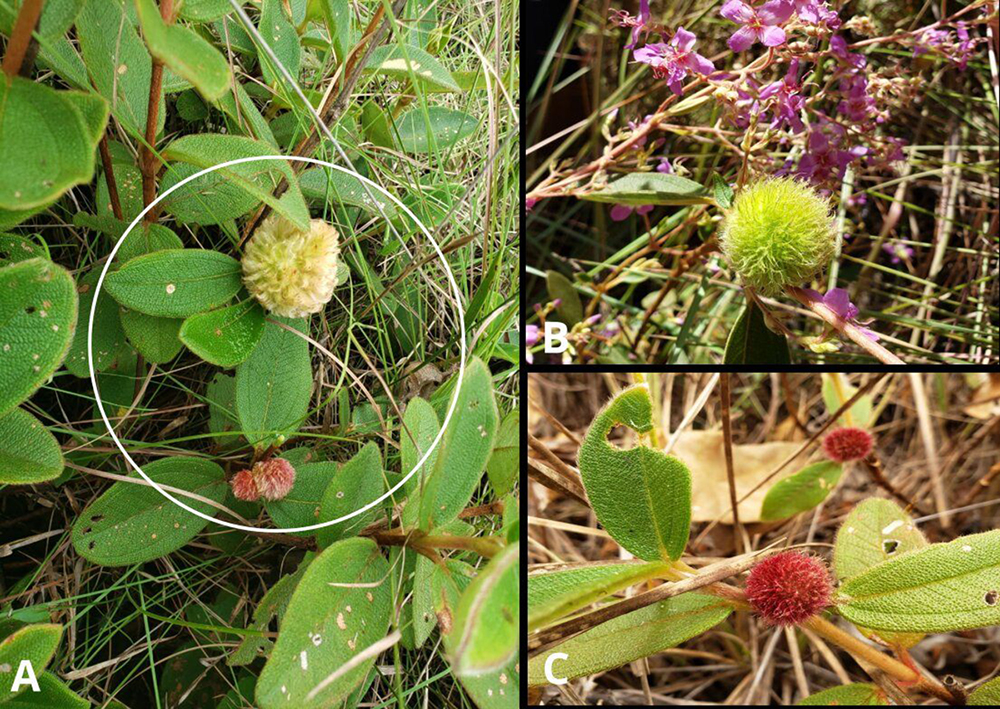
Galls induced by Palaeomystella oligophaga (Lepidoptera) on Macairea radula buds (Melastomataceae) (Figure 1) were sampled randomly from two populations of Cerrado vegetation located in the Estação Ecológica do Panga (19° 10’S, 48°24’W) and Araguari municipalities in the waterfall at the Irmâs site (19° 02’ S, 49° 10’ W). A voucher specimen of the fertile material (including flowers) was deposited in the Herbário Uberlandense (HUFU) under the accession number HUFU00059152. The galls were globoid-shaped and covered with a dense indumentum featuring long projections that varied in color. They have a diameter ranging from 10 to 15 mm when fully mature (Figure 1). The galls were considered mature when they reached their maximal size and when the gall-inducing insects were in the larval stage. The samples were collected during the second infestation period (July-August), immersed in liquid nitrogen, and stored in an ultrafreezer at -81 °C. The galls were then opened to select only those that were mature and contained galling insects in the larval stage. The larvae of the galling insect were not removed from the galls for subsequent analysis of phytohormones, polyamines, and metals (Figure 2).
Galls induced by Palaeomystella oligophaga Becker and Adamski (Lepidoptera) on buds of Macairea radula Bonpl. (Melastomataceae). A. Both green and red galls may occur in the same or different individuals. B. Details of a green gall. C. Details of red galls.

Schematic diagram of the study system showing galls induced by Palaeomystella oligophaga Becker and Adamski (Lepidoptera) on the buds of Macairea radula Bonpl. (Melastomataceae), along with the molecules analyzed in galls with gall-inducing in the larval stage, such as polyamines, phytohormones, and metals. 1) Green and red globoid galls; 2) open galls with galling insects in the larval stage with different metals; and 3) molecular structures of polyamines and phytohormones.
Metal quantification
The samples with 200 mg of galls (n = 4, with three or four galls for each sample) were dried, crushed, sieved, and then digested in 8.75 ml of 2 mol/l nitric acid and 1.25 ml of hydrogen peroxide with the aid of a microwave (Ethos, Milestone) (Wu et al., 1997). After digestion, the volume was increased to approximately 18 ml with the addition of Milli-Q water. The final dilution of the sample in the digestion step was approximately 90 times. In the digestion stage, a vial containing only the reagents used and a reference material (NIST 1515 - Apple Leaves) was also added. After each round with 24 bottles, the microwave was decontaminated. The samples were subsequently diluted in Milli-Q water according to the following dilution factors for each round of analysis: twofold for Cu, Pb, and Cd; fiftyfold for Al, Fe, and Zn; and one thousandfold for Mg. The concentrations of these elements were analyzed via mass spectrometry with inductively coupled plasma‒mass spectrometry (ICP‒MS) (Agilent 7700, Agilent Technologies, Santa Clara, USA).
The concentrations of P, S, and Ca were determined via total reflection X-ray fluorescence (TXRF). Quartz glass disks 30 mm in diameter were used as sample carriers and were covered with 10 μL of silicon solution in isopropanol (ServaTM, Heidelberg, Germany). The digested sample (450 μL) and 50 μL of 100 mg/L gallium solution were mixed for the determination of the internal standard. These final solutions (10 μL) were applied to the siliconized disks, and the disks were dried at 60°C for 15 min and analyzed in an S2 PICOFOXTM (Bruker Nano GmbH, Berlin, Germany).
Phytohormone and polyamine analysis by liquid chromatography‒mass spectrometry (LC‒MS)
Approximately 110 mg of plant material-fresh galls (n = 3, with two or three galls for each sample)-was added to 1.5 ml Eppendorf tubes and macerated via glass or tungsten beads at 25 Hz/s for 3 minutes, with three replicates. Then, 400 µL of extraction solution (methanol:isopropanol: acetic acid - 20:79:1) was added, and the control without plant material (white) was added. Each sample was vortexed 4 times for 20 s on ice and sonicated for 15 minutes. The samples were placed on ice for 45 minutes, sonicated (15 minutes), and centrifuged at 13,000 × g for 10 minutes at 4°C. A total of 350 µL of the supernatant was pipetted into new 2.0 ml tubes (Eppendorf). Steps 2 and 3 were repeated for the remaining pellet, and the supernatants were added. Centrifuge again at 20,000 × g for 5 minutes and transfer approximately 600 µL into new 2.0 ml tubes. The samples were passed through filters (13 mm, 0.2 µm PVDF syringe filter, Hexis brand, AG5190-5261EST or HX0097-02623) to remove any particulate matter that could damage the LC‒MS equipment. Three hundred microliters of each vial were added to the triple quadrupole (QQQ) (Forcat et al., 2008).
The phytohormone and polyamine data obtained via liquid chromatography coupled with mass spectrometry (LC‒MS-QQQQQ) were identified and quantified via Skyline software (Adams et al., 2020). Liquid chromatography coupled with mass spectrometry (LC‒MS-QQQQQ) of the Nucleus of Biomolecules Analysis (UFV) was also used.
Statistical analysis
Differences between means for treatments were tested via Student’s t-test for polyamines, phytohormones, and chemical element quantification. All the data were subjected to the Shapiro‒Wilk normality test with a significance level of p ≤ 0.05, which was performed via R software version 4.3.2 (2023).
Results
Red galls accumulated more Al, Fe, Pb, and Cu than green galls did. Specifically, red galls accumulate 75 % more Fe (t = -10.586; d.f. = 2.1007; p value = 0.007416), 64.4 % more Al (t = -12.75; d.f. = 2.1731; p value = 0.004406), 52.9 % more Pb (t =-6.8959; d.f. = 3.2044; p value = 0.005036) and 19.4 % more Cu (t = -13.129; d.f. = 3.8705; p value = 0.0002367) than do green galls. On the other hand, there were no significant differences in the accumulation of Cd (t = 3.4325; d.f. = 2.3242; p value = 0.06078), Ca (t = 1.5979; d.f. = 2.0504; p value = 0.2481), Mg (t = 1.2553; d.f. =2.0983; p value = 0.3311), P (t = 0.84509; d value = 2.3832; p value = 0.4744), S (t = 0.95429; d.f. = 2.2454; p value =0.4311) or Zn (t = 0.95, p value =0.3932) (Table 1) between red and green galls.
Metal quantification (mean ± SD) in mg kg-¹ from green and red galls induced by Palaeomystella oligophaga Becker and Adamski (Lepidoptera) on buds of Macairea radula Bonpl. (Melastomataceae). Differences between means were tested via Student’s t test and considered statistically significant differences when p ≤ 0.05.
The putrescine content was 60 % greater in the red galls than in the green galls (t = -7.812; d.f. =2.0027; p value = 0.01593) (Figure 3 A ). Additionally, spermine (t = -4.8265; d.f. = 2.0009; p value = 0.04031) was more abundant in red galls than in green galls (Figure 3 C ). However, there was no difference in spermidine (t = 2.3186; d.f. = 3.9999; p value = 0.08126) or proline levels (t = -1.0664; d.f. = 2.0966; p value = 0.3935) (Figure 3 B, D ).
The contents of abscisic acid (ABA), gibberellic acid (GA3), and aminocyclopropane carboxylic acid (ACC) were greater in green galls than in red galls, whereas SA and MeJA were more abundant in red galls (Figure 4). There was 65 % more ABA (t = 7.11; d.f. = 2.00; p value = 0.01; Figure 4 A ), 69 % more ACC (t = 20.865; d.f. = 2.5756; p value = 0.0006075; Figure 4 D ) and 15.8 % more GA3 (t = 8.9908, df = 2.5071, p value = 0.005704; Figure 4 B ) in green galls than in red galls (Figure 4 A and B ). However, red galls presented 96 % more SA (t = 17.199; d.f. = 2.1478; p value = 0.002439; Figure 4 E ) than did green galls and 25 % more MeJA (t = -4.1218; d.f. = 3.8728; p value = 0.01559; Figure 4 F ) than did green galls (Figure 4 D and E ). The differences in IAA levels between green and red galls were not statistically significant. (t = 0.91878; d.f. = 2.0077; p value = 0.4549; Figure 4 C ).

Polyamines quantification from red and green mature galls induced by Palaeomystella oligophaga Becker and Adamski (Lepidoptera) on buds of Macairea radula Bonpl. (Melastomataceae) with gall-inducing in the larval stage. (A) Putrescine, (B) spermidine, (C) spermine, and (D) proline. Differences between means were tested via Student’s t-test, and statistically significant differences (p ≤ 0.05) were indicated by different letters.

Phytohormone quantification from red and green mature galls induced by Palaeomystella oligophaga Becker and Adamski (Lepidoptera) on buds of Macairea radula Bonpl. (Melastomataceae) with gall induction in the larval stage. (A) Abscisic acid (ABA), (B) GA3, (C) indole acetic acid (IAA), (D) aminocyclopropane carboxylic acid (ACC), (E) salicylic acid (SA), and (F) methyl jasmonate (MeJA). Differences between means were tested via Student’s t-test, and statistically significant differences (p ≤ 0.05) were indicated by different letters.
Discussion
Several hypotheses have been proposed regarding the evolution, ecology, and functionality of red galls in plants. In the present study, the greater amounts of Al, Fe, Pb, and Cu found in red galls suggest a possible functional relationship between anthocyanin and metal accumulation in these structures (Mulyaningsih et al., 2023). Anthocyanins may play a role in mitigating the oxidative stress caused by metals (Ahammed & Yang, 2022). The available form of aluminum for plants is trivalent (Al3+), which is highly toxic to cells, tissues, and organs (Kochian et al., 2015). When absorbed by cells, Al3+ indirectly induces oxidative stress, inhibits antioxidant enzymes, and promotes lipid peroxidation (Yamamoto et al., 2002; Jones et al., 2006; Ranjan et al., 2021). Metals can also interact with phenolic compounds, leading to red coloration overexpression in plant tissues (Fedenko et al., 2022).
Plants possess various mechanisms to maintain the homeostasis of essential metals, and under stress, they undergo physiological and metabolic reactions leading to the accumulation of proteins, hormones, antioxidants, and stress-related signaling molecules, such as PAs (Alcázar et al., 2010). These molecules interact with plant hormones to act as signals for ROS production under both biotic and abiotic stresses (Wang et al., 2019; Diao et al., 2017; Napieraj et al., 2023). Most of the PAs evaluated in this study were more abundant in red galls than in green galls, which may indicate the relationship between these molecules and anthocyanins (Hudec et al., 2006). As phenolic compounds, anthocyanins accumulate in high amounts in galls induced by P. oligophaga, leading to red coloration (Cardoso et al., 2022). These molecules can scavenge free radicals produced under stress in plants and are important for antioxidant activity (Falahi et al., 2018; Li & Ahammed, 2023) and plant gall interactions (Guedes et al., 2022).
The higher putrescine and spermine levels in red galls may be related to the translocation of metals and the biosynthesis of chelating compounds to reduce their toxicity, stabilize ROS, increase the efficiency of antioxidant enzymes and biosynthesize photosynthetic pigments (Nahar et al., 2016; Balal et al., 2016). The high concentration of putrescine, for example, may also be due to stress caused by the accumulation of nonessential metals such as Al and Pb (Amist et al., 2017). On the other hand, proline is directly involved in insect nutrition and is connected to Fe metabolism and bioavailability (Arriola et al., 2024 a ). Compared with green galls, red galls accumulate high concentrations of both Al and Fe, which confirms previously discussed patterns of the association of these metals with the formation of red colors inside gall tissues (Arriola et al., 2024). Polyamines can also reduce Cd toxicity in plants, as occurs in Inula crithmoides (Asteraceae) (Ghabriche et al., 2017), and protect cell membranes from oxidative damage through the formation of phospholipids and Fe2+ complexes (Velikova et al., 2000; Spormann et al., 2021). Thus, in red galls induced by P. oligophaga on M. radula, PAs can play an important chemical role in reducing Fe and in the control of Al accumulation and toxicity, facilitating the formation of metallo-anthocyanins in gall tissues, as previously reported for red galls induced on Nothofagus obliqua (Arriola et al., 2024b).
In galls induced on oak leaves, the PA content is determined by the activity of the enzymes lysine decarboxylase (LDC), tyrosine decarboxylase (TyDC), and ornithine decarboxylase (ODC) (Kot et al., 2019). The intensity of the changes in both PAs and associated enzymes may depend on the developmental stage of the gall and the gall-inducing insect (Kmiec et al., 2017). These proteins can help detoxify metals, forming chelates to prevent the excessive accumulation of nonessential metals in plant cells and transforming them into less toxic forms through complexation with primary and secondary metabolism molecules, such as hormonal regulators (Rahman et al., 2023). Since PAs induce ROS production via NADPH oxidase and amine oxidase, the increase in PA content in red galls seems to be a response to the high level of metal accumulation and, consequently, increased capacity for ROS detoxification, as occurs in foliar plant tissues (Asija et al., 2023). Under low-temperature stress, for example, plants can accumulate MeJA, which significantly increases free Put and Spm, clearly indicating the role of PAs in stress signaling and the metabolism of phytohormones (González-Aguilar et al., 2000; Yoshikawa et al., 2007).
Phytohormones associated with responses to stress, such as SA and MeJA, were also found at high concentrations in red galls, corroborating their association with anthocyanin biosynthesis (Li & Ahammed, 2023). SA is a polyphenol compound synthesized in all plants through phenylpropanoid reactions and is a well-defined phytohormone that mediates responses to biotic stresses (Rahman et al. 2023) and protects plants against heavy metal stress (Jańczak-Pieniążek et al., 2022). In addition to SA, MeJA is a phytohormone that regulates several biological functions, especially those related to biotic and abiotic stress (Saini et al., 2021). Both SA and MeJA upregulate different enzymatic pathways associated with stress in plants under high concentrations of Cd, Pb, and Cu, among other heavy metals (Rahman et al., 2023). The high concentrations of certain metals in red galls may trigger increases in both SA and MeJA in response to toxicity.
Another phytohormone that modulates a broad array of plant responses, including stress and senescence, is ethylene (Sharma et al., 2012). The biosynthesis of this phytohormone competes with PAs for the same precursor, S-adenosyl-L-methionine (SAM) (Wang et al., 2020), and the increase in PAs can be associated with a decrease in ethylene in red galls, a possible metabolic advantage for controlling oxidative stress. GA3 and ABA are associated with different metabolic regulatory mechanisms in plants, but their relationships with PAs are limited to plant responses to salt stress (Ryu & Cho, 2015). In this context, green galls accumulate more ABA than red galls do, and our results may be associated with the negative feedback imposed by the high PAs and metal accumulation in red galls. An example of a relationship between phytohormones and metals is the toxic effects caused by Pb on a green microalga, Acutodesmus obliquus. In this microalga, Pb is associated with the downregulation of auxins, cytokinins, and gibberellins but may simultaneously increase the ABA content (Piotrowska-Niczyporuk et al., 2020). Lead also increases oxidative damage in plants, interfering with enzymatic activities and stomatal closure due to the induction of abscisic acid (ABA) (Alsokari & Aldesuquy, 2011). Compared with green galls, red galls presented high concentrations of Pb associated with lower levels of ABA, IAA, and ACC. Therefore, the increase in Pb in the red galls of P. oligophaga may be associated with an increase in oxidative stress and, consequently, an increase in the biosynthesis of phenolic compounds, such as anthocyanins and SA.
In summary, the accumulation of phenolic compounds, such as anthocyanins, can reduce the toxicity effects caused by the accumulation of Al, Fe, Pb, and Cu, transforming them into less toxic forms for galls and maintaining red coloration as a form of protection. Additionally, certain molecules, such as polyamines and phytohormones, particularly salicylic acid (SA) and methyl jasmonate (MeJA), are present at higher levels in red galls than in green galls. This response is part of a stress dissipation mechanism triggered by metal accumulation. Although reddish coloration in galls may appear idiosyncratic, investigating the metabolic pathways of polyamines, phytohormones, and associated metals provides promising insights into the role of these molecules in enhancing oxidative defense within gall tissues.
Acknowledgments
We are grateful to Laboratório de Anatomia, Desenvolvimento Vegetal e Interações (LADEVI-UFU), and Laboratório de Fisiologia Vegetal (LAFIVE-UFU). Technical and methodological support for the preparation of the digestions and the elemental analyses was provided by Dr. Maurílio Assis Figueiredo (Geology Department, UFOP) and Dr. Clésia Cristina Nascentes (Chemistry Department, UFMG).
References
-
Adams KJ, Pratt B, Bose N et al 2020. Skyline for Small Molecules: A Unifying Software Package for Quantitative Metabolomics. Journal of Proteome Research 19: 1447-1458. doi: 10.1021/acs.jproteome.9b00640
» https://doi.org/10.1021/acs.jproteome.9b00640 -
Ahammed GJ, Yang Y. 2022. Anthocyanin-mediated arsenic tolerance in plants. Environmental Pollution 292: 118475. doi: 10.1016/j.envpol.2021.118475
» https://doi.org/10.1016/j.envpol.2021.118475 -
Alcázar R, Planas J, Saxena T et al 2010. Putrescine accumulation confers drought tolerance in transgenic Arabidopsis plants overexpressing the homologous arginine decarboxylase 2 gene. Plant Physiology Biochemistry 48: 547-552. doi: 10.1016/j.plaphy.2010.02.002
» https://doi.org/10.1016/j.plaphy.2010.02.002 - Alsokari SS, Aldesuquy HS. 2011. Synergetic effect of polyamines and waste water on leaf turgidity and heavy metal accumulation in relation to grain yield. Journal of Applied Sciences Research. 7: 376-384
-
Amist N, Singh NB, Yadav K, Singh SC, Pandey JK. 2017. Comparative studies of Al3+ ions and Al2O3 nanoparticles on growth and metabolism of cabbage seedlings. Journal of Biotechnology 254: 1-8. doi: 10.1016/j.jbiotec.2017.06.002
» https://doi.org/10.1016/j.jbiotec.2017.06.002 -
Angulo-Bejarano PI, Puente-Rivera J, Cruz-Ortega R. 2021. Metal and Metalloid Toxicity in Plants: An Overview on Molecular Aspects. Plants 10: 635. doi: 10.3390/plants10040635
» https://doi.org/10.3390/plants10040635 -
Arriola ÍA, Figueiredo MA, Boanares D, França MGC, Isaias RMS. 2020. Apoplast-symplast compartmentalization and functional traits of iron and aluminum in promeristematic tissues of nematode induced galls on Miconia spp. Plant Physiology and Biochemistry 154: 360-368. doi.org/10.1016/j.plaphy.2020.06.031
» https://doi.org/10.1016/j.plaphy.2020.06.031 -
Arriola ÍA, Costa EC, de Oliveira DC, Isaias RMS. 2024a. Soil-plant-gall relationships: From gall development to ecological patterns. Biological Reviews Cambridge Philosophical Society 99: 1948-1975. doi: 10.1111/brv.13106
» https://doi.org/10.1111/brv.13106 -
Arriola ÍA, Guedes LM, Moreira ASFP, Aguilera N, Isaias RMS, Oliveira DC. 2024b. Iron metabolism acts as bridge between red coloration of bud galls induced on Nothofagus obliqua (Nothofagaceae). Physiologia Plantarum 176: e14651. doi: 10.1111/ppl.14651
» https://doi.org/10.1111/ppl.14651 -
Arif N, Vaishali Y, Shweta S et al 2016. Influence of High and Low Levels of Plant-Beneficial Heavy Metal Ions on Plant Growth and Development. Frontiers in Environmental Science 4: 99. doi: 10.3389/fenvs.2016.00069
» https://doi.org/10.3389/fenvs.2016.00069 -
Asija S, Seth T, Umar S, Gupta R. 2023. Polyamines and Their Crosstalk with Phytohormones in the Regulation of Plant Defense Responses. Journal of Plant Growth Regulation. 42: 5224-5246. doi: 10.1007/s00344-022-10837-5
» https://doi.org/10.1007/s00344-022-10837-5 -
Balal RM, Shahid MA, Javaid MM et al 2016. The role of selenium in amelioration of heat-induced oxidative damage in cucumber under high temperature stress. Acta Physiologiae Plantarum 38: 158. doi: 10.1007/s11738-016-2174-y
» https://doi.org/10.1007/s11738-016-2174-y -
Bedetti CS, Modolo LV, Isaias RMS. 2014. The role of phenolics in the control of auxin in galls of Piptadenia gonoacantha (Mart.) MacBr (Fabaceae: Mimosoideae). Biochemical Systematics and Ecology 55: 53-59. doi: 10.1016/j.bse.2014.02.016
» https://doi.org/10.1016/j.bse.2014.02.016 -
Bomfim PMS, Cardoso JCF, Rezende UC, Martini VC, Oliveira DC. 2019. Red galls: The different stories of two gall types on the same host. Plant Biology 21: 284-291. doi: 10.1111/plb.12915
» https://doi.org/10.1111/plb.12915 -
Buer CS, Imin N, Djordjevic MA. 2010. Flavonoids: New Roles for Old Molecules. Journal of Integrative Plant Biology. 52: 98-111. doi: 10.1111/j.1744-7909.2010.00905.x
» https://doi.org/10.1111/j.1744-7909.2010.00905.x -
Cardoso JCF, Goncalves PHP, Oliveira DC, Rezende UC. 2022. Host plant intraspecific variation determines gall traits. Plant Biology 25: 208-214. doi: 10.1111/plb.13472
» https://doi.org/10.1111/plb.13472 - Chamandoosti F. 2019. The Role of Salicylic Acid, Jasmonic Acid and Ethylene in Plant Defense. International Journal of Environmental & Agriculture Research 5: 7-18.
-
Chen D, Shao Q, Yin L, Younis A, Zheng B. 2019. Polyamine Function in Plants: Metabolism, Regulation on Development, and Roles in Abiotic Stress Responses. Frontiers in Plant Science 9: 1945. doi: 10.3389/fpls.2018.01945
» https://doi.org/10.3389/fpls.2018.01945 -
Connor EFL, Bartlett S, Otoole S, Byrd K, Orozco BJ. 2012. The mechanism of gall induction makes galls red. Arthropod-Plant Interactions 6: 489-495. doi: 10.1007/s11829-012-9210-7
» https://doi.org/10.1007/s11829-012-9210-7 -
Diao Q, Song Y, Shi D, Qi H. 2017. Interaction of Polyamines, Abscisic Acid, Nitric Oxide, and Hydrogen Peroxide under Chilling Stress in Tomato (Lycopersicon esculentum Mill.) Seedlings. Frontiers in Plant Science 8: 203. doi: 10.3389/fpls.2017.00203
» https://doi.org/10.3389/fpls.2017.00203 -
Falahi H, Sharifi M, Ahmadian Chashmi N, Zare Maivan H. 2018. Water stress alleviation by polyamines and phenolic compounds in Scrophularia striata is mediated by NO and H2O2 Plant Physiology Biochemistry 30: 139-147. doi: 10.1016/j.plaphy.2018.07.004
» https://doi.org/10.1016/j.plaphy.2018.07.004 -
Fedenko VS, Landi M, Shemet SA. 2022. Metallophenolomics: A Novel Integrated Approach to Study Complexation of Plant Phenolics with Metal/Metalloid Ions. International Journal of Molecular Sciences 23: 11370. doi: 10.3390/ijms231911370
» https://doi.org/10.3390/ijms231911370 -
Ferreira B, Freitas M, Bragança G, Moreira A, Carneiro R, Isaias RMS. 2019. Enzyme-mediated metabolism in nutritive tissues of galls induced by Ditylenchus gallaeformans (Nematoda: Anguinidae). Plant Biology 21: 1052-1062. doi: 10.1111/plb.13009
» https://doi.org/10.1111/plb.13009 -
Forcat S, Bennett MH, Mansfield JW, Grant MR. 2008. A rapid and robust method for simultaneously measuring changes in the phytohormones ABA, JA and SA in plants following biotic and abiotic stress. Plant Methods 4: 16. doi: 10.1186/1746-4811-4-16
» https://doi.org/10.1186/1746-4811-4-16 -
Ghabriche R, Ghnaya T, Mnasri M et al 2017. Polyamine and tyramine involvement in NaCl-induced improvement of Cd resistance in the halophyte Inula chrithmoides L. Journal of Plant Physiology 216: 136-144. doi: 10.1016/j.jplph.2017.05.018
» https://doi.org/10.1016/j.jplph.2017.05.018 -
González-Aguilar G, Zacarías L, Perez-Amador MA, Carbonell J, Lafuente MT. 2000. Polyamine content and chilling susceptibility are affected by seasonal changes in temperature and by conditioning temperature in cold‐stored ‘Fortune’ mandarin fruit. Physiologia Plantarum 108: 140-146. doi: 10.1034/j.1399-3054.2000.108002140.x
» https://doi.org/10.1034/j.1399-3054.2000.108002140.x -
Groppa MD, Benavides MP. 2008. Polyamines and abiotic stress: Recent advances. Amino Acids 34: 35-45. doi: 10.1007/s00726-007-0501-8
» https://doi.org/10.1007/s00726-007-0501-8 -
Guedes LM, Torres S, Sáez-Carillo K, Becerra J, Pérez CI, Aguilera N. 2022. High antioxidant activity of phenolic compounds dampens oxidative stress in Espinosa nothofagi galls induced on Nothofagus obliqua buds. Plant Science 314: 111114. doi: 10.1016/j.plantsci.2021.111114
» https://doi.org/10.1016/j.plantsci.2021.111114 -
Hudec J, Bakos D, Mravec D et al 2006. Content of phenolic compounds and free polyamines in black chokeberry (Aronia melanocarpa) after application of polyamine biosynthesis regulators. Journal of Agricultural and Food Chemistry 54: 3625-3628. doi: 10.1021/jf060299q
» https://doi.org/10.1021/jf060299q -
Inbar M, Izhaki I, Lupo I et al 2010. Why do many galls have conspicuous colors? A new hypothesis. Arthropod-Plant Interaction 4: 1-6. doi: 10.1007/s11829-009-9082-7
» https://doi.org/10.1007/s11829-009-9082-7 -
Isaias RMS, Oliveira DC, Carneiro RGS, Kraus JE. 2014. Developmental anatomy of galls in the neotropics: Arthropods stimuli versus host plant constraints. In: Fernandes GW, Santos JC (eds.). Neotropical insect galls. Springer, New York. p 13-34. doi: 10.1007/978-94-017-8783-3_2
» https://doi.org/10.1007/978-94-017-8783-3_2 -
Isaias RMS, Oliveira DC, Moreira ASFP, Soares GLG, Carneiro RGS. 2015. The imbalance of redox homeostasis in arthropod-induced plant galls: Mechanisms of stress generation and dissipation. Biochimica et Biophysica Acta - General Subjects 1850: 1509-1517. doi: 10.1016/j.bbagen.2015.03.007
» https://doi.org/10.1016/j.bbagen.2015.03.007 -
Jańczak-Pieniążek M, Cichoński J, Michalik P, Chrzanowski G. 2022. Effect of Heavy Metal Stress on Phenolic Compounds Accumulation in Winter Wheat Plants. Molecules 28: 241. doi: 10.3390/molecules28010241
» https://doi.org/10.3390/molecules28010241 -
Jones DL, Blancaflor EB, Kochian LV, Gilroy S. 2006. Spatial coordination of aluminum uptake, production of reactive oxygen species, callose production and wall rigidification in maize roots. Plant Cell Environment 29: 1309-1318. doi: 10.1111/j.1365-3040.2006.01509.x
» https://doi.org/10.1111/j.1365-3040.2006.01509.x -
Kmiec K, Sempruch C, Chrzanowski G, Czerniewicz P. 2017. The effect of Tetraneura ulmi L. galling process on the activity of amino acid decarboxylases and the content of biogenic amines in Siberian elm tissues. Bulletin of Entomological Research 108: 69-76. doi: 10.1017/S0007485317000505
» https://doi.org/10.1017/S0007485317000505 -
Kochian LV, Piñeros MA, Liu J, Magalhaes JV. 2015. Plant adaptation to acid soils: The molecular basis for crop aluminum resistance. Annual Review of Plant Biology 66: 571-598. doi: 10.1146/annurev-arplant-043014-114822
» https://doi.org/10.1146/annurev-arplant-043014-114822 -
Kot I, Sempruch CP, Czerniewicz P, Chrzanowski G. 2019. The effect of leaf galls of Cynipidae on accumulation and biosynthesis of plant amines in oak trees. Biochemical Systematics and Ecology 83: 26-32. doi: 10.1016/j.bse.2018.12.016
» https://doi.org/10.1016/j.bse.2018.12.016 -
Kumar M, Reddy CR, Ralph PJ. 2015. Polyamines in morphogenesis and development: A promising research area in seaweeds. Frontiers in Plant Science 6: 27. doi: 10.3389/fpls.2015.00027
» https://doi.org/10.3389/fpls.2015.00027 -
Kuster VC, Rezende UC, Cardoso JCFC, Isaias RMS, Oliveira DC. 2019. How Galling Organisms Manipulate the Secondary Metabolites in the Host Plant Tissues? A Histochemical Overview in Neotropical Gall Systems. In: Merillon JM, Ramawat K (eds.). Co-Evolution of Secondary Metabolites. Reference Series in Phytochemistry. Cham, Springer. p. 823-845. doi: 10.1007/978-3-319-96397-6_29
» https://doi.org/10.1007/978-3-319-96397-6_29 -
Lev-Yadun S. 2016. Defensive (anti-herbivory) Coloration in Land Plants. Cham, Springer . doi: 10.1007/978-3-319-42096-7
» https://doi.org/10.1007/978-3-319-42096-7 -
Li Z, Ahammed GJ. 2023. Plant stress response and adaptation via anthocyanins: A review. Plant Stress 10: 100230. doi: 10.1016/j.stress.2023.100230
» https://doi.org/10.1016/j.stress.2023.100230 -
Li N, Han X, Feng D, Yuan D, Huang LJ. 2019. Signaling Crosstalk between Salicylic Acid and Ethylene/Jasmonate in Plant Defense: Do We Understand What They Are Whispering? International Journal of Molecular Science 20: 671. doi: 10.3390/ijms20030671
» https://doi.org/10.3390/ijms20030671 -
Liu JH, Wang W, Wu H, Gong X, Moriguchi T. 2015. Polyamines function in stress tolerance: From synthesis to regulation. Frontiers in Plant Science 6: 827. doi: 10.3389/fpls.2015.00827
» https://doi.org/10.3389/fpls.2015.00827 -
Malik A, Yadav P, Singh S. 2022. Role of polyamines in heavy metal stressed plants. Plant Physiology Reports 27: 680-694. doi: 10.1007/s40502-022-00657
» https://doi.org/10.1007/s40502-022-00657 -
Mulyaningsih R, Pratiwi R, Hasanah AN. 2023. An Update on the Use of Natural Pigments and Pigment Nanoparticle Adducts for Metal Detection Based on Color Response. Biosensors 13: 554. doi: 10.3390/bios13050554
» https://doi.org/10.3390/bios13050554 -
Murphy A, Peer WA, Taiz L. 2000. Regulation of auxin transport by aminopeptidases and endogenous flavonoids. Planta 211: 315-324. doi: 10.1007/s004250000300
» https://doi.org/10.1007/s004250000300 -
Mustafavi SH, Badi HN, Sękara A et al 2018. Polyamines and their possible mechanisms involved in plant physiological processes and elicitation of secondary metabolites. Acta Physiogiae Plantarum 40: 102. doi: 10.1007/s11738-018-2671-2
» https://doi.org/10.1007/s11738-018-2671-2 -
Nahar K, Hasanuzzaman M, Alam MM, Rahman A, Suzuki T, Fujita M. 2016. Polyamine and nitric oxide crosstalk: Antagonistic effects on cadmium toxicity in mung bean plants through upregulating the metal detoxification, antioxidant defense and methylglyoxal detoxification systems. Ecotoxicology and Environmental Safety 126: 245-255. doi: 10.1016/j.ecoenv.2015.12.026
» https://doi.org/10.1016/j.ecoenv.2015.12.026 -
Napieraj N, Janicka M, Reda M. 2023. Interactions of Polyamines and Phytohormones in Plant Response to Abiotic Stress. Plants 12: 1159. doi: 10.3390/plants12051159
» https://doi.org/10.3390/plants12051159 -
Naves GFS, Kuster VC, Mariana Machado M, Santos PD, Martini VC, Oliveira DC. 2021. Metabolite investments and stress levels among tissue compartments of Paleomystella olygophaga (Lepidoptera) galls on Macairea radula (Melastomataceae). Australian Journal of Botany 69: 131-142. doi: 10.1071/BT20128
» https://doi.org/10.1071/BT20128 -
Oliveira DC, Isaias RMS, Fernandes GW, Ferreira BG, Carneiro RGS, Fuzaro L. 2016. Manipulation of host plant cells and tissues by gall-inducing insects and adaptive strategies used by different feeding guilds. Journal of Insect Physiology 84: 103-113. doi: 10.1016/j.jinsphys.2015.11.012
» https://doi.org/10.1016/j.jinsphys.2015.11.012 -
Peer WA, Murphy AS. 2007. Flavonoids and auxin transport: Modulators or regulators? Trends in Plant Science 12: 556-563. doi: 10.1016/j.tplants.2007.10.003
» https://doi.org/10.1016/j.tplants.2007.10.003 -
Piotrowska-Niczyporuk A, Bajguz A, Kotowska U, Zambrzycka-Szelewa E, Sienkiewicz A. 2020. Auxins and cytokinins regulate phytohormone homeostasis and thiol-mediated detoxification in the green alga Acutodesmus obliquus exposed to lead stress. Scientific Report 10: 10193. doi: 10.1038/s41598-020-67085-4
» https://doi.org/10.1038/s41598-020-67085-4 -
Rahman SU, Li Y, Hussain S et al 2023. Role of phytohormones in heavy metal tolerance in plants: A review. Ecological Indicators 146: 109844. doi: 10.1016/j.ecolind.2022.109844
» https://doi.org/10.1016/j.ecolind.2022.109844 -
Ranjan R, Kumar N, Gautam A, Kumar Dubey A, Pandey SN, Mallick S. 2021. Chlorella sp. modulates the glutathione mediated detoxification and S-adenosylmethionine dependent methyltransferase to counter arsenic toxicity in Oryza sativa L. Ecotoxicology and Environmental Safety 208: 111418. doi: 10.1016/j.ecoenv.2020.111418
» https://doi.org/10.1016/j.ecoenv.2020.111418 -
Rezende UC, Cardoso JCF, Kuster VC, Gonçalves LA, Oliveira DC. 2019. How the activity of natural enemies changes the structure and metabolism of the nutritive tissue in galls? Evidence from the Palaeomystella oligophaga (Lepidoptera) - Macairea radula (Metastomataceae) system. Protoplasma 256: 669-677. doi: 10.1007/s00709-018-1321-2
» https://doi.org/10.1007/s00709-018-1321-2 -
Ryu H, Cho YG. 2015. Plant hormones in salt stress tolerance. Journal of Plant Biology 58: 147-155. doi: 10.1007/s12374-015-0103-z
» https://doi.org/10.1007/s12374-015-0103-z -
Saini S, Kaur N, Pati PK. 2021. Phytohormones: Key players in the modulation of heavy metal stress tolerance in plants. Ecotoxicology and Environmental Safety 223: 112578. doi: 10.1016/j.ecoenv.2021.112578
» https://doi.org/10.1016/j.ecoenv.2021.112578 -
Santos PD, Bragança GPP, Kuster VC, Rocha DI, Oliveira DC. 2024. Cell wall epitope distribution in the functional compartments of galls induced by Palaeomystella oligophaga (Lepidoptera) in Macairea radula (Melastomataceae). Australian Journal of Botany 72: BT23064. doi: 10.1071/BT23064
» https://doi.org/10.1071/BT23064 -
Sarwar N, Imran M, Shaheen MR et al 2017. Phytoremediation strategies for soils contaminated with heavy metals: Modifications and future perspectives. Chemosphere 171: 710-721. doi: 10.1016/j.chemosphere.2016.12.116
» https://doi.org/10.1016/j.chemosphere.2016.12.116 -
Sharma P, Ambuj J, Dubey R, Pessarakli M. 2012. Reactive Oxygen Species, Oxidative Damage, and Antioxidative Defense Mechanism in Plants under Stressful Conditions. Journal of Botany 12: 217037. doi: 10.1155/2012/217037
» https://doi.org/10.1155/2012/217037 -
Spormann S, Soares C, Teixeira J, Fidalgo F. 2021. Polyamines as key regulatory players in plants under metal stress - A way for an enhanced tolerance. Annals of Applied Biology 178: 209-226. doi: 10.1111/aab.12660
» https://doi.org/10.1111/aab.12660 -
Stone GN, Schönrogge K. 2003. The adaptive significance of insect gall morphology. Trends in Ecology and Evolution 18: 512-522. doi: 10.1016/S0169-5347(03)00247-7
» https://doi.org/10.1016/S0169-5347(03)00247-7 -
Tyagi A, Ali S, Ramakrishna G et al 2023 Revisiting the Role of Polyamines in Plant Growth and Abiotic Stress Resilience: Mechanisms, Crosstalk, and Future Perspectives. Journal of Plant Growth Regulations 42: 5074-5098. doi: 10.1007/s00344-022-10847-3
» https://doi.org/10.1007/s00344-022-10847-3 -
Velikova V, Yordanov I, Edreva A. 2000. Oxidative stress and some antioxidant systems in acid rain-treated bean plants protective role of endogenous polyamines. Plant Science 151: 59-66. doi: 10.1016/S0168-9452(99)00197-1
» https://doi.org/10.1016/S0168-9452(99)00197-1 -
Vuosku J, Karppinen K, Muilu-Mäkelä R et al 2018. Scots pine aminopropyltransferases shed new light on evolution of the polyamine biosynthesis pathway in seed plants. Annals of Botany 121: 1243-1256. doi: 10.1093/aob/mcy012
» https://doi.org/10.1093/aob/mcy012 -
Wang Y, Gong X, Liu W et al 2020. Gibberellin mediates spermidine-induced salt tolerance and the expression of GT-3b in cucumber. Plant Physiology and Biochemistry 152: 147-156. doi: 10.1016/j.plaphy.2020.04.041
» https://doi.org/10.1016/j.plaphy.2020.04.041 -
Wang M, Qiao J, Yu C et al 2019. The auxin influx carrier OsAUX3 regulates rice root development and response to aluminum stress. Plant Cell Environment 42: 1125-1138. doi: 10.1111/pce.13478
» https://doi.org/10.1111/pce.13478 -
Wybraniec S, Starzak K, Skopińska A et al 2013. Effects of Metal Cations on Betanin Stability in Aqueous-Organic Solutions. Food Science and. Biotechnology 22: 353-363. doi: 10.1007/s10068-013-0088-7
» https://doi.org/10.1007/s10068-013-0088-7 -
Wu S, Feng X, Wittmeier A. 1997. Microwave Digestion of Plant and Grain Reference Materials in Nitric Acid or a Mixture of Nitric Acid or a Mixture of Nitric Acid and Hydrogen Peroxide for the Determination of Multi-elements by Inductively Coupled Plasma ‒ Mass Spectrometry. Journal of Analytical Atomic Spectrometry 12: 797-806. doi: 10.1039/a607217h
» https://doi.org/10.1039/a607217h -
Yadav SK. 2010. Heavy metals toxicity in plants: An overview on the role of glutathione and phytochelatins in heavy metal stress tolerance of plants. South African Journal of Botany 76: 167-179. doi: 10.1016/j.sajb.2009.10.007
» https://doi.org/10.1016/j.sajb.2009.10.007 -
Yamamoto Y, Kobayashi Y, Devi SR, Rikiishi S, Matsumonto H. 2002. Aluminum toxicity is associated with mitochondrial dysfunction and the production of reactive oxygen species in plant cells. Plant Physiology 128: 63-72. doi: 10.1104/pp.010417
» https://doi.org/10.1104/pp.010417 -
Yoshikawa H, Honda C, Kondo S. 2007. Effect of low-temperature stress on abscisic acid, jasmonates, and polyamines in apples. Plant Growth Regulation 52: 199-206. doi: 10.1007/s10725-007-9190-2
» https://doi.org/10.1007/s10725-007-9190-2