 An overview of Asteraceae in the Brazilian Caatinga: species diversity, distribution, collection history and endemic species conservation
Abstract
Caatinga is one of the largest and most important seasonally dry phytophysiognomies in the neotropical region, with high species diversity and endemism. Asteraceae is constantly neglected in floristic studies of Caatinga areas, and the richness, distribution and conservation status of members of the family in this area are little known. The objective of this paper is to provide an overview of the diversity, distribution, collection activity and endemic species conservation status of Asteraceae occurring in the Caatinga. We created an Asteraceae dataset for Caatinga, which was analyzed in a GIS environment to verify the intensity of collections and species richness; using the same dataset, we created the checklist and carried out the preliminary conservation status of endemic species. Our results show that a total of 137 species (16 endemic) and 82 genera within 16 tribes occur within the Caatinga. We highlight that areas with greater species richness and collection density concentrate in the north, central northeast and central-south portions of the Caatinga and that, although a certain spatial imbalance was observed, these variables present a high correlation, with collections explaining 90.92% of the species richness. Finally, a preliminary conservation status assessment revealed that among the endemic species, all are threatened.
Keywords:
Compositae; Protected Areas; Semiarid; SDTFW; Species density
Introduction
The Caatinga is part of the vegetations that make up the seasonally dry forests and woods (STDFW) biome (Queiroz et al., 2017; Fernandes et al., 2022) and is composed mostly of herbs, subshrubs, and shrubs with xerophilic characteristics (Prado, 2003). It is one of the most extensive among the units contained in this biome, covering most of the Northeastern region of Brazil and a small fraction of northern Minas Gerais, in the Southeastern region, totaling approximately 10% of the Brazilian territory (Silva et al., 2017) and 31% of all STDFW (Queiroz et al., 2017).
The Flora e Funga do Brasil (2022) indicates the occurrence of at least 130 families, 707 genera and 2293 species (290 endemic) of Angiosperms in Caatinga vegetation (= Caatinga sensu stricto). The high levels of biological biodiversity and endemicity impute a high relevance and biological importance to this physiognomy among neotropical ecosystems (Queiroz et al., 2017). However, the Caatinga is considered the least protected and most threatened Brazilian vegetation (Teixeira et al., 2021). Its territory is marked by fragmentation, deterioration, and a low number of protected areas, which cover only 8% of its total territorial extension (Teixeira et al., 2021).
Facing this worrying scenario, several floristic studies have been completed within its limits, helping to constantly expand the knowledge of its flora, especially through checklists (e.g., Athiê-Souza et al., 2019; Fernandes et al., 2020), taxonomic treatments (e.g., Amorim & Bautista, 2016; Soares et al., 2021) and a constant flow of new species (e.g., Côrtes & Rapini, 2011; Rebouças et al., 2021). These studies show that taxonomic and floristic studies are an important tool in the initial formulation and scientific expansion of knowledge, also providing primary data to be used in further studies of the biotic elements that make up an area (Funk, 2006).
Additionally, floristic and taxonomic approaches also contribute to data on species distribution, which can be used in a spatial context, helping to detect more or less sampled areas and locations with higher species diversity (e.g., Alves & Loeuille, 2021; Pessoa et al., 2022; Soares et al., 2022). This type of a posteriori approach provides crucial data for conservation strategies, allowing greater efficiency in highlighting areas in need of higher sampling efforts as well as in detecting favorable areas for conservation, for example.
Asteraceae is one of the largest families of flowering plants, with 28,000-30,000 species recorded worldwide (Pallazezi et al., 2022). Of these, c. 2,200 species (62% endemic) and 326 genera occur across the Brazilian phytogeographical domains (Roque et al., 2020; Siniscalchi et al., 2021). In Caatinga areas, in particular, Asteraceae is one of the five most representative in species number, especially when it comes to the herbaceous stratum (Moro et al., 2014; Fernandes et al., 2020). However, Asteraceae is constantly neglected in floristic and taxonomic studies in Caatinga, where the number of recorded species is usually disproportionate to their representativeness (Siniscalchi et al., 2018).
Furthermore, it should be noted that there is still imprecision regarding the number of Asteraceae species confirmed in the Caatinga, ranging from 67 (Moro et al., 2014) to 80 (Roque et al., 2020) and 147 (Fernandes et al., 2020). Asteraceae also is known for its high degree of endemism and micro-endemism in seasonally dry areas (Mandel et al., 2019), but this context is not usually explored for species present in the Caatinga, and information about endemism and conservation is deficient in the literature. Currently, according to Roque et al. (2020), the Caatinga has 11 endemic species of Asteraceae, and most have not yet been evaluated for their conservation status.
In this study, we followed the proposal adopted by Soares et al. (2022) of a combined approach of floristic study with spatial analysis in a Geographic Information System environment, with a focus on Asteraceae. We aimed to provide an overview of the diversity, distribution, collection activity and conservation of species of Asteraceae occurring in the Caatinga, providing subsidies to increase the knowledge of the family and useful data for elaboration of conservation strategies in the region.
More specifically, we seek to answer the following questions: 1. How many and which species of Asteraceae occur in the Caatinga? 2. Which areas of the Caatinga have the greatest species richness and collection activity? 3. Does the intensity of collections influence the species richness of Asteraceae in the Caatinga? 4. What is the conservation status of the endemic species of Asteraceae in the Caatinga?
Material and methods
Caatinga concept adopted in this study
Due to its use in different ecological and biogeographic classification systems in varied contexts, the term Caatinga has a notorious complexity, and definitions vary between authors (Lima, 2021). In this study, we define the Caatinga as a core of seasonally dry deciduous forest that occurs predominantly in the northeast region (there is a small part to the north of the state of Minas Gerais, in the Southeast region) of Brazil under a semiarid climate that is part of the STDFW biome. This concept also fits the interpretation of Caatinga sensu stricto presented in other studies, such as Lima (2021) and Flora e Funga do Brasil (2022), and is similar to Caatinga area delimitation adopted in Moro et al. (2014) and Fernandes et al. (2020).
Obtaining data and procedures for preparing the checklist
Initially, to produce our checklist of Asteraceae inhabiting the Caatinga, we compiled records from SpeciesLink (http://www.splink.org.br/), Reflora (http://reflora.cria.org.br/) and the specialized literature (taxonomic treatments and revisions conducted by Asteraceae experts). We listed all species that occur in the states contained in the Caatinga area (an exception was made for the state of Minas Gerais, where Caatinga covers a small area; the data were then downloaded by municipality), creating a database of nomenclature and distribution. Additionally, we included in our database field data from around 20 collections obtained during the elaboration of the flora of Asteraceae for the Curimataú microregion, in the state of Paraíba (Soares et al., 2021) and updated data obtained in Soares et al. (2022) for the state of Alagoas.
We kept only records identified or checked by one of the authors of this work or other experts in Asteraceae systematics and taxonomy, especially when it came to complex groups, such as Mikania Willd. and Baccharis L. Genera and/or species records with previously known, widespread occurrence in the Caatinga from studies carried out by non-experts were kept after evaluating specimen images available on the aforementioned platforms or provided by herbarium curators.
Then, we carried out the procedures for cleaning occurrence records mentioned in Hijmans et al. (1999) and Magdalena et al. (2018), such as troublesome coordinate adjustments (e.g., records in the ocean, incorrect coordinates, incomplete location, and incorrect municipalities) and removal of duplicates using RStudio, version 4.1.1 (R Development Core Team, 2023) and QGIS, version 3.18.2 (https://qgis.org/en/site/). To adjust problematic coordinates, we obtained the correct coordinates using the GeoLoc tool (https://splink.cria.org.br/geoloc) and Google Maps (https://www.google.com.br/maps).
Once the general database was obtained, we filtered only for species associated with Caatinga formations, considering that other phytophysiognomies are present within state limits and the limits of the study area itself (Moro et al., 2014, Fernandes et al., 2020). We used a shapefile of the study area obtained from the IBGE (2019) database, and we removed all occurrence records that were outside its limits. We took into consideration comments available in collection records and removed those that mentioned occurrence in any vegetation other than Caatinga. Additionally, we used the maps provided by Campassos (2004), IBGE (2019), Moro et al. (2014), Moro et al. (2015), SOS Mata Atlântica (2018) and Campos et al. (2019) to filter records included in other types of vegetation within the limits of the Caatinga, especially for areas of campos rupestres, brejos de altitudes and cerrados. Finally, we evaluated large, complex genera or species with doubtful occurrence and consulted experts through personal communication to confirm their presence in the study area and/or validate the record.
From 35,658 records obtained in the initial stage (that is, records obtained from the totality of the states in which caatinga occur), 4,127 were identified as belonging to our study area (records available at Soares & Loeuille, (2024) [dataset]), and the resulting species were then incorporated into a checklist. To validate the species and their respective vouchers we consulted the collection of EAN, HCES, MAC, JPB, IPA, UFP and PEURF (acronyms according to Thiers (2022), continuously updated), which contained vouchers for 90% of the listed species; the remaining 10% were checked through high-resolution images available online or were type collections, which were digitally checked with JSTOR Plants (https://plants.jstor.org/).
Vouchers were cited in this checklist according to at least one of three criteria: (1) type collection; (2) materials identified by experts in taxonomy and systematics of the tribe and/or genus to which the species belongs; (3) materials identified or verified in person by one of the authors of this study. Finally, we incorporated into our checklist data on non-native or ruderal species in addition to habit, which were compiled from Roque et al. (2020) and observations available on the record sheets.
Species richness, collection density and correlation analyses
We analyzed species richness and collection density for Asteraceae in the Caatinga using the DivaGis software, version 7.5.0 (https://www.diva-gis.org/), using as input data the dataset mentioned above. These analyses were performed using Neighborhood Circular Interpolation, which performs calculations based on the radius of a circle where the point of occurrence is the centroid. We opted for this methodology to avoid issues associated with grid-based spatial geographic analysis mentioned in Hijmans et al. (2012) and Oliveira et al. (2015). Here, we use the Number of Different Classes parameter to interpolate the richness and Number of Observations for collections. For both analyses, the circle size was 0.01º (ca. 10 km²).
Once the raster files with the results were obtained, we tested the correlation between species richness and collection density in the study area. We initially submitted the data to the Shapiro-Wilk normality test, which revealed a non-normal distribution (see residuals distribution in Fig. 3C, in the Results topic). Then, we checked whether there was a correlation between variables using Spearman’s correlation test, recommended for non-parametric data and once confirmed, we performed a non-exponential asymptotic regression analysis with two and three parameters. To determine the most appropriate statistical model we performed a variance analysis (ANOVA). We emphasize that the ANOVA choice, in this case, is not to test the variation between species richness versus collection intensity, but rather to test the variation between the different regression models generated in analyses with two and three parameters, which is recommended in Crawley (2015) and Jones et al. (2023). All statistical steps were performed in R.
Preliminary endemic species conservation status
The endemic species mentioned here were confirmed through the specialized literature (Siniscalchi et al., 2018; Siniscalchi et al., 2019; Roque et al., 2020; Rebouças et al., 2021). For species without a preliminary conservation status, we carried out an assessment here. For this purpose, we used the GeoCat tool (Bachman et al., 2011), with AOO (area of occupation) and EOO (extent of occurrence) as evaluation criteria. The criteria and sub-criteria applied for the definition of each category were obtained from IUCN (2012; 2022). When the AOO and EOO values were discrepant and resulted in divergent conservation categories, we prioritized the results generated by AOO, as endemic species generally have restricted habitats (Thomas et al., 2004) that limit them to specific locations, not necessarily occurring throughout their range of occurrence.
Results
Checklist
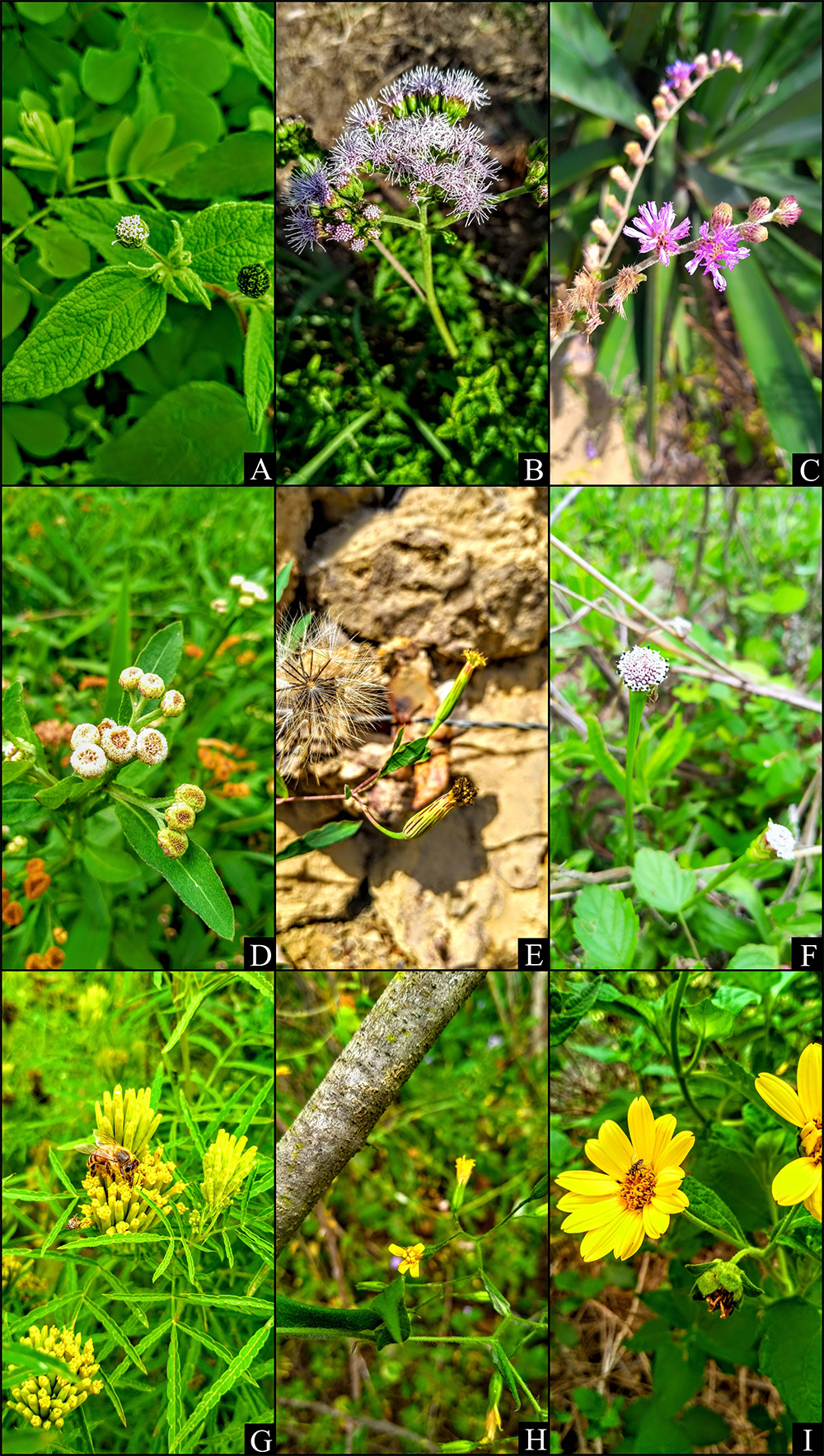
Asteraceae is represented in the Caatinga vegetation by 137 species, 82 genera and 16 tribes (Table 1, Fig. 1). The most representative genera are Lepidaploa (Cass.) Cass. with nine species, Aspilia Thouars and Pectis L. with six each, Bidens L. with five, and Acmella Rich. ex Pers., Baccharis L., Chresta Vell. ex DC. and Stilpnopappus Mart ex. DC. with four species each. Among the tribes, those with the greatest diversity of genera/species were Vernonieae (21/40), Heliantheae (19/29) and Eupatorieae (14/17) (Fig. 2A), representing 62.7% of the total species in the area. 29 species are restricted to Brazil, 16 of which are endemic to the Caatinga (Table 2). Here, we also indicate 13 new occurrences for the state of Rio Grande do Norte, 12 for Pernambuco, 11 for Piauí and Sergipe, nine for Paraíba and eight for Ceará (Table S1).

Representatives of some Asteraceae species and tribes of the Caatinga. A. Blainvillea acmella (L.) Philipson (Heliantheae); B. Conocliniopsis grossedentata (Mart. ex Colla) D.J.N.Hind (Eupatorieae); C. Lepidaploa chalybaea (Mart. ex DC.) H.Rob. (Vernonieae); D. Pluchea sagittalis (Lam.) Cabrera (Inuleae); E. Porophyllum ruderale (Jacq.) Cass. (Tageteae); F. Spilanthes urens Jacq. (Heliantheae); G. Tagetes minuta L. (Tageteae); H. Trixis antimenorrhoea (Schrank) Kuntze (Nassauvieae); I. Wedelia goyazensis Gardner (Heliantheae). An overview of Asteraceae in the Brazilian Caatinga: species diversity, distribution, collection history and endemic species conservation

A. Proportion of genera and species per tribe, highlighting the greater predominance of Vernonieae, Heliantheae and Eupatorieae as the most representative in number of genera and species. B. Proportion of habits by tribe, highlighting the dominance of the herbaceous and shrubby habit in most tribes; the climber habit restricted to the Astereae and Eupatorieae tribes is still noticeable. For both graphs n = 137.
Endemic species of Asteraceae in Caatinga vegetation and preliminary conservation status with IUCN (2012; 2022) criteria. Abbreviations: AOO = Area of Occupancy, CR = Critically Endangered, DD = Deficient Data, EOO = Extend of Occurrence, EN = Endangered.
The proportion of habit per tribe is shown in Fig. 2B and shows there is a clear predominance of herbs (77 spp.) and shrubs (28 spp.) in the study area in relation to other habits, which together represent 81.4% of the total number of registered species. The tribes with the highest number of herbs are Heliantheae (21 spp.), Vernonieae (17 spp.) and Coreopsideae (eight spp.); Gochnatieae and Barnadesieae were the only ones that did not present herbs in their composition. The lianas are represented by Baccharis cinerea DC., B. trinervis Pers. and Mikania cordifolia (L.f) Willd.; the trees, in turn, are Acritopappus buiquensis Bautista & D.J.N.Hind, Eremanthus capitatus (Spreng.) MacLeish, Gorceixia decurrens Baker, Gymnanthemum amygdalinum (Delile) Sch.Bip. ex Walp., Moquiniastrum oligocephalum (Gardner) G.Sancho and Paralychnophora reflexoauriculata (G.M.Barroso) MacLeish.
GIS spatial analysis: richness and collections
The comparative analysis between species richness and collection density interpolations (Fig. 3A-B) for Asteraceae in Caatinga areas shows spatial equivalence and correspondence among the localities with the highest and lowest collection densities. Our results indicate that higher species richness is predominantly concentrated in three regions: (1) in the northern portion, in north Ceará; (2) in the central-northeast portion, among the states of Paraíba, Pernambuco, Alagoas and South Ceará; and (3) southern portion, within the state of Bahia. As for collections, these are predominantly concentrated in the Caatinga central portion.

Results of GIS analyses. A. Species richness interpolation, showing greater representation of species in the north, central-northeast and central-south regions of the study area. B. Collection density interpolation, reflecting a similar pattern to that observed for species richness and showing that most of the study area is still under sampled for Asteraceae. C. Correlation graph showing the strong positive correlation between species richness and collection density. The bar graph represents the distribution of the collection and richness interpolations residuals, showing that their distribution is not normal.
Our analyses showed a high positive correlation between species richness and collection density interpolation, with rho = 0.971 and p < 2.2-16. The analysis of variance (ANOVA) between exponential regression models (with two and three parameters) that presented the best responses resulted in p = 3.031-16. Therefore, we concluded that the most adequate model was the non-linear asymptotic exponential regression with three parameters, which explained, with high significance (90.92%), the variation in species richness as a function of the number of collections (Fig. 3C).
Preliminary conservation status of endemic species
Asteraceae has 16 endemic species in Caatinga areas (Table 2), which belong to the tribes Vernonieae (10 spp.), Eupatorieae (five spp.) and Tageteae (one spp.). Table 2 shows results from the preliminary conservation status assessment of these species, except for Acritopappus buiquensis Bautista & D.J.N.Hind, Lepidaploa luetzelburgii (Mattf.) H.Rob. and Pectis loiolei Rebouças, V.S.Sampaio & Roque, which are only known from collections in their type locality and therefore not assessed; all other species are critically endangered or endangered.
Discussion
Asteraceae diversity in the Caatinga
In recent years there has been intense collaborative activity by Brazilian and foreign taxonomists aiming to inventory the species of plants and fungi that occur in Brazil. As a result, Flora e Funga do Brasil (2022) was elaborated, where Asteraceae is identified as one of the most diverse Angiosperm families in the country. These results highlight the great importance of the group in the Brazilian flora and provide valuable information for biological biodiversity management and conservation. Here, we carried out the first survey focused on Asteraceae in Caatinga vegetation, and our results expanded by 148% the number of species presented in the FFB (Roque et al., 2020), by 140% in Moro et al. (2014) and decreased 7% the species listed by Fernandes et al. (2020) for the study area.
As previously shown, the number of recorded species of Asteraceae varies in different Caatinga checklists. We believe this is due to some limitations in other published studies related to the use of digitized specimens. Although images and data available on most digital platforms are valuable for taxonomic studies, Asteraceae is a complex group that often requires observation of microcharacters (e.g., Angulo & Dematteis, 2014; Marques et al., 2018, Antar et al., 2021) or structures that are difficult to observe (e.g., style branches and anther appendages) for accurate identification.
Additionally, the knowledge about the taxonomy and distribution of Caatinga species is deficient, as it is fragmented in local floristic or taxonomic inventories, such as Rodal et al. (1998), Pereira & Melo (2009), Amorim & Bautista (2016) and Soares et al. (2021), which limits studies based only on the literature compilation. Although our study follows a methodology similar in some respects to previous studies regarding the use of digitized specimens, we believe that the use of field data, visits to herbarium collections, spatial filtering based on occurrence records, and queries to Asteraceae experts allowed us to more finely evaluate the species that actually occur in the study area.
In addition to this difference in number of recorded species, we also noticed several inconsistencies between the species mentioned here and those found in previous studies, especially when we compared our list with that of Fernandes et al. (2020), which had similar numbers but differed significantly in terms of representatives. Concurrently, this is also due to the discovery of a new species (Rebouças et al., 2021), the recent synonymization of four names in Wedelia goyazensis Gardner (Alves et al., 2020), in addition to new records from the area of study (e.g., Soares & Loeuille, 2021).
This literature fragmentation and the small number of studies focused on Asteraceae in the Caatinga is reflected here by the large number of new records for different Brazilian states that have Caatinga vegetation. In the states with the highest number of new occurrences, such as Piauí and Rio Grande do Norte, we did not find studies on Asteraceae carried out in the last 10 years. On the other hand, in the state of Bahia, which did not have new records, the occurrence of Asteraceae is well documented in numerous works (e.g., Ogazawara & Roque, 2015; Alves & Roque, 2016; Amorim & Bautista, 2016; Gandara & Roque, 2020).
The fact that Bahia is one of the states where Asteraceae is better documented is not by chance. Other vegetation types that occur interspersed with the Caatinga in this state, such as campos rupestres, are notoriously diverse and considered biodiversity hotspots, especially for Asteraceae (Campos et al., 2019; Staudt et al., 2017), attracting strong scientific activity. We believe that the higher scientific activity carried out there also results in a greater exploration of the surrounding Caatinga, which consequently improves the knowledge of its diversity.
As for the number of registered species, our study puts the Caatinga as the Brazilian phytophysiognomy with the fourth highest diversity of Asteraceae, behind campos rupestres, campos de altitude and cerrado s.s. vegetations (Roque et al., 2020). It is interesting to note that the proportion of habits is the opposite in these other vegetations when compared to Caatinga areas. In the cerrado s.s. there is a clear predominance of shrubs and subshrubs (~51% vs. 25%), followed by herbs (~30% vs. 61%) (Roque et al., 2020). In the campos de altitude the same was observed: among the 383 species listed, 50% are subshrubs/shrubs and 35% are herbs (Roque et al., 2020; Siniscalchi et al., 2021).
Although herbaceous and shrubby habits dominate in the family in different Brazilian domains (Siniscalchi et al., 2021), the greater prevalence of herbs in the Caatinga is likely a reflection of the environmental conditions of the area, especially the semi-arid climate, which favors the colonization of ephemeral species, as water availability is reduced for most of the year (Queiroz et al., 2017). The small number of scandent species, especially of the genus Mikania Willd., when compared to studies on Asteraceae carried out in areas of the Atlantic Forest domain is also probably linked to the semi-arid climate (e.g., Bazante et al., 2022; Soares et al., 2022).
GIS spatial analysis: species richness and collections
Our work aligns with previous studies by displaying a high statistical or spatial correlation between collection intensity and species richness (e.g., Pessoa et al., 2022; Alves & Loeuille, 2021; Soares et al., 2022). In fact, it is expected that as collection efforts increase, species richness increases as well, as more intensive collection efforts would lead to the detection and documentation of more species. However, the correlation is not always perfect, as other factors such as habitat quality, environmental variables and historical factors can also influence species richness (Simberloff ,1986; Waide et al., 1999; Gotelli & Kowell, 2001).
Regarding collections interpolation, as shown in the maps in Figure 1, it is noteworthy that more than half of the study area still has a low number of collections, especially in localities in the states of Piauí, Rio Grande do Norte and southwestern Bahia. We believe that factors such as adverse climatic conditions, especially high temperatures, the difficulty of penetrating the vegetation, and the ephemeral nature of many Asteraceae species that occur in this vegetation (Amorim & Bautista, 2016) may explain this pattern.
Additionally, the pattern observed for places with higher species richness and collection densities seems to be closely associated with the presence of protected areas. We observe that the central-northeast portion of the Caatinga is home to two of its main protected areas: Parque Nacional do Catimbau and Estação Ecológica do Raso da Catarina. In the northern portion, there is Área de Proteção Ambiental Serra da Meruoca in the state of Ceará; while the Área de Relevante Interesse Biológico Serra do Orobó is present in the southern portion (ICMBio, 2019). This same pattern was recently reported for Asteraceae in areas of Caatinga and Atlantic Forest in the state of Alagoas, in the study carried out by Soares et al. (2022).
In general, protected areas tend to receive more attention and resources for biodiversity monitoring and species inventory, leading to increased collection efforts. However, the correlation between protected areas, collection efforts and species richness is complex, since factors such as the quality and duration of collection efforts, the availability of resources, and the presence of threats to biodiversity can all influence the relationship (Nelson et al., 1990; Parnell et al., 2003).
Endemic species and conservation considerations
In this study, only one genus stands out in terms of representativeness of endemic species (seven in total): Chresta Vell. ex DC. It belongs to the tribe Vernonieae and mainly occupies areas of cerrado s.s. and campos rupestres (Siniscalchi et al., 2020). However, the species that occur in the Caatinga seem to be morphologically specialized to this vegetation, as they are mainly rupicolous, restricted to quartzitic and/or granitic rock outcrops in elevations above 500 m (Siniscalchi et al., 2018; Siniscalchi et al., 2019). This reinforces a common characteristic of endemic species: they are normally associated with restricted vegetation bands and usually present in small populations with specific habitat requirements, requiring adequate environmental conditions and resources (Thomas et al., 2004), which makes them extremely susceptible to environmental changes.
Global level extinction risk assessment (Malcolm et al., 2006) shows that habitat specificity is one of the most important variables in the loss of potential distribution of species in an area. In view of these factors and analyzing the data in Table 2, our results indicate a strong need for the conservation of these species and for their distribution to be, at least partially, included in protected areas. However, the lack of protection of endemic species, associated with the effectiveness of coverage of protected areas in the Caatinga, was the objective of the study prepared by Teixeira et al. (2021), where it was found that most full protection areas have problems in this regard.
This is even more worrying in the light of the history of habitat degradation of the Caatinga, where human and agricultural exploitation, the lack of conservation policies and population and industrial growth have resulted in a drastic decrease in the native vegetation cover over time (Santos et al., 2011; Albuquerque et al., 2017; Silva & Barbosa, 2017), which increases pressure on natural habitats, jeopardizing the survival of many species.
In recent years, conservation efforts have been underway to protect the Caatinga and its biodiversity, including the creation of protected areas, reforestation programs, and community-based conservation initiatives (Sampaio, 2010). Even so, its current protected areas cover less than 10% of its total area (Prado, 2003; Leal et al., 2005; Teixeira et al., 2021). Another worrying factor is that historical data from IBGE (2018) show that the Northeast region has experienced marked population and industrial growth in recent years, being the second most populated region in Brazil, which causes even more exploitation of natural areas and deposition of pollutants, which increases our concern over these species.
In this study, we conclude that Asteraceae is an important component of the phanerogamic flora of the Caatinga, represented by 137 species (16 of them endemic), and strongly contributing to the herbaceous and shrubby component. However, the preliminary conservation status of endemic species is worrying, as all of them are threatened or endangered, and their situation is getting worse due to anthropogenic processes and low effectiveness of conservation measures in the area.
We argue that the conservation of these endemic species of the Caatinga can be carried out through measures for the protection and management of habitats, including the expansion of preserved areas and the creation of protected areas for endangered species. In addition, it is also important to encourage research and monitoring of these taxa, to better understand the population dynamics and existing threats, as well as to propose adequate and personalized conservation measures for each case.
We show that species richness is significantly correlated with collection intensity, but the number of collections is still considered low in most of the territory of the study area, which may be due to the difficulty of accessing an inhospitable environment with high temperatures and dense vegetation. Other possible causes may be the ephemerality of the species and the low number of herbaria and taxonomists in the Northeast compared to other Brazilian regions.
Acknowledgments
The authors would like to thank the technicians and curators of the consulted herbaria for providing access to their collections; to Asteraceae experts Caetano Troncoso Oliveira, Carolina M. Siniscalchi, Gustavo Heiden, Nádia Roque and Maria Alves for answering queries about morphology and/or distribution of some species; to Marcelo F. Moro for providing one of the shape files used to filter coordinates; to Fábio Alves for his assistance in carrying out the statistical analyses. Additional thanks to Carolina M. Siniscalchi for proofreading the English. This study was carried out with support from Coordenação de Aperfeiçoamento de Pessoal de Nível Superior - Brazil (CAPES) - Finance code 001.
References
-
Alves FV, Loeuille B. 2021. Geographic distribution patterns of species of the subtribe Lychnophorinae (Asteraceae: Vernonieae). Rodriguésia 72: e02072019. doi: 10.1590/2175-7860202172072.
» https://doi.org/10.1590/2175-7860202172072. -
Alves M, Bringel Jr. JBA. 2020. Wedelia in Flora e Funga do Brasil. Jardim Botânico do Rio de Janeiro. Jardim Botânico do Rio de Janeiro. https://floradobrasil.jbrj.gov.br/FB16451 27 Dec. 2021.
» https://floradobrasil.jbrj.gov.br/FB16451 -
Alves M, Roque N. 2016. Flora da Bahia: Asteraceae - Tribo Heliantheae. Sitientibus série Ciências Biológicas 16: 1-63. doi: 10.13102/scb1127.
» https://doi.org/10.13102/scb1127 -
Amorim VO, Bautista HP. 2016. Asteraceae da Ecorregião do Raso da Catarina. Rodriguésia 67: 785-794. doi: 10.1590/2175-7860201667317.
» https://doi.org/10.1590/2175-7860201667317 -
Angulo MB, Dematteis M. 2014. Floral microcharacters in Lessingianthus (Vernonieae Asteraceae) and their taxonomic implications. Plant Systematics and Evolution 300: 1925-1940. doi: 10.1007/s00606-014-1019-7.
» https://doi.org/10.1007/s00606-014-1019-7 -
Antar GM, Siniscalchi CM, Gonella PM, Monge M, Loeuille B. 2021. Novelties in Lepidaploineae (Asteraceae, Vernonieae) from the easternmost campos rupestres of Minas Gerais, Brazil: Two new species and a range expansion. Plant Ecology and Evolution 154: 121-136. doi: 10.5091/plecevo.2021.1792.
» https://doi.org/10.5091/plecevo.2021.1792 -
Athiê-Souza SM, Melo JIM, Silva LP et al 2019. Phanerogamic flora of the Catimbau National Park, Pernambuco, Brazil. Biota Neotropica 19: e20180622. doi: 10.1590/1676-0611-BN-2018-0622.
» https://doi.org/10.1590/1676-0611-BN-2018-0622 -
Bachman S, Moat J, Hill AW, Torre J, Scott B. 2011. Supporting Red List threat assessments with GeoCAT: Geospatial conservation assessment tool. ZooKeys 126: 117-126. doi: 10.3897/zookeys.150.2109.
» https://doi.org/10.3897/zookeys.150.2109 -
Bazante M, Soares G, Loeuille B. 2022. Flora da Usina São José, Igarassu, Estado de Pernambuco, Brasil: Asteraceae. Hoehenea 49: e152021. doi: 10.1590/2236-8906-08/2021.
» https://doi.org/10.1590/2236-8906-08/2021 -
Campos L, Moro MF, Funk VA, Roque N. 2019. Biogeographical Review of Asteraceae in the Espinhaço Mountain Range, Brazil. The Botanical Review 85: 293-336. doi: 10.1007/s12229-019-09216-9.
» https://doi.org/10.1007/s12229-019-09216-9 -
Côrtes ALA, Rapini A. 2011. Four new species of Justicia (Acanthaceae) from the Caatinga biome of Bahia, Brazil. Kew Bulletin 66: 453-461. doi: 10.1007/s12225-011-9295-7.
» https://doi.org/10.1007/s12225-011-9295-7 - Crawley MJ. 2015. Statistics: An introduction using R. 2nd. ed. London, Imperial College London/Wiley.
-
Fernandes MF, Cardoso D, Queiroz LP. 2020. An updated plant checklist of the Brazilian Caatinga seasonally dry forests and woodlands reveals high species richness and endemism. Journal of Arid Environments 174: 1-8. doi: 10.1016/j.jaridenv.2019.104079.
» https://doi.org/10.1016/j.jaridenv.2019.104079 -
Fernandes MF, Cardoso D, Pennington RT, Queiroz LP. 2022. The Origins and Historical Assembly of the Brazilian Caatinga Seasonally Dry Tropical Forests. Frontiers in Ecology and Evolution 10: 1-13. doi: 10.3389/fevo.2022.723286.
» https://doi.org/10.3389/fevo.2022.723286 -
Flora e Funga do Brasil. 2022. Jardim Botânico do Rio de Janeiro. https://floradobrasil.jbrj.gov.br/ 03 Apr. 2023.
» https://floradobrasil.jbrj.gov.br/ - Funk VA. 2006. Floras: A model for biodiversity studies or a thing of the past? Taxon 55: 581-588.
-
Gandara A, Roque N. 2020. Mikania (Asteraceae, Eupatorieae) no estado da Bahia, Brasil. Rodriguesia 71: e02882017. doi: 10.1590/2175-7860202071022.
» https://doi.org/10.1590/2175-7860202071022 -
Gotelli NJ, Colwell RK. 2001. Quantifying biodiversity: Procedures and pitfalls in the measurement and comparison of species richness. Ecology Letters 4: 379-391. doi: 10.1046/j.1461-0248.2001.00230.x.
» https://doi.org/10.1046/j.1461-0248.2001.00230.x -
Hijmans RJ, Guarino L, Mathur P. 2012. DIVA-GIS v7.5: A geographic information system for the analysis of species distribution data. https://www.diva-gis.org 03 Apr. 2023.
» https://doi.org/03 Apr. 2023» https://www.diva-gis.org - Hijmans RJ, Schreuder M, De la Cruz L, Guarino L. 1999. Using GIS to check coodinates of germoplasm acession. Genetic Resources and Crop evolution 46: 291-296.
-
IBGE - Instituto Brasileiro de Biogeografia e Estatística . 2018. Aspectos demográficos: informações gerais. https://ww2.ibge.gov.br/home/estatistica/populacao/condicaodevida/indicadoresminimos/tabela1.shtm 28 Jun. 2020.
» https://ww2.ibge.gov.br/home/estatistica/populacao/condicaodevida/indicadoresminimos/tabela1.shtm -
IBGE - Instituto Brasileiro de Geografia e Estatística. 2019. Mapa de biomas do Brasil: Escala 1:250.000. IBGE, Rio de Janeiro. https://www.ibge.gov.br/geociencias/cartas-e-mapas/informacoes-ambientais/15842-biomas.html 04 May 2023.
» https://www.ibge.gov.br/geociencias/cartas-e-mapas/informacoes-ambientais/15842-biomas.html -
ICMBio - Instituto Chico Mendes de Conservação da Biodiversidade. 2019. Mapa Temático e Dados Geoestatísticos das Unidades de Conservação Federais http://www.icmbio.gov.br/portal/geoprocessamentos/51-menu-servicos/4004-downloads-mapa-tematico-e-dados-geoestatisticos-das-uc-s 10 Aug. 2022.
» http://www.icmbio.gov.br/portal/geoprocessamentos/51-menu-servicos/4004-downloads-mapa-tematico-e-dados-geoestatisticos-das-uc-s -
IUCN. 2012. IUCN Red list Categories and Criteria. Version 3.1. 2nd. ed. https://portals.iucn.org/library/node/10315 10 Oct. 2022.
» https://portals.iucn.org/library/node/10315 -
IUCN. 2022. Standards and Petitions Subcommittee. Guidelines for using the IUCN red list categories and criteria, version 12. Prepared by the Standards and Petitions Subcommittee. https://www.iucnredlist.org/resources/redlistguidelines 10 Oct. 2022.
» https://www.iucnredlist.org/resources/redlistguidelines - Jones E, Harden S, Crawley MJ. 2023. The R Book. 3rd. ed. London, Imperial College London/Willey.
- Leal IR, Silva JMC, Tabarelli M, Lacher Jr. TE. 2005. Mudando o curso da conservação da biodiversidade da Caatinga do nordeste do Brasil. Megadiversidade 1: 139-146.
-
Lima RD. 2021. Birds of the Caatinga revisited: The problem of enclaves within, but not of, the Caatinga. Journal of Arid Environments 191: 3-11. doi: 10.1016/j.jaridenv.2021.104537.
» https://doi.org/10.1016/j.jaridenv.2021.104537 -
Magdalena UR, Silva LAE, Lima RO, Bellon E, Ribeiro R, Oliveira FA, Siqueira MF, Forza RC. 2018. A new methodology for the retrieval and evaluation of geographic coordinates within databases of scientific plant collections. Applied Geography 96: 11-15. doi: 10.1016/j.apgeog.2018.05.002.
» https://doi.org/10.1016/j.apgeog.2018.05.002 -
Malcolm JR, Liu C, Neilson RP, Hansen L, Hannah L. 2006. Global warming and extinctions of endemics species from biodiversity hotspots. Conservation Biology 20: 538-548. doi: 10.1111/j.1523-1739.2006.00364.
» https://doi.org/10.1111/j.1523-1739.2006.00364 -
Mandel J, Dikow RB, Siniscalchi CM, Thapa R, Watson LE, Funk V. 2019. A fully resolved backbone phylogeny reveals numerous dispersals and explosive diversifications throughout the history of Asteraceae. PNAS 16: 14083-14088. doi: 10.1073/pnas.1903871116.
» https://doi.org/10.1073/pnas.1903871116 -
Marques D, Ângulo MB, Nakagima JN, Dematteis M. 2018. The taxonomic utility of micromorphology in Lepidaploa (Vernonieae: Asteraceae). Nordic Journal of Botany 36: e01686. doi: 10.1111/njb.01686.
» https://doi.org/10.1111/njb.01686 -
Moro MF, Bezerra MM, Moura-Fé MM, Castro ASF, Costa RC. 2015. Vegetação, unidades fitoecológicas e diversidade paisagística do estado do Ceará. Rodriguésia 66: 717-743. doi: 10.1590/2175-7860201566305.
» https://doi.org/10.1590/2175-7860201566305 -
Moro MF, Lughadha EM, Filer DL, Araújo FS, Martins FR. 2014. A catalogue of the vascular plants of the Caatinga Phytogeographical Domain: A synthesis of floristic and phytosociological surveys. Phytotaxa 160: 1-180. doi: 10.11646/phytotaxa.160.1.1.
» https://doi.org/10.11646/phytotaxa.160.1.1 -
Nelson BW, Ferreira CAC, Silva MF, Kawasaki ML. 1990. Endemism centres, refugia and botanical collection density in Brazilian Amazonia. Nature 345: 714-716. doi: 10.1038/345714a0.
» https://doi.org/10.1038/345714a0 -
Ogazawara HA, Roque N. 2015. Flora da Bahia: Asteraceae - Subtribo Vernoniinae. Sitientibus série Ciências Biológicas 15: 1-24. doi: 10.13102/scb250
» https://doi.org/10.13102/scb250 -
Pallazezi L, Pellicer J, Barreda VD et al 2022. Asteraceae as a model system for evolutionary studies: from fossils to genomes. Botanical Journal of the Linnean Society 200: 143-164. doi: 10.1093/botlinnean/boac032.
» https://doi.org/10.1093/botlinnean/boac032 -
Parnell JAN, Simpson DA, Moat J et al 2003. Plant collecting spread and densities: Their potential impact on biogeographical studies in Thailand. Journal of Biogeography 30: 193-209. doi: 10.1046/j.1365-2699.2003. 00828.x
» https://doi.org/10.1046/j.1365-2699.2003. 00828.x - Pereira RCA, Melo MRCS. 2009. Checklist da Flora de Mirandiba: Asteraceae. In: Alves M, Araújo MF, Maciel JR, Martins S. Flora da Mirandiba. Associação Plantas do Nordeste, Recife. p. 71-83.
-
Pessoa E, Silva MJC, Oliveira MS, Silva Jr, WR, Ferreira AWC. 2022. An updated checklist reveals strong incongruities with previous studies: Insights after revisiting a regional orchid list. Acta Botanica Brasilica 36: e2020abb0487. doi: 10.1590/0102-33062020abb0487.
» https://doi.org/10.1590/0102-33062020abb0487 - Prado D. 2003. As Caatingas da América do Sul. In: Leal IR, Tabarelli M, Silva JMC (eds.). Ecologia e conservação da Caatinga. Recife, Editora Universitária da UFPE. p. 3-73.
- Queiroz LP, Cardoso D, Fernandes MF, Moro MF. 2017. Diversity and Evolution of Flowering Plants of the Caatinga Domain. In: Silva JMC, Leal IR, Tabarelli M (eds.). Caatinga: The Largest Tropical Dry Forest Region in South America. Swtzerland, Springer. p. 23-63.
-
C. 2023. R: A language and environment for statistical computing. R Foundation for Statistical Computing. https://www.rproject.org/ 10 Oct. 2022.
» https://www.rproject.org/ -
Rebouças NC, Sampaio VS, Bunger MO, Roque N. 2021. Pectis loiolae (Asteraceae: Tageteae): New Species Registered in a Natural Monument at an Archaeological Site in Northeast Brazil. Systematic Botany 46: 486-492. doi: 10.1600/036364421X16231782047514.
» https://doi.org/10.1600/036364421X16231782047514 - Rodal MJN, Andrade KVSA, Sales MF, Gomes APS. 1998. Fitossociologia do componente lenhoso de um refúgio vegetacional no município de Buíque, Pernambuco. Revista Brasileira de Biologia 58: 517-526.
-
Roque N, Nakajima J, Heiden G et al 2020. Asteraceae in Flora e Funga do Brasil. Jardim Botânico do Rio de Janeiro. Jardim Botânico do Rio de Janeiro. https://floradobrasil.jbrj.gov.br/reflora/floradobrasil/FB55 27 Dec. 2021.
» https://floradobrasil.jbrj.gov.br/reflora/floradobrasil/FB55 - Sampaio EVSB. 2010. Caracterização do bioma Caatinga. In: Garglio MA, Sampaio EVSB, Cestaro LA, Kageyama PY (orgs.). Uso Sustentável e Conservação dos Recursos Florestais da Caatinga. 2nd. ed. Brasília, Ministério do Meio Ambiente, Serviço Florestal Brasileiro. p. 27-48.
- Simberloff D. 1986 Are we on the verge of a mass extinction in tropical rain forests? In: Elliott DK (ed.). Dynamics of Extinction. New York, John Wiley & Sons. p. 165-180.
-
Siniscalchi CM, Loeuille B, Roque N. 2021. Asteraceae in a megadiverse flora: Results from the Flora of Brazil 2020. Capitulum 1: 54-60. doi: 10.53875/capitulum.01.1.06.
» https://doi.org/10.53875/capitulum.01.1.06 -
Siniscalchi CM. 2020. Chresta in Flora e Funga do Brasil. Jardim Botânico do Rio de Janeiro. https://floradobrasil.jbrj.gov.br/FB25219 23 Oct. 2022.
» https://floradobrasil.jbrj.gov.br/FB25219 -
Siniscalchi CM, Loeuille B, Pirani JR. 2018. Two new rupiculous species of Chresta (Asteraceae , Vernonieae) from the Brazilian Caatinga. Sistematic Botany 43: 1059-1071. doi: 10.1600/036364418X697698
» https://doi.org/10.1600/036364418X697698 -
Siniscalchi CM, Loeuille B, Siqueira-Filho JA, Pirani JR. 2019. Chresta artemisiifolia (Vernonieae, Asteraceae), a new endangered species from a recently created protected area in the Brazilian Caatinga. Phytotaxa 399: 119-126. doi: 10.11646/phytotaxa.399.2.2.
» https://doi.org/10.11646/phytotaxa.399.2.2 -
Soares G, Loeuille B. 2021. Notes in Brazilian Vernonieae: Two new combinations and a range expansion. Phytotaxa 522: 139-149. doi: https://doi.org/10.11646/phytotaxa.522.2.6
» https://doi.org/10.11646/phytotaxa.522.2.6 -
Soares G, Santos CAG, Loeuille B. 2021. Asteraceae na microrregião do Curimataú Ocidental, Estado da Paraíba, Brasil. Hoehnea 48: e662020. doi: 10.1590/2236-8906-66/2020.
» https://doi.org/10.1590/2236-8906-66/2020 -
Soares G, Roque N, Alves FVS et al 2022. Using an Asteraceae checklist to understand collection history, species density and conservation implications: A case study in the state of Alagoas, Northeastern Brazil. Phytotaxa 571: 21-38. doi: 10.11646/phytotaxa.571.1.2.
» https://doi.org/10.11646/phytotaxa.571.1.2 -
Soares G, Loeuille B. 2024. An overview of Asteraceae in the Brazilian Caatinga: Species diversity, distribution, collection history and endemic species conservation. https://doi.org/10.48331/scielodata.CDYHG3 23 Oct. 2022.
» https://doi.org/10.48331/scielodata.CDYHG3 -
SOS Mata Atlântica. 2018. Acesso às informações do Atlas dos Remanescentes Florestais. Fundação SOS Mata Atlântica. https://mapas.sosma.org.br/ 23 Oct. 2022.
» https://mapas.sosma.org.br/ -
Staudt MG, Alves M, Roque N. 2017. Asteraceae in the northern Espinhaço Range, Brazil: Richness, endemism and conservation. Acta Botanica Brasilica 31: 698-719. doi: 10.1590/0102-33062017abb0167.
» https://doi.org/10.1590/0102-33062017abb0167 -
Teixeira LP, Lughadha EM, Silva MVC, Moro MF. 2021. How much of the Caatinga is legally protected? An analysis of temporal and geographical coverage of protected areas in the Brazilian semiarid region. Acta Botanica Brasilica 35: 473-485. doi: 10.1590/0102-33062020abb0492.
» https://doi.org/10.1590/0102-33062020abb0492 -
Thomas CD, Cameron A, Green RE et al 2004. Extinction risk from climate changes. Nature 427: 145-148. doi: 10.1038/nature02121.
» https://doi.org/10.1038/nature02121 -
Waide RB, Willig MR, Steiner CF et al 1999. The relationship between productivity and species richness. Annual Review of Ecology and Systematics 30: 257-300. doi: 10.1146/annurev.ecolsys.30.1.257.
» https://doi.org/10.1146/annurev.ecolsys.30.1.257
Supplementary material
The following online material is available for this article: