 Floral Water Status: How This Functional Trait Can Explain the Relationships between Floral Visitors Within a Phytophysiognomic Context in the Cerrado
Abstract
The flora of the Cerrado is highly adaptable to climatic and edaphic variability, yet climate change and anthropogenic activities pose increasing challenges. Water is a vital resource for plant physiological and reproductive processes, and directly influences floral traits and pollinator visitation. Moreover, plant responses to fluctuations in water availability can similarly affect their ability to attract pollinators by altering floral attractants. The production and maintenance of flowers require considerable energetic investment, in addition to supporting critical physiological functions. This study assessed the water potential of Palicourea rigida inflorescences across different Cerrado phytophysiognomies and times of day, relating it to the frequency of floral visitors. The results revealed that water potential varied with environment and time and was positively correlated with visitation frequency, explaining up to 19.3 % of the variation in the number of floral visitors. These findings highlight the importance of water potential as a functional trait, especially in the context of increasing drought, with implications for reproductive success and the conservation of savanna flora. This factor should be taken into account in studies addressing functional traits in savanna ecosystems.
Keywords:
Cerrado savanna; Floral visitors; Functional traits; Palicourea rigida; Water potential
Introduction
Water is a fundamental resource for the physiological and ecological processes of plants, directly influencing their survival, growth, and reproduction (Chapin et al., 2000; Chaves & Pinheiro, 2009; Brendel, 2021). In flowering species, water availability may affect not only biomass production but also the allocation of resources to reproductive structures such as nectar, pollen, and volatiles (Dicks et al., 2002; Pigozzo & Viana, 2010; Burkle & Runyon, 2016; Barônio et al., 2018). Restrictions on water availability may impair the ability of plants to maintain flower turgor pressure, transpiration, or the assimilation of essential nutrients, which may result in reduced resources for reproductive structures and, consequently, reproductive success (Shuel, 1957; Caruso et al., 2005; Caruso, 2006; Burkle & Irwin, 2009; Burkle & Runyon, 2016; Roddy, 2019; Liu & Li, 2020; Vaudo et al., 2022). The production of floral structures and rewards for pollinators represents a high energy cost, demanding the reallocation of photoassimilates and essential nutrients during the reproductive period (Pyke, 1991; Ashman & Schoen, 1994; Borghi & Fernie, 2021).
Plants face a trade-off between vegetative growth (e.g., roots for water absorption) and reproductive structures (e.g., flower size), especially in environments with limited resources (Ashman, 1994; Obeso, 2002; Kuppler & Kotowska, 2021; Dorken et al., 2025). Although leaves and flowers differ in their primary functions, they utilize water in similar ways, which is not surprising given that flowers evolved from leaves (Weigel & Meyerowitz, 1994). The capacity of plants to adjust their functional traits to adapt to different regimes of water availability is crucial in seasonal biomes and significantly impacts pollinators throughout the year (McLaren & McDonald, 2005). As an example, Palicourea rigida Kunth (Rubiaceae) may exhibit phenotypic plasticity in distinct floral traits (e.g., flower size, nectar production), which enables it to attract visitors of different identities, such as bees, hummingbirds, and moths, thereby maintaining attractiveness under varying water conditions (Machado et al., 2010; Trevizan et al., 2024).
The water potential, or water status, of a plant is defined as the sum of hydrostatic pressure and osmotic pressure. Thus, the flow of water through the soil-plant continuum over macroscopic distances is driven by hydrostatic pressure gradients and, ultimately, is responsible for cell, tissue, and organ growth (Passioura, 2010). Flowers can adopt drought-prevention strategies by altering anatomical and physiological traits, such as increasing hydraulic capacitance to compensate for greater water loss (An et al., 2023). Water potential can also influence flower size, as larger flowers require more water to survive, which is regulated by distinct anatomical and morphological traits (Roddy et al., 2021). In flowers, factors such as size, ambient temperature, color, and phenology influence water requirements (Roddy, 2019; 2021), which in turn may affect pollinator selection (Harder & Johnson, 2009; Schiestl & Johnson, 2013). For example, water demand is closely linked to nectar secretion (De la Barrera & Nobel, 2004). Factors such as temperature and water availability may change throughout the day, altering nectar production and, consequently, influencing both the number of visits and the identity of the floral visitors. These daily microclimatic variations can shift pollinators' foraging behavior, altering their activity patterns and their preferences for specific flowers.
The Cerrado is the most biodiverse savanna on the planet, with its vegetation shaped by a unique combination of acidic soils, frequent fire regimes, and pronounced climatic seasonality (Eiten, 1972; Ribeiro & Walter, 2008). However, climate change and human activities, which are responsible for the loss of nearly half of the native vegetation of the biome (Overbeck et al., 2015) are altering environmental conditions and significantly impacting ecosystem composition, complexity, and conservation efforts (Simon et al., 2009; Strassburg et al., 2017). These significant changes increase conservation challenges, as they reduce resource availability and may compromise interactions between plants and pollinators. Distinct phytophysiognomies within the biome, such as typical cerrado (characterized by deep, well-drained soils) and rupestrian fields (characterized by shallow, rocky soils), differ markedly in water retention capacity, imposing varying degrees of physiological stress on plants (Ribeiro & Walter, 2008; Silveira et al., 2016). This environmental heterogeneity makes the Cerrado an ideal system for investigating how variation in floral water potential influences plant-pollinator interactions at fine spatial scales. Herein, we investigate how water availability for Palicourea rigida affects the number of floral visits it receives. We hypothesize that plants whose inflorescences have greater water potential receive more floral visits. In this regard, we expected that (i) plants would receive more floral visits at predawn than at midday (having lost more water and likely having lower water potential) and that (ii) plants from the typical cerrado would receive more floral visits than those from the rupestrian field (as they grow in soil that retains less water and likely have lower water potential).
Methods
Study site and plant species
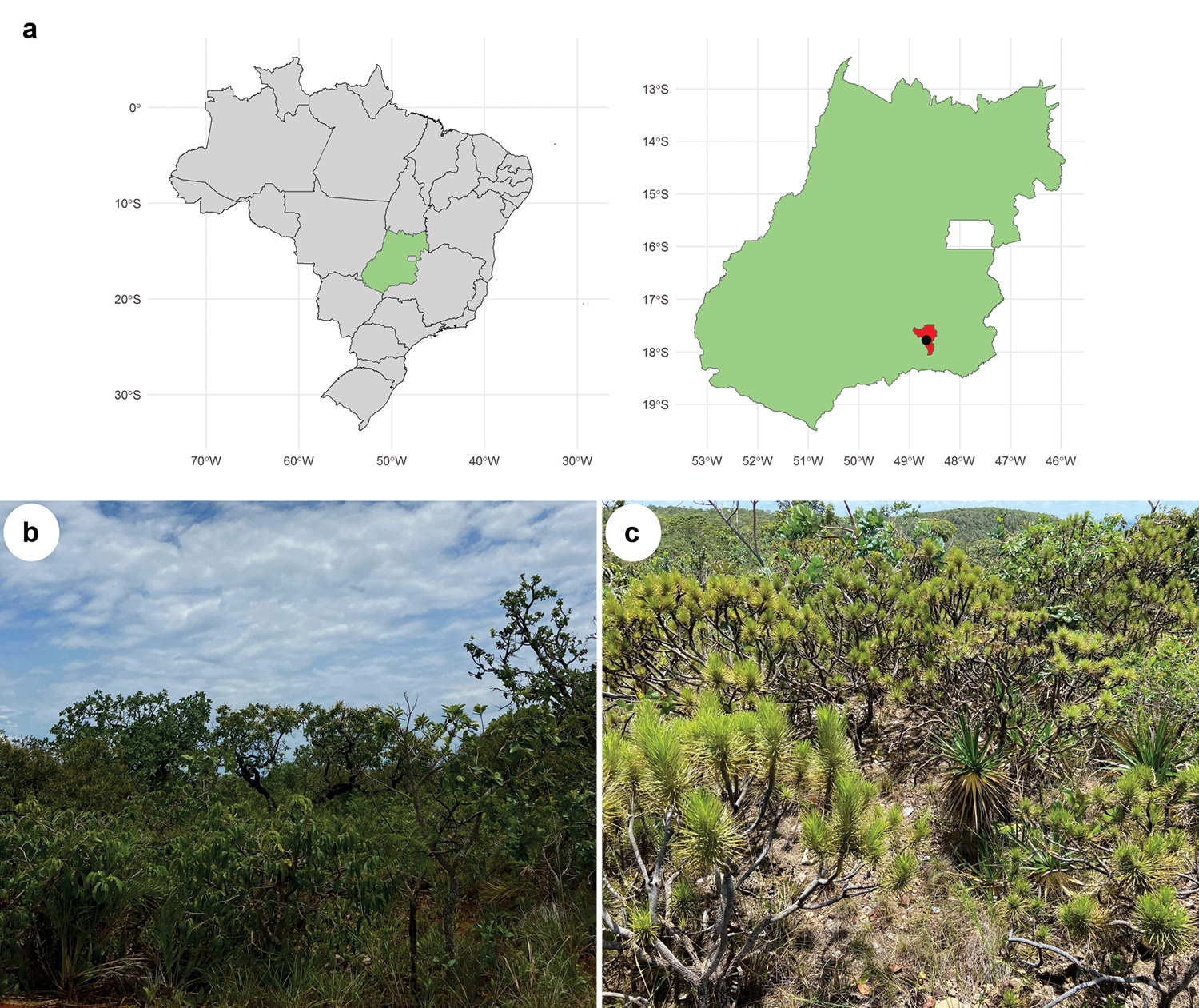
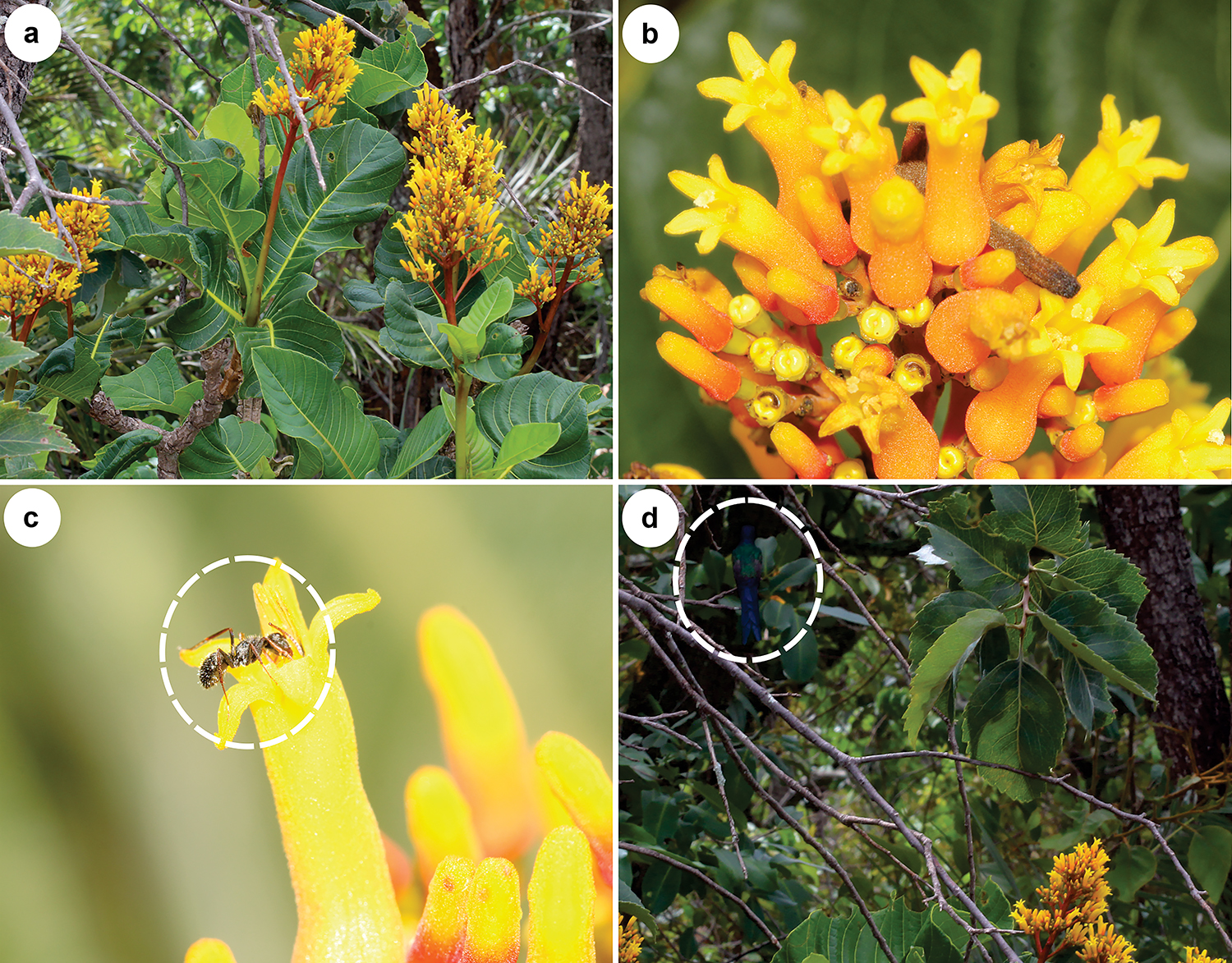
The study site is located in a conservation unit, the Serra de Caldas Novas State Park (PESCAN; 17°46’S, 48°40’W), Caldas Novas municipality, Goiás, Brazil (Fig. 1A). We used Palicourea rigida as a study model and collected inflorescences from six individuals (n = 6) in each environment, typical cerrado (Fig. 1B) and rupestrian field (Fig. 1C). This woody species has a shrubby habit; its branches are woody and thin, and its leaves are large and rigid at the tips (Fig. 2A). In addition, it has inflorescences with multiple yellow‒orange flowers, each small and with a tubular calyx (Fig. 2A-B). It is widely distributed in the Cerrado biome (Brazilian savanna) and occurs in both rupestrian field and typical cerrado, two different phytophysiognomies.
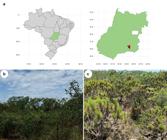
Geographic location of the study area and the vegetation types where Palicourea rigida was sampled. (A) Map of Brazil highlighting the state of Goiás (in green), the Caldas Novas municipality (in red), and the PESCAN (Parque Estadual da Serra de Caldas Novas), represented by the black point. (B) View of typical cerrado vegetation and (C) view of a rupestrian field within the study area.
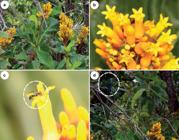
Floral morphology and floral visitors of Palicourea rigida. (A) General view of the inflorescence. (B) Close-up of the flowers. (C) A floral visitor: an ant foraging on a flower. (D) A hummingbird observed in the background after visiting the flowers.
In general, rupestrian fields have rocky outcrops and rugged terrain with calcareous soil. It also has a low water retention capacity, resulting in sparser vegetation (Ribeiro & Walter, 2008; Reys et al., 2013). The typical cerrado is generally located over profound red or yellow latosols. These types of soils are well-drained but can retain water longer than rupestrian environments. The vegetation in the typical cerrado consists of a mix of grasses, shrubs, and small trees, which do not result in significant canopy coverage (Lima et al., 2010; Reys et al., 2013). According to the Köppen-Geiger classification (Beck et al., 2018), this municipality is part of the Tropical Savanna Climate (Aw), which has a dry season from April to September and a rainy season from October to March (Instituto Nacional de Meteorologia, 2024). This study was carried out between November 24 and 26, 2023.
Flower visits and flower quantification
We conducted all the data collection considering two periods: predawn (between 7:00 and 8:00) and midday (between 12:00 and 13:00). We chose these periods because at predawn, the soil tends to have regained moisture during the nighttime, whereas it tends to be drier at midday.
First, we collected two inflorescences (one for each time of day: predawn and midday) from six individuals of Palicourea rigida (n = 6) in each environment (rocky and typical cerrado), totaling 24 inflorescences (six in the rocky savanna before dawn, six in the rocky savanna at midday, six in the typical savanna before dawn, and six in the typical savanna at midday). Individuals were chosen on the basis of the availability of flowers and inflorescences, with individuals having at least six inflorescences being considered for the experiment. The number of flowers and flower buds on each inflorescence was subsequently counted. The number of flowers and flower buds counted in each environment and period is summarized in Table 1.
Number of flowers and flower buds (mean ± 1 standard deviation ) (total) counted in the inflorescences of Palicourea rigida used to measure water potential. The data is summarized according to the period of inflorescence collection and the type of environment.
Then, for each plant, a team member observed and counted the number of flower visits for 30 minutes (once at predawn and once at midday). To be considered a visit, the animal had to make clear contact with a flower (Fig. 2C). In addition, the water potential of each plant (see below) was measured before the flower visits both at predawn and at midday. The length of the visitor's stay was not taken into account in the count. Different types of flower visitors can interact with the flowers of P. rigida in different ways, ranging from pollination to resource pillaging, and at different frequencies (Machado et al., 2010). Some studies have shown that the way floral visitors exploit floral resources is related to their size and taxonomic classification, including studies involving visitors of P. rigida and other Rubiaceae species (e.g., Castro & Oliveira, 2002; Machado et al., 2010; Consolaro et al., 2011). For this reason, we classified the flower visitors into functional categories based on their order, family, and size, as these characteristics likely group visitors with similar flower exploitation behaviors into the same categories. Given the central role of bees as floral visitors, we additionally classified them into two distinct categories: small bees, defined as those equivalent in size to or smaller than the Apis mellifera bee (13 mm), and large bees, characterized by larger dimensions than Apis mellifera. All hummingbirds (Fig. 2D) were classified into the same functional group, given their similar mode of interaction with P. rigida during our observations. Finally, we highlight that similar functional categorizations have also been adopted in other studies where the main focus is not the visitors' identity, but their general functional role in flower exploitation (e.g., Oliveira & Gibbs, 2000; Castro & Oliveira, 2002; Consolaro et al., 2011).
Water potential measurement
Water potential analyses were performed in the field, using only a Scholander pressure chamber. Inflorescences at the same stage of development were selected and removed from individual plants by pruning to estimate the water potential. Measurements were taken immediately via a Scholander pressure chamber, where the inflorescences are turned upside down so that the amount of water eliminated by pressure exits through the floral petiole on the outside of the pump (visible to the naked eye) (Soilmoisture Equipment Corp., USA) (Rodriguez-Dominguez et al., 2022). The temperature measured before dawn was 20 °C, whereas at noon, it was 31 °C (Fig. 3).
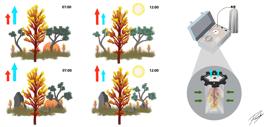
Schematic representations of the study design and water potential measurements. We collectedPalicourea rigida inflorescences under different temperatures (red arrows) and humidities (blue arrows). At 07:00, individuals were exposed to lower temperatures and higher humidity in both typical cerrado (top-left) and rupestrian fields (bottom-left). At 12:00, individuals were exposed to higher temperatures and lower humidity in both typical cerrado (top-right) and rupestrian fields (bottom-right). All the inflorescences were placed in a Scholander pressure chamber (right). Their water potential was measured by applying the pressure required to expel water from their cut base.
Data analyses
Our hypothesis assumed that plants whose inflorescences have relatively high water potential would receive more floral visits. Therefore, we first assessed which temporal and environmental conditions led P. rigida inflorescences to exhibit greater water potential. To assess whether inflorescences presented differences in water potential according to period and environment, we performed a Generalized Estimating Equation (GEE) with a Gaussian error distribution and an exchangeable correlation structure. This method was chosen to account for the repeated measures on the same plants (at predawn and midday). Plant identity was specified as the clustering variable to model the within-subject correlation (Xu et al., 2025). In this model, the water potential of each inflorescence was the response variable; the period (predawn and midday) and the environment (rupestrian field and typical cerrado) were the predictor variables. We also included the number of flowers and flower buds counted in the measured inflorescences as predictor variables in this model, due to their potential effect on water potential. Differences in the mean water potential of inflorescences among these four scenarios (rupestrian field predawn, rupestrian field midday, typical cerrado predawn, and typical cerrado midday) were evaluated with a post hoc test of multiple comparisons using pairwise contrasts of estimated marginal means (EMMs) with Tukey-adjusted p-values.
Once the differences in water potential in the inflorescences between periods and environments were analyzed, we were able to test how these differences influenced the number of floral visits in P. rigida. To assess whether the number of flower visits differed between the periods and environments, we performed a Generalized Linear Model (GLM) with a negative binomial error distribution. In this model, the number of observed flower visits was the response variable; the period (predawn and midday), the environment (rupestrian field and typical cerrado), and their interaction were the predictor variables. Again, we also included the number of flowers and flower buds per inflorescence as predictor variables in the model, due to their potential to attract floral visitors. In addition, we specified robust standard errors clustered by plant identity in this GLM to account for within-subject correlation from repeated measures on the same plants. We adopted this approach because GEE implementations do not support negative binomial distributions. Given the significant effect of the period in this GLM (see Results), we compared the EMMs of flower visits between predawn and midday periods.
In addition, to assess whether and to what degree the number of flower visits is related to the water potential in inflorescences, we performed an additional GLM with a negative binomial error distribution. In this model, the number of flower visits was the response variable, and the water potential in each inflorescence was the predictor variable. The environment (rupestrian field and typical cerrado), and the number of flowers and flower buds per inflorescence were also included as predictor variables in this model, due to their potential effects on the number of floral visits. The measurement period was not included in this model because we aimed to assess the influence of water potential on attracting floral visits, independent of when it peaked. Furthermore, we also specified robust standard errors clustered by plant identity in this model to account for within-subject correlation from repeated measures on the same plants. We estimated the 95 % confidence interval for the water potential predictor coefficient (β) in this model to inspect whether it included the null effect (zero). Finally, we measured the explanatory power of this GLM by calculating a variance-function-based pseudo-R² (pseudo coefficient of determination), which standardizes residuals by the expected variance of each observation under the negative binomial model (Zhang, 2017).
Finally, we assessed whether the types of flower visitors were associated with specific survey periods (predawn and midday) and environments (rupestrian field and typical cerrado). We then performed permutation multivariate analyses of variance (PERMANOVAs) with the matrix of the abundance of flower visitors as the response variable and the matrices of survey periods and environments as predictor variables. In these tests, we calculated the Bray‒Curtis dissimilarities of flower visitors in terms of these spatial and temporal variables and compared these dissimilarities with those stochastically estimated with 10,000 permutations. Since there was no spatial or temporal bias (see Results), we could keep all the statistical tests without considering the identities of flower visitors.
All analyses were conducted via R version 4.3.1 (R Core Team 2023). The dataset and analysis code (R scripts) are available in Supplementary Material I. We performed a graphical inspection of residuals to evaluate whether the linear mean structure of the Gaussian GEE was appropriately specified. We considered the negative binomial error distribution in the two GLMs, given the integer response variables (number of floral visits), and choosing a Poisson error distribution violated the residual overdispersion assumption (see Supplementary Material I). We used the vegan package (Oksanen et al., 2019) package to performed the PERMANOVA, and the geepack package (Højsgaard et al., 2006) to perform the GEE. Since negative binomial error distributions are not implemented in geepack, we used the lmtest (Zeileis & Hothorn, 2002) and sandwich (Zeileis et al., 2020) packages to implement the clustering variable (Xu et al., 2025) in a negative binomial GLM built with the MASS package (Venables & Ripley, 2002). The rsq (Zhang, 2024) and miceadds (Robitzsch & Grund, 2025) packages were used to calculate the coefficients of determination of the models, the emmeans (Lenth & Piaskowski, 2025) and multcomp (Hothorn et al., 2008) packages to conduct post hoc analyses, and the ggplot2 (Wickham, 2016; Wickham et al., 2023) and patchwork (Pedersen, 2024) packages to edit the graphics.
Results
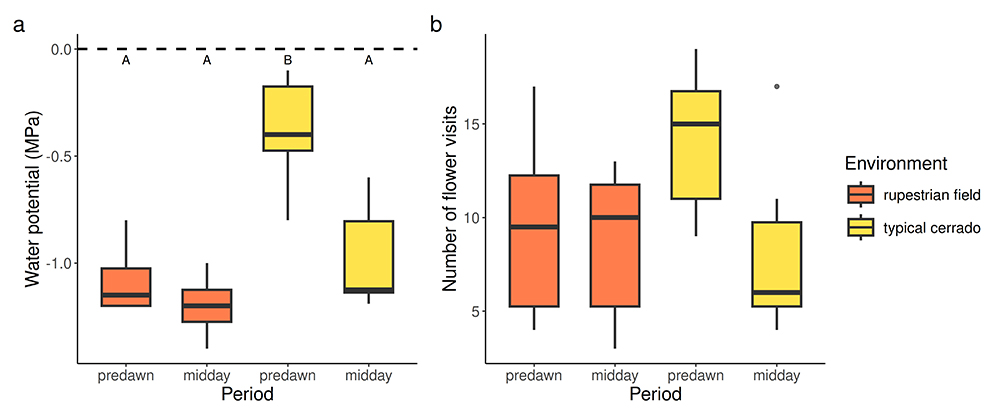
We observed that the period and the environment type interactively influenced the water potential of P. rigida inflorescences (Gaussian GEE: period × environment: Wald = 9.53, P < 0.01). In this same model, the environment also influenced the water potential, but the survey period did not (Gaussian GEE: period: Wald = 2.85, P = 0.09; environment: Wald = 25.59, P < 0.01). Finally, the number of flowers and flower buds in the inflorescences did not influence the water potential (Gaussian GEE: flowers: Wald = 2.27, P = 0.13; flower buds: Wald = 0.28, P = 0.59). When comparing the EMMs, only the plants in typical cerrado during the predawn presented a significantly (P < 0.05) higher average of water potential than those in other conditions (Fig. 4A).
When comparing the number of flower visits according to the period of observation and the type of environment (Fig. 4B), these predictors did not present a significant interaction (negative binomial GLM: period × environment: z = -1.48, P = 0.13). For this reason, this interaction was removed from the model. The number of flower visits statistically increased at predawn compared with that at midday (negative binomial GLM: period: z = -2.49, P = 0.01) but did not differ according to the environment (negative binomial GLM: environment: z = 0.46, P = 0.64). In this same model, the number of flowers in the inflorescences influenced the number of visits, but the number of flower buds did not (negative binomial GLM: flowers: z = -2.62, P < 0.01; flower buds: z = -0.47, P = 0.64). When comparing the EMMs, the average number of flower visits during the predawn was significantly (P < 0.05) higher than during the midday (Fig. 4B). Given that the interaction of predictors was removed from the model, only the periods (the significant predictor) were compared in this post hoc test.
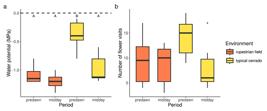
Quantile box plots for water potential (MPa) (A) and for the number of flower visitors (B) according to the periods (predawn and midday) and environments of the survey (rupestrian and typical cerrado). Different capital letters denote significant differences when contrasting the EMMs. The dashed line (A) denotes the lowest water scarcity possible (highest water potential).
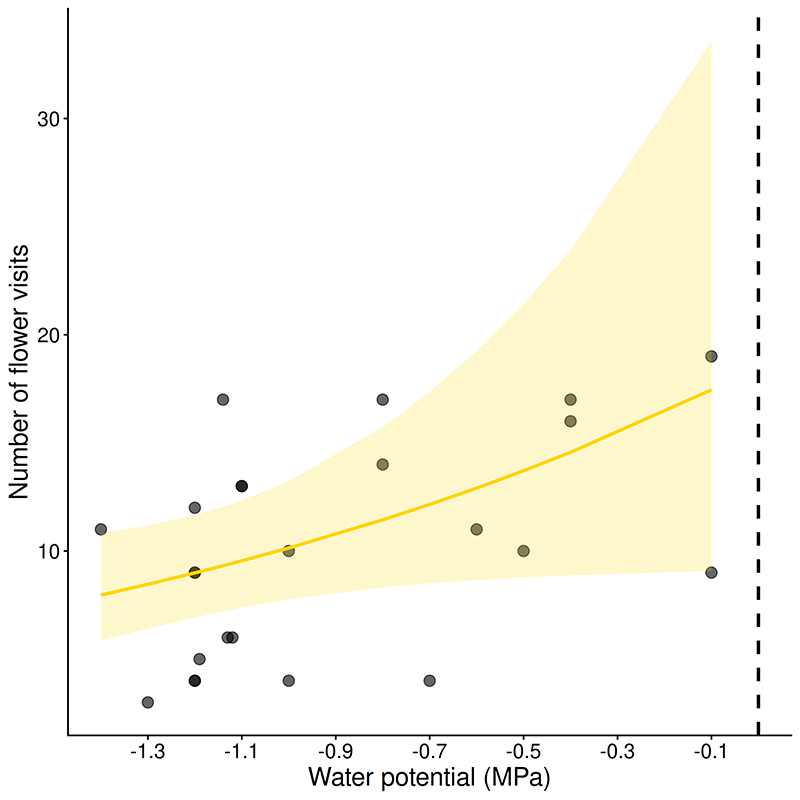
Finally, the number of floral visits was positively associated with water potential of the inflorescences (Fig. 5), even considering the potential influence of the environment type, number of flowers and flower buds in this model (negative binomial GLM: water potential: z = 2.09, P = 0.03, βwater potential = 0.60, 95 % confidence interval [0.02-1.19]) (Fig. 5). This model explained 19.3 % of the variation of the number of floral visits (pseudo-R² = 0.193).
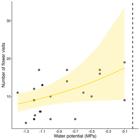
The adjusted model (yellow line; negative binomial GEE) and its 95 % confidence interval (yellow shaded area) considering the effects of water potential (MPa) on the number of flower visitors, irrespective of the environment, number of flowers and flower buds in the inflorescences (fixed effects), and P. rigida individuals' identities as clustering variable. The dashed line denotes the lowest water scarcity possible (highest water potential).
In addition to hummingbirds, we observed a wide range of insects visiting the flowers (Supplementary Material II, Table S1). However, the types of flower visitors were not associated with specific periods or environments. Although 15 % and 80 % of the dissimilarities of flower visitors were related to these temporal and spatial features, respectively, they were not different from those stochastically expected (PERMANOVA: I - period: F = 0.35, R² = 0.15, df = 1, df residuals = 2, P = 0.66; II - environment: F = 8.30, R² = 0.80, df = 1, df residuals = 2, P = 0.33). We need to emphasize that our observations were not extensive enough to detect taxonomic patterns of floral visitors across environments and periods. This result most likely reflects only the specific timing of our observations, given that some of the main functional categories of visitors were shared between periods and environments at that time. Furthermore, our sampling design mitigated potential temporal and spatial biases. Observations of flower visitors were highly synchronous among plant individuals, as all surveys within a given period were completed within the same one-hour interval (07:00-08:00 for predawn and 12:00-13:00 for midday). Moreover, all plants within a given environment were exposed to the same weather conditions, with no individuals being disproportionately distant from the others.
Discussion
In this study, both the time of day and the type of environment affected, to some extent, the water potential in the inflorescences of P. rigida. Specifically, inflorescences in the typical cerrado during predawn presented especially greater water potential than those in the rupestrian field or during midday. Inflorescences received more floral visits at predawn than at midday. Inflorescences received more floral visits at predawn than at midday. The tendency of inflorescences in typical cerrado to receive a high number of visits during predawn probably contributed to this result. Finally, we identified a significant tendency for inflorescences with higher water potential to attract more visits, regardless of their environment. Despite some floral visitors being clearly associated with only one environment type (e.g., hummingbirds and dipterans in the typical cerrado), many visitors (e.g., bees, wasps, ants) were present in both periods and environments. Consequently, the taxonomic composition of floral visitors did not differ significantly between environments and observation periods. While floral visitor taxa likely vary significantly across environments and times of day, such differences would probably only be detectable with more extensive sampling than our short-term observations provided. For the objectives of this study, however, we proceeded with our analyses without incorporating visitor taxonomy, as no significant taxonomic variation was observed during our specific sampling periods. We must highlight that expanding this investigation to other locations and replicating these observations is crucial to better identify the animals associated with P. rigida and how the water content of this plant affects its attractiveness. However, the visitation rate of P. rigida was high enough to allow us to detect some patterns, providing good insight into how the water potential of inflorescences may affect them.
However, it is also possible that the flowering characteristics of P. rigida, such as flowering duration and nectar quantity, influence the high diversity of visitors it attracts. This diversity of visitors could, in turn, make it more difficult to detect associations between visitor types and specific environments and periods. Considered a generalist, P. rigida is visited by a variety of distinct groups of visitors, whether for the purpose of acquiring resources, seeking shelter, or herbivory (Machado et al., 2010). Certainly, other variables, such as the plant's and inflorescences' morphology, as well as the vegetation structure and community of each physiognomy, must also be crucial in determining the assemblages of floral visitors in P. rigida (Ribeiro & Walter, 2008; Colli et al., 2020).
The Cerrado is one of the largest Brazilian biomes and has a characteristic and distinct flora, as it is under the influence of climate, soil composition and formation, the water table, anthropogenic actions, climate change and the frequency of fires (Klink & Machado, 2005; Ribeiro & Walter, 2008; Oliveira et al., 2014; Lehmann et al., 2014). For example, both phytophysiognomies studied have distinct environmental characteristics, and the typical cerrado occurs over deep Quartzarenic Oxisols and Neosols, which are composed of shrubs, subshrubs, and trees with partial soil cover (Ribeiro & Walter, 2008; Oliveira-Filho & Ratter 2002). The rupestrian field has shrubs and subshrubs with shallow soil with rocky outcrops and low soil cover (Ribeiro & Walter, 2008; Silveira et al., 2016). Although P. rigida is one of the most common species in the Brazilian Cerrado (Ratter et al., 2003; Ribeiro & Walter, 2008), we observed that in the morning, phytophysiognomies influence the water potential of inflorescences. The water status of P. rigida inflorescences was greater in the typical cerrado. This result may be related to the environmental characteristics present in each phytophysiognomy. The rupestrian field species are subject to limited availability of water and nutrients and high solar irradiation (Burke, 2002), which may explain the low amount of water in the inflorescences of P. rigida in both periods studied. However, in the typical cerrado, rainwater interception and water uptake by the roots are greater because of its denser vegetation (Oliveira et al., 2014;2015; Oliveira et al., 2017). In addition, the night can influence the water status, since the loss of soil moisture (low water retention) in the rupestrian field may be easier than that in the typical cerrado (Ribeiro & Walter, 2008; Silveira et al., 2016; Colli et al., 2020). The transpiration of Cerrado plants is regulated during the day, tends to increase considerably in the morning (higher soil moisture), briefly reaches a maximum value before noon, and then decreases (Meinzer et al., 1999; Scholz et al., 2002). Therefore, the difference in the water potential of P. rigida inflorescences may be related to transpiration and high solar irradiation.
In P. rigida, the number of floral visitors increased with higher water potential in the inflorescences. Water availability can directly or indirectly affect the production and maintenance of nectar and other resources throughout the day (Dicks et al., 2002; Pigozzo & Viana, 2010; Burkle & Runyon, 2016; Barônio et al., 2018). These findings may explain the relationship between water status and the number of floral visitors. Plants have several strategies to achieve reproductive success, but in pollination systems, the relationships are considered mutualistic, where the plant necessarily provides a resource for the pollinator (Carroll et al., 2001; Burkle & Irwin, 2009; Halpern et al., 2010; Waser & Price, 2016). For example, a study on hummingbird behavior associated with Palicourea rigida showed that reduced floral abundance and nectar availability caused hummingbirds to abandon their territories (Justino et al., 2012). In contrast, higher resource availability increased the frequency of territorial intruders (Justino et al., 2012). Another hypothesis is that the turgor of flowers may also vary, affecting their attractiveness or even functionality for other visitors who explore flowers in different ways. Therefore, maintaining the abundance of this resource during the flowering period may be an important strategy for attracting and diversifying floral visitors (Galen et al., 1999; Burkle & Runyon, 2016; Gallagher & Campbell, 2017). As water is an important component of these resources, its availability in greater or lesser amounts can affect these relationships (Shuel, 1957; Caruso et al., 2005; Caruso, 2006; Burkle & Irwin, 2009; Burkle & Runyon, 2016; Vaudo et al., 2022). In Bauhinia brevipes Vogel (Fabaceae), for instance, flower production is costly because the flowers are large, produce sugar-rich nectar, and appear during periods of low water availability before the rainy season, increasing floral display (Galen et al., 1993; Silveira et al., 2015). Therefore, we observed that both in the typical cerrado field and in the rupestrian field, the number of floral visitors and pollinators in P. rigida increases proportionally to the water status of fluorescence.
Several factors can interfere with this interaction, such as nutrients in the soil and exposure to the sun, which were not addressed in this study and serve as perspectives for future studies. In this study, the water potential had a positive correlation in both scenarios, explaining 19.3 % of the changes in the visitation rate. These data reinforce the importance of water for the Cerrado and its plants, as these data indicate a possible change in the reproductive success of the species indirectly related to water. Therefore, water potential is a relevant functional and physiological characteristic and should be taken into account in studies on functional traits in the Cerrado. In addition, with the advancement of climate change, the effects of soil water change may further impact the flora of the Cerrado and its phenology.
Supplementary Material
The following online material is available for this article:
Supplementary Data 1.
Table S1.
Acknowledgments
We are thankful to the Programa de Pós-Graduação em Ecologia, Conservação e Biodiversidade da Universidade Federal de Uberlândia for the support and field course offered.
References
-
An YD, Roddy AB, Zhang TH, Jiang GF. 2023. The hydraulic differences between flowers and leaves are driven primarily by pressure - volume traits and water loss. Frontiers in Plant Science 14: 1130724. doi: 10.3389/fpls.2023.1130724.
» https://doi.org/10.3389/fpls.2023.1130724 -
Ashman T-L, Schoen DJ. 1994. How long should flowers live? Nature 371: 788-791 doi: 10.1038/371788a0.
» https://doi.org/10.1038/371788a0 -
Ashman T-L. 1994. A dynamic perspective on the physiological cost of reproduction in plants. The American Naturalist 144: 300-316. doi: 10.1086/285676.
» https://doi.org/10.1086/285676 -
Barônio GJ, Guimarães BMC, Oliveira LC et al 2018. Between flowers and visitors: Strategies for making available and collecting floral resources. Oecologia Australis 22: 390-409. doi: 10.4257/oeco.2018.2204.04
» https://doi.org/10.4257/oeco.2018.2204.04 -
Beck HE, Zimmermann NE, McVicar TR, Vergopolan N, Berg A, Wood EF. 2018. Present and future Köppen-Geiger climate classification maps at 1-km resolution. Scientific Data 5: 180214. doi: 10.1038/sdata.2018.214.
» https://doi.org/10.1038/sdata.2018.214 -
Borghi M, Fernie AR. 2021. From flowers to seeds: How the metabolism of flowers frames plant reproduction. The Biochemist 43: 14-18. doi: 10.1042/bio_2021_134.
» https://doi.org/10.1042/bio_2021_134 -
Brendel O. 2021. The relationship between plant growth and water consumption: A history from the classical four elements to modern stable isotopes. Annals of Forest Science 78: 47. doi: 10.1007/s13595-021-01063-2.
» https://doi.org/10.1007/s13595-021-01063-2 -
Burke A. 2002. Island - matrix relationships in Nama Karoo inselberg landscapes Part II: Are some inselbergs better sources than others? Plant Ecology 158: 41-48. doi: 10.1023/A:1014791501882.
» https://doi.org/10.1023/A:1014791501882 -
Burkle LA, Irwin RE. 2009. The effects of nutrient addition on floral characters and pollination in two subalpine plants, Ipomopsis aggregata and Linum lewisii Plant Ecology 203: 83-98. doi: 10.1007/s11258-008-9512-5
» https://doi.org/10.1007/s11258-008-9512-5 -
Burkle L, Runyon J. 2016. Drought and leaf herbivory influence floral volatiles and pollinator attraction. Global Change Biology 22: 1644-1654. doi: 10.1111/gcb.13149.
» https://doi.org/10.1111/gcb.13149 -
Carroll AB, Pallardy SG, Galen C. 2001. Drought stress, plant water status, and floral trait expression in fireweed, Epilobium angustifolium (Onagraceae). American Journal of Botany 88: 438-446. doi: 10.2307/2657108.
» https://doi.org/10.2307/2657108 -
Caruso CM. 2006. Plasticity of inflorescence traits in Lobelia siphilitica (Lobeliaceae) in response to soil water availability. American Journal of Botany 93: 531-538. doi: 10.3732/ajb.93.4.531.
» https://doi.org/10.3732/ajb.93.4.531 -
Caruso CM, Remington DLD, Ostergren KE. 2005. Variation in resource limitation of plant reproduction influences natural selection on floral traits of Asclepias syriaca Oecologia 146: 68-76. doi: 10.1007/s00442-005-0183-4
» 10.1007/s00442-005-0183-4 -
Castro CC, Oliveira PEM. 2002. Pollination Biology of Distylous Rubiaceae in the Atlantic Rain Forest, SE Brazil. Plant Biology 4: 640-646. doi: 10.1055/s-2002-35433.
» https://doi.org/10.1055/s-2002-35433 -
Chapin FS, Zavaleta ES, Eviner VT et al 2000. Consequences of changing biodiversity. Nature405: 234-242. doi: 10.1038/35012241
» 10.1038/35012241 -
Chaves MM, Pinheiro C. 2009. Photosynthesis under drought and salt stress: Regulation mechanisms from whole plant to cell. Annals of Botany 103: 551-560. doi: 10.1093/aob/mcn125.
» https://doi.org/10.1093/aob/mcn125 -
Colli GR, Vieira CR, Dianese JC. 2020. Biodiversity and conservation of the Cerrado: Recent advances and old challenges. Biodiversity and Conservation 29: 1465-1475. doi: 10.1007/s10531-020-01967-x.
» https://doi.org/10.1007/s10531-020-01967-x -
Consolaro H, Silva SCS, Oliveira PE. 2011. Breakdown of distyly and pin-monomorphism in Psychotria carthagenensis Jacq. (Rubiaceae). Plant Species Biology 26: 24-32. doi: 10.1111/j.1442-1984.2010.00300.x.
» https://doi.org/10.1111/j.1442-1984.2010.00300.x -
De la Barrera E, Nobel PS. 2004. Nectar: properties, floral aspects, and speculations on origin. Trends in Plant Science 9: 65-69. doi: 10.1016/j.tplants.2003.12.003.
» https://doi.org/10.1016/j.tplants.2003.12.003 -
Dicks LV, Corbet SA, Pywell RF. 2002. Compartmentalization in plant-insect flower visitor webs. Journal of Animal Ecology 71: 32-43. doi: 10.1046/j.0021-8790.2001.00572.x
» https://doi.org/10.1046/j.0021-8790.2001.00572.x -
Dorken ME, van Kleunen M, Stift M. 2025. Costs of reproduction in flowering plants. New Phytologist 247: 55-70. doi: 10.1111/nph.70166.
» https://doi.org/10.1111/nph.70166 -
Eiten G. 1972. The cerrado vegetation of Brazil. The Botanical Review 38: 201-341. doi: 10.1007/bf02859158.
» https://doi.org/10.1007/bf02859158 -
Galen C, Dawson TE, Stanton ML. 1993. Carpels as leaves: Meeting the carbon cost of reproduction in an alpine buttercup. Oecologia 95: 187-193. doi: 10.1007/BF00323489.
» https://doi.org/10.1007/BF00323489 -
Galen C, Sherry RA, Carroll AB. 1999. Are flowers physiological sinks or faucets? Costs and correlates of water use by flowers of Polemonium viscosum. Oecologia 118: 461-470. doi: 10.1007/s004420050749.
» https://doi.org/10.1007/s004420050749 -
Gallagher MK, Campbell DR. 2017. Shifts in water availability mediate plant-pollinator interactions. New Phytologist 215: 792-802. doi: 10.1111/nph.14602.
» https://doi.org/10.1111/nph.14602 -
Halpern SL, Adler LS, Wink M. 2010. Leaf herbivory and drought stress affect floral attractive and defensive traits in Nicotiana quadrivalvis Oecologia 163: 961-971. doi: 10.1007/s00442-010-1651-z.
» https://doi.org/10.1007/s00442-010-1651-z -
Harder LD, Johnson SD. 2009. Darwin’s beautiful contrivances: Evolutionary and functional evidence for floral adaptation. New Phytologist 183: 530-545. doi: 10.1111/j.1469-8137.2009.02914.x.
» https://doi.org/10.1111/j.1469-8137.2009.02914.x -
Hothorn T, Bretz F, Westfall P. 2008. Simultaneous inference in general parametric models. Biometrical Journal 50: 346-363. doi: 10.1002/bimj.200810425.
» https://doi.org/10.1002/bimj.200810425 -
Højsgaard S, Halekoh U, Yan J. 2006. The R Package geepack for Generalized Estimating Equations. Journal of Statistical Software15: 1-11. doi: 10.18637/jss.v015.i02.
» https://doi.org/10.18637/jss.v015.i02 -
Instituto Nacional de Meteorologia. 2024. Dados históricos anuais. https://portal.inmet.gov.br/dadoshistoricos 29 Apr. 2025.
» https://portal.inmet.gov.br/dadoshistoricos -
Justino DG, Maruyama PK, Oliveira PE. 2012. Floral resource availability and hummingbird territorial behavior on a Neotropical savanna shrub. Journal of Ornithology 153: 189-197. doi: 10.1007/s10336-011-0726-x.
» https://doi.org/10.1007/s10336-011-0726-x -
Klink CA, Machado RB. 2005. Conservation of the Brazilian Cerrado. Conservation Biology 19: 707-713. doi: 10.1111/j.1523-1739.2005.00702.x.
» https://doi.org/10.1111/j.1523-1739.2005.00702.x -
Kuppler J, Kotowska MM. 2021. A meta-analysis of responses in floral traits and flower-visitor interactions to water deficit. Global Change Biology 27: 3095-3108. doi: 10.1111/gcb.15621.
» https://doi.org/10.1111/gcb.15621 -
Lehmann CER, Anderson TM, Sankaran M et al 2014. Savanna vegetation-fire-climate relationships differ among continents. Science 343: 548-552. doi: 10.1126/science.1247355.
» https://doi.org/10.1126/science.1247355 -
Lenth R, Piaskowski J. 2025. emmeans: Estimated Marginal Means, aka Least-Squares Means. R package version 2.0.0. https://CRAN.R-project.org/package=emmeans 29 Apr. 2025.
» https://CRAN.R-project.org/package=emmeans -
Lima TA, Pinto JRR, Lenza E, Pinto AS. 2010. Florística e estrutura da vegetação arbustivo-arbórea em uma área de cerrado rupestre no Parque Estadual da Serra de Caldas Novas, Goiás. Biota Neotropica 10: 159-166. doi: 10.1590/S1676-06032010000200020.
» https://doi.org/10.1590/S1676-06032010000200020 -
Liu Y, Li Z. 2020. Effects of water addition on reproductive allocation of dominant plant species in Inner Mongolia steppe. Frontiers in Plant Science 11: 555743. doi: 10.3389/fpls.2020.555743
» https://doi.org/10.3389/fpls.2020.555743 -
Machado ADO, Silva AP, Consolaro H, Barros MA, Oliveira PE. 2010. Breeding biology and distyly in Palicourea rigida H.B. & K. (Rubiaceae) in the Cerrados of Central Brazil. Acta Botanica Brasilica 24: 686-696. doi: 10.1590/S0100-84042003000300013.
» https://doi.org/10.1590/S0100-84042003000300013 -
McLaren KP, McDonald. 2005. Seasonal patterns of flowering and fruiting in a Dry Tropical Forest in Jamaica. Biotropica 37: 584-590. doi: 10.1111/j.1744-7429.2005.00075.x.
» https://doi.org/10.1111/j.1744-7429.2005.00075.x -
Meinzer FC, Goldstein G, Franco AC et al 1999. Atmospheric and hydraulic limitations on transpiration in Brazilian Cerrado woody species. Functional Ecology 13: 273-282. doi: 10.1046/j.1365-2435.1999.00313.x.
» https://doi.org/10.1046/j.1365-2435.1999.00313.x -
Obeso J-R. 2002. The costs of reproduction in plants. New Phytologist 155: 321-348. doi: 10.1046/j.1469-8137.2002.00477.x.
» https://doi.org/10.1046/j.1469-8137.2002.00477.x -
Oliveira PE, Gibbs PE. 2000. Reproductive biology of woody plants in a cerrado community of Central Brazil. Flora 195: 311-329. doi: 10.1016/S0367-2530(17)30990-8.
» https://doi.org/10.1016/S0367-2530(17)30990-8 - Oliveira- AT Filho, Ratter JA. 2002. Vegetation physiognomies and woody flora of the Cerrado. In: Oliveira PS, Marquis RJ (eds.). The Cerrados of Brazil: Ecology and natural history of a neotropical savanna. New York, Columbia University Press. p. 91-120.
-
Oliveira PTS, Nearing MA, Moran MS, Goodrich DC, Wendland E, Gupta HV. 2014. Trends in water balance components across the Brazilian Cerrado. Water Resources Research 50: 7100-7114. doi: 10.1002/2013WR014333.
» https://doi.org/10.1002/2013WR014333 -
Oliveira PT, Wendland E, Nearing MA, Scott RL, Rosolem R, Da Rocha HR. 2015. Water balance components of undisturbed tropical woodlands in the Brazilian Cerrado. Hydrology and Earth System Sciences 19: 2899-2910. doi: 10.5194/hess-19-2899-2015.
» https://doi.org/10.5194/hess-19-2899-2015 -
Oliveira PTS, Leite MB, Mattos T et al 2017. Groundwater recharge decreases with increasing vegetation density in the Brazilian Cerrado. Ecohydrology 10: e1759. doi: 10.1002/eco.1759.
» https://doi.org/10.1002/eco.1759 -
Overbeck GE, Vélez-Martin E, Scarano FR et al 2015. Conservation in Brazil needs to include non-forest ecosystems. Diversity and Distributions21: 1455-1460. doi: 10.1111/ddi.12380.
» https://doi.org/10.1111/ddi.12380 -
Oksanen J, Blanchet FG, Friendly M et al 2019. vegan: Community Ecology Package. R package version 2.5-6.https://CRAN.R-project.org/package=vegan 29 Apr. 2025.
» https://CRAN.R-project.org/package=vegan - Passioura JB. 2010. Plant-water relations. In: Encyclopedia of Life Sciences. Hoboken, John Wiley & Sons.
-
Pedersen T. 2024. patchwork: The Composer of Plots. R package version 1.2.0. https://CRAN.R-project.org/package=patchwork 29 Apr. 2025.
» https://CRAN.R-project.org/package=patchwork -
Pigozzo CM, Viana BF. 2010. Estrutura da rede de interações entre flores e abelhas em ambiente de caatinga. Oecologia Australis 14: 100-114. doi: 10.4257/oeco.2010.1401.04.
» https://doi.org/10.4257/oeco.2010.1401.04 -
Pyke GH. 1991. What does it cost a plant to produce floral nectar? Nature 350: 58-59. doi: 10.1038/350058a0.
» https://doi.org/10.1038/350058a0 -
R Development Core Team. 2023. R version 4.3.1. The R Foundation for Statistical Computing, Vienna, Austria. https://www.R-project.org/ 29 Apr. 2025.
» https://www.R-project.org/ -
Ratter JA, Bridgewater S, Ribeiro JF. 2003. Analysis of the floristic composition of the Brazilian cerrado vegetation III: Comparison of the woody vegetation of 376 areas. Edinburgh Journal of Botany 60: 57-109. doi: 10.1017/S0960428603000064.
» https://doi.org/10.1017/S0960428603000064 -
Reys P, Camargo MGG, Guaratini MTG, Teixeira AP, Assis MA, Morellato LPC. 2013. Estrutura e composição florística de um Cerrado sensu stricto e sua importância para propostas de restauração ecológica. Hoehnea40: 449-464. doi: 10.1590/S2236-89062013000300005.
» https://doi.org/10.1590/S2236-89062013000300005 - Ribeiro JF, Walter BMT. 2008. As principais fitofisionomias do bioma Cerrado. In: Sano SM, Almeida SP, Ribeiro JF (eds.). Cerrado: Ecologia e flora. Brasília, Embrapa-Cerrados. p. 152-212.
-
Robitzsch A, Grund S. 2025. miceadds: Some Additional Multiple Imputation Functions, Especially for 'mice'. R package version 3.18-36. https://CRAN.R-project.org/package=miceadds 29 Apr. 2025.
» https://CRAN.R-project.org/package=miceadds -
Roddy AB. 2019. Energy balance implications of floral traits involved in pollinator attraction and water balance. International Journal of Plant Sciences180: 944-953. doi: 10.1086/705586.
» https://doi.org/10.1086/705586 -
Roddy AB, Martínez-Perez C, Teixido AL et al 2021. Toward the flower economics spectrum. New Phytologist 229: 665-672. doi: 10.1111/nph.16823.
» https://doi.org/10.1111/nph.16823 -
Rodriguez-Dominguez CM, Forner A et al 2022. Leaf water potential measurements using the pressure chamber: Synthetic testing of assumptions toward best practices for precision and accuracy. Plant, Cell & Environment 45: 2037-2061. doi: 10.1111/pce.14330.
» https://doi.org/10.1111/pce.14330 -
Scholz FG, Bucci SJ, Goldstein G, Meinzer FC, Franco AC. 2002. Hydraulic redistribution of soil water by neotropical savanna trees. Tree Physiology22: 603-612. doi: 10.1093/treephys/22.9.603.
» https://doi.org/10.1093/treephys/22.9.603 -
Schiestl FP, Johnson SD. 2013. Pollinator-mediated evolution of floral signals. Trends in Ecology & Evolution 28: 307-315. doi: 10.1016/j.tree.2013.01.019.
» https://doi.org/10.1016/j.tree.2013.01.019 -
Simon MF, Grether R, Queiroz LP, Skema C, Pennington RT, Hughes CE. 2009. Recent assembly of the Cerrado, a neotropical plant diversity hotspot, by in situ evolution of adaptations to fire. Proceedings of the National Academy of Sciences of the United States of America 106: 20359-20364. doi: 10.1073/pnas.0903410106.
» https://doi.org/10.1073/pnas.0903410106 -
Silveira FAO, Negreiros D, Barbosa NPU et al 2016. Ecology and evolution of plant diversity in the endangered campo rupestre: A neglected conservation priority. Plant Soil 403: 129-152. doi: 10.1007/s11104-015-2637-8.
» https://doi.org/10.1007/s11104-015-2637-8 -
Shuel RW. 1957. Some aspects of the relation between nectar secretion and nitrogen, phosphorus, and potassium nutrition. Canadian Journal of Plant Science 37: 220-236. doi: 10.4141/cjps57-027.
» https://doi.org/10.4141/cjps57-027 -
Silveira FA, Santos JC, Franceschinelli EV, Morellato LPC, Fernandes GW. 2015. Costs and benefits of reproducing under unfavorable conditions: An integrated view of ecological and physiological constraints in a cerrado shrub. Plant Ecology 216: 963-974. doi: 10.1007/s11258-015-0482-8.
» https://doi.org/10.1007/s11258-015-0482-8 -
Strassburg BBN, Brooks T, Feltran-Barbieri R et al 2017. Moment of truth for the Cerrado hotspot. Nature Ecology & Evolution 1: 0099. doi: 10.1038/s41559-017-0099.
» https://doi.org/10.1038/s41559-017-0099 -
Trevizan R, Cardoso JC, Coelho CP, Oliveira PE. 2024. Intraindividual flower variation in distylous plants. Plant Systematics and Evolution 310: 34. doi: 10.1007/s00606-024-01917-y.
» https://doi.org/10.1007/s00606-024-01917-y -
Vaudo AD, Erickson E, Patch HM, Grozinger CM, Mu J. 2022. Effects of soil nutrition on floral traits, pollinator attraction, and fitness in cucumbers (Cucumis sativus L.). Scientific Reports 12: 21802. doi: 10.1038/s41598-022-26164-4.
» https://doi.org/10.1038/s41598-022-26164-4 - Venables WN, Ripley BD. 2002. Modern Applied Statistics with S. FourthEdition. Springer, New York.
-
Waser NM, Price MV. 2016. Drought, pollen and nectar availability, and pollination success. Ecology 97: 1400-1409. doi: 10.1890/15-1423.1.
» https://doi.org/10.1890/15-1423.1 -
Weigel D, Meyerowitz EM. 1994. The ABCs of floral homeotic genes. Cell78: 203-209. doi: 10.1016/0092-8674(94)90291-7.
» https://doi.org/10.1016/0092-8674(94)90291-7 -
Wickham H. 2016. ggplot2: Elegant Graphics for Data Analysis. https://ggplot2.tidyverse.org 29 Apr. 2025.
» https://ggplot2.tidyverse.org -
Wickham H, Chang W, Henry L et al 2023. ggplot2: Create Elegant Data Visualisations Using the Grammar of Graphics. R package, version 3.4.1. https://cloud.rproject.org/web/packages/ggplot2/index.html 29 Apr. 2025.
» https://cloud.rproject.org/web/packages/ggplot2/index.html -
Xu Z, Fine JP, Song W, Yan J. 2025. On GEE for mean-variance-correlation models: Variance estimation and model selection. Statistics in Medicine 44: e10271. doi: 10.1002/sim.10271.
» https://doi.org/10.1002/sim.10271 - Zeileis A, Hothorn T. 2002. Diagnostic Checking in Regression Relationships. R News2: 7-10.
-
Zeileis A, Köll S, Graham N. 2020. Various Versatile Variances: An Object-Oriented Implementation of Clustered Covariances in R. Journal of Statistical Software 95: 1-36. doi: 10.18637/jss.v095.i01.
» https://doi.org/10.18637/jss.v095.i01 -
Zhang D. 2017. A coefficient of determination for generalized linear models. The American Statistician 71: 310-316. doi: 10.1080/00031305.2016.1256839
» 10.1080/00031305.2016.1256839 -
Zhang D. 2024. rsq: R-Squared and Related Measures. R package version 2.7. https://CRAN.R-project.org/package=rsq 29 Apr. 2025.
» https://CRAN.R-project.org/package=rsq
-
Data Availability
The entire dataset is available in Supplementary Material I.
-
Funding Information
This work was funded by a research grant from the National Council for Scientific and Technological Development - CNPq - to Denis Coelho Oliveira (303691/2022-0), and by master’s and doctoral scholarships from the Coordination for the Improvement of Higher Education Personnel - CAPES - granted to Jessyca Santana dos Santos (doctoral), Jéssica Ferreira de Lima (doctoral), and Phillipe Cardoso (master’s) (finance code 001). This work also received financial support from the Research Support Foundation of the State of Minas Gerais - FAPEMIG.
The entire dataset is available in Supplementary Material I.