
 First record of Darcya vandellioides (Benth.) Scatigna (Plantaginaceae) in the Brazilian Amazon and first report of hydathodes in the Gratioleae
Abstract
Darcya vandellioides was originally endemic to the Brazilian Atlantic Forest, and it is herein recorded for the first time in the Amazon domain in Mato Grosso, Brazil. In addition, hydathodes in Gratioleae are reported and characterized for the first time. We presented a morphological description, photographs, and anatomic features of the species’ hydathodes, and we updated the taxonomic key for all known species of Darcya.
Keywords:
Anatomy; Distribution; Introduced species; Lamiales; Taxonomy
Darcya B.L.Turner & C.C.Cowan is a small genus of Gratioleae, Plantaginaceae, comprising four species and distributed in Central America and Brazil (Turner & Cowan, 1993; Scatigna et al., 2022). This genus is characterized by leaves with 3-5 main veins arising from the base of the blade, terminal racemes, pubescent anthers, very short styles, and trapezoidal stipitate seeds (Turner & Cowan, 1993). Darcya vandellioides (Benth.) Scatigna is the only species of its genus occurring in Brazil. It was first treated under the genus Conobea Aubl. (Bentham, 1846), followed by Wettstein (1891), then under Lindernia All. (Barroso, 1952), and, subsequently, under Stemodia L. (Souza, 2003; Souza & Giulietti, 2009), until Scatigna et al. (2022) provided phylogenetic and morphological evidence to support its placement under Darcya.
This Brazilian endemic species is presumably restricted to the Atlantic Forest domain from Bahia (Northeast region) to Santa Catarina (South region) states (Flora e Funga do Brasil, 2025). However, during botanical expeditions in the northern Mato Grosso, Brazil, we found a population of D. vandelliodes. Thus, in this study, we updated its geographic distribution and presented the anatomical features of its hydathodes, which are reported for the first time in the tribe Gratioleae. In addition, we updated the taxonomic key for Darcya.
The Cristalino region, located on the southern Amazon border, presents geological and geomorphological complexities, with elevations ranging from 100 to 400 m above sea level, and encompasses different types of vegetation (Zappi et al., 2011). The region has an equatorial climate with two well-defined seasons: the dry season (from May to September) and the rainy season (from October to April). It presents an average annual precipitation of 2,400 mm, a temperature ranging from 20 °C to 38 °C, and an average temperature of 26 °C (FEC, 2010). The Cristalino Private Natural Heritage Reserves (RPPN - Reserva Particular do Patrimônio Natural, acronym in Portuguese) are located along the banks of the Cristalino River, a tributary of the Teles Pires River, which is part of the Tapajós River basin, in the municipalities of Alta Floresta and Novo Mundo, Mato Grosso.
Collection and herborization followed Fidalgo & Bononi (1984). Description, illustrations, and images were based on two fertile materials. Descriptive terminology followed Turner & Cowan (1993) and Scatigna et al. (2022). The vouchers were deposited at UFMT and HERBAM herbaria (acronyms according to Thiers 2025, continuously updated).
To observe the hydathode of D. vandellioides, expanded leaves were diaphanized in a solution of sodium hydroxide in distilled water (1:1) for approximately three days. Then, the leaves were washed in distilled water and submerged in a solution of sodium hypochlorite in distilled water (1:3) until the leaf blade became transparent. After washing again, the leaves were stained with 10% safranin and mounted in glycerin water (Kraus & Arduin, 1997, with modifications). For anatomical analyses, leaf samples were embedded in glycol methacrylate (Leica) and sectioned at a thickness of 5 μm using a rotary microtome (Microm HM 315 R). The sections were stained with 0.05% toluidine blue (O'Brien et al., 1964). Images were captured using an Olympus BX51 light microscope equipped with an Olympus DP70 digital imaging system.
For scanning electron microscopy (SEM) analysis, samples were removed from herbarium sheets (A.K.Koch 1298 and A.K.Koch 1831, both housed at UFMT). They were attached to stubs with double-sided carbon adhesive tape and covered with gold for 90 s in a sputter coater (DII-29010 SCTR Smart Coater JEOL). Observations and digital images were carried out using SEMon a scanning electron microscope at 5kV (Vega3 LMU, Tescan), at the Centro de Pesquisa Multiusuário do Araguaia (CPMUA, acronym in Portuguese) of the Universidade Federal de Mato Grosso.
Darcya vandellioides (Benth.) Scatigna. Bot. J. Linn. Soc. 200(2): 213, 2022. Fig. 1A-O and 2A-E.
Sprawling perennial herbs 5-10 cm high (Fig 1A). Stems sparingly branched, decumbent to erect (Fig. 1B), angulate and slightly winged, green, pubescent (Fig. 1J), covered with two types of glandular trichomes, short-stalked and long-stalked capitate trichomes (Fig. 2A-B). Leaves opposite, simple, discolor, adaxially green, sparsely villous adaxially, abaxially pale-green, 0.6-2.4 × 0.5-1.5 cm (petiole and blade), blades ovate, with 5 digitate main nerves from near the base, margin serrate (Fig. 1G-I); petioles 1-2 mm long, sparsely villous (Fig 2C). Flowers axillary, resupinate, single, ebracteolate (Fig. 1C-D); pedicels 5-7 mm long, pubescent; sepals 5, green, 3-4 × 1 mm, linear-lanceolate, margin entire, villous; corolla salverform, lilac lobes, tube throat, lilac-hyaline, externally villous, up to 10 mm long, throat pale-white (Fig. 1E); lobes 5, subequal, the upper 3 lobes 3-3.5 × 2-2.5 mm, the lower 2 lobes 2.5-2.8 × 1.8-2 mm (Fig. 1F), minutely pubescent at margin, internally glabrous; stamens 4, the upper pair ca. 2 mm long, 2 thecae, separated by the connective arms, the lower pair ca. 1 mm long, 2 thecae, separated by an inconspicuous connective; thecae glabrous; ovary ovoid, green, 1-2 mm long, glabrous, style green, 1.5-1.8 mm long, stigmatic region papillose. Fruit capsule ovoid, 5-6 × 5 mm, glabrous, style persistent, 2 valvate (Fig. 1K-L). Seeds obpyramidal (Fig. 1M-N), 0.2-0.3 × 0.1 mm, reticulate-faveolate (Fig. 1O).
Material examined: BRAZIL. Mato Grosso: Alta Floresta, Cristalino Lodge, arredores da RPPN Lote Cristalino, 16.VI.2023, fl., fr., A.K. Koch 1298 (UFMT; HERBAM); Floresta Amazônica Hotel, Reserva Surucuá, 29.VI.2024, fr., A.K. Koch 1831 (UFMT).

Darcya vandellioides (Benth.) Scatigna. (A-B) Habit. (C) Flower in ventral view. (D) Flower in lateral view. (E) Corolla in ventral view. (F) Corolla in frontal view with details of lobes apex. (G) Leaf abaxial surface. (H) Leaf adaxial surface. (I) Detail of villous adaxial surface and serrate margin. (J) Detail of stem. (K) Fruit immature. (L) Fruit mature. (M) Seeds. (N) Seed observed under scanning electron microscopy (SEM). (O) Detail of seed surface observed under scanning electron microscopy (SEM).
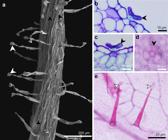
Glandular trichomes in Darcya vandellioides. (A) Stem observed under scanning electron microscopy (SEM), showing short-stalked and long-stalked capitate trichomes. Short-stalked capitate trichomes observed under light microscopy (LM) in a stem (B) and a leaf (C). Cleared leaves highlighting the head of a short-stalked capitate trichome (D) and long-stalked capitate trichomes (E). Black arrowheads: short-stalked capitate trichomes; white arrowheads: long-stalked capitate trichomes.
Darcya vandelliodes is endemic to Brazil. It is distributed throughout Bahia, Espírito Santo, Minas Gerais, Paraná, Rio de Janeiro, Santa Catarina, and São Paulo, inhabiting areas of Semideciduous Seasonal Forest, Ombrophilous Forest, Mixed Ombrophilous Forest, and Restinga in the Atlantic Forest (Flora e Funga do Brasil, 2025). Two populations of D. vandellioides were found in the municipality of Alta Floresta, in the southern Brazilian Amazon, Mato Grosso. The first one was growing on the lawn near the Cristalino Lodge facilities, in the surroundings of the RPPN Lote Cristalino. The second one was growing on the lawn in the Surucuá Reserve, annexed to the Floresta Amazônica Hotel. The owner of both areas reported that the lawn at the Floresta Amazônica Hotel was formed from seeds, and, years later, carpets and seedlings of this lawn were used around the Cristalino Lodge (Vitoria da Riva, pers. comm.). Thus, we suggest that tiny seeds of D. vandelliodes arrived in the municipality of Alta Floresta mixed with grass seeds, since the specimens are growing among the introduced lawn. These presumably introduced records expand the species distribution in Brazil to Mato Grosso, in the Amazon domain (Fig. 3).

Distribution map of Darcya vandelliodes, including the occurrence in Mato Grosso state, Brazil.
In the Atlantic Forest, specimens of D. vandellioides usually grow in disturbed areas in humid and shaded environments, such as forest borders, pond edges, and roadsides (Scatigna pers. obs.). In the Surucuá Reserve, in an area of approximately 1.7 ha, only a few scattered individuals are found in a shadier, more humid site, on the border between the lawn and the forest edge. At this location, the grass is not irrigated during the dry season. In contrast, the Cristalino Lodge population consists of hundreds of individuals at various stages of maturity, spread across approximately 1 ha of the lawn areas, with a higher concentration along the edges of this grassland bordering the forest. In this case, the grass is regularly irrigated. The species appears to be annual that prefers partial shade. In this scenario, it would not have invasive potential within the forest, unless the lawn areas are expanded and continuously irrigated.
A hydathode consists of a structure that mediates guttation in plants (Cerutti et al., 2019; Bellenot et al., 2022). Guttation is the formation of droplets at leaf tips and leaf margin serrations, usually observed in moist conditions (Bellenot et al., 2022). In Plantaginaceae, hydathodes are described at the leaf apex in Aragoa corrugatifolia Fer. Alonso (Oskolski et al., 2021) and Parahebe brevistylis (Garn.-Jones) Heads (Garnock-Jones & Lloyd, 2004).
Since hydathodes are associated with leaf teeth in different angiosperm families (Cerutti et al., 2019; Rios et al., 2020) and D. vandelliodes exhibits leaves with a serrated margin, we tested the presence of this gland through structural analysis. The marginal hydathodes are associated with leaf teeth in D. vandelliodes (Fig. 4). Water pores are distributed on the adaxial and abaxial surface of the hydathode (Fig. 4A-B). They are delimited by two guard cells (Fig. 4C), which appear visibly larger than the stomatal guard cells. Beneath the water pores, there is an epithem, a parenchyma composed of small, thin-walled cells and intercellular spaces (Fig. 4D). Several vascular endings composed of xylem elements irrigate the epithem (Fig. 4D-E).

Hydathodes in Darcya vandellioides. Details of adaxial (A) and abaxial (B) surfaces of leaf margin under scanning electron microscopy (SEM), highlighting the water pores (white arrows). (C) Cleared leaf margin, highlighting the water pores (white arrows) formed by two large guard cells. (D) Leaf margin observed under light microscopy (LM), showing the epithem, xylem elements irrigating the hydathode, and a water pore (black arrow). (E) Cleared leaf highlighting many xylem elements irrigating the leaf margin where the hydathodes are located. ep: epithem; xy: xylem.
This study presented the first report of hydathodes in Darcya and the first structural characterization of this gland in Plantaginaceae. Until now, only apical hydathodes have been observed in this family. However, we observed marginal hydathodes associated with leaf teeth in Darcya, a common condition in angiosperms (Rios et al., 2020).
Taxonomic key to all known species of Darcya (partially based on Turner & Cowan 1993 )
-
1. Flowers axillary………………………………….………..D. vandellioides (Benth.) Scatigna
-
1. Flowers in terminal racemose inflorescence……………………...………………..………..2
-
2. Inflorescence glabrous…………….…………..…. D. costaricensis (B.L.Turner) B.L.Turner
-
2. Inflorescence pubescent.........................................................................................................3
-
3. Inflorescence covered with glandular trichomes……………………………D. reliquiarum (D’Arcy) B.L.Turner & C.C.Cowan
-
3. Inflorescence covered with non-glandular trichomes….D. mutisii (Fern.Alonso) B.L.Turner
Acknowledgments
We thank the Centro de Pesquisa Multiusuário do Araguaia (CPMUA) for conducting the surface analyses using the Scanning Electron Microscope. We also thank the Fundação Ecológica Cristalino and Cristalino Lodge for logistical support and the Universidade Federal de Mato Grosso for transportation support.
References
- Barroso GM. 1952. Scrophulariaceae indígenas e exóticas no Brasil. Rodriguésia 27: 9-108.
- Bellenot C, Routaboul JM, Laufs P, Noël LD. 2022. Hydathodes. Current Biology 32: R763-R764.
- Bentham G. 1846. Scrophulariaceae. In: De Candolle A (ed.). Prodromus. Paris, Victor Masson. vol. X, p. 186-201.
-
Cerutti A, Jauneau A, Laufs P et al 2019. Mangroves in the leaves: Anatomy, physiology, and immunity of epithemal hydathodes. Annual Review of Phytopathology 57: 91-116. doi: 10.1146/annurev-phyto-082718-100228
» https://doi.org/10.1146/annurev-phyto-082718-100228 -
FEC - Fundação Ecológica Cristalino. 2010. Reservas Naturais Cristalino. https://www.fundacaocristalino.org.br/o-que-fazemos/reservas-naturais-do-cristalino/. 22 Jan. 2025.
» https://www.fundacaocristalino.org.br/o-que-fazemos/reservas-naturais-do-cristalino - Fidalgo O, Bononi VL. 1984. Técnicas de coleta, preservação e herborização de material botânico. São Paulo, Instituto de Botânica do Estado de São Paulo.
-
Flora e Funga do Brasil. 2025. Plantaginaceae. Jardim Botânico do Rio de Janeiro. https://floradobrasil.jbrj.gov.br/FB624262 22 Jan. 2025.
» https://floradobrasil.jbrj.gov.br/FB624262 -
Garnock‐Jones P J, Lloyd DG. 2004. A taxonomic revision of Parahebe (Plantaginaceae) in New Zealand. New Zealand Journal of Botany 42: 181-232. doi: 10.1080/0028825X.2004.9512899
» https://doi.org/10.1080/0028825X.2004.9512899 - Kraus J, Arduin M. 1997. Manual básico de métodos em morfologia vegetal. Seropédica, EDUR.
-
O'Brien T, Feder N, McCully M.E. 1964. Polychromatic staining of plant cell walls by toluidine blue O. Protoplasma 59: 368-373. doi: 10.1007/BF01248568
» https://doi.org/10.1007/BF01248568 -
Oskolski A, Vuza N, Shipunov A. 2021. Stem and leaf anatomy of Aragoa (Plantaginaceae): In search of lost rays. Plants 10: 1773. doi: 10.3390/plants10091773
» https://doi.org/10.3390/plants10091773 -
Rios ABM, Menino GCDO, Dalvi VC. 2020. Leaf teeth in eudicots: What can anatomy elucidate? Botanical Journal of the Linnean Society 193: 504-522. doi: 10.1093/botlinnean/boaa028
» https://doi.org/10.1093/botlinnean/boaa028 -
Scatigna AV, Souza VC, Sosa MM, Colletta GD, Machado RM, Simões AO. 2022. Phylogenetics of Gratioleae (Plantaginaceae): Paraphyly of Stemodia and its implications for generic circumscriptions, with insights from floral evolution. Botanical Journal of the Linnean Society 200: 194-217. doi: 10.1093/botlinnean/boac013
» https://doi.org/10.1093/botlinnean/boac013 - Souza VC. 2003. Scrophulariaceae. In: Wanderley MGL, Shepherd GJ, Melhem TSA, Giulietti AM (eds.). Flora fanerogâmica do Estado de São Paulo. São Paulo, FAPESP/Rima. vol. III, p. 297-321.
- Souza VC, Giulietti AM. 2009. Levantamento das espécies de Scrophulariaceae sensu lato nativas do Brasil. Pesquisas, Botânica 60: 7-288.
-
Thiers B. [continually updated] 2025. Index Herbariorum: The Herbaria of the world. https://sweetgum.nybg.org/science/ih/http://sweetgum.nybg.org/science/ih/ 22 Jan. 2025.
» https://sweetgum.nybg.org/science/ih/http://sweetgum.nybg.org/science/ih/ - Turner B, Cowan CC. 1993. Darcya (Scrophulariaceae), a new genus from Central and South America. Phytologia 74: 267-270.
- Wettstein R. 1891. Scrophulariaceae. In: Engler A, Prantl K (eds.). Die natürlichen Pflanzenfamilien, IV, 3B. Leipzig, Engelmann. p. 39-107.
-
Zappi DC, Sasaki D, Millihken W et al 2011. Plantas vasculares da região do Parque Estadual Cristalino, norte de Mato Grosso, Brasil. Acta Amazonica 41: 29-38. doi: 10.1590/S0044-59672011000100004
» https://doi.org/10.1590/S0044-59672011000100004
All data supporting the findings of this study are included in the article.


