| 1 |
Universal HBV vaccination — preferably initiated at birth — should be implemented as a
primary prevention strategy to reduce the incidence of HBV-related HCC. |
High |
Strong |
| 2 |
Antiviral treatment with nucleotide analogs should be initiated in patients with chronic HBV
who have high serum HBV DNA levels (>104 copies/mL or >2,000 IU/mL), elevated alanine
aminotransferase, HBeAg positivity, and/or cirrhosis, as long-term viral suppression reduces
the risk of HCC and disease progression. There is no recommendation for routine antiviral
treatment in patients in the immune-tolerant phase solely to prevent HCC. |
Moderate |
Weak |
| 3 |
Early treatment of chronic HCV infection with DAA is recommended to prevent the progres
sion to advanced fibrosis or cirrhosis and reduce the risk of HCC. The benefit is most evident
in patients who achieve sustained virologic response. |
High |
Strong |
| 4 |
DAA therapy improves the quality of life and helps prevent hepatic decompensation in
patients with cirrhosis. However, the impact of DAAs on reducing the risk of HCC recur
rence remains incompletely elucidated, as does the appropriate timing for initiating antiviral
treatment. Antiviral therapy may be offered to patients with HCC who have previously been
treated with curative intent, given the uncertain impact on recurrence risk, while recogniz
ing the clear benefits of viral eradication in maintaining liver function. While current evidence
does not conclusively demonstrate a reduction in recurrence risk, delaying antiviral therapy
solely due to concerns about recurrence is not supported. |
Moderate |
Weak |
| 5 |
Patients with HCV-related HCC treated with curative intent should undergo indefinite
surveillance with dynamic contrast-enhanced imaging (either multiphasic abdominal MRI or
triphasic CT) every 3 to 6 months, given the persistent risk of recurrence related to underly
ing liver disease and the field effect of hepatocarcinogenesis. |
Moderate |
Weak |
| 6 |
Postoperative antiviral therapy is recommended for all patients with HBV-related HCC un
dergoing curative-intent treatment, including liver resection or transplantation, regardless of
baseline viral load. |
High |
Strong |
| 7 |
Although no randomized controlled trials have confirmed a direct benefit of glycemic control
in preventing HCC, diabetes management is strongly recommended in patients with fatty liver
disease, especially when additional risk factors for cirrhosis are present. |
Low |
Strong |
| 8 |
For overweight or obese patients with nonalcoholic fatty liver disease, lifestyle interventions,
such as dietary changes and regular physical activity, are recommended to promote weight
loss, improve metabolic parameters, and potentially reduce the risk of HCC. |
High |
Strong |
| 9 |
To reduce the risk of HCC, it is recommended to avoid excessive alcohol consumption. Ex
cessive alcohol use is associated with hepatic steatosis, fibrosis progression, and HCC. |
High |
Strong |
| 10 |
Coffee consumption should be encouraged in patients with chronic liver disease as an ac
cessible and potentially protective strategy against HCC. Metformin use is recommended in
diabetic patients with chronic liver disease for its glycemic benefits and potential reduction in
HCC risk. Despite promising observational data, statins should not be routinely used solely
for HCC prevention until higher-quality evidence confirms their benefit in this setting. |
Moderate |
Weak |
| 11 |
HCC surveillance is recommended for all patients with advanced fibrosis (F3) or cirrhosis
(F4), regardless of etiology. In chronic HBV, surveillance is also indicated in F0–F2 patients
with high-risk features (e.g., older age, male sex, high HBV DNA, family history, or Asian/Af
rican ancestry). In selected F0–F2 cases with overlapping risks, individualized surveillance may
be considered. |
High |
Strong |
| 12 |
HCC surveillance is recommended for patients with MASLD who have biopsy-proven or
non-invasively diagnosed advanced fibrosis (F3) or cirrhosis (F4). |
High |
Strong |
| 13 |
Abdominal ultrasound is the first-line imaging modality for HCC surveillance. |
Moderate |
Strong |
| 14 |
Serum alpha-fetoprotein should not be used as a standalone method for HCC surveillance.
However, its combination with abdominal ultrasound may increase sensitivity for early tumor
detection and can be considered, particularly in high-risk patients. |
Moderate |
Weak |
| 15 |
HCC surveillance should be performed every 6 months. |
Moderate |
Strong |
| 16 |
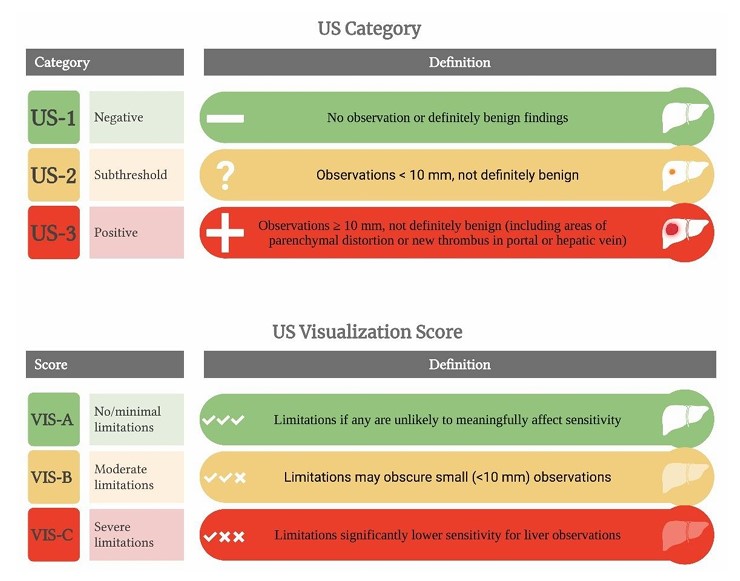
Ultrasound reports used for HCC surveillance in high-risk patients should be structured and
standardized according to LI-RADS US®, explicitly documenting any acoustic limitations that
may impair liver visualization and lesion detection. The report must clearly state the presence
or absence of focal hepatic lesions and describe nodules with indeterminate morphology,
specifying whether they are smaller or larger than 1 cm. In high-risk patients, ultrasound
alone should not be used to establish a definitive diagnosis of hepatic hemangioma, and ad
ditional imaging evaluation is required. Color and spectral Doppler assessment of hepatic and
portal vascular structures should be routinely included to evaluate portal hypertension and to
identify possible tumor-related or hematologic thrombosis. |
Low |
Strong |
| 17 |
In patients with nodules smaller than 1 cm detected on ultrasound, follow-up should be
performed at 3–4-month intervals for the first 2 years. If the nodule size remains stable after
this period, follow-up can be resumed every 6 months. |
Low |
Strong |
| 18 |
In patients with cirrhosis, MRI or CT may be considered as a surveillance modality for HCC
when ultrasound has technical limitations that compromise its diagnostic performance. |
Low |
Strong |

 Prevenção, rastreamento e detecção precoce do carcinoma hepatocelular – um consenso multidisciplinar brasileiro
 Thumbnail
 Thumbnail
 Thumbnail