 UNEXPECTED FINDINGS DURING LAPAROTOMY SURGERY AND URGENT SURGICAL INDICATIONS ARE ASSOCIATED WITH POSTOPERATIVE COMPLICATIONS IN PATIENTS WITH CROHN’S DISEASE
ABSTRACT
BACKGROUND: Patients undergoing Crohn’s disease (CD) surgery may develop a higher rate of postoperative complications (POC) than other patients.
AIMS: The aim of this study was to investigate factors determining POC in patients with CD undergoing urgent laparotomy.
METHODS: This is a retrospective cohort study conducted on adult patients undergoing urgent laparotomy for CD. Clinical and surgical variables, medication history, American Society of Anesthesiologists classification, and POC were investigated. Data collection and management were carried out using the REDCap software (REDCap electronic data capture tools) hosted at the hospital institution. For statistical analysis, the χ2 (or Fisher’s exact) test, Student’s t-test, Mann-Whitney test, and simple and multiple multilevel logistic regression analyses were used.
RESULTS: There was an association regarding the history of adalimumab use (p=0.04, OR 2.8, 95%CI 1.03-7.65), previous use of prednisone (p<0.01, OR 2.03, 95%CI 2.00-2.05), urgent surgery indications (p<0.01, OR=4.32, 95% CI=1.58-11.82), mechanical anastomosis (p=0.02, OR=0.22, 95%CI 0.06-0.80), unexpected intraoperative findings (p=0.02, OR 10.46, 95%CI 1.50-72.99), length of hospital stay greater than 10 days (p<0.01, OR 16.86, 95%CI 2.99-94.96), unplanned intensive care unit (ICU) admission (p=0.01, OR 15.06, 95%CI 1.96-115.70), and planned ICU admission (p<0.01, OR 18.46, 95%CI 3.60-94.51). On multivariate analysis, there was an association between the indication of urgent surgery (or emergency) (p=0.01, OR 4.38, 95%CI 1.43-13.37) and unexpected intraoperative findings (p=0.03, OR 8.11, 95%CI 1.21-54.50).
CONCLUSIONS: Unexpected changes and urgent surgical indications are considered risk factors for POC in patients with CD.
HEADINGS:
Crohn’s Disease; Laparotomy; Postoperative Complications; Risk Factors.
RESUMO
RACIONAL: Pacientes submetidos à cirurgia de doença de Crohn podem desenvolver mais complicações pós-operatórias do que outros pacientes.
OBJETIVOS: Investigar fatores determinantes de complicações pós-operatórias em portadores de doença de Crohn submetidos à laparotomias de urgência.
MÉTODOS: Estudo de coorte retrospectivo desenvolvido com pacientes adultos submetidos a laparotomias de urgência por doença de Crohn. Foram investigadas variáveis clínicas e cirúrgicas, histórico medicamentoso, classificação da American Society of Anesthesiology e complicações pós-operatórias. A coleta e o gerenciamento dos dados foram realizados através do software REDCap (ferramentas eletrônicas de captura de dados REDCap) hospedadas na instituição hospitalar. Para a análise estatística foram utilizados os testes χ2 (ou Exato de Fisher), Teste t de Student, Mann-Whitney e análise de regressão logística multinível simples e múltipla.
RESULTADOS: Houve associação quanto ao histórico de uso de adalimumabe (p=0.04, OR 2.8, IC95% 1.03-7.65), uso prévio de prednisona (p<0.01, OR 2.03, IC95% 2.00-2.05), cirurgia de urgência (emergência) (p<0.01, OR 4.32, IC95% 1.58-11.82), anastomose mecânica (p=0.02, OR 0.22, IC95% 0.06-0.80), achados inesperados no intraoperatório (p=0.02, OR 10.46, IC95% 1.50-72.99), tempo de internação hospitalar maior que 10 dias (p<0.01, OR 16.86, IC95% 2.99-94.96), admissão em uti não-planejada (p=0.01, OR 15.06, IC95% 1.96-115.70) e admissão em uti planejada (p<0.01, OR 18.46, IC95% 3.60-94.51). Pela análise multivariada verificou-se associação para indicação de cirurgia de urgência (e emergência) (p=0.01, OR 4.38, IC95% 1.43-13.37) e achados inesperados (p=0.03, OR 8.11, IC95% 1.21-54.50).
CONCLUSÕES: Alterações inesperadas e indicação cirúrgica de urgência são fatores de risco para complicações pós-operatórias em pacientes com doença de Crohn.
DESCRITORES:
Doença de Crohn; Laparotomia; Complicações Pós-Operatórias; Fatores de Risco.
INTRODUCTION
Crohn’s disease (CD) is an inflammatory intestinal disease that can affect any part of the digestive system, but, most commonly, the terminal ileum, colon, or perianal region, and may possibly develop in more than one of these organs concomitantly38. It is a disease with an increasing prevalence and different clinical manifestations. Patients may be asymptomatic to seriously ill, with a recurrent and inflammatory process that causes impairment of functions, malnutrition, and other irreversible consequences34. The most common symptoms, however, are chronic diarrhea and abdominal pain45. Pharmacological treatment is the first option in most cases; a wide range of medications is available, but mainly corticosteroids, immunomodulators, and immunobiologicals13 have been used.
In the past, surgery was the initial treatment for CD. It was observed, though, that the recurrent inflammatory process led to repeated surgeries, with multiple intestinal resections potentially progressing to a short intestine3,4. Today, despite the evolution of treatments and the use of immunobiologicals, abdominal surgery is still frequently recommended for these patients, with 26.2% undergoing surgery within 10 years44. Thus, patients are currently operated on when they present with signs of subocclusion or obstruction due to a stenosing condition, with symptomatic fistulas or in the case of patients refractory to immunobiologicals, and with intracavitary abscesses that cannot be percutaneously drained33. In patients with a predominantly inflammatory pattern, laparoscopic ileal resection is an alternative to the use of anti-tumor necrosis factor (TNF) drugs36,41.
Depending on the patient’s condition and the manifestation of the disease, several types of abdominal procedures can be used in patients with CD. Single or combined intestinal resection surgeries (enterectomy, ileocolectomy, or colectomy), comprising manipulation or resection of adjacent organs due to the involvement secondary to fistulas and strictures, can be performed2,42. The most common postoperative complications (POC) are anastomotic leakage, bleeding from the intestinal suture line, adynamic ileus, complications with stoma, surgical-site infections, and genitourinary complications21.
Patients undergoing CD surgery may develop a higher rate of POC than other patients, mainly intra-abdominal sepsis, possibly due to the use of corticosteroids, immunobiologicals, and multiple previous resections4. Another study has shown that POC were considered independent risk factors for endoscopic recurrence after primary CD surgery9.
The objective of this study was to investigate the possible factors determining POC in patients with CD undergoing laparotomy.
METHODS
This was a retrospective cohort study carried out in a large referral hospital that serves a representative population of the country. The investigation was approved by the institution’s ethics and research committee (number 51623021.4.0000.5481). Data were collected from the medical records. As an inclusion criterion, patients with CD who underwent laparotomy alone or in combination with other procedures were considered eligible. Such procedures included colon and/or small intestine resections with or without creation of a stoma; strictureplasty; intestinal transit reconstructions; corrections of paracolostomy hernias; drainage of abscesses via laparotomy; and surgical reapproaches via laparotomy. Such surgical procedures were performed at the institution hospital between the years 2000 and 2022 and were followed up for at least 30 days. Patients with little diagnostic differentiation, among other causes of colitis, were excluded from the study.
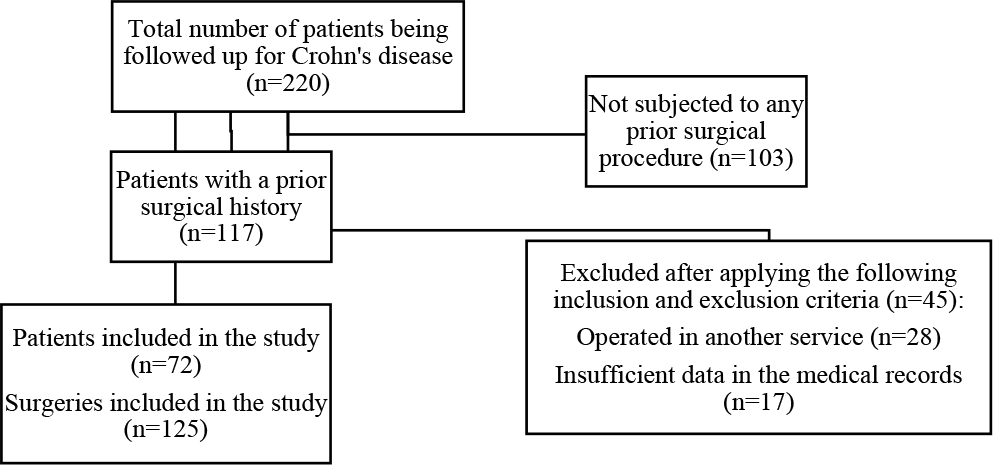
Initially, from a total of 220 CD patients undergoing outpatient follow-up, 117 patients with a history of surgery were identified. After reviewing the inclusion and exclusion criteria, the medical records of 72 adult CD patients who underwent 125 laparotomy surgeries in the last 20 years were considered eligible for participation in the study (Figure 1).

Study procedures and variables studied
The following information was collected: demographic data, hospital records, gender, age, educational data, smoking and drinking habits, comorbidities, age at disease diagnosis and onset of symptoms, family history of inflammatory bowel disease (IBD) and autoimmune diseases, history of medications already used establishing the CD treatment, previous abdominal surgeries, medications for CD in use at the time of surgery, location and pattern of the disease, presence of extra-intestinal manifestations, and weight, height, and body mass index (BMI) classified according to the cutoff points defined by the WHO (<18.5 kg/m2: underweight; 18.5-24.9 kg/m2: normal; 25.0-29.9 kg/m2: overweight; 30.0-34.9 kg/m2: Grade 1 obesity; 35.0-39.9 kg/m2: Grade 2 obesity; and =40 kg/m2: Grade 3 obesity)48. Laboratory hemoglobin tests were also collected (<12.0 g/L for women and <13.0 g/L for men)49; hematocrit (<36% for women and <39% for men)24; and albumin (>3.5: well nourished and <3.5: malnourished)7.
The disease-affected areas (colon, small intestine, and/or perianal region) were classified according to the pattern of CD manifestation, as follows: penetrating, stenosing, penetrating and stenosing, or nonpenetrating and nonstenosing. The extra-intestinal manifestations included arthralgia or arthritis, uveitis, erythema nodosum, pyoderma gangrenosum, aphthous ulcer, anal fissure, or perianal fistula. The Crohn’s Disease Activity Index (CDAI)5 and the Harvey-Bradshaw Index (HBI)6 were calculated. The American Society of Anesthesiologists (ASA) classification was reviewed as follows: ASA I: normal health; ASA II: mild systemic disease; ASA III: severe nondisabling systemic disease; ASA IV: severe, disabling, life-threatening systemic disease; ASA V: dying patient, with minimal survival expectancy; and ASA VI: cadaver organ donor15.
Surgical variables
Previous abdominal surgeries were divided into surgeries performed due to CD and surgeries required due to other etiologies. In both cases, the type of surgery was specified.
Regarding the surgical procedures, information was collected regarding preoperative laboratory tests for hemoglobin, hematocrit, and albumin; prescription of preoperative enteral or parenteral nutrition; preoperative blood transfusion; type of surgery; presence of anastomosis and/or stoma; surgical nature; surgical time; intraoperative complications; unexpected intraoperative findings; length of hospital stay; admission and time in the intensive care unit (ICU); and identification of POC.
The type of surgery was initially described in five categories, depending on the anatomical structure involved. The first category involved operating exclusively on the small intestine and the second, solely on the colon. The third covered ileocolectomy surgery. For the fourth category, laparotomy with procedures on more than one organ was selected. The fifth category included laparotomy to release fibrous adhesions, cavity washings, nontherapeutic laparotomies, or parastomal hernias with access to the abdominal cavity. The nature of the surgery was divided into elective and urgent, according to the records of the relevant hospitalizations.
To define unexpected intraoperative findings, based on the descriptive recording of the surgical procedure, information about the abdominal cavity inventory that was found as being not consistent with the clinical condition or previous imaging examinations was considered. POC were defined and classified according to the method proposed by Clavien-Dindo14, which stratifies them according to the therapy required for their treatment. POC were considered to be those manifested in the first 30 days following laparotomy.
Statistical analysis
In this study, data collection and management were carried out using the REDCap software (REDCap electronic data capture tools) hosted at the hospital where this investigation was conducted22,23. The REDCap (Research Electronic Data Capture) is a secure, web-based data capture tool designed to support information capture for research studies, offering an intuitive interaction area, audit trails for export methodology and element scanning, automated procedures for continuous data downloads for common statistical packages, and mechanisms for interaction with external sources22,23.
Data were described considering the mean, standard deviation, and median for quantitative variables and frequency tables for qualitative variables. The characteristics of the patients and procedures were related to complications using the χ2 (or Fisher’s exact) test for categorical variables and Student’s t-test (or Mann-Whitney test) for numerical variables.
Subsequently, intra-patient procedures were considered dependent, and therefore, to relate the characteristics of the patients, simple (to verify the effect of just one characteristic) and multiple (to verify the joint effect of the characteristics) multilevel logistic regression analyses were used. For the multiple multilevel logistic regression analysis, only variables that presented a p-value less than 0.05 in the simple analysis or that presented clinical validity defined by the researchers were selected. The odds ratio (OR) and the respective 95% confidence intervals (CIs) were estimated. A significance level of 0.05 was considered, and the data were analyzed using SPSS v25, R v4.1.2, and the lme4 package. Variables such as albumin, hemoglobin, hematocrit, BMI, surgical time, and hospital stay were classified into two categories, considering the cutoff points indicated by the receiver operating characteristic (ROC) curve (in relation to the occurrence or not of the complication). The ROC curve area, sensitivity, specificity, positive predictive value, negative predictive value, and accuracy (with their respective 95% CIs) were calculated for these points.
RESULTS
Population
A total of 40 patients (55.5%) underwent only one laparotomy. The other 32 patients had been operated more than once; 18 of them (25%) had undergone the surgery twice, 10 (13.8%) were operated three times, two (2.7%) had the surgery four times, one (1.3%) was operated five times, and another patient (1.3%) underwent the surgery six times. During the eligible patients’ data collection, we observed that some information was missing in the medical records due to the absence of entries at the time of care. Therefore, when characterizing the distribution of some variables, the rates were calculated considering only the available data.
Male gender prevailed in 61.1% (n=44) of patients, 4.8% (n=3) reported a family history of IBD, and none of them had a family history of autoimmune diseases. Other characteristics of the study population are summarized in Table 1. The 125 surgeries in the study were performed in patients who had diseases affecting the small intestine in 74.4% (n=93), the colon in 48% (n=60), and the perianal region in 16% (n=20); there were a few cases in which the patient had more than one organ affected (Table 1). The perianal region cases (n=20) included perianal involvement in 8.8% (n=11), perianal fistulas in 5.6% (n=7), and perianal abscesses and anal fissures in 1.6% (n=2) of the patients. The average age at the onset of symptoms and at diagnosis was 28.3±9.4 and 28.7±9.9 years, respectively. The mean CDAI was 199.5±132.6 and the HBI was 4.6±4.2.
Regarding drug treatment, 59.7% (n=43) of the patients had previously used immunobiologicals. The medications included infliximab (20.8%, n=15), adalimumab (18%, n=13), vedolizumab (13.9%, n=10), ustekinumab (4.2%, n=3), and certolizumab (2.8%, n= 2). There was a history of corticosteroid therapy in 41 individuals, mostly prednisone (54.2%, n=39) and budesonide (2.8%, n=2). Previous use of immunosuppressants was detected in 34.7% (n=27) of the patients: azathioprine in 33.3% (n=24), methotrexate in 2.8% (n=2), and mercaptopurine in 4% (n=1) of the patients.
In 109 of the 125 procedures (87.2%), drug treatment for CD was prescribed. Prednisone was used in 35.2% (n=44) of the surgeries. Immunobiologicals were administered in 34.4% (n=43) of the surgeries, with adalimumab in 12.8% (n=16), infliximab in 12% (n=15), vedolizumab in 6.4% (n=6), ustekinumab in 3.2% (n=4), and certolizumab in 1.6% (n=2) of the surgeries. Aminosalicylates were used in 31% (n=37) of the surgeries, with oral mesalazine in 20.8% (n=26), sulfasalazine in 8% (n=10), and rectal mesalazine in 0.8% (n=1) of the surgeries. In 22.4% (n=28) of laparotomies, treatment with ciprofloxacin was prescribed and in 21.6%, (n=27) treatment with azathioprine was prescribed.
Variables related to surgeries
Regarding preoperative laboratory tests, the level of albumin was 3.6±0.7 g/dL, hemoglobin was 11.9±2 g/dL, and hematocrit was 36±6%. BMI was 20.4±7.6 kg/m2. Among the 125 laparotomies, 39.2% (n=49) involved only the small intestine, 24% (n=30) involved the terminal ileum and colon, 15.2% (n=19) involved exclusively the colon, 12% (n=15) involved more than one viscera, and 9.6% (n=12) involved other organs. Regarding the nature of the surgeries, 78.5% (n=95) were elective, 20.7% (n=25) were urgent, and only 0.8% (n=1) was considered emergency. An abdominal drain was placed in 8.3% (n=10) of laparotomy surgeries.
Primary anastomosis occurred in 72.6% (n=90) of the surgeries, with 60.5% (n=75) of them with a mechanical suture and 12% (n=15) with a manual suture. Terminal stoma creation was adopted in 14.5% (n=18) of the procedures, with 15 ileostomies, two terminal colostomies, and one Mikulicz ileostomy and colostomy. Protective ileostomies were performed in 7.2% (n=9) of laparotomy surgeries. Unexpected intraoperative findings were observed in 7.2% (n=9) of surgeries, with 2.4% (n=3) of minor stenosis, 1.6% (n=2) of enterocolic fistulas, 1.6% (n=2) of colon perforations, and 2.4% (n=2) of intracavitary collections. Surgical complications were recorded in 2.4% (n=2) of the procedures, characterized as enterotomies secondary to small-loop adhesions.
The mean age at the time of laparotomy was 38.9±1.7 years. The average time between the onset of symptoms and surgery and the time between the diagnosis and surgery were 12.7±10 and 11.8±9.7 years, respectively. In 14.3% (n=24) of hospitalizations, there was admission to the ICU for postoperative care, with an average stay of 4±3 days. The duration of hospital stay was 13.6±21.4 days, with a median of 8 days. One of the patients had a hospital stay of 131 days due to complications from the disease.
Postoperative complications
There were 20% of POC in the study population (n=125 surgeries). Other characteristics related to POC are shown in Table 2.
Incidence of postoperative complications and distribution according to the Clavien-Dindo classification14.
Association between variables and the presence of postoperative complications
In the analysis of the association between the studied variables and the presence of POC, a significant difference was found only for higher education (p=0.050) and a history of drug treatment with the drug adalimumab (p=0.035). In the analysis of the association between all nutritional variables and laboratory tests, in patients who did or did not present POC, there was no significant difference. When reviewing the association between variables related to the disease and the presence or absence of POC, a significant difference was found in CDAI (p=0.023) and HBI (p=0.019). There was no significant association between current drug treatment and the presence of POC.
When analyzing the association between variables related to surgery and the presence or absence of POC, a significant difference was found regarding the nature of the surgical indication (p=0.002); presence of unexpected intraoperative findings (p=0.016); preoperative blood transfusions (p=0.030); length of hospital stay (p<0.001); and ICU admission requirement (p<0.001).
Univariate logistic regression analysis
In the study of the risk factors assessed by univariate logistic regression for POC associated with patients’ demographic characteristics, personal history, and nutritional and laboratory parameters (n=125 surgeries), it was found that only low hematocrit values were associated with POC (p=0.01, OR 1.24, 95%CI 1.23-1.26) (Table 3).
Study of risk factors for postoperative complications using univariate regression analysis (patients’ demographic characteristics, personal history, and nutritional and laboratory parameters) (n=125 surgeries).
Regarding the history of drug treatment, no statistical association was observed while assessing the type of drug. An association was found regarding the history of adalimumab use (p=0.04, OR 2.8, 95%CI 1.03-7.65) and previous use of prednisone (p<0.01, OR 2.03, 95%CI 2.00-2.05). No medication in use at the time of surgery was decisive for complications (Table 4).
Study of risk factors for postoperative complications using univariate regression analysis, related to previous and current drug treatment (n=125 surgeries).
While reviewing the OR of POC associated with variables related to CD (location and pattern of the disease, CDAI, and HBI), a statistical association greater than 3.5 (p=0.03, OR 3.58, 95%CI 1.13-11.34) was observed only for HBI. The stenosing pattern and IADC greater than or equal to 450 (indicating severe active disease) did not show a statistical association (data not shown in table).
Table 5 shows the study of risk factors for variables related to surgery. There was a statistical association regarding urgent surgical indications (p<0.01, OR 4.32, 95%CI 1.58-11.82), mechanical anastomosis (p=0.02, OR 0.22, 95%CI 0.06-0.80), unexpected findings in intraoperative events (p=0.02, OR 10.46, 95%CI 1.50-72.99), length of hospital stay greater than 10 days (p<0.01, OR 16.86, 95%CI 2.99-94.96), unplanned admission to ICU (p=0.01, OR 15.06, 95%CI 1.96-115.70), and planned ICU admission (p<0.01, OR 18.46, 95%CI 3.60-94.51) (Table 5).
Study of risk factors for postoperative complications using univariate regression analysis, for variables related to surgery (n=125 surgeries).
Multivariate logistic regression analysis
Table 6 shows the study of risk factors for POC with the use of a multivariate analysis. There was a statistical association between urgent surgical indications (p=0.01, OR 4.38, 95%CI 1.43-13.37) and unexpected findings (p=0.03, OR 8.11, 95%CI 1.21-54.50).
Study of risk factors for postoperative complications using multivariate regression analysis.
The multivariate analysis initially included the variables that were valid (significant association) in the univariate regression analysis. As extended hospital stay and ICU admission are, according to the Clavien-Dindo14 definition, already considered as POC, we decided to exclude them from this multivariate regression analysis.
DISCUSSION
A total of 125 abdominal surgeries due to CD were evaluated; similar Brazilian studies that investigated risk factors for surgical complications after abdominal surgeries due to CD included 44 and 103 surgeries25,39. Regarding the recurrence of laparotomy surgeries, a study reported that 58.2% of the patients underwent surgery only once, 26.5% twice, and 15.3% more than twice12; similar results were found in our investigation. Another study showed that 26.6% of the patients required at least one reoperation27, and another study showed that 6.3% (n=7) of patients were reoperated within 36 months35.
Characteristics of patients with Crohn’s disease
Data from our study showed an association between higher education and a history of drug treatment with adalimumab and the incidence of POC, whereas no association was observed between educational level and complications in another investigation25.
In surgeries due to CD conditions, a greater risk of complications in the elderly was not identified in our work; similar findings were observed in another investigation39. Other studies have shown that frailty is a stronger predictor of postoperative morbidity than advanced age in patients undergoing intestinal resection for CD47; similar findings were observed comparing the postoperative outcome of CD patients of different age groups30.
In our study, albumin level was found to be 3.6±0.7 g/dL, and surgeries involving patients with hypoalbuminemia accounted for 38.5% of cases; no statistical association was observed with POC. However, other investigations reported in the literature indicate low serum albumin levels and malnutrition as risk factors for POC29,40,51.
Drug treatment
In this investigation, drug treatment was divided into two groups: medications that the patient had already used (history) and current medications. An association was verified by a simple regression in relation to the history of previous use of prednisone or adalimumab. No drug therapy used during laparotomies resulted in a significant association. Some studies have shown that the use of corticosteroids can interfere with the postoperative outcome: the use of corticosteroids prior to the surgical procedure was associated with a greater chance of anastomotic leakage28; an increased risk of intra-abdominal sepsis with the use of corticosteroids associated with immunomodulators52 and a risk of reoperation within 30 days in patients receiving corticosteroid therapy were observed19.
Other studies have reported contradictory results regarding the risk of postoperative morbidity in CD patients using anti-TNF; they indicated that the therapy with immunobiologicals increases the chance of total infectious complications and surgical wound infections46. Another study reported that these medications are risk factors for general POC in patients with IBD; however, they observed that immunobiologicals, when administered 4 weeks in advance of the surgical procedure, do not interfere with the postsurgical outcome37. And another investigation suggested that the use of infliximab 8 weeks in advance of surgery is considered a risk factor for infectious complications in CD patients43, with no greater risk of postsurgical complications being observed in patients with IBD using anti-TNF, as shown in another literature8.
Factors related to surgery
In our study, 21.5% of the 125 laparotomies were performed urgently or emergently. After multivariate logistic regression, it was observed that urgent surgery was considered a risk factor for POC while comparing urgent or emergency surgeries with elective surgeries. Similar findings were observed in other investigations, with 31.1% of surgeries being urgent39 and an increased chance of postsurgical morbidity in CD patients when the surgeries are performed on an urgent basis20,50.
In our study, 22 different types of surgery were performed, and it was observed that mechanical anastomosis showed a statistical association with the surgery. There are studies showing that mechanical anastomosis leads to a lower incidence of dehiscence in patients undergoing right colectomies11, and other studies have not observed any difference in postoperative morbidity related to the anastomosis technique10.
The identification of unexpected intraoperative findings was, at the end of the multivariate analysis, determined as a risk factor for POC. Among the 125 surgeries, there was a discrepancy between intraoperative findings and previous imaging examinations in 7.2% of cases (n=9 cases). This result differs from that obtained in a study that reported the presence of unexpected intra-abdominal findings in 279 of the 375 surgeries examined (74.4%), including 123 (30.4%) small fistulas with other structures and 33 (8.8%) abscesses16. The impact of these findings on postoperative outcomes was not described16.
In the present study, although a length of hospital stay longer than 10 days was associated with POC in the simple regression, it was decided not to consider this variable in the multiple regression. Type 1 Clavien-Dindo14 classification considers any deviation from the normal postoperative course as a complication. An extended hospital stay is generally not expected in the uncomplicated postoperative period of CD patients’ surgeries. Therefore, it would become a confusing factor when interpreting the final result. The same rationale was applied considering the need for ICU admission.
Incidence of complications
POC occurred in 25 of the 125 laparotomy surgeries included in this study (20%). In comparison, national surveys with a similar methodological structure25,39 reported complication rates of 32% and 40.9%, respectively. International retrospective studies reviewing the risk factors for postsurgical complications reported rates between 25.5% and 45.6%1,17,18,20.31. Some publications only considered septic POC26,32,50, describing an incidence of 15.5%, 17%, and 8%, respectively. In our survey, four septic complications were observed (3.2%).
POC within 30 days after the surgical procedure occurred in 32% of patients in another retrospective study39. Out of these, 81.8% of the patients experienced surgical complications and 18.2% experienced clinical complications. Among the surgical complications, 51.8% were related to the abdominal wound, and 48.2% were associated with infection and/or dehiscence of suture lines. The creation of a stoma and urgent surgeries were considered risk factors for the complications39.
As a strong point of our investigation, we highlight the fact that this work was developed in a hospital which is a referral center for the treatment of IBDs, especially in CD patients, and which attends a representative population of a large metropolitan region of the country. And, as limiting factors of the study, we can consider the surgeries of different procedures and the fact that the study is retrospective.
CONCLUSIONS
The findings of our study allow us to conclude, through the use of univariate analysis, that prior treatment with prednisone and adalimumab, HBI>3.5, urgent (or emergency) surgical indications, failure to perform mechanical anastomosis, identification of unexpected intraoperative findings, length of hospital stay longer than 10 days, and the need for postoperative care in the ICU were considered risk factors for POC. And according to the multivariate analysis, the presence of unexpected intraoperative findings and surgeries indicated on an urgent (or emergency) were considered determining factors of POC in CD patients undergoing laparotomy.
Central Message
Patients undergoing Crohn’s disease surgery may develop a higher rate of postoperative complications (POC) than other patients, mainly intra-abdominal sepsis, possibly due to the use of corticosteroids, immunobiologicals, and multiple previous resections. The most common POC are anastomotic leakage, bleeding from the intestinal suture line, adynamic ileus, complications with stoma, surgical-site infections, and genitourinary complications.
Perspectives
The findings of our study allow us to conclude that prior treatment with prednisone and adalimumab, Harvey-Bradshaw Index>3.5, urgent (or emergency) surgical indications, failure to perform mechanical anastomosis, identification of unexpected intraoperative findings, length of hospital stay longer than 10 days, and the need for postoperative care in the intensive care unit were considered risk factors for postoperative complications (POC). The presence of unexpected intraoperative findings and indications of urgent or emergency surgeries were considered determining factors of POC in Crohn’s disease patients undergoing laparotomy.
-
Editorial Support:
National Council for Scientific and Technological Development (CNPq).
-
How to cite this article:
Teixeira GZ, Teixeira MG, Gimenez MC, Ribeiro SCN, Chimello NB, Leandro-Merhi VA. Unexpected findings during laparotomy surgery and urgent surgical indications are associated with postoperative complications in patients with Crohn’s disease. ABCD Arq Bras Cir Dig. 2024;37e1867. https://doi.org/10.1590/0102-6720202400073e1867.
-
Financial source:
None
REFERENCES
-
1 Abdalla S, Brouquet A, Maggiori L, Zerbib P, Denost Q, Germain A, et al. Postoperative morbidity after iterative ileocolonic resection for Crohn’s disease: should we be worried? a prospective multicentric cohort study of the GETAID chirurgie. J Crohns Colitis. 2019;13(12):1510-7. https://doi.org/10.1093/ecco-jcc/jjz091
» https://doi.org/10.1093/ecco-jcc/jjz091 -
2 Adamina M, Bonovas S, Raine T, Spinelli A, Warusavitarne J, Armuzzi A, et al. ECCO Guidelines on Therapeutics in Crohn’s disease: surgical treatment. J Crohns Colitis. 2020;14(2):155-68. https://doi.org/10.1093/ecco-jcc/jjz187
» https://doi.org/10.1093/ecco-jcc/jjz187 -
3 Aksan A, Farrag K, Blumenstein I, Schröder O, Dignass AU, Stein J. Chronic intestinal failure and short bowel syndrome in Crohn’s disease. World J Gastroenterol. 2021;27(24):3440-65. https://doi.org/10.3748/wjg.v27.i24.3440
» https://doi.org/10.3748/wjg.v27.i24.3440 -
4 Barnes EL, Lightner AL, Regueiro M. Perioperative and postoperative management of patients with Crohn’s disease and ulcerative colitis. Clin Gastroenterol Hepatol. 2020;18(6):1356-66. https://doi.org/10.1016/j.cgh.2019.09.040
» https://doi.org/10.1016/j.cgh.2019.09.040 - 5 Best WR, Becktel JM, Singleton JW, Kern Jr F. Development of a Crohn’s disease activity index. National Cooperative Crohn’s Disease Study. Gastroenterology. 1976;70(3):439-44. PMID: 1248701.
-
6 Best WR. Predicting the Crohn’s disease activity index from the Harvey-Bradshaw Index. Inflamm Bowel Dis. 2006;12(4):304-10. https://doi.org/10.1097/01.MIB.0000215091.77492.2a
» https://doi.org/10.1097/01.MIB.0000215091.77492.2a -
7 Blackburn GL, Bistrian BR, Maini BS, Schlamm HT, Smith MF. Nutritional and metabolic assessment of the hospitalized patient. JPEN J Parenter Enteral Nutr. 1977;1(1):11-22. https://doi.org/10.1177/014860717700100101
» https://doi.org/10.1177/014860717700100101 -
8 Byrne LW, McKay D. Does perioperative biological therapy increase 30-day post-operative complication rates in inflammatory bowel disease patients undergoing intra-abdominal surgery? A systematic review. Surgeon. 2021;19(5):e153-e167. https://doi.org/10.1016/j.surge.2020.09.001
» https://doi.org/10.1016/j.surge.2020.09.001 -
9 Carvello M, D’Hoore A, Maroli A, Cuenca C, Vermeire S, Danese S, et al. Postoperative complications are associated with an early and increased rate of disease recurrence after surgery for Crohn’s disease. Dis Colon Rectum. 2023;66(5):691-9. https://doi.org/10.1097/DCR.0000000000002446
» https://doi.org/10.1097/DCR.0000000000002446 -
10 Celentano V, Pellino G, Spinelli A, Selvaggi F; SICCR Current status of Crohn’s disease surgery collaborative; Celentano V, et al. Anastomosis configuration and technique following ileocaecal resection for Crohn’s disease: a multicentre study. Updates Surg. 2021;73(1):149-56. https://doi.org/10.1007/s13304-020-00918-z
» https://doi.org/10.1007/s13304-020-00918-z -
11 Ali Chaouch M, Kellil T, Jeddi C, Saidani A, Chebbi F, Zouari K. How to prevent anastomotic leak in colorectal surgery? A systematic review. Ann Coloproctol. 2020;36(4):213-22. https://doi.org/10.3393/ac.2020.05.14.2
» https://doi.org/10.3393/ac.2020.05.14.2 -
12 Colombo F, Frontali A, Baldi C, Cigognini M, Lamperti G, Manzo CA, et al. Repeated surgery for recurrent Crohn’s disease: does the outcome keep worsening operation after operation? A comparative study of 1224 consecutive procedures. Updates Surg. 2022;74(1):73-80. https://doi.org/.1007/s13304-021-01187-0
» https://doi.org/.1007/s13304-021-01187-0 -
13 Cushing K, Higgins PDR. Management of Crohn disease: a review. JAMA. 2021;325(1):69-80. https://doi.org/10.1001/jama.2020.18936
» https://doi.org/10.1001/jama.2020.18936 -
14 Dindo D, Demartines N, Clavien PA. Classification of surgical complications: a new proposal with evaluation in a cohort of 6336 patients and results of a survey. Ann Surg. 2004;240(2):205-13. https://doi.org/10.1097/01.sla.0000133083.54934.ae
» https://doi.org/10.1097/01.sla.0000133083.54934.ae - 15 Doyle DJ, Hendrix JM, Garmon EH. American Society of Anesthesiologists Classification. In: StatPearls. Treasure Island: StatPearls Publishing; 2024. PMID: 28722969.
-
16 2015 European Society of Coloproctology collaborating group. Risk factors for unfavourable postoperative outcome in patients with Crohn’s disease undergoing right hemicolectomy or ileocaecal resection an international audit by ESCP and S-ECCO. Colorectal Dis. 2017 [online ahead of print]. https://doi.org/10.1111/codi.13889
» https://doi.org/10.1111/codi.13889 -
17 Galata C, Weiss C, Hardt J, Seyfried S, Post S, Kienle P, et al. Risk factors for early postoperative complications and length of hospital stay in ileocecal resection and right hemicolectomy for Crohn’s disease: a single-center experience. Int J Colorectal Dis. 2018;33(7):937-45. https://doi.org/10.1007/s00384-018-3072-0
» https://doi.org/10.1007/s00384-018-3072-0 -
18 Ghoneima AS, Flashman K, Dawe V, Baldwin E, Celentano V. High risk of septic complications following surgery for Crohn’s disease in patients with preoperative anaemia, hypoalbuminemia and high CRP. Int J Colorectal Dis. 2019;34(12):2185-8. https://doi.org/10.1007/s00384-019-03427-7
» https://doi.org/10.1007/s00384-019-03427-7 -
19 Grass F, Ansell J, Petersen M, Mathis KL, Lightner AL. Risk factors for 90-day readmission and return to the operating room following abdominal operations for Crohn’s disease. Surgery. 2019;166(6):1068-75. https://doi.org/10.1016/j.surg.2019.08.006
» https://doi.org/10.1016/j.surg.2019.08.006 -
20 Gutiérrez A, Rivero M, Martín-Arranz MD, García Sánchez V, Castro M, Barrio J, et al. Perioperative management and early complications after intestinal resection with ileocolonic anastomosis in Crohn’s disease: analysis from the PRACTICROHN study. Gastroenterol Rep (Oxf). 2019;7(3):168-75. https://doi.org/10.1093/gastro/goz010
» https://doi.org/10.1093/gastro/goz010 -
21 Hanna DN, Hawkins AT. Colorectal: management of postoperative complications in colorectal surgery. Surg Clin North Am. 2021;101(5):717-29. https://doi.org/10.1016/j.suc.2021.05.016
» https://doi.org/10.1016/j.suc.2021.05.016 -
22 Harris PA, Taylor R, Thielke R, Payne J, Gonzalez N, Conde JG. Research electronic data capture (REDCap)--a metadata-driven methodology and workflow process for providing translational research informatics support. J Biomed Inform. 2009;42(2):377-81. https://doi.org/10.1016/j.jbi.2008.08.010
» https://doi.org/10.1016/j.jbi.2008.08.010 -
23 Harris PA, Taylor R, Minor BL, Elliott V, Fernandez M, O’Neal L, et al. The REDCap consortium: building an international community of software platform partners. J Biomed Inform. 2019;95:103208. https://doi.org/10.1016/j.jbi.2019.103208
» https://doi.org/10.1016/j.jbi.2019.103208 - 24 Hoffbrand AV, Moss PAH, Pettit JE. Fundamentos em hematologia. Porto Alegre: Artmed; 2013.
-
25 Hossne RS, Sassaki LY, Baima JP, Meira Júnior JD, Campos LM. Analysis of risk factors and postoperative complications in patients with crohn’s disease. Arq Gastroenterol. 2018;55(3):252-7. https://doi.org/10.1590/S0004-2803.201800000-63
» https://doi.org/10.1590/S0004-2803.201800000-63 -
26 Iesalnieks I, Spinelli A, Frasson M, Di Candido F, Scheef B, Horesh N, et al. Risk of postoperative morbidity in patients having bowel resection for colonic Crohn’s disease. Tech Coloproctol. 2018;22(12):947-53. https://doi.org/10.1007/s10151-018-1904-0
» https://doi.org/10.1007/s10151-018-1904-0 -
27 Ikeuchi H, Uchino M, Bando T, Horio Y, Kuwahara R, Minagawa T, et al. Localization of recurrent lesions following ileocolic resection for Crohn’s disease. BMC Surg. 2021;21(1):145. https://doi.org/10.1186/s12893-020-00980-9
» https://doi.org/10.1186/s12893-020-00980-9 -
28 Kühn F, Nixdorf M, Schwandner F, Klar E. Risk factors for early surgery and surgical complications in Crohn’s disease. Zentralbl Chir. 2018;143(6):596-602. https://doi.org/10.1055/a-0645-1489
» https://doi.org/10.1055/a-0645-1489 -
29 Liu X, Wu X, Zhou C, Hu T, Ke J, Chen Y, et al. Preoperative hypoalbuminemia is associated with an increased risk for intra-abdominal septic complications after primary anastomosis for Crohn’s disease. Gastroenterol Rep (Oxf). 2017;5(4):298-304. https://doi.org/10.1093/gastro/gox002
» https://doi.org/10.1093/gastro/gox002 -
30 Luceri C, Dragoni G, Zambonin D, Pesi B, Russo E, Scaringi S, et al. Is the age at surgery in Crohn’s disease clinically relevant? Differences and peculiarities: a wide single centre experience after long-term follow-up. Langenbecks Arch Surg. 2022;407(7):2987-96. https://doi.org/10.1007/s00423-022-02613-6
» https://doi.org/10.1007/s00423-022-02613-6 -
31 Luglio G, Pellegrini L, Rispo A, Tropeano FP, Imperatore N, Pagano G, et al. Post-operative morbidity in Crohn’s disease: what is the impact of patient-, diseaseand surgery-related factors? Int J Colorectal Dis. 2022;37(2):411-9. https://doi.org/10.1007/s00384-021-04076-5
» https://doi.org/10.1007/s00384-021-04076-5 -
32 McKenna NP, Habermann EB, Zielinski MD, Lightner AL, Mathis KL. Body mass index: implications on disease severity and postoperative complications in patients with Crohn’s disease undergoing abdominal surgery. Surgery. 2019;166(4):703-8. https://doi.org/10.1016/j.surg.2019.04.038
» https://doi.org/10.1016/j.surg.2019.04.038 -
33 Meima-van Praag EM, Buskens CJ, Hompes R, Bemelman WA. Surgical management of Crohn’s disease: a state of the art review. Int J Colorectal Dis. 2021;36(6):1133-45. https://doi.org/10.1007/s00384-021-03857-2
» https://doi.org/10.1007/s00384-021-03857-2 -
34 Mendonça CM, Correa Neto IJF, Rolim AS, Robles L. Inflammatory bowel diseases: characteristics, evolution, and quality of life. Arq Bras Cir Dig. 2022;35:e1653. https://doi.org/10.1590/0102-672020210002e1653
» https://doi.org/10.1590/0102-672020210002e1653 -
35 Ozgur I, Kulle CB, Buyuk M, Ormeci A, Akyuz F, Balik E, et al. What are the predictors for recurrence of Crohn’s disease after surgery? Medicine (Baltimore). 2021;100(14):e25340. https://doi.org/10.1097/MD.0000000000025340
» https://doi.org/10.1097/MD.0000000000025340 -
36 Ponsioen CY, Groof EJ, Eshuis EJ, Gardenbroek TJ, Bossuyt PMM, Hart A, et al. Laparoscopic ileocaecal resection versus infliximab for terminal ileitis in Crohn’s disease: a randomised controlled, open-label, multicentre trial. Lancet Gastroenterol Hepatol. 2017;2(11):785-92. http://doi.org/10.1016/S2468-1253(17)30248-0
» http://doi.org/10.1016/S2468-1253(17)30248-0 -
37 Qiu Y, Zheng Z, Liu G, Zhao X, He A. Effects of preoperative anti-tumour necrosis factor alpha infusion timing on postoperative surgical site infection in inflammatory bowel disease: a systematic review and meta-analysis. United European Gastroenterol J. 2019;7(9):1198-214. https://doi.org/10.1177/2050640619878998
» https://doi.org/10.1177/2050640619878998 -
38 Roda G, Ng SC, Kotze PG, Argollo M, Panaccione R, Spinelli A, et al. Crohn’s disease. Nat Rev Dis Primers. 2020;6(1):22. https://doi.org/10.1038/s41572-020-0156-2
» https://doi.org/10.1038/s41572-020-0156-2 -
39 Kimura CMS, Scanavini Neto A, Queiroz NSF, Horvat N, Camargo MGM, Borba MR, et al. Abdominal surgery in Crohn’s disease: risk factors for complications. Inflamm Intest Dis. 2021;6(1):18-24. https://doi.org/10.1159/000510999
» https://doi.org/10.1159/000510999 -
40 Shah RS, Bachour S, Jia X, Holubar SD, Hull TL, Achkar JP, et al. Hypoalbuminaemia, not biologic exposure, is associated with postoperative complications in Crohn’s disease patients undergoing ileocolic resection. J Crohns Colitis. 2021;15(7):1142-51. https://doi.org/10.1093/ecco-jcc/jjaa268
» https://doi.org/10.1093/ecco-jcc/jjaa268 -
41 Stevens TW, Haasnoot ML, D’Haens GR, Buskens CJ, Groof EJ, Eshuis EJ, et al. Laparoscopic ileocaecal resection versus infliximab for terminal ileitis in Crohn’s disease: retrospective long-term follow-up of the LIR!C trial. Lancet Gastroenterol Hepatol. 2020;5(10):900-7. https://doi.org/10.1016/S2468-1253(20)30117-5
» https://doi.org/10.1016/S2468-1253(20)30117-5 -
42 Tajra JBM, Calegaro JU, Silva SM, Silveira DB, Ribeiro LM, Crispim SM, et al. Assessment of risk factors for surgery treatment of crohn’s disease: a hospital cohort. Arq Bras Cir Dig. 2023;36:e1730. https://doi.org/10.1590/0102-672020230002e1730
» https://doi.org/10.1590/0102-672020230002e1730 -
43 Tang S, Dong X, Liu W, Qi W, Ye L, Yang X, et al. Compare risk factors associated with postoperative infectious complication in Crohn’s disease with and without preoperative infliximab therapy: a cohort study. Int J Colorectal Dis. 2020;35(4):727-37. https://doi.org/10.1007/s00384-019-03481-1
» https://doi.org/10.1007/s00384-019-03481-1 -
44 Tsai L, Ma C, Dulai PS, Prokop LJ, Eisenstein S, Ramamoorthy SL, et al. Contemporary risk of surgery in patients with ulcerative colitis and Crohn’s disease: a meta-analysis of population-based cohorts. Clin Gastroenterol Hepatol. 2021;19(10):2031-45.e11. https://doi.org/10.1016/j.cgh.2020.10.039
» https://doi.org/10.1016/j.cgh.2020.10.039 - 45 Veauthier B, Hornecker JR. Crohn’s disease: diagnosis and management. Am Fam Physician. 2018;98(11):661-9. PMID: 30485038.
-
46 Waterland P, Athanasiou T, Patel H. Post-operative abdominal complications in Crohn’s disease in the biological era: systematic review and meta-analysis. World J Gastrointest Surg. 2016;8(3):274-83. https://doi.org/10.4240/wjgs.v8.i3.274
» https://doi.org/10.4240/wjgs.v8.i3.274 -
47 Wolf JH, Hassab T, D’Adamo CR, Svoboda S, Demos J, Ahuja V, et al. Frailty is a stronger predictor than age for postoperative morbidity in Crohn’s disease. Surgery. 2021;170(4):1061-5. https://doi.org/10.1016/j.surg.2021.04.030
» https://doi.org/10.1016/j.surg.2021.04.030 - 48 Obesity: preventing and managing the global epidemic. Report of a WHO consultation. World Health Organ Tech Rep Ser. 2000;894:i-xii, 1-253. PMID: 11234459.
-
49 World Health Organization. Hemoglobin concentrations for the diagnosis of anemia and assessment of severity. Geneva: World Health Organization; 2011. Available at: https://apps.who.int/iris/handle/10665/85839 Accessed: May 23, 2024.
» https://apps.who.int/iris/handle/10665/85839 -
50 Wu E, Duan M, Han J, Zhang H, Zhou Y, Cao L, et al. Patients with Crohn’s disease undergoing abdominal surgery: clinical and prognostic evaluation based on a single-center cohort in China. World J Surg. 2022;46(2):450-60. https://doi.org/10.1007/s00268-021-06366-z
» https://doi.org/10.1007/s00268-021-06366-z -
51 Yamamoto T, Shimoyama T, Umegae S, Kotze PG. Impact of preoperative nutritional status on the incidence rate of surgical complications in patients with inflammatory bowel disease with vs without preoperative biologic therapy: a case-control study. Clin Transl Gastroenterol. 2019;10(6):e00050. https://doi.org/10.14309/ctg.0000000000000050
» https://doi.org/10.14309/ctg.0000000000000050 -
52 Yu CS, Jung SW, Lee JL, Lim SB, Park IJ, Yoon YS, et al. The influence of preoperative medications on postoperative complications in patients after intestinal surgery for Crohn’s disease. Inflamm Bowel Dis. 2019;25(9):1559-68. https://doi.org/10.1093/ibd/izz010
» https://doi.org/10.1093/ibd/izz010