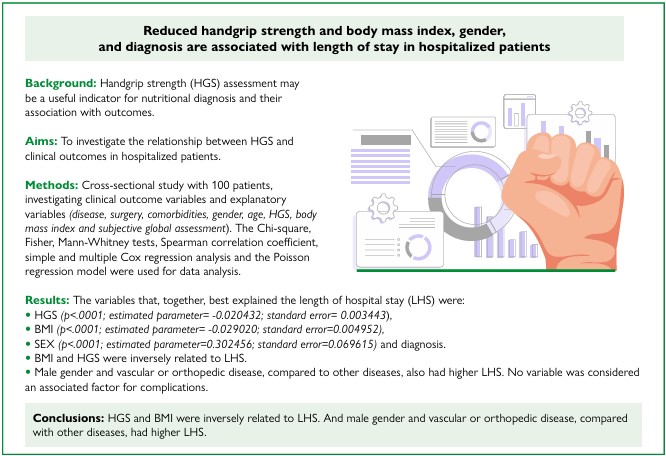
 Reduced handgrip strength and body mass index, gender, and diagnosis are associated with length of stay in hospitalized patients
Background: Handgrip strength assessment may be a useful indicator for nutritional diagnosis and association with outcomes.
Aims: To investigate the relationship between handgrip strength and clinical outcomes in hospitalized patients.
Methods: A cross-sectional study with 100 patients, investigating clinical outcome variables and explanatory variables (disease, surgery, comorbidities, gender, age, handgrip strength, body mass index, and subjective global assessment). The χ2 test, Fisher’s exact test, Mann-Whitney test, Spearman correlation coefficient, simple and multiple Cox regression analysis, and the Poisson regression model were used for data analysis.
Results: The variables that, together, best explained the length of hospital stay were handgrip strength (p<0.0001; estimated parameter=-0.020432; standard error=0.003443), body mass index (p<0.0001; estimated parameter=-0.029020; standard error=0.004952), gender (p<0.0001; estimated parameter=0.302456; standard error=0.069615), and diagnosis. Body mass index and handgrip strength were inversely associated with the length of hospital stay. Male gender and vascular or orthopedic disease, compared to other diseases, were also associated with a higher length of hospital stay. No variable was considered an associated factor for complications.
Conclusions: Handgrip strength and body mass index were inversely associated with the length of hospital stay. Male gender and vascular or orthopedic disease, compared to other diseases, were associated with a higher length of hospital stay.
Headings:
Muscle strength; Nutritional status; Disease; Length of stay
A higher mean (or median) age, lower mean handgrip strength, and a higher rate of vascular disease, lung disease, and neoplasms were observed in patients with at least one comorbidity.
Body mass index and mean handgrip strength were inversely associated with the length of hospital stay (the lower the values, the longer the hospital stay).
Male gender and vascular or orthopedic disease, compared to other diseases, evidenced longer hospital stays.

CENTRAL MESSAGE The association between patients’ malnutrition in the hospital setting and unfavorable clinical outcomes has already been well established in the literature. The loss of muscle mass is a critical malnutrition finding observed in patients with acute and chronic diseases. An alternative method to estimate muscle mass that could contribute as a relevant indicator for assessing the nutritional status of hospitalized patients is the assessment of handgrip strength, as a marker of health status in older adults.
PERSPECTIVES Handgrip strength and body mass index were inversely associated with the length of hospital stay. Male gender and vascular or orthopedic disease, compared to other diseases, were associated with a longer hospital stay.