 Excimer light 308 nm therapy for alopecia areata resistant to other treatments: a clinical study of three patients
Dear Editor,
Alopecia areata (AA) is an autoimmune, T-cell-mediated dis-ease that causes hair loss on the scalp and/or other areas of the body.1,2 It is the second most common cause of non-scarring alopecia and significantly affects patients’ quality of life.1-6
The cornerstone of treatment has traditionally been topical, intralesional, or systemic corticosteroid ther-apy, although responses are unpredictable.2,5,6 Other alternatives include expectant management, immunother-apies, or systemic immunosuppressants.1-3,6 Additional therapeutic options exist, such as JAK inhibitors and photobiomodulation-based therapies, including excimer light, a subtype of Narrow-Band-UVB (NB-UVB) phototherapy that emits a monochromatic and coherent wavelength.5,6 Unlike conventional NB-UVB phototherapy, it provides deeper penetration and a more localized effect, enabling targeted treatment of difficult-to-reach areas. This trans-lates into fewer sessions, shorter treatment times, and lower cumulative UVB dosage, thereby reducing the risk of adverse effects.7,8 It is considered safe and does not induce systemic adverse effects, with only local events reported, such as erythema, scaling, pruritus, localized hyperpigmen-tation, and mild pain.1,6,9
Its effectiveness has not been demonstrated in cases of alopecia universalis or totalis,7,8 and there is no consensus regarding the most effective protocol for the use of this device or which patients benefit most.5
We present three patients with AA refractory to conven-tional therapy, considering the potential of excimer light as an effective and safe therapeutic option. Treatment ses-sions were administered with variable frequency and dosage parameters depending on tolerance and clinical response.
Case 1
A 43-year-old woman, diagnosed with AA during the sixth month postpartum, presented with an extensive alopecic patch affecting the coronal, biparietal, and bitemporal regions, with a SALT score of 54 (Fig. 1A). Trichoscopy revealed yellow dots and fine long hairs. After one and a half years of treatment with methotrexate, deflazacort, top-ical clobetasol, and oral minoxidil, and due to only a partial therapeutic response, 308 nm excimer light was added. She underwent 23 twice-weekly sessions with escalating doses up to 800 mJ, with no adverse effects. She achieved an excellent response, SALT 0, with trichoscopy showing no signs of activity. No recurrence was observed after 6-months of follow-up (Fig. 1B).
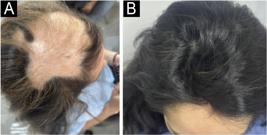
(A) Case 1. Photograph of the patient before the start of excimer laser therapy. An alopecic patch is observed affecting the biparietal and bitemporal coronal areas of the scalp. The SALT score was 54. (B) Same patient, photograph after 23 excimer laser sessions and at the 3-month follow-up after discontinuation of therapy. Hair regrowth is evident, and the SALT score is 0.
Case 2
A 30-year-old woman with no medical history presented with four months of burning sensation and pruritus of the scalp. A single frontal alopecic plaque was noted; despite intrale-sional and topical corticosteroids, the alopecia progressed throughout the scalp. The SALT score was calculated at 46 (Fig. 2A). Trichoscopy showed yellow dots, black dots, bro-ken hairs, coudability hairs, and exclamation-mark hairs, consistent with active disease. Histopathology supported the diagnosis of alopecia areata. After four months of treat-ment with intralesional corticosteroids, clobetasol 0.05%, and topical tacrolimus 0.1% with poor response, intrale-sional corticosteroids were discontinued, and deflazacort plus excimer light were initiated. After 16 weekly sessions with escalating doses up to 250 mJ, she achieved a SALT score of 0 (Fig. 2B). No adverse effects occurred. She is cur-rently receiving twice-weekly oral corticosteroids and oral minoxidil, without relapse after three months of follow-up.

(A) Case 2. Photograph of a patient diagnosed with alopecia areata with a large alopecic patch in the frontal area, midline, parietal, temporal and occipital areas of the scalp, SALT index 46. (B) Same patient, after one month of discontinuation of therapy, after having received 16 sessions of excimer light with SALT 0.
Case 3
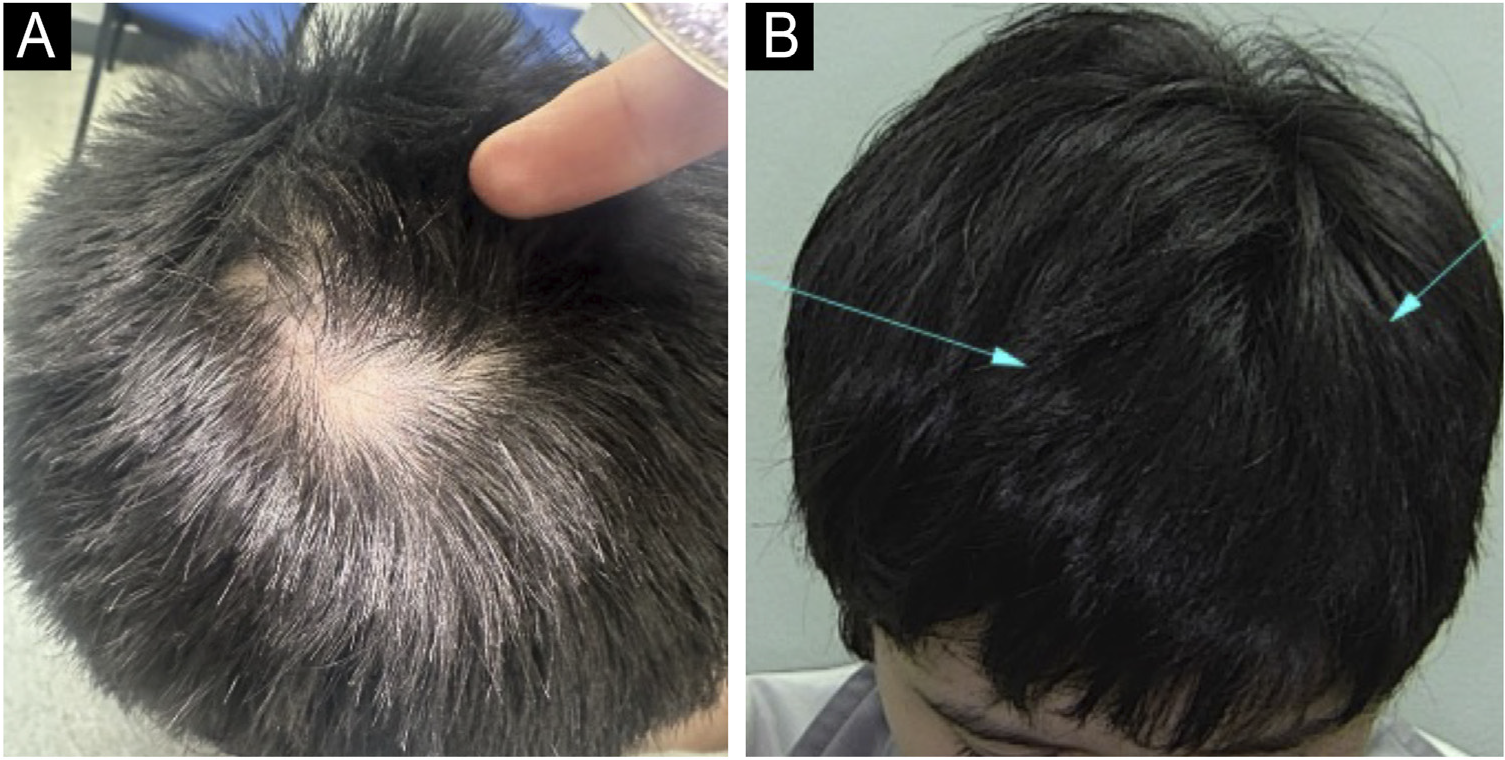
A 12-year-old boy with no medical history and a diagnosis of alopecia totalis was treated with diphencyprone, clobetasol 0.05%, oral deflazacort, and topical minoxidil 5%. He showed a partial response after three years of treatment, with persistent alopecic areas with signs of activity on the occipital, parietal, and temporal regions. Trichoscopy revealed black dots, broken hairs, and exclamation-mark hairs. Due to poor tolerance to intralesional corticosteroids secondary to pain, excimer light was added to the refractory alopecic patches (Fig. 3A). After 16 twice-weekly sessions with escalating doses up to 700 mJ, he showed hair regrowth (Fig. 3B). Although vellus and pigtail hairs were observed, trichoscopy revealed no signs of activity. He experienced erythema last-ing longer than 48 hours on two occasions AA poses a therapeutic challenge due to its variable and unpredictable responses.2,6 However, excimer light demon-strates a favorable safety profile, good tolerability, and absence of systemic adverse effects.1,6 In all three cases presented, hair regrowth was observed, assessed by SALT score and trichoscopy, with minimal adverse events.

(A) Case 3. Photograph of a pediatric patient before starting 308 nm excimer laser treatment. Refractory alopecia patches are observed on the vertex and occipital region. (B) After 16 sessions of 308 nm excimer laser treatment, significant hair regrowth is observed (light blue arrows).
This therapy appears to be a promising and safe therapeutic alternative for patients with refractory AA, complementary to other strategies. Given the lack of consensus regarding standardized protocols, additional studies are needed to further define its therapeutic role and explore its potential use as monotherapy.
Research data availability
Does not apply.
References
- 1 Gupta AK, Carviel JL. Meta-analysis of 308-nm excimer laser ther-apy for alopecia areata. J Dermatolog Treat. 2021;32:526-9.
- 2 Zhang J, Lin P, Lin H, Ma C, Hu Y, Wang Y, et al. Laser and light therapy combined with topical minoxidil for alopecia areata: a systematic review and meta-analysis of randomized controlled trials. Lasers Med Sci. 2023;38:74.
- 3 Tawfik YM, Hofny ERM, Zidan FM, Ghazally A. 308 nm-excimer light together with topical betamethasone valerate in treating alopecia areata. Arch Dermatol Res. 2025;317:342.
- 4 Yu DF, Hu M, Passeron T. Efficacy of 308-nm excimer therapy in alopecia areata: a retrospective study with long-term follow-up. Photodermatol Photoimmunol Photomed. 2022;38:507-10.
- 5 Kianfar N, Dasdar S, Mahmoudi H, Abedini R, Fahim S, Hos-seini SA, et al. Comparison of the efficacy and safety of 308-nm excimer laser with intralesional corticosteroids for the treatment of alopecia areata: a randomized controlled study. Lasers Surg Med. 2022;54:502-10.
- 6 Lee JH, Eun SH, Kim SH, Ju HJ, Kim GM, Bae JM. Excimer laser/light treatment of alopecia areata: a systematic review and meta-analyses. Photodermatol Photoimmunol Photomed. 2020;36:460-9.
- 7 Hartmann Schatloff D, Retamal Altbir C, Valenzuela F. The role of excimer light in dermatology: a review. An Bras Dermatol. 2024;99:887-94.
- 8 Ly K, Smith MP, Thibodeaux QG, Beck KM, Liao W, Bhutani T. Beyond the booth: excimer laser for cutaneous conditions. Der-matol Clin. 2020;38:157-63.
- 9 Jafari MA, Bazgir G, Hosseini-Baharanchi FS, Jafarzadeh A, Goodarzi A. Efficacy and safety of laser therapy and phototherapy in cicatricial and non-cicatricial alopecia: a systematic review study. Health Sci Rep. 2024;7:e70180.
Edited by
-
Editor
Jane Tomimori.