 Isotretinoin and serum thyroid parameters: systematic review and meta-analysis
Abstract
Background: Isotretinoin is an effective therapy for acne vulgaris, but its impact on thyroid function remains uncertain, with existing studies reporting inconsistent biochemical changes. Objective: To assess the effects of oral isotretinoin on serum thyroid function parameters and thyroid antibody levels in patients with acne vulgaris.
Methods: A systematic review and meta-analysis of observational studies was conducted according to PRISMA guidelines and prospectively registered (INPLASY202560049). PubMed, Sco-pus, Embase, and Web of Science were searched from January 1980 to September 2025. Studies reporting serum thyroid parameters before and during isotretinoin therapy were included. Random-effects meta-analyses were performed for parameters reported in more than three studies. Heterogeneity was assessed using the I2 statistic, and risk of bias using NIH tools.
Results: Fifteen studies were included. Meta-analysis showed a small statistically significant increase in thyroid-stimulating hormone after isotretinoin treatment (MD = 0.03, 95% CI 0.02-0.05, p < 0.001), with significant decreases in thyroxine (MD = -0.19, 95% CI -0.24 to -0.15, p < 0.001) and triiodothyronine (MD = -0.62, 95% CI-0.76 - -0.48, p < 0.001). Heterogeneity was substantial for thyroid-stimulating hormone (I2 = 85%) and triiodothyronine (I2 = 86%), and moderate for thyroxine (I2 = 60%). Evidence regarding thyroid antibodies was limited and inconsistent. Study limitations: Included studies were observational, predominantly single-centre, and het-erogeneous in dosing, duration, and laboratory assessments.
Conclusions: Isotretinoin is associated with statistically significant alterations in serum thyroid function parameters, though the clinical significance of these changes remains uncertain.
KEYWORDS
Acne vulgaris; Autoantibodies; Hypothyroidism; Isotretinoin; Systematic review; Thyroid function tests; Thyroid hormones
Introduction
Isotretinoin has been used in the treatment of acne vul-garis and other follicular occlusion disorders since the 1980s and remains an effective therapy for severe or refractory acne. Acne vulgaris is one of the most common derma-tological conditions worldwide, with an estimated global prevalence of 9.4%. Acne is more common in adolescents; however also affects a substantial proportion of adults.1 The condition can lead to significant psychosocial morbid-ity and permanent scarring, highlighting the importance of effective treatment strategies.2 Isotretinoin’s mechanism of action remains incompletely understood but is thought to be mediated through effects on sebum production, hyperkera-tinization, inflammation, and Cutibacterium acnes.3 It has been postulated that one of the ways in which isotretinoin may help to treat acne is by suppressing pituitary hormone levels.4,5
Despite its efficacy, isotretinoin therapy is associated with a wide range of adverse effects that require clini-cal and biochemical monitoring. Several systematic reviews and meta-analyses have evaluated the safety profile of isotretinoin and consistently report laboratory alterations involving lipid metabolism, liver function tests, and hema-tological parameters. For example, systematic reviews have shown that isotretinoin therapy may lead to increases in serum triglycerides, cholesterol, and low-density lipopro-tein levels, with variable effects on liver enzymes and other laboratory markers.6,7
In addition to metabolic effects, isotretinoin has also been implicated in endocrine changes. Retinoids interact with nuclear receptors that belong to the steroid-thyroid hormone receptor superfamily, suggesting that isotretinoin may influence hormonal signalling pathways, including those involving the hypothalamic-pituitary-thyroid axis. Some observational studies have reported alterations in thyroid function tests during isotretinoin therapy, includ-ing increases in Thyroid-Stimulating Hormone (TSH) and reductions in circulating Triiodothyronine (T3) and Thy-roxine (T4).5 Additionally, acne itself has been associated with endocrine abnormalities, including hypothyroidism and autoimmune thyroiditis, further complicating the interpre-tation of these biochemical findings.8
Although individual studies have explored the relation-ship between isotretinoin and thyroid function, the data remain limited and conflicting. Furthermore, while previ-ous systematic reviews investigating the use of isotretinoin in acne have examined its other systemic adverse effects, to date, there has been limited prior synthesis of the avail-able evidence specifically addressing thyroid function during isotretinoin therapy.6,7
Given the widespread use of isotretinoin and the potential systemic implications of thyroid dysfunction, clar-ification of this relationship is clinically important. A comprehensive synthesis of existing evidence may help determine whether changes in thyroid parameters represent a consistent pharmacological effect of isotretinoin or reflect heterogeneity between individual studies.
Therefore, the aim of this systematic review and meta-analysis is to collate and describe observational studies of serum thyroid function and antibody testing in patients tak-ing oral isotretinoin and to evaluate the effects of oral isotretinoin therapy on serum thyroid function parameters and thyroid antibody levels in patients undergoing treatment for acne vulgaris.
Methods
This systematic review was conducted using PRISMA (Preferred Reporting Items for Systematic reviews and Meta-Analyses) guidelines and prospectively registered with INPLASY (International Platform of Registered Systematic Review and Meta-analysis Protocols) with registration num-ber INPLASY202560049.
The review question was formulated using the Population-Exposure-Outcome (PEO) framework. The population comprised individuals of any age or sex receiving oral isotretinoin therapy, primarily for acne vulgaris. The exposure was treatment with systemic isotretinoin. The outcomes of interest were changes in serum thyroid func-tion parameters, including Thyroid-Stimulating Hormone (TSH), Thyroxine (T4), Triiodothyronine (T3), and thyroid antibody levels.
Eligible study designs included observational studies reporting thyroid function measurements before and dur-ing isotretinoin therapy. These included cohort studies, case-control studies, observational studies, and case series. Studies conducted in human participants and reporting at least one thyroid parameter were considered for inclusion.
Data sources
The information sources for this review encompassed PubMed (January 1, 1980 - September 5, 2025), Scopus (January 1, 1980 - September 5, 2025), Embase (January 1, 1980 - September 5, 2025), and Web of Science (January 1, 1980 - September 5, 2025). The full search strategy for PubMed, including Boolean operators and filters applied, is presented in Table 1.
Study eligibility criteria
The eligibility criteria for this review included observational studies, such as cohort studies, case-control studies, and case series. There are no restrictions placed on age, sex or ethnicity.
Eligible studies were those reporting at least one thy-roid parameter (thyroid-stimulating hormone, thyroxine, triiodothyronine, thyroid peroxide antibodies, thyroglobulin antibodies, thyroid-stimulating hormone receptor antibod-ies, thyrotropin receptor antibodies) tested in the serum of subjects taking oral isotretinoin.
Articles deemed not eligible were those which: Reported results from animal (non-human) subjects; Were written in a language other than English; Were reports of single cases.
Study selection
All records identified through the database searches were imported into a reference management software, and dupli-cates were removed. Two reviewers independently screened titles and abstracts for relevance. Articles that did not meet the inclusion criteria were excluded at this stage. The full texts of potentially eligible studies were then assessed independently by two reviewers. Any disagreements regarding study inclusion were resolved through discussion with a third reviewer. The study selection process is summarized in the PRISMA flow diagram (Fig. 1).

Appraisal and synthesis methods
Data collection was performed independently by two authors, with any disagreements regarding data being referred to a third author for mediation. Information was collected using a standardised data collection form, with the principal outcomes of interest being serum thyroid param-eters. If data from individual patients was not available, then the aggregate data were collected. Potential sources of bias in the identified studies are acknowledged, includ-ing the small size of patient cohorts and the variability in the methods and scope of testing. Therefore, these varia-bles were collated to assess the heterogeneity of studies. Bias was assessed using the NIH quality assessment tools (Supplementary Table S1-S2).
Meta-analysis
Following full-text screening, all fifteen studies were deemed eligible for data extraction. The sample size for cases reporting serum thyroid parameter/s was pooled and parameters reported in more than three stud-ies were subjected to quantitative analysis. Statistical analyses were performed with RStudio 4.3.1 (RStudio: Inte-grated Development for R. RStudio, PBC, Boston, MA URL http://www.rstudio.com/) using packages meta 6.5-0 and dmetar. Meta-analysis for mean differences was performed with the metaprop function and presented as a Forest plot. A Funnel plot was constructed to make a visual assessment of whether small-study effects were present and used to assess publication bias.
Results
Fifteen articles were eligible for inclusion (Table 2).4,5,8-20 Twelve studies were cohort designs and three were case-control designs. Six studies included patients under the age of eighteen years, with the youngest aged fourteen years. Two studies included females only, and a single study included males only. All studies, except one, were conducted on individuals with acne vulgaris. All studies except one used weight-based dosing, with the lowest and highest being 0.2 mg/kg/day and 0.8 mg/kg twice daily, respectively. Six studies employed a dosing range. The most common treatment duration was three months, with a max-imum of eight months. All fifteen articles reported on Thyroid-Stimulating Hormone (TSH) levels, thirteen mea-sured Thyroxine (T4), and twelve measured Triiodothyronine (T3). Three articles reported thyroid antibodies. Serum thy-roid testing was done prior to initiation of isotretinoin and on at least one other occasion in all studies, with an upper limit of eight months.
T4 and T3 levels were shown to have decreased after isotretinoin treatment in nine and eight studies, respec-tively. TSH levels were found to have increased and remained unchanged in seven and six studies, respectively. Thyroid antibodies were found in two studies to have decreased, and remained unchanged in one. Isotretinoin and serum thyroid parameters are summarized in Table 3.4,5,8-20
Meta-analysis
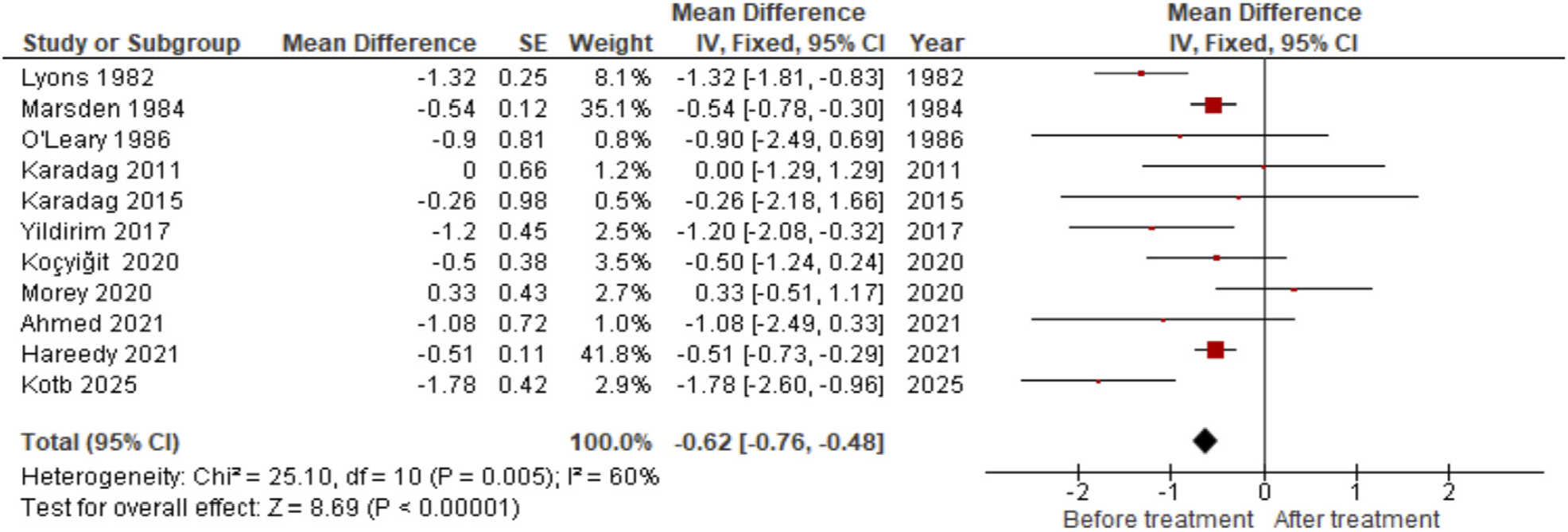
Pooled results showed a small, but statistically significant increase in the levels of thyroid-stimulating hormone (Mean Difference [MD = 0.03], 95% CI 0.02-0.05, p < 0.001) follow-ing the administration of isotretinoin (Fig. 2). Conversely, there was a statistically significant decrease in the levels of both thyroxine (MD = -0.19, 95% CI -0.24 to -0.15, p < 0.001) and triiodothyronine (MD = -0.62, 95% CI -0.76 to -0.48, p < 0.001) (Figs. 3 and 4).


Assessment of study heterogeneity
The heterogeneity between the studies reporting TSH and T3 levels was substantial (I2 = 85% and 86%, respectively). There was moderate heterogeneity between studies report-ing thyroxine (I2 = 60%). There were 12 cohort studies and three case-control studies and all 15 were sampled from a single centre. The sample size ranged widely (7 to 100) and three studies sampled a single sex only. Four and seven dif-ferent thyroid panels and testing intervals were reported, respectively. The dose of isotretinoin varied between the lowest and highest by 1.4 mg/kg/day, and duration by months.
Assessment of bias
The results of bias assessments using NIH criteria are pre-sented in Supplementary Tables S1 and S2. All 15 studies clearly stated the research question and had well-defined study populations. The subjects (and controls) in all 15 studies were selected from the same/similar populations; however, only nine cohort studies documented inclusion and/or exclusion criteria. Karadag et al. was the only study to consider different levels of exposure.13 None of the case control studies documented having blinded their assessors to the case or control status of the participants. Kocyigit et al. was the only study to account for possible confounding variables.14 Funnel plots constructed using studies reporting thyroid-stimulating hormone, thyroxine and triiodothyro-nine all showed low risk of small study effect and publication bias (Supplementary Figs. S1-S3).
Discussion
This systematic review and meta-analysis synthesizes the available evidence regarding the effects of oral isotretinoin on thyroid function and autoimmunity in the acne vul-garis population. Across fifteen studies, isotretinoin therapy was associated with a statistically significant increase in thyroid-stimulating hormone and reductions in both Thy-roxine (T4) and Triiodothyronine (T3).4,5,8-20 These findings suggest that isotretinoin may exert measurable effects on the hypothalamic-pituitary-thyroid axis, although the clinical significance of these changes requires cautious inter-pretation.
From a clinical perspective, the magnitude of thyroid hormone changes reported in most studies appears mod-est and frequently remains within reference ranges.9,16,17,19
This suggests that, for the majority of patients, isotretinoin is unlikely to exert clinically-apparent thyroid dysfunction. Nevertheless, the consistent direction of change across mul-tiple studies, characterized by increased TSH and reduced T3 and T4, raises the possibility of a mild, subclinical alteration in thyroid homeostasis on treatment. Similar biochemical alterations have been described in previous studies evaluating thyroid function during isotretinoin therapy.5,11,20
Several biological mechanisms may explain these find-ings. Retinoids act through nuclear retinoic acid receptors and Retinoid X Receptors (RXRs), which belong to the steroid-thyroid hormone receptor superfamily.21 Impor-tantly, RXRs can form heterodimers with thyroid hormone receptors and regulate transcription of thyroid hormone-responsive genes, providing a mechanistic explanation for the interaction between retinoid signaling and thyroid hor-mone pathways.22 Through these shared nuclear receptor pathways, isotretinoin or its metabolites may influence thyroid hormone synthesis, metabolism, and/or pituitary regulation of TSH secretion.
Although these biochemical changes appear largely sub-clinical, the findings may be most relevant to selected populations. Individuals with pre-existing thyroid disease or borderline thyroid function may be more susceptible to hormonal perturbations during isotretinoin treatment. Retinoids have also been implicated in immune modula-tion and endocrine signaling, suggesting a potential role in modifying thyroid autoimmunity in susceptible individuals, although evidence remains limited.23,24 In clinical practice, this raises the possibility that patients who develop symp-toms suggestive of thyroid dysfunction (e.g. fatigue, weight changes, mood disturbance) on isotretinoin treatment may benefit from targeted biochemical evaluation.
Interpretation of these findings must also consider the substantial heterogeneity observed between included stud-ies. Differences in isotretinoin dosing regimens, treatment duration, study populations, and laboratory testing intervals likely contributed to the variability in reported outcomes. Additionally, thyroid antibody testing was performed in only a small subset of studies, limiting conclusions regarding the potential effects of isotretinoin on thyroid autoimmunity.
Overall, this review suggests that isotretinoin therapy is associated with consistent but generally mild alterations in thyroid parameters that are unlikely to be clinically significant in most patients. However, the findings high-light a potentially under-recognized endocrine effect of isotretinoin and suggest that targeted thyroid monitoring may be appropriate in selected individuals. Larger prospec-tive studies with standardized thyroid testing protocols and longer follow-up will be useful to clarify whether these bio-chemical changes translate into clinically significant thyroid dysfunction.
Limitations
This review had several limitations that must be considered when interpreting the findings.
All studies were observational in design, with most being small, single-centre cohorts, which possibly intro-duced selection bias. There was considerable heterogeneity between the studies, reflected in dosing regimens, treat-ment duration, and laboratory testing methods. This compromises the pooling of results and limits the compara-bility of effect sizes. Only a single study measured different levels of exposure, which can lead to inaccurate categori-sation of measured exposures, resulting in an incorrect estimate of the exposure’s effect. Generally, the studies did not adjust for possible confounding factors, with very few reporting actively excluding participants with pre-existing thyroid disease or asking about participants’ other regular medications. It is also possible that publication bias played a role in our sample, as we restricted our search to the English language and only three of the included studies reported ‘no effect’ across their measured parameters.
Conclusions/Recommendations
This systematic review and meta-analysis suggest that isotretinoin use is associated with changes in serum thy-roid function parameters, with the overall trend towards increased TSH and decreased triiodothyronine and thyrox-ine. Future research should include prospective, multicenter studies with rigorous inclusion and exclusion criteria, standardized testing panels (including thyroid antibodies), multivariate analyses, and long-term follow-up to better elucidate the clinical significance and durability of these isotretinoin-induced thyroid alterations.
Appendix A. Supplementary material
Supplementary material related to this article can be found, in the online version, at doi:https://doi.org/10.1016/j.abd.2026.501380.
Appendix A. Supplementary material
Research data availability
The entire dataset supporting the results of this study was published in this article.
References
- 1 Alexis A, Tan J, Rocha M, Kerob D, Demessant A, Ly F, et al. Is acne the same around the world? J Clin Aesthet Dermatol. 2024;17:16-22.
- 2 Hazarika N, Archana M. The psychosocial impact of acne vul-garis. Indian J Dermatol. 2016;61:515-20.
-
3 Pile HD, Patel P. Isotretinoin. In: In: StatPearls [Inter-net]. Treasure Island (FL): StatPearls Publishing; 2026 [cited 2026 Mar 9]. Available from: https://www.ncbi.nlm.nih.gov/books/NBK525949/
» https://www.ncbi.nlm.nih.gov/books/NBK525949/ - 4 Karadag AS, Ertugrul DT, Tutal E, Akin KO. Isotretinoin influences pituitary hormone levels in acne patients. Acta Derm Venereol. 2011;91:31-4.
- 5 Ahmed FA, Zaky AM, El-Qodos SMA. Evaluation of thyroid func-tion tests before and after systemic isotretinoin treatment of acne vulgaris patients. Al-Azhar Med J. 2021;50:1989-96.
- 6 Sibi Krishna T, Kaur R, Malhotra V, Fatima Z, Mustajab M, Singh T, et al. The impact of isotretinoin on lipid profile: a systematic review. Ann Med Surg. 2025;87:4395-403.
- 7 Lee YH, Scharnitz TP, Muscat J, Chen A, Gupta-Elera G, Kirby JS. Laboratory monitoring during isotretinoin therapy for acne: a systematic review and meta-analysis. JAMA Dermatol. 2016;152:35-44.
- 8 Aktar R, Gunes Bilgili S, Yavuz IH, Ozaydin Yavuz G, Aktar S, Ozturk M, et al. Evaluation of hirsutism and hormonal param-eters in acne vulgaris patients treated with isotretinoin. Int J Clin Pract. 2021;75:e13791.
- 9 AlSaif F, AlOtaibi H, Balbisi A, AlAmari A, AlSaif F, AlAmari A, et al. Effect of oral isotretinoin therapy on thyroid function in patients with moderate-tosevere acne vulgaris: a prospective study. J Dermatol Dermatol Surg. 2020;24:38-40.
- 10 Chandrakar R, Gupta R. Effects of isotretinoin on the thyroid gland volume and serum thyroid stimulating hormone in patients of acne vulgaris. Int J Pharm Clin Res. 2022;14:826-32.
- 11 Salem Hareedy M, Mahmoud WA, Tawfik KM. Patterns of thy-roid dysfunctions in adolescent patients suffering from severe acne during isotretinoin treatment. Clin Exp Pharmacol Physiol. 2021;48:1317-26.
- 12 Karadag AS, Takci Z, Ertugrul DT, Bilgili SG, Balahoroglu R, Takir M. The effect of different doses of isotretinoin on pituitary hormones. Dermatology. 2015;230:354-9.
- 13 Kocyigit SE, Sahin M, Houshyar Y, Dost Günay FS, Çorapçio˘glu D. Effects of isotretinoin treatment on levels of hormones involved in the etiopathogenesis of acne. Turk J Endocrinol Metab. 2020;24:237-46.
- 14 Kotb MA, Bin Dayel S, Abahussein O, Hussein RS. Impact of isotretinoin therapy on thyroid hormone levels in acne vulgaris: a prospective study. Medicine (Baltimore). 2025;104:e44236.
- 15 Lyons F, Laker MF, Marsden JR, Manuel R, Shuster S. Effect of oral 13-cis-retinoic acid on serum lipids. Br J Dermatol. 1982;107:591-5.
- 16 Marsden JR, Trinick TR, Laker MF, Shuster S. Effects of isotretinoin on serum lipids and lipoproteins, liver and thyroid function. Clin Chim Acta. 1984;143:243-51.
- 17 Morey A, Madke B, Singh A. Effect of isotretinoin on thyroid function test in acne patients. J Clin Diagn Res. 2020;14. WC09-11.
- 18 O’Leary TJ, Simo IE, Kanigsberg ND, Ooi TC. Lack of effect of isotretinoin on thyroid function tests. Clin Chem. 1986;32:913-4.
- 19 Uyar B, Solak A, Saklamaz A, Akyildiz M, Genc B, Gökduman A. Effects of isotretinoin on the thyroid gland and thyroid function tests in acne patients: a preliminary study. Indian J Dermatol Venereol Leprol. 2016;82:587-8.
- 20 Yıldırım N, Do˘gan S, Atakan N. Evaluation of thyroid func-tion tests of acne vulgaris patients treated with systemic isotretinoin. J Dermatolog Treat. 2017;28:141-4.
- 21 Lefebvre P, Benomar Y, Staels B. Retinoid X receptors: com-mon heterodimerization partners with distinct functions. Trends Endocrinol Metab. 2010;21:676-83.
- 22 Lee S, Privalsky ML. Heterodimers of retinoic acid receptors and thyroid hormone receptors display unique combinatorial regulatory properties. Mol Endocrinol. 2005;19:863-78.
- 23 Hall JA, Grainger JR, Spencer SP, Belkaid Y. The role of retinoic acid in tolerance and immunity. Immunity. 2011;35:13-22.
- 24 Nugroho J, Schweiger B. Isotretinoin as a possible environmen-tal trigger to autoimmunity in genetically susceptible patients. Case Rep Pediatr. 2017;2017:4207656.
Edited by
-
Editor
Hiram Larangeira de Almeida Jr.