 In-silico evaluation of Calotropis procera phytochemicals as dual-acting agents against Anopheles gambiae and Plasmodium falciparum
ABSTRACT
Phytochemicals are explored as alternatives for vector control and antimalarial drug discovery. In this study, sixty-two Calotropis procera constituents were screened in silico against four protein targets against Anopheles gambiae (5X61, 3N7H, 2CH2, 2IMI) and Plasmodium falciparum (1OB1, 7F9N, 1OB3, 6S8T). The strongest binders identified as α-amyrin (-11.973) and multiflorenol (11.982kcal/moL) for 5X61, pinoresinol-4-O-glucoside for 3N7H (-10.560kcal/moL), desglucouzarin for 2CH2 (-8.325kcal/moL), and daucosterol for 2IMI (-9.259 kcal/mol). For P. falciparum, the top binders included afroside for 1OB1 (-9.156kcal/moL), and for 7F9N (-8.495 kcal/mol), calactin for 1OB3 (-9.005kcal/moL), and α-amyrin for 6S8T (-9.598kcal/moL). Ecotoxicity analysis of 16 shortlisted compounds produced composite safety scores (S) ranging from 4.028 (Cycloart-23-ene-3β,25-diol; lowest predicted hazard to -4.630 (Uscharidin; highest hazard). Toxicity clustering further distinguished a high-risk module (carcinogenicity, mutagenicity, hepatotoxicity) and a low-risk module with minimal systemic toxicity. Overall, compounds α-amyrin, cycloart-23-ene-3β,25-diol, lupeol, desglucouzarin, and daucosterol emerge as the most promising dual-acting candidates with strong multi-target affinity and favorable safety profiles.
Keywords:
Calotropis procera; molecular docking; Anopheles gambiae; Plasmodium falciparum; ecotoxicity prediction
RESUMO
Fitoquímicos são explorados como alternativas para o controle de vetores e a descoberta de fármacos antimaláricos. Neste estudo, 62 constituintes de Calotropis procera foram triados in silico contra quatro alvos proteicos de Anopheles gambiae (5X61, 3N7H, 2CH2, 2IMI) e Plasmodium falciparum (1OB1, 7F9N, 1OB3, 6S8T). Os ligantes mais fortes identificados foram α-amirina (-11,973) e multiflorenol (11,982kcal/moL) para 5X61, pinoresinol-4-O-glicosídeo para 3N7H (-10,560kcal/moL), desglucouzarina para 2CH2 (-8,325kcal/moL) e daucosterol para 2IMI (-9,259kcal/moL). Para P. falciparum, os principais ligantes incluíram afrosídeo para 1OB1 (-9,156 kcal/moL) e para 7F9N (-8,495 kcal/moL), calactina para 1OB3 (-9,005 kcal/moL) e α-amirina para 6S8T (-9,598kcal/moL). A análise de ecotoxicidade de 16 compostos pré-selecionados gerou escores de segurança compostos (S) que variaram de 4,028 (cicloart-23-eno-3β,25-diol; menor risco previsto) a -4,630 (uscharidina; maior risco). O agrupamento por toxicidade distinguiu ainda um módulo de alto risco (carcinogenicidade, mutagenicidade, hepatotoxicidade) e um módulo de baixo risco com toxicidade sistêmica mínima. Em geral, os compostos α-amirina, cicloart-23-eno-3β,25-diol, lupeol, desglucouzarina e daucosterol emergem como os candidatos de dupla ação mais promissores, com forte afinidade por múltiplos alvos e perfis de segurança favoráveis.
Palavras-chave:
Calotropis procera; acoplamento molecular; Anopheles gambiae; Plasmodium falciparum; previsão de ecotoxicidade
INTRODUCTION
In 2023, the global malaria incidence rose to an estimated 263 million cases, with Africa bearing 94% of cases and 95% of the 597,000 global deaths. The current global mortality rate of 13.7 per 100,000 is nearly three times higher than the level needed to achieve the 2025 goal of a 75% reduction (WHO, 2024). Despite large-scale deployment of insecticidal nets and indoor residual spraying, the efficacy of these interventions is increasingly undermined by widespread resistance in Anopheles gambiae (Balboné et al., 2022). Although synergists such as piperonyl butoxide (PBO) partially restore susceptibility in several regions (Toe et al., 2018) (Hien et al., 2021), sustainable control efforts are constrained by the limited availability of novel insecticide classes approved for public health use.
Parallel to vector control, malaria elimination efforts require new therapeutic agents to address rising resistance in P. falciparum. It is the most lethal malaria parasite responsible for severe pathology and nearly half of global malaria cases (Dipto et al., 2025; Weiss et al., 2019; Reyburn et al., 2005; Milligan et al., 2004). The emergence of resistance to multiple drug classes, including artemisinin-based combination therapies (Achan et al., 2011; Wongsrichanalai and Sibley, 2013), highlights the need for compounds with novel mechanisms of action.
The urgent need for alternative control agents has renewed interest in plant-derived compounds. These natural products are biodegradable, environmentally safe, and composed of complex mixtures of bioactive constituents that reduce the likelihood of resistance development (Isman, 2000; Chaachouay and Zidane, 2024). More than 3,000 compounds have been identified from over 17,500 aromatic plants (Mossa, 2016), many showing potent insecticidal activity across mosquito vectors (Ghosh et al., 2012; Nazmin et al., 2025) including Aedes and Anopheles species (Gebissa et al., 2025; Abbas et al., 2025). Phytocompunds can demonstrate synergistic formulations combining phytocompunds with chemical insecticides have been shown to enhance efficacy while minimizing adverse effects (Mansour et al., 2012).
Calotropis procera has recently gained substantial attention for its rich phytochemical profile and biological activities (Rodríguez-Macías et al., 2025; Nogueira et al., 2025). The plant produces diverse secondary metabolites including cardenolides, triterpenoids, flavonoids, alkaloids, and phenolic compounds (Abidemi et al., 2025; Meena et al., 2010) which exhibit potent larvicidal, insecticidal, antiviral, and anticancer effects (Dogara, 2023; Singh et al., 2024; Gebissa et al., 2025; Al-Qahtani et al., 2020; Mamidala and Munipally, 2025). Although C. procera has shown activity against Anopheles larvae (Elimam et al., 2009; Singh et al., 2005), P. falciparum (Satish et al., 2017 Olorukooba and Bello, 2025 Mudi and Bukar, 2011), their molecular targets remain poorly characterized. No comprehensive structure-based investigation has examined how these phytochemicals interact with target proteins of An. gambiae and P. falciparum.
An integrated in-silico analysis was conducted to evaluate C. procera phytochemicals as dual-action agents with potential efficacy against both An. gambiae and P. falciparum. Molecular docking, ADMET screening, and toxicity profiling were employed. This study identifies promising C. procera-compounds that exhibit strong binding affinities, favorable pharmacokinetic properties, and potential inhibitory activity.
This study provides a mechanistic foundation for the development of plant-derived agents that target the malaria vector and parasite addressing urgent challenges posed by increasing insecticide and antimalarial drug resistance.
ETHICAL ASPECTS
This research was not submitted to the Ethics Committee on Animal Use.
MATERIALS AND METHODS
A dataset of 62 compounds was extracted from the review article (Wadhwani et al., 2021). Their 3D conformers were either retrieved directly from the PubChem compound database or generated using NovoPro (https://www.novoprolabs.com/tools). These conformers were then converted to PDB format using OpenBabel (version 3.1.1). Ligand structures were prepared using AutoDock Tools by assigning Gasteiger partial charges and merging nonpolar hydrogens and rotatable bonds were automatically identified. The fully prepared ligands were saved in PDBQT format. Ligand 61 (Glycerol) was designated as a negative control for all protein targets. Positive controls were selected for each target based on known binding activity: 4-(2-hydroxyethyl)-1-piperazine ethanesulfonic acid for AgAChE1 (5X61), N,N-diethyl-m-toluamide (DEET) for AgamOBP1 (3N7H), S-hexylglutathione for AgGSTe (2IMI), 4-(2-aminophenyl)-4-oxobutanoic acid for AgHKT (2CH2), and Quinone for P. falciparum targets (1OB1, 7F9N, 1OB3, 6S8T). These reference ligands enabled comparative evaluation and validation of docking results across all targets.
Crystal structures were retrieved from the Protein Data Bank for P. falciparum targets, including merozoite surface protein 1-19 (MSP1-19; PDB: 1OB1), RIFIN variable region #4 (PDB: 7F9N), PfPK5 kinase (PDB: 1OB3), and PfEMP1 IT4var13 DBLβ domain (PDB: 6S8T), as well as for A. gambiae proteins, including Acetylcholinesterase 1 (AgAChE1; PDB: 5X61), epsilon-class Glutathione S-transferase (AgGSTe; PDB: 2IMI), Odorant Binding Protein 1 (AgamOBP1; PDB: 3N7H), and 3-Hydroxykynurenine Transaminase (AgHKT; PDB: 2CH2). All structures were processed using AutoDock Tools 1.5.7 by removing crystallographic water molecules, non-essential ions, and co-crystallized ligands. Missing hydrogen atoms were added, Kollman charges were assigned, nonpolar hydrogens were merged, and the final receptor structures were saved in PDBQT format. Grid boxes were centered on the active sites of each protein with dimensions of 40 × 40 × 40 Å. For A. gambiae targets, the grids were: 2CH2 (-11.165, 32.406, -27.581), 2IMI (39.022, -18.603, 68.837), 3N7H (12.810, -4.675, 18.012), and 5X61 (-66.236, 31.765, 87.463). For P. falciparum targets, the grids were: 1OB1 (-9.913, -12.456, -11.425), 1OB3 (15.923, -1.353, 32.061), 6S8T (-24.884, 5.941, 108.626), and 7F9N (-18.704, 17.548, -67.955). These grids were applied consistently for all ligands during docking using AutoDock Vina.
Docking simulations were performed using AutoDock Vina 1.2.5 under default scoring function settings. For each ligand, Vina generated up to 9 binding conformations ranked by predicted binding affinity (kcal/moL). The top-ranked pose was selected for all comparative analyses.
The distribution of docking scores was illustrated using heatmaps for each protein target. Plots were generated using Python 3.10. Protein-ligand interactions were visualized using PyMOL 2.5 and PLIP.
The ecotoxicity potential of the compounds, represented by their SMILES codes, was evaluated using the ADMETlab 3.0 platform. This analysis systematically assessed a range of critical organic and exposure toxicity endpoints. The specific endpoints modeled included the bioaccumulation factor (BCF) and acute aquatic toxicity, such as growth inhibition (Tetrahymena pyriformis IGC50) and lethal concentrations (fathead minnow 96h LC50 and Daphnia magna 48h LC50). Furthermore, the assessment covered various organ toxicity risks, including cardiotoxicity, ototoxicity, skin sensitization, carcinogenicity, Ames mutagenicity, rat oral acute toxicity, human hepatotoxicity, hematotoxicity, and nephrotoxicity. Exposure-related hazards like eye corrosion/irritation and neurotoxicity were also predicted.
Ecotoxicological data for the 16 most promising candidate compounds included the Bioaccumulation Factor (BCF) and three aquatic toxicity endpoints: T. pyriformis IGC₅₀, P. promelas LC₅₀ (96 h), and D. magna LC₅₀ (48 h). All aquatic toxicity metrics were converted to the standardized -log₁₀[(mg L⁻¹)/(1000 × MW)] scale, where higher values indicate lower toxic potency. BCF values were used as provided (unitless), with higher values representing greater bioaccumulation risk. All endpoints were z-score normalized to enable direct comparison across differing units and magnitudes. To align endpoint directionality such that higher values consistently denote safer profiles, normalized BCF values were inverted (-zBCF). A Composite Environmental-Safety Score (S) was then calculated:
Compounds with higher S values exhibit lower bioaccumulation potential and reduced organismal toxicity.
Hierarchical clustering (Ward’s linkage, Euclidean distance) applied to the z-normalized matrix revealed distinct low- and high-risk clusters, consistent with the composite scoring. A clustered heatmap generated using the viridis colormap visualized endpoint contributions across compounds. All preprocessing, normalization, scoring, and visualizations were conducted in Python (v3.10) using pandas (v2.0), numpy (v1.26), scipy (v1.11), seaborn (v0.13), matplotlib (v3.8), and scikit-learn (v1.4).
Computational toxicity profiles were generated for 16 candidate compounds using a panel of structure-based predictive models covering 16 endpoints, including hERG inhibition (10µM), ototoxicity, skin sensitization, carcinogenicity, FDAMDD, respiratory toxicity, DILI, eye corrosion/irritation, neurotoxicity, hERG binding, Ames mutagenicity, rat oral acute toxicity (ROA), human hepatotoxicity (H-HT), genotoxicity, and hematotoxicity. All endpoints were expressed as normalized probabilities (0-1), except carcinogenicity, which was retained in its categorical form (0-2). Each compound was represented by a 16-endpoint toxicity vector. As all variables were already standardized by the predictive models, no further normalization was applied.
Hierarchical clustering was performed on the endpoint dimension using Ward’s linkage and Euclidean distance to identify co-varying toxicity signatures. The clustered toxicity matrix was visualized using a continuous blue-white-red scale (0.0 → 1.0), with the dendrogram-defined feature order applied to the heatmap. All analyses were carried out in Python (v3.10) using SciPy and Matplotlib.
RESULTS
Docking simulations were carried out against four A. gambiae protein targets namely, (5X61), (3N7H), HKT (2CH2), and (2IMI) to evaluate the binding affinities of 62 ligands. Across all targets, docking scores ranged from -11.982 to -3.756 kcal moL⁻¹, with Ligand 61 (glycerol) and Ligand 62 (quinine) serving as negative and positive controls, respectively. The global distribution of docking scores is summarized in Fig. 1. Molecular docking simulations against four key mosquito protein targets revealed distinct, high-affinity ligand profiles for each protein. For 5X61, the top-scoring ligands were α-amyrin (−11.973 kcal/mol), multiflorenol (−11.982 kcal/mol), lupeol (−11.156 kcal/moL), oleanolic acid (−10.626kcal/mol), and cycloart-23-ene-3β,25-diol (−10.171kcal/moL). Conversely, 3N7H showed strongest binding to ligands pinoresinol-4-O-glucoside (−10.560kcal/moL), luteolin (−9.446kcal/moL), quercetin (−9.592kcal/moL), daucosterol (−8.960kcal/moL), and 5,7,4′-tri-O-methyl-apigenin (−9.088kcal/mol). The HKT protein (2CH2) exhibited its lowest binding energies with desglucouzarin (−8.325kcal/moL), methyl rosmarinate (−7.543kcal/mol), daucosterol (−7.599kcal/moL), 6'-hydroxycalactin (−7.796kcal/moL), and uscharin (−7.720kcal/moL), while Glutathione S-transferase (2IMI) top binders included daucosterol (−9.259kcal/moL), methyl rosmarinate (−9.059kcal/moL), rosmarinic acid (−8.847kcal/moL), pinoresinol-4-O-glucoside (−7.527kcal/moL), and calactin (−7.519kcal/moL). Detailed interaction analyses were subsequently performed on representative high-ranking complexes to elucidate key binding determinants.

Heatmap showing molecular docking scores (kcal/mol) of ligands across mosquito protein targets. The visualization presents binding affinities against Anopheles gambiae proteins (PDB IDs: 5X61, 3N7H, 2CH2, and 2IMI). Each row represents an individual ligand, and each column corresponds to a protein target. Docking scores are color-coded according to binding affinity, with more negative values indicating stronger predicted interactions. Ligand 61 (glycerol) and ligand 62 are included as negative and positive controls, respectively.
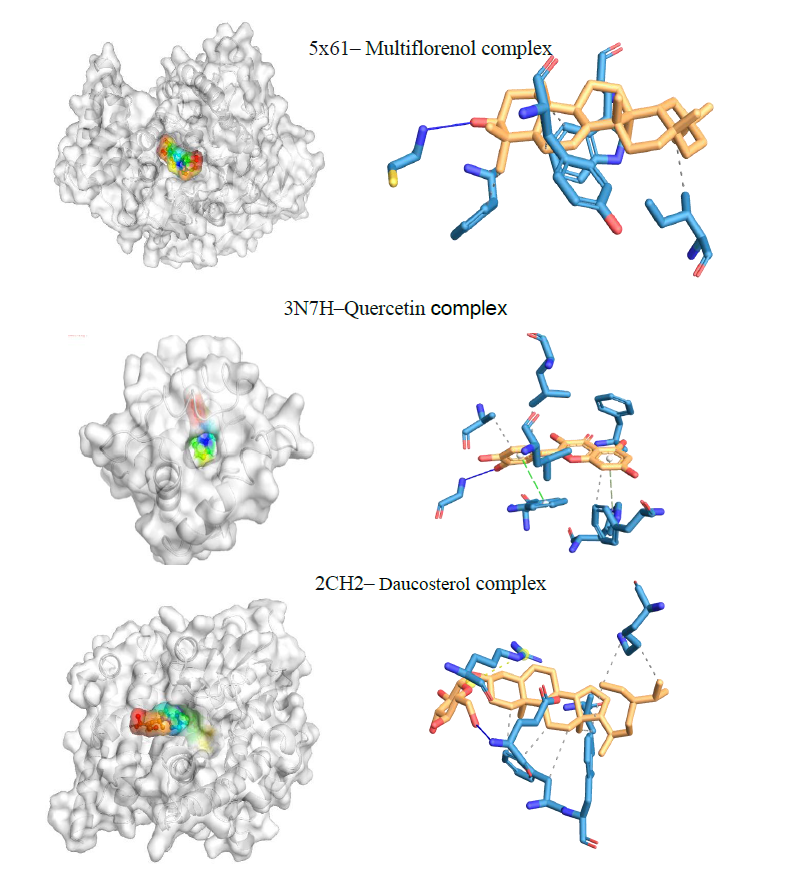
To characterize the molecular basis of the high-affinity interactions, we analyzed key stabilizing contacts within the top-ranked ligand-protein complexes. The 5X61- α-amyrin complex was stabilized by hydrophobic contacts (3.12-4.00 Å) involving residues ILE-231A, TRP-441A (2×), LEU-444A, PHE-449A, PHE-490A, and TYR-494A (2×), and two hydrogen bonds with GLY-445A (2.91 Å) and CYS-447A (2.28 Å). For 3N7H- Quercetin, key interactions included four hydrophobic contacts (3.24-3.75 Å) with PHE-59A, LEU-76A, LEU-80A, and ALA-88A, two hydrogen bonds with GLY-92A (3.16 Å) and PHE-123A (1.92 Å), and two π-stacking interactions with HIS-111A (5.23 Å) and TRP-114A (4.56 Å). The 2CH2- desglucouzarin complex featured three hydrophobic contacts (3.21-3.82 Å), three hydrogen bonds with GLN-30A (3.29 Å), ARG-229A (2.80 Å), and VAL-110A (3.22 Å), and two salt bridges with ARG-107D (4.48 Å) and ARG-229A (4.51 Å). In the 2IMI-daucosterol complex, stability was conferred by eight hydrophobic contacts (3.18-3.99 Å) with LEU-105B, ARG-112B, ALA-113B, ILE-116B, TYR-121A, PRO-122A, LEU-127B, and ILE-129B, one hydrogen bond to GLU-116B (3.57 Å), and a salt bridge with ARG-112B (4.68 Å).
Docking simulations were performed against four P. falciparum targets 1OB1, 7F9N, 1OB3, and 6S8T to assess the binding affinities of all ligands (Figure 2). Across all targets, docking scores ranged from -9.598 to -3.579kcal moL⁻¹, with glycerol and quinone serving as internal negative and positive controls, respectively. The overall distribution of docking scores is summarized in Fig. 1. For MSP1-19 (1OB1), the top-scoring ligands were afroside (-9.156kcal/moL), uscharin (-9.056kcal/moL), uscharidin (-8.813kcal/moL), voruscharin (-8.832kcal/moL), and multiflorenol (-8.647kcal/moL). The RIFIN VR#4 protein (7F9N) was best targeted by afroside (-8.495kcal/moL), uscharin (-8.198kcal/moL), multiflorenol (-8.370kcal/moL), uscharidin (-8.190kcal/moL), and rutin (-8.142kcal/moL). PfPK5 (1OB3) showed strongest binding to calactin (-9.005kcal/moL), luteolin (-8.941kcal/moL), 6'-Hydroxycalactin (-8.650kcal/moL), and rosmarinic acid (-8.654kcal/moL). Conversely, the PfEMP1 DBLβ domain (6S8T) displayed the strongest affinities for ligands α-amyrin (-9.598 kcal/mol), desglucouzarin (-8.942kcal/moL), calactin (-8.906kcal/moL), and uscharin (-8.885 kcal/mol). Detailed molecular interaction analyses were subsequently performed on selected top-ranked complexes to elucidate the structural basis of binding.
To delineate the molecular interactions underlying the high predicted affinity, we analyzed key residues and binding modes for a top-ranked ligand-receptor complex from each target. The 1OB1 - Afroside complex was stabilized by four hydrophobic contacts (3.22-3.95 Å) involving ILE-10A, GLN-38A, LYS-103A, and LYS-141A, and supported by four hydrogen bonds with ARG-39B (2.45 Å), THR-85A (2.87 Å), TYR-87A (3.00 Å), and TRP-162A (2.26 Å), alongside a T-shaped π-stacking interaction with TRP-162A (4.66 Å). For 7F9N (RIFIN VR#4)-Ligand 16, binding involved five hydrophobic contacts (3.33-3.91 Å) with LEU-60C, PHE-86C, ILE-236A, ALA-245A, and ASP-246A, two hydrogen bonds to ASN-69C (2.92 Å) and ASP-70C (2.08 Å), and a salt bridge with LYS-233A (4.01 Å). In the 1OB3- Calactin complex, six hydrophobic contacts (3.46-3.96 Å) were observed with TYR-15A, LEU-36A, GLU-37A, and PHE-150A, complemented by three hydrogen bonds to GLU-37A (1.90 Å), THR-47A (2.92 Å), and ASP-125A (3.70 Å) and a π-stacking interaction with PHE-150A (4.74 Å). Conversely, the binding of 6S8T (PfEMP1 DBLβ) α-amyrin was driven predominantly by an extensive network of seven hydrophobic interactions (2.84-3.99 Å) with ALA-746A, ASN-749A, TYR-916A, ILE-1023A, ARG-1028A, VAL-1031A, and GLU-1156A, with no conventional hydrogen bonds or π-stacking observed.
The composite score (S), which integrates four ecotoxicity endpoints after z-score normalization, effectively ranked the 16 candidate compounds (Table 1) by predicted environmental hazard. A higher S indicates a lower toxicity and bioaccumulation. The analysis revealed a broad range of environmental profiles among the compounds (Fig. 1). The composite environmental-safety score (S) effectively ranked the candidate compounds, revealing a broad spectrum of environmental profiles. Cycloart-23-ene-3β,25-diol was identified as the most favorable with the highest score (S = 4.028), indicating the lowest environmental impact predicted. In contrast, uscharidin exhibited the least favorable profile, scoring lowest (S = -4.630) and suggesting the highest combined hazard. The analysis further highlighted a cluster of top-ranked compounds including cycloart-23-ene-3β,25-diol, lupeol (S = 1.902), desglucouzarin (S = 1.805), methyl rosmarinate (S = 1.146), and daucosterol (S = 0.997) which consistently scored at the high end of the scale. This favorable ranking stems from their synergistic profile of low bioaccumulation potential (BCF) and high aquatic toxicity thresholds, denoting lower toxicity.
The Low-Risk Cluster comprised most top-ranked compounds, including cycloart-23-ene-3β,25-diol, lupeol, desglucouzarin, methyl rosmarinate, and daucosterol. The heatmap visualization confirmed these share a favorable profile characterized by low BCF z-scores (dark blue, indicating low bioaccumulation) and high IGC₅₀/LC₅₀ z-scores (bright yellow, indicating low toxicity). Conversely, the High-Risk Cluster contained the lowest-ranked compounds, such as uscharidin, corosolic acid, and multiflorenol. These exhibited the inverse pattern high BCF z-scores (yellow, indicating higher bioaccumulation) and low IGC₅₀/LC₅₀ z-scores (dark blue, indicating higher toxicity) thereby confirming their elevated intrinsic hazard profile. The heatmap also illustrates the relative contribution of each endpoint to compound-level risk, visually validating the integrated scoring system.
Chemical profiles and molecular weights of promising phytochemical constituents of Calotropis procera
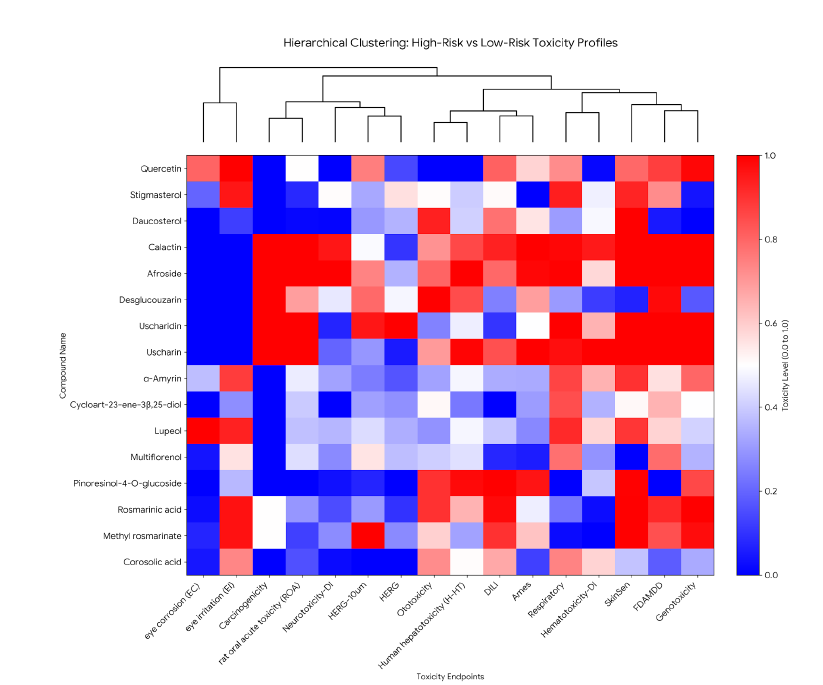
Hierarchical clustering of the 16 toxicity endpoints produced two major modules. A high-risk module comprised endpoints with consistently elevated probabilities across multiple compounds, including carcinogenicity, FDAMDD, respiratory toxicity, Ames mutagenicity, ROA toxicity, human hepatotoxicity, genotoxicity, and hematotoxicity (Figure 6). Several compounds most prominently calactin, afroside, uscharidin, uscharin, rosmarinic acid, and methyl rosmarinate exhibited high probabilities across these endpoints, forming a coherent high-toxicity cluster. In contrast, a low-risk module included endpoints that exhibited minimal or highly variable predicted toxicity, such as hERG (binding), neurotoxicity, EC, and EI. Compounds quercetin, Stigmasterol, Daucosterol, α-amyrin, cycloart-23-ene-3β,25-diol, and corosolic acid predominantly aligned with this lower-risk profile.
The dendrogram-ordered heatmap revealed distinct, compound-specific toxicity signatures. High-risk compounds, such as Calactin, afroside, uscharidin, uscharin, rosmarinic acid, and methyl rosmarinate, were characterized by widespread and intense red coloration, reflecting elevated probabilities for multiple systemic toxicities including carcinogenicity and hepatotoxicity. In contrast, low-risk compounds, exemplified by Qurcetin, stigmasterol, daucosterol, α-amyrin, and cycloart-23-ene-3β,25-diol, exhibited fewer high-probability endpoints and a lower overall toxicity burden. The categorical carcinogenicity endpoint provided a sharp demarcation, separating compounds into high-risk (value = 2) and no-risk (value = 0) classes. Furthermore, eye-related endpoints (EC and EI) displayed highly polarized values; while most compounds were predicted to be minimally irritating, a subset showed strong eye irritation probabilities approaching 1.0. Collectively, the hierarchical clustering analysis delineated clear toxicity substructures and successfully highlighted compounds with either convergent high-risk or divergent, more favorable safety profiles.

Heatmap of molecular docking scores across malaria protein targets. Heatmap illustrates the docking scores (kcal/moL) of ligands against four malaria-related protein targets (1OB1, 7F9N, 1OB3, and 6S8T). Each row represents an individual ligand and each column corresponds to a protein target. Docking scores are color-coded according to binding affinity, with more negative values indicating stronger predicted interactions. Ligand 61 (glycerol) and ligand 62 (quinone) are included as negative and positive controls, respectively.

2D and 3D binding-interaction maps of selected top-scoring ligand-protein complexes with A. gambiae targets. Interaction profiles for (A) 5X61- α-amyrin, (B) 3N7H-Quercetin, and (C) 2CH2- Daucosterol complexes.Hydrogen bonds, hydrophobic contacts, salt bridges, and π-interactions are indicated in the 2D diagrams, with corresponding 3D views illustrating the spatial orientation of each ligand within the active site.

2D and 3D binding-interaction maps of selected top-scoring ligand-protein complexes with malaria protein targets. Interaction profiles for (A) 1OB1-Ligand 16, (B) 7F9N-Ligand 16, (C) 1OB3-Ligand 14, and (D) 6S8T- α-amyrin. Hydrogen bonds, hydrophobic contacts, salt bridges, and π-interactions are indicated in the 2D diagrams, with corresponding 3D views illustrating binding-site positioning.

Composite Environmental-Safety Score (S) and Hierarchical Clustering and Heatmap of Ecotoxicity Endpoints A: Bar chart showing the ranking of the 16 candidate compounds based on the Composite Environmental-Safety Score (S). Higher S values indicate a more favorable environmental profile. The score is derived from summing the z-normalized and directionally aligned endpoints: S = -z(BCF) + z(IGC₅₀) + z(LC50_fish) + z(LC50_Daphnia). A dashed reference line at S = 0 represents the average safety performance across the dataset. B: A clustered heatmap visualizing the z-normalized ecotoxicity data. Rows (compounds) are clustered using Ward’s linkage and Euclidean distance. Columns represent the four standardized endpoints. The 'viridis' colormap indicates the magnitude of each z-score: yellow shades correspond to high z-scores (for BCF, this indicates high bioaccumulation; for IGC₅₀/LC₅₀, this indicates low toxicity). Dark blue shades correspond to low z-scores (low bioaccumulation for BCF, high toxicity for IGC₅₀/LC₅₀). The resulting dendrogram and color patterns separate the compounds into distinct high-risk and low-risk clusters.

Hierarchical clustering and heatmap of predicted toxicity profiles for 16 compounds. Heatmap displaying predicted toxicity probabilities (0.0 to 1.0, blue-white-red scale) for 16 compounds across 16 endpoints. Endpoints (columns) are ordered via hierarchical clustering using Ward’s linkage and Euclidean distance to identify co-varying toxicity modules. High-risk compounds exhibit convergent systemic toxicity (red), while low-risk compounds show divergent safety profiles. Dendrogram branches delineate a high-risk systemic module and a variable/low-risk module.
DISCUSSION
This study establishes an integrated computational pipeline combining multi-target molecular docking with predictive ecotoxicology and human toxicology to prioritize phytochemical candidates for malaria control. By targeting proteins in A. gambiae and P. falciparum, we identify phytochemicals capable of disrupting both mosquito viability and parasite survival. In parallel, predictive toxicology models evaluate candidates for their potential environmental and human safety. This dual-target, safety-aware strategy aligns with the need for multi-modal interventions that mitigate resistance risk and minimize ecological impact.
Multi-target vector-control agents offer better potency and reduced resistance risk compared to single-site insecticides (Li et al., 2021a; Ding et al., 2023; Shen et al., 2024). Natural products often display polypharmacology, enabling simultaneous disruption of neural, metabolic, and detoxification pathways mechanisms previously reported for botanical insecticides with strong larvicidal and adulticidal effects (Koul, 2008; Saha et al., 2017; Liang et al., 2021; Li et al., 2021b; Cen et al., 2020). The broad interaction observed for several ligands are consistent with this pattern and may reflect the capacity of phytochemicals to engage chemically diverse binding pockets, induce conformational changes, or disrupt protein stability. Similar multi-target interaction patterns underlie the success of major insecticidal compounds, such as neonicotinoids and pyrethroids. They exert their toxicity through complementary neurophysiological pathways (Soderlund, 2012; Blackman et al., 2015).
Drug resistance remains a persistent challenge in malaria treatment. The extensive use of frontline therapies such as quinine and chloroquine has contributed to the emergence of resistant P.falciparum strains (Achan et al., 2011). Chloroquine resistance is primarily driven by mutations in the PfCRT transporter, which reduce drug accumulation within the parasite’s digestive vacuole and thereby diminish therapeutic efficacy (Da, 2000; Diptoy et al., 2025). Targeting parasite proteins is considered an effective strategy for antimalarial development because such proteins have a high likelihood of interacting with diverse compounds. Five essential protein targets (PfCRT, MSP1, AMA1, PfEMP1, and PfPK5) were selected for this study. These proteins play critical roles in parasite survival and host infection (Juárez-Saldivar et al., 2023; Diptoy et al., 2025). Such multi-target activity is increasingly recognized as a valuable characteristic in anti-malarial drug development. Compounds that disturb more than one parasite pathway reduce the likelihood of resistance emergence (Tarkang et al., 2016; (Makhoba et al., 2020; Nwonuma et al., 2025).
Several compounds exhibited strong binding to multiple essential target proteins of A. gambiae and P. falciparum. This multi-target activity could help mitigate resistance driven by single-target mutations and may retain efficacy against resistant strains. The varied binding sites observed in molecular docking analyses suggest a potential to limit classical resistance mechanisms. Given their favorable in silico performance these compounds represent promising antimalarial candidates. However, further in vitro and in vivo studies are needed to validate their therapeutic potential.
The ecotoxicity assessments add an essential dimension by ensuring that candidate compounds are evaluated not only for potency but also for safety. This early-stage environmental screening aligns with OECD and regulatory guidance that increasingly promotes computational toxicology as a foundational step before in vivo testing (Mombelli and Pandard, 2021).
The clear separation between low- and high-risk clusters highlights substantial variability in environmental hazard among compounds with similar docking performance. This divergence mirrors observations from environmental monitoring studies. Structurally similar xenobiotics can exhibit markedly different persistence, bioaccumulation, and aquatic toxicity profiles (Muir and Howard, 2006; Wang et al., 2025). Importantly, compounds predicted to have low bioaccumulation and higher aquatic toxicity thresholds align with the design principles of “reduced-risk pesticides,” which emphasize rapid degradation and minimal impacts on non-target organisms (Druzina and Stegu, 2007; Lyton et al., 1996 ; Hanel et al., 2025; Wan et al., 2025). Computational toxicity predictions provide a valuable first step for prioritizing safer candidate molecules. However, intrinsic toxicity alone does not fully reflect environmental risk. Real ecosystems involve complex chemical mixtures with cumulative and interactive effects. Thus, while the safety scores support the selection of promising phytochemical candidates, comprehensive evaluation will require chronic aquatic toxicity testing, degradation studies, and mixture-interaction assessments under environmentally relevant conditions. Hierarchical clustering of toxicity endpoints identified two distinct modules, separating compounds with higher risks of hepatotoxicity, carcinogenicity, mutagenicity, and systemic toxicity from those with substantially lower risk. The identification of low-risk compounds such as quercetin, stigmasterol, daucosterol, α-amyrin, and cycloart-23-ene-3β,25-diol is particularly significant, given that hepatotoxicity, cardiotoxicity, and genotoxicity are major contributors to early drug-development (Zhang et al., 2025).
CONCLUSION
Overall, integrating multi-target molecular docking with computational toxicology provides a rational strategy for identifying phytochemicals with both promising bioactivity and favorable safety profiles. This combined pipeline enables efficient triage of large ligand libraries, highlights compounds with the strongest potential for further development, and supports data-driven decision-making in early-stage antimalarial research. More broadly, the framework is generalizable and can be applied to additional vector species, biological pathways, or chemical classes. Together, these approaches contribute to the advancement of sustainable, environmentally responsible vector-control and antimalarial therapeutics.
ACKNOWLEDGEMENT
The authors express their sincere appreciation to Ongoing Research Funding program, (ORF-2026-757), King Saud University, Riyadh, Saudi Arabia
REFERENCES
- ABBAS, M.G.; BINYAMEEN, M.; AZEEM, M. et al Chemical analysis, repellent, larvicidal, and oviposition deterrent activities of plant essential oils against Aedes aegypti, Anopheles gambiae, and Culex quinquefasciatus Front. Insect Sci, v.5, p.1582669, 2025.
- ABIDEMI, S.O.; ISHOLA, A.O.; OLAKUNLE, F.A. Unveiling the intriguing properties: a study on the powerful phytochemicals and biological marvels of Calotropis procera plant. Afr. J. Biol. Chem. Phys. Sci, v.4, p.102-110, 2025.
- ACHAN, J.; TALISUNA, A.O.; ERHART, A. et al Quinine, an old anti-malarial drug in a modern world: Role in the treatment of malaria. Malar. J, v.10, p.144, 2011.
- AL-QAHTANI, M.A.M.; FARAH, M.A.; ABOU-TARBOUSH, F.M. et al Anticancer effects of Calotropis procera latex extract in MCF-7 breast cancer cells. Pharmacogn. Mag, v.16, p.1-7, 2020.
- BALBONÉ, M.; SAWADOGO, I.; SOMA, D.D. et al Essential oils of plants and their combinations as an alternative adulticides against Anopheles gambiae Sci. Rep, v.12, p.19077, 2022.
- BLACKMAN, B.; LANKA, S.; HUMMEL, N. et al Comparison of the effects of neonicotinoids and pyrethroids against Oebalus pugnax in rice. Fla. Entomol, v.98, p.18-26, 2015.
- CEN, Y.; ZOU, X.; LI, L. et al Inhibition of the glutathione biosynthetic pathway increases phytochemical toxicity to insects. Pestic. Biochem. Physiol, v.168, p.104632, 2020.
- CHAACHOUAY, N.; ZIDANE, L. Plant-derived natural products: a source for drug discovery and development. Drugs Drug Candidates, v.3, p.184-207, 2024.
- DA, F. Mutations in the Plasmodium falciparum digestive vacuole transmembrane protein PfCRT and evidence for their role in chloroquine resistance. Mol. Cell, v.6, p.861-871, 2000.
- DING, Y.; CHEN, S.; LIU, H. et al Discovery of multitarget inhibitors against insect chitinolytic enzymes via machine learning-based virtual screening. J. Agric. Food Chem, v.71, p.8769-8777, 2023.
- DIPTO, K.Z.; SHARIAR, R.; SAHA, C.K. et al Computational insights into harmala alkaloids as novel antimalarial candidates against Plasmodium falciparum Sci. Rep, v.15, p.36814, 2025.
- DOGARA, A.M. A systematic review on the biological evaluation of Calotropis procera Future J. Pharm. Sci, v.9, p.16, 2023.
- DRUZINA, B.; STEGU, M. Degradation study of selected organophosphorus insecticides in natural waters. Int. J. Environ. Anal. Chem, v.87, p.1079-1093, 2007.
- ELIMAM, A.M.; ELMALIK, K.H.; ALI, F.S. Efficacy of leaves extract of Calotropis procera in controlling mosquitoes. Saudi J. Biol. Sci, v.16, p.95-100, 2009.
- GEBISSA, N.; TOLOSSA, K.; GEBRESILASSIE, A. et al Larvicidal effects of selected medicinal plant extracts against mosquitoes. J. Vector Borne Dis, v.62, p.1-10, 2025.
- GHOSH, A.; CHOWDHURY, N.; CHANDRA, G. Plant extracts as potential mosquito larvicides. Indian J. Med. Res, v.135, p.581-598, 2012.
- HANEL, A.; NOTTINGHAM, L.B.; NORTHFIELD, T.D.; SCHMIDT-JEFFRIS, R. Non-target effects of insecticides and herbicides on earwigs. J. Econ. Entomol, v.118, p.541-550, 2025.
- HIEN, A.S.; SOMA, D.D.; MAIGA, S. et al Evidence supporting deployment of next generation insecticide treated nets. Malar. J, v.20, p.406, 2021.
- ISMAN, M.B. Plant essential oils for pest and disease management. Crop Prot, v.19, p.603-608, 2000.
- JUÁREZ-SALDIVAR, A.; CAMPILLO, N. E.; ORTIZ-PEREZ, E. et al In silico analysis of potential drug targets for protozoan infections. Med. Chem, v.19, p.91-98, 2023.
- KOUL, O. Phytochemicals and insect control: An antifeedant approach. Crit. Rev. Plant Sci, v.27, p.1-24, 2008.
- LI, W.; DING, Y.; QI, H. et al Discovery of natural products as multitarget inhibitors of insect chitinolytic enzymes. J. Agric. Food Chem, v.69, p.10830-10837, 2021.
- LI, X.; DENG, Z.; CHEN, X. Regulation of insect P450s in response to phytochemicals. Curr. Opin. Insect Sci, v.43, p.108-116, 2021.
- LIANG, J.Y.; YANG, Y.Y.; AN, Y. et al Insecticidal activity of essential oil. J. Environ. Sci. Health B, v.56, p.423-430, 2021.
- LYTON, W.; DONALD, L.; SEIBER, N.; THOMAS, R. Ambient air concentration of pesticide in California. Environ. Sci. Technol, v.30, p.1365-1368, 1996.
- MAKHOBA, X.H.; VIEGAS, C.; MOSA, R.A. et al Potential impact of the multi-target drug approach in the treatment of complex diseases. Drug Des. Dev. Ther, v.14, p.3235-3249, 2020.
- MAMIDALA, E.; MUNIPALLY, P. Inhibitory potential of α-amyrin from Calotropis procera against HIV-1 reverse transcriptase. Silico Pharmacol, v.13, p.201, 2025.
- MANSOUR, S.A.; FODA, M.S.; ALY, A.R. Mosquitocidal activity of bacterial endotoxins combined with plant oils and insecticides. Ind. Crops Prod, v.35, p.44-52, 2012.
- MEENA, A.K.; YADAV, A.K.; NIRANJAN, U.S. et al Review on Calotropis procera and its pharmacological profile. Drug Invent. Today, v.2, p.185-190, 2010.
- MILLIGAN, P.; NJIE, A.; BENNETT, S. Comparison of two cluster sampling methods for health surveys. Int. J. Epidemiol, v.33, p.469-476, 2004.
- MOMBELLI, E.; PANDARD, P. Evaluation of OECD QSAR toolbox for toxicity prediction. Regul. Toxicol. Pharmacol, v.122, p.104893, 2021.
- MOSSA, A.T.H. Green pesticides: Essential oils as biopesticides. J. Environ. Sci. Technol, v.9, p.354-360, 2016.
- MUDI, S.; BUKAR, A. Anti-plasmodial activity of leaf extracts of Calotropis procera Biokemistri, v.23, p.1-7, 2011.
- MUIR, D.C.; HOWARD, P.H. Persistent organic pollutants: environmental impact. Environ. Sci. Technol, v.40, p.7157-7166, 2006.
- NAZMIN, F.; BAREK, M.A.; MIAH, A. et al Mosquito repellent and larvicidal activity of essential oils. Clin. Phytosci, v.11, p.7, 2025.
- NOGUEIRA, B.L.; ABREU VIEIRA, F.; GRANGEIRO, T.B. Cysteine peptidases of Calotropis procera Curr. Protein Pept. Sci, v.26, p.296-307, 2025.
- NWONUMA, C.O.; ACHO, M.A.; ADAMS, M.D. et al Current antimalarial drugs and targets. NIPES JSTR, v.7, p.1359-1367, 2025.
- OLORUKOOBA, A.B.; BELLO, A. Efficacy of Calotropis procera extract in malaria model. Trop. J. Drug Res, v.2, p.186-196, 2025.
- REYBURN, H.; MBATIA, R.; DRAKELEY, C. et al Transmission intensity and malaria fatality. JAMA, v.293, p.1461-1470, 2005.
- RODRÍGUEZ-MACÍAS, J.D.; SAURITH-CORONELL, O.; MARTÍNEZ PARRA, L. et al Antimicrobial potential of Calotropis procera Int. J. Mol. Sci, v.26, p.10574, 2025.
- SAHA, T.; CHANDRAN, N.; SHA, S. Role of phytochemicals in pest management. Biopestic. Bioagents, v.1, p.1-25, 2017.
- SATISH, P.; KUMARI, D.S.; SUNITA, K. Antiplasmodial efficacy of Calotropis gigantea J. Vector Borne Dis, v.54, p.215-225, 2017.
- SHEN, S.; DING, B.; YANG, M. et al Multitarget inhibitors of insect enzymes. J. Agric. Food Chem, v.72, p.26957-26966, 2024.
- SINGH, N.K.; BHUSHAN, B.; AGRAHARI, Y. Phytochemical and therapeutic potential of Calotropis procera Pharmacol. Res. Mod. Chin. Med, v.11, p.100441, 2024.
- SINGH, R.; MITTAL, P.; DHIMAN, R. Larvicidal properties of Calotropis procera J. Commun. Dis, v.37, p.109-113, 2005.
- SODERLUND, D.M. Molecular mechanisms of pyrethroid toxicity. Arch. Toxicol, v.86, p.165-181, 2012.
- TARKANG, P.A.; APPIAH-OPONG, R.; OFORI, M.F. et al Multi-target phytotherapy in malaria. Biomark. Res, v.4, p.25, 2016.
- TOE, K.; MÜLLER, P.; BADOLO, A. et al Bed net protection against resistant mosquitoes. Med. Vet. Entomol, v.32, p.407-416, 2018.
- WADHWANI, B.D.; MALI, D.; VYAS, P. et al Phytochemical constituents of Calotropis procera RSC Adv, v.11, p.35854-35878, 2021.
- WAN, N.F.; FU, L.; DAINESE, M. et al Pesticides effects on non-target organisms. Nat. Commun, v.16, p.1360, 2025.
- WANG, C.; MAGNUSON, J.T.; ZHENG, C.; QIU, W. Toxic effects in aquatic ecosystems. Aquat. Toxicol, v.1, p.107469, 2025.
- WEISS, D.J.; LUCAS, T.C.; NGUYEN, M. et al Global prevalence of malaria. Lancet, v.394, p.322-331, 2019.
- WONGSRICHANALAI, C.; SIBLEY, C. Fighting drug-resistant malaria. Clin. Microbiol. Infect, v.19, p.908-916, 2013.
- WHO malaria policy advisory group meeting report. Geneva: World Health Organization, 2024. v.1, p.1-50.
- ZHANG, J.; LI, H.; ZHANG, Y. et al Computational toxicology in drug discovery. Brief. Bioinform, v.26, p.bbaf533, 2025.
The research data are available upon request