 Counseling guides for patients with hearing and cognitive impairment and their communicative partners
ABSTRACT
Purpose To describe the development of two communication guides for patients with hearing loss and cognitive impairment, with and without hearing aid fittings, and their companions.
Methods The guides were designed to guide group counselling sessions on communication for the target population. A bibliographical survey was carried out on the most suitable adaptations for this population and the main communication strategies used. The material’s structure and content were adapted for the main difficulties of older adults, such as visual and cognitive challenges.
Results Two communication guides were developed as planned. Mnemonic strategies were used to improve content retention, such as summaries, illustrations, and a diary. Concepts about communication were addressed, relating them to hearing and cognitive difficulties and their elements, such as hearing loss and dementia. They addressed communication partners and communication strategies. One of the guides dealt with hearing aids and their care. Therefore, the text’s presentation aimed to encourage learning through content predictability, as well as clear and intuitive signposting and layout.
Conclusion Individuals with hearing and cognitive difficulties require a variety of care throughout the rehabilitation process. Counselling is an important step in the process of adapting to hearing aids, along with the use of communication strategies. The use of printed educational material is a viable and reasonably cost-effective tool for these individuals and their communication partners.
Keywords:
Cognitive impairment; Hearing loss; Communication; Counselling; Health education
RESUMO
Objetivo Descrever o desenvolvimento de dois guias de orientações sobre comunicação ao paciente com perda auditiva e comprometimento cognitivo, com e sem adaptação de aparelhos auditivos, e ao seu acompanhante.
Métodos Os guias foram idealizados para orientar sessões de aconselhamento em grupo sobre a comunicação do público-alvo. Realizou-se levantamento bibliográfico sobre as adaptações mais adequadas a esse público e principais estratégias comunicativas utilizadas. A estrutura e conteúdo do material foram adaptados às principais dificuldades dos idosos, como as visuais e cognitivas.
Resultados Foram desenvolvidos dois guias de orientações, conforme planejado, inserindo-se estratégias mnemônicas para melhor fixação do conteúdo, como sumário, ilustrações e um diário. Abordaram-se conceitos sobre comunicação, relacionando-os às dificuldades auditivas e cognitivas e seus elementos, como as perdas auditivas e demências. Tratou-se de parceiros comunicativos e estratégias de comunicação. Um dos guias abordou conteúdo sobre aparelhos auditivos e seus cuidados. Assim, a apresentação do material buscou favorecer o aprendizado por meio da previsibilidade do conteúdo, além de sinalização e posicionamento claros e intuitivos.
Conclusão Indivíduos com dificuldades auditivas e cognitivas requerem diversos cuidados ao longo do processo de reabilitação. O aconselhamento é uma importante etapa nesse processo de adaptação aos aparelhos auditivos, juntamente com o uso de estratégias de comunicação. A utilização de material educativo impresso torna-se uma ferramenta viável e facilitadora do tratamento.
Palavras-chave:
Comprometimento cognitivo; Perda auditiva; Comunicação; Aconselhamento; Educação em saúde
INTRODUCTION
The current age structure of the Brazilian population shows an aging tendency(1), which is also true of the global population(2). Dementias are the main cause of morbidity and dependency among older adults and are defined by cognitive and/or behavioral decline. The symptoms affect their activities of daily living (ADLs), leading to functional impairment compared to previous levels, which cannot be explained by delirium or major psychiatric disorders(3).
According to the World Health Organization (WHO), more than 55 million people worldwide currently live with dementia. This number is expected to double by 2050 due to the increasingly older population, mainly in low and middle-income countries(2,4,5).
Language and communication impairments, regardless of hearing loss, are common in dementia. Additionally, individuals may experience difficulties with memory, attention, reasoning, judgment, and problem-solving, and visual perception deficits unrelated to vision problems. These issues can contribute to autonomy loss, caregiver burden, and overall stress(6).
Linguistic, motor, and cognitive skills—such as memory and attention—are integral to communication, involving the exchange of information, ideas, needs, and desires. When understanding speech requires greater auditory effort, there is an increased need to access global cognitive skills such as memory and attention. In cognitive deficits, fewer resources are available for understanding information(7).
Hearing loss is more common in people with cognitive impairment and has been identified as one of the major modifiable risk factors for dementia(8). Like dementia, hearing loss has a high prevalence in older adults, accounting for two-thirds of adults over 70 and over 80% of those over 80 years old(5).
The control of modifiable risk factors is crucial to preventing dementia, since 40% of dementia cases could be prevented by eliminating their risk factors(9). Difficulty understanding speech due to hearing loss can lead to socialization difficulties, reduced physical activity, and frailty, leading to social isolation, poor social interactions, and even depression. These impacts damage the person's overall quality of life and increase the risk of developing dementia(7,10).
In this context, hearing rehabilitation by fitting hearing aids can improve speech understanding, reduce social isolation, and keep older people socially active, preventing, delaying, or reducing the impact of dementia(7). However, there is poor adherence to intervention, especially in low-income countries, where less than 10 percent of individuals use hearing aids(5,10). Furthermore, the factors behind the success of hearing rehabilitation in people with dementia are complex. The main reasons are related to impaired cognitive abilities, lack of hearing loss awareness, and apathy(8). Therefore, it is important to identify barriers and individual needs involved in the rehabilitation of people with dementia. Thus, personalized interventions should be used for this public(8,11).
Speech-language-hearing intervention can mitigate the social impacts of dementia through guidance, counseling, and communication-facilitating strategies. This treatment can be carried out in groups and is usually mediated by a facilitator – i.e., a speech-language-hearing pathologist and/or a psychologist(6). Communication training also extends to caregivers, who the literature has shown to be communication partners and essential players in improving the quality of life and communication of patients with dementia(8,12).
Communicative partners are often friends, family members, or formal caregivers. Understanding and managing cognitive impairment avoids stigmatization and care barriers, which encourages socialization and mitigates dementia's impacts(2,7,11). Hence, it is important to use educational health tools with both the patient and their communication partner, also considering specific needs of the target population(13).
This study aimed to describe the development of two communication guidelines for patients with hearing loss and cognitive impairment, fitted and not fitted with hearing aids, respectively, and their companions. It is worth pointing out that there are few similar materials in the literature, which highlights the relevance of this research(13).
METHODS
The guides were developed as part of a research project by the Speech-Language-Hearing Program at the Federal University of Minas Gerais (UFMG), Brazil. The study was approved by the institution's ethics committee, under approval no. 5.626.511.
The guides were designed to direct group counseling sessions on communication for patients with hearing loss and cognitive impairment and their caregivers. These sessions were part of another study, not described in this paper. All patients and their caregivers signed an informed consent form and an informed assent form, respectively.
Firstly, the bibliography was surveyed to identify the most appropriate production and organization for the research's target population(14) and the main communication strategies used(15). It is important to point out the lack of up-to-date literature on the topic. Also, no specific instruments were found for individuals with hearing and cognitive impairment. Therefore, the guides were developed based mainly on the content of three materials: Guide for Hearing Aid Users and Communication Partners, from UFMG’s Hearing Rehabilitation and Guidance Group (GRAO-UFMG)(16), which guides hearing aid users and their communication partners; Aphasia Manual, from UFMG’s EstimulAÇÃO outreach program, which guides patients and caregivers regarding aphasia(17); REIS Guide to Inclusive and Accessible Communication, from the Brazilian Business Network for Social Inclusion (REIS, in Portuguese), to adapt the guides to more inclusive and accessible communication for the target population(18).
Moreover, observation and unstructured conversations were carried out with patients at a cognitive and behavioral neurology outpatient clinic. This investigation revealed the following common complaints among most older people: deficits in vision and fine motor coordination and hearing, and cognitive difficulties, often intensified by dementia and hearing loss. Team discussions were also held regarding the development of the material and the adaptations necessary for the target population. This team included two speech-language-hearing pathologists, respectively specialized in audiology and in aging and dementia, a doctor specialized in cognitive and behavioral neurology, and a psychologist specialized in aging psychology.
The guide's development was adapted given common difficulties of aging already described in the literature, such as deficits in fine motor coordination, vision, and, above all, cognition(14). The content was adapted to make visualization, organization, and handling more accessible to the target population. Thus, the information was arranged in smaller amounts and with higher predictability.
RESULTS
Two communication guidelines were produced for patients with hearing loss and cognitive impairment and their companions. The first one, entitled “Communication Guide for Patients and Companions”, was designed for patients not fitted with hearing aids and their communication partners (Figure 1). The second, entitled “Guide to Communication and Hearing Aid Use for Patients and Companions”, was developed for individuals fitted with hearing aids and their communication partners (Figure 2).


The guides were printed on 150-gram A5 matte coated paper, using a font size 14 for the body of the text and 18 for the titles. Also, most pictures used were available on a free image database, and some were illustrated by one of the authors of this research. The first guide, aimed at patients not fitted with hearing aids, had a front and back cover and 16 information pages. It also included a summary and eight topics. The second guide, designed for patients fitted with hearing aids, had a front and back cover and 19 information pages. It included an author page, summary, space for notes, and nine topics.
A diary was added as the first topic in each guide, as an external mnemonic aid. It was designed to register relevant points in the patient's daily life that relate to the topics covered in the guides (Figure 3). The diary contains a column for recording the weekly session’s date. Another column was created to record the week’s task, which was assigned to the participants at the end of each session. The diary space was also divided into “What was good?”, “What was bad?”, and “Observations” for notes related to the week's activity, thus monitoring the performance of patients and their caregivers regarding the guidance they received. Furthermore, a page was set aside in the second guide to register general notes and cover each patient's specific needs better. All users were instructed on how to use the material to benefit the most from it.

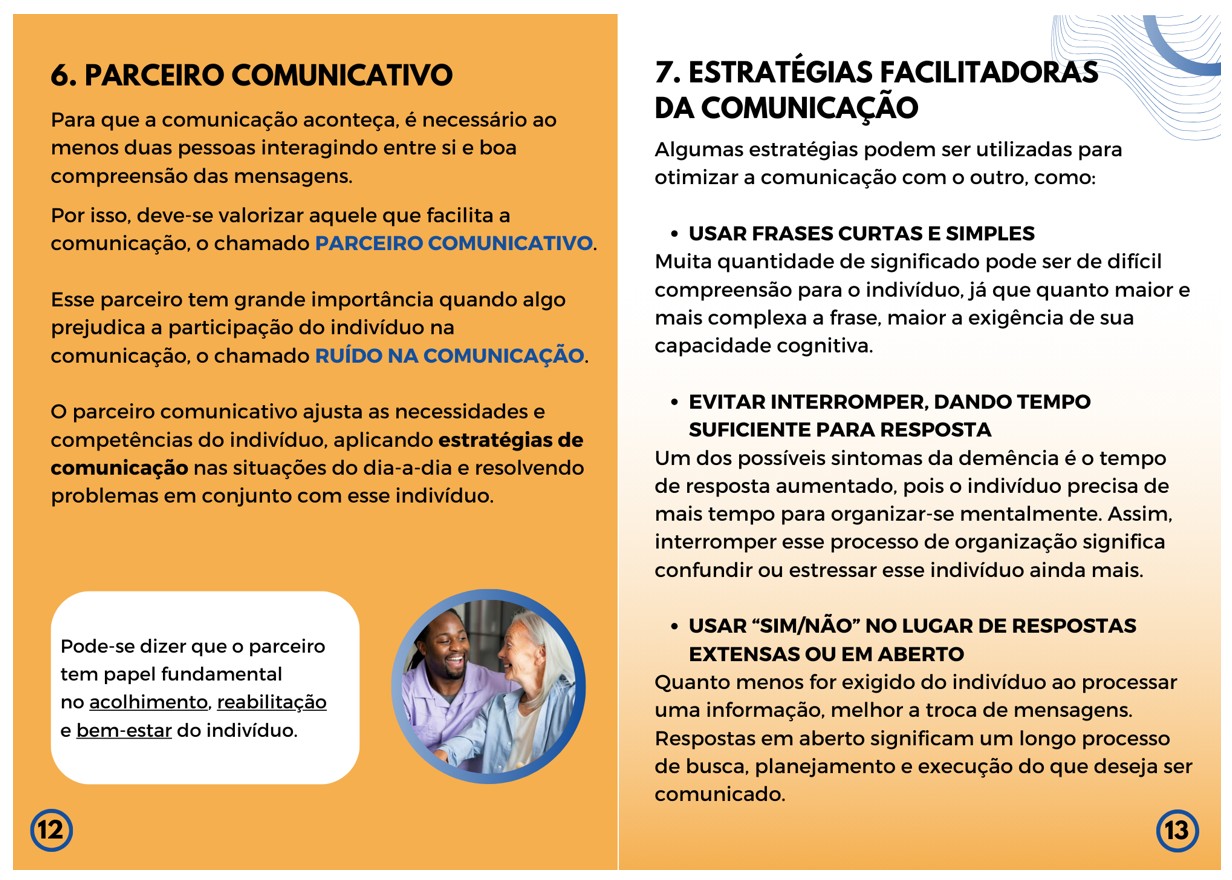
The second guide addressed the same topics as the first, but with an additional chapter about hearing aid use and care (Figure 4). Both guides covered topics about the main cognitive complaints related to advanced age, hearing loss, dementia, communication, communication partners, and cognitive stimulation. They also addressed strategies for improving communication with patients with hearing loss and cognitive impairment (Figure 5). The main cognitive complaints common to advancing age were described in the guides’ second topic. They were related to difficulties in storing information and remembering facts and events, such as well-known peoples’ names or important appointments, forgetting to take medication, not remembering where personal objects are, forgetting the stove or the iron on, difficulties remembering words, using vague terms such as “things” and “that”. There were also common complaints about difficulties in hearing or understanding speech and conversations in noisy environments, difficulty talking to people who speak too quickly or too quietly, the need to turn up the television or radio volume to hear well, difficulty talking when they are not facing the other person, and not hearing when they are called from a distance, from another room in the house, or across the street.
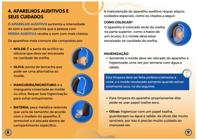
Chapter “Hearing aids and their maintenance” of the Guide to Communication and Hearing Aid Use for Patients and Companions

Chapters “Communicative Partner” and “Communication-Facilitating Strategies” of the Communication Guide for Patients and Companions
Concerning hearing loss, the guides’ third topic describes the gradual loss of sound perception. This results in the need for more intense stimuli to perceive and understand speech, thus making communication harder. They also cover the main influences of aging on hearing loss, such as long-term noise exposure, harmful agents, illnesses, and medical treatments. In addition, information on hearing loss unrelated to aging was included, such as in cases of intense and prolonged noise exposure and accidents, and illnesses that affect hearing.
In the guide for patients fitted with hearing aids, the fourth topic, “hearing aids and their maintenance”, is located after the hearing loss section. The topic contains information on how hearing aids work, their main components - earmold, dome, microtube/hose, and battery - and special care related to hygiene and how to use the device. It also explains how long it takes to change the accessories, such as earmolds, domes, tubes, and hoses. It addresses general precautions as well, such as avoiding falls and shocks against hard surfaces, storing the device in its box, in a dry, moisture-free place, leaving the battery compartment open whenever the device is not in use to keep it charged, not getting the device wet, taking it out before shower, among other relevant measures. Important information about batteries was also included, such as their different types, with varying durations, where and how to buy and dispose of them, and the device’s audible signal when the battery charge is low. Finally, this section deals with specific situations common to hearing aid use, such as how to deal with microphonics (i.e., noise produced and detected by the device) and possible causes of the lack of acoustic signal.
The following topic defines dementia and its manifestation and impact on the person's life, and highlights the relationship between hearing loss and cognitive decline. Finally, the main communication difficulties that dementia causes were presented, such as “solid thinking” (i.e., difficulties understanding abstract, imaginary, or hypothetical concepts), increased response time, memory difficulties, sensory deficits, attentional failures, and difficulties in remembering words and in processing two or more tasks at the same time.
They also addressed the concept of communication and how the quality of this interaction is favored or hindered, especially regarding hearing and cognitive difficulties, which generate noise and communication failures. Also, the communicative context was discussed, such as noisy environments, low or whispered voice intensity, speech muffled by a mask or glass, distance between the speaker and interlocutor. A communication partner section was included to clarify their role in communication and group counseling sessions.
In addition, the subsequent topic included strategies to facilitate communication. Some of them refer to ways to facilitate their understanding, such as using short and simple sentences, since long and complex information makes it difficult to understand due to greater demand on their cognitive capacity; using “yes” and “no” instead of long or open-ended answers, since open-ended answers require a long process of searching, planning, and executing what they are to communicate; repeating messages with the same or different words as the first time, according to what is most effective, recognizing that cognitive difficulties can cause important information loss, causing the need to repeat the message so it can be properly processed; asking one question/making one request at a time, since fewer commands carry less meaning, helping them memorize and understand the message; speaking slowly, since accelerated speech requires attention and agility to process the message, which are possible difficulties for individuals with cognitive impairment.
Strategies relating to the person’s expression were also included, such as avoiding interrupting and providing sufficient time to respond, as one of the possible symptoms of dementia is increased response time due to the person's greater need for time for mental organization. Another strategy is to ask for a description of the word the individual is looking for, since lexicon access is favored by retrieving different aspects related to the word, such as its characteristics, meaning, function, among others.
Furthermore, environmental adaptations were discussed to encourage communication, such as avoiding possible distractions, like television, radio, and others, given the possible concentration difficulties characteristic of dementia; speaking in front of the other person, establishing eye contact, recognizing that vision supports communication through facial expressions and mouth movements, among other aspects.
The last section dealt with information on cognitive stimulation, such as its principles, functions, and determinants for a good result, namely life experiences, genetics, education, and practice of social and leisure activities.
The main adjustment was the text layout, close to what is physiologically and cognitively expected for eye movement during reading, thus favoring word decoding. Paragraphs were aligned to the left, words were not segmented, and long words were avoided. In addition, priority was given to material predictability to make it easier to locate the aimed content and facilitate learning. As a result, the content was clearly and intuitively signposted, highlighting titles to the detriment of secondary texts. They also included a summary, page numbers, and boxes to review subjects previously addressed. Furthermore, components were positioned conventionally, such as titles at the top of the page, page numbering at the bottom edge, and images next to the related text, favoring the handling of the material and location in the text.
In addition, the layout was designed to be comfortable and easy for people with possible cognitive and visual impairments, since both frames represent challenges for memorizing information. For this reason, contrasting colors were selected for the text and background, as well as an increased text size. The amount of content per page was also limited, reducing the possibility of confusing the reader.
Finally, images and illustrations were placed close to the relevant content. Thus, the graphic support is instinctively visualized and reinforces the subject. Also, its location on the page favors the search for specific topics.
DISCUSSION
Despite the modifiable nature of hearing loss as a risk factor for dementia, adherence to its treatment faces several barriers, ranging from socioeconomic factors to complex determinants inherent to the fitting process(5,10). Moreover, hearing rehabilitation in people with dementia has its challenges, considering difficulties in assessing, fitting, and monitoring patients with this comorbidity(19). The proficiency degree in handling the hearing aid, the perception of positive consequences of using the device, the comfort degree or adjustment of the hearing aid, person-environment interactions, and social reinforcement are all factors that influence the effective use of hearing aids by people with dementia(8). The user's support network and the caregiver's understanding of the person's health status also interfere with treatment adherence, easing stress and care burden, favoring the patient’s and caregiver’s quality of life(6,8).
Allied to hearing rehabilitation, cognitive stimulation is another important method for treating cognitive decline, since the dementia syndrome's impact on the individual is directly influenced by their cognitive state before impairment(2). This highlights the cognitive stimulation benefits in delaying, mitigating, or avoiding cognitive decline impacts(7).
Health education tools are needed to help counsel patients and their families, facilitate communication, and minimize difficulties in retaining information. To this end, communication strategies facilitate this process on a daily basis until they have access to hearing aids and favor adaptation to the device. In addition, the printed material provides the individual and their companion with more autonomy to learn about a particular subject without the health professionals' presence. There is also the possibility of reinforcement and quick access for consultation, encouraging self-care(13). Therefore, informative materials are important for users to properly understand aspects of their treatment and are a determining factor in the intervention's success.
The adequacy of health education material used as support for guidance and counseling has an important relationship with performance in care activities and hearing aid use, as well as lower demand for repetition of instructions and users' ability to solve problems. It is also important that the content, design, and readability of health materials match the reader’s cognitive level and socioeconomic and cultural background(14). This highlights the challenges in developing printed material adapted to older people with cognitive and hearing impairment. Besides the lack of health information materials in the literature aimed at this specific audience, effectively transmitting this information to these patients is complex due to their frequent memory and attention difficulties. Furthermore, providing information that is easy for them to understand is challenging due to the cognitive difficulties involved in understanding complex topics, such as hearing and cognitive health literacy.
Thus, the communicative partner’s role is essential for managing the material developed, highlighting the importance of counseling in treatment. The results in the literature demonstrate that the population may benefit from learning strategies that aim to improve the ability to handle hearing aids. In addition, communicative partners' awareness and instruction favor rehabilitation, given the patient’s difficulty in appropriating and memorizing new information about the treatment. Thus, caregiver education can decrease stress and delay institutionalization, becoming a prevention tool that can mitigate healthcare costs inherent to dementia, hospitalization, and even morbidity and mortality(12).
Guidance and counseling are important elements for individuals with hearing loss and cognitive decline. This is due to influential factors in hearing rehabilitation with hearing aids and difficulties that cognitive impairment can impose on the process. Treating these conditions includes providing information, awareness, and training to manage these changes(2); these services were made available in the communication guides developed in this study. Furthermore, counseling was included as a minimum requirement in rehabilitation services, since lack of knowledge about these conditions leads to a deficit in the search for treatment and, therefore, worse prognosis(20). Thus, this material can also be used to promote information to the population waiting for specialized care, a common scenario in the Brazilian national public health system(21).
Since the proficiency in handling hearing aids impacts adherence to hearing rehabilitation in individuals with dementia, the guides were illustrated with the device's components, elucidating its appropriate handling and cleaning.
Communication strategies are a set of attitudes that facilitate visual or auditory reception of the message. Their use by individuals with hearing impairment is evident as another alternative to addressing sensory deficits, regardless of hearing aid use. Communication strategies can be adopted when it is not possible to use hearing aids, or when their use does not generate satisfactory benefits, for example, in acoustically complex situations(22). Therefore, communication strategies aim to improve communication, person-environment interaction, and the communicators' well-being through instruction, thus relieving overload and general stress.
The materials developed have already been used in group sessions, but their application outcomes and validation are still to be addressed. To date, it can be stated that the guides served their purpose since they were referred to by users and therapists as useful and relevant support for treatment. Applying this tool required monitoring to understand and establish proper handling. Nevertheless, it can be confirmed that the guide's implementation was simple due to easy access and low production cost, involving only printing the material in a printing shop.
CONCLUSION
Individuals with hearing and cognitive difficulties require a variety of care throughout the rehabilitation process. Counseling is an important step in hearing aid fitting, along with the use of communication strategies, which can have a positive impact on adherence to treatment. In a population that may have greater difficulty recalling the information provided by health professionals (patients with memory deficits and overburdened caregivers), printed educational material is a feasible tool that facilitates treatment.
-
Study carried out at Curso de Fonoaudiologia, Universidade Federal de Minas Gerais – UFMG – Belo Horizonte (MG), Brasil.
-
Data Availability Statement
No research data was used.
-
Funding:
None.
References
-
1 IBGE: Instituto Brasileiro de Geografia e Estatística. PNAD contínua: características gerais dos domicílios e dos moradores 2022 [Internet]. 2022 [citado em 2003 Out 29]. Disponível em: https://biblioteca.ibge.gov.br/visualizacao/livros/liv102004_informativo.pdf
» https://biblioteca.ibge.gov.br/visualizacao/livros/liv102004_informativo.pdf -
2 OMS: Organização Mundial da Saúde. Dementia [Internet]. 2023 [citado em 2003 Out 29]. Disponível em: https://www.who.int/news-room/fact-sheets/detail/dementia
» https://www.who.int/news-room/fact-sheets/detail/dementia -
3 Smid J, Studart-Neto A, César-Freitas KG, Dourado MCN, Kochhann R, Barbosa BJAP, et al. Declínio cognitivo subjetivo, comprometimento cognitivo leve e demência - diagnóstico sindrômico: recomendações do Departamento Científico de Neurologia Cognitiva e do Envelhecimento da Academia Brasileira de Neurologia. Dement Neuropsychol. 2022;16(3 Suppl 1):1-24. http://doi.org/10.1590/1980-5764-dn-2022-s101en PMid:36533160.
» http://doi.org/10.1590/1980-5764-dn-2022-s101en -
4 Lin FR, Pike JR, Albert MS, Arnold M, Burgard S, Chisolm T, et al. Hearing intervention versus health education control to reduce cognitive decline in older adults with hearing loss in the USA (ACHIEVE): a multicentre, randomised controlled trial. Lancet. 2023;402(10404):786-97. http://doi.org/10.1016/S0140-6736(23)01406-X PMid:37478886.
» http://doi.org/10.1016/S0140-6736(23)01406-X -
5 Mukadam N, Sommerlad A, Huntley J, Livingston G. Population attributable fractions for risk factors for dementia in low-income and middle-income countries: an analysis using cross-sectional survey data. Lancet Glob Health. 2019;7(5):e596-e603. http://doi.org/10.1016/S2214-109X(19)30074-9 PMid:31000129.
» http://doi.org/10.1016/S2214-109X(19)30074-9 - 6 El-Wahsh S, Monroe P, Kumfor F, Ballard KJ. Communication interventions for people with dementia and their communication partners. In Lee-Fay L, Laver K, editors. Dementia rehabilitation: evidence-based interventions and clinical recommendations. Cambridge: Academic Press; 2021. p. 35-56.
- 7 Gonçalves LF, De Paiva KM, André PRPS, Samelli A, Haas P. Perda auditiva e função cognitiva em idosos: uma revisão sistemática. Rev Neurocienc. 2023;31:1-20.
-
8 Hooper E, Brown LJE, Cross H, Dawes P, Leroi I, Armitage CJ. Systematic review of factors associated with hearing aid use in people living in the community with dementia and age-related hearing loss. J Am Med Dir Assoc. 2022;23(10):1669-675.e16. http://doi.org/10.1016/j.jamda.2022.07.011 PMid:35988590.
» http://doi.org/10.1016/j.jamda.2022.07.011 -
9 Suemoto CK, Mukadam N, Brucki SMD, Caramelli P, Nitrini R, Laks J, et al. Risk factors for dementia in Brazil: differences by region and race. Alzheimers Dement. 2023;19(5):1849-57. http://doi.org/10.1002/alz.12820 PMid:36326095.
» http://doi.org/10.1002/alz.12820 -
10 Watson J, Coleman E, Jackson C, Bell K, Maynard C, Hickson L, et al. Randomised controlled feasibility trial of an active communication education programme plus hearing aid provision versus hearing aid provision alone (ACE To HEAR). BMJ Open. 2021;11(4):e043364. http://doi.org/10.1136/bmjopen-2020-043364 PMid:33827834.
» http://doi.org/10.1136/bmjopen-2020-043364 -
11 Caramelli P, Marinho V, Laks J, Coletta MVD, Stella F, Camargos EF, et al. Tratamento da demência: recomendações do Departamento Científico de Neurologia Cognitiva e do Envelhecimento da Academia Brasileira de Neurologia. Dement Neuropsychol. 2022;16(3 Suppl 1):88-100. http://doi.org/10.1590/1980-5764-dn-2022-s106en PMid:36533154.
» http://doi.org/10.1590/1980-5764-dn-2022-s106en -
12 Marquete VF, Chaves TA, Barreto SS. A efetividade da terapia fonoaudiológica no nível discursivo: estudo de caso de distúrbio linguístico-cognitivo na demência. CoDAS. 2021;33(2):e20200023. http://doi.org/10.1590/2317-1782/20202020023 PMid:34008775.
» http://doi.org/10.1590/2317-1782/20202020023 - 13 Sá GGM, Silva FL, Santos AMRD, Nolêto JDS, Gouveia MTO, Nogueira LT. Technologies that promote health education for the community elderly: integrative review. Rev Lat Am Enfermagem. 2019;27:e3186. PMid:31618386.
-
14 Nakamura MY, Almeida K. Desenvolvimento de material educacional para orientação de idosos candidatos ao uso de próteses auditivas. Audiol Commun Res. 2018;23:e1938. http://doi.org/10.1590/2317-6431-2017-1938
» http://doi.org/10.1590/2317-6431-2017-1938 -
15 Delfino LL, Cachioni M. Estratégias comunicativas de cuidadores de idosos com demência: uma revisão sistemática. J Bras Psiquiatr. 2016;65(2):186-95. http://doi.org/10.1590/0047-2085000000122
» http://doi.org/10.1590/0047-2085000000122 -
16 UFMG: Universidade Federal de Minas Gerais. GRAO-UFMG: Grupo de Reabilitação Auditiva e Orientações da UFMG. Guia para usuários de prótese auditiva e para os parceiros comunicativos [Internet]. Belo Horizonte: Faculdade de Medicina, UFMG; 2020 [citado 2023 Nov 12]. Disponível em: https://www.medicina.ufmg.br/fon/wp-content/uploads/sites/26/2020/11/cartilha_usu%C3%A1rio_aparelhosauditivos-05-11-2020.pdf
» https://www.medicina.ufmg.br/fon/wp-content/uploads/sites/26/2020/11/cartilha_usu%C3%A1rio_aparelhosauditivos-05-11-2020.pdf -
17 Araújo ALF, Oliveira AJD, Melo DCS, Braga TC, Nicácio AMF, Machado TH. Manual da afasia [Internet]. Belo Horizonte: Faculdade de Medicina, UFMG; 2023 [citado 2023 Nov 29]. Disponível em: https://www.medicina.ufmg.br/fon/wp-content/uploads/sites/26/2023/06/Manual-estimulacao-para-impressao.pdf
» https://www.medicina.ufmg.br/fon/wp-content/uploads/sites/26/2023/06/Manual-estimulacao-para-impressao.pdf -
18 REIS: Rede Empresarial de Inclusão Social. Guia REIS de comunicação inclusiva e acessível [Internet]. 2021 [citado em 2023 Nov 12]. Disponível em: https://www.redeempresarialdeinclusao.org.br/wp-content/uploads/2025/02/Guia-de-Comunicacao-Inclusiva-e-Acessivel-2021.pdf
» https://www.redeempresarialdeinclusao.org.br/wp-content/uploads/2025/02/Guia-de-Comunicacao-Inclusiva-e-Acessivel-2021.pdf -
19 Kricos PB. Providing hearing rehabilitation to people with dementia presents unique challenges. Hear J. 2009;62(11):39-40. http://doi.org/10.1097/01.HJ.0000364275.44847.95
» http://doi.org/10.1097/01.HJ.0000364275.44847.95 - 20 Wieselberg M, Sousa M. Aconselhamento na reabilitação audiológica. In: Lopes O Fo, editor. Novo Tratado de Fonoaudiologia. São Paulo: Manole; 2013. p. 413-25.
-
21 Gonçalves RF, Giovanini AF, Nascimento GB, Isolan GR, Sigwalt MF, Polanski JF. Impacto da utilização da teleneurologia na redução de encaminhamentos no Sistema Único de Saúde. SciELO Prep. 2023. No prelo. http://doi.org/10.1590/SciELOPreprints.7701
» http://doi.org/10.1590/SciELOPreprints.7701 -
22 Ross LA, Saint-Amour D, Leavitt VM, Javitt DC, Foxe JJ. Do you see what i am saying? exploring visual enhancement of speech comprehension in noisy environments. Cereb Cortex. 2006;17(5):1147-53. http://doi.org/10.1093/cercor/bhl024
» http://doi.org/10.1093/cercor/bhl024
Edited by
-
Editor-in-Chief:
Maria Cecília Martinelli.
-
Associate Editor:
Ana Cláudia Mirândola Barbosa Reis.
No research data was used.

 Source: The author
 Source: The author
 Source: The author
 Source: The author
 Source: The author