 Reduction in self-perceived vocal effort after photobiomodulation in a group of women without vocal problems: a brief communication
ABSTRACT
Purpose To present initial results of an ongoing research about the effects of photobiomodulation (PBM) and inactive laser (placebo) on self-perception of vocal effort in women without voice complaints.
Methods The participants were randomly divided in two groups: CG (Control Group - inactive laser); EG (Experimental Group - application of 9J per point of low-intensity laser in infrared wavelength). Vocal samples were recorded according to the CAPE-V protocol, numbers (1-20) and months of the year. During these tasks, the participants were guided to realize their self-perception of vocal effort, that was measured using the Borg CR10-BR Scale adapted for vocal effort applied before and after each intervention. Descriptive and inferential statistics were performed. The Shapiro-Wilk test didn't confirm the normality of the data, so the Wilcoxon test was used for intra and inter group comparisons (p-value<0.05).
Results The total sample was composed of 20 women (18-45 years old), without voice complaints, with mean age of 28,6 years (SD=6,71) in the CG and 27,1 (SD=6,57) in the EG. CG showed a significant mean reduction in BORG scale scores (p=0.031) between pre and post intervention, as did EG (p=0.020). There was no statistically significant difference in the comparison between the two groups.
Conclusion There was a general reduction in the self-perceived vocal effort in the pre and post intervention for both groups. A placebo effect was observed in the CG. No one reported a worsening of self-perceived vocal effort after PBM.
Keywords:
Speech, language and hearing sciences; Voice; Low-level light therapy; Laser therapy; Placebo effect
RESUMO
Objetivo Apresentar resultados iniciais de uma pesquisa em andamento sobre os efeitos da fotobiomodulação e do laser inativo (placebo) na autopercepção do esforço vocal em mulheres sem queixa vocal.
Métodos Participantes divididas aleatoriamente em dois grupos: grupo-controle - laser inativo; grupo experimental - 9J por ponto do laser de baixa intensidade em λ infravermelho. Amostras vocais foram gravadas de acordo com tarefas do Consensus Auditory-Perceptual Evaluation of Voice, números (1-20) e meses do ano. Nesses momentos, as participantes foram orientadas a perceber possível sensação de esforço em suas vozes, medida posteriormente pela Escala Borg CR10-BR adaptada para esforço vocal, aplicada antes e depois das intervenções. Realizou-se estatística descritiva (média e frequência de ocorrência das variáveis analisadas) e estatística inferencial. O teste de Shapiro-Wilk não evidenciou padrão de normalidade dos dados e o teste de Wilcoxon foi realizado para a comparação intra e intergrupos (p-valor<0.05).
Resultados Amostra foi composta por 20 mulheres (18-45 anos) sem queixa vocal autorreferida; média de idade para o grupo-controle 28 anos e 6 meses e grupo experimental 27 anos e 1 mês). O grupo-controle apresentou redução média significativa dos escores da escala BORG (p=0,031) entre momentos pré e pós-intervenção, assim como o grupo experimental (p=0,020). Não houve diferença estatisticamente significativa na comparação entre os grupos.
Conclusão Houve redução do esforço vocal autopercebido nos momentos pré e pós-intervenção para ambos os grupos. Foi observado efeito placebo no grupo-controle. Nenhuma participante referiu aumento do esforço vocal após a fotobiomodulação.
Palavras-chave:
Fonoaudiologia; Voz; Terapia com luz de baixa intensidade; Terapia a laser; Efeito placebo
INTRODUCTION
Photobiomodulation (PBM) is a phototherapy technique involving light amplification by stimulated emission of radiation (laser), which generates photophysical, photochemical, and photobiological effects(1). It helps reduce inflammation and edema, repair tissues, enhance muscle performance(1), and reduce fatigue(2). Additionally, it is a non-invasive, non-drug(1), and non-volitional voice therapy instrument(3).
Fatigued muscles consume more oxygen(4). Since PBM acts at the mitochondrial level, stimulating the production of adenosine triphosphate and oxygen, it is assumed that it can reduce vocal fatigue(5). Women’s smaller vocal folds, higher fundamental frequency, and hormonal factors make them more prone to vocal fatigue(6), posing a risk for vocal problems(7). Therefore, it is necessary to investigate the efficacy of ingredients such as PBM used in voice therapy with women without self-reported vocal problems.
There is no consensus on the indication of PBM for vocal habilitation or rehabilitation in any gender. Nonetheless, patients repeatedly seek it, and speech-language-hearing pathologists specializing in voice consider it promising and choose to use it, even in the absence of evidence(8,9).
Investigating the effects of PBM in individuals without self-reported voice problems may support future studies with people with problems. This population would improve self-perceived vocal effort, as the laser modulates metabolic processes and increases resistance to fatigue in a shorter recovery time(8,9). Therefore, this brief communication presents preliminary results of the effects of PBM on self-perceived vocal effort in women without self-reported voice problems, aiming to promote evidence for its safe use.
METHODS
Study design
Experimental, randomized, blind, ongoing study, approved by the Ethics Committee of the Speech-Language-Hearing Clinic of the State University of Campinas (Unicamp) (approval no. 5,563,711). It followed the guidelines of the Consolidated Standards of Reporting Trials (CONSORT)(10). The participants signed an informed consent form.
Research setting
Data collection took place at Unicamp’s Speech-Language-Hearing Clinic. All stages were carried out in a single day.
Subjects
The non-probabilistic sample was selected for convenience and, subsequently, by the snowball method. The study comprised 20 women without self-reported voice problems, aged 18 to 45 years. Age was limited to minimize the effects of menopause and aging. Women with thyroid or hormonal changes, flu-like symptoms, upper airway allergies on the day of the intervention, and contraindications for phototherapy were excluded(5).
Instruments
A sociodemographic questionnaire collected personal information. The study also used the Borg CR10-BR Scale adapted for vocal effort(11), developed in English, adapted and validated for Brazilian Portuguese, to measure the participants' self-perception of vocal effort before and after each intervention. The scale ranges from 0 to 10 (no vocal effort-maximum vocal effort). Only one researcher had access to the voice samples and Borg Scale scores.
The voices were recorded in an acoustically controlled booth with ambient noise of 30 dB, directly on a desktop computer with a Tascam sound card and a Shure SM-58 unidirectional microphone, using Praat software. The tasks included emissions from the Consensus Auditory-Perceptual Evaluation of Voice (CAPE-V) protocol(12) (three sustained vowels [a] and phonetically balanced phrases), numbers (1-20), and months of the year. Participants were instructed to observe their vocal effort in the voice recording tasks. Analysis of the recordings is part of the later stages of this study.
Procedures
A person unrelated to the research divided the participants randomly by drawing lots: CG (control group - laser application turned off) and EG (experimental group with laser application). The research was carried out in three stages:
Stage 1: Voice recording in an acoustic booth, according to CAPE-V tasks, numbers (1-20), and months of the year, and the Borg CR10-BR Scale adapted for vocal effort(11).
Stage 2: Laser application with a DMC device, model Therapy EC, with 100 mW/0.028 cm2 (equipment on for EG and off for CG). The participants were positioned in the supine position on a stretcher in a quiet room and instructed not to swallow, speak, or cough. Their larynges were palpated to mark the application points: one on each lamina of the thyroid cartilage in each hemilarynx (to reach the level of the vocal folds) and one on the laryngeal prominence (Figure 1)(5).
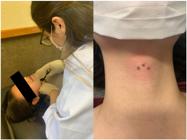
The researchers applied 9J per point. This dosimetry, recommended for small muscles(5), can improve the performance of those in this region(8). The infrared wavelength was used for a greater light-tissue range in point contact on the thyroid lamina(5). The same application steps were followed for both the EG and the CG.
Stage 3: The voices were recorded in an acoustic booth with the same tasks as in Stage 1, and the Borg CR10-BR Scale adapted for vocal effort was reapplied.
Data analysis
The researchers renamed and stored the voice samples on a storage platform, tabulated the Borg Scale scores in a spreadsheet, and performed descriptive and inferential statistics. The Shapiro-Wilk test did not attest to the normality of the data; hence, the Wilcoxon test (nonparametric) was used for intragroup and intergroup comparisons (p-value < 0.05). The SPSS v.26 (2019), Minitab 21.2 (2022), and Excel Office 2010 software were used.
RESULTS
The sample characterization is presented in Table 1. No participant was excluded after randomization.
General characterization of the sample according to age, occupational voice use, and previous otorhinolaryngological examination (N = 20)
Six participants had their larynx examined in the previous year. Only one had an alteration, diagnosed with vocal fold asymmetry to the right and a smaller sulcus vocalis on the right. This participant also had no self-reported voice problems.
The intergroup comparison (EG + CG) before and after the intervention found a significant difference, indicating a reduction in self-perceived vocal effort. However, there was no significant difference in the intragroup analysis (Table 2).
Comparison of self-perception of vocal effort measured by the BORG CR10-BR Scale adapted for vocal effort between and within the experimental and control groups before and after the intervention
DISCUSSION
EG’s Borg Scale scores were statistically different, indicating a reduction in the sensation of vocal effort after PBM, validating the study hypothesis. The CG also had a reduction, indicating a possible placebo effect.
The placebo and Hawthorne effects may overlap(13). The intervention context, the professional-patient relationship(14), the expectation about the new therapeutic modality(14), and the application positioning may justify the placebo effect. However, the Hawthorne effect cannot be ruled out since most participants were health professionals, who wanted to contribute to the results (selection bias), knew they were being observed, and responded to the same scale twice (observation bias)(13).
Although both groups’ median scores decreased after the intervention, indicating similar overall improvement, analysis of the means showed a more pronounced reduction, suggesting extreme values after the intervention. Thus, some participants responded more intensely, but the improvement was not homogeneous across the sample, with a greater perception of change in the EG than in the CG.
The dosimetry and application technique may have allowed the verification of beneficial effects in the EG(5). No one reported voice worsening after PBM, reinforcing that prior PBM training and knowledge of the vocal tract are fundamental to opt for the correct dosimetry and achieve positive results(15).
A study with PBM carried out over a month with weekly sessions in women without voice problems observed improved voice quality and acoustic indices of the Acoustic Voice Quality Index (AVQI) only after the third application, showing good long-term results(2). As it is a longitudinal study, the interface of these results with the findings of the present research requires caution. However, there are no available studies investigating the immediate effects of PBM on self-perceived vocal effort.
This brief communication suggests that PBM immediately improves self-perceived vocal effort after a habitual speaking task. The available study(2) complements these findings and proposes its safe use in situ when clients have already used their voices and will continue to use it, needing to reduce the sensation of effort. PBM can aid recovery after intense vocal use with little or no break. However, healthy vocal habits and lifestyle are irreplaceable.
Although vocal intensity was not controlled in the recordings, the participants' self-perception of the basic aspects of their voices stands out. For this reason, the recordings were made at their usual speaking intensity, although vocal effort can also be assessed in high-demand tasks. Limitations include the lack of control over voice use, the time of day of recording, the small sample size, the recruitment method, and the lack of an otorhinolaryngological diagnosis, which could help understand the effects of PBM on the larynx.
CONCLUSION
All groups’ self-perceived vocal effort decreased after the interventions. Larger samples are recommended to compare the effects of PBM and placebo. No participant reported an increase in self-perceived effort, proving the safe use of PBM following the mentioned specifications.
ACKNOWLEDGMENTS
We thank CAPES for the financial support (88887.688511/2022-00).
-
Study carried out at Universidade Estadual de Campinas – Unicamp – Campinas (SP), Brasil.
-
Data Availability Statement
Research data is only available upon request.
-
Funding:
Fundação Coordenação de Aperfeiçoamento de Pessoal de Nível Superior (CAPES) (88887.688511/2022-00).
References
-
1 Crow JA, Stauffer JW, Levine D, Dale D, Borsa PA. Therapeutic photobiomodulation before strenuous exercise attenuates shoulder muscle fatigue. J Athl Train. 2024;59(7):724-30. http://doi.org/10.4085/1062-6050-0171.23 PMid:38015822.
» http://doi.org/10.4085/1062-6050-0171.23 -
2 Kagan LS, Heaton JT. The effectiveness of low-level light therapy in attenuating vocal fatigue. J Voice. 2017 Maio;31(3):384.e15-23. http://doi.org/10.1016/j.jvoice.2016.09.004 PMid:27839705.
» http://doi.org/10.1016/j.jvoice.2016.09.004 - 3 Batista DJ, Lopes LW, Almeida AA, Siqueira LTD, Ribeiro VV. What factors determine the use of volitional and non-volitional devices in vocal interventions performed by Brazilian Speech-Language Pathologists? J Voice. 2023. No prelo. PMid:37957072.
-
4 Vasquez-Bonilla A, Yáñez-Sepúlveda R, Tuesta M, Martín E, Monsalves-Álvarez M, Olivares-Arancibía J, et al. Acute fatigue impairs heart rate variability and resting muscle oxygen consumption kinetics. Appl Sci. 2024;14(20):9166. http://doi.org/10.3390/app14209166
» http://doi.org/10.3390/app14209166 - 5 Balata PMM, Bastos RSA, Cunha MD, Silva HJ. Fotobiomodulação na clínica vocal. In: Mouffron V, Alves GA, Motta AR, Silva HJ, editores. Fotobiomodulação aplicada à fonoaudiologia. Carapicuíba: Pró Fono; 2022. p. 284-98.
-
6 Hunter E, Maxfield L, Graetzer S. The effect of pulmonary function on the incidence of vocal fatigue among teachers. J Voice. 2020;34(4):539-46. http://doi.org/10.1016/j.jvoice.2018.12.011 PMid:30686633.
» http://doi.org/10.1016/j.jvoice.2018.12.011 -
7 Azari S, Shavaki YA, Ghelichi L, Moossavi A, Saneii S. Voice handicap index in Iranian rehabilitation professors with and without vocal complaints. Middle East J Rehabil Health Stud. 2022 Jul;9(3):e121048. http://doi.org/10.5812/mejrh-121048
» http://doi.org/10.5812/mejrh-121048 -
8 Pontes ES, Vaiano TG, Bastos RSA, Lopes LW. Opinião de fonoaudiólogos sobre uso da fotobiomodulação na clínica vocal. CoDAS. 2023;35(6):e20220060. http://doi.org/10.1590/2317-1782/20232022060pt PMid:37729333.
» http://doi.org/10.1590/2317-1782/20232022060pt -
9 Pontes ES, Vaiano TG, Bastos RSA, Duarte JMT, Santana ER, Lopes LW. Fotobiomodulação na habilitação e reabilitação vocal: consenso Delphi baseado em especialistas. CoDAS. 2025;37(2):e20230356. http://doi.org/10.1590/2317-1782/e20230356en PMid:39936808.
» http://doi.org/10.1590/2317-1782/e20230356en -
10 Schulz KF, Altman DG, Moher D. CONSORT 2010 statement: updated guidelines for reporting parallel group randomised trials. BMJ. 2010 Mar 23;340:c332. http://doi.org/10.1136/bmj.c332 PMid:20332509.
» http://doi.org/10.1136/bmj.c332 -
11 Camargo MRMC, Zambon F, Moreti F, Behlau M. Tradução e adaptação cultural e linguística da Adapted Borg CR10 for Vocal Effort Ratings para o português brasileiro. CoDAS. 2019;31(5):e20180112. http://doi.org/10.1590/2317-1782/20192018112 PMid:31691744.
» http://doi.org/10.1590/2317-1782/20192018112 - 12 ASHA: American Speech-Language-Hearing Association. Consensus auditory-perceptual evaluation of voice (CAPE-V). Rockville: ASHA; 2002.
-
13 Berkhout C, Berbra O, Favre J, Collins C, Calafiore M, Paremans L, et al. Defining and evaluating the Hawthorne effect in primary care, a systematic review and meta-analysis. Front Med. 2022 Nov 8;9:1033486. http://doi.org/10.3389/fmed.2022.1033486 PMid:36425097.
» http://doi.org/10.3389/fmed.2022.1033486 -
14 Anderson S, Stebbins GT. Determinants of placebo effects. Int Rev Neurobiol. 2020;153:27-47. http://doi.org/10.1016/bs.irn.2020.03.029 PMid:32563291.
» http://doi.org/10.1016/bs.irn.2020.03.029 - 15 SBFA: Sociedade Brasileira de Fonoaudiologia. Parecer: o uso da fotobiomodulação em Fonoaudiologia. São Paulo: SBFA; 2020.
Edited by
-
Editor-in-Chief:
Renata Mota Mamede Carvallo.
-
Associate Editor:
Leonardo Wanderley Lopes.
Research data is only available upon request.

 Source: The authors