 The electronic search for the terms vape and hoarseness in Brazil: an infodemiological study
ABSTRACT
Purpose To verify the interest of the Brazilian population in online searches for the terms “vape” and “hoarseness.”
Methods This quantitative infodemiological study utilized data from Google Trends to analyze web searches for “vape” and “hoarseness.” The data were collected on July 2, 2024, and normalized as Relative Search Volume (RSV) on a scale from zero to 100. Statistical analysis was conducted using JAMOVI 2.3.28 and R 4.2.3 software. The Shapiro-Wilk test was used to verify data normality, and the correlation between variables was analyzed using Spearman's test. The Mann-Kendall trend test was applied to identify trends in the time series, with a significance level of 5%.
Results The highest search peak for the term “vape” occurred in December 2021 (100 RSV), and for “hoarseness” in June 2022 (22 RSV). There was a higher search volume for “vape” (25.9 ± 21.6 RSV) than for “hoarseness” (3.87 ± 3.77 RSV) over the time series. A significant upward trend was observed for both terms, with strong growth for “vape” (Tau = 0.73; p<0.001) and moderate growth for “hoarseness” (Tau = 0.46; p<0.001). There was a significant moderate positive correlation between the co-occurrence of the terms (Spearman's Rho = 0.66; p<0.001).
Conclusion The Brazilian population shows growing interest in “vape,” and the search for this term is related to searches for “hoarseness,” which may suggest concerns about the impact of this device on vocal health.
Keywords:
Vaping; Voice; Infodemiology; Public health; Respiratory tract disease
RESUMO
Objetivo verificar o interesse da população brasileira na pesquisa on-line pelos termos “vape” e “rouquidão”.
Métodos estudo infodemiológico quantitativo que utilizou dados do Google Trends para analisar as buscas por “vape” e “rouquidão” na web. Os dados foram coletados em 2 de julho de 2024, normalizados como Volume de Pesquisa Relativa (VPR), em uma escala de 0 a 100. A análise estatística foi conduzida nos softwares JAMOVI 2.3.28 e R 4.2.3. O teste de Shapiro-Wilk foi utilizado para verificar a normalidade dos dados e a correlação entre as variáveis (Rho) foi analisada pelo teste de Spearman. O teste de tendência de Mann-Kendall foi aplicado para identificar tendências na série temporal (Tau), com um nível de significância de 5%.
Resultados o maior pico de busca pelo termo “vape” ocorreu em dezembro de 2021 (100 VPR) e pelo termo “rouquidão” em junho de 2022 (22 VPR). Houve um volume de busca maior por “vape” (25,9 ± 21,6 VPR) do que por “rouquidão” (3,87 ± 3,77 VPR) ao longo da série temporal. Observou-se uma tendência de crescimento significativo dos termos, com forte crescimento para “vape” (Tau de 0,73; p<0,001) e moderado para “rouquidão” (Tau de 0,46; p<0,001). Verificou-se correlação positiva significativa de grau moderado na coocorrência entre os termos (Rho de Spearman = 0,66; p<0,001).
Conclusão a população brasileira demonstra um interesse crescente pelo vape e a busca por esse termo tem relação com a busca por “rouquidão”, o que pode sugerir preocupações com o uso desse dispositivo para a voz.
Palavras-chave:
Vaping; Voz; Infodemiologia; Saúde pública; Doenças respiratórias
INTRODUCTION
In Brazil, despite the ban on advertising, commercialization, and importation(1), the use of electronic smoking devices continues to rise, particularly among adolescents and young adults. The Pan American Health Organization (PAHO) and the World Health Organization (WHO) monitor the scientific developments concerning the consumption of vaping devices to support national regulatory efforts. One of the population’s frequent questions concerns the risks of vaping compared to traditional cigarettes. These organizations emphasize that the product’s toxicity should not be the sole focus(2).
These battery-powered devices heat a liquid to produce an inhalable aerosol and are marketed under various names, such as electronic cigarettes, vapes, and mods(3). Despite the exponential growth in the popularity of vaping, considerable uncertainty remains regarding its potential health risks compared to conventional smoking. Health education about the harms of vaporization is essential, especially for young people and adults who use this new model of nicotine consumption(4).
Inhaling the chemical substances released by electronic smoking devices can lead to alterations in different systems and organs of the body, in addition to triggering inflammatory processes(5). However, the long-term adverse effects remain unclear, as they may take years to become evident(5). The severity of these outcomes has been demonstrated by reports of serious respiratory injuries associated with electronic cigarette use, which have prompted investigations and coordinated actions by health authorities in various regions(6).
These respiratory alterations, in turn, may impair vocal functionality and affect the control of the pulmonary aerodynamic and myoelastic relationship of the larynx. A systematic review(7) observed that in four studies, including pulmonary function tests during voice assessment, previously undiagnosed respiratory diseases were identified. Furthermore, a meta-analysis confirmed that smoking produces moderate and significant effects on fundamental frequency and maximum phonation time, reinforcing the association between the inhalation of substances and vocal changes(8).
When seeking specialized care, individuals who report complaints related to vocal quality frequently use terms such as “hoarseness” and “aphonia” to describe their symptoms(9). In this context, it is the responsibility of the speech-language pathologist and/or the otolaryngologist to investigate the underlying factors contributing to these changes, taking into account both organic and functional aspects. Given the relationship between respiratory health and vocal functionality, understanding the impact of inhaled substances, such as those present in electronic smoking devices, becomes essential for the assessment and clinical management of these patients.
Thus, investigating the adverse effects of vaping on voice is essential to raising user awareness and addressing common concerns arising in vocal clinical practice. Accordingly, the objective of this study was to examine the Brazilian population’s interest in online search using the terms “vape” and “hoarseness.”
METHODS
This is an infodemiological, observational study with a quantitative approach, conducted using Google Trends™ with the aim of analyzing user search behavior for specific information(10). This analytical tool employs advanced algorithms to process large volumes of Google search data and is widely used in infodemiology and infoveillance studies within the field of public health. To perform searches on this platform, a limited number of terms is required an inherent constraint of the tool. Therefore, it is recommended to select broad and popular terms, which are pre-tested, prioritizing those with the highest search volumes, that is, the most frequently queried terms. Google Trends data are publicly accessible, and this type of study does not require approval by a research ethics committee.
For data collection, the following search terms were selected after identifying the synonymous terms with the highest search volume on Google: “vape” and “rouquidão” (hoarseness). The terms were chosen in Portuguese under the web search category. The analysis period ranged from 2014 to 2024. The online search was performed on July 2, 2024.
Google Trends data were presented as normalized Relative Search Volume (RSV), on a scale from 0 to 100, with 100 representing the highest search volume. After the search, the information was downloaded in CSV (Comma-Separated Values) format and organized in a Microsoft Excel spreadsheet. Data analysis was performed using JAMOVI software version 2.3.28 and R version 4.2.3. To assess data normality, the Shapiro-Wilk test was applied, and Spearman’s rank correlation test was used to evaluate correlations between variables. The presence of trends in the time series was assessed using the Mann-Kendall trend test. For all inferential analyses, a 5% significance level was adopted.
RESULTS
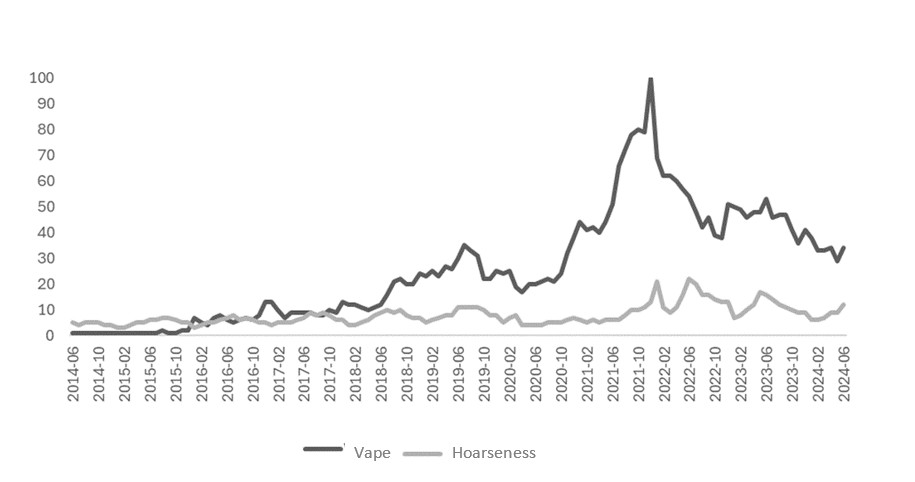
The highest search peak for the term “vape” occurred in December 2021 (100 RSV), and for the term “rouquidão” (hoarseness) in June 2022 (22 RSV). The average search volume over the ten years analyzed was 25.9 ± 21.6 RSV for “vape” and 3.87 ± 3.77 RSV for “rouquidão.”
Figure 1 presents the time series and the search behavior of the Brazilian population for the studied terms. A significant upward trend in RSV was observed. For “vape,” the Mann-Kendall trend test indicated a positive trend – Tau = 0.73; p < 0.001, and for “rouquidão,” Tau = 0.46; p < 0.001. A statistically significant moderate positive correlation was found between the terms analyzed (Spearman’s rho = 0.66; p < 0.001).

DISCUSSION
This infodemiological study found that Google searches for the terms “vape” and “rouquidão” (hoarseness) are correlated, and that search volume increased over the time series analyzed, indicating a growing interest among the Brazilian population.
Regarding tobacco use, although Brazil achieved a 35% relative reduction in tobacco consumption starting in 2010(11), the issue remains a public health challenge. The popularity of vaping has given a new form to an old problem, appearing more appealing to young people due to its design and the absence of lingering odors in the air.
Authors have reported a high global prevalence of both electronic and conventional cigarette use among adults(12), as well as a predominance of electronic cigarette use among youth and adolescents(13). Evidence points to the emergence of a new tobacco use epidemic driven by the growing use of electronic cigarettes(14).
In Brazil, an estimated one million people use electronic smoking devices, with 70% of the sample consisting of individuals aged 15 to 24 who had never used traditional cigarettes(15). In Brazilian capitals, researchers identified a higher prevalence of electronic cigarette use among males with higher education levels and among those reporting abusive alcohol consumption(16).
There are numerous reports of health impacts associated with the use of vapes and electronic cigarettes. Moderate evidence has been found regarding the exacerbation of asthma, coughing, and wheezing in adolescents(17,18), as well as various pulmonary injuries associated with electronic cigarette use(19). A range of oral symptoms has also been observed in vape users(20). In this context, it is known that excessive nicotine use from tobacco, especially when combined with alcoholism, is one of the factors that may lead to the development of head and neck cancers(21). This concern becomes even more prominent when considering that the incidence of laryngeal cancer has increased by 23% worldwide(22).
The most notable search peak for the term “vape” occurred in December 2021, coinciding with the global rise in discussions about vaping-related lung injuries and subsequent warnings issued by public health agencies(23,24). This increased interest likely reflects heightened public concern and extensive media coverage during that period.
Similarly, the peak in searches for the term “rouquidão” (hoarseness) in June 2022 may be attributed to seasonal factors and possibly to heightened public awareness about vocal health issues during the post-pandemic period, when individuals resumed social and occupational activities. A study conducted in France in 2024 identified, through laryngostroboscopic examination, a vocal fold lesion following inhalation of hot vapor from an electronic cigarette(25).
The significant increase in search volume for the term “vape” in Brazil suggests that vaping has become a prominent topic of interest among the Brazilian population. This trend is consistent with international reports highlighting the growing use of electronic cigarettes, particularly among young people(24,26). The implications of this trend are critical for public health initiatives, as the rising interest in vaping calls for enhanced educational campaigns and regulatory measures to mitigate the potential health risks associated with electronic cigarette use.
A study(27) that investigated U.S. media behavior in the context of national anti-tobacco efforts found increased journalistic coverage in 2019. Most of the content consisted of news articles or reports, followed by editorials or opinion pieces in support of the initiative. The most frequently cited arguments in favor of anti-tobacco actions emphasized the urgent need to reduce tobacco use among youth. In contrast, opposing arguments focused on concerns about violations of individual freedom. This study underscores the importance of media engagement in shaping public discourse on tobacco-related topics and its influence on youth consumption.
Regarding the lower and more variable search volume for the term “rouquidão” (hoarseness), this behavior may reflect episodic public concern, possibly related to specific health events or seasonal changes affecting vocal health. The moderate correlation between searches for “vape” and “rouquidão” highlights the need for health professionals to remain vigilant regarding respiratory and vocal symptoms associated with vaping, as users of electronic cigarettes may be at increased risk for developing laryngeal and vocal alterations(28), as well as experiencing vocal health issues.
The methodology of this study, which utilized Google Trends data, proved to be a valuable approach for understanding public interest and search behavior regarding health-related information. However, it is essential to acknowledge the limitations of this approach, which include potential biases in search data and the inability to capture specific demographic perceptions, as well as the challenge of encompassing all the terms used by the population when searching for a given topic. Another limitation inherent to all observational studies—including this infodemiological study—is the inability to determine whether the observed correlations in search behavior are truly causal or merely spurious. Despite these limitations, the study provided a robust overview of trends and correlations in searches for the terms “vape” and “hoarseness,” offering valuable insights for public health professionals and policymakers.
CONCLUSION
The Brazilian population demonstrates a growing interest in vaping, and the search for this term appears to be related to the search for “hoarseness,” which may suggest public concern regarding the impact of vaping on voice quality.
Data Availability Statement:
Funding:
References
-
1 Brasil. Ministério da Saúde. Instituto Nacional de Câncer – INCA. Dispositivos eletrônicos para fumar [Internet]. Brasília: Ministério da Saúde; 2022 [citado em 2024 Jun 3]. Disponível em: https://www.gov.br/inca/pt-br/assuntos/causas-e-prevencao-do-cancer/tabagismo/dispositivos-eletronicos-para-fumar
» https://www.gov.br/inca/pt-br/assuntos/causas-e-prevencao-do-cancer/tabagismo/dispositivos-eletronicos-para-fumar -
2 OPAS: Organização Pan-Americana da Saúde. Perguntas e respostas: vape e outros cigarros eletrônicos [Internet]. Washington: OPAS; 2023 [citado em 2024 Jun 3]. Disponível em: https://www.paho.org/pt/noticias/5-5-2023-perguntas-e-respostas-vape-e-outros-cigarros-eletronicos
» https://www.paho.org/pt/noticias/5-5-2023-perguntas-e-respostas-vape-e-outros-cigarros-eletronicos -
3 Gotts JE, Jordt SE, McConnell R, Tarran R. What are the respiratory effects of e-cigarettes? BMJ. 2019 Set 30;366:l5275. http://doi.org/10.1136/bmj.l5275 PMid:31570493.
» http://doi.org/10.1136/bmj.l5275 -
4 Jonas A. Impact of vaping on respiratory health. BMJ. 2022 Jul 18;378:e065997. http://doi.org/10.1136/bmj-2021-065997 PMid:35851281.
» http://doi.org/10.1136/bmj-2021-065997 -
5 Auschwitz E, Almeda J, Andl CD. Mechanisms of e-cigarette vape-induced epithelial cell damage. Cells. 2023 Out 31;12(21):2552. http://doi.org/10.3390/cells12212552 PMid:37947630.
» http://doi.org/10.3390/cells12212552 -
6 Khorrami A, Khorrami MA, Gheriani H. Vaping-induced acute epiglottitis: a case report. Int J Emerg Med. 2023 Set 5;16(1):56. http://doi.org/10.1186/s12245-023-00532-x PMid:37670242.
» http://doi.org/10.1186/s12245-023-00532-x -
7 Tong JY, Sataloff RT. Respiratory function and voice: the role for airflow measures. J Voice. 2022 Jul;36(4):542-53. http://doi.org/10.1016/j.jvoice.2020.07.019 PMid:32981809.
» http://doi.org/10.1016/j.jvoice.2020.07.019 -
8 Byeon H, Cha S. Evaluating the effects of smoking on the voice and subjective voice problems using a meta-analysis approach. Sci Rep. 2020 Mar 13;10(1):4720. http://doi.org/10.1038/s41598-020-61565-3 PMid:32170174.
» http://doi.org/10.1038/s41598-020-61565-3 - 9 Behlau M. Voz: o livro do especialista. 1. ed. Rio de Janeiro: Revinter; 2001.
-
10 Google. Google trends [Internet]. Mountain View, CA: Google LLC; 2024 [citado em 2024 Mai 28]. Disponível em: https://trends.google.com.br/trends/
» https://trends.google.com.br/trends/ -
11 OPAS: Organização Pan-Americana da Saúde. Com queda de 35% desde 2010, Brasil é um dos líderes mundiais na redução do consumo de tabaco [Internet]. Washington: OPAS; 2024 [citado em 2024 Ago 3]. Disponível em: https://brasil.un.org/pt-br/257946-com-queda-de-35-desde-2010-brasil-é-um-dos-líderes-mundiais-na-redução-do-consumo-de- tabaco#:~:text=O Brasil obteve uma redução,interferência da indústria do tabaco
» https://brasil.un.org/pt-br/257946-com-queda-de-35-desde-2010-brasil-é-um-dos-líderes-mundiais-na-redução-do-consumo-de- -
12 Hair EC, Do EK, Liu SM, Tulsiani S, Vallone DM, Pierce JP. Patterns of daily cigarette and e-cigarette use among United States youth and young adults: insights from the truth longitudinal cohort between 2018 and 2019. Prev Med Rep. 2023 Dez;36:102416. http://doi.org/10.1016/j.pmedr.2023.102416 PMid:37753384.
» http://doi.org/10.1016/j.pmedr.2023.102416 -
13 Roberts ME, Singer JM, Lu B, Wagner DD, Wold LE, Qiang R, et al. The case of young people who use e-cigarettes infrequently: who is this population? What becomes of them? Drug Alcohol Depend. 2024 Jun;259:111316. http://doi.org/10.1016/j.drugalcdep.2024.111316 PMid:38704886.
» http://doi.org/10.1016/j.drugalcdep.2024.111316 -
14 Tao X, Zhang J, Meng Q, Chu J, Zhao R, Liu Y, et al. The potential health effects associated with electronic-cigarette. Environ Res. 2024 Mar;245:118056. http://doi.org/10.1016/j.envres.2023.118056 PMid:38157958.
» http://doi.org/10.1016/j.envres.2023.118056 -
15 Bertoni N, Cavalcante TM, Souza MC, Szklo AS. Prevalence of electronic nicotine delivery systems and waterpipe use in Brazil: where are we going? Rev Bras Epidemiol. 2021;24(Suppl. 2). http://doi.org/10.1590/1980-549720210007.supl.2
» http://doi.org/10.1590/1980-549720210007.supl.2 -
16 Bertoni N, Szklo AS. Dispositivos eletrônicos para fumar nas capitais brasileiras: prevalência, perfil de uso e implicações para a Política Nacional de Controle do Tabaco. Cad Saude Publica. 2021;37(7):e00261920. http://doi.org/10.1590/0102-311x00261920 PMid:34259751.
» http://doi.org/10.1590/0102-311x00261920 -
17 Tackett AP, Urman R, Barrington-Trimis J, Liu F, Hong H, Pentz MA, et al. Prospective study of e-cigarette use and respiratory symptoms in adolescents and young adults. Thorax. 2024 Jan 18;79(2):163-8. http://doi.org/10.1136/thorax-2022-218670 PMid:37582630.
» http://doi.org/10.1136/thorax-2022-218670 -
18 Kim SY, Sim S, Choi HG. Active, passive, and electronic cigarette smoking is associated with asthma in adolescents. Sci Rep. 2017 Dez 19;7(1):17789. http://doi.org/10.1038/s41598-017-17958-y PMid:29259221.
» http://doi.org/10.1038/s41598-017-17958-y -
19 Cao DJ, Aldy K, Hsu S, McGetrick M, Verbeck G, Silva I, et al. Review of health consequences of electronic cigarettes and the outbreak of electronic cigarette, or vaping, product use-associated lung injury. J Med Toxicol. 2020 Jul;16(3):295-310. http://doi.org/10.1007/s13181-020-00772-w PMid:32301069.
» http://doi.org/10.1007/s13181-020-00772-w -
20 Yang I, Sandeep S, Rodriguez J. The oral health impact of electronic cigarette use: a systematic review. Crit Rev Toxicol. 2020 Fev 7;50(2):97-127. http://doi.org/10.1080/10408444.2020.1713726 PMid:32043402.
» http://doi.org/10.1080/10408444.2020.1713726 -
21 Pratson CL, Larkins MC, Karimian BH, Curtis CM, Lepera PA, Brodish BN, et al. The impact of smoking, alcohol use, recurrent disease, and age on the development of neck fibrosis in head and neck cancer patients following radiation therapy. Front Oncol. 2021 Ago 13;11:707418. http://doi.org/10.3389/fonc.2021.707418 PMid:34485144.
» http://doi.org/10.3389/fonc.2021.707418 -
22 Gormley M, Creaney G, Schache A, Ingarfield K, Conway DI. Reviewing the epidemiology of head and neck cancer: definitions, trends and risk factors. Br Dent J. 2022 Nov;233(9):780-6. http://doi.org/10.1038/s41415-022-5166-x PMid:36369568.
» http://doi.org/10.1038/s41415-022-5166-x -
23 Smith ML, Gotway MB, Crotty Alexander LE, Hariri LP. Vaping-related lung injury. Virchows Arch. 2021 Jan;478(1):81-8. http://doi.org/10.1007/s00428-020-02943-0 PMid:33106908.
» http://doi.org/10.1007/s00428-020-02943-0 -
24 WHO: World Health Organization. Electronic Nicotine Delivery Systems (ENDS) are addictive and not: heal promot [Internet]. Genebra: WHO; 2021 [citado em 2024 Ago 3]. Disponível em: https://www.who.int/teams/health-promotion/tobacco-control/global-tobacco-report-2021
» https://www.who.int/teams/health-promotion/tobacco-control/global-tobacco-report-2021 -
25 Lechien JR, Papon JF, Pouliquen C, Hans S. E-cigarette vaping-related vocal fold injury: a case report. J Voice. 2024 Jan;38(1):195-6. http://doi.org/10.1016/j.jvoice.2021.06.034 PMid:34389219.
» http://doi.org/10.1016/j.jvoice.2021.06.034 -
26 OPAS: Organização Pan-Americana da Saúde. Medidas urgentes são necessárias para proteger as crianças e os jovens dos cigarros eletrônicos [Internet]. Washington: OPAS; 2023 [citado em 2024 Ago 5]. Disponível em: https://www.paho.org/pt/noticias/14-12-2023-medidas-urgentes-sao-necessarias-para-proteger-criancas-e-os-jovens-dos
» https://www.paho.org/pt/noticias/14-12-2023-medidas-urgentes-sao-necessarias-para-proteger-criancas-e-os-jovens-dos -
27 Hrywna M, Singh B, Wackowski OA, Hudson SV, Delnevo CD. Can states continue to set the agenda for tobacco 21? insights from US news coverage between 2012 and 2020. Nicotine Tob Res. 2022 Jul 13;24(8):1305-9. http://doi.org/10.1093/ntr/ntac025 PMid:35092441.
» http://doi.org/10.1093/ntr/ntac025 -
28 Tuhanioğlu B, Erkan SO, Özdaş T, Derici Ç, Tüzün K, Şenkal ÖA. The effect of electronic cigarettes on voice quality. J Voice. 2019 Set;33(5):811.E13-7. http://doi.org/10.1016/j.jvoice.2018.03.015 PMid:29884511.
» http://doi.org/10.1016/j.jvoice.2018.03.015
Conflict of interests:
Corresponding author:
Ariane Damasceno Pellicani. E-mail: adpellicani@academico.ufs.brEditor-in-Chief:
Associate Editor: