 Reproductive biology traits of two invasive fish species in Rio Doce State Park, Minas Gerais, Brazil
Abstract
Aim This study aims to analyze the reproductive biology of two invasive fish species, tucunaré (Cichla kelberi) and red piranha (Pygocentrus nattereri), introduced into the middle Rio Doce Lake system (southeastern Brazil).
Methods Quarterly samplings were carried out from 2018 to 2019 using gillnets and casting nets. For each individual, biometric data were recorded and the gonadal maturation stage was determined by macroscopic and histological analyses. Sex ratio, length–weight relationship, gonadosomatic index, and reproductive stages were analyzed to characterize reproductive patterns.
Results A total of 132 red piranhas and 33 tucunarés were captured. Both species presented males and females at all reproductive stages throughout the year indicating asynchronous spawning and successful reproduction in the invaded environment. A higher frequency of spawned females occurred in July and September for tucunaré, corresponding to the dry season, and between December and March for red piranha, coinciding with the rainy season. The species exhibited distinct growth patterns: positive allometric growth for the tucunaré and negative for the red piranha. Histological analyses revealed typical gonadal development patterns for freshwater fish, with traits associated with parental care behavior.
Conclusions The tucunaré showed reproductive activity toward the dry season, contrasting with the well-defined rainy season reproductive peak observed for the red piranha. This suggests a potential temporal partitioning of reproductive niches. The results reinforce that both species are successfully reproducing under local environmental conditions and highlight the ecological risks associated with their introduction into protected Atlantic Forest ecosystems.
Keywords:
biological invasions; reproduction; Cichla kelberi; Pygocentrus nattereri; non-native species

Resumo
Objetivo Este estudo teve como objetivo analisar a biologia reprodutiva de duas espécies de peixes invasoras, o tucunaré (Cichla kelberi) e a piranha-vermelha (Pygocentrus nattereri), introduzidas no sistema lacustre do Médio Rio Doce, sudeste do Brasil.
Métodos Amostragens trimestrais foram realizadas entre 2018 e 2019 com redes de emalhar e de arrasto. Para cada indivíduo, registraram-se dados biométricos e o estágio de maturação gonadal foi determinado por análises macroscópicas e histológicas. A proporção sexual, a relação comprimento-peso, o índice gonadossomático e os estágios reprodutivos foram analisados para caracterizar os padrões reprodutivos.
Resultados Foram capturados 132 indivíduos de piranha-vermelha e 33 de tucunaré. Ambas as espécies apresentaram machos e fêmeas em todos os estágios reprodutivos ao longo do ano, indicando desova assíncrona e reprodução bem-sucedida no ambiente invadido. Maior frequência de fêmeas desovadas ocorreu em julho e setembro para o tucunaré (não significativa) e entre dezembro e março para a piranha-vermelha (significativa). As espécies exibiram padrões de crescimento distintos, com alometria positiva para o tucunaré e negativa para a piranha-vermelha. Análises histológicas revelaram padrões típicos de desenvolvimento gonadal em peixes de água doce, com características associadas ao cuidado parental.
Conclusões O tucunaré apresenta tendência reprodutiva associada à estação seca, enquanto a piranha-vermelha apresenta pico bem definido na estação chuvosa, sugerindo partição temporal dos nichos reprodutivos. Os resultados indicam que ambas as espécies se reproduzem com sucesso sob as condições locais e destacam riscos ecológicos associados à sua introdução em ecossistemas protegidos da Mata Atlântica, com potenciais impactos negativos adicionais relevantes.
Palavras-chave:
invasões biológicas; reprodução; Cichla kelberi; Pygocentrus nattereri; espécies não-nativas
1. Introduction
Freshwater ecosystems are among the most threatened worldwide in terms of environmental quality and biodiversity (Reid et al., 2018). Biodiversity loss results from multiple stressors, including climate change and pollution; however, biological invasions are recognized as a significant driver, particularly when non-native species exhibit reproductive and demographic traits that favor their establishment and population expansion (Dudgeon & Strayer, 2024).
In Brazil, intentional and unintentional fish introductions have intensified over the last few decades, including in the Rio Doce basin lake system, largely driven by sport fishing and aquaculture activities (Bueno et al., 2021). The Rio Doce State Park (PERD, in Portuguese), southeastern Brazil, protects one of the largest and best-preserved lake systems within the Atlantic Forest and is recognized as a Ramsar wetland of international importance (Tozato, 2017). Despite its conservation status, several lakes within this system have been colonized by non-native fish species introduced since the 1970s, resulting in marked alterations to native fish assemblages (Souza et al., 2021).
Among the introduced species, the top predators of the Amazon basin, the tucunaré (Cichla kelberi Kullander & Ferreira, 2006) and the red piranha (Pygocentrus nattereri Kner, 1958), stand out for both their ecological and economic importance (Carvalho et al., 2020; Souza et al., 2021; Andrade & Pelicice, 2022). The voracious predatory nature of C. kelberi has been experimentally proven, indicating that this species exhibited higher Type II functional responses than the traíras, Hoplias malabaricus (Bloch, 1794), the native top predators in PERD lakes, in relation to different prey species (Carvalho et al., 2020). Furthermore, C. kelberi can exhibit phenotypic and behavioral variation, making it a species with high invasive potential (Gaspar et al., 2025). Like most piranhas, P. nattereri is reportedly a voracious predator with sharp teeth and a consumption of a wide variety of prey, especially fish (Duponchelle et al., 2007; Dias et al., 2024). The introduction of tucunaré and red piranha has been associated with local extinctions, reductions in juvenile abundance of native species, and changes in community structure (Latini & Petrere Junior, 2004; Fragoso-Moura et al., 2016). Stable isotope analyses indicate trophic overlap between invasive and native species, suggesting competition for food resources (Fráguas et al., 2025).
In this context of predation and competition, the native Hoplias malabaricus in the Rio Doce Lake system presented traits of reproductive biology affected by the presence of introduced species (Araújo et al., 2022). On the other hand, the reproductive biology of tucunaré and red piranha remains poorly understood in this environment. Because reproductive traits are key determinants of invasion success, this study evaluated the population structure and reproductive biology of these species in the Carioca Lake. Specifically, we assessed sex ratio, size structure, gonadal maturation, reproductive activity, spawning patterns, and seasonal variation in the gonadosomatic index (GSI). Our objective was to elucidate the reproductive dynamics of each species, assess the degree of temporal overlap in their reproductive activity, and investigate whether temporal segregation may serve as a mechanism facilitating the successful establishment and coexistence of these invasive fishes within the Carioca Lake.
2. Material and Methods
2.1. Study area
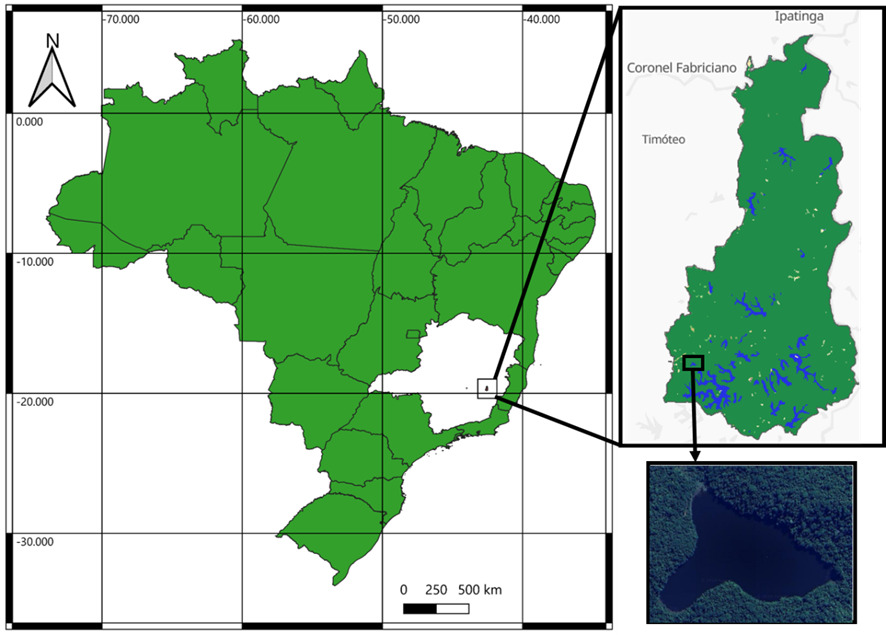
The Rio Doce State Park (PERD) is a conservation unit located in the Vale do Aço region (Minas Gerais state, Brazil), and is the largest remnant of Atlantic Forest in the state of MG. The park belongs to the Middle Rio Doce Lake system, which contains around 300 lakes, 42 of which are found within the boundaries of the protected area (Bezerra-Neto & Pinto-Coelho, 2008). Among these lakes, the study was conducted in Carioca Lake (19.75ºS 42.6ºW) (Figure 1), which has a surface area of 0.14 km2 (Bezerra-Neto et al., 2010).

Geographic location of Carioca Lake within the Middle Rio Doce Lake System, Minas Gerais State, Brazil. The figure was prepared in QGIS using cartographic data from MapBiomas (2026; 10.1), and Google Maps (2026).
The park is in the humid tropical savannah climate according to the Koppen classification. The rainfall regime is divided between two seasons, a rainy season that occurs from October to March and a dry season from April to September, with precipitation varying between 235 and 9 mm per month (Tundisi & Saijo, 1997).
2.2. Sampling, biological indexes and population structure
Specimens of red piranha and tucunaré were sampled with different fishing gears in Carioca Lake from March 2018 to June 2019 every three months. The fish were caught using casting nets (active fishing) and two sets of gill nets of different sizes (3 to 16 cm between nodes), which were set for 14 hours and checked every 4 hours (passive fishing). Fish captured alive were euthanized with an overdose of anesthetics (Eugenol 6 ml.L-1). The care and use of animals followed CEUA/UFSJ protocol number 046/2017 and was approved by SISBIO 60903-1, IEF 054/2017.
Each specimen was taxonomically identified, and biometric data was obtained: total length (TL; ruler, accuracy: 1 mm), body weight (BW; Shimadzu precision scale, accuracy 0.001 g), and gonad weight (GW; accuracy 0.001 g). The values were used to calculate the gonadosomatic index (GSI = GW ÷ BW × 100) and the length-weight ratio according to the expression BW = a*TLb, “a” is the linear coefficient, related to the shape of the body; and “b” is an exponent indicating the type of growth presented. The parameter b was derived from a linear regression analysis that examined the relationship between the logarithm (base 10) of the length and weight of individuals of both sexes. The value of b represents the slope of the regression line, also known as the angular coefficient.
Prior to fitting the final length-weight relationship, separate regressions were performed for males and females. Differences in growth patterns between sexes were evaluated using an Analysis of Covariance (ANCOVA) on log10-transformed data, with sex as a categorical factor and the interaction term between log10-transformed total length and sex used to test for differences in slopes. The interaction term was not significant for either species (C. kelberi: F = 0.15, p = 0.702; P. nattereri: F = 3.25, p = 0.0736), indicating similar length-weight relationships between males and females. Therefore, individuals of both sexes were pooled for the estimation of the final length-weight relationship parameters.
To ensure the robustness of the length-weight relationship, linear model assumptions were verified through visual inspection of diagnostic plots (residuals vs. fitted values and Q-Q plots). Potential outliers were identified and removed based on studentized residuals with a threshold of ± 3 (res < -3 or res > 3). For P. nattereri, three individuals were identified as outliers (final n = 129), while for C. kelberi, one individual was removed (final n = 32). Following outlier exclusion, the models were refitted to obtain the final parameters.
To estimate the sex ratio, the number of males and females in all collections was obtained to calculate the relative frequency. The χ2 test was used to identify statistically significant differences in relation to the expected sex ratio of 1F:1M.
2.3. Gonadal morphology and frequency of reproductive stages
Gonad fragments were fixed in Bouin's solution, submitted to routine histological methods, embedded in paraffin wax, sectioned at 5 µm thickness and the sections were stained with hematoxylin-eosin (H.E) (Feldman & Wolfe, 2014). The determination of the reproductive cycle was carried out by macro and microscopic observations of the gonads according to Lowerre‐Barbieri et al. (2011): 1) Resting stage; 2) Initial maturation stage; 3) Advanced maturation/mature stage; 4) Spawned stage. The type of spawning was determined according to the histological findings of oocyte development, as per Rizzo & Bazzoli (2020).
To assess potential differences in the frequency of reproductive stages across months, a Fisher’s Exact Test was performed. This test was chosen due to the presence of small sample sizes and several cells with low expected frequencies (< 5 individuals) in the contingency table. To identify specific associations between months and reproductive stages, a post-hoc analysis was conducted using standardized Pearson residuals. Results were visualized through an association plot, where residuals exceeding ±1.96 were considered statistically significant at the level p < 0.05 (Sharpe, 2015). To compare the gonadosomatic index (GSI) between the two species, a Mann-Whitney U test was employed. This non-parametric approach was selected due to the small and unequal sample sizes (n = 23 and n = 5) and the potential non-normal distribution of the data (Mann & Whitney, 1947). Statistical significance was set at p < 0.05. All analyses were run in the R software version 4.5.1 (R Core Team, 2024).
3. Results
A total of 132 individuals of red piranha (Pygocentrus nattereri) and 33 individuals of tucunaré (Cichla kelberi) were collected in Carioca Lake. Among red piranhas, 72 were females and 60 males, resulting in a sex ratio of 1.2F:1M (χ2 = 1.09, p = 0.29). For tucunaré, 16 females and 17 males were captured, with a ratio of 1F:1.06M (χ2 = 0.03, p = 0.86). These values indicate balanced sex ratios for both populations.
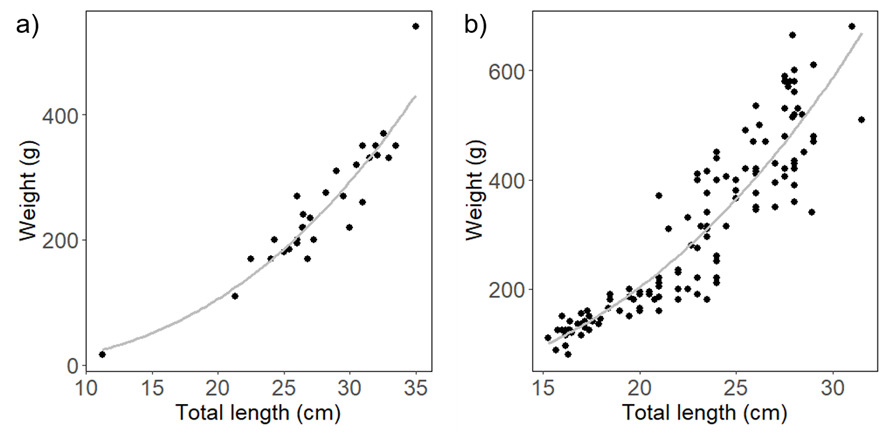
The length–weight relationship revealed positive allometric growth for tucunaré, with b = 3.58 (95% CI 2.75 – 4.42, p < 0.0001, R2 = 0.94; Figure 2a) and negative allometric growth for red piranha, with b = 2.63 (95% CI 2.47 – 2.81, p < 0.0001, R2 = 0.88; Figure 2b).

Relationship between total length and weight of individuals of tucunaré (Cichla kelberi, n = 32) (a) and red piranha (Pygocentrus nattereri, n = 129) (b) caught in Carioca Lake (Rio Doce State Park – MG).
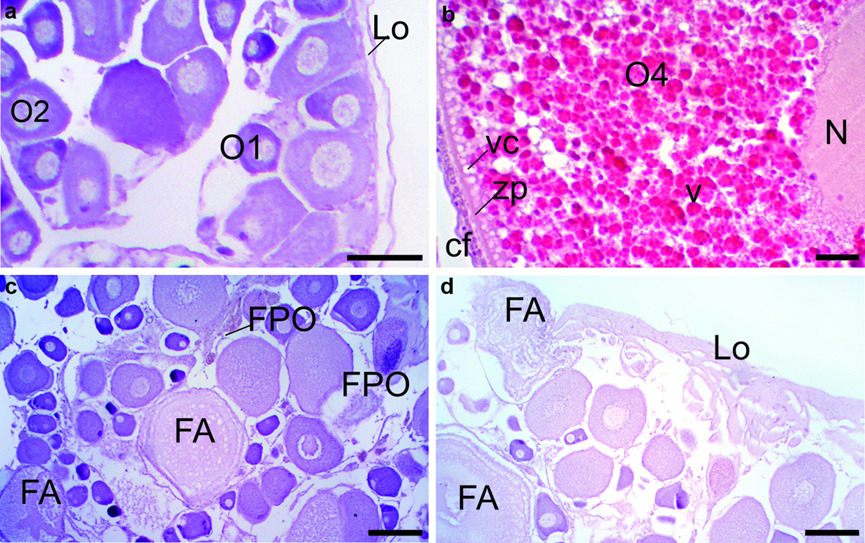
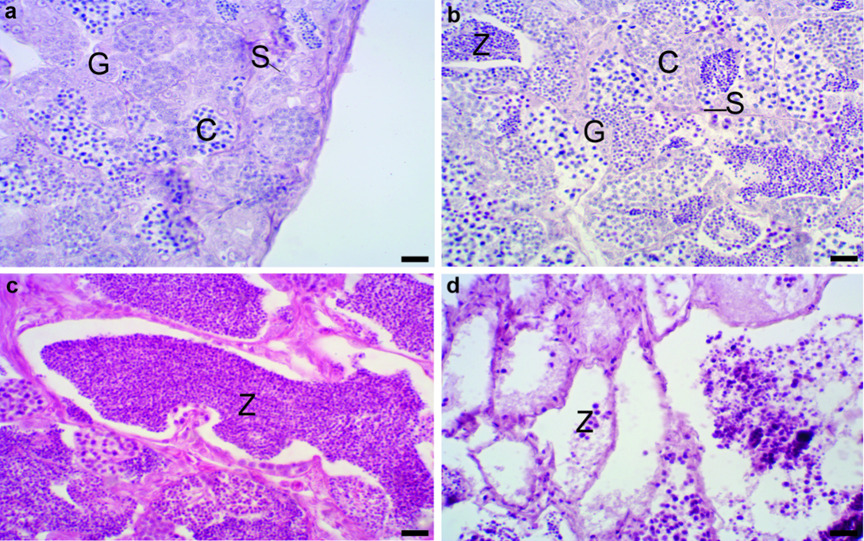
Immature individuals were not recorded in any of the macroscopic and microscopic analyses. The morphological characteristics of the gonads of C. kelberi were described in Figures 3 and 4, whereas those of P. nattereri were presented in Figures 5 and 6. The resting stage ovary (F1) was characterized by the presence of nests of oogonia and early and advanced perinucleolar oocytes (Figure 3a and Figure 5a), and the testis (M1) with closed seminiferous tubules formed only by spermatogonial cysts (Figure 6a). In the initial maturation stage (F2), previtellogenic oocytes, with numerous cortical vesicles, appear in the red piranha (Figure 5b). In males (M2), the seminiferous tubules present spermatogonia (G), spermatocytes (E), and a small sperm number in both species (Figure 4a) and Figure 6b). In ovaries at the mature stage (F3), all types of oocytes were observed, but with a predominance of vitellogenic ones. In tucunaré the vitellogenic oocytes present cubic follicular cells, thin zona pellucida and small grains of yolk (Figure 3b), while in red piranha the follicular cells were squamous and with large yolk grains (Figure 5c). Males at the same stage (M3) had seminiferous tubules with thin walls and a lumen filled with sperm (Figures 4 b and 6c). In ovaries, the presence of post-ovulatory and atretic follicles characterized the spawning stage (Figure 3cd and Figure 5d) and testis with open seminiferous tubules, which may be empty or contain residual sperm (Figure 6d).

Histological section of tucunaré (Cichla kelberi) ovaries stained with hematoxylin and eosin. a) resting stage with several early (O1) and advanced (O2) perinucleolar oocytes associated with a thin ovuligerous lamella (Lo). b) advanced maturation stage with emphasis on the vitellogenic oocyte (O4) rich in yolk (v), with cubic follicular cells (cf), cortical vesicles (vc), zona pellucida (zp), as well as the oocyte nucleus slightly displaced towards the periphery (N). c) and d) spawning stage with the presence of post-ovulatory follicles (FPO) and atretic follicles (FA), as well as a thicker ovuligerous lamella (Lo). Bars: a-c-d) 50 µm, b) 20 µm.

Histological sections of tucunaré (Cichla kelberi) males stained with hematoxylin and eosin. a) initial maturation stage, with seminiferous tubules more closed with spermatogenic cysts delimited by Sertoli cells (S) containing cells of the spermatogenic lineage such as spermatogonia (G), spermatocytes (C) and spermatozoa (Z). b) advanced maturation stage, with the seminiferous tubules filled with sperm (Z). Bars: 50 µm.

Histological sections of red piranha (Pygocentrus nattereri) ovaries stained with hematoxylin and eosin. a) resting stage with nests of oogonia (Oo), several early (O1), and advanced (O2) perinucleolar oocytes. b) maturation stage initiated, highlighting the presence of previtellogenic oocytes (O3). c) advanced maturation stage with predominance of the vitellogenic oocyte (O4) rich in yolk, with squamous follicular cells (Cf), cortical vesicles (vc), and zona pellucida (zp). d) spawning stage with the presence of post-ovulatory follicles (FPO). Bars: a) 20 µm; b-c-d) 50 µm.

Histological section of red piranha (Pygocentrus nattereri) males stained with hematoxylin and eosin. a) resting stage with the seminiferous tubules closed with several cysts supported by Sertoli cells (S) containing spermatogonia (G) and some cysts containing spermatocytes (C). b) initial maturation stage, with seminiferous tubules still closed with spermatogenic cysts delimited by Sertoli cells (S) containing cells of the spermatogenic lineage such as spermatogonia (G), spermatocytes (C), spermatids and spermatozoa (Z). c) advanced maturation stage, with the seminiferous tubules filled with sperm (Z). d) spermatozoa stage with the seminiferous tubules open and few sperm in the lumen (Z). Bars: 50 µm.
Females and males of both species were collected at all reproductive stages throughout almost the entire year, demonstrating asynchronous spawning for both populations. For tucunaré, individuals were captured homogeneously across months, and reproductive activity was observed throughout the year (March = 7; July = 10; September = 8; December = 8). Although a higher frequency of spawned females occurred in July and September (dry period and lower temperatures in the Carioca Lake region) (Figure 7a), these differences were not statistically significant (Fisher’s Exact Test, p = 0.5467). Regarding the red piranha, a distinct peak in reproductive activity was statistically identified between December and March, coinciding with the rainy season (Fisher’s Exact Test, p = 0.009; Figure 7b).

Frequency of reproductive stages of tucunaré (Cichla kelberi) (a) and red piranha (Pygocentrus nattereri) (b) females. F1 = rest; F2 = initial maturation; F3 = mature; F4 = spawned.
The values of the Gonadosomatic Index (GSI, ratio between gonadal weight and body weight) of mature females were lower for tucunaré when compared to the red piranha (Figure 8).

Gonadosomatic index (GSI) values of mature female tucunaré (CK: Cichla kelberi, n = 5) and red piranha (PN: Pygocentrus nattereri, n = 23) in Carioca Lake. Boxplots represent the median, interquartile range (box), and whiskers (minimum and maximum values). Gray dots represent individual data points (jitter plot). Different letters above boxes indicate significant differences between species (p < 0.05) according to the Mann-Whitney U test.
4. Discussion
The results of this study demonstrate that the tucunaré (Cichla kelberi) and red piranha (Pygocentrus nattereri) exhibit asynchronous oocyte development with multiple spawning, but with indications of different reproductive seasons in the Carioca Lake. These findings align with patterns observed in other Neotropical systems where these species were introduced (Normando et al., 2009; Queiroz et al., 2010; Guedes et al., 2021).
Both the balanced sex ratio and the condition expressed by the length–weight relationship support the inference that tucunaré and red piranha populations are well established in Carioca Lake. A sex ratio close to 1:1 indicates that both sexes are equally represented in the population, reflecting demographic stability and suggesting the absence of strong environmental or anthropogenic pressures that could differentially affect survival or recruitment between males and females (Fryxell et al., 2015; Azour et al., 2015). The length–weight relationships (LWRs) also provide evidence of population stability and successful adaptation to local conditions. Changes in fish body morphology throughout development are closely associated with feeding strategies and swimming behavior (Russo et al., 2007; Dikou, 2022). The high b value observed for tucunaré (3.58) indicates strong positive allometric growth and may be associated with feeding ecology. In piscivorous species, increased body robustness can enhance both prey ingestion capacity and swimming performance, particularly considering the predatory strategy of tucunaré, which involves active pursuit and swallowing of relatively large prey (Santos et al., 2010). Moreover, this pattern may be favored by the availability of prey in the simplified food webs of invaded systems (Pelicice & Agostinho, 2009).
In contrast, the red piranha exhibited negative allometric growth (b = 2.63), indicating that its length increases more rapidly than its body mass. Although this pattern may be driven by high population density and intense intraspecific competition, it does not inherently reflect poor physiological condition (Le Cren, 1951; Giarrizzo et al., 2015). From an ecological perspective, this negative allometry can be interpreted as a morphological or condition-based adaptation to novel environments, different from the positive allometric growth typically reported for other piranha species (Carvajal-Vallejos et al., 2025). Variation in body size and shape, particularly body elongation, represents a recurrent axis of morphological diversification among fishes that could be influenced by habitat structure and swimming dynamics (DeLorenzo et al., 2023). Because enhanced swimming performance improves both predator evasion and prey capture efficiency (Langerhans, 2009), it is plausible that predation pressure from visually oriented predators, such as the tucunaré, coupled with the red piranha's active foraging behavior, selectively favors the observed LWR. However, this interpretation remains speculative and should be approached with caution, as observational data alone cannot establish direct causality.
The presence of individuals at all reproductive stages throughout the year indicates that both species are well adapted to the local photoperiod and temperature regimes, despite the absence of flood pulses typical of their native Amazonian habitats. The flood regimes characteristic of the Amazon region are considered important reproductive triggers for both species (Jepsen et al., 1999; Muñoz et al., 2006; Vicentin et al., 2013), as well as the abundance and diversity of prey (Marto et al., 2015). The establishment of a species in a new environment is an essential step for it to disperse to new areas, becoming an invasive species (Blackburn et al., 2011). In addition to features of the environment, characteristics of the species' life history and adaptive strategies are essential for it to establish itself, being able to survive and reproduce successfully and, therefore, maintain a self-sustainable population.
In this sense, the asynchronous spawning observed may enhance offspring survival by spreading recruitment over time, a strategy that favors persistence in stable lentic environments (Rizzo & Bazzoli, 2020). Although the tucunaré did not show a statistically significant peak, its broader reproductive activity throughout the year, with a biological trend toward the dry season, contrasts with the well-defined rainy season peak observed for the red piranha. Reproduction during the dry season is also a well-documented pattern for Cichla species, particularly in tropical systems where reduced water-level fluctuations favor nest construction, egg survival, and parental care (Marto et al., 2015). However, this pattern could also suggest a potential temporal partitioning of reproductive niches, since Carioca Lake is small and shallow (Bezerra-Neto et al., 2010), and overlap in spawning sites must likely occur. This staggered reproduction could potentially reduce direct interspecific competition for spawning sites or prey resources (Jepsen et al., 1999; Nakayama et al., 2011). Temporal segregation of breeding has been described as a mechanism facilitating coexistence among different fish species (Lowerre‐Barbieri et al., 2011) and among invasive predators and native species (Fennell et al., 2022). On the other hand, the difference in the way prey is attacked could generate different pressures on growth and, consequently, on the spawning period and trophic overlap between invasive species. In this case, since the tucunaré ingests whole prey (Marto et al., 2015), reproduction during the dry season (July to September) allows its offspring to be at an advanced size and able to feed on larvae or smaller juveniles in the rainy season (December to March). On the other hand, the red piranha tears and rips pieces from its prey, and this means that the prey can be of varying sizes (Lowe et al., 2023).
Our findings regarding the spawning period do not differ from those found in other locations that the tucunaré was introduced, as in the population in the Campo Grande reservoir, Rio Grande do Norte state, Brazil (Chellappa et al., 2003). However, in the study by Souza et al. (2008), the reproductive period of tucunaré in the Lobo reservoir (São Paulo state, Brazil) peaks between November and April. Guedes et al. (2021) found two reproductive periods: August/September and April/May in the tucunaré population in the Lajes reservoir (Rio de Janeiro state, Brazil). The differences found may be related to variations in environmental conditions that serve as triggers to induct the hormonal axis that regulates reproduction, such as hydrological cycle, temperature (Rizzo & Bazzoli, 2020), food availability, and reproductive strategies to reduce competition for resources (Jepsen et al., 1999). In tropical systems, reproductive activity of Cichla is commonly associated with the hydrological cycle, with spawning occurring preferentially during the dry season when water-level fluctuations are reduced, favoring nest stability and reproductive success (Marto et al., 2015). Regarding the red piranha, the greatest reproductive activity in Carioca Lake coincides with data found in the Amazon region (Queiroz et al., 2010; Carvalho et al., 2021), covering the months of December to March (rainy season).
Histological analyses revealed gonadal structures and dynamics in the development of gametes similar to other freshwater fish (Rizzo & Bazzoli, 2020). The analyses also showed features associated with parental care, such as large yolky oocytes and thin zona pellucida (Suzuki et al., 2000). Parental care, common in both tucunaré and red piranha, increases juvenile survival and contributes to invasion success (Gross, 2005). Moreover, the higher gonadosomatic index (GSI) values found in red piranha may be related to a reproductive tactic to generate more offspring throughout the year, supporting continuous recruitment and, thus, characterizing higher success for red piranha in invading the environment (Zeyl et al., 2014).
The establishment of these species poses ecological risks for native fish communities. Previous studies in the Rio Doce system reported declines in native fish abundance and changes in community structure following introductions of these predators (Latini & Petrere Junior, 2004; Fragoso-Moura et al., 2016). Moreover, Araújo et al. (2022) demonstrated that the reproductive cycle of the native traíra (Hoplias malabaricus) was shifted in response to the reproductive activity of these invaders, suggesting plasticity in native species as a potential compensatory mechanism but also a sign of ecological disturbance.
The results found in the present study indicate that both invasive species have adapted successfully to the environmental conditions of Carioca Lake, maintaining reproductive activity across seasons. Moreover, we characterized the reproductive dynamics of each of the introduced species. The continued dominance of both non-native species may further alter trophic interactions and native biodiversity within this protected Atlantic Forest ecosystem. Furthermore, since populations of these species are well established in Carioca Lake, management actions aimed at eradicating the populations are difficult. However, the data shown here can serve as guides for potential management implications, for example, mechanical removal (selective fishing) of tucunaré and red piranha while individuals of the native species are relocated to Carioca Lake.
Acknowledgements
We are thankful to the Research Support Program of the Universidade do Estado de Minas Gerais (UEMG) for the productivity grant to LSB (Call 01/2021 Research Productivity Grant Program - PQ/UEMG) and UEMG and the Conselho Nacional de Desenvolvimento Científico e Tecnológico (CNPq) for the grant to GRDC (PIBIC/UEMG/CNPq 03/2020) and to LAPROTEC (Universidade Federal de São João del-Rei) for the equipment and supplies used for the research. The fieldwork was financed by the Long-Term Ecological Research Project (PELD), site-4 (CNPq/CAPES/FAPEMIG - Proc. N° 441481/2016-7), in addition to logistical support from Rio Doce State Park employees (IEF-MG, authorization 054/2017). We thank Anderson Kelvin Saraiva Macêdo and Amarildo Alves Rodrigues (Beré) for their valuable contribution during fieldwork.
Data availability
Research data analyzed in this study is not publicly available by any mean.
-
Cite as:
Brighenti, L.S. et al. Reproductive biology traits of two invasive fish species in Rio Doce State Park, Minas Gerais, Brazil. Acta Limnologica Brasiliensia, 2026, vol. 38, e21. https://doi.org/10.1590/S2179-975X7725
References
-
Andrade, G.D.S., & Pelicice, F.M., 2022. Coexistence of endemic peacock basses (Cichla) in a Neotropical reservoir (Cichlidae: cichliformes). Neotrop. Ichthyol., 20(3), e220039. https://doi.org/10.1590/1982-0224-2022-0039
» https://doi.org/10.1590/1982-0224-2022-0039 -
Araújo, T.P., Brighenti, L.S., Dolabela, B.M., Ribeiro, S.P., dos Santos, H.B., & Thomé, R.G., 2022. Can the introduction of non-native fish induce variation in life-history traits of a native species in a neotropical lake? Mar. Freshw. Res., 73(5), 651-661. https://doi.org/10.1071/MF21138
» https://doi.org/10.1071/MF21138 -
Azour, F., van Deurs, M., Behrens, J., Carl, H., Hüssy, K., Greisen, K., Ebert, R., & Møller, P.R., 2015. Invasion rate and population characteristics of the round goby Neogobius melanostomus: effects of density and invasion history. Aquat. Biol., 24(1), 41-52. https://doi.org/10.3354/ab00634
» https://doi.org/10.3354/ab00634 - Bezerra-Neto, J.F., & Pinto-Coelho, R.M., 2008. Morphometric study of Lake Dom Helvécio, Parque Estadual do Rio Doce (PERD), Minas Gerais, Brazil: A re-evaluation. Acta Limnol. Bras., 20(2), 117-130.
-
Bezerra-Neto, J.F., Brighenti, L.S., & Pinto-Coelho, R.M., 2010. A new morphometric study of Carioca Lake, Parque Estadual do Rio Doce (PERD), Minas Gerais State, Brazil. Acta Sci. Biol. Sci., 32(1), 49-54. https://doi.org/10.4025/actascibiolsci.v32i1.4990
» https://doi.org/10.4025/actascibiolsci.v32i1.4990 -
Blackburn, T.M., Pyšek, P., Bacher, S., Carlton, J.T., Duncan, R.P., Jarošík, V., Wilson, J.R.U., & Richardson, D.M., 2011. A proposed unified framework for biological invasions. Trends Ecol. Evol., 26(7), 333-339. PMid:21601306. https://doi.org/10.1016/j.tree.2011.03.023
» https://doi.org/10.1016/j.tree.2011.03.023 -
Bueno, M.L., Magalhães, A.L.B., Andrade Neto, F.R., Alves, C.B.M., Rosa, D.M., Junqueira, N.T., Pessali, T.C., Pompeu, P.S., & Zenni, R.D., 2021. Alien fish fauna of southeastern Brazil: species status, introduction pathways, distribution and impacts. Biol. Invasions 23(10), 3021-3034. https://doi.org/10.1007/s10530-021-02564-x
» https://doi.org/10.1007/s10530-021-02564-x -
Carvajal-Vallejos, F., Gallo-Cardozo, F., Careaga, M., & Campero, M., 2025. Weight–length relationships of piranhas Serrasalmus in Bolivia: relationships to molecular divergence and maximum size. Ecol. Evol., 15(1), e70970. PMid:41069873. https://doi.org/10.1002/ece3.70970
» https://doi.org/10.1002/ece3.70970 -
Carvalho, I.F.S., Cantanhêde, L.G., Diniz, A.L.C., Carvalho-Neta, R.N.F., & Almeida, Z.S., 2021. Reproductive biology of seven fish species of commercial interest. Neotrop. Ichthyol., 19(1), e200067. https://doi.org/10.1590/1982-0224-2020-0067
» https://doi.org/10.1590/1982-0224-2020-0067 -
Carvalho, T., De Almeida Ferreira, E., Pelicice, F.M., & Fernandes, R., 2020. Comparative functional responses predict the predatory impact of the highly invasive fish Cichla kelberi. Hydrobiologia 848(9), 2203-2211. https://doi.org/10.1007/s10750-020-04440-6
» https://doi.org/10.1007/s10750-020-04440-6 -
Chellappa, S., Câmara, M., & Chellappa, N., 2003. Ecology of Cichla monoculus (Osteichthyes: Cichlidae) from a reservoir in the semi-arid region of Brazil. Hydrobiologia 504(1-3), 267-273. https://doi.org/10.1023/B:HYDR.0000008526.83477.2f
» https://doi.org/10.1023/B:HYDR.0000008526.83477.2f -
DeLorenzo, L., Mathews, D., Brandon, A., Joglekar, M., Baez, A., Moore, E., Ciccotto, P., Roberts, N., Roberts, R., & Powder, K.E., 2023. Genetic basis of ecologically relevant body shape variation among four genera of cichlid fishes. Mol. Ecol., 32(14), 3975-3988. PMid:37161914. https://doi.org/10.1111/mec.16977
» https://doi.org/10.1111/mec.16977 -
Dias, J.O., Sant’Anna, I.R.A., Bezerra Neto, E.F.S., Sousa, R.G.C., & Dantas Filho, J.A.S., 2024. Population parameters of the red-bellied piranha Pygocentrus nattereri. Bol. Inst. Pesca 50, e853. https://doi.org/10.20950/1678-2305/bip.2024.50.e853
» https://doi.org/10.20950/1678-2305/bip.2024.50.e853 -
Dikou, A., 2022. Weight–length relationship in fish populations reflects environmental regulation on growth. Hydrobiologia 850(2), 335-346. https://doi.org/10.1007/s10750-022-05072-8
» https://doi.org/10.1007/s10750-022-05072-8 -
Dudgeon, D., & Strayer, D.L., 2024. Bending the curve of global freshwater biodiversity loss. Biol. Rev. Camb. Philos. Soc., 100(1), 205-226. PMid:39221642. https://doi.org/10.1111/brv.13137
» https://doi.org/10.1111/brv.13137 -
Duponchelle, F., Lino, F., Hubert, N., Panfili, J., Renno, J.F., Baras, E., Torrico, J.P., Dugué, R., & Nuñez, J., 2007. Environment-related life-history trait variations of Pygocentrus nattereri. J. Fish Biol., 71(4), 1113-1134. https://doi.org/10.1111/j.1095-8649.2007.01583.x
» https://doi.org/10.1111/j.1095-8649.2007.01583.x -
Feldman, A.T., & Wolfe, D., 2014. Tissue processing and hematoxylin and eosin staining. Methods Mol. Biol., 1180, 31-43. PMid:25015141. https://doi.org/10.1007/978-1-4939-1050-2_3
» https://doi.org/10.1007/978-1-4939-1050-2_3 -
Fennell, J.M., Rosenthal, W.C., Wagner, C., Burckhardt, J., & Walters, A.W., 2022. Temporal segregation in spawning between native Yellowstone cutthroat trout and introduced rainbow trout. Ecol. Freshwat. Fish 32(1), 94-106. https://doi.org/10.1111/eff.12672
» https://doi.org/10.1111/eff.12672 -
Fragoso-Moura, E.N., Oporto, L.T., Maia-Barbosa, P.M., & Barbosa, F.A.R., 2016. Loss of biodiversity in a Neotropical lake: response of a planktonic community to fish introduction. Braz. J. Biol., 76(1), 18-27. PMid:26909619. https://doi.org/10.1590/1519-6984.07914
» https://doi.org/10.1590/1519-6984.07914 -
Fráguas, P.S., de Carvalho, D.R., de Castro, C.C., Ferreira, F.F., Dergam, J.A., Sperber, C.F., & Pompeu, P.S., 2025. Temporal stability in fish assemblage isotopic niches. Environ. Biol. Fishes 108(5), 835-852. https://doi.org/10.1007/s10641-025-01688-6
» https://doi.org/10.1007/s10641-025-01688-6 -
Fryxell, D.C., Arnett, H.A., Apgar, T.M., Kinnison, M.T., & Palkovacs, E.P., 2015. Sex ratio variation shapes the ecological effects of a globally introduced freshwater fish. Proc. Biol. Sci., 282(1817), 20151970. PMid:26490793. https://doi.org/10.1098/rspb.2015.1970
» https://doi.org/10.1098/rspb.2015.1970 -
Gaspar, M.R.C., Agostinho, A.A., Catelani, P.A., Fernandes, R., Franco, A.C.S., Novaes, J.L.C., Peretti, D., Petry, A.C., & Pelicice, F.M., 2025. Phenotypic and behavioral variation as invasion mechanisms in freshwater fishes. Hydrobiologia 852(8), 2133-2147. https://doi.org/10.1007/s10750-024-05663-7
» https://doi.org/10.1007/s10750-024-05663-7 -
Giarrizzo, T., de Sena Oliveira, R.R., Costa Andrade, M., Pedrosa Gonçalves, A., Barbosa, T.A.P., Martins, A.R., & Melo de Sousa, L., 2015. Length–weight relationships for 102 fish species from Xingu River, Brazilian Amazon. J. Appl. Ichthyology 31(2), 415-424. https://doi.org/10.1111/jai.12677
» https://doi.org/10.1111/jai.12677 -
Google Maps, 2026. Google Maps: imagem de satélite da área de estudo [Lagoa Carioca]. Mountain View: Google [online]. Retrieved in 2026, June 4, from https://www.google.com/maps
» https://www.google.com/maps -
Gross, M.R., 2005. The evolution of parental care. Q. Rev. Biol., 80(1), 37-45. PMid:15884734. https://doi.org/10.1086/431023
» https://doi.org/10.1086/431023 -
Guedes, G.H.S., Gomes, I.D., Nascimento, A.A., Aguiar, F.S., & Araújo, F.G., 2021. Reproductive strategy of Cichla kelberi (Perciformes: Cichlidae) in a Neotropical reservoir. J. Fish Biol., 98(3), 743-755. PMid:33206375. https://doi.org/10.1111/jfb.14618
» https://doi.org/10.1111/jfb.14618 -
Jepsen, D.B., Winemiller, K.O., Taphorn, D.C., & Olarte, D.R., 1999. Age structure and growth of Cichla species from a Neotropical blackwater river. J. Fish Biol., 55(2), 433-450. https://doi.org/10.1111/j.1095-8649.1999.tb00689.x
» https://doi.org/10.1111/j.1095-8649.1999.tb00689.x -
Langerhans, R.B., 2009. Trade-off between swimming modes in mosquitofish (Gambusia affinis). J. Evol. Biol., 22(5), 1057-1068. PMid:21462405. https://doi.org/10.1111/j.1420-9101.2009.01716.x
» https://doi.org/10.1111/j.1420-9101.2009.01716.x -
Latini, A.O., & Petrere Junior, M., 2004. Reduction of native fish fauna in four natural lakes of Southeastern Brazil which were introduced with exotic species. Fish. Manag. Ecol., 11(2), 71-79. https://doi.org/10.1046/j.1365-2400.2003.00372.x
» https://doi.org/10.1046/j.1365-2400.2003.00372.x -
Le Cren, E.D., 1951. The length-weight relationship and seasonal cycle in gonad weight and condition in the perch (Perca fluviatilis). J. Anim. Ecol., 20(2), 201-219. https://doi.org/10.2307/1540
» https://doi.org/10.2307/1540 -
Lowe, A., Kolmann, M., & Paig-Tran, E.W.M., 2023. How to survive a piranha attack: functional morphology of armor in armored catfish (Callichthyidae). Integr. Org. Biol., 5(1), obad032. PMid:37818205. https://doi.org/10.1093/iob/obad032
» https://doi.org/10.1093/iob/obad032 -
Lowerre‐Barbieri, S.K., Ganias, K., Saborido‐Rey, F., Murua, H., & Hunter, J.R., 2011. Reproductive timing in marine fishes: variability, temporal scales, and methods. Mar. Coast. Fish. 3(1), 71-91. https://doi.org/10.1080/19425120.2011.556932
» https://doi.org/10.1080/19425120.2011.556932 -
Mann, H.B., & Whitney, D.R., 1947. On a test of whether one of two random variables is stochastically larger than the other. Ann. Math. Stat., 18(1), 50-60. https://doi.org/10.1214/aoms/1177730491
» https://doi.org/10.1214/aoms/1177730491 -
Marto, V.C.O., Akama, A., & Pelicice, F.M., 2015. Feeding and reproductive ecology of Pygocentrus nattereri Kner, 1858 in a Neotropical reservoir. Neotrop. Ichthyol., 13(3), 625-636. https://doi.org/10.1590/1982-0224-20140165
» https://doi.org/10.1590/1982-0224-20140165 -
Muñoz, H., Van Damme, P.A., & Duponchelle, F., 2006. Breeding behaviour of Pygocentrus nattereri, Serrasalmus spilopleura and S. humeralis (Characiformes: Characidae) in the Bolivian Amazon. J. Fish Biol., 69(4), 1018-1030. https://doi.org/10.1111/j.1095-8649.2006.01177.x
» https://doi.org/10.1111/j.1095-8649.2006.01177.x -
Nakayama, S., Rose, K.A., & Fuiman, L.A., 2011. Batch spawning in a coastal fish: implications for reproductive success. Mar. Ecol. Prog. Ser., 441, 213-223. https://doi.org/10.3354/meps09382
» https://doi.org/10.3354/meps09382 -
Normando, F.T., Arantes, F.P., Luz, R.K., Thomé, R.G., Rizzo, E., Sato, Y., & Bazzoli, N., 2009. Reproduction and fecundity of the piranha Pygocentrus nattereri Kner, 1858 in the São Francisco River, Southeastern Brazil. J. Appl. Ichthyology 25(3), 299-305. https://doi.org/10.1111/j.1439-0426.2008.01174.x
» https://doi.org/10.1111/j.1439-0426.2008.01174.x -
Pelicice, F.M., & Agostinho, A.A., 2009. Fish fauna destruction after the introduction of a non-native apex predator (Cichla kelberi) in a Neotropical reservoir. Biol. Invasions 11(8), 1789-1801. https://doi.org/10.1007/s10530-008-9358-3
» https://doi.org/10.1007/s10530-008-9358-3 -
MapBiomas, 2026. Coleção 10.1 da Série Anual de Mapas de Cobertura e Uso da Terra do Brasil. Mountain View: Google Earth Engine [online]. Retrieved in 2026, June 4, from https://plataforma.brasil.mapbiomas.org/
» https://plataforma.brasil.mapbiomas.org/ -
Queiroz, H.L., Sobanski, M.B., & Magurran, A.E., 2010. Reproductive strategies of piranhas (Serrasalmus spp.) in the Mamirauá Reserve, Brazilian Amazon. Environ. Biol. Fish., 89(1), 11-19. https://doi.org/10.1007/s10641-010-9658-1
» https://doi.org/10.1007/s10641-010-9658-1 -
R Core Team, 2024. R: A language and environment for statistical computing [online]. Vienna: R Foundation for Statistical Computing. Retrieved in 2026, June 4, from https://www.R-project.org/
» https://www.R-project.org/ -
Reid, A.J., Carlson, A.K., Creed, I.F., Eliason, E.J., Gell, P.A., Johnson, P.T.J., Kidd, K.A., MacCormack, T.J., Olden, J.D., Ormerod, S.J., Smol, J.P., Taylor, W.W., Tockner, K., Vermaire, J.C., Dudgeon, D., & Cooke, S.J., 2018. Emerging threats and persistent conservation challenges for freshwater biodiversity. Biol. Rev. Camb. Philos. Soc., 94(3), 849-873. PMid:30467930. https://doi.org/10.1111/brv.12480
» https://doi.org/10.1111/brv.12480 -
Rizzo, E., & Bazzoli, N., 2020. Reproduction and embryogenesis. In: Baldisserotto, B., Urbinati, E.C., & Cyrino, J.E.P., eds. Biology and physiology of freshwater neotropical fish. Amsterdam: Academic Press, 287-313. https://doi.org/10.1016/B978-0-12-815872-2.00013-0
» https://doi.org/10.1016/B978-0-12-815872-2.00013-0 -
Russo, T., Costa, C., & Cataudella, S., 2007. Correspondence between shape and feeding habit in Neotropical cichlids. J. Fish Biol., 71(3), 629-656. https://doi.org/10.1111/j.1095-8649.2007.01528.x
» https://doi.org/10.1111/j.1095-8649.2007.01528.x -
Santos, A.C.A., Santos, L.S., & Araújo, F.G., 2010. Digestive tract morphology and feeding habits of Cichla kelberi. Rev. Biol. Trop., 58(4), 1245-1255. https://doi.org/10.15517/rbt.v58i4.5411
» https://doi.org/10.15517/rbt.v58i4.5411 -
Sharpe, D., 2015. Chi-square test is statistically significant: now what? Pract. Assess. Res. Eval., 20(1), 8. https://doi.org/10.7275/tbfa-x148
» https://doi.org/10.7275/tbfa-x148 -
Souza, C.S., Rodrigues-Filho, C.A.O., Barbosa, F.A.R., & Leitão, R.P., 2021. Drastic reduction of the functional diversity of native ichthyofauna. Neotrop. Ichthyol., 19(4), e210033. https://doi.org/10.1590/1982-0224-2021-0033
» https://doi.org/10.1590/1982-0224-2021-0033 -
Souza, J.E.D., Fragoso-Moura, E.N., Fenerich-Verani, N., Rocha, O., & Verani, J.R., 2008. Population structure and reproductive biology of Cichla kelberi (Perciformes, Cichlidae) in Lobo Reservoir, Brazil. Neotrop. Ichthyol., 6(2), 201-210. https://doi.org/10.1590/S1679-62252008000200007
» https://doi.org/10.1590/S1679-62252008000200007 -
Suzuki, H.I., Agostinho, A.A., & Winemiller, K.O., 2000. Oocyte morphology and reproductive strategy in Neotropical freshwater fishes. J. Fish Biol., 57(3), 791-807. https://doi.org/10.1111/j.1095-8649.2000.tb00275.x
» https://doi.org/10.1111/j.1095-8649.2000.tb00275.x -
Tozato, H.C., 2017. Gestão de áreas protegidas. Rev. Gest. Polit. Publicas 7(2), 147-169. https://doi.org/10.11606/issn.2237-1095.v7p147-169
» https://doi.org/10.11606/issn.2237-1095.v7p147-169 - Tundisi, J.G., & Saijo, Y., 1997. Limnological studies on the Rio Doce valley lakes, Brazil. São Carlos: Brazilian Academy of Sciences, University of São Paulo.
-
Vicentin, W., dos Santos Costa, F.E., & Súarez, Y.R., 2013. Population ecology of piranha Pygocentrus nattereri (Characiformes, Characidae) in the Negro River basin, Pantanal, Brazil. Environ. Biol. Fishes 96(1), 57-66. https://doi.org/10.1007/s10641-012-0022-5
» https://doi.org/10.1007/s10641-012-0022-5 -
Zeyl, J.N., Love, O.P., & Higgs, D.M., 2014. Gonadosomatic index evaluation in freshwater fishes. J. Great Lakes Res., 40(1), 164-171. https://doi.org/10.1016/j.jglr.2013.12.004
» https://doi.org/10.1016/j.jglr.2013.12.004
Edited by
-
Associate Editor:
Fernando Mayer Pelicice.